An imported oil tax could create a floor through which oil prices in the US would not fall. At the same time, the tax could be removed when oil gets high, to soften the blow of high oil prices.
When oil prices go up, innovation and investment are put into alternative energy as well as conservation. Then oil prices fall causing alternative plans to go belly up. After the alternatives go belly up, oil gets expensive again.
A variable tax on imported oil could create more predictable market conditions for energy alternatives.
If we don't impose something like this, the Saudis might. I hear Saudi Arabia is talking about trying to shore up oil prices.
They need the money.
Their population keeps growing. Many more mouths to feed. Hungary people can breed terrorism.
While we are addicted to their oil, they are addicted to our money.
Too bad the Saudis are a conservative "traditionalist" society, thus not taking kindly to the concept of "diversity." Otherwise, they would have an easier time "diversifying" their economy. Diversifying it beyond oil.
We have our problems with "traditionalist thinking" here in the USA as well.
Republicans keep saying, "no new taxes;" people are too addicted to their money.
Democrats are a little better, but they often "go to bed" with consumer interests.
Does consumer interests mean consumptive culture?
Democrats complain when gas prices go up. What they should be doing is using periods of high prices to argue for alternatives. Alternative lifestyles, transit, planning, what ever.
The price of oil goes up and down, but over the long term, this trend is up. Demand will eventually outstrip supply. Then we will wish our alternative energy plans had not been drowned out by temporary periods of cheap oil.
I saw a real good piece by New York Times Columnist Tom Friedman advocating the tax on imported oil. Soon after reading that column, I heard of the Saudi plan for not allowing oil prices to drop so far. If we don't do something, the Saudis will. We will be paying anyway.

Wednesday, January 31, 2007

Saturday, January 27, 2007
Not letting hostile folks control our thinking
A religious columnist, of the right wing variety, was talking about Islamic extremists. He was saying that they don't mind America's capitalism, consumption or freedoms.
Instead, he said, the extremists don't like America's feminists and gays.
Yes, a right wing religious fanatic would say that.
He thinks USA could reduce the hatred that Islamic extremists hold toward this country if we just decide to hide our feminists and gays. Show the so-called "decent heartland of family life" side of America. Then, extremist anger would soften, supposedly.
Well, it ain't gonna work. Not that way, at least.
America could show it's "family heartland side" till it's "blue in the face," or "red in the face" as in "red states - blue states."
It's not gonna work. It's not enough. The Islamic extremists would not be impressed.
Those type of extremists would still not be satisfied until Israel was wiped off the map.
The extremists would want to eliminate Israel and her people.
Then the extremists would turn on one another. Actually they are already turning on one another.
Sunnis versus Shiites, various tribes, clans.
They're fighting among themselves anyway.
That's what is meant by the term "mean spirited."
We shouldn't try to appeal to that kind of hatred. It would just turn us sour also. Turn us into "angry extremists" ourselves.
Hopefully, the world doesn't have too many hostile extremists in it.
We should appeal to the more humane mindsets that are out there also. Appeal to the more humane mindsets by supporting our gays and feminists; for instance.
As for how to deal with the hostile mindsets in this world, it is hard to say what the best strategy would be.
Ignoring the hatred might be a good strategy.
Yes, ignoring it.
You may think I am crazy.
I know, there is the phrase "squeaky wheel gets the grease." At the same time, when media focuses on all the hostility, rather than more positive things, it does create "copy cat" hostility in it's wake.
Ignoring the angry screamers, in this world, might be worth considering.
America has tried war against hostile elements.
"War on terror," "War in Iraq."
Outcome is dubious at best.
I could do a bad pun and say, "outcome is Dubya at best;" as in George Dubya Bush.
I know that's a bad pun.
USA's war effort, in Iraq, may be just playing into the hands of the hostile ideologies anyway.
Putting one set of religious fanatics in power over another.
We are really stuck trying to play referee.
We've tried to be referee in the Middle East for years and it seems like practically no one is impressed.
Well, there does have to be some defense against terrorism. Defense like having the police around to protect people from crime.
Maybe we should not call it a "war on terrorism" as "war" is too negative a response. "Police work" might be more effective.
Yes, police work, like "good intelligence," "breaking up terror plots" and so forth.
We can still use the military for this. No, I am not advocating disbanding the military and just relying on underfunded local police.
We do need some kind of force to deal with hostility, but we don't need to blow it out of proportion.
Maybe we are allowing ourselves to be dominated by the negative. It's too much "Tit for tat."
Ignoring the terrorists, or at least treating it more as "common garden variety crime" is worth considering.
We should not let the terrorists and bigots of this world govern our thinking.
Instead, he said, the extremists don't like America's feminists and gays.
Yes, a right wing religious fanatic would say that.
He thinks USA could reduce the hatred that Islamic extremists hold toward this country if we just decide to hide our feminists and gays. Show the so-called "decent heartland of family life" side of America. Then, extremist anger would soften, supposedly.
Well, it ain't gonna work. Not that way, at least.
America could show it's "family heartland side" till it's "blue in the face," or "red in the face" as in "red states - blue states."
It's not gonna work. It's not enough. The Islamic extremists would not be impressed.
Those type of extremists would still not be satisfied until Israel was wiped off the map.
The extremists would want to eliminate Israel and her people.
Then the extremists would turn on one another. Actually they are already turning on one another.
Sunnis versus Shiites, various tribes, clans.
They're fighting among themselves anyway.
That's what is meant by the term "mean spirited."
We shouldn't try to appeal to that kind of hatred. It would just turn us sour also. Turn us into "angry extremists" ourselves.
Hopefully, the world doesn't have too many hostile extremists in it.
We should appeal to the more humane mindsets that are out there also. Appeal to the more humane mindsets by supporting our gays and feminists; for instance.
As for how to deal with the hostile mindsets in this world, it is hard to say what the best strategy would be.
Ignoring the hatred might be a good strategy.
Yes, ignoring it.
You may think I am crazy.
I know, there is the phrase "squeaky wheel gets the grease." At the same time, when media focuses on all the hostility, rather than more positive things, it does create "copy cat" hostility in it's wake.
Ignoring the angry screamers, in this world, might be worth considering.
America has tried war against hostile elements.
"War on terror," "War in Iraq."
Outcome is dubious at best.
I could do a bad pun and say, "outcome is Dubya at best;" as in George Dubya Bush.
I know that's a bad pun.
USA's war effort, in Iraq, may be just playing into the hands of the hostile ideologies anyway.
Putting one set of religious fanatics in power over another.
We are really stuck trying to play referee.
We've tried to be referee in the Middle East for years and it seems like practically no one is impressed.
Well, there does have to be some defense against terrorism. Defense like having the police around to protect people from crime.
Maybe we should not call it a "war on terrorism" as "war" is too negative a response. "Police work" might be more effective.
Yes, police work, like "good intelligence," "breaking up terror plots" and so forth.
We can still use the military for this. No, I am not advocating disbanding the military and just relying on underfunded local police.
We do need some kind of force to deal with hostility, but we don't need to blow it out of proportion.
Maybe we are allowing ourselves to be dominated by the negative. It's too much "Tit for tat."
Ignoring the terrorists, or at least treating it more as "common garden variety crime" is worth considering.
We should not let the terrorists and bigots of this world govern our thinking.
Saturday, January 20, 2007
A Bicycle Safety Idea. Bicycle Christmas lights video
See colored lights go around on my bicycle spokes. A 53 second Youtube video. Also see brightly lit car sales lot. If the cars are all lit up even while parked, why can't we celebrate our bikes with lights. It's good for safety and flamboyance.
Tuesday, January 16, 2007
Baker from Sehome Hill and thoughts on running at the gym or running outside
A Running Commentary
Some folks are already grumbling at the gym because parking lot is too small.
They're running out of space.
Try running to the gym, instead of running your vehicle.
When I run past the gym, while running my errands, I see folks running on treadmills. They claim they can't run to the gym, else they'd run out of time.
I don't make it to a treadmill since I run into so many interesting people in the locker room. It's an ongoing conversation. Topics run the gambit from politics to confessions.
Locker room can be more enlightening than a bar where they run too many watts through those ear shattering amplifiers. Before Washington State banned smoking in the nightclubs, it would make my eyes run. Smoke used to run me right out of those places.
For dancing, I would rather run to aerobics where the music is kinder. That's still not a treadmill.
Running, or actually jogging and walking up Sehome hill, Mount Baker greeted me via the zoom lens.

Some folks are already grumbling at the gym because parking lot is too small.
They're running out of space.
Try running to the gym, instead of running your vehicle.
When I run past the gym, while running my errands, I see folks running on treadmills. They claim they can't run to the gym, else they'd run out of time.
I don't make it to a treadmill since I run into so many interesting people in the locker room. It's an ongoing conversation. Topics run the gambit from politics to confessions.
Locker room can be more enlightening than a bar where they run too many watts through those ear shattering amplifiers. Before Washington State banned smoking in the nightclubs, it would make my eyes run. Smoke used to run me right out of those places.
For dancing, I would rather run to aerobics where the music is kinder. That's still not a treadmill.
Running, or actually jogging and walking up Sehome hill, Mount Baker greeted me via the zoom lens.

Monday, January 15, 2007
Happened to walk past WTA transit terminal
Bellingham's bus terminal is getting a face lift. Buses are using temporary quarters for a while.
As I was walking by, they happened to be tearing out some of the old roofing. Passerby commented, "It's easier than using your hands."
I agreed. Hear our voices. This may not be a great film, but it's only 51 seconds. I'm just learning how to use video.
Will be nice to have larger waiting area for passengers in our bus terminal. They hope to have that ready in October.
As I was walking by, they happened to be tearing out some of the old roofing. Passerby commented, "It's easier than using your hands."
I agreed. Hear our voices. This may not be a great film, but it's only 51 seconds. I'm just learning how to use video.
Will be nice to have larger waiting area for passengers in our bus terminal. They hope to have that ready in October.
Saturday, January 13, 2007
Education: paramount duty of the state?
My first Youtube video. Impressive light show at Whatcom Educational Credit Union on Holly Street.
I hear that there is a group called Network for Excellence in Washington Schools. They are considering filing of a law suite against Washington State over school funding levels.
Watch out.
Since our state constitution has wording about education being the paramount duty of state government, there are some who feel funding of education has been inadequate. This could be grounds for having a court parcel out state funding, rather than the legislature.
In theory, the state constitution puts education on top of the list, but in practice "public safety" is probably the paramount duty of government. Usually police, fire and public safety are thought of as the most important functions for state and local government.
After that, everything else.
It can be argued that just about all functions of government provide "education." Really, education never stops throughout life; or at least it shouldn't.
Washington State's Basic Health Plan for low income workers could be seen as an educational thing because it provides access to a doctor. Seeing the doctor could "teach" someone about better diet, exercise and stopping smoking. If these lessens are taught to a low income worker in Washington's service economy, it could be seen as important. Possibly more important than some part of the school curriculum.
Many people do not have access to doctors in this state until they get to the emergency room.
Even state parks could be viewed as educational institutions. Interpretive centers, hands on museums and nature trails are all educational. The schools even benefit from state parks. Where do people go for field trips?
All of society should be seen as an educational experience, not just a machine for making money.
People who work in supermarkets can benefit just as much from a publicly funded museum as their kids can from school.
Kids might even do better in school if they are immersed in a society of learning, not just a state that provides good schools, but lets everything else go to pot.
I hope this school funding issue doesn't mean big cuts to other important services that state government provides.
On the other hand, maybe it's time for the state of Washington to impose an income tax.
I hear that there is a group called Network for Excellence in Washington Schools. They are considering filing of a law suite against Washington State over school funding levels.
Watch out.
Since our state constitution has wording about education being the paramount duty of state government, there are some who feel funding of education has been inadequate. This could be grounds for having a court parcel out state funding, rather than the legislature.
In theory, the state constitution puts education on top of the list, but in practice "public safety" is probably the paramount duty of government. Usually police, fire and public safety are thought of as the most important functions for state and local government.
After that, everything else.
It can be argued that just about all functions of government provide "education." Really, education never stops throughout life; or at least it shouldn't.
Washington State's Basic Health Plan for low income workers could be seen as an educational thing because it provides access to a doctor. Seeing the doctor could "teach" someone about better diet, exercise and stopping smoking. If these lessens are taught to a low income worker in Washington's service economy, it could be seen as important. Possibly more important than some part of the school curriculum.
Many people do not have access to doctors in this state until they get to the emergency room.
Even state parks could be viewed as educational institutions. Interpretive centers, hands on museums and nature trails are all educational. The schools even benefit from state parks. Where do people go for field trips?
All of society should be seen as an educational experience, not just a machine for making money.
People who work in supermarkets can benefit just as much from a publicly funded museum as their kids can from school.
Kids might even do better in school if they are immersed in a society of learning, not just a state that provides good schools, but lets everything else go to pot.
I hope this school funding issue doesn't mean big cuts to other important services that state government provides.
On the other hand, maybe it's time for the state of Washington to impose an income tax.
Monday, January 08, 2007
Shifting Debate On Global Warming
The debate about global warming seems to be shifting now that there is more of a consensus among scientists that global warming is a reality.
Instead of debating whether this problem exists, the debate is shifting toward what to do about it.
One school of thought would emphasize altering lifestyles so less energy is consumed, thus less greenhouse gas generated.
Another school of thought would do things like developing more nuclear power. Nuclear energy could allow us to consume as much energy as we do today with out getting it from burning coal and fossil fuels.
I believe the problem will have to be addressed from both directions. Lifestyle changes and new sources of energy that don't create greenhouse gas. Nuclear may be one of the answers.
Radio talk host Bill Wattenburg makes a strong case for nuclear during his show on KGO in San Freancisco.
I notice that humankind seems to be better at solving problems with technology than social innovation. Wonder why that is?
Social innovation can be good also. I love riding my bike. Having a lifestyle that doesn't lead to population growth is good also. What about having more free time?
Our local paper recently ran a story from the Philadelphia Inquirer. It was about how "long work hours" can lead to more energy use. Two researchers from the center for Economic and Policy Research saw a correlation between length of workweek and energy consumption. They compared these factors in several industrialized nations.
Populations that work more, tend to consume more.
This sounds interesting.
Let's have more free time so we can reduce global warming.
We can build a few nuclear power plants as well. I won't make a big complaint about that as long as I get my free time.
As for mainstream lifestyles, I thought of the phrase, "nuclear power for the nuclear family."
On a technological front, the Bellingham Herald recently ran an article about light emitting diodes in city stop lights. These new stoplights can save the city well over $100,000 in electricity and maintenance costs per year.
Less work? Less work replacing bulbs.
One can always ask, "How many Americans does it take to replace a light bulb?"
I came up with an answer to that question; speaking of things like traffic signals.
It takes two.
One is needed to run out of the car and replace the bulb, while the other drives around the block looking for a place to park.
Maybe someday we will get rid of cars and stoplights altogether.
In the meantime, light emitting diodes is another technological solution. I am for just about all the solutions we can muster.
Instead of debating whether this problem exists, the debate is shifting toward what to do about it.
One school of thought would emphasize altering lifestyles so less energy is consumed, thus less greenhouse gas generated.
Another school of thought would do things like developing more nuclear power. Nuclear energy could allow us to consume as much energy as we do today with out getting it from burning coal and fossil fuels.
I believe the problem will have to be addressed from both directions. Lifestyle changes and new sources of energy that don't create greenhouse gas. Nuclear may be one of the answers.
Radio talk host Bill Wattenburg makes a strong case for nuclear during his show on KGO in San Freancisco.
I notice that humankind seems to be better at solving problems with technology than social innovation. Wonder why that is?
Social innovation can be good also. I love riding my bike. Having a lifestyle that doesn't lead to population growth is good also. What about having more free time?
Our local paper recently ran a story from the Philadelphia Inquirer. It was about how "long work hours" can lead to more energy use. Two researchers from the center for Economic and Policy Research saw a correlation between length of workweek and energy consumption. They compared these factors in several industrialized nations.
Populations that work more, tend to consume more.
This sounds interesting.
Let's have more free time so we can reduce global warming.
We can build a few nuclear power plants as well. I won't make a big complaint about that as long as I get my free time.
As for mainstream lifestyles, I thought of the phrase, "nuclear power for the nuclear family."
On a technological front, the Bellingham Herald recently ran an article about light emitting diodes in city stop lights. These new stoplights can save the city well over $100,000 in electricity and maintenance costs per year.
Less work? Less work replacing bulbs.
One can always ask, "How many Americans does it take to replace a light bulb?"
I came up with an answer to that question; speaking of things like traffic signals.
It takes two.
One is needed to run out of the car and replace the bulb, while the other drives around the block looking for a place to park.
Maybe someday we will get rid of cars and stoplights altogether.
In the meantime, light emitting diodes is another technological solution. I am for just about all the solutions we can muster.
Saturday, January 06, 2007
Trails To Balfour Village?
A large development is proposed in Columbia Valley / Kendall area. Quite a few trails and parks are planned in the development which is described as using "environmental friendly" design. More compact and "low impact" than a lot of what's out there now; so they say.
It is controversial. Just about all the new development in this corner of the world is. Traffic on Mount Baker Highway has folks worried. It's getting worse each year.
Rather than jumping onto the "pro, or anti" development side, I tend to have a different line of thinking.
I think, "trails," "parks;" maybe we can extend these features beyond just the development itself.
How about a bike trail from Balfour area to Deming, for instance? That's one of the worse stretches of Mount Baker Highway. East of Deming, the road has practically no shoulder. A trail could take some pressure off the highway.
People sometimes dismiss me as an idealist.
Who rides bikes? they ask.
Okay, bus service can be talked about also. Maybe even buses every 15 minutes, like they have on some routes in Bellingham. WTA has added a route to Kendall fairly recently.
More people should mean more bus service, if folks are giving these type of things priority.
There are even trail plans on the books.
"Bay to Baker Trail" has been talked about for years.
Another proposal is made up of short trail segments that connect different destinations in the Foothills area. That proposal has been called "Chain Of Trails." It would make things safer for kids walking to school and stores, for instance.
If politics can work, economic growth could be harnessed to improve the Mount Baker Highway corridor. Improve it for "alternative" travel.
At worse, a big "wish list" could even tax and kill development out there.
While I am not advocating that development be taxed to death, it might make the anti growth people happy at least.
On the other hand we could get just the right balance of taxes, impact fees and volunteer contributions. Just the right balance so there can be alternatives to car travel out the Mount Baker Highway.
It is controversial. Just about all the new development in this corner of the world is. Traffic on Mount Baker Highway has folks worried. It's getting worse each year.
Rather than jumping onto the "pro, or anti" development side, I tend to have a different line of thinking.
I think, "trails," "parks;" maybe we can extend these features beyond just the development itself.
How about a bike trail from Balfour area to Deming, for instance? That's one of the worse stretches of Mount Baker Highway. East of Deming, the road has practically no shoulder. A trail could take some pressure off the highway.
People sometimes dismiss me as an idealist.
Who rides bikes? they ask.
Okay, bus service can be talked about also. Maybe even buses every 15 minutes, like they have on some routes in Bellingham. WTA has added a route to Kendall fairly recently.
More people should mean more bus service, if folks are giving these type of things priority.
There are even trail plans on the books.
"Bay to Baker Trail" has been talked about for years.
Another proposal is made up of short trail segments that connect different destinations in the Foothills area. That proposal has been called "Chain Of Trails." It would make things safer for kids walking to school and stores, for instance.
If politics can work, economic growth could be harnessed to improve the Mount Baker Highway corridor. Improve it for "alternative" travel.
At worse, a big "wish list" could even tax and kill development out there.
While I am not advocating that development be taxed to death, it might make the anti growth people happy at least.
On the other hand we could get just the right balance of taxes, impact fees and volunteer contributions. Just the right balance so there can be alternatives to car travel out the Mount Baker Highway.
Wednesday, January 03, 2007
Silent Slaughter For Another Year
Automobiles.
A great editorial in December 30 06 Toronto Star was pointed out to me. About the silent slaughter of traffic accidents in US and Canada. Among other things, it points out that the US would have to lose soldiers for 50 years in Iraq at a rate of 800 soldiers per year in order to match one year of highway deaths back home.
Also there are around 2 million injuries from auto accidents each year.
These truths hardly get discussed in the media or mentioned in things like the State Of The Union address.
That editorial advocates stronger and slower cars, more law enforcement against dangerous drivers and so forth.
One thing it doesn't mention is reducing dependency on the automobile altogether. Public transit is much safer and currently available in many areas. More folks can use public transit now, even before auto makers improve safety or highways adopt slower speeds.
The life you save could be your own.
A great editorial in December 30 06 Toronto Star was pointed out to me. About the silent slaughter of traffic accidents in US and Canada. Among other things, it points out that the US would have to lose soldiers for 50 years in Iraq at a rate of 800 soldiers per year in order to match one year of highway deaths back home.
Also there are around 2 million injuries from auto accidents each year.
These truths hardly get discussed in the media or mentioned in things like the State Of The Union address.
That editorial advocates stronger and slower cars, more law enforcement against dangerous drivers and so forth.
One thing it doesn't mention is reducing dependency on the automobile altogether. Public transit is much safer and currently available in many areas. More folks can use public transit now, even before auto makers improve safety or highways adopt slower speeds.
The life you save could be your own.
Tuesday, January 02, 2007
Death toll of US solders just fades into background noise
I hear that the US spends almost half of the world's entire outlay for military spending. Almost half of the total for all other nations combined, yet this still may not be enough. One hears of solders having to buy their own armor, veterans not getting proper medical care and the list goes on.
Lots of money, yet it still isn't enough?
How much is enough?
Maybe this is enough money, but the money isn't being spent wisely?
Another possibility is that USA is now "in over its head." This war is too expensive, both in lives and dollars?
Still, the cost of war isn't reflected in the lives of most Americans. War is still financed by deficits that never seem to come due. Also, I just heard that only 2% of American population is involved in the military.
There is a phrase, "solders go to war while civilians go to the mall."
I am sure that the civilian highway death toll is a lot more than 3,000 for year 2006.
This is a big country.
Most people just experience the war as background noise. That background noise hisses and pops a bit louder at times. Impressions from Saddam Hussein's hanging have flowed into the media.
Now these impressions start to fade away into history.
Not that long ago, the state of Washington, here on the west coast, carried out it's death penalty by hanging. Our state's last hanging was 1994 at the penitentiary in Walla Walla. More recently, the death sentence is through lethal injection, unless the prisoner asks for hanging instead.
Crime and punishment - more negative background noise.
Highway death tolls - background noise.
The city of Walla Walla, WA. is remembered for it's penitentiary, but that city can also bring up more positive memories. Walla Walla is home of Whitman College, for instance. There is also Stateline Wind Project. This is a bunch of windmills generating "alternative" energy west of Walla Walla.
We really need to spend more mental energy on positive things, like alternative energy. We need to spend more money on these things as well.
Unfortunately, 911 robbed much of the idealism from people, or maybe they didn't have much to begin with.
How much national policy is based on fear versus hope?
I hope some of these brutal things can recede into history and idealism can expand.
Lots of money, yet it still isn't enough?
How much is enough?
Maybe this is enough money, but the money isn't being spent wisely?
Another possibility is that USA is now "in over its head." This war is too expensive, both in lives and dollars?
Still, the cost of war isn't reflected in the lives of most Americans. War is still financed by deficits that never seem to come due. Also, I just heard that only 2% of American population is involved in the military.
There is a phrase, "solders go to war while civilians go to the mall."
I am sure that the civilian highway death toll is a lot more than 3,000 for year 2006.
This is a big country.
Most people just experience the war as background noise. That background noise hisses and pops a bit louder at times. Impressions from Saddam Hussein's hanging have flowed into the media.
Now these impressions start to fade away into history.
Not that long ago, the state of Washington, here on the west coast, carried out it's death penalty by hanging. Our state's last hanging was 1994 at the penitentiary in Walla Walla. More recently, the death sentence is through lethal injection, unless the prisoner asks for hanging instead.
Crime and punishment - more negative background noise.
Highway death tolls - background noise.
The city of Walla Walla, WA. is remembered for it's penitentiary, but that city can also bring up more positive memories. Walla Walla is home of Whitman College, for instance. There is also Stateline Wind Project. This is a bunch of windmills generating "alternative" energy west of Walla Walla.
We really need to spend more mental energy on positive things, like alternative energy. We need to spend more money on these things as well.
Unfortunately, 911 robbed much of the idealism from people, or maybe they didn't have much to begin with.
How much national policy is based on fear versus hope?
I hope some of these brutal things can recede into history and idealism can expand.
Sunday, December 31, 2006
Often Bellingham's fanciest displays are on almost dead end streets. In keeping with subdued excitement

One of my readers informed me that her sister saw Bellingham's Erie St. featured on national television and she lives in South Carolina.
I went looking, on my bicycle. What a good way to see Christmas lights, by bicycle. Last time I did this in someone's car, the windows kept fogging up. Couldn't see much.
Erie is in an area with lots of dead-end streets. Kind of hidden away and not that many people pass by. They went through a lot of work in that neighborhood. I wonder what the birds think.
There are many lit up homes around Bellingham. I can enjoy them without having to do it myself.
Some people worry about the energy used, but I wouldn't be surprised if it still takes more energy to heat the average American home.
Saturday, December 30, 2006
Executive Workout

I always thought "executive workout" means just using the sauna at a gym and not any of the gym's exercise areas.
I do so much bicycling that I get lots of exercise without going to a gym. I usually go to the gym just for the sauna and steam room area. Around here, the term executive workout gets used for that.
When I do a Google search another concept comes up.
Executive workout can also mean a quick workout that executives add to their busy lives. They stick it in on top of all those other things that are piled into their lives.
That's not me. My lifestyle is more leisurely.
Never owning an car means not having gained that 2,000 lb "love handle made of steel" commonly referred to as an automobile. Walking, jogging and bicycling is second nature for me. One can literally "run their errands," or at least jog them.
Occasionally I do aerobics at the gym. This is not because it's a workout, but because the music is good. More positive than the negative stuff they play in Bellingham's scuzzy bars. The workout can be a byproduct of a good time.
I call my workout a "playout."
Aerobics is like dancing. More fun than running on a treadmill. Treadmills remind me of corporate America. "Keep running faster, faster and you don't go anywhere."
Some people go to a sauna after the workout to soothe muscle aches. I can just go for the social aspect of the sauna as my muscles seldom ache. They are toned from the gentle, steady pace of a bicycling lifestyle. Little strain or injury. Not like competitive sports.
I didn't even bother using a sauna after bicycling 60 miles to Vancouver, last autumn. There was a sauna where I was staying, but eating was a bigger priority. The sauna is social and warmth for me, not "pragmatic therapy after a workout."
After 60 miles, I was hungry. Went over to Davie Street and quenched my hunger with the largest bowl of soup I have ever eaten. It was full of crisp broccoli and just the right touch of meat.
One waitress in an Asian restaurant said, "eat lots of vegetables and a little meat to stay healthy."
"Lots of fruits, vegetable's and a little meat."
That's not going to the extreme of being a vegetarian, it's just a meal with some balance.
After the big meal, I was ready for a short nap back at my hotel. Then a fun night of dancing at a bar called Numbers on Davie Street. That place really does have good music, in my opinion. Old disco tunes. Good energy music.
I have never made a New Year's resolution, but maybe I should. I could brush my teeth more often, but eating lots of apples has helped. It seems like less of a chore than brushing. Apples taste good.
There is an old phrase that goes, "an apple a day keeps the doctor away." Sounds like a good New Year's resolution.
Friday, December 29, 2006
More gruesome news from the Middle East
Now it's the execution of Hussein who himself executed many.
Monday, December 25, 2006
I don't remember ever believing in Santa Claus

To my scientific mind, it didn't seem practical that anyone could get to all the rooftops and go down all the chimneys in one night.
There are just too many of them.
Then, one special Christmas eve, my dad drove us out to the Pullman airport to pick up my oldest sister who was flying in from Seattle. There was a red glow in the sky. It did looked convincing.
Was this Rudolph's nose reflecting off low clouds and fog? It was a hopeful sign. Maybe there is a Santa Claus.
Then my brother pointed out that the airstrip's runway lights were casting unusual glows on the clouds.
*Picture wasn't actually taken at airport, but has similar look.
Sunday, December 24, 2006
Christmas Lights On My Bicycle

For the season, but mostly for safety.
Why not put colored lights on your bike where people will see them? Who would see a Christmas tree in your apartment?
Then leave the lights on till Spring, like the city of Bellingham does by keeping it's lighted stars up in the downtown till around February.
Why not have showy lights for safety?

There are cyclists who go through the trouble of welding together those high bikes, you know with the seat and handlebars way up off the ground. That's good for special events like parades, but why not something showy to enhance bike safety?
I used a product called Spoke Brites. A pack of three sold for $9.95. Colored light emitting diodes that are powered with button batteries. Motion switches turn them on when the wheel is turning; especially if there are bumps in the pavement.
Problem is, they don't turn off for daytime riding, unless one removes them from spokes. This isn't a big problem in our long periods of winter dark and the batteries last a long time.
Spoke Brites don't seem to be available in the local bike shop I checked. Lance Armstrong must have not used them. I found some in a Fred Myers on Bakerview Road. It's one of those big box stores that has variety.
There are some other glowing LED products designed for wheel spokes. One friend has them in his wheels, but I am not sure where he got them. Some kind of mail order place.
I also retrofitted another type of light that can be more easily found in bike shops. Two LED blinkers that people normally wear on clothing, or place on the back of the bike. I used clear plastic tape to stick these in among the spokes for red lights that move with the wheels. They have switches.
If you are trying this, make sure to mount them so they don't catch on the frame or brakes as they go around.
So far, no one has stolen them. They look kind of tacky in their wads of tape, when turned off.
I get a lot of comments as I ride. Picture may have not turned out as good as they look in motion.
Saturday, December 23, 2006
Downtown Bellingham Building Heights Controversy

Drilling for coffee? Image shows drilling rig set up at drive-through coffee place.
Is it local production of that "brown liquid" from the ground? "Buy local, mine it local?"
No. I think it is drilling to explore firmness of underlying rock. A six story condominium building is planned for that lot. That's the corner of State and Magnolia.
Then there's the next block south. That's the block where two parcels sit side by side along State Street.
At State and Holly, a new bank is proposed. The Key Bank that sits there now would be replaced with a newer version of Key Bank.
Some people fear that the bank plans would not be tall enough for that location. They say that downtown Bellingham needs a more dramatic "first impression" as one comes down Holly Street, but just next door, there is another story.
That's the proposed Bay View Tower. 23 floors of mostly condominiums, give or take a few stories. To be Bellingham's tallest building, but there are people who fear that it would be too tall.
"Not tall enough" and "too tall," just with-in the same block. I guess one can never please everyone.
Some people would like to impose height limits in downtown Bellingham.
On the other hand, I like the diverse architecture that one sees in places like downtown Seattle or Vancouver, BC, where tall buildings can sit next to small structures and mini parks. It gives a city that exciting and diverse look.
As an observer, I don't mind seeing some of the many changes happening around me. Population growth and prosperity are underlying issues that could be questioned on the global scale, but the architectural fruits of growth - the urban landscape - provides an interesting drama. I enjoy watching things unfold.
When I was a kid, my dad used to keep tabs on all the construction projects around town. We lived in the college town of Pullman, Washington where major buildings were being added to the university campus. Pullman is home of Washington State University.
Speaking of dramatic architecture, the corner of High and Holly Streets, in Bellingham, holds a new facility of note. It's part of Whatcom Educational Credit Union. That credit union is getting so big, it's like an empire.
Ceiling kind of looks like an inverted pyramid.
Interesting, and it's true, "education is big business." Big business, especially in towns like Pullman and Bellingham.
With all these things going on, it looks like quite a few people have money.
Money has never been a big goal of mine. My lifestyle of "living in one small room" remains intact however.
One small room with a computer and a bicycle.
Mainstream "professional and middle class America" lives differently than me, but my lifestyle seems to work okay right along side mainstream culture.
People say my lifestyle is unusual.
Unusual because I don't even drink coffee.
Several years ago I read that Bellingham leads the nation in the number of drive-through coffee locations, per capita. The most coffee places for it's size.
There must be a lot of coffee drinkers here, or more likely a lot of hopeful entrepreneurs. Merchants wanting to sell to coffee drinkers. Local businesses and also the chains.
Just about everyone seems to be in the act. It's called aspirations. Coffee kiosks on so many street corners. Drinking, driving. Not the kind of bad drinking and driving that comes to mind, but still. It's people and their hurrying lifestyles.
Coffee, cell phones, driving.
My aspirations are a bit different. I don't drink coffee, or drive an automobile, but chocolate milk, that's another story. Chocolate milk is an addiction as I bike.
Here is something else to think about. The Key Bank plans some drive-through lanes as an important part of it's design. What happens if people actually do cut back on driving cars? If gasoline goes to, say $10 per gallon?
Walking or biking past Bellingham's construction sites is entertaining. Interesting, but also a bit worrisome. Rent increases, related to prosperity, can push "non moneyed" people out of cities.
I hope our city can succeed in respecting it's diversity of incomes and lifestyles as well as it's ever evolving diversity in architecture.
At least for now, it looks like construction creates a lot of "available living space."
Also I hear that some of the tall buildings may never get built. It's aspirations, but there is also the need for a foundation of financing and buyers.
Like the many coffee places around town; there are a lot of "for rent" and "for lease" signs. That's kind of reassuring for renters, like me. Construction can create the "elbow room" needed for keeping life affordable as population and the economy keep growing.
Someday, people still need to talk about lifestyles and population.
Thursday, December 21, 2006
Power Outages: another argument against sprawl

Power outages that have plagued western Washington after the December 15 2006 windstorm could be used to illustrate a problem with sprawl. It's a problem with low density development where houses are spaced far apart among a lot of large trees. Power lines have to be strung long distances to service each resident.
It seemed like most of the denser, more urban neighborhoods didn't suffer outages, or the outages were shorter lived. In denser neighborhoods, lines are less vulnerable to large trees. Also there can be more redundancy in lines so if one goes down, power can be rerouted over an alternative path; sort of like how the Internet works.
This is another reason to encourage more compact development.
Image from my mimeographed newsletter of 1981.
Tuesday, December 19, 2006
Time Magazine's Person Of The Year 2006 - You
Dethroning The Celebrity
I am reminded of a controversy over Time Magazine's person of the year in 2001; New York Mayor Rudolph Giuliani.
Who had the biggest impact on news in 2001?
The thought of giving such an award to Bin Laden for orchestrating those 911 events was disgusting. Giuliani was a safer compromise. More heroic, but not necessarily the person making the biggest splash to shape our memory of 2001.
That's the problem with "top dog" celebrity, "winner take all" contests.
It looks like Time's 2006 pick has dethroned the whole idea of being top dog and given the award to all of us.
I am pleased with this turn of events.
The Internet can empower all of you.
We can all share a tiny fragment of being "person of the year." There really isn't one centralized "person of the year."
I have often thought that too much emphasis is placed on the winners and celebrities in society. We all have stories to tell. I am happy to see all of us share in the 2006 award.
Hope no one has to do something really ominous to be heard.
One year, the computer, rather than a person, won that prize. I think it was sometime in the 1990s.
I am reminded of a controversy over Time Magazine's person of the year in 2001; New York Mayor Rudolph Giuliani.
Who had the biggest impact on news in 2001?
The thought of giving such an award to Bin Laden for orchestrating those 911 events was disgusting. Giuliani was a safer compromise. More heroic, but not necessarily the person making the biggest splash to shape our memory of 2001.
That's the problem with "top dog" celebrity, "winner take all" contests.
It looks like Time's 2006 pick has dethroned the whole idea of being top dog and given the award to all of us.
I am pleased with this turn of events.
The Internet can empower all of you.
We can all share a tiny fragment of being "person of the year." There really isn't one centralized "person of the year."
I have often thought that too much emphasis is placed on the winners and celebrities in society. We all have stories to tell. I am happy to see all of us share in the 2006 award.
Hope no one has to do something really ominous to be heard.
One year, the computer, rather than a person, won that prize. I think it was sometime in the 1990s.
Sunday, December 17, 2006
Saturday, December 16, 2006
Two Comments On The Weather

Wind and rain on the window pane, but this is actually a swiped image from some web cam. I doctored it with my cheap image editor.
Traveling lightly in an urban core
It's been winter with wind, rain and snow.
My little room has been quite cozy in this downtown area.
Lights seem to never go out here. An advantage of living among dense development. Not that many trees to fall on power lines and there are a lot of redundant circuits. If one goes down, they can usually switch to another.
In the last wind, we did loose power, for about 5 seconds.
5 seconds is all.
I was at work which is just a few blocks from my residence. Outage wasn't even long enough to remove the afterimage of the brightly lit lobby from my eyes.
Before the wind, I shut my home computer off at the strip. It doesn't need to be on 24/7. My web sites run on servers that are located back east and in California. These hosting corporations have fortresses with everything they need till Armageddon.
Shared hosting, kind of like communal living.
Yes, technological civilization has a certain amount of redundancy and resiliency.
Agility is a good attribute as well. Being able to get around on foot.
Living in a dense urban area, there were lots of restaurants and stores to choose from. Quite a few things did close during the snow, but there were enough places that I could always find something open.
One time, I had to walk out to Lakeway Drive for a decent meal. That wasn't too bad. I needed the exercise anyway.
My little rented room doesn't have much space to stash things.
I can't really afford to be a survivalist.
With practically no food stored at home, I rely on my agility to get around and the fact that there are so many restaurants and stores in this downtown area.
Hard to imagine them all being closed.
Being single makes it easier to get around as well.
That's my lifestyle, traveling lightly in the heart of an urban core.
Some other folks stock their homes with lots of food, auxiliary generators and so forth. Sometimes things like generators can be more of a hassle. I hear of problems with fumes and even fuel storage fires. Still, it makes more sense to try this in rural areas where services are farther away. It wouldn't make sense with my lifestyle.
I do have a portable radio with batteries. My bike light and camping gear could work for a short while if needed.
The radio can go with me where ever I go. It has been interesting listening. KOMO radio's "neighbor to neighbor" coverage has been good.
The most recent wind was a lot harsher just south of here.
I have to count my blessings. The storms have just been interesting things to watch and follow on the news for me.
That's my lifestyle. Not having many things to worry about, having a lot of agility and being close to a lot of urban services.
Green House Catastrophe?
Conservatives might laugh during the snow and say, "where's the green house effect?" Liberals might say, "it's really climate change and some areas, like northern Europe could get colder."
Well I say, it's just a normal winter.
We have gotten wind, rain and some snow, other years. It's just that we have had quite a string of "milder than normal" winters recently.
Maybe the milder than normal winters have been related to global warming so when we have a normal winter, it seems abnormal.
A perception incubated in global warming.
Really, there is never a normal year for weather. That's because "normal" is only a "many year" average. Random weather fluctuations are always either "warmer than normal," or "colder than normal," or "wetter" or "drier."
It's a random thing.
One can be philosophical about the concept of normal. Most things aren't really normal.
Things are always unique. "Normal" is only the sum total of things over a long period.
Normal is, basically, abnormal.
Remember, that is true for people as well. Us, abnormal folks, (abnormal in many directions) are really the majority.
I've probably lost you all by now.
Anyway, hope you are surviving the winter.
Monday, December 11, 2006
Sunday, December 10, 2006
First year in new Pullman High School 1972 - 73

It's a bit blurry, but I just dug up this photo. It was taken inside my old high school; Pullman High.
This picture was taken during the 30Th reunion as the class of 73 was touring the building.
Class of 73 was the first graduating class from this innovative building. There was a lot of open minded thinking, even back then.
Pullman is a college town. That school even had an award for "most individualistic student." They gave it to me in spring of my freshman year.
The art teacher, Vic Moore, was quite a character. One spring his students piled gooey stuff around a sink to create something that looked like an elixir spring in the art department.
A burbling elixir spring.
He would then bottle water in glass jars and label it with things like "pen and ink," "watercolor" or "felt pen." He took these jars around the school pretending to be selling them; like a "snake oil salesman."
Students enjoyed the stunts, or thought he was a bit weired.
It was that same teacher who staged a "pep rally" for some paintings that were being entered into a competition.
If PE classes get pep rallies, why not art?
I once suggested that modern school needed a throne.
A throne, like where a king would sit. Something to make that new school look like the Gothic building we had just moved out of.
This wasn't a serious suggestion, but some students built one. The students scrounged up farm implements and combine parts from wheat ranches around town.
Rusty old farm implements.
They welded a "junk throne" together. It went on display at the school. That art teacher sat there and pretended he was commanding students from the throne.
This was the same teacher who built a castle out of old car doors, washing machine lids, bed springs and, of course, farm implements. It was located on a country road out of town.
Soon the throne went on display to a circuit of art galleries around the region.
Quite an "art happening."
I also remember that art teacher asking students to ponder this question.
"In the hamburger of high school, what would art be? Would art be the relish, the bun, the patty?"
Those were nice memories.
A small "college town" that felt safe and creative back in the year 1972-73.
That was back when the Watergate scandal was starting to make news. Political science classes followed Watergate hearings and people used to laugh at Richard Nixon.
Maybe we were too harsh on our poor president.
I think Pullman went for McGovern in 1972. Surprised some folks being that we were in the Palouse region of eastern Washington.
It is a college town.
In history class, the teacher once called Pullman,
"The Athens of the Palouse."
Athens of the Palouse. Slogan must have never stuck.
I was planning to go into broadcasting, back then. Even took a TV production class in the school's shining new TV studio.
They were proud of that facility.
Radio was really my big interest.
Never imagined I would get a web page. Web pages hadn't been invented back in 1973.
A classmate brought me back to Pullman for the weekend of the 30Th reunion.
Wednesday, December 06, 2006
It's A Lost Cause
Lots of news on the radio about how badly the war in Iraq is going. It's a lost cause.
This may be a bit simplistic, but the "religious right," in this country, is wrong. Maybe our "religious right" put too much faith in deeply religious people of the Middle East. Maybe they thought the religious folks of that region would co-operate in a fledgling democracy. "After all, aren't they moral people with deep religious convictions, albeit Muslim?"
Well, the intolerance of that region has turned to sectarian violence and civil war. Religious fundamentalists will do that.
Here in America, it took our so called "good people;" often religious people, several hundred years to craft the liberal democracy we now enjoy. In the "good old days," we nearly exterminated the American Indian and made their religions illegal, until more recent times. We've had slavery and our own civil war.
It took us several hundred years and we are still learning the lessons of tolerance. Still learning how to celebrate diversity. If the Middle East learns these lessons in 50 years, it will be moving faster than our past history.
We have come a long way as a liberal democracy. We even have liberal and accepting religions.
We need to tend to our own needs better, so as to become an even greater example of civilization to the world. Continue to put our own house in order.
Just think, what if all the billions spent on "military in Iraq" could have been used domestically, on things like alternative energy. Our foreign policy could advance past the ulterior motive of keeping oil flowing.
That would be "domestic spending;" not the priority of most Republicans. It would also be idealism. Daring to dream.
Some would scoff, but look what so called "realistic thinking" has brought us - a lost cause in Iraq and a black hole for large sums of money, not to mention all the lives lost.
Right at the start, it looked like getting rid of Iraq's dictator had some merit. I admit, I was a fence sitter (undecided) on the question of yes, or no, back in 2003.
Now it looks like the various religious fanatics in that region are making any positive outcome improbable.
This may be a bit simplistic, but the "religious right," in this country, is wrong. Maybe our "religious right" put too much faith in deeply religious people of the Middle East. Maybe they thought the religious folks of that region would co-operate in a fledgling democracy. "After all, aren't they moral people with deep religious convictions, albeit Muslim?"
Well, the intolerance of that region has turned to sectarian violence and civil war. Religious fundamentalists will do that.
Here in America, it took our so called "good people;" often religious people, several hundred years to craft the liberal democracy we now enjoy. In the "good old days," we nearly exterminated the American Indian and made their religions illegal, until more recent times. We've had slavery and our own civil war.
It took us several hundred years and we are still learning the lessons of tolerance. Still learning how to celebrate diversity. If the Middle East learns these lessons in 50 years, it will be moving faster than our past history.
We have come a long way as a liberal democracy. We even have liberal and accepting religions.
We need to tend to our own needs better, so as to become an even greater example of civilization to the world. Continue to put our own house in order.
Just think, what if all the billions spent on "military in Iraq" could have been used domestically, on things like alternative energy. Our foreign policy could advance past the ulterior motive of keeping oil flowing.
That would be "domestic spending;" not the priority of most Republicans. It would also be idealism. Daring to dream.
Some would scoff, but look what so called "realistic thinking" has brought us - a lost cause in Iraq and a black hole for large sums of money, not to mention all the lives lost.
Right at the start, it looked like getting rid of Iraq's dictator had some merit. I admit, I was a fence sitter (undecided) on the question of yes, or no, back in 2003.
Now it looks like the various religious fanatics in that region are making any positive outcome improbable.
Sunday, December 03, 2006
A thought I had about why retro-causality can't happen

Clock and intercom unit at my old high school in Pullman, WA.
In my opinion
What is retrocausality?
It is something being able to change the past. For instance, going back in time and shooting Aldof Hitler before he takes over Germany.
At least that's my understanding of what the term retrocausality means.
Why can't this happen?
Here are some results from the time I spend in contemplation. Yes, I get to do a lot of contemplation time working as a custodian.
Some physicists talk about the theoretical ability of going back in time. Photons being able to go back, or what ever. I guess this makes some sense in theory. In popular media, it brings up questions related to whether the past can be changed, or not.
Well, I would say that the past could not be changed, even though something might be able to travel to a past time.
The past can not be changed.
Why not?
Einstein talked about space and time being the same thing. (At least my understanding of Einstein indicates this, help me if I am off base).
He talked about "space/time."
If this is the case, then I would say that traveling through time would be similar to traveling through space. One can go forwards, backwards or even sideways through space.
As for time, our common experience always goes forward, but theoretically one should be able to go backwards as well.
When traveling backwards in space, we don't automatically expect that we will revisit the exact experiences that we encountered on our last visit to that spot space.
For instance, I recently traveled back to the space of my old high school, but I didn't expect to find my old high school experiences. I did not expect to find those same experiences just because I was revisiting that space.
The experience I did encounter was different. It was my 30th high school reunion.
My reunion wasn't being in high school again, even though I went back to the space of my old high school. No I couldn't retake a test I took back then and get a better grade.
Well, can't the same thing be said about traveling back to a place in time?
One can go back to 1973, for instance, but all the things that were located in 1973 are now "moved on." They are moved on to the present.
Going back to 1973 might not be that much different than going back to the space of my old high school. The space is still there, but the experience is different. The high school students have all moved on, gotten jobs and so forth.
When I went back, the students had all changed and the space was filled with the 30th reunion experience.
Now going back in time might bring the same idea. The year is still there, but the experience is different. Our universe is no longer residing in 1973. Going back there might mean leaving this universe. Yes there is still a 1973, but this universe has moved on. Maybe there is another universe experiencing 1973.
The space where my old grade school once stood is still there. The space is still there, but no school resides at that spot anymore.
That spot is now occupied with apartment buildings.
So, if we can go back in space and not encounter the world as it was when we visited that space last, why wouldn't that happen in time as well?
I would say that one could not go back to Germany in 1935 and shoot Hitler. Maybe one can go back to Germany and one could go back to 1935, but Hitler would no longer be there.
Maybe I am missing something? Help me out. What is wrong with this idea?
Now I know that traveling to my old high school space is not really visiting the space that my high school was in back in 1973. The galaxy is moving through the universe, so it's always in a different space. It is the same space in relation to the surface of the Earth. That is the point of reference I am using for this contemplation.
Anyway, am I missing something? Or, does this make sense? Your comments welcome.
The reason why I wrote this is because of some interesting articles that someone recently sent me about a professor Cramer, at University Of Washington. He is doing research on these issues. Check out this interesting blog article on that research.
Thursday, November 30, 2006
Shopping: Your Patriotic Duty?
Scenes from my bike trip down the coast.
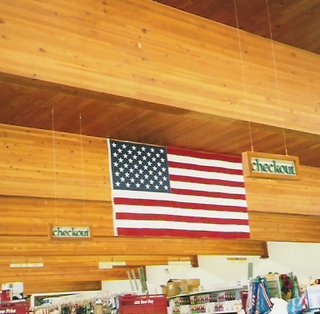
Red and white stripes of the American flag fit well with horizontal lines of these laminated beams in the store ceiling. I am not much of a shopper so I notice other things, like the architecture of the store building.
Saw this interesting ceiling in a store on my 2006 bike tour down the California coast. I think it was in Manchester, CA.
Makes a good image as people do the Christmas Shopping Season.
Not having kids, I am not much of a shopper.
I remember when I was a kid, I felt cheated if I didn't get as many toys under the tree as my older sister. She got more packages because she had friends up the street. They gave her stuff as well as the stuff we all got from mom and dad.
Now that I am older, I realize that friendships are valuable even if it doesn't necessarily mean more toys.
There is more to life than shopping, but a kid might not comprehend that as easily.
Amazing that shopping is a pastime for many folks. Not much else to do in "small town" America. Not much that's social at least.
On my trips, I keep seeing places that sell hot tubs. They are always selling hot tubs, but there is practically never a place where people gather to use the hot tub.
Imagine what the world would be like if all those hot tub stores where actually places where people went to relax in a hot tub and enjoy conversation with one another. I find the best philosophical conversations in places like saunas and hot tubs.
Places for deep conversation are rare in our society. We usually just find places to buy the hot tub and bring it home as another piece of clutter around the house.
Something more to need maintenance. Something more so the "house can own you."
I can think of more enjoyable ways to meet people than shopping. More intelligent conversations than just repeating the question over and over again, all day,
"Would you like that in a paper or plastic bag?"
Does the store clerk really feel connected after discussing that topic all day with hundreds of folks?
By the way, in answer to that "paper or plastic" question, I surprise some environmentalists by preferring plastic bags. They hold up better in the rain while walking or bicycling. Since mainstream society drives cars, they might not notice the propensity of paper bags to deteriorate in the rain.
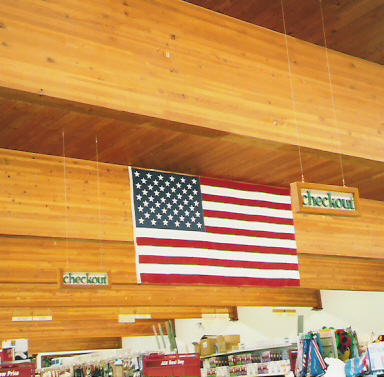
Red and white stripes of the American flag fit well with horizontal lines of these laminated beams in the store ceiling. I am not much of a shopper so I notice other things, like the architecture of the store building.
Saw this interesting ceiling in a store on my 2006 bike tour down the California coast. I think it was in Manchester, CA.
Makes a good image as people do the Christmas Shopping Season.
Not having kids, I am not much of a shopper.
I remember when I was a kid, I felt cheated if I didn't get as many toys under the tree as my older sister. She got more packages because she had friends up the street. They gave her stuff as well as the stuff we all got from mom and dad.
Now that I am older, I realize that friendships are valuable even if it doesn't necessarily mean more toys.
There is more to life than shopping, but a kid might not comprehend that as easily.
Amazing that shopping is a pastime for many folks. Not much else to do in "small town" America. Not much that's social at least.
On my trips, I keep seeing places that sell hot tubs. They are always selling hot tubs, but there is practically never a place where people gather to use the hot tub.
Imagine what the world would be like if all those hot tub stores where actually places where people went to relax in a hot tub and enjoy conversation with one another. I find the best philosophical conversations in places like saunas and hot tubs.
Places for deep conversation are rare in our society. We usually just find places to buy the hot tub and bring it home as another piece of clutter around the house.
Something more to need maintenance. Something more so the "house can own you."
I can think of more enjoyable ways to meet people than shopping. More intelligent conversations than just repeating the question over and over again, all day,
"Would you like that in a paper or plastic bag?"
Does the store clerk really feel connected after discussing that topic all day with hundreds of folks?
By the way, in answer to that "paper or plastic" question, I surprise some environmentalists by preferring plastic bags. They hold up better in the rain while walking or bicycling. Since mainstream society drives cars, they might not notice the propensity of paper bags to deteriorate in the rain.
Monday, November 27, 2006
Someone's bicycle buried in snow
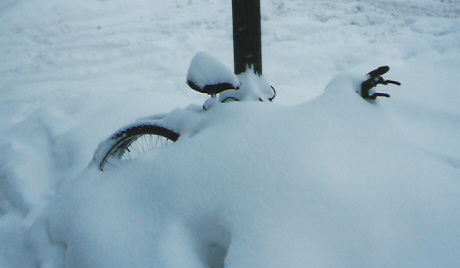
I took this image back in 1996 during a large snowstorm. Went out walking with my camera. That was a bigger snow than our recent one. In 1996, we had over 3 feet of snow.
Today it is around 8 inches in town and 15 inches in parts of the county. Still a lot of snow for Bellingham as some years it hardly snows at all. Most cars are not prepared with snow tires in this area.
Glad I live within easy walking distance of my job and errands.
The freeway had a big slowdown headed northbound. I was in my cozy room listening to the radio. They were directing people to some back roads, like Colony Road and Ershing Road. Callers had no idea where said roads were. Those are roads I often take on my bike. I guess I know back roads better than people who seldom leave the freeway.
Being able to walk to work, I helped tidy up another co worker's area who wasn't able to make it in yesterday.
Tuesday, November 21, 2006
Stanley Park. Open space near the dense city
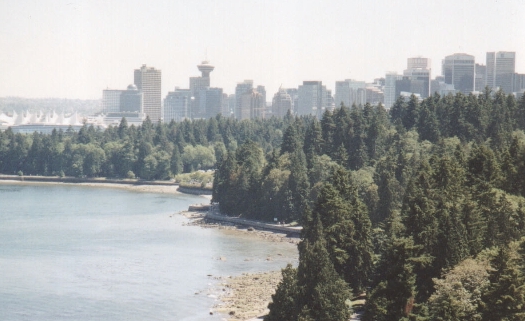
 Density is a good way to accommodate large populations especially if planning is used to provide open space for breathing room. Stanley Park is a great example of urban open space. I took these images from the Lion's Gate Bridge looking east over Stanley Park toward downtown and the densely populated West End of Vancouver.
Sunday, November 19, 2006
Customs house on a lonely road
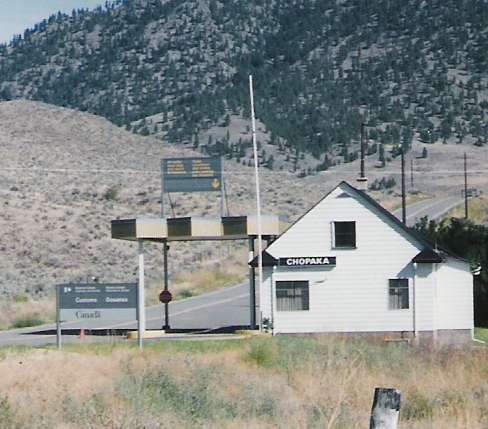
On my 1995 bike trip to Northeastern Washington State, I came back through part of Canada. Entered Canada at this lonely customs house in the west part of the Okanogan Country. This isn't even the Okanogan's main "Highway 97" crossing. It is along a road between Nighthawk, WA. and the Chopaka area of BC.
The pressure strip made a "ding." The agent looked up from his book, or maybe woke up from a nap, when I arrived.
Like an old filling station.
Yes, Canada is a big country with lots of open space and they are trying to keep it that way. I get a few questions while crossing the border. These questions are mostly aimed at making sure I have plans to come back home to USA. They like to know that my job is waiting for me when I get back.
"Thanks for reminding me folks, I thought I was on vacation."
They say, "Go on through" as they ascertain that I am just planning to visit, not stay.
This remote crossing is different than the multi-lane crossing at Peace Arch. That is along I-5 which is just about becoming one city all the way from Olympia, WA. to Vancouver, BC.
A city with some gaps in between.
Bellingham is just another wisp in that "I-5 corridor swirl" which has been called Pugetopilis before.
As I peddle my bike in this "close to the border" area, many thoughts come to mind, including the subjects in yesterday's post.
Saturday, November 18, 2006
Inuit hunting lifestyle may require more geographic space to be viable than typical American lifestyle
Is the world too crowded? Over populated?
Depends on how you want to live.
If every one's lifestyle was similar to that of the Inuit people in northern Canada, the world would definitely be too crowded. Living on the seal hunt, fishing and nomadic lifestyles takes lots of open space. Plenty of elbow room.
If the Canadian north were as densely populated as, say, the state of California, it wouldn't work. There wouldn't be enough fish and wildlife to go around. People would starve.
Some lifestyles, like those of the Inuit people, take up lots of space.
Folks might say the Inuits are "space hogs" even though they don't do that much harm to the environment.
This brings up an interesting point.
Someone can need a lot of space without necessarily harming the environment.
Many of the traditional living patterns on this planet haven't had that big of an impact on nature, but at the same time they need huge amounts of space to survive.
On the other hand, the stereotypical American "drive to the mall" lifestyle does have a big impact on the environment. It has an impact, but the typical American may need less space to survive than the typical Inuit.
Imagine that. Less space.
Yes, it does take some space to drive to the supermarket, find a parking place and pick out the fish from a fish counter, but if the fish is raised in a fish farm it might take a lot less space than if it were raised in some wild stream.
Imagine that. Less space needed for the typical American?
That's counter intuitive.
One hears that if the entire world were to live like Americans, we would need 7 planets the size of Earth. Yes, it is true. Our industrial society does have a big impact on nature. Land used for oil production, parking, subdivisions, agriculture, garbage, timber, mining, whatever.
Still, thanks to technological advances such as high intensity agriculture, we can cram more people into smaller land areas and still survive.
My guess is, traditional cultures like the Inuit of the Canadian North, need a lot more space than we do, even though their impact on the environment is less. They just need the elbow room, so the world is too crowded for them.
How many Earths would we need if we all lived like Inuits; all 6 billion of us on this planet?
That's a good question.
For just about all of the world's history, there were less than one billion people on this planet. When most of the world's people lived as some natives do today, there were very few people.
Then along came agriculture.
How many people can survive off one acre?
That's another "geographical" question.
It depends on the way people are living. Technology and high yield agra-industry can produce more food, per acre, and allow more folks to live on the planet. Things like high rise apartment towers can hold many folks while minimizing impact on the environment.
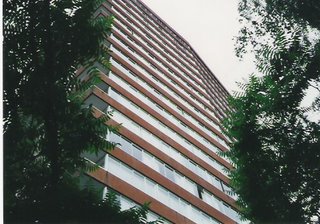
High rise residential tower and greenery in the well planned West End section of Vancouver, BC. One of the more densely populated parts of the world, but the West End holds its people quite comfortably.
"Car free West End living" could fit more people onto the planet than "sprawling auto centered American lifestyles," or, for that matter, "nomadic centered native lifestyles."
How many people can survive per acre?
It also depends on what type of acre you are talking about. Arctic tundra, or Iowa farm country? Cold ice, or fertile farmlands.
One has to hand it to the Inuit people for being able to survive thousands of years in arctic conditions. It's not like they are living in an area with hundreds of bushels per acre. It would take real talent to survive in the arctic.
So, land use and over population are interesting subjects.
People often debate whether the world is too crowded, or not.
Just remember one thing.
Some people need huge amounts of land, "elbow room," even if they don't have the technology to exploit that land the way modern Americans do.
The world may already be too crowded for these people.
Depends on how you want to live.
If every one's lifestyle was similar to that of the Inuit people in northern Canada, the world would definitely be too crowded. Living on the seal hunt, fishing and nomadic lifestyles takes lots of open space. Plenty of elbow room.
If the Canadian north were as densely populated as, say, the state of California, it wouldn't work. There wouldn't be enough fish and wildlife to go around. People would starve.
Some lifestyles, like those of the Inuit people, take up lots of space.
Folks might say the Inuits are "space hogs" even though they don't do that much harm to the environment.
This brings up an interesting point.
Someone can need a lot of space without necessarily harming the environment.
Many of the traditional living patterns on this planet haven't had that big of an impact on nature, but at the same time they need huge amounts of space to survive.
On the other hand, the stereotypical American "drive to the mall" lifestyle does have a big impact on the environment. It has an impact, but the typical American may need less space to survive than the typical Inuit.
Imagine that. Less space.
Yes, it does take some space to drive to the supermarket, find a parking place and pick out the fish from a fish counter, but if the fish is raised in a fish farm it might take a lot less space than if it were raised in some wild stream.
Imagine that. Less space needed for the typical American?
That's counter intuitive.
One hears that if the entire world were to live like Americans, we would need 7 planets the size of Earth. Yes, it is true. Our industrial society does have a big impact on nature. Land used for oil production, parking, subdivisions, agriculture, garbage, timber, mining, whatever.
Still, thanks to technological advances such as high intensity agriculture, we can cram more people into smaller land areas and still survive.
My guess is, traditional cultures like the Inuit of the Canadian North, need a lot more space than we do, even though their impact on the environment is less. They just need the elbow room, so the world is too crowded for them.
How many Earths would we need if we all lived like Inuits; all 6 billion of us on this planet?
That's a good question.
For just about all of the world's history, there were less than one billion people on this planet. When most of the world's people lived as some natives do today, there were very few people.
Then along came agriculture.
How many people can survive off one acre?
That's another "geographical" question.
It depends on the way people are living. Technology and high yield agra-industry can produce more food, per acre, and allow more folks to live on the planet. Things like high rise apartment towers can hold many folks while minimizing impact on the environment.

High rise residential tower and greenery in the well planned West End section of Vancouver, BC. One of the more densely populated parts of the world, but the West End holds its people quite comfortably.
"Car free West End living" could fit more people onto the planet than "sprawling auto centered American lifestyles," or, for that matter, "nomadic centered native lifestyles."
How many people can survive per acre?
It also depends on what type of acre you are talking about. Arctic tundra, or Iowa farm country? Cold ice, or fertile farmlands.
One has to hand it to the Inuit people for being able to survive thousands of years in arctic conditions. It's not like they are living in an area with hundreds of bushels per acre. It would take real talent to survive in the arctic.
So, land use and over population are interesting subjects.
People often debate whether the world is too crowded, or not.
Just remember one thing.
Some people need huge amounts of land, "elbow room," even if they don't have the technology to exploit that land the way modern Americans do.
The world may already be too crowded for these people.
Wednesday, November 15, 2006
Bellingham Logo Scrapped

I read that Bellingham's new logo has been scrapped. It got lots of flack from citizens. Now it looks like the old mayor might be remembered for the logo fiasco. Kind of too bad as he wasn't that bad a mayor. Good on pedestrian and bike issues.
Problem with the logo is that it was too "professional." Tried to boil Bellingham down into a simple design. Slick design elements. This isn't easy to do. Bellingham is a very eclectic city and doesn't lend itself to one theme.
Maybe a place like Ashland, Oregon, famous for the Shakespeare Festival, could have a unifying theme, but Bellingham?
What would it be?
Mount Baker? the waterfront? the university? the folk music scene? Walmart? the freeway? Old Fairhaven? retired folks? students? tourists? greenways?
Or maybe just some simple design elements that don't really reflect any city in particular. That's the problem. It was too professional. With "professional" comes the price tag. $25,000, or so.
Too professional and clean.
The blue shapes in the background were supposed to represent mountains. Maybe the lines were too straight, too clean. They did look like buildings with consistent 45 degree roof lines. People kept saying they looked like condominium towers with a puddle in front. Mountains would be jagged, fuzzy, foggy, furry. With trees, holes, gaps, uneven.
One hears the term "fractals" when trying to get a computer to represent something natural like a mountain. Throw in the random element.
That's eclectic.
Anyway, it's now "water under the bridge." So much for imposing the concept of "branding" on our eclectic world.
Subscribe to:
Posts (Atom)