As for unplugging from the internet, I do use it each day. I find the internet useful.
I don't unplug for long periods of time, like a wilderness adventure, or summer camp for unplugging.
Instead I unplug by just not being connected to it 24/7. I tend to use posts and comments to things like Facebook walls rather than real time chats. My relationships with people don't require me to be there for them 24/7.
I often tell people, I am not a 24 hour radio station.
Before the term 24/7 became popular, I was fascinated in 24 hour radio stations. They were more rare in the late 1960s / early 1970s. I had an interest in the tubes warming up and staying on for days on end.
Living in a basement room in my parents house, I had a 300 watt lightbulb with no lampshade. It did have a porcelain socket for safety. It reminded me of a powerful tube. During college, I set it up in my dorm room, but didn't use it that much. One time I did have it on when a friend was visiting and he said that he felt like he was being interrogated by the KGB.
Most radio stations, back then, went off the air, sometimes with the Star Spangled Banner to resume broadcast next morning. Each morning, they would warm up the transmitter tubes again. It took some time for the tubes to stabilize and then they would flip another switch to start the broadcast day.
TV, back then would often start the day, as well as ending the day with a test pattern.
During high school, I thought I would have a career in radio. Of course I didn't know about social media before that technology change.
I used to hang out in the studios of KWSU Radio, in Pullman to watch and chat with a student host named John Briel thinking it was good to familiarize myself with the field I was planning to go into.
Some material I got while attending Communications Center dedication.
One time, I arrived at the Edward R Murrow Communications Center early in the morning. It was dedicated with that name my senior year in high school. John let me in the building and I watched as he started up the station. When he turned on the transmitter tubes, I said, "they are warming up now." His response was, "yes, everything is starting to cook."
Back then, KWSU had a studio to transmitter microwave link. The transmitter was located out by Knott Dairy Center west of Pullman. Knott Dairy Center named for Joe Knott, a colleague of my dad in the Dairy Science Department. Also a neighbor who's house was kittycorner across the back fence from ours.
The control system was a telephone dial; a rotory dial. Different number codes commanded actions out at the transmitter. Codes for turning on the tubes, codes for sending just the carrior signal as well as codes for starting the broadcast day. One time, during sunset, I saw him dial up the transmitter so I ask, "what did you just do." His answer was, "I just turned on the tower lights." Allows pilots to see the tower and avoid crashing into it.
24 hour stations, in big cities, did interest me. I picked up both KGO and KNBR, from San francisco, at night due to ionospheric skip.
Even the 24 hour stations had to shut down sometimes for transmitter maintenence. KNBR used to have a broadcast week. At 1 am early Monday morning after their Sunday evening period, they went off the air. At 4 am, they would return to the air. Sometimes I would listen to the sign on and sign off with interest. KNBR would sometimes have interesting tones, after going off the air, as they callabrated audio, I guess. Then it would turn to static as they turned off the transmitter.
KGO never seemed to go off the air. It run 24/7, week after week. I figured they had 2 transmitters. When they needed to service one, the other transmitter was switched on.
Sure enough, many years later, on the internet, I saw a picture of the inside of KGO's transmitter building. 2 identical transmitters were side by side.
Showing posts with label my-1970s-early. Show all posts
Monday, February 10, 2025
Tuesday, November 26, 2024
Remembering the George McGovern, Richard Nixon race in 1972.
Start of my Senior year in high school, 1972 George McGovern was pretty far to the left. He wanted to end the Vietnam War.
The Democrats did back him after a pitched nomination contest. He won the nomination and ran for president, but lost badly in the general election only carrying the state of Massachusetts and the District of Columbia.
Republican Richard Nixon won all other states, but by spring of my Senior year, he was embroiled in the Watergate Scandal.
By the summer, between my freshman and sophomore years in college, Nixon became the first US president to resign from office under threat of impeachment and possible removal from office.
The Democrats did back him after a pitched nomination contest. He won the nomination and ran for president, but lost badly in the general election only carrying the state of Massachusetts and the District of Columbia.
Republican Richard Nixon won all other states, but by spring of my Senior year, he was embroiled in the Watergate Scandal.
By the summer, between my freshman and sophomore years in college, Nixon became the first US president to resign from office under threat of impeachment and possible removal from office.
Labels:
democraticparty,
my_history,
my-1970s-early,
politics,
pullman
Friday, November 10, 2023
My first time in San Francisco. Spring 1974.
A trip down memory lane. My first visit to San Francisco, Spring 1974; my freshman year in college at Bellingham. Judith (my sister who, back then lived in Bellingham) and I went to visit a brother Jack (back then a grad student at Stanford; Palo Alto area).
On our way to the Bellingham Greyhound Station (then on State Street) I gave a dollar (maybe a quarter back then) to a pan handler. My sister implied that giving to pan handlers could be overwhelming in the big city, but ironically that was the only pan handler who approached us, as I remember at least.
Most of our time was spent in Palo Alto area for the visit, but we planned a sightseeing trip to San Francisco; often affectionately called "The City." Photo from old postcard showing downtown and Trans America Pyramid.
I forgot how we got up there; maybe by car or transit.
During my childhood, San Francisco seemed like a dream city by the Golden Gate Bridge. Home of some powerful 50,000 watt radio stations that provided a slight connection between my hometown life in Pullman and that city by the bay. Old postcard from the 1970s. KGO is no longer a talk show station.
By the time I got to college, my view of that city became more tainted and a bit grimy, however. I had learned more about it's problems as well.
As I remember, we divided our sightseeing day into two parts. Morning at the De Young Museum and an afternoon of walking around looking at downtown buildings (my idea).
All I remember, from the museum, was some long lines, echoing spaces and lots of children on tour as if all the schools were taking field trips at once.
I remember snacking in a cafeteria and I guess the only display I remember was a moon rock. It was in a glass case guarded by a security guard.
The rest of the museum must have gone into my memory as a blur. Museums can be overwhelming with information overload; looking and reading quickly while moving on to the next.
Afternoon was walking around downtown. The buildings were quite fascinating, but there was a spooky, somewhat dangerous feel to the city.
As we passed the studios of one of the radio stations that I even had dreams about during childhood, the building looked small. It was KGO which was, back then, located in the somewhat scruffy Tenderloin District. As I remember, from lots of listening to that station it was at 277 Golden Gate Avenue.
Doors were locked tight, but my brother was able to find a doorbell, I think. A security guard only opened the door a slight crack and said, "no tours." He then shut the door quickly. Back then, a crime called the "Alphabet Bomber" was in Bay Area news.
The rest of our walk was more interesting with lots of beautiful vistas, art, architecture, cafes and so forth.
When we got to Trans America Pyramid the doors were open and a guard in the lobby said we could go up in an elevator to an office that wasn't leased so it was open for showing to potential tenants; I guess. That office was near the top; the actual top being a pinnacle, of course.
Another guard, in that lofty space, was quite friendly. We visited while taking in the panorama. The view was spectacular, but the windows only faced one direction, as I remember. We stepped into the Hyatt Regency at Embarcadero and saw this impressive atrium. It was open to the public and full of shops and places to eat on the main floor. Picture from old postcard.
After our walk through downtown, I think we concluded that our walk around downtown was the most interesting part of the day.
I've been there a few other times in more recent years including passing through during bicycle trips down the coast.
On our way to the Bellingham Greyhound Station (then on State Street) I gave a dollar (maybe a quarter back then) to a pan handler. My sister implied that giving to pan handlers could be overwhelming in the big city, but ironically that was the only pan handler who approached us, as I remember at least.
Most of our time was spent in Palo Alto area for the visit, but we planned a sightseeing trip to San Francisco; often affectionately called "The City." Photo from old postcard showing downtown and Trans America Pyramid.
I forgot how we got up there; maybe by car or transit.
During my childhood, San Francisco seemed like a dream city by the Golden Gate Bridge. Home of some powerful 50,000 watt radio stations that provided a slight connection between my hometown life in Pullman and that city by the bay. Old postcard from the 1970s. KGO is no longer a talk show station.
By the time I got to college, my view of that city became more tainted and a bit grimy, however. I had learned more about it's problems as well.
As I remember, we divided our sightseeing day into two parts. Morning at the De Young Museum and an afternoon of walking around looking at downtown buildings (my idea).
All I remember, from the museum, was some long lines, echoing spaces and lots of children on tour as if all the schools were taking field trips at once.
I remember snacking in a cafeteria and I guess the only display I remember was a moon rock. It was in a glass case guarded by a security guard.
The rest of the museum must have gone into my memory as a blur. Museums can be overwhelming with information overload; looking and reading quickly while moving on to the next.
Afternoon was walking around downtown. The buildings were quite fascinating, but there was a spooky, somewhat dangerous feel to the city.
As we passed the studios of one of the radio stations that I even had dreams about during childhood, the building looked small. It was KGO which was, back then, located in the somewhat scruffy Tenderloin District. As I remember, from lots of listening to that station it was at 277 Golden Gate Avenue.
Doors were locked tight, but my brother was able to find a doorbell, I think. A security guard only opened the door a slight crack and said, "no tours." He then shut the door quickly. Back then, a crime called the "Alphabet Bomber" was in Bay Area news.
The rest of our walk was more interesting with lots of beautiful vistas, art, architecture, cafes and so forth.
When we got to Trans America Pyramid the doors were open and a guard in the lobby said we could go up in an elevator to an office that wasn't leased so it was open for showing to potential tenants; I guess. That office was near the top; the actual top being a pinnacle, of course.
Another guard, in that lofty space, was quite friendly. We visited while taking in the panorama. The view was spectacular, but the windows only faced one direction, as I remember. We stepped into the Hyatt Regency at Embarcadero and saw this impressive atrium. It was open to the public and full of shops and places to eat on the main floor. Picture from old postcard.
After our walk through downtown, I think we concluded that our walk around downtown was the most interesting part of the day.
I've been there a few other times in more recent years including passing through during bicycle trips down the coast.
Labels:
my_history,
my-1970s-early,
radio
Wednesday, May 24, 2023
In many cases gender and gender pronouns don't really matter
Talking to some young people about the gender pronoun issue, I shared memories from my college past of almost 40 years ago.
Back then, the gay issue was coming out on campus. I also knew quite a few transgender people, but pronouns wasn't a topic that people were discussing. As I remember, there was less anxiety about proper pronouns.
The folks, I was discussing this with, understood and seemed accepting of my perspective.
Back in my college days, I think expectations were lower, but I would like to think that society keeps progressing forward. On the other hand, people may have been just as happy, back then, or maybe even happier back then. Expectations were less demanding.
It's kind of like before electric lightbulbs were invented, folks didn't fret about the inconvenience of not having electric lights. They didn't know what they were missing.
These days, I think the science about gender has progressed, so it's seen as less binary. One now hears about folks who want to be called "they" instead of he or she. The term "gender fluid" was less in the lexicon, back then.
Science has progressed to where gender fluid is more recognized, though most people still identify as either male or female. There are shades of grey that are more recognized today.
The term "they" is kind of awkward. Maybe a new term can be found? They is usually thought of as non singular.
At the same time, I have used the term they to describe one person before. For instance, "I wondered how to get to a certain road so I ask someone how to get there and THEY pointed me in the right direction."
In many cases, gender doesn't matter.
Back in my college days, the big issue was that women didn't want to be called "girls." Often people were corrected when they said "college girls." It's "college women." The term "chick" for woman was totally incorrect.
As I remember, I always did say women and my mom once said, "in this case it's" when I was talking about my nieces that were, then in grade school.
I also remember the attempts to put the word womyn. in the language. It's womyn instead of women. That term less subservient without the "men" in it.
The folks, I was discussing this with, understood and seemed accepting of my perspective.
Back in my college days, I think expectations were lower, but I would like to think that society keeps progressing forward. On the other hand, people may have been just as happy, back then, or maybe even happier back then. Expectations were less demanding.
It's kind of like before electric lightbulbs were invented, folks didn't fret about the inconvenience of not having electric lights. They didn't know what they were missing.
These days, I think the science about gender has progressed, so it's seen as less binary. One now hears about folks who want to be called "they" instead of he or she. The term "gender fluid" was less in the lexicon, back then.
Science has progressed to where gender fluid is more recognized, though most people still identify as either male or female. There are shades of grey that are more recognized today.
The term "they" is kind of awkward. Maybe a new term can be found? They is usually thought of as non singular.
At the same time, I have used the term they to describe one person before. For instance, "I wondered how to get to a certain road so I ask someone how to get there and THEY pointed me in the right direction."
In many cases, gender doesn't matter.
Back in my college days, the big issue was that women didn't want to be called "girls." Often people were corrected when they said "college girls." It's "college women." The term "chick" for woman was totally incorrect.
As I remember, I always did say women and my mom once said, "in this case it's" when I was talking about my nieces that were, then in grade school.
I also remember the attempts to put the word womyn. in the language. It's womyn instead of women. That term less subservient without the "men" in it.
Saturday, April 22, 2023
Another Earth Day
Sometimes I think Earth Day is just another way to appease our guilt and make it look like we are trying to do something to save the livability of the planet.
This year, a friend was thinking of attending a tree planting event, but found that the event, near his neighborhood, was fully booked. Maybe not enough saplings at that location, but other locations, in the city, still had openings. He wanted to walk, rather than drive across town, but he may attend anyway regardless of whether there is a sapling for him to plant.
The events offer instructions on where to park for attending the event.
Years ago, another friend walked into a meeting, I was at, with sapling in hand asking people if they wanted to take one for planting. I took one and then walked to Sehome Hill to plant it myself. There wasn't an event. I don't know if it survived or not. There wasn't an event to show me how to plant it.
Now I can't tell if it survived, or not, as when I look at that area, I just see lots of trees anyway. I forgot exactly where I planted it.
Many more years before that, I remember the first Earth Day while I was in high school. The art teacher led a tree planting event, but a biology teacher thought the trees wouldn't survive on that hillside which was naturally a grassland environment. That event was still a nice memory.
This year, a friend was thinking of attending a tree planting event, but found that the event, near his neighborhood, was fully booked. Maybe not enough saplings at that location, but other locations, in the city, still had openings. He wanted to walk, rather than drive across town, but he may attend anyway regardless of whether there is a sapling for him to plant.
The events offer instructions on where to park for attending the event.
Years ago, another friend walked into a meeting, I was at, with sapling in hand asking people if they wanted to take one for planting. I took one and then walked to Sehome Hill to plant it myself. There wasn't an event. I don't know if it survived or not. There wasn't an event to show me how to plant it.
Now I can't tell if it survived, or not, as when I look at that area, I just see lots of trees anyway. I forgot exactly where I planted it.
Many more years before that, I remember the first Earth Day while I was in high school. The art teacher led a tree planting event, but a biology teacher thought the trees wouldn't survive on that hillside which was naturally a grassland environment. That event was still a nice memory.
Monday, October 25, 2021
Dedication of Edward R. Murrow Center at WSU, 1973. My senior year in Pullman High School.
Going through old photos and thinking about my senior year in high school. Long before anyone knew what social media was, I was thinking about a possible career in broadcast media. It ended up being more like an avocation in social media.
During my senior year in high school (1972-73), I used to wander freely in the halls of KWSU's radio and TV studios in Pullman. It was in campus buildings open to the public.
One could peer through windows into an interesting world.
In 2013, when I bicycled back to Pullman for my 40th high school reunion, I revisited those same halls.
My sister Judith lives in Pullman. Being a bit less shy than me, at the time, she ask someone passing in the hall if we could tour a studio. They opened some things up, beyond just the hallways and answered many questions.
Here's a view from one of the halls I wandered in high school. The hall is still there, but the view has changed in this 2013 image.
KWSU TV Master Control.
New equipment now, but back then, the office looking room on the right had big video tape decks in it. They were the kind that stood on the floor; the size of a big home furnace back then. Furnaces are smaller, these days, as well.
Through the windows more to the left was master control, itself, with many TV screens. Looked different then.
The door on the right led to an observation area that looked down into two big TV studios.
More facilities than a small town TV station would need, but this was also a college of communications.
To this day, one still hears NWPB say they are a "service of the Edward R. Murrow College of Communications at Washington State University."
Here's another hallway I wandered. Probably more off limits, but they invited me in, during my high school years. Then again in 2013.
The radio studios.
On the right was the news booth. Farther down the hall was the main studios.
To the left was more space where they said, when I was in high school, "we will probably get FM."
KWSU Radio was all on AM back then, but now it's the heart of a large empire of regional transmitters, mostly on FM. The heart of Northwest Public Broadcasting which serves many parts of the Pacific Northwest, including Bellingham.
During my high school years, it was a bit more informal. One of the students, working there, told a story about how they used to try and get the newscaster to break up laughing during the news.
One of the antics was to walk past the news booth and start crouching at the knees. From inside the booth, it looked like the person was starting down a flight of stairs.
There were no stairs in that hallway.
I attended the dedication of what was those new studios, during my senior year. It's the Edward R. Murrow Communications Center.
A building dating back to 1899 was remodeled and a new wing was added behind. Radio and journalism was in the old section, TV in the new section.
There was some other stuff too; like the WSU Syndicated Tape Network. Educational shows were mailed out on reel-to-real tape for various other radio stations.
A practice now made obsolete by the internet.
Someone, who lived on my paper route when I was in 8th grade, had a show called "Science In The News." That was one of the shows sent out over the WSU Tape Network.
Another view of the old section of Murrow Center.
I kept a lot of papers from that dedication.
A famous CBS news commentator named Eric Sevareld came out from New York City to speak at the dedication.
My only memory of his address, which was held at Bohler Gymnasium that many years ago, was his description of trying to book a flight to Pullman, WA. from New York City.
A travel agent handed him the ticket with several stopovers to change planes. She said, "I think this will get you there, but it's the first time it's ever been tried." Most people in New York City have never heard of Pullman, WA.
This might be an urban legend that I heard from my mom. She had read an article, somewhere, that one of the plane stops was Spokane, just before Pullman.
Knowing that Sevareld would be in the area, they invited him to speak in Spokane also. He sent them a postcard with one word on it.
"Bunk."
Like thinking of Spokane as just a whistle stop, it must have been seen as an insult.
For Pullman, it was a David and Goliath moment, as Spokane is the biggest city and trade center of that region.
My mom didn't think much of Spokane with it's more conservative politics than little Pullman. Pullman is a college town.
These days, that story would be thought of as "liberal elitism."
My mom noted that she traveled to Seattle, 300 miles away, more often than Spokane; a mere 80 miles away. She often took the Greyhound Bus (she was a non driver) to Seattle where she had volunteer activity, at the state level, in our liberal church denomination; the United Church of Christ (Congregationalist Churches).
Comparing Seattle to Spokane, my mom would say, "Spokane thinks its big, Seattle knows its big."
As I remember, there was some friction between the CBS news operation, in New York, and Spokane's CBS affiliate which was then KXLY TV Channel 4.
Several years later (if I remember correctly) CBS dropped KXLY and went to Spokane's KREM, Channel 2. KXLY then picked up the ABC network so the Spokane stations kind of did a network shuffle.
Picture of me on left in a high school TV production class.
I also kept copies of the high school newspaper that I was a reporter for.
The high school was also in a brand new building, my senior year. It featured some sophisticated communications equipment of its own.
Headline below is from another edition where I wrote an editorial. I still have that copy posted on Flickr.
KWSU TV was planning to move their transmitter to Kamiak Butte and I favored the idea. Increase the reach for educational media.
The editor, of the high school newspaper, was against the plans for putting a TV tower on Kamiak.
She printed my editorial and wrote one of her own in a "point counterpoint feature."
Before moving to Kamiak, KWSU's TV antenna was on the top of Bryan Hall Clock Tower. It only had about a 15 mile reach from there.
After that controversy cleared, they did build a tower on the left side of Kamiak Butte north of Pullman. Built sometime after I graduated from high school.
The tower is hardly visible (or not visible at all) in this picture that I took looking north from Terrell Library Plaza at WSU in 2001. There are dormatories in the foreground.
The range of the signal is much farther from Kamiak, but now it might not matter as much as just about everything goes worldwide on the internet.
During my senior year in high school (1972-73), I used to wander freely in the halls of KWSU's radio and TV studios in Pullman. It was in campus buildings open to the public.
One could peer through windows into an interesting world.
In 2013, when I bicycled back to Pullman for my 40th high school reunion, I revisited those same halls.
My sister Judith lives in Pullman. Being a bit less shy than me, at the time, she ask someone passing in the hall if we could tour a studio. They opened some things up, beyond just the hallways and answered many questions.
Here's a view from one of the halls I wandered in high school. The hall is still there, but the view has changed in this 2013 image.
KWSU TV Master Control.
New equipment now, but back then, the office looking room on the right had big video tape decks in it. They were the kind that stood on the floor; the size of a big home furnace back then. Furnaces are smaller, these days, as well.
Through the windows more to the left was master control, itself, with many TV screens. Looked different then.
The door on the right led to an observation area that looked down into two big TV studios.
More facilities than a small town TV station would need, but this was also a college of communications.
To this day, one still hears NWPB say they are a "service of the Edward R. Murrow College of Communications at Washington State University."
Here's another hallway I wandered. Probably more off limits, but they invited me in, during my high school years. Then again in 2013.
The radio studios.
On the right was the news booth. Farther down the hall was the main studios.
To the left was more space where they said, when I was in high school, "we will probably get FM."
KWSU Radio was all on AM back then, but now it's the heart of a large empire of regional transmitters, mostly on FM. The heart of Northwest Public Broadcasting which serves many parts of the Pacific Northwest, including Bellingham.
During my high school years, it was a bit more informal. One of the students, working there, told a story about how they used to try and get the newscaster to break up laughing during the news.
One of the antics was to walk past the news booth and start crouching at the knees. From inside the booth, it looked like the person was starting down a flight of stairs.
There were no stairs in that hallway.
I attended the dedication of what was those new studios, during my senior year. It's the Edward R. Murrow Communications Center.
A building dating back to 1899 was remodeled and a new wing was added behind. Radio and journalism was in the old section, TV in the new section.
There was some other stuff too; like the WSU Syndicated Tape Network. Educational shows were mailed out on reel-to-real tape for various other radio stations.
A practice now made obsolete by the internet.
Someone, who lived on my paper route when I was in 8th grade, had a show called "Science In The News." That was one of the shows sent out over the WSU Tape Network.
Another view of the old section of Murrow Center.
I kept a lot of papers from that dedication.
A famous CBS news commentator named Eric Sevareld came out from New York City to speak at the dedication.
My only memory of his address, which was held at Bohler Gymnasium that many years ago, was his description of trying to book a flight to Pullman, WA. from New York City.
A travel agent handed him the ticket with several stopovers to change planes. She said, "I think this will get you there, but it's the first time it's ever been tried." Most people in New York City have never heard of Pullman, WA.
This might be an urban legend that I heard from my mom. She had read an article, somewhere, that one of the plane stops was Spokane, just before Pullman.
Knowing that Sevareld would be in the area, they invited him to speak in Spokane also. He sent them a postcard with one word on it.
"Bunk."
Like thinking of Spokane as just a whistle stop, it must have been seen as an insult.
For Pullman, it was a David and Goliath moment, as Spokane is the biggest city and trade center of that region.
My mom didn't think much of Spokane with it's more conservative politics than little Pullman. Pullman is a college town.
These days, that story would be thought of as "liberal elitism."
My mom noted that she traveled to Seattle, 300 miles away, more often than Spokane; a mere 80 miles away. She often took the Greyhound Bus (she was a non driver) to Seattle where she had volunteer activity, at the state level, in our liberal church denomination; the United Church of Christ (Congregationalist Churches).
Comparing Seattle to Spokane, my mom would say, "Spokane thinks its big, Seattle knows its big."
As I remember, there was some friction between the CBS news operation, in New York, and Spokane's CBS affiliate which was then KXLY TV Channel 4.
Several years later (if I remember correctly) CBS dropped KXLY and went to Spokane's KREM, Channel 2. KXLY then picked up the ABC network so the Spokane stations kind of did a network shuffle.
Picture of me on left in a high school TV production class.
I also kept copies of the high school newspaper that I was a reporter for.
The high school was also in a brand new building, my senior year. It featured some sophisticated communications equipment of its own.
Headline below is from another edition where I wrote an editorial. I still have that copy posted on Flickr.
KWSU TV was planning to move their transmitter to Kamiak Butte and I favored the idea. Increase the reach for educational media.
The editor, of the high school newspaper, was against the plans for putting a TV tower on Kamiak.
She printed my editorial and wrote one of her own in a "point counterpoint feature."
Before moving to Kamiak, KWSU's TV antenna was on the top of Bryan Hall Clock Tower. It only had about a 15 mile reach from there.
After that controversy cleared, they did build a tower on the left side of Kamiak Butte north of Pullman. Built sometime after I graduated from high school.
The tower is hardly visible (or not visible at all) in this picture that I took looking north from Terrell Library Plaza at WSU in 2001. There are dormatories in the foreground.
The range of the signal is much farther from Kamiak, but now it might not matter as much as just about everything goes worldwide on the internet.
Labels:
my_history,
my-1970s-early,
pullman,
radio
Friday, June 04, 2021
Looking back on one of my career goals and why it didn't happen.
From 1972 KHQ Spokane radio TV brochure.
I look back on a career I thought I might have when I was in high school. Broadcast journalism? Radio interested me more than television, but this 1972 brochure from a Radio / TV station I admired shows more TV than radio. TV more colorful.
That career never happened the way I had envisioned it. My nervous conditions and unusual personality was a factor. While having my aspirations, I also worried that I might freak out, flunk out of school or flunk out of college. That didn't happen either.
The industry, I thought I might go into, has it's problems also. On radio and also television, most of the creative programing comes from the top down. It's fed from the national networks. That was true in my high school days and still today; to some extent.
My high school self would have had no idea what the term "social media" met.
It didn't quite work out the way people envisioned, back then, but I have expressed many thoughts, mostly on social media. I made my living in a fairly peaceful way as a custodian.
My life, during my working years, might have been a middle ground between failure and fame. Modest, but I would like to say still worthy. It does kind of make sense, to me, how it turned out.
On a trip from Pullman, where I grew up, to Spokane, I wanted to tour some of the radio studios. My dad took me to a few. KREM, KJRB; also KHQ.
At the wonderful world of KHQ, a staff person playing tour guide ask me what specialty I wanted in broadcasting. Sales, news, cameraman (back in the pre feminist days).
I hadn't decided so I was stumbling for an answer. My dad tried to fill the void by saying, "he wants to be president of the company."
The person giving the tour was taken aback. He said, "well, you really can't start there." I was a bit embarrassed. I basically just was interested in an overview tour.
See also How my career plans got changed and I ended up in Bellingham.
I look back on a career I thought I might have when I was in high school. Broadcast journalism? Radio interested me more than television, but this 1972 brochure from a Radio / TV station I admired shows more TV than radio. TV more colorful.
That career never happened the way I had envisioned it. My nervous conditions and unusual personality was a factor. While having my aspirations, I also worried that I might freak out, flunk out of school or flunk out of college. That didn't happen either.
The industry, I thought I might go into, has it's problems also. On radio and also television, most of the creative programing comes from the top down. It's fed from the national networks. That was true in my high school days and still today; to some extent.
My high school self would have had no idea what the term "social media" met.
It didn't quite work out the way people envisioned, back then, but I have expressed many thoughts, mostly on social media. I made my living in a fairly peaceful way as a custodian.
My life, during my working years, might have been a middle ground between failure and fame. Modest, but I would like to say still worthy. It does kind of make sense, to me, how it turned out.
On a trip from Pullman, where I grew up, to Spokane, I wanted to tour some of the radio studios. My dad took me to a few. KREM, KJRB; also KHQ.
At the wonderful world of KHQ, a staff person playing tour guide ask me what specialty I wanted in broadcasting. Sales, news, cameraman (back in the pre feminist days).
I hadn't decided so I was stumbling for an answer. My dad tried to fill the void by saying, "he wants to be president of the company."
The person giving the tour was taken aback. He said, "well, you really can't start there." I was a bit embarrassed. I basically just was interested in an overview tour.
See also How my career plans got changed and I ended up in Bellingham.
Labels:
my_history,
my-1970s-early,
radio
Sunday, June 23, 2019
Believe it or not, I had some camping experiences with Fundamentalist Christians when I was a teenager
I am thinking about this experience after reading the news about The Firs Campground near Bellingham and it's firing of Jace Taylor for being gay. Some people were surprised when this happened as, I guess, the Firs seemed pretty mellow. A stricter theology lies underneath the fun.
I grew up in a very liberal church that is now pro gay rights, but when I was in 6th grade, a friend invited me to join the Boy Scouts. He was in the Mormon Scout Troop; Church of Jesus Christ of Latter Day Saints.
Being good liberals, my parents said, "we don't necessarily believe the theology in that church, but if your friends are there, have a good time."
I enjoyed the first few camping trips and scout meetings.
By the time I got to 7th grade, it was becoming evident that I wasn't motivated. Scouting was kind of like a para military organization. Maybe too macho for me? I wasn't motivated to achieve any ranking beyond second class; a badge in scouting. They also have a system of merit badges and my merit badge count was zero. One other badge I did get, come to think about it, was something called "Order of the Arrow."
I still hung out in the troop mostly as a social outlet. Friends were there, it was a place to go.
By the time I got into high school, I was beginning to realize that it was politically more conservative than my own upbringing.
Still, as a teenager, I had mixed feelings. Part of the time, I was drawn to the more liberal leanings of my parents and siblings. At other times, I was sort of rebellious toward my own family so I trended toward conservative. Military service both inspired and frightened me. The Vietnam War and the military draft were hanging over people's heads.
Another one of my friends, named Jeff, who was in that troop, got Eagle Scout; the highest rank in scouting, I guess.I was somewhat inspired and also intimidated as I wasn't motivated to climb that ladder. My mom pointed out a nice thought tho. When a picture came out in the local paper about the scouting awards. My mom noted that the picture showed a Methodist scoutmaster pinning the Eagle Badge on a Catholic kid who was in the Mormon Troop. She thought that was a statement in ecumenical-ism.
Later in high school, during one of my liberal leaning phases, I decided to write some kind of statement and pin it to the bulletin board in that church. It was some kind of rambling theological essay. The only part I remember, today, was a statement I made that went, "if a stick doesn't bend, it breaks."
I tacked that essay to the bulletin board on the main entryway of the church outside the scout room. It felt like Martin Luther tacking the poster to the church doors.
I left it up a few days and then must have gotten nervous as I eventually took it down.
It was a bit surprising, to me, that no one paid any attention to it. Life in the church and the scout troop went on as normal. No one said anything to me about my essay. Maybe they couldn't read it as the writing wasn't the best.
Eventually, I decided I was in the wrong pew; so to speak and I quite the scout troop.
More stories from my scouting days and other memories to follow.
I grew up in a very liberal church that is now pro gay rights, but when I was in 6th grade, a friend invited me to join the Boy Scouts. He was in the Mormon Scout Troop; Church of Jesus Christ of Latter Day Saints.
Being good liberals, my parents said, "we don't necessarily believe the theology in that church, but if your friends are there, have a good time."
I enjoyed the first few camping trips and scout meetings.
By the time I got to 7th grade, it was becoming evident that I wasn't motivated. Scouting was kind of like a para military organization. Maybe too macho for me? I wasn't motivated to achieve any ranking beyond second class; a badge in scouting. They also have a system of merit badges and my merit badge count was zero. One other badge I did get, come to think about it, was something called "Order of the Arrow."
I still hung out in the troop mostly as a social outlet. Friends were there, it was a place to go.
By the time I got into high school, I was beginning to realize that it was politically more conservative than my own upbringing.
Still, as a teenager, I had mixed feelings. Part of the time, I was drawn to the more liberal leanings of my parents and siblings. At other times, I was sort of rebellious toward my own family so I trended toward conservative. Military service both inspired and frightened me. The Vietnam War and the military draft were hanging over people's heads.
Another one of my friends, named Jeff, who was in that troop, got Eagle Scout; the highest rank in scouting, I guess.I was somewhat inspired and also intimidated as I wasn't motivated to climb that ladder. My mom pointed out a nice thought tho. When a picture came out in the local paper about the scouting awards. My mom noted that the picture showed a Methodist scoutmaster pinning the Eagle Badge on a Catholic kid who was in the Mormon Troop. She thought that was a statement in ecumenical-ism.
Later in high school, during one of my liberal leaning phases, I decided to write some kind of statement and pin it to the bulletin board in that church. It was some kind of rambling theological essay. The only part I remember, today, was a statement I made that went, "if a stick doesn't bend, it breaks."
I tacked that essay to the bulletin board on the main entryway of the church outside the scout room. It felt like Martin Luther tacking the poster to the church doors.
I left it up a few days and then must have gotten nervous as I eventually took it down.
It was a bit surprising, to me, that no one paid any attention to it. Life in the church and the scout troop went on as normal. No one said anything to me about my essay. Maybe they couldn't read it as the writing wasn't the best.
Eventually, I decided I was in the wrong pew; so to speak and I quite the scout troop.
More stories from my scouting days and other memories to follow.
Labels:
my_history,
my-1970s-early,
religion
Monday, March 04, 2019
Tuesday, December 25, 2018
A history of my erotic fetish. Kind of a mild and unusual fetish, I guess
As a child growing up in the college town of Pullman, WA. I didn't really have the concept of gay sexuality. Partially because I was in my own world and also it just wasn't talked about in the Pullman of the 1960s.
Naive ignorance, I guess.
I found myself attracted to the shape of the body of slim guys with long hair. The hippie culture was in the news. It was a turn on to see people showering at the campus pools.
Toward the end of high school and heading off to college, gay issues started surfacing. At first it was seen as a human rights topic. I was lucky to have enlightened parents who went to a liberal church; United Church of Christ. Today, that denomination has big contingents in gay parades.
I didn't hear the term faggot till I got to my freshman dorm at what's now Western Washington University, here in Bellingham. People in that dorm seemed shallow and prejudice. I would debate theology with some of the conservative Christians. Others, in the dorm just seemed like drunkards.
Eventually I went to a gay rap group on campus (back then discussion groups were often called "rap groups" I guess for rapport). This was partially to spite the "Christian" who lived across the hall from me in my dorm. I told him that Jesus hung out with oppressed peoples. It helped, at the time, to be taking a class on Mahatma Gandhi.
Folks in that dorm were at least kind of light hearted. I was the dorm eccentric.
This led me to start participating in the gay political group on campus; a world mostly made up of lesbian women.
My first time in a gay bar was a class field trip to the Hut Tavern which had just opened in Bellingham. This was during a class on the gay rights movement, taught by Fairhaven College Professor David Mason.
While I was getting politically involved, I really had no desire for sexual intercourse. The thought of anal or oral intercourse didn't appeal to me. This lack of interest in intercourse was reinforced by the AIDS epidemic. The idea of getting a blow job had no appeal to me. I wanted to get to know the person better. At least see the face.
Being part of a couple, tho, was not that appealing also. I'm probably the type of person that people would swipe past if I were on dating apps. I'm popular, in my own way; in a friendship way. Maybe, if I lived in a big metropolitan area there would be a lot more choices. Sometimes I wonder how my life would be different if I lived in a big metro area. At the same time, I don't seem to miss dating.
I've always been a bit awkward and unusual. Now I'm in the past 50 years of my life which, most likely, get swiped past a lot on dating apps in Bellingham.
Growing up, I thought masturbation was an involuntary wet dream. It took my campus counselor to explain that masturbation could be done while one is awake. Eventually I started enjoying masturbation, but it took a while to get used to the idea.
One sexual minority is asexual or celibate. To be unique, I thought I would describe myself as asexual; a part of the sexual minority spectrum. Attracted to guys, but not sexually active. Most of the other gay activists, around me, were women, at that time anyway.
Seeing long haired men in the gym shower was still a turn on. I wasn't obvious, in public, but it fed my masturbation fantasies after I got home well away from other people. For some reason, I didn't connect this fetish to my political life in the gay student group. I still thought I was asexual.
After graduating from college, I began to think, maybe I do have a legitimate sexual life. I'm turned on by getting to know people, seeing attractive folks in the nude and mingling. If others find me attractive, it's flattering. Still no interest in intercourse or being in the drama of a relationship, however. As time goes on, my attraction for men has widened to beyond just folks with long hair.
The bar never interested me much during my youth. Maybe I wasted my youth not going out dancing. The cigarette smoke and superficial conversation of the bars turned me off.
One time I remember having a discussion with the liberal minister of the church, I grew up in. It was about gay life and going to the bar. That minister was cautiously liberal and said he was probably the first pastor to breach the subject of gay rights from the pulpit at that church. We'd have some heart to heart talks in his office and I remember saying it was hard to discuss interesting topics, like economics, in a noisy bar. As I left to head back to Bellingham, he said, with a twinkle in his eye, "keep up the good work trying to discuss economics in the bar." It was an Lol moment.
By the mid 1980s, I started to discover the fun of dancing. Now, many years later, I still like to dance. I missed some of the normal play of youth, but I also missed a lot of the health hazards. It's taken me a while to "get" why people like to party and dance. Now that a lot of my friends, who liked to party during my youth, are in recovery; if still alive, I'm ready to party. Healthy partying, however. Free form ecstatic dance anyone?
Also I enjoy getting to know people and having intelligent conversation; especially in places of nudity. Seems like places of nudity are among the friendliest spots for conversation. Saunas and hot springs, for instance. Sometimes people are quiet. I'm not real outgoing, but folks often do start up conversation. For some reason, intelligent discussions come easier at those kinds of places than in a lot of other settings.
Bars can be too loud or too drunk, everyone is on their computers at coffee shops. Discussion groups can be good, but they are rare, most folks are in too big a hurry at the supermarket, but I do know lots of folks in town so serendipitous conversation can happen. Concerts, films or lectures; it's still better to go where people are interacting, rather than just watching the stage.
I'm pretty involved in a lot of community things and have friends from many orientations. It's hard to imagine not living alone. It's also hard to imagine not having lots of friends.
Since I'm not into being part of a couple, or intercourse, my sexuality must be kind of unusual. Maybe it's a fetish, but a very mild fetish, indeed.
Naive ignorance, I guess.
I found myself attracted to the shape of the body of slim guys with long hair. The hippie culture was in the news. It was a turn on to see people showering at the campus pools.
Toward the end of high school and heading off to college, gay issues started surfacing. At first it was seen as a human rights topic. I was lucky to have enlightened parents who went to a liberal church; United Church of Christ. Today, that denomination has big contingents in gay parades.
I didn't hear the term faggot till I got to my freshman dorm at what's now Western Washington University, here in Bellingham. People in that dorm seemed shallow and prejudice. I would debate theology with some of the conservative Christians. Others, in the dorm just seemed like drunkards.
Eventually I went to a gay rap group on campus (back then discussion groups were often called "rap groups" I guess for rapport). This was partially to spite the "Christian" who lived across the hall from me in my dorm. I told him that Jesus hung out with oppressed peoples. It helped, at the time, to be taking a class on Mahatma Gandhi.
Folks in that dorm were at least kind of light hearted. I was the dorm eccentric.
This led me to start participating in the gay political group on campus; a world mostly made up of lesbian women.
My first time in a gay bar was a class field trip to the Hut Tavern which had just opened in Bellingham. This was during a class on the gay rights movement, taught by Fairhaven College Professor David Mason.
While I was getting politically involved, I really had no desire for sexual intercourse. The thought of anal or oral intercourse didn't appeal to me. This lack of interest in intercourse was reinforced by the AIDS epidemic. The idea of getting a blow job had no appeal to me. I wanted to get to know the person better. At least see the face.
Being part of a couple, tho, was not that appealing also. I'm probably the type of person that people would swipe past if I were on dating apps. I'm popular, in my own way; in a friendship way. Maybe, if I lived in a big metropolitan area there would be a lot more choices. Sometimes I wonder how my life would be different if I lived in a big metro area. At the same time, I don't seem to miss dating.
I've always been a bit awkward and unusual. Now I'm in the past 50 years of my life which, most likely, get swiped past a lot on dating apps in Bellingham.
Growing up, I thought masturbation was an involuntary wet dream. It took my campus counselor to explain that masturbation could be done while one is awake. Eventually I started enjoying masturbation, but it took a while to get used to the idea.
One sexual minority is asexual or celibate. To be unique, I thought I would describe myself as asexual; a part of the sexual minority spectrum. Attracted to guys, but not sexually active. Most of the other gay activists, around me, were women, at that time anyway.
Seeing long haired men in the gym shower was still a turn on. I wasn't obvious, in public, but it fed my masturbation fantasies after I got home well away from other people. For some reason, I didn't connect this fetish to my political life in the gay student group. I still thought I was asexual.
After graduating from college, I began to think, maybe I do have a legitimate sexual life. I'm turned on by getting to know people, seeing attractive folks in the nude and mingling. If others find me attractive, it's flattering. Still no interest in intercourse or being in the drama of a relationship, however. As time goes on, my attraction for men has widened to beyond just folks with long hair.
The bar never interested me much during my youth. Maybe I wasted my youth not going out dancing. The cigarette smoke and superficial conversation of the bars turned me off.
One time I remember having a discussion with the liberal minister of the church, I grew up in. It was about gay life and going to the bar. That minister was cautiously liberal and said he was probably the first pastor to breach the subject of gay rights from the pulpit at that church. We'd have some heart to heart talks in his office and I remember saying it was hard to discuss interesting topics, like economics, in a noisy bar. As I left to head back to Bellingham, he said, with a twinkle in his eye, "keep up the good work trying to discuss economics in the bar." It was an Lol moment.
By the mid 1980s, I started to discover the fun of dancing. Now, many years later, I still like to dance. I missed some of the normal play of youth, but I also missed a lot of the health hazards. It's taken me a while to "get" why people like to party and dance. Now that a lot of my friends, who liked to party during my youth, are in recovery; if still alive, I'm ready to party. Healthy partying, however. Free form ecstatic dance anyone?
Also I enjoy getting to know people and having intelligent conversation; especially in places of nudity. Seems like places of nudity are among the friendliest spots for conversation. Saunas and hot springs, for instance. Sometimes people are quiet. I'm not real outgoing, but folks often do start up conversation. For some reason, intelligent discussions come easier at those kinds of places than in a lot of other settings.
Bars can be too loud or too drunk, everyone is on their computers at coffee shops. Discussion groups can be good, but they are rare, most folks are in too big a hurry at the supermarket, but I do know lots of folks in town so serendipitous conversation can happen. Concerts, films or lectures; it's still better to go where people are interacting, rather than just watching the stage.
I'm pretty involved in a lot of community things and have friends from many orientations. It's hard to imagine not living alone. It's also hard to imagine not having lots of friends.
Since I'm not into being part of a couple, or intercourse, my sexuality must be kind of unusual. Maybe it's a fetish, but a very mild fetish, indeed.
Labels:
about-me,
my_history,
my-1970s-early,
sexuality
Thursday, March 22, 2018
How my original career plans got changed and I ended up in Bellingham
Planning for a career in radio, I wrote to some broadcasting schools during my junior year in high school. A fast lane into the field versus the more "scenic" route through college.
As brochures arrived, my sister, Lillian looked over the stack and noticed that several of those private schools boasted of faculty trained at Washington State University's school of communications. Her comment was, "why bother with these schools?" "Go to the source;" meaning WSU in Pullman.
Communications at WSU has a very high reputation across the country. Home of KWSU Radio and TV where my sister went to school toward the end of her college days. The WSU campus was next door to our childhood neighborhood.
Part of Edward R. Murrow College of Communications.
Interest in the fast lane of vocational training quickly dissolved to where I was making plans for WSU. Who could beat the Murrow program?
My mom still suggested living in the dorms, rather than at home, however. She valued that "going away for college" experience even if it could end up being dorms over looking our front yard. More likely she would have recommended dorms on the other side of campus tho.
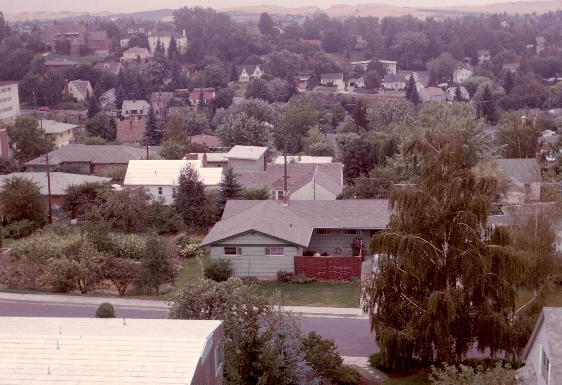
Image my brother Bill took from the dorm over looking our house in the mid 1960s when he worked on campus.
Spring break of my junior year, the family took a trip to Walla Walla where my other brother Jack was attending Whitman College. That summer, he was living in a tree house; so to speak. Jack was the caretaker of an estate for a woman named Mrs. Studebaker. Her family owned some local radio stations. If I remember correctly, the stations were KUJ in Walla Walla and KRLC in Lewiston, Idaho.
Bandstand in Pioneer Park, Walla Walla. Looks kind of like the Studebaker Estate.
We got invited into the "big house" for a cup of tea. Not the Walla Walla Penitentiary, but Mrs. Studebaker's main residence. Learning of my radio interest, she suggested I go to the heart of the matter. Follow the money. Get a start in advertising.
Following her inspiration, I signed up to be on next year's sales staff of Pullman High School's newspaper. It would be my senior year, but after that summer, I decided I was too shy and would not be very good at selling. I backed out of sales first thing my senior year when I signed up for newspaper staff. Had a very good senior year, tho, in the new Pullman High School building. I wrote a few articles for the newspaper.
Planning on college at WSU, I also applied to what is now called Western Washington University in Bellingham. It was a backup strategy just in case WSU didn't accept my application. Western was my "plan B." It responded right away accepting my application. WSU remained silent.
My senior year, I also thought about doing an internship at WSU Communications. It would be for the second semester, but jumping in that quickly was kind of a scary prospect. I backed out of that plan for several reasons including wanting to stay at the high school for my entire senior year. It was a very special year in Pullman High School's new building. I didn't want to miss out.
Pullman High School's very creative art teacher sitting on a student built throne in spring of 1973.
Back in those days, the concept of being gay was pretty much under the radar but I had an erotic fascination with slim men who had long hair. The anti war, hippie scene was intriguing. When I did come out, so to speak, my family and church were supportive being from a liberal college environment.
My sister Judith was a student at Fairhaven College; a division of Western in Bellingham. Ground zero for hippie culture. The thought of being among all those hippies; swimming in the campus pool and showering in the locker room was alluring. Pullman had its hippies as well, but not to the extent of Bellingham.
Also the thought of going to WSU, was becoming more intimidating. It's a big school with a fairly rigorous reputation. Maybe I could start at Western, be among lots of sexy looking people, get my feet under me and then go back to WSU. Western was smaller and was starting to look more inviting. That thought started haunting me more and more. Meanwhile, the letter of acceptance from WSU had not arrived yet. Maybe I'd have to go to Western anyway.
Group pose for early World Naked Bike Ride in Bellingham. 2009 before the city agreed to allow more nudity.
Still thinking about WSU, I joked with my mom that I might get to know the organist at our church, First Congregational in Pullman. Besides playing the organ, his main job was head of the WSU office for academic probation. Probation is what they put students on when their grades are too low. Confidence was never my greatest talent.
Pretty soon that letter arrived from WSU. Accepted, but by then the scale of my preferences was starting to tip real strongly toward Western and Bellingham. A few weeks later, I made the decision and enrolled at Western. Figured it would be a good start for my Freshman year and then I could come back to Pullman and tackle Communications at WSU.
My thinking had evolved quite a bit. Having nervous problems through childhood, I first thought that staying in Pullman would be easier than going away for college. I even mentioned that on my application to WSU. Later on, my thinking evolved to the idea that it might be easier to go away for college, rather than staying in Pullman haunted by childhood memories. My childhood was pretty good, but I have suffered from an anxiety condition all my life. I was beginning to think that a move to Bellingham could be a new beginning.
After the summer of 1973, My parents brought me across the state to start fall quarter of my freshman year. Checked into the dorm. Being from a college oriented family, I had a fairly good understanding of campus life.
I changed my name upon coming to Bellingham. Not officially, tho. My official name has always been Robert, but in Pullman, people called me Bobby. I also went by Bob. Being a late bloomer, the Bobby name stuck among classmates clear through high school. In Bellingham, I'd start using the name Robert. It was getting to where I didn't like the name Bobby.
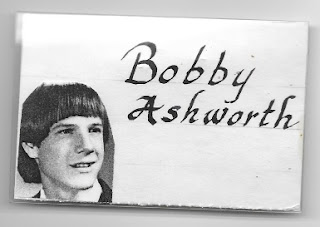
Name tag from a high school reunion with my senior picture from the Annual.
More recently, I enjoy hearing people call me Bobby at High School reunions. It's fun to come back to the reunions after, say 40 years. I've come back by bicycle.
After bicycling to Pullman from Bellingham for my my 40th high school reunion, I was a guest on the radio in Bellingham. I was on a show called "The Joe Show" that used to be aired on KBAI, 930 on the AM dial. Progressive Talk. More recently that station has converted to a music format, but Joe Teehan, the host, now as a show on the bigger station KGMI. I call that show often.
When it came time to register for my first freshman year classes, there was a glitch. Administration placed me in a program called Vicoed since I had shown interest in communications. This happened even though I had written on the form "communications, but not Vicoed." Vicoed dealt more with classroom media, film projectors and so forth for Ed majors. Rather than being able to choose classes, Vicoed students had a prescribed program.
My assigned advisor was a somewhat tired looking man named Dr. Shwam; chairman of the Vicoed program. His first comments were, "if you want to do communications at WSU, you should go there." "Western would just be a waste of time." "You should go back to Pullman so you can get in on the ground floor."
Well, I was at Western. It was a bit late to heed that advise.
I went to the class registration center and told the entry clerk that they had put me in the wrong cue. She said, "you can go on in and register for your classes now." "You don't have to wait to go in with the Vicoed students."
Back then, registration was done with stacks of cards. Computers were employed, but the card stacks were submitted to administration for computer processing. You'd get your class schedule in a day or two. Registration was a big scramble on the basketball floor of Carver Gym.
Part of Carver Gym during a recent remodel. Image taken 2017.
The schedule turned out okay. My sister Lillian commented that I'd learned the ropes pretty fast figuring out how to get out of Vicoed.
A few days after class started, a dorm mate ask me, "when does college start?" I said, "have you registered for classes yet?" He said, "Register?" I suggested he go to the administration and explain his situation.
I wouldn't be surprised if he did okay after that.
I tried to be easy on myself taking mostly electives my first quarter. One of the first classes I picked was introduction astronomy. Turns out I got onto something called the "College President's List" my first quarter due to high grades. College started with a bang, but my grades degraded, so to speak, after that.
December of 1973 brought the end of fall quarter and my 19th birthday. Lillian, arranged a great birthday gift. A personal tour of KOMO Broadcasting; home of KOMO TV and Radio. Tour was led by my sister's friend and well known newscaster Bill Brubaker. It was very interesting, but afterwards I had a strange feeling. Did I really want to work in a place like that? KOMO seemed a bit like an ant hill to me. Start at the bottom, not much room for creativity until one rises pretty high in the ranks. Lots of stress and deadlines.
As I walked back to meetup with Lillian again, I thought that maybe broadcasting wasn't right for me. What should I do? City planning came to mind as well as other creative endeavors. A lot of broadcasting does come off the national networks so opportunities for creative work are limited at the local level.
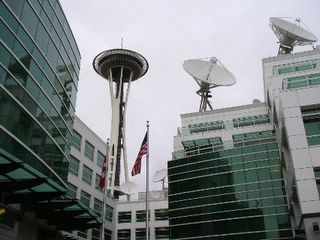
Back then, KOMO was in a fairly bland looking building. More recently the studios moved to Fisher Plaza pictured in this 2005 image.
Memories of an earlier tour of Spokane's KHQ comes to mind. Coming home from Spokane, one summer during high school, I was with my dad. We stopped by the old KHQ Radio TV building on Regal Street. One of the station's administrative staff greeted us at the door and ask what specialty I was planning to go into. News, advertising, engineering?
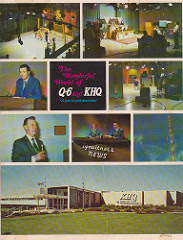
KHQ brochure from around 1972.
I hesitated as I wasn't sure. Basically I just wanted a general overview, but didn't think to say that in time. My dad beat me to the answer and said, "he wants to be the company president." The person leading the tour was a bit taken aback, but the tour was interesting anyway.
Eventually, geography became my major as it was the subject of most of my elective classes. I took a scenic route through college and graduated from Western in spring of 1978.
Since then, my life has had a low footprint for the most part. Being afraid to drive, my travels have been mostly by bicycle. I've bicycled across the America. As for a career of self expression in the media, I'm fairly prolific on the web and Facebook. I'm at www.theslowlane.com
As brochures arrived, my sister, Lillian looked over the stack and noticed that several of those private schools boasted of faculty trained at Washington State University's school of communications. Her comment was, "why bother with these schools?" "Go to the source;" meaning WSU in Pullman.
Communications at WSU has a very high reputation across the country. Home of KWSU Radio and TV where my sister went to school toward the end of her college days. The WSU campus was next door to our childhood neighborhood.
Part of Edward R. Murrow College of Communications.
Interest in the fast lane of vocational training quickly dissolved to where I was making plans for WSU. Who could beat the Murrow program?
My mom still suggested living in the dorms, rather than at home, however. She valued that "going away for college" experience even if it could end up being dorms over looking our front yard. More likely she would have recommended dorms on the other side of campus tho.
Image my brother Bill took from the dorm over looking our house in the mid 1960s when he worked on campus.
Spring break of my junior year, the family took a trip to Walla Walla where my other brother Jack was attending Whitman College. That summer, he was living in a tree house; so to speak. Jack was the caretaker of an estate for a woman named Mrs. Studebaker. Her family owned some local radio stations. If I remember correctly, the stations were KUJ in Walla Walla and KRLC in Lewiston, Idaho.
Bandstand in Pioneer Park, Walla Walla. Looks kind of like the Studebaker Estate.
We got invited into the "big house" for a cup of tea. Not the Walla Walla Penitentiary, but Mrs. Studebaker's main residence. Learning of my radio interest, she suggested I go to the heart of the matter. Follow the money. Get a start in advertising.
Following her inspiration, I signed up to be on next year's sales staff of Pullman High School's newspaper. It would be my senior year, but after that summer, I decided I was too shy and would not be very good at selling. I backed out of sales first thing my senior year when I signed up for newspaper staff. Had a very good senior year, tho, in the new Pullman High School building. I wrote a few articles for the newspaper.
Planning on college at WSU, I also applied to what is now called Western Washington University in Bellingham. It was a backup strategy just in case WSU didn't accept my application. Western was my "plan B." It responded right away accepting my application. WSU remained silent.
My senior year, I also thought about doing an internship at WSU Communications. It would be for the second semester, but jumping in that quickly was kind of a scary prospect. I backed out of that plan for several reasons including wanting to stay at the high school for my entire senior year. It was a very special year in Pullman High School's new building. I didn't want to miss out.
Pullman High School's very creative art teacher sitting on a student built throne in spring of 1973.
Back in those days, the concept of being gay was pretty much under the radar but I had an erotic fascination with slim men who had long hair. The anti war, hippie scene was intriguing. When I did come out, so to speak, my family and church were supportive being from a liberal college environment.
My sister Judith was a student at Fairhaven College; a division of Western in Bellingham. Ground zero for hippie culture. The thought of being among all those hippies; swimming in the campus pool and showering in the locker room was alluring. Pullman had its hippies as well, but not to the extent of Bellingham.
Also the thought of going to WSU, was becoming more intimidating. It's a big school with a fairly rigorous reputation. Maybe I could start at Western, be among lots of sexy looking people, get my feet under me and then go back to WSU. Western was smaller and was starting to look more inviting. That thought started haunting me more and more. Meanwhile, the letter of acceptance from WSU had not arrived yet. Maybe I'd have to go to Western anyway.
Group pose for early World Naked Bike Ride in Bellingham. 2009 before the city agreed to allow more nudity.
Still thinking about WSU, I joked with my mom that I might get to know the organist at our church, First Congregational in Pullman. Besides playing the organ, his main job was head of the WSU office for academic probation. Probation is what they put students on when their grades are too low. Confidence was never my greatest talent.
Pretty soon that letter arrived from WSU. Accepted, but by then the scale of my preferences was starting to tip real strongly toward Western and Bellingham. A few weeks later, I made the decision and enrolled at Western. Figured it would be a good start for my Freshman year and then I could come back to Pullman and tackle Communications at WSU.
My thinking had evolved quite a bit. Having nervous problems through childhood, I first thought that staying in Pullman would be easier than going away for college. I even mentioned that on my application to WSU. Later on, my thinking evolved to the idea that it might be easier to go away for college, rather than staying in Pullman haunted by childhood memories. My childhood was pretty good, but I have suffered from an anxiety condition all my life. I was beginning to think that a move to Bellingham could be a new beginning.
After the summer of 1973, My parents brought me across the state to start fall quarter of my freshman year. Checked into the dorm. Being from a college oriented family, I had a fairly good understanding of campus life.
I changed my name upon coming to Bellingham. Not officially, tho. My official name has always been Robert, but in Pullman, people called me Bobby. I also went by Bob. Being a late bloomer, the Bobby name stuck among classmates clear through high school. In Bellingham, I'd start using the name Robert. It was getting to where I didn't like the name Bobby.
Name tag from a high school reunion with my senior picture from the Annual.
More recently, I enjoy hearing people call me Bobby at High School reunions. It's fun to come back to the reunions after, say 40 years. I've come back by bicycle.
After bicycling to Pullman from Bellingham for my my 40th high school reunion, I was a guest on the radio in Bellingham. I was on a show called "The Joe Show" that used to be aired on KBAI, 930 on the AM dial. Progressive Talk. More recently that station has converted to a music format, but Joe Teehan, the host, now as a show on the bigger station KGMI. I call that show often.
When it came time to register for my first freshman year classes, there was a glitch. Administration placed me in a program called Vicoed since I had shown interest in communications. This happened even though I had written on the form "communications, but not Vicoed." Vicoed dealt more with classroom media, film projectors and so forth for Ed majors. Rather than being able to choose classes, Vicoed students had a prescribed program.
My assigned advisor was a somewhat tired looking man named Dr. Shwam; chairman of the Vicoed program. His first comments were, "if you want to do communications at WSU, you should go there." "Western would just be a waste of time." "You should go back to Pullman so you can get in on the ground floor."
Well, I was at Western. It was a bit late to heed that advise.
I went to the class registration center and told the entry clerk that they had put me in the wrong cue. She said, "you can go on in and register for your classes now." "You don't have to wait to go in with the Vicoed students."
Back then, registration was done with stacks of cards. Computers were employed, but the card stacks were submitted to administration for computer processing. You'd get your class schedule in a day or two. Registration was a big scramble on the basketball floor of Carver Gym.
Part of Carver Gym during a recent remodel. Image taken 2017.
The schedule turned out okay. My sister Lillian commented that I'd learned the ropes pretty fast figuring out how to get out of Vicoed.
A few days after class started, a dorm mate ask me, "when does college start?" I said, "have you registered for classes yet?" He said, "Register?" I suggested he go to the administration and explain his situation.
I wouldn't be surprised if he did okay after that.
I tried to be easy on myself taking mostly electives my first quarter. One of the first classes I picked was introduction astronomy. Turns out I got onto something called the "College President's List" my first quarter due to high grades. College started with a bang, but my grades degraded, so to speak, after that.
December of 1973 brought the end of fall quarter and my 19th birthday. Lillian, arranged a great birthday gift. A personal tour of KOMO Broadcasting; home of KOMO TV and Radio. Tour was led by my sister's friend and well known newscaster Bill Brubaker. It was very interesting, but afterwards I had a strange feeling. Did I really want to work in a place like that? KOMO seemed a bit like an ant hill to me. Start at the bottom, not much room for creativity until one rises pretty high in the ranks. Lots of stress and deadlines.
As I walked back to meetup with Lillian again, I thought that maybe broadcasting wasn't right for me. What should I do? City planning came to mind as well as other creative endeavors. A lot of broadcasting does come off the national networks so opportunities for creative work are limited at the local level.
Back then, KOMO was in a fairly bland looking building. More recently the studios moved to Fisher Plaza pictured in this 2005 image.
Memories of an earlier tour of Spokane's KHQ comes to mind. Coming home from Spokane, one summer during high school, I was with my dad. We stopped by the old KHQ Radio TV building on Regal Street. One of the station's administrative staff greeted us at the door and ask what specialty I was planning to go into. News, advertising, engineering?
KHQ brochure from around 1972.
I hesitated as I wasn't sure. Basically I just wanted a general overview, but didn't think to say that in time. My dad beat me to the answer and said, "he wants to be the company president." The person leading the tour was a bit taken aback, but the tour was interesting anyway.
Eventually, geography became my major as it was the subject of most of my elective classes. I took a scenic route through college and graduated from Western in spring of 1978.
Since then, my life has had a low footprint for the most part. Being afraid to drive, my travels have been mostly by bicycle. I've bicycled across the America. As for a career of self expression in the media, I'm fairly prolific on the web and Facebook. I'm at www.theslowlane.com
Labels:
about-me,
my_history,
my-1970s-early,
radio
Tuesday, February 20, 2018
Core shutdown when I toured WSU nuclear reactor
There was an emergency core shutdown which sounded like our tour guide had just gotten a phone call. He left for a moment to check with the office and then came back to say "don't worry, the core has just had an emergency shutdown which is fairly routine, we can go on with our tour." That was sometime back around early 1980s when I went on a guided tour of Washington State University's research reactor in Pullman. We had just visited the pool room where the reactor resides 20 feet down toward the bottom of a deep pool. This faint blue glow around the reactor was said to be neutrons reacting with the water.
WSU's research reactor is very small and doesn't generate electricity. It is used to irradiate samples for various forms of research. Used a lot in biological, medical and other fields of inquiry.
Soon after we left the observation deck in the pool room, a buzzer sounded while we were heading down some stairs. As we waited at a landing, our tour guide checked his message and said that the reactor had just shut down. I think we all had little Geiger counters around our necks that they issued to tourists; like having little hardhats. None of these were reporting any radiation problem.
Apparently there was a minor glitch in the reactor's control panel. If anything is amiss, everything shuts down as a precautionary step.
Possibly the only loss was the sample that was being irradiated at that time. That experiment would just have to be redone later.
We continued our tour past a couple more labs and classrooms. Then it was back outside to a sunny day.
Labels:
my_history,
my-1970s-early,
pullman
Thursday, January 25, 2018
Can we still afford the curriculum of general university requirements?
I think if I were in my 20s today, I wouldn't go to college. My confidence in the marketability of my skills isn't that high so I wouldn't want to incur a huge debt. Some other people have a clearer vision toward a lucrative career, but without that, the debt may not be worth it.
Back when I did go to college, the costs were much lower. My parents were able to pay my way so I graduated with no debt. They were only slightly upper middle class. If I couldn't have my way paid today, I doubt I would go. Instead I would live my life, kind of like I am living it now, looking for quality of life things that are low cost. I'd be spending some time at the university anyway, attending free discussions. Also I would be taking advantage of educational things in the community and on the net. Listening to a lot of NPR podcasts as I do now.
My mom was a strong believer that college should be about more than just preparing for a job. It's the virtue of being an informed citizen. She believed in the balance of humanities and sciences. Her own major was physical education, but she never used it vocationally. She did lots of volunteer work and was married to my dad who was a science professor at WSU in Pullman. I feel fortunate to have been brought up in that family; a situation made possible by affordable education.
While I was going to college, I did have my own struggle with humanities requirements. I was never much of a reader. I'm definitely not a speed reader. Some of the general education requirements seemed irrelevant to me back then. Kind of distant and theoretical. I had my own humanities issues dealing with campus life, coming out as a gay person and so forth. My own life situations spoke so loud to me that I had trouble putting my life experiences aside enough to concentrate on the classics. I knew that there are insights one could get from that study, but it was hard for me to make that connection.
Fortunately, when I got to college here at WWU in Bellingham, they had just done a major revamp of their general university requirements; the GURs. They were starting to put aside a fairly rigid GUR curriculum and were adopting more of a smorgasbord system with a lot of choices to fill each GUR category. They offered choices in several categories of sciences, humanities, and ethnic studies. Ethnic studies was a new addition, I think. The definition of a well rounded education keeps evolving. We had a certain number of classes required from each category. Lots of choices. I tried to avoid classes that had a heavy reading load. The system worked pretty well and I made it through. That was back in the mid 1970s.
Back then, WWU was facing a very different situation than it is today. When I entered college, the student enrollment was going down. Imagine that today as these days they turn away students and face enrollment ceilings. Part of the reason for the shortage of students was their rigid system of humanities requirements which is a big reason why they were adopting the more open "choice" system. Demographics effected enrollment also as the Vietnam war was winding down and the push of people going to college for draft deferment was basically over. They had more faculty than the enrollment could justify so they were under some pressure, from the state, to boost enrollment and also lay off faculty and staff. They had a program called RIF meaning "reduction in force." People nicknamed that "ripoff in force." Eventually, as I got toward graduation, enrollment was going up again and the situation was stabilizing.
There's been lots of history since then, but I thought I would share my own college experience. I think I did get a good education with a variety of topics. A broad based education, but also a lot of choice within the parameters as I tried to take classes that interested me. I was glad to be able to take lots of electives. Took me 5 years to get a 4 year degree. I was able to go "the scenic route" so to speak.
Back when I did go to college, the costs were much lower. My parents were able to pay my way so I graduated with no debt. They were only slightly upper middle class. If I couldn't have my way paid today, I doubt I would go. Instead I would live my life, kind of like I am living it now, looking for quality of life things that are low cost. I'd be spending some time at the university anyway, attending free discussions. Also I would be taking advantage of educational things in the community and on the net. Listening to a lot of NPR podcasts as I do now.
My mom was a strong believer that college should be about more than just preparing for a job. It's the virtue of being an informed citizen. She believed in the balance of humanities and sciences. Her own major was physical education, but she never used it vocationally. She did lots of volunteer work and was married to my dad who was a science professor at WSU in Pullman. I feel fortunate to have been brought up in that family; a situation made possible by affordable education.
While I was going to college, I did have my own struggle with humanities requirements. I was never much of a reader. I'm definitely not a speed reader. Some of the general education requirements seemed irrelevant to me back then. Kind of distant and theoretical. I had my own humanities issues dealing with campus life, coming out as a gay person and so forth. My own life situations spoke so loud to me that I had trouble putting my life experiences aside enough to concentrate on the classics. I knew that there are insights one could get from that study, but it was hard for me to make that connection.
Fortunately, when I got to college here at WWU in Bellingham, they had just done a major revamp of their general university requirements; the GURs. They were starting to put aside a fairly rigid GUR curriculum and were adopting more of a smorgasbord system with a lot of choices to fill each GUR category. They offered choices in several categories of sciences, humanities, and ethnic studies. Ethnic studies was a new addition, I think. The definition of a well rounded education keeps evolving. We had a certain number of classes required from each category. Lots of choices. I tried to avoid classes that had a heavy reading load. The system worked pretty well and I made it through. That was back in the mid 1970s.
Back then, WWU was facing a very different situation than it is today. When I entered college, the student enrollment was going down. Imagine that today as these days they turn away students and face enrollment ceilings. Part of the reason for the shortage of students was their rigid system of humanities requirements which is a big reason why they were adopting the more open "choice" system. Demographics effected enrollment also as the Vietnam war was winding down and the push of people going to college for draft deferment was basically over. They had more faculty than the enrollment could justify so they were under some pressure, from the state, to boost enrollment and also lay off faculty and staff. They had a program called RIF meaning "reduction in force." People nicknamed that "ripoff in force." Eventually, as I got toward graduation, enrollment was going up again and the situation was stabilizing.
There's been lots of history since then, but I thought I would share my own college experience. I think I did get a good education with a variety of topics. A broad based education, but also a lot of choice within the parameters as I tried to take classes that interested me. I was glad to be able to take lots of electives. Took me 5 years to get a 4 year degree. I was able to go "the scenic route" so to speak.
Labels:
about-me,
my_history,
my-1970s-early
Monday, December 25, 2017
A great Birthday / Christmas present, 1971
During my sophomore year in high school, My mom bought us a trip to Spokane from Pullman on the Greyhound Bus. Just her and me. Primary objective was to buy the multi band radio I had been dreaming about in the Radio Shack catalog. No Radio Shack store in Pullman, back then.
While in the "city" she wanted me to see some sights.
The Crescent Department Store was all decked out in holiday trimmings. A must see; the animated window with moving Santa mannequin. We walked around to the front of the block and entered through the main door where said window would be. When we got there, my mom just kept walking while I stopped. I wondered why she suddenly lost interest. With some disgust in her voice she said, "it's Christmas on the moon." Santa was in a space suit. No warm fire, snowy fields, or chestnuts roasting. It was moon rocks and grey dust. Santa picking up rocks and placing them in specimen pouches.
Moving on, we did had a nice meal on the Crescent's top floor cafe named The Tea Room. Then did a bit more window shopping in downtown Spokane before heading to pick up my prized radio.
I still have that radio. It served me well for many years, but today the only thing that works is the dial light. I taped what I thought was a better AM dial onto the radio. Used another Christmas gift; a label maker, to put my address on this prized possession.
Some other memories below.
Baked goods that we exchanged with neighbors. To increase variety of goods in everyone's home, folks would bring around what they baked to share with the neighborhood. The doorbell would ring and it was the Stevens. Then the Swansons and so forth. Often carols were sung. Each year, we had the chore of passing out our goodies as well. One year, while I was back home from college, I noted that most of the neighbors were at a party next door. I thought we should pass out our plate at that house to save having to go to each house. My brother Jack nixed the idea thinking it would be awkward picking out just the neighbors at that party where others would be also. He thought we would have to say, "okay, here's one for you up the street and you from across town don't get one."
A climax of our family Christmas was opening presents on Christmas morning. All excited, I would get up early. The house was filled with the sweet smell of my mom's holiday bread. It had very sugary frosting with a strong ting of orange. My sister Judith Ashworth and I would stake out our heat vents on both sides of the tree where warm air from the furnace would blow into the living room. Warmth would flow up into my shirt. We would wait, somewhat impatiently, as my older sister, Lillian, would remain in bed. After traveling to Pullman, from Seattle, she would be getting more sleep. Sometimes we would be waiting for my brother, Bill Ashworth also. When everyone was up and around the tree, we would start opening packages. A big pile of spent wrapping paper would accumulate in the laundry basket that my mom would set up. We reused much of the wrapping paper year after year. We would reuse paper, ribbons and bows that were still in fairly good shape and weren't torn up by the cat jumping into the basket.
Labels:
about-me,
my_history,
my-1970s-early,
radio
Monday, January 09, 2017
Were gay issues talked about in Pullman, Bellingham in early 1970s?
A personal perspective.
I just got to thinking that I didn't hear much derogatory talk against gay people, until I got to Bellingham. That was back in 1973 when I came to Bellingham for Western Washington University. Back in Pullman, where I grew up, being gay just wasn't discussed. It was kind of a "conspiracy of silence." That was a different era and the subject was pretty much deep in the closet. There was a naive silence, but I don't remember much scorn. Pullman is a fairly liberal, college town, but back then the gay issue was very hidden.
When I came to Bellingham, my freshman year, it was suddenly more out in the open. There were gay symposiums on campus, but back in my freshman dorm, folks were telling lots of faggot jokes.
Coming from my liberal background, I didn't have much respect for the people in my dorm. They seemed superficial and shallow. It seemed like the folks, in my freshman dorm, were either "Jesus Freaks" (a big term in the early 1970s) or drunks. I missed the slower, more thoughtful ways of Pullman High School. Just about everyone's dad, in Pullman, was connected to Washington State University so there was an academic feel. Here in Bellingham, many of the students, in my freshman dorm, were from more commercial backgrounds. They seemed less genuine, more phony and hurried. Also more materialistic.
I went to some of the gay discussion groups, on Western campus, in part to (sort of) jokingly horrify a "Christian" who was living across the hall from me in the dorm.
As time went on, I started meeting more varieties of people, here in Bellingham. It took some time, but I did find a variety of intelligent and genuine people scattered around.
Ironically, as I got somewhat involved in the gay student group, I found many of those people to be shallow and superficial as well. I've always been an outsider and never fit, very well, into any of those boxes. I've usually gotten along fairly well being on the edge, rather than in the middle, of various clicks. Some of the intelligent and genuine people, I find today, are gay.
I think things are quite a bit different today, than back then. I sometimes wonder what being in a freshman dorm, at Western, would be like today?
I just got to thinking that I didn't hear much derogatory talk against gay people, until I got to Bellingham. That was back in 1973 when I came to Bellingham for Western Washington University. Back in Pullman, where I grew up, being gay just wasn't discussed. It was kind of a "conspiracy of silence." That was a different era and the subject was pretty much deep in the closet. There was a naive silence, but I don't remember much scorn. Pullman is a fairly liberal, college town, but back then the gay issue was very hidden.
When I came to Bellingham, my freshman year, it was suddenly more out in the open. There were gay symposiums on campus, but back in my freshman dorm, folks were telling lots of faggot jokes.
Coming from my liberal background, I didn't have much respect for the people in my dorm. They seemed superficial and shallow. It seemed like the folks, in my freshman dorm, were either "Jesus Freaks" (a big term in the early 1970s) or drunks. I missed the slower, more thoughtful ways of Pullman High School. Just about everyone's dad, in Pullman, was connected to Washington State University so there was an academic feel. Here in Bellingham, many of the students, in my freshman dorm, were from more commercial backgrounds. They seemed less genuine, more phony and hurried. Also more materialistic.
I went to some of the gay discussion groups, on Western campus, in part to (sort of) jokingly horrify a "Christian" who was living across the hall from me in the dorm.
As time went on, I started meeting more varieties of people, here in Bellingham. It took some time, but I did find a variety of intelligent and genuine people scattered around.
Ironically, as I got somewhat involved in the gay student group, I found many of those people to be shallow and superficial as well. I've always been an outsider and never fit, very well, into any of those boxes. I've usually gotten along fairly well being on the edge, rather than in the middle, of various clicks. Some of the intelligent and genuine people, I find today, are gay.
I think things are quite a bit different today, than back then. I sometimes wonder what being in a freshman dorm, at Western, would be like today?
Labels:
about-me,
my_history,
my-1970s-early,
sexuality
Monday, March 04, 2013
Contemplating innovation and Thomas Edison
After a recent Diane Rehm show about a book called "The Age of Edison: Electric Light and the Invention of Modern America," I decided to dig out a picture I painted in a high school art class.
Menlo Park, NJ. where Edison's labs were. It probably didn't look like this, but that was my impression.
The art assignment was "brown and yellow tone in tempera paint." I threw in blue for an out of the box twist and the art teacher loved it.
The blue was for arc lamps that worked on the spark gap principle. It was an 1800s style of electric streetlights. I added it to the warm yellow glow from inside the buildings from Edison's incandescent lamps.
Around the time of painting this, I was reading the book "Men and Volts, the story of General Electric."
The grade school I went to was Edison School. Edison School in Pullman, WA. where Thomas Edison was quite the role model. My childhood dream was to be an inventor when I grew up. Well, maybe writing unusual blog entries is good enough.
Edison School was an innovative design in it's day when it was built in the late 1940s. By the time I came along in the mid 1960s, it's problems with rotting timbers was already evident. The school district was discussing tearing it down. I felt sorry for the old school.
Some pictures I took of poor old Edison, in Pullman, during a bike tour around the state in summer of 1989. By then, it was abandoned.
They finally got around to tearing it down in the 1990s after it stood empty for many years. Apartment buildings now stand where Edison was as Pullman doesn't need as many grade schools as it did back then. There seems to always be need for apartments, however.
There is another Edison School close to where I live today. It's in the town of Edison, WA. just down the road from my home in Bellingham, WA. I've biked around Edison, Washington many a time; more recently.
Long past those early days, I've heard quite a bit about Edison's rival Nikola Tesla. While Edison stuck dogmatically to using direct current. Tesla was working with the magical properties of alternating current. It must have seemed like magic, back in his day as one of the properties of alternating current is it's ability to "induce" electricity to flow in a coil that's not even physically connected to another coil where electricity is flowing. It's as if the energy just magically jumps across empty space between two unconnected coils. The work of an electromagnetic field. Well, that little piece of magic is taken for granted today and it's what allows transformers to work. It's also what's behind the "magic" of radio.
In a world that was used to water flowing in pipes, the idea of inducing a current from one unconnected wire to another must have seemed revolutionary. Edison resisted, thinking that alternating current wouldn't be safe. Also, Edison was building his empire on direct current. It was his business model.
Eventually, alternating current won out. It won out for many reasons including it's ability to make transformers work. Transformers step the voltage up or down depending on need. This allows the high voltage transmission of power over long distances. High voltage power is then "stepped down" with transformers to lower voltage power which can be safely used in buildings. DC current isn't as easy to step up or down, voltage wise, so it forces people to choose one voltage. It forces a compromise that's either too low to be sent long distances or too high to be safe in the home. Transformers solved that problem and eventually Tesla's style of electricity won out, for the most part.
These days, there is somewhat of a cult following of Tesla. People think he may have had some magic that today's capitalists want to hide. Sending free power through the air in lieu of power lines, or something.
I'm not sure how practical it would be to send large amounts of power through the air for long distances. Radio works over long distances with tiny amounts of power. Transformers work over short distances with large amounts of power. It is possible to send power via microwave and there are proposals to build solar power satellites in space which would send power back to Earth in a beam of microwaves.
So far, the solar satellite idea hasn't been implemented, but it may have it's downsides. Imagine how much fear people would have about high powered microwaves zapping through the air from various installations. People are even paranoid about cell phone towers.
So the magic of Tesla and, for that matter Edison, is already around us today. Things that may have seemed magical in the past, like electrical induction, are common place today. I'm sure more innovations are being thought up now, tho, as always, new innovations often meet resistance from the status quo.
Menlo Park, NJ. where Edison's labs were. It probably didn't look like this, but that was my impression.
The art assignment was "brown and yellow tone in tempera paint." I threw in blue for an out of the box twist and the art teacher loved it.
The blue was for arc lamps that worked on the spark gap principle. It was an 1800s style of electric streetlights. I added it to the warm yellow glow from inside the buildings from Edison's incandescent lamps.
Around the time of painting this, I was reading the book "Men and Volts, the story of General Electric."
The grade school I went to was Edison School. Edison School in Pullman, WA. where Thomas Edison was quite the role model. My childhood dream was to be an inventor when I grew up. Well, maybe writing unusual blog entries is good enough.
Edison School was an innovative design in it's day when it was built in the late 1940s. By the time I came along in the mid 1960s, it's problems with rotting timbers was already evident. The school district was discussing tearing it down. I felt sorry for the old school.
Some pictures I took of poor old Edison, in Pullman, during a bike tour around the state in summer of 1989. By then, it was abandoned.
They finally got around to tearing it down in the 1990s after it stood empty for many years. Apartment buildings now stand where Edison was as Pullman doesn't need as many grade schools as it did back then. There seems to always be need for apartments, however.
There is another Edison School close to where I live today. It's in the town of Edison, WA. just down the road from my home in Bellingham, WA. I've biked around Edison, Washington many a time; more recently.
Long past those early days, I've heard quite a bit about Edison's rival Nikola Tesla. While Edison stuck dogmatically to using direct current. Tesla was working with the magical properties of alternating current. It must have seemed like magic, back in his day as one of the properties of alternating current is it's ability to "induce" electricity to flow in a coil that's not even physically connected to another coil where electricity is flowing. It's as if the energy just magically jumps across empty space between two unconnected coils. The work of an electromagnetic field. Well, that little piece of magic is taken for granted today and it's what allows transformers to work. It's also what's behind the "magic" of radio.
In a world that was used to water flowing in pipes, the idea of inducing a current from one unconnected wire to another must have seemed revolutionary. Edison resisted, thinking that alternating current wouldn't be safe. Also, Edison was building his empire on direct current. It was his business model.
Eventually, alternating current won out. It won out for many reasons including it's ability to make transformers work. Transformers step the voltage up or down depending on need. This allows the high voltage transmission of power over long distances. High voltage power is then "stepped down" with transformers to lower voltage power which can be safely used in buildings. DC current isn't as easy to step up or down, voltage wise, so it forces people to choose one voltage. It forces a compromise that's either too low to be sent long distances or too high to be safe in the home. Transformers solved that problem and eventually Tesla's style of electricity won out, for the most part.
These days, there is somewhat of a cult following of Tesla. People think he may have had some magic that today's capitalists want to hide. Sending free power through the air in lieu of power lines, or something.
I'm not sure how practical it would be to send large amounts of power through the air for long distances. Radio works over long distances with tiny amounts of power. Transformers work over short distances with large amounts of power. It is possible to send power via microwave and there are proposals to build solar power satellites in space which would send power back to Earth in a beam of microwaves.
So far, the solar satellite idea hasn't been implemented, but it may have it's downsides. Imagine how much fear people would have about high powered microwaves zapping through the air from various installations. People are even paranoid about cell phone towers.
So the magic of Tesla and, for that matter Edison, is already around us today. Things that may have seemed magical in the past, like electrical induction, are common place today. I'm sure more innovations are being thought up now, tho, as always, new innovations often meet resistance from the status quo.
Labels:
about-me,
my_history,
my-1970s-early
Tuesday, April 22, 2008
My first Earth Day, 1970 at Pullman High School
1970, I was a freshman in Pullman High School, Pullman, WA. Art and humanities teachers led a tree planting day on the dry grassy bank down from the high school parking lot.
Pragmatic minded and I think more politically conservative, the biology teacher laughed and said he didn't think the trees would "take hold" there. Dry grassy bank was not quite the environment for that type of tree to thrive in; unless someone had time to constantly organize a "watering brigade." Leave it to the biology teacher to figure that out.
That Earth Day planting activity was a beautiful thought, but, sure enough, I think most of the trees died. Maybe a few took hold.
Pragmatic minded and I think more politically conservative, the biology teacher laughed and said he didn't think the trees would "take hold" there. Dry grassy bank was not quite the environment for that type of tree to thrive in; unless someone had time to constantly organize a "watering brigade." Leave it to the biology teacher to figure that out.
That Earth Day planting activity was a beautiful thought, but, sure enough, I think most of the trees died. Maybe a few took hold.
Labels:
my_history,
my-1970s-early,
pullman
Saturday, April 07, 2007
The only time I remember an older man coming on to me as a child.
All the media talk about Catholic priests, predatory web sites and parents afraid to let their children bike to school has brought up a memory from my childhood.
It's too bad there's so much fear out there. So much fear that parents often don't allow kids to bike places. Obesity is on the rise.
Is the problem really that bad, compared to traffic hazards, for instance?
Still I remember an encounter. I hadn't thought about it for a long time, but all this recent talk in the local media has brought back the memory.
One weekend I was riding to a nearby town to have a picnic in the city park. Maybe I was in early high school, but my memory is a bit foggy.
Anyway, this fellow, in grubby overalls, struck up a conversation with me. Of course, "grubby overalls" - the stereotype.
He was a construction worker. Working on one of the dams on the Snake River. They were building dams back then so a lot of the workers lived in the area.
Being a kid, I started asking a bunch of questions. I was interested in dam construction.
How thick is the concrete? How does the coffer dam work? How deep are the foundations? When do they start putting the generators in?
Instead of being a "font of information" about the dams, this man I met in the park just invited me into a nearby restroom.
I wondered what he was trying to show me; concrete work, pluming examples, electrical conduit?
Instead, he pointed to the nasty graffiti on the stalls. The sexual graffiti. He started asking, "Do you do this?" "Have you done that?"
I just said "no" and "huh?"
I didn't know what to make of the conversation so I left.
He wasn't giving me very much information about the dams on the Snake River. I wasn't interested in the graffiti, it just seemed kind of dirty, or nasty, to me. The dam construction interested me more, so I just left. I got on my bicycle and rode away. The bicycle can be a good escape.
It didn't seem like that big a deal.
Sometimes I wonder if the fear is worse than the problem. Not that the problem is good, it's just that the fear can really be traumatizing and crippling.
It's always good to be careful and use common sense, but when fear starts to rule, everyone needs to stop and take a deep breath; so to speak.
It's too bad there's so much fear out there. So much fear that parents often don't allow kids to bike places. Obesity is on the rise.
Is the problem really that bad, compared to traffic hazards, for instance?
Still I remember an encounter. I hadn't thought about it for a long time, but all this recent talk in the local media has brought back the memory.
One weekend I was riding to a nearby town to have a picnic in the city park. Maybe I was in early high school, but my memory is a bit foggy.
Anyway, this fellow, in grubby overalls, struck up a conversation with me. Of course, "grubby overalls" - the stereotype.
He was a construction worker. Working on one of the dams on the Snake River. They were building dams back then so a lot of the workers lived in the area.
Being a kid, I started asking a bunch of questions. I was interested in dam construction.
How thick is the concrete? How does the coffer dam work? How deep are the foundations? When do they start putting the generators in?
Instead of being a "font of information" about the dams, this man I met in the park just invited me into a nearby restroom.
I wondered what he was trying to show me; concrete work, pluming examples, electrical conduit?
Instead, he pointed to the nasty graffiti on the stalls. The sexual graffiti. He started asking, "Do you do this?" "Have you done that?"
I just said "no" and "huh?"
I didn't know what to make of the conversation so I left.
He wasn't giving me very much information about the dams on the Snake River. I wasn't interested in the graffiti, it just seemed kind of dirty, or nasty, to me. The dam construction interested me more, so I just left. I got on my bicycle and rode away. The bicycle can be a good escape.
It didn't seem like that big a deal.
Sometimes I wonder if the fear is worse than the problem. Not that the problem is good, it's just that the fear can really be traumatizing and crippling.
It's always good to be careful and use common sense, but when fear starts to rule, everyone needs to stop and take a deep breath; so to speak.
Labels:
my_history,
my-1970s-early,
sexuality
Sunday, December 10, 2006
First year in new Pullman High School 1972 - 73

It's a bit blurry, but I just dug up this photo. It was taken inside my old high school; Pullman High.
This picture was taken during the 30Th reunion as the class of 73 was touring the building.
Class of 73 was the first graduating class from this innovative building. There was a lot of open minded thinking, even back then.
Pullman is a college town. That school even had an award for "most individualistic student." They gave it to me in spring of my freshman year.
The art teacher, Vic Moore, was quite a character. One spring his students piled gooey stuff around a sink to create something that looked like an elixir spring in the art department.
A burbling elixir spring.
He would then bottle water in glass jars and label it with things like "pen and ink," "watercolor" or "felt pen." He took these jars around the school pretending to be selling them; like a "snake oil salesman."
Students enjoyed the stunts, or thought he was a bit weired.
It was that same teacher who staged a "pep rally" for some paintings that were being entered into a competition.
If PE classes get pep rallies, why not art?
I once suggested that modern school needed a throne.
A throne, like where a king would sit. Something to make that new school look like the Gothic building we had just moved out of.
This wasn't a serious suggestion, but some students built one. The students scrounged up farm implements and combine parts from wheat ranches around town.
Rusty old farm implements.
They welded a "junk throne" together. It went on display at the school. That art teacher sat there and pretended he was commanding students from the throne.
This was the same teacher who built a castle out of old car doors, washing machine lids, bed springs and, of course, farm implements. It was located on a country road out of town.
Soon the throne went on display to a circuit of art galleries around the region.
Quite an "art happening."
I also remember that art teacher asking students to ponder this question.
"In the hamburger of high school, what would art be? Would art be the relish, the bun, the patty?"
Those were nice memories.
A small "college town" that felt safe and creative back in the year 1972-73.
That was back when the Watergate scandal was starting to make news. Political science classes followed Watergate hearings and people used to laugh at Richard Nixon.
Maybe we were too harsh on our poor president.
I think Pullman went for McGovern in 1972. Surprised some folks being that we were in the Palouse region of eastern Washington.
It is a college town.
In history class, the teacher once called Pullman,
"The Athens of the Palouse."
Athens of the Palouse. Slogan must have never stuck.
I was planning to go into broadcasting, back then. Even took a TV production class in the school's shining new TV studio.
They were proud of that facility.
Radio was really my big interest.
Never imagined I would get a web page. Web pages hadn't been invented back in 1973.
A classmate brought me back to Pullman for the weekend of the 30Th reunion.
Labels:
about-me,
my_history,
my-1970s-early,
pullman
Wednesday, August 03, 2005
Picture before and after, Fairhaven Village Green. Also the Bellingham that was.

Not necessarily better than the Bellingham that is.
Village Green in Fairhaven District, before it was spruced up recently. Some miss the funkier old ways.

New Village Green in Fairhaven. A friend of mine read, in tourist guide books, that Fairhaven was kind of a hippy hang out. When he got here, he said, "where are the hippies?" They're in some guide books, but not really here.
In the Bellingham that was, my second day of college unfolded at Western Washington State College; WWU's name back in mid 1970s.
A sulfurous fog blew across campus causing mild eye irritation.
One campus newsletter was named, "Tuna Gas News" from the smell that often permeated the air from Georgia Pacific's pulp mill.
Pollution control technology all but eliminated that smell during the 1980s.
More recently, that pulp mill has closed, but it's air could be seen as a "preservative." It may have kept so many people from wanting to move here for retirement.
Not only are there more retirees now, but students are swelling the ranks as well.
Back in the mid 70s, Western's enrollment was declining.
Quite the opposite problem from today when enrollment ceilings must be imposed on the popular school.
Western grew in late 1960s with students seeking a deferment from being drafted. By mid 70s the draft was gone. Enrollment was going down.
Also the post war baby boom was graduating and a smaller generation of college students was arriving.
Faculty feared being laid off.
It was like a downward spiral.
Less students met less faculty.
Less faculty met less class offerings.
Less class offerings would attract even less students.
It was feared to be a spiral of decline.
There was a process called "Reduction In Force." Trying to trim the staff to meet lower enrollment levels. Someone nicknamed the whole thing, "Rip Off In Force," rather than "Reduction In Force."
It was easy for students to get in to Western, however.
The welcome mat was out.
One didn't have to have a high grade point. They were almost begging for students.
Soon after graduation, I rented a one bedroom apartment for $155 per month. It was a nice apartment. Could pay my rent from the few gardening and lawn mowing jobs I scrounged up. That was about the only work one could find.
Bellingham is now benefiting, or suffering, from a double boom in world population trends. Just as post war baby boomers look for places to retire, their kids are going to college. The welcome mat is being replaced with a "full" sign.
Things have been spruced up in town. Some fear it's been sanitized.
Downtown Bellingham was scruffier in the early 1980s.
It was "pragmatic." More traffic, before the mall was built.
Less trees.
Less desirable, but it got the job done.
Just past the bridge on prospect street, I remember noticing a view out over the bay. One had to squint between the bushes and a building to see it. Through tiny gaps among blackberry bushes, one could see a ship in port. Down below was an old sewage plant that is now Maritime Heritage Center.
A woman must have wondered what I was looking at as she sat in the building dispatching taxies. I was trying to find the best gap between the bushes for seeing out over that bluff. She had a puzzled look on her face as if to say, "what's he looking at."
Now, the area is a park and viewpoint.
The old garage, that served as a taxi dispatch and blocked the view, is gone.
Labels:
bellingham,
bellingham_history,
my_history,
my-1970s-early
Subscribe to:
Posts (Atom)