In 1989, my letter to the editor was a contributing factor for a local woman to throw out her car keys. Bellingham Herald did an article about her back then. My letter was one of the factors leading to her lifestyle change at the time.
This was not long after the Exxon Valdez spill in Alaska.

Wednesday, May 19, 2010

Saturday, May 15, 2010
Another ride with your politician

 New place where the trail goes under I-5 just north of Fraser St.
Flag seen in background is at Diehl Ford.
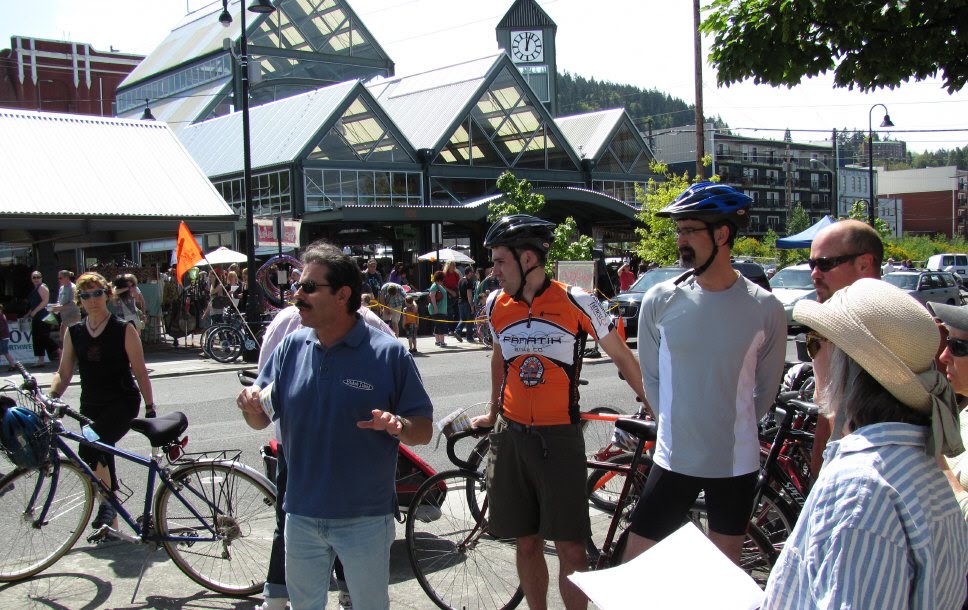
Each year, people gather with some local politicians to go on a bike ride. The politicians get to see parts of the city from a bicycle perspective.
This year, the group went from Depot Market Square to civic field. A fairly short ride with good conversation along the way. Ellen Barton, seen at right, from Whatcom Council of Governments leads the ride.
Wednesday, May 12, 2010
More bike signs starting to appear in this area
 A dip in the trail along Interurban Trail south of Bellingham.
Sunday, May 09, 2010
I lucked out
 Biked up to Fragrance Lake near Larabee State Park on Saturday. Found this table of snacks set up in the woods. A Skagit running club was just finishing up their event. They were about to toss everything so they said, "help yourself to as much as you want." The home made peanut brittle was particularly good.
Thousand point plunge in stock market
I slept through it.
Blink and you probably miss it.
I have a small amount of money in a mutual fund. Hope it rode out the blip OK. I wouldn't know for quite a while as the fund charges a fee for hour by hour access to watching it on the Internet. I haven't paid that fee.
Friday, April 30, 2010
Better on a bicycle, not so good as a car bumper sticker
 Saw this bike parked downtown.
Better to see this sign on a bike than on the bumper sticker of a car even though I wrote earlier, in this blog "if we keep consuming oil we might as well drill for it in our own territory."
I wasn't against Obama's plan to open up more offshore areas to drilling, even though I've never driven a car. Domestic production is still better than imports, but better yet is less consumption and more alternatives.
Oil well blowout in Gulf of Mexico is "rough seas" for the politics of oil drilling. Here in this area, people of Anacortes, WA. are still morning the loss of 7 workers in the Tesoro Refinery accident.
Even though it's better to produce locally, it's still best to figure out how to consume less fossil fuel.
Thursday, April 29, 2010
Laura Bush killed a guy
Car accident in 1963 where she ran a stop sign, and the driver of another car going through the intersection was killed. This and more in former first lady Laura Bush's new book, "Spoken from the Heart." It's now in the news.
Makes me think of the horror stories hidden in so many people's lives about auto accidents. Some folks famous and powerful, others ordinary. So many have been traumatized that I think Americans would be too shell shocked to drive, but this isn't the case. People go right on driving, for the most part.
Roads have gotten safer over the years, I hear the highway death toll in US is down to a bit over 30,000 per year when it was closer to 40,000 several years back. News reports even come out saying it's the lowest it's been since 1954; co-incidence, the year I was born.
Safer roads, better drunk driving enforcement and safer cars have helped, but the carnage is still too high. Back in the 50s and 60s, seat belts weren't as common, but now we have distracted driving from cellphones and the like.
If this many people kept dying in workplace accidents, or terrorist attacks, imagine how outraged the nation would be. Car accidents are still a silent slaughter.
I just think people and society would be more traumatized by this. So traumatized that folks would be afraid to drive and there would be more planning around alternative transportation.
Saturday, April 24, 2010
Hubble celebrates 20th anniversary
 I say, "even if you don't live in a big fancy house, you can still say you live in a fantastic universe."
Descriptions below reprinted from Hubble web site.
Hubble's 20th anniversary image shows a mountain of dust and gas rising in the Carina Nebula. The top of a three-light-year tall pillar of cool hydrogen is being worn away by the radiation of nearby stars, while stars within the pillar unleash jets of gas that stream from the peaks.
Credit: NASA, ESA, and M. Livio and the Hubble 20th Anniversary Team (STScI)
Below:
A brilliant white core is encircled by thick dust lanes in this spiral galaxy, seen edge-on. The galaxy is 50,000 light-years across and 28 million light years from Earth.
Credit: NASA and The Hubble Heritage Team (STScI/AURA)
 Last few posts, I've been on a "space roll." Just found out that this is the 20th anniversary of Hubble. Thursday was Earth Day and Wednesday was "first light" for a solar observatory.
I was a custodian at the Bellingham Yacht Club when Hubble was launched back in 1990.
Back then, something called "a spherical aberration" caused images coming back from the Hubble mirror to be blurry. Not as easy to fix as cleaning the mirrors in Yacht Club bathrooms with Windex.
Still, scientists were able to figure a "work around" and some good science came from Hubble, even in the early years.
Then Shuttle astronauts went on that repair mission in 1993 and solved the problem; not with Windex, but a set of mirrors, called COSTAR - "Corrective Optics Space Telescope Axial Replacement."
Worked like a charm. COSTAR has since been replaced because Hubble's newest cameras have the feature built in.
Then there's "Coinstar."
When I get a jug full of nickels, dimes and pennies, I go to the supermarket and pour them into a vending machine called Coinstar. It tallies the coins for me. Much easier than counting out all those pennies by hand. Ah, technological innovation.
Thursday, April 22, 2010
Today is Earth Day
 This image of Earth from NASA Astronomy Picture of the Day, March 25 2007. Taken by Apollo 17 crew back in the 1970s.
Yesterday, I had a picture of the Sun. Also from NASA. They've got a lot of good stuff.
I'm going to an Earth Day dance.
Wednesday, April 21, 2010
Looking at the sun with our new eyes
 Today was what they call "first light" for a huge new observatory that's looking at the sun with ten times the resolution of high definition TV.
Image courtesy of:
This video is fun to watch and the guy's cute also.
Here's a BBC news report.
I've been following SDO since it's launch in February.
Most people take the sun for granted, but it's quite something.
Just think, the Earth only gets a tiny fraction of the sun's energy. We're like a gnat just intercepting a tiny fraction. Most of that energy just pours out into space in all directions from the sun. Accountants would be horrified. All that energy going to waste. At least it isn't entering our defenition of "being employed" if it doesn't reach Earth.
There's certainly a lot of abundance coming from the sun. Most of it just radiating out into the vastness of space.
Thursday, April 15, 2010
Rainbow in window at Garden Street Methodist
 Biking past window on Magnolia St. side of Garden St. Methodist Church.
Monday, April 12, 2010
The Great Unleashing Event by Transition Whatcom
 Parts of Bellingham High School housed "The Great Unleashing" last weekend. Sponsored by a network called Transition Whatcom.
Workshops, speakers, music and events revolving around how to live in a future with less fossil fuel.
Bellingham High School reminded me of an arcology that day. Arcologies are "city in one building" structures. This could be a "mini arcology."
I pictured that building full of apartments with the commons (pictured above) being an indoor "town square."
What a concept in our rainy climate.
It's normally just a school cafeteria, but a nice looking one with natural light. BHS was remodeled recently.
Wouldn't it be neat to live in a place like that?
I've often thought schools, malls and college campuses could make nice arcologies.
My thinking is a different direction from many other folks in the transition movement who talk about people growing food and going closer to the land.
Some folks have a rural vision, I have a more urban vision of the future.
I ask, "can the farmland hold all the people?"
Just one of many discussions that can get going.
That weekend turned the school into a "virtual city of thinking people."
I was ask to be on a panel for one of the many workshops. A discussion about "car-less in Bellingham and beyond?" I've never driven a car and survived so far.
We met in the "Staff Room."
Way back when I was in high school, wasn't the staff room where faculty snuck off to smoke?
There were many other events including a few keynote speakers in the theater.
 Was a full house not that long before I took this picture.
Several bands brought music to the cafeteria where folks mingled and impromptu conversations broke out.
They say around 800 people attended Unleashing.
Cafeteria was closed, but Food Not Bombs had their table set up near the "food service" sign. They were one of many participants in the Unleashing.
 Each Friday, Food Not Bombs rolls this table to the corner of Cornwall and Magnolia streets where people gather around 4-5pm for the Bellingham Peace Vigil. That corner becomes another place for mingling and conversation.
Transition Whatcom is quite successful in bridging on-line with face to face experience. It has an active social networking site, like a local Facebook, but also sposors events where people meet in person.
Both the on-line and face to face experiences enhance one another.
Wednesday, April 07, 2010
Xerox copy price remains stable for decades
 Around 5 cents. Even when the machines were first introduced in March 1960.
I remember 5 cents per copy in the 1970s during my first experience with copy machines. Some machines were 10 cents per copy. Coin operated at the WSU library where I grew up in Pullman, WA.
Meanwhile, house prices in Seattle, WA. have soared from around 20 thousand dollars in the 1970s to approaching one million dollars for the same house today.
Amazing.
Diverging rates of inflation.
Tuesday, April 06, 2010
Fancy new bike rack made from old bike parts at downtown Bellingham Food Coop
 Painted purple. Made by The Hub Bicycle Collective in Bellingham. Check out similar one at North side Coop.
Friday, April 02, 2010
Large Hadron Collider and the slow lane
Riding my bike and working as a custodian gives me lots of time to ponder questions like "where did the universe come from?"
March 30th was that historic day of first proton collisions in Hadron at 7 TeV.
It's interesting to follow the news and watch some of the videos from Cern Lab as they celebrate this event. Brings back childhood memories of the TV when Apollo astronauts first landed on the moon.
Nice to see scientists all over the world cooperating on something that provides more grist for pondering of cosmic questions. Much better than using their technical minds for waging war. Also more interesting than building shopping malls.
World universities turn out lots of educated minds and at times it seems like there's a glut of educated people for the job market.
After the Soviet Union crumbled, there was a scramble to try and find gainful employment for lots of physicists to keep them from having to find work in more destructive fields such as oil funded terrorist mills of the Middle East.
Keeping the Soyuz space flights going helps. One took off today for the International Space Station; for instance.
Some people grumble that these scientific efforts take lots of energy.
They do use energy, but not anywhere near as much as billions of people all over the world trying to live the "typical USA drive everywhere lifestyle." Look at the millions of "show boat homes" all over the place.
It seems like people don't want life to be mundane. If we start living in smaller places and use less energy, life does present the hazard of becoming more boring; especially if people start suffering withdrawal pains from previous lifestyles of driving and jetting around the world.
Pondering cosmic questions, by just reading interesting things on the Internet, can put more spice into our lives, even if we don't all live in showboat homes.
It's like a spiritual quest, wondering what's being discovered next about the laws of physics and the origins of the universe. One doesn't have to have lots of money, or be something more than "just a custodian" to enjoy that.
Thursday, April 01, 2010
As long as we (USA) keep using oil, we might as well drill for it in our own territory
Obama's decree to allow drilling off more of our coastlines doesn't bother me. As long as USA is so dependent on oil, we might as well extract more of it locally.
On the other hand, I like working so locally that I can walk to my job. I never owned a car. Transportation accounts for 2/3 of our oil imports.
Some environmentalists feel that restrictions on oil drilling can force us to kick the habit, but that strategy hasn't seemed to work. Instead, it's like squeezing one part of a balloon that bubbles out another direction. Drilling for our consumption just goes overseas.
If we really want to cut back on oil consumption, as supplies diminish and the price goes up, we need to make living without a car more doable and affordable. I can do it, but my rent is affordable living near the heart of town. Some people can't afford to live where they can do their errands without driving.
We really need to think about affordable living, density, lifestyles, transit and urban planning. Also, of course, greener energy sources, but these transitions take time.
If we have a clear direction toward change, we can still get to a greener future, but since we've floundered on these things over the last 30 years, we've been burning more and more imported oil.
Sunday, March 28, 2010
A bicycle alternative to Lakeway in Bellingham, WA. Fraser St.
 Image, along Fraser St. Better alternative than Lakeway for bicycling.
Thursday, March 25, 2010
School's out one day because of good weather
When Bellingham Christian School took a day off because of good weather, it made national news. I even heard something about it on NPR.
Opposite idea from having school run all summer and no summer vacation. A day off can be useful from time to time. Change from the routine for other kinds of learning. Time for friends and family, time for even resting. In the case of summer vacation, it's often time for travel.
I heard about a school, somewhere in USA taking a day off to see the sun when I was in grade school. That school was in a place with lots of clouds; similar to Bellingham. Good to hear of it happening again, this time in the town I live in; often cloudy Bellingham.
Saturday, March 20, 2010
At Big Rock Sculpture Garden
 Untitled, by Pat Kuehnel.
 Commemorating the US. solders who saved many Korean children after the Korean War.
Some friends of mind had a leisurely picnic in Big Rock Garden Park. I biked up there and met them. It's hidden in a residential area off of Sylvan Street top of Alabama Hill. I rode up Barkley.
There are quite a few sculptures in the park.
Monday, March 15, 2010
Some of the Sebastian sculptures in Bellingham
 Another one of 19 Sebastian sculptures temporarily on display around downtown Bellingham. This one in the lawn behind the library. Whatcom County Courthouse in background to the right.
 While I'm out walking, here's another sculpture. Is it a giraffe or dinosaur? Probably a giraffe. Some would call building behind it a dinosaur, however. Many bland, square buildings came out of the 1980s. Civic Center Building was built as private offices in 1980. The county now has this building and is planning to move some of it's operations there, after renovating parts of it.
 19 urban sculptures by "Sebastian," said to be Mexico’s most famous contemporary sculptor are on display in downtown Bellingham from February through October 2010. Sculptures are in town courtesy of the “Sebastian in Bellingham” Project.
They also make nice thumbnail images to spice up the gray type of my blog.
Friday, March 12, 2010
Paying China back
About the only way we can pay China back for all the goods it has sent us is to start shipping goods and services back to China.
Someone just forwarded an email to me about this impressive cargo ship called the Emma Maersk. Ship made in Denmark, but now part of shipping commerce across the Pacific.
Efficiency.
The Maersk can cross Pacific in about 5 days. It's 1302 feet long. Carries 15,000 containers full of products and only needs a crew of 13. Imagine, only 13.
A US aircraft carrier has a crew of 5,000, according to that email.
Then it says most of the containers go back to China empty. Yes, that email was about US jobs being outsourced.
I think, "maybe we can just sit back and let the 13 member crew bring us the goods while we go on welfare." Let China finance our government, which buying our debt basically does. And government is the largest consumer thus propping up US economy.
Maybe we have already paid off part of our debt to China and other world industrious powers.
Our military? Keeping the shipping lanes open including the Persian Gulf oil lanes to keep fueling the world economy.
Remember 5,000 crew to run an aircraft carrier and only 13 to run this huge cargo ship.
Also I hear industrial powers and think of the word industrious.
The industrious powers.
Work is good and being industrious is OK to a point, but things can get out of balance.
The way to pay China back is to start exporting our goods and services again.
Figure out how to lower our dollar, or something to balance world trade again.
Several connotations of obesity behind health care crisis
Obese corporate executive salaries in the health care industries.
Lifestyles leading to obesity among much of the general public increasing incidence of chronic disease.
An obese Congress mired in gridlock.
Out of control law suites and liability issues.
A president who is at least trying to sound the alarm, but even himself admits to sneaking in a cigarette now and then.
The post war baby boom "bulge in demographics" getting older. That's a bulge also.
Then there are the health care reform bills themselves. Heavy, thousands of pages and fine print. Could be good legislation, but large and obtuse are relevant adjectives.
You get the idea. Lots of things that aren't sustainable and need to be trimmed down, hopefully without too much pain.
Maybe pleasure trimming things down; like walking on a nice spring day if still possible.
Sunday, March 07, 2010
Freight train passing through
 Walking around town with my camera. Freight train passing through under Bay and Chestnut Streets. In background is smoldering remains of fire in Old Town. Image taken March 1 2010.
Sunday, February 28, 2010

Saturday, February 27, 2010
Inertia, rather than love makes the world go around
The planet turns due to inertia. Also, inertia may be what runs governments and organizations. The world could use more love. Especially universal non possessive love.
Friday, February 19, 2010
Will people be bicycling in future centuries?
Bicycling wouldn't work for going between space colonies that may be built near the earth. Built as additions if our economy outgrows Earth.
Maybe people will bicycle within the environments of each space colony as well as still on Earth.
Also hard to say what humans will be like in several centuries. Will we still need exercise? Will our minds just be uploaded into computers and our lives be those of avatars interacting in cyberspace?
Still bicycling is pleasure even if one only need to take pills to tone a future body. Enjoyable like dancing is pleasure.
Hard to say whether this sort of artificial future will emerge, but in the present, bicycling is a wonderful way to get around here on Earth. Closer to what we remember as nature now. At least in the present and near future, bicycling is great.
Sunday, February 14, 2010
Shorter workweek in BBC news
Someone in my friends list on Facebook posted this to his wall. Good idea even 32 hour week would be good.
Cut working week to 21 hours, urges think tank.
The foundation says the move would give more balanced working...
Friday, February 12, 2010
Olympics in Vancouver
Nice to see Canada showcase to the world. A great democracy where even gay marriage is legal. Better than when China was showcased (2008 Olympics) amid all the controversy over human rights abuses. China produced a really big show. Big and regimented.
Maybe even Canada's show was too big. I had no plans to go near it, even though Vancouver is just a bike ride away (60 miles) from my place in Bellingham, WA. Rumors of sold out, expensive hotels abound. I'm not much for hype and competition anyway.
I think humbug, but opening ceremonies at BC Place Stadium was impressive. Especially the dancing and that whole audience waving lights. An ocean of lights across the stands. Like a show of democracy, or at least audience participation.
On some summers, I've biked past BC Place Stadium. Normally I think of the Olympics as being far away.
No plans to go near it and glad that the hype and expense remains, for the most part north of our border.
Still, the world can learn a lot from Canada.
Sunday, February 07, 2010
Obama's space proposal better than a strip mall
Privatizing human space flight is a good idea.
Can private enterprise do something loftier than the vast array of services we're accustomed to at strip malls from Starbucks to laundromats?
With government as a farsighted consumer, yes it can.
Obama's proposal for the future of US space travel could be a good blend of public and private initiative.
Government doing what it does well; long term vision (hopefully). Spending public dollars on things people wouldn't normally reach into their wallets for on the way through the drive through. Tonight's dinner and the quick cup of coffee make cash registers ring from market forces, but what about long term visions like going into space? Maybe not, except for some notable private ventures like SpaceShipOne.
That's where the long term interests of government can help out. The public sector can reach into a large wallet without expecting short term profit.
Government as a consumer can be motivated with long term vision, while private companies come up with a variety of innovative ways to get the job done.
Private enterprise can offer a better solution for human spaceflight than NASA's own government bureaucracy.
Obama has proposed scrapping the Project Constellation which seemed like kind of a repeat of Apollo moon flight technology. Constellation was part of the vision outlined by President Bush which would have had astronauts returning to the moon and preparing for travel to Mars.
Apollo was great when it flew, but maybe there's something newer than a slightly modified rerun of past triumph.
Constellation would have been expensive and it wasn't getting enough funding to continue without threatening to cannibalize other parts of NASA's budget. Other parts that are doing exciting things like looking for planets around neighboring stars in the galaxy.
There is a lot of intriguing science that is mostly coming from unmanned missions such as Kepler's search for extrasolar planets.
On the human spaceflight frontier, I remember reading something about SpaceShipOne's reentry system. It worked like a badminton birdie for slowing down the spacecraft upon reentering our atmosphere. This innovation seems less cumbersome than the heat shield of tiles on our Space Shuttle.
It's time to turn human spaceflight over to private enterprise, but keep the long term vision and wallet of government handy.
Wednesday, February 03, 2010
Old KWSC radio tower
 Memories from my childhood. I drew this recently.
Old KWSC radio tower in Pullman, WA. before 1970.
Only example of a radio tower with both guy wires and self supporting structure that I've seen.
Lower half of the tower is self supporting with no guy wires while the upper half uses guy wires that are stretched over 4 spacer bars. The wires were attached to tower's midpoint; kind of like a ship's mast.

Around 1970, this tower was replaced by the current KWSU tower that is west of town. Present tower is an example of guyed support from the ground up with no self supporting section; more typical in AM towers of modern times.
Call letters for KWSC were later changed to KWSU.
Before 1970, transmitter was in an old house quite a ways from the base of the tower. That house was down a hill and across an arterial called Stadium Way.
A long feed line from transmitter to tower presented some idiosyncrasies.
One day, the station was knocked off the air when someone practicing archery hit the line with his bow and arrow. I think it made national news, if my memory is correct.
Riding along Stadium Way in my parents car met having KWSC bleed in all up and down the dial of the car radio while passing under the transmission line.
The station also bled in on phone lines in Troy Hall where my dad had his office. Mozart would often be in the background of his phone conversations.
That was during my grade and middle school years.
Photo below taken from hillside several blocks east of where that tower stood. Tower was torn down in late 1970s or early 80s.
Right behind Troy is Johnson Tower where I visited a psychologist from late 8th grade through my high school years.

Subscribe to:
Posts (Atom)