It looks like the conservative Republican from Idaho who had that police encounter in the men's room at Minneapolis Airport may have been a victim of tighter airport security.
Yes, there are lots more police around airports these days.
For the most part, for good reason; terrorist threat. At the same time, this society tends to be uptight about sexuality. Tighter airport security, which is needed to spur out terrorists can also be used to police potential sexual activity. Combination of tight security and sexual up tightness can create an Orwellian world.

Saturday, October 06, 2007

2007 round Washington State trip on-line
By bicycle, of course.
It's posted a bit differently than my other trips. Maybe the videos aren't that "Hollywood," but they are authentic. Haven't figured out editing software yet.
Flikr presents images nicely. Flickr Pro is just $24.95 per year. One can get thumbs, if in a hurry, moderate size with descriptions or click on the magnifying glass for large higher resolution. One can even try "slide show."
I'm still experimenting myself. Enjoy.
Individual trip menu no longer exists, but pictures are blended into all my pictures as cataloged by region, subject and so forth. Note added 2010.
It's posted a bit differently than my other trips. Maybe the videos aren't that "Hollywood," but they are authentic. Haven't figured out editing software yet.
Flikr presents images nicely. Flickr Pro is just $24.95 per year. One can get thumbs, if in a hurry, moderate size with descriptions or click on the magnifying glass for large higher resolution. One can even try "slide show."
I'm still experimenting myself. Enjoy.
Individual trip menu no longer exists, but pictures are blended into all my pictures as cataloged by region, subject and so forth. Note added 2010.
Tuesday, October 02, 2007
Some videos from my 2007 bicycle tour around Washington State
Gorge power house
Ladder Creek Falls behind Gorge power house.
Spinning shaft Grand Coulee generator tour.
Antique wheat harvest event near Davenport, WA.
Spokane Falls gondola ride
Palouse wheat harvest near Colfax
Stateline wind farm near Walla Walla
Yakima River float trip
Escalator in downtown Seattle public library
Traffic from Columbia Tower
Ladder Creek Falls behind Gorge power house.
Spinning shaft Grand Coulee generator tour.
Antique wheat harvest event near Davenport, WA.
Spokane Falls gondola ride
Palouse wheat harvest near Colfax
Stateline wind farm near Walla Walla
Yakima River float trip
Escalator in downtown Seattle public library
Traffic from Columbia Tower
Wednesday, September 26, 2007
Feuding fundamentalists
The president of Iran claims there are no gay people in Iran. Meanwhile President Bush opposes gay marriage. While both presidents feud among one another, they both have opposition to gay rights in common. Maybe Bush isn't quite as harsh as the Iranian President, but watch out when people who play lip service to fundamentalist religions feud amongst one another.
Saturday, September 22, 2007
Stay Tuned as I organize photos from my 2007 bike tour

A barn in the palouse, somewhere between Spokane and Tekoa, Washington. Along the Palouse Scenic Byway.

Old Waitsburg Road. Alternative to Highway 12 between Waitsburg and Walla Walla, WA.
Thursday, September 13, 2007
Thin line connects Mount Baker to the bay

Logo from visitor's organization for branding Bellingham in the eyes of tourists. Emphasizes bay to Mt. Baker connection. A refreshing change?
Logo looks nice, but too bad there is only one highway connecting Bellingham to Mt. Baker. State Route 542 (Mt. Baker Highway) is getting busier and busier.
Mt. Baker Hellway?
Some of it is okay, but long stretches have no shoulder. Traffic gets worse each year. Too bad there isn't a more ecologically friendly way to go.
Plans for a Bay to Baker Trail have been discussed for years, but tight funds and private property issues slow its progress. One would think the logo should mandate the trail; a no brainier for bay to Baker eco-tourism.
Another trail system called Chain Of Trails is also in the works. It calls for smaller trail segments scattered around the Foothills area. Easier for funding sources to swallow. If placed properly, these segments could provide some alternatives to, at least, the worse stretches of highway.
WTA bus service now goes as far as Kendell, but that is only part way. The rest of the way it's a long thin line of cars and trucks. Reminds me of President Carter's 1979 comment about how our nation was too dependent on a "thin line of oil tankers stretching half-way around the Earth."
* Today's flurry of posts comes from reorganizing other parts of my site.
My faith based tax initiative: Raise taxes, then allow bigger charitable deduction
Raise federal income tax, especially on upper middle class and the wealthy, then allow people to cut their own taxes with deductions for charitable contributions.
Raise the amount allowed for charitable contribution.
This way, taxes could stay low if people are willing to give back to the community.
I think people owe a debt of gratitude for the fabric of the communities they live in; especially well off folks who reap so much benefit.
Maybe they don't trust the government to spend their money wisely so let private nonprofit organizations do it.
This could be a diversified investment in our communities. Some of these non profits may be faith based so that is why I call this idea my "faith based tax hike initiative."
Raise the amount allowed for charitable contribution.
This way, taxes could stay low if people are willing to give back to the community.
I think people owe a debt of gratitude for the fabric of the communities they live in; especially well off folks who reap so much benefit.
Maybe they don't trust the government to spend their money wisely so let private nonprofit organizations do it.
This could be a diversified investment in our communities. Some of these non profits may be faith based so that is why I call this idea my "faith based tax hike initiative."
Diverging rates of inflation is the real problem
Diverging inflation rates between, different sectors of the economy, is the real problem. Standard inflation figures do not show this.
Media outlets often talk about the annual rate of inflation that is published by our federal government. This figure is meaningless for the most part. When everything, in our diverse economy, is boiled down to one number, the figure does not say much. Some sectors of the economy have serious inflation problems while others do okay. A low inflation rate can be deceiving. When things like computers come down in price, it hides the fact that housing and health insurance go way up.
Our economy is shearing apart. It is splitting into high price and low price worlds. Many people, and businesses, get caught in this shearing. That is where the real problems occur.
Rather than basing so much news, and public policy, on the inflation rate, it makes more sense to follow what is happening between sectors of the economy. Housing and health insurance costs are in a different world than most of the rest of our economy. The annual inflation rate does not show this, but shearing between sectors is the real problem.
Media outlets often talk about the annual rate of inflation that is published by our federal government. This figure is meaningless for the most part. When everything, in our diverse economy, is boiled down to one number, the figure does not say much. Some sectors of the economy have serious inflation problems while others do okay. A low inflation rate can be deceiving. When things like computers come down in price, it hides the fact that housing and health insurance go way up.
Our economy is shearing apart. It is splitting into high price and low price worlds. Many people, and businesses, get caught in this shearing. That is where the real problems occur.
Rather than basing so much news, and public policy, on the inflation rate, it makes more sense to follow what is happening between sectors of the economy. Housing and health insurance costs are in a different world than most of the rest of our economy. The annual inflation rate does not show this, but shearing between sectors is the real problem.
Land costs render Habitat For Humanity modle obsolete?
Gathering volunteer labor to build a house may not be the magic bullet to affordable housing in many areas. Land costs seem to be the biggest stumbling block to affordable housing in metropolitan areas; especially here on the pricey west coast.
Labor and construction expense is not as big a percentage of the overall home expense anymore.
Maybe organizations, like Habitat for Humanity need to (or already are starting to for all I know) update their strategies.
In this age of $500,000 lot prices, the pathway to affordability would be multi unit development.
Apartment buildings, condominiums.
In more rural settings, mobile home parks can be nice as well.
Maybe the Habitat for Humanity model of sweat equity can be applied in the multi family arena.
Also it could do more for single people.
There is a lot of thinking, in this society, that is too "family oriented."
When people think of condominium towers and high density, they often think of singles. Families tend to gravitate toward detached homes in the outskirts of town.
Sometimes people move to the outskirts to save on land costs while adding to automobile cost and environmental degradation in the process.
Often the needs of the growing population of singles and "child free" people are neglected by low income housing programs that focus on family living.
Is there a Habitat for Humanity for multi unit living?
Maybe there is.
The model of "bringing community together to build a home" is a nice Norman Rockwell ideal.
Maybe this ideal can also be applied to apartment and condo living not just during construction, but after residents move in.
Some people don't like the idea of "apartments" as they have bad visions of "strangers stacked in tin cans." It helps when there are incentives for neighbors to get to know one another.
Community life.
Also community management of buildings, such as ownership co-ops.
I am sure many of these things are being done, but at the same time there does seem to be a bias toward "detached family oriented living" in some of the low income housing programs.
This tends to drive people out into sprawling areas. Drive people to more driving.
Families in our culture seem to shy away from multifamily living.
In other cultures families often occupy multi family spaces.
As our population grows, American families could be too spoiled?
At the same time, our culture does have a growing segment of single and child free people who are often under served if they are low income.
I read, on the web, that there is a Habitat For Humanity condominium project in San Francisco. Considered a new innovation for that organization. Maybe it will be a future trend.
* Today's flurry of posts come from reorganizing other parts of my site.
Labor and construction expense is not as big a percentage of the overall home expense anymore.
Maybe organizations, like Habitat for Humanity need to (or already are starting to for all I know) update their strategies.
In this age of $500,000 lot prices, the pathway to affordability would be multi unit development.
Apartment buildings, condominiums.
In more rural settings, mobile home parks can be nice as well.
Maybe the Habitat for Humanity model of sweat equity can be applied in the multi family arena.
Also it could do more for single people.
There is a lot of thinking, in this society, that is too "family oriented."
When people think of condominium towers and high density, they often think of singles. Families tend to gravitate toward detached homes in the outskirts of town.
Sometimes people move to the outskirts to save on land costs while adding to automobile cost and environmental degradation in the process.
Often the needs of the growing population of singles and "child free" people are neglected by low income housing programs that focus on family living.
Is there a Habitat for Humanity for multi unit living?
Maybe there is.
The model of "bringing community together to build a home" is a nice Norman Rockwell ideal.
Maybe this ideal can also be applied to apartment and condo living not just during construction, but after residents move in.
Some people don't like the idea of "apartments" as they have bad visions of "strangers stacked in tin cans." It helps when there are incentives for neighbors to get to know one another.
Community life.
Also community management of buildings, such as ownership co-ops.
I am sure many of these things are being done, but at the same time there does seem to be a bias toward "detached family oriented living" in some of the low income housing programs.
This tends to drive people out into sprawling areas. Drive people to more driving.
Families in our culture seem to shy away from multifamily living.
In other cultures families often occupy multi family spaces.
As our population grows, American families could be too spoiled?
At the same time, our culture does have a growing segment of single and child free people who are often under served if they are low income.
I read, on the web, that there is a Habitat For Humanity condominium project in San Francisco. Considered a new innovation for that organization. Maybe it will be a future trend.
* Today's flurry of posts come from reorganizing other parts of my site.
Flaws in the brain drain theory of talent
I hope the Enron scandal challenges a prevalent assumption in this society. People assume that they must pay enormous salaries to attract high quality professionals for their top jobs. Administrator pay raises are often justified by the fear that the talent will go elsewhere. This is the so called "brain drain" argument. One must ask if Enron's high paid executives were really the cream of the crop? Were they the best personnel, when it comes to talent and ethics?
Enron's mess may be an extreme example, but I am not impressed with the quality of leadership in many American corporations and government agencies. Besides greed and corruption, there is also lots of poor planning.
Maybe an organization would be better off if it held the line on executive salaries. When leaders threaten to leave, it could be seen as a good thing. It is an opportunity to bring new talent and fresh ideas to the top. Some of America's best people can even be found in the volunteer sector. Money isn't the only motivation.
*Today's flurry of posts comes from reorganizing other parts of my site.
Enron's mess may be an extreme example, but I am not impressed with the quality of leadership in many American corporations and government agencies. Besides greed and corruption, there is also lots of poor planning.
Maybe an organization would be better off if it held the line on executive salaries. When leaders threaten to leave, it could be seen as a good thing. It is an opportunity to bring new talent and fresh ideas to the top. Some of America's best people can even be found in the volunteer sector. Money isn't the only motivation.
*Today's flurry of posts comes from reorganizing other parts of my site.
George Bush's free ride
The huge federal deficit looks bad on paper, but interest rates remain low. There seems to be no tangible consequences from being in debt to make life hard for George W. Bush.
The debt has not driven up interest rates, as some economists predict, by drying up available capital. In fact, rates are the lowest they have been in years, thus fueling real estate mania.
Who is suffering because the ledger books look bad?
On the other hand, lots of folks would suffer if spending was cut deeply enough, or taxes were raised, to right the ledger.
That's why Bush is said to be "spending like a drunken sailor," but it works. There never seems to be a shortage of capital to borrow or consequences from being in debt.
China giving us her money? Our own printing presses running? Money growing on trees?
Maybe it's just as well as huge cuts would be catastrophic.
The debt has not driven up interest rates, as some economists predict, by drying up available capital. In fact, rates are the lowest they have been in years, thus fueling real estate mania.
Who is suffering because the ledger books look bad?
On the other hand, lots of folks would suffer if spending was cut deeply enough, or taxes were raised, to right the ledger.
That's why Bush is said to be "spending like a drunken sailor," but it works. There never seems to be a shortage of capital to borrow or consequences from being in debt.
China giving us her money? Our own printing presses running? Money growing on trees?
Maybe it's just as well as huge cuts would be catastrophic.
Small can be better. Lesson from computer industry
Learn from the computer industry. Today's computers are smaller, use less resources while being far more sophisticated. Yes, we can still have progress, but it must be defined in new ways.
Can all the world's 6 billion people have two car garages?
Not even all USA aspires for that two car garage. A different vision is needed for what progress is about. Shorter work week, less consumption, more time with family and friends, smaller lot sizes, shorter commutes, still higher technology. We don't have to go back to the stone age for protecting this planet. With current population, we are less harm to the planet if we don't try living in the stone age again. Solar electricity or smoky fires?
* Today's flurry of posts comes from reorganizing another part of my site.
Can all the world's 6 billion people have two car garages?
Not even all USA aspires for that two car garage. A different vision is needed for what progress is about. Shorter work week, less consumption, more time with family and friends, smaller lot sizes, shorter commutes, still higher technology. We don't have to go back to the stone age for protecting this planet. With current population, we are less harm to the planet if we don't try living in the stone age again. Solar electricity or smoky fires?
* Today's flurry of posts comes from reorganizing another part of my site.
Was Iraq war justified? Probably not

The second Iraq War was "unfinished business" from the first Iraq War. Part of the American psyche must have felt guilty about how the first war ended with Saddam still in power.
The first war was mostly about oil.
Back in the 1970s, President Carter spoke about the danger of lifestyles and economies dependent on "a thin strand of oil tankers stretching half way around the Earth."
Above photo is display of old jet near Point Mugu base in southern California. Seen during my 2003 bicycle trip down the west coast.
Persian Gulf wars were being predicted clear back then. One of many factors that have lead to these wars has been concern over stability of world oil supplies. There have been some other factors as well.
If all the money we spent on war was put into alternative energy, transit and changing lifestyles, things might be much better.
Instead, in recent years, there has been a strong guilt feeling, among Americans especially, over the human rights abuses of Saddam Hussein. A feeling that we should have really, "finished the job and taken him out in the 1991 Gulf War" was pervasive.
Our oil dependency fuels our perception of being "the keepers of the Middle East."
"You break it, you buy it?"
*Today's flurry of essays comes from reorganizing other parts of my site.
Law of diminishing returns and military spending, also other things
There is a law of diminishing returns when it comes to security and defending our country. This law also applies to other things like reaching the temperature of absolute zero in a lab.
Scientists can come very close to absolute zero, but never right there. Those last few steps are increasingly difficult, the closer to perfection one goes.
For instance, maybe 60 billion dollars (just numbers I found in my hat for discussion) will stop 90 percent of the terrorist plots. 60 billion can buy a reasonable amount of airport security, beefed up CIA and military action against terrorist outposts. There would still be a one in ten percent chance that it isn't enough.
Another 60 billion dollars, or twice the original sum, can buy an added 5% guarantee. Now we are spending a total of 120 billion dollars. Double that figure again to 240 billion and the safety factor goes up to 99.5 percent. Of course perfection of 100% is seldom, if ever, achieved. It's sort of a mathematical improbability.
As one forges their way toward that 100 percent safety factor, there is a law of diminishing returns. Each final percentage point gained comes at greater cost. The burden, on our economy, grows until there comes a point when leaving those last stones unturned is less of a risk than bankrupting society in pursuit of that unattainable state of perfection.
Where are we on the diminishing returns index? Rather than provide an answer, basically I don't know, I just feel this question is worth considering.
A similar issue applies to health care. If your life depends on it, don't you want the very best? Or, can this thinking distort everything.
That law applies to other fields as well
Like security, the sports world is another "law of diminishing returns" thing.
Paying a thousand dollars to shave a few more grams off that racing bike?
Is one second that important? Maybe it means the difference between winning and loosing.
* Today's flurry of posts comes from reorganizing another part of my site.
Scientists can come very close to absolute zero, but never right there. Those last few steps are increasingly difficult, the closer to perfection one goes.
For instance, maybe 60 billion dollars (just numbers I found in my hat for discussion) will stop 90 percent of the terrorist plots. 60 billion can buy a reasonable amount of airport security, beefed up CIA and military action against terrorist outposts. There would still be a one in ten percent chance that it isn't enough.
Another 60 billion dollars, or twice the original sum, can buy an added 5% guarantee. Now we are spending a total of 120 billion dollars. Double that figure again to 240 billion and the safety factor goes up to 99.5 percent. Of course perfection of 100% is seldom, if ever, achieved. It's sort of a mathematical improbability.
As one forges their way toward that 100 percent safety factor, there is a law of diminishing returns. Each final percentage point gained comes at greater cost. The burden, on our economy, grows until there comes a point when leaving those last stones unturned is less of a risk than bankrupting society in pursuit of that unattainable state of perfection.
Where are we on the diminishing returns index? Rather than provide an answer, basically I don't know, I just feel this question is worth considering.
A similar issue applies to health care. If your life depends on it, don't you want the very best? Or, can this thinking distort everything.
That law applies to other fields as well
Like security, the sports world is another "law of diminishing returns" thing.
Paying a thousand dollars to shave a few more grams off that racing bike?
Is one second that important? Maybe it means the difference between winning and loosing.
* Today's flurry of posts comes from reorganizing another part of my site.
Population Explosion in Iraq could mean Quagmire for US
Letter to the editor, I wrote November 9 2003.
I fear that President Bush's plans for turning Iraq into a showcase of democracy and prosperity have not taken an important factor into account. Population growth, is staggering in that part of the world. Unemployment has been rising in countries like Saudi Arabia. Wealth from the limited oil resource is being spread thin to more people. Per capita incomes are dropping. With out taking this problem into account, our efforts may lead to a hopeless quagmire.
The Bush Administration must have a blind spot for recognizing population issues. Many of its supporters come from our own "family values" movement. Marginalizing people who don't jump on the bandwagon of procreation can be a serious problem; especially in societies where traditions are strict, such as much of the islamic world.
Would distribution of condoms and safe sex information work in the middle east?
A friend of mine pointed out that middle eastern people might resent things like sex education; especially if it was coming from the "liberal" west. There may not be an easy answer, but population and resource issues need to be discussed when developing strategies.
There are many good things about life in the west, but we are not always shining examples of sustainable living either. Our population growth is slowing down, but per capita consumption of resources like oil is high. Are we willing to change our traditions as well?
* Today's flurry of posts is from reorganizing another part of my site.
I fear that President Bush's plans for turning Iraq into a showcase of democracy and prosperity have not taken an important factor into account. Population growth, is staggering in that part of the world. Unemployment has been rising in countries like Saudi Arabia. Wealth from the limited oil resource is being spread thin to more people. Per capita incomes are dropping. With out taking this problem into account, our efforts may lead to a hopeless quagmire.
The Bush Administration must have a blind spot for recognizing population issues. Many of its supporters come from our own "family values" movement. Marginalizing people who don't jump on the bandwagon of procreation can be a serious problem; especially in societies where traditions are strict, such as much of the islamic world.
Would distribution of condoms and safe sex information work in the middle east?
A friend of mine pointed out that middle eastern people might resent things like sex education; especially if it was coming from the "liberal" west. There may not be an easy answer, but population and resource issues need to be discussed when developing strategies.
There are many good things about life in the west, but we are not always shining examples of sustainable living either. Our population growth is slowing down, but per capita consumption of resources like oil is high. Are we willing to change our traditions as well?
* Today's flurry of posts is from reorganizing another part of my site.
America: best country compared to who?
When people say America is the best country in the world, they are usually comparing it with some horrible dictatorship. America doesn't have to be that good to be better than that.
President Bush looks like a saint compared to some tin horn dictator, but Bush doesn't have to be very good to be better than them.
America could be even smarter than it is. It doesn't look as good when compared to places like Canada or maybe Holland. We still have room for improvement in some "quality of life" issues. Things like the murder rate, the gap between the haves and have nots, percent of population covered by health insurance and so forth make us look bad compared to places like Canada.
Comparing ourselves to tin horn dictatorships or terrorist bands does us a disservice. It allows us to stagnate in our own status quo as we so often compare ourselves to folks who are worse off.
We are like C students who feel we don't have to strive for anything more because the rest of the class is all F students.
* Today's posts are essays moved from another part of my web site as I reorganize things.
President Bush looks like a saint compared to some tin horn dictator, but Bush doesn't have to be very good to be better than them.
America could be even smarter than it is. It doesn't look as good when compared to places like Canada or maybe Holland. We still have room for improvement in some "quality of life" issues. Things like the murder rate, the gap between the haves and have nots, percent of population covered by health insurance and so forth make us look bad compared to places like Canada.
Comparing ourselves to tin horn dictatorships or terrorist bands does us a disservice. It allows us to stagnate in our own status quo as we so often compare ourselves to folks who are worse off.
We are like C students who feel we don't have to strive for anything more because the rest of the class is all F students.
* Today's posts are essays moved from another part of my web site as I reorganize things.
Friday, September 07, 2007
Meditation on possible tall buildings in Bellingham's future

Food court at the base of huge tower. Visiting Seattle on my bicycle trip, I stepped into Columbia Center for the first time. (It used to be called Columbia Tower).
Quite impressed.
Yes, it does have an observation space that's open to the public. Years ago, there was a rumor that one had to wear a suite and tie to go inside the "exclusive Columbia Center Club."
Kind of snooty.
There wasn't a public observation deck back then, so I heard.
I never really approached the building before. Just walked by thinking it would be nothing but a wall of security guards in the lobby.
Well, it's different now.
There is an observation deck on the 73 floor. It's open during business hours. Costs money, but not unreasonable. Maybe around $5. I got in for $3. They must have thought I was eligible for the student rate.
Columbia Center club is on up at the 75 and 76 floor level. That's the top, but 73 was high enough.
Somewhere in mid elevator ride, where one changes elevators part way up, there's a Starbucks. I even met someone, at the Starbucks, who was from Bellingham. We got to talking. It wasn't too "hurry up."
View from the observation lounge is fantastic, but that space doesn't wrap around entire building. It does go most of the way around.
On the ground floors there is a nice food court. Spacious. Lots of elbow room with a big fountain in the center.
Thinking about the proposed Bayview Tower in Bellingham, I hear that no observation floor is planned that would be open to the public.
Quite a pity.
Bayview Tower is proposed for somewhere around 24 stories. Mostly condominiums and the required parking. I hear that two ground level store fronts are planned as well.
Store fronts, but not quite a food court full of fountains and all that.
Normally, I like tall buildings, especially if they "give back to the community" by providing interesting space for the public.
I wish Bayview Tower luck, but it seems like the lot it would sit on is small for that kind of a building. Not a lot of "elbow room" to work with for providing things like food courts, or public space.
The parking lot that is there now doesn't look that big when I walk by. Density is good, but I have scratched my head while contemplating all the things that would need to go in that space. Maybe a slightly bigger lot could afford more "public space?"
I'm just offering opinions after seeing some interesting "public space" associated with tall buildings in Seattle. I had thought Columbia Center would be foreboding, but it turned out to be quite welcoming.
Hopefully Bayview tower will add some interesting space to Bellingham rather than just being a "vertical gated community."
Saturday, September 01, 2007
Tearoom and Teapot Scandals

Listening to my radio.
Also just stopped at a filling station in Zillah, WA. It's shaped like a teapot. This historic site is related to the Teapot Dome Scandal of the 1920s. That was during the Harding Administration.
Today, my radio is full of news and comment about the so called "Larry Craig" scandal. That's Republican Senator Larry Craig, from Idaho, who the police thought was soliciting sex in a men's room of the Minneapolis Airport.
Why make a big deal about that? I doubt he committed any crime except for the "crime" (in my book) of being a conservative Republican probably voting against gay rights.
Well, it's interesting to have this topic all over the radio. Talk shows love it.
Back in the 1970s, I remember a book about restroom cruising titled "Tea Room Trade." Now I am at the tea pot filling station.
From tea room to tea pot. There must be connectedness in the universe.
Interesting to note that President Harding's election results are said to be the first program broadcast over America's first regularly scheduled radio station. The 1920 Harding Cox election results broadcast over KDKA in Pittsburgh, PA. Harding was also a Republican.
Sunday, August 19, 2007
Now bicycling in Spokane

Along Centennial Trail near Gonzaga University.
On Sunset coming into town, a motel wouldn't take VISA with out a driver's licence. Non driver's ID isn't enough. Discrimination against non drivers, so I headed on downtown. Found a more friendly place.
The trip is going well for the most part. Enjoyed my visit to Grand Coulee Dam. Also had a good ride over North Cascades Pass. Have camped most nights, but stayed in a few motels.
Spokane does have a great bike path that goes from downtown all the way into Idaho. Over 50 miles of velvet like pavement just for bikes. Plan to ride on part of it tomorrow, but have ridden the entire distance in 2005.
It's raining and the forests need it, but my socks are wet. I can change to dry socks easier than a burned forest can be replanted.
More news farther down the road. Headed to Pullman next.
Saturday, August 11, 2007
Fairhaven, inside the folding real estate bubble?

With much of Bellingham's Fairhaven District getting so pricey, riding that retirement real estate bubble, there's signs the bubble's aging.
Nationwide and even here. How long can the bubble inflate? Dow dropping, sub prime rates ending. Was it over priced to begin with?
Left behind, so much of America that people cherished. Even in the midst of "high end city," there's still the empty storefronts.
I walked past these old rail cars. They've been parked for years in a circle. Held small businesses, but seem to be empty now. I am not sure what the story is, but I have also noticed quite a few empty storefronts in many of the new condominiums around town. People living upstairs and shops downstairs, but how many trinkets can the shoppers absorb?
Then I hear a large percentage of the condominiums, maybe half, are actually used as rentals. Good news for those of us who rent.
Can the bubble remain pumped up before it implodes.
Having the shop keeper live above work is a good idea, but the market is still holding up the malls also. Can those who work downstairs afford to live upstairs?
An empty space doesn't pay inflated mortgage, but it allows one a memory of things beyond "the bottom line."
Thursday, August 09, 2007
Passing through town

He was following the map on my web site from Vancouver, BC to Seattle. Called me before starting his trip. Visited as he passed through Bellingham. Plans to ride all the way to San Diego where he plans to relocate. Was living in Seattle.
I say, "isn't San Diego expensive?" "He says he finds some good rent deals by running notices on Craig's List. Lots of people owning McMansions are needing revenue to make house payments. Good news for responsible renters where even places like San Diego can offer good deals. Sometimes it pays to just be a renter, with the help of Craig's List and a lot of homeowners out there needing to make house payments.
Tuesday, August 07, 2007
Way out on the water

Sailing ships were doing something while I was doing something else in the park. I used the zoom lens.
Sunday, August 05, 2007
I say no to most fasting. The body, like a river, if it has low throughput it stagnates, High throughput with high fiber and exercise is cleaner.

Someone tossed a market basket into the murky waters of Whatcom Creek. Photo from late 80s or early 1990s.
Folks make money pushing various fasts and diets for cleansing the body. Most of these aren't much good. My diet for cleansing the body is the diet I have all the time.
A high fiber diet.
The old phrase "an apple a day keeps the doctor away." makes sense.
When I was a kid, I changed the wording of that phrase to say, "an apple a day keeps the doctor unhappy." Basically that's if the doctor needs sick patients to make money.
Fasts don't mean much to me, unless prescribed by a doctor for unusual circumstances. I think of the body as being like a river. When stuff is flowing quickly through it, the river is clean. When it's starved and stagnate, the river gets scummy.
I say put lots of healthy and high fiber foods through the system. Cut back on fats and carbohydrates. And most importantly exercise a lot.
Exercise may be the most important component to keep that healthy river of clean energy flowing through the body.
Sometimes I don't pay too much attention to meticulous details of diet. An active lifestyle is great. When biking across USA, in 1991, I enjoyed the lean meat of a Buffalo Burger with plenty of vegetables. That was at the Wall Drugstore; a Disneyland style attraction in South Dakota. One sees the billboards for miles.
On another note, I haven't been blogging much this week as my life has been full of local activities, friends and bike rides. Weather has been so nice that I've been riding the roads and trails, rather than sitting in front of my computer. This room that gets real hot in late afternoon. Rather than getting an air conditioner, so I can stay at my computer, I've been riding through the breeze with my bike and eating lots of apples.
Friday, July 27, 2007
Tangerine Carbon Footprint
I still eat a variety of fruits that sometimes come from distant lands. Eating local is easier to do in summer, but not so easy in winter. How much energy does it take to can? How much space. I live in a small urban space with little place to store things.
Some folks would move to a rural area so they can have their own apple tree. Then they can end up commuting farther than the average city dweller thus having more, rather than less of a carbon footprint.
How much energy does it take to ship small pieces of fruit from afar? Probably not as much as it would take if everyone lived much farther from their work and errands so each of them could try to have a garden.
"Drive till you qualify." Qualify for a mortgage that is. A mantra of sprawl.
Some folks would move to a rural area so they can have their own apple tree. Then they can end up commuting farther than the average city dweller thus having more, rather than less of a carbon footprint.
How much energy does it take to ship small pieces of fruit from afar? Probably not as much as it would take if everyone lived much farther from their work and errands so each of them could try to have a garden.
"Drive till you qualify." Qualify for a mortgage that is. A mantra of sprawl.
Sunday, July 22, 2007
Alternative Lifestyles Can Reduce Global Warming
It's either "lifestyle changes" or "technology" that can be the solution to global warming.
Lifestyle changes, technology, or a little of both.
Nuclear power anyone? At least it's not fossil fuel. That's an example of "technology to the rescue." I'm not against this, but lifestyle changes are needed also.
Balance.
When people think of "alternative lifestyles" they often think "the gay community." Actually, alternative is a much broader term than just gay people, but gay lifestyles can be part of the concept.
Alternative also means things that are different from mainstream. Things like "alternative transportation" rather than cars, or "alternative energy" rather than fossil fuels.
As for gay people, there is a great, but often missed opportunity to tie sexual politics with environmental politics.
The big issue of population growth is one of the connections.
Often the opportunity to make this tie is missed. It's missed, in part, because the orthodoxy in gay politics is to say, "we're family too."
It's true, many gay people do have kids and there's nothing wrong with that. It's just that gay relationships don't lead to procreation. Most of the kids are from previous marriages and there are also things like adoption. Much of the gay movement talks about being family and not really being that different from mainstream society. Even consumptive society.
Still, lower birth rates is an important part of the solution to global warming.
Another way to tie sexual politics and the environment has to do with neighborhood density.
Yes, in filling the towns and cities, rather than permitting sprawl to spread out across rural areas. This is a lifestyle issue also. For instance it seems like people cite their "families and kids" as the main reason why they can't live without their cars. Living in a denser environment tends to favor walking, bicycling and public transit over cars. Often people are most "car free" when they live in the dense inner neighborhoods of large cities. There is a big correlation between "neighborhood density" and success in making public transit a large percentage of trips.
It seems to be more than just a coincidence that the dense neighborhoods toward the heart of cities are often thought of as the "gay districts." For instance, "Capital Hill," in Seattle, or "The West End" in Vancouver, BC.
At the same time, one can see a lot of wealth and conspicuous consumption in these neighborhoods. Lots of big SUVs parked in condominium garages. On the surface, it might look like much of urban life is not into the environment. Also, people who can afford to live on this prime real estate will also be able to afford things like big cars.
Somehow, it seems like there are a lot of missed opportunities here.
A better connection could be made between the popular concepts of alternative lifestyle and the environment. Also dense neighborhoods could become more affordable, if more of them were built. For instance denser zoning in more areas.
Families can live in dense environments as well. It's just that in American culture, families tend to spread out to where there is yard space. In the denser city, "yard space" can be "the city park."
If we are to solve global warming, we really need to think in terms of alternative lifestyles. Alternative in a broad sense. This includes accepting gay culture, but it also goes way beyond just that. It means accepting change in many lifestyles. Also, a dose of new technology. Yes, we have to be able to accept change. Change can come in many forms.
People can be set in their ways, but people can also be innovative. The challenge is here and the future will tell if we are up to this task.
Lifestyle changes, technology, or a little of both.
Nuclear power anyone? At least it's not fossil fuel. That's an example of "technology to the rescue." I'm not against this, but lifestyle changes are needed also.
Balance.
When people think of "alternative lifestyles" they often think "the gay community." Actually, alternative is a much broader term than just gay people, but gay lifestyles can be part of the concept.
Alternative also means things that are different from mainstream. Things like "alternative transportation" rather than cars, or "alternative energy" rather than fossil fuels.
As for gay people, there is a great, but often missed opportunity to tie sexual politics with environmental politics.
The big issue of population growth is one of the connections.
Often the opportunity to make this tie is missed. It's missed, in part, because the orthodoxy in gay politics is to say, "we're family too."
It's true, many gay people do have kids and there's nothing wrong with that. It's just that gay relationships don't lead to procreation. Most of the kids are from previous marriages and there are also things like adoption. Much of the gay movement talks about being family and not really being that different from mainstream society. Even consumptive society.
Still, lower birth rates is an important part of the solution to global warming.
Another way to tie sexual politics and the environment has to do with neighborhood density.
Yes, in filling the towns and cities, rather than permitting sprawl to spread out across rural areas. This is a lifestyle issue also. For instance it seems like people cite their "families and kids" as the main reason why they can't live without their cars. Living in a denser environment tends to favor walking, bicycling and public transit over cars. Often people are most "car free" when they live in the dense inner neighborhoods of large cities. There is a big correlation between "neighborhood density" and success in making public transit a large percentage of trips.
It seems to be more than just a coincidence that the dense neighborhoods toward the heart of cities are often thought of as the "gay districts." For instance, "Capital Hill," in Seattle, or "The West End" in Vancouver, BC.
At the same time, one can see a lot of wealth and conspicuous consumption in these neighborhoods. Lots of big SUVs parked in condominium garages. On the surface, it might look like much of urban life is not into the environment. Also, people who can afford to live on this prime real estate will also be able to afford things like big cars.
Somehow, it seems like there are a lot of missed opportunities here.
A better connection could be made between the popular concepts of alternative lifestyle and the environment. Also dense neighborhoods could become more affordable, if more of them were built. For instance denser zoning in more areas.
Families can live in dense environments as well. It's just that in American culture, families tend to spread out to where there is yard space. In the denser city, "yard space" can be "the city park."
If we are to solve global warming, we really need to think in terms of alternative lifestyles. Alternative in a broad sense. This includes accepting gay culture, but it also goes way beyond just that. It means accepting change in many lifestyles. Also, a dose of new technology. Yes, we have to be able to accept change. Change can come in many forms.
People can be set in their ways, but people can also be innovative. The challenge is here and the future will tell if we are up to this task.
Monday, July 16, 2007
Bellingham Pride Parade and Festival 2007
Youtube videos.
Rainbow City Band
After Bellingham's Gay Pride March down Cornwall Avenue, the band preformed at Depot Market Square where over 1,000 people from many walks of life gathered for a festival that day. There were over 40 booths from various organizations and churches showing solidarity for gay rights.
Betty Desire Preforms
Small town drag show that's not in a bar. Kids in the audience. Has a family, folksy feel with a lot of heart in the community. It's at the Bellingham Gay Pride Festival in Depot Market Square; also home for Farmer's Market on other days. The Gay Pride Parade and Festival brought people from many walks of life. Betty Desire was one of several performers that day. Betty's son was also in the audience (from an earlier marriage) and believe it or not he has a grand child in California. 1 minute 15 seconds.
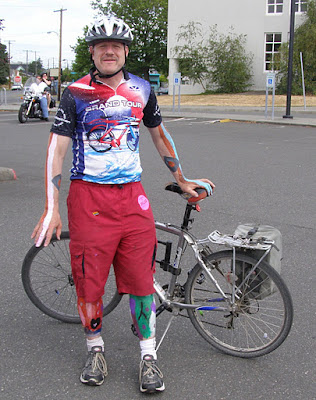 Of course, I rode my bike in the parade. Notice painted legs.
Rainbow City Band
After Bellingham's Gay Pride March down Cornwall Avenue, the band preformed at Depot Market Square where over 1,000 people from many walks of life gathered for a festival that day. There were over 40 booths from various organizations and churches showing solidarity for gay rights.
Betty Desire Preforms
Small town drag show that's not in a bar. Kids in the audience. Has a family, folksy feel with a lot of heart in the community. It's at the Bellingham Gay Pride Festival in Depot Market Square; also home for Farmer's Market on other days. The Gay Pride Parade and Festival brought people from many walks of life. Betty Desire was one of several performers that day. Betty's son was also in the audience (from an earlier marriage) and believe it or not he has a grand child in California. 1 minute 15 seconds.
 Of course, I rode my bike in the parade. Notice painted legs.
Thursday, July 12, 2007
After Supreme Court decision Making it harder to Integrate Schools
Talk shows have been buzzing. John Rothman expressed outrage about the ruling on his KGO show. I often feel like talking back to the radio, but I'm not very articulate on the phone.
Really, the best way to create racial balance in the schools is to better integrate the neighborhoods.
I've never been a big fan of busing, or other "band aid" solutions that attempt to integrate society on the backs of the children. We really need to mix the neighborhoods more.
Restrictive "single family" zoning can be a problem. Maybe racial integration would be easier, if we attempted "income integration."
Allow more of a mix in housing types in residential neighborhoods. Single family homes, apartments, low income housing, mother-in-law units. If there was more of a mix of housing types in each neighborhood, society would be less stratified by class. This would also lead to more racial integration because there is still an income disparity between races.
Rather than taking kids away from neighborhood schools, so they can't stay for after school activities, it's better to create a mix in the neighborhoods around the schools. Also complies with the current mood of Supreme Court which seems to be nixing the idea of using race as a criteria for determining school enrollment.
I'm not a fan of the conservative Supreme Court, but I do think there is a better way to integrate our society, than just tossing the entire burden on the schools, or trying to do this solely on the backs of the children.
Saves energy if there is less "busing" also.
There are environmental reasons for more mixed use zoning as well.
Pedestrian advocates talk a lot about this. Being able to walk to destinations.
If there is nothing but "single family homes" as far as the eye can see, it doesn't make for an interesting walk. How about having a small business, where one can stop for refreshments along the way? How about being able to walk to one's job, rather than having to drive?
Allowing more of a mix of densities and uses, with-in residential neighborhoods, creates options for affordable housing.
With houses starting at 1 million dollars in many neighborhoods that were considered "average middle class" not that long ago, something needs to change.
If the cleaning lady can live in the neighborhood where she works, she can trust the "upper class" more. Also she saves time in commuting.
Who knows, she can participate in your community, take classes and even be on your board of directors. She just has to be able to afford living in your community.
Really, the best way to create racial balance in the schools is to better integrate the neighborhoods.
I've never been a big fan of busing, or other "band aid" solutions that attempt to integrate society on the backs of the children. We really need to mix the neighborhoods more.
Restrictive "single family" zoning can be a problem. Maybe racial integration would be easier, if we attempted "income integration."
Allow more of a mix in housing types in residential neighborhoods. Single family homes, apartments, low income housing, mother-in-law units. If there was more of a mix of housing types in each neighborhood, society would be less stratified by class. This would also lead to more racial integration because there is still an income disparity between races.
Rather than taking kids away from neighborhood schools, so they can't stay for after school activities, it's better to create a mix in the neighborhoods around the schools. Also complies with the current mood of Supreme Court which seems to be nixing the idea of using race as a criteria for determining school enrollment.
I'm not a fan of the conservative Supreme Court, but I do think there is a better way to integrate our society, than just tossing the entire burden on the schools, or trying to do this solely on the backs of the children.
Saves energy if there is less "busing" also.
There are environmental reasons for more mixed use zoning as well.
Pedestrian advocates talk a lot about this. Being able to walk to destinations.
If there is nothing but "single family homes" as far as the eye can see, it doesn't make for an interesting walk. How about having a small business, where one can stop for refreshments along the way? How about being able to walk to one's job, rather than having to drive?
Allowing more of a mix of densities and uses, with-in residential neighborhoods, creates options for affordable housing.
With houses starting at 1 million dollars in many neighborhoods that were considered "average middle class" not that long ago, something needs to change.
If the cleaning lady can live in the neighborhood where she works, she can trust the "upper class" more. Also she saves time in commuting.
Who knows, she can participate in your community, take classes and even be on your board of directors. She just has to be able to afford living in your community.
Tuesday, July 10, 2007
Celebrating in July

Notice the dim dot on right near tree. That's Venus! (I think).
Just got around to putting my images on-line, from Bellingham 4th of July fireworks.
I know, lots of people upload fireworks this time of year.
The 4th is over for another year, but there is still celebration. Bellingham's Gay Pride Festival is coming this weekend.
Sunday, July 15, Noon to 5 PM at Depot Market Square (where Farmer's Market is held on Saturdays).
Actually there are events for Pride this entire weekend. Bellingham is coming more of age when it comes to the "urban trait of exhibiting diversity."
Celebrating freedom and open mindedness.
Sunday, July 08, 2007
Just Before Roll Out Day for the Boeing 787 Dreamliner
Someone calls talk show and says this new light weight plane which is made using carbon composite material will not reduce the greenhouse gas emissions that it is touted for.
Why?
Because even more people will fly.
Lower fuel costs can make air travel less expensive so there will be more air travel, thus wiping out any savings in greenhouse gas.
I guess that's population growth. More people, so more flying.
Step forward, slide back.
It also depends on what the people would be doing if they weren't flying.
The 787 saves energy if people are flying, instead of driving across country. It doesn't save energy if the people fly instead of taking the train, or biking across country.
The main reason why I biked across USA was to see more of America than the in flight movie, but I am not against flying.
I have flown before. Several times, but not since the 1980s.
One flight was on a small plane with "every seat a window seat." Seattle to Pullman, WA. Clear day and Cascade snow cones were visible from Canada to Oregon.
Fantastic, but that joyous trip only lasted a bit over 1 hour.
Since then, I haven't had occasion to fly. Living in the slow lane.
By bicycle, the scenery can last 6 days, but it's not quite so intense. Takes patience.
I ask someone what it was like to fly over a blanket of thick clouds. To be in sunshine, but look down on nothing but clouds. He said, "it's very interesting, for about 5 minutes."
Still, I do like most technology. It's kind of exciting to have the first, basically non metal plane. Actually, I guess there was the wooden Spruce Goose.
Why?
Because even more people will fly.
Lower fuel costs can make air travel less expensive so there will be more air travel, thus wiping out any savings in greenhouse gas.
I guess that's population growth. More people, so more flying.
Step forward, slide back.
It also depends on what the people would be doing if they weren't flying.
The 787 saves energy if people are flying, instead of driving across country. It doesn't save energy if the people fly instead of taking the train, or biking across country.
The main reason why I biked across USA was to see more of America than the in flight movie, but I am not against flying.
I have flown before. Several times, but not since the 1980s.
One flight was on a small plane with "every seat a window seat." Seattle to Pullman, WA. Clear day and Cascade snow cones were visible from Canada to Oregon.
Fantastic, but that joyous trip only lasted a bit over 1 hour.
Since then, I haven't had occasion to fly. Living in the slow lane.
By bicycle, the scenery can last 6 days, but it's not quite so intense. Takes patience.
I ask someone what it was like to fly over a blanket of thick clouds. To be in sunshine, but look down on nothing but clouds. He said, "it's very interesting, for about 5 minutes."
Still, I do like most technology. It's kind of exciting to have the first, basically non metal plane. Actually, I guess there was the wooden Spruce Goose.
Friday, July 06, 2007
In-filling is good, but it doesn't automatically curb sprawl
Here in Bellingham, in-filling the city is being advocated to reduce sprawl in Whatcom County. At the same time, many anti growth advocates fear that we will get both in-filling and sprawl.
I am an advocate for density, but I realize these anti growth naysayers might have a point. In-filling and sprawl can happen simultaneously.
To curb sprawl, there would need to be strict land use laws in the county. Watershed preservation, farmland preservation and so forth.
That could reduce new housing construction in the county. Then Bellingham would need to do in-filling in order to maintain some affordability of housing in this area. Otherwise there could be a shortage of housing if population keeps growing.
Also the county could do a version of in-filling itself. By encouraging clustered housing. Pockets of density rather than sparsely scattered 1 and 5 acre lots filling up the entire area.
The towns in the county can in-fill as well.
County and city planners talk about this, but the hardest part of this task is getting average people to cooperate.
People are slowly changing and the lifestyles that go with in-filling are getting more popular. Things like "car free" living are gaining appeal.
I am an advocate for density, but I realize these anti growth naysayers might have a point. In-filling and sprawl can happen simultaneously.
To curb sprawl, there would need to be strict land use laws in the county. Watershed preservation, farmland preservation and so forth.
That could reduce new housing construction in the county. Then Bellingham would need to do in-filling in order to maintain some affordability of housing in this area. Otherwise there could be a shortage of housing if population keeps growing.
Also the county could do a version of in-filling itself. By encouraging clustered housing. Pockets of density rather than sparsely scattered 1 and 5 acre lots filling up the entire area.
The towns in the county can in-fill as well.
County and city planners talk about this, but the hardest part of this task is getting average people to cooperate.
People are slowly changing and the lifestyles that go with in-filling are getting more popular. Things like "car free" living are gaining appeal.
Subscribe to:
Posts (Atom)