New twists could mean death nail to typical "Republican Party" thought
In the past, "no new taxes" mantra was chanted by Republicans. They said, "low taxes, keep business rolling in the private sector."
Now, some new types of people are chanting that mantra as well; folks that are uncomfortable bedfellows to typical Republicans. These new folks say, "don't raise the gas tax, we shouldn't be building roads." "Cripple highway construction budget." "Force traffic to gridlock and a standstill." "That will cut sprawl, slow growth and maybe force people to get out of their cars."
Yes, it's not the typical "no new taxes" argument, but it is a perspective that has increasing following.
The gas tax debate is said to be among the most divisive issues with-in Republican Party circles. Some party loyalists still cling to the "less government" mantras, but others are getting scared. Scared by their new bedfellows who typically hail from more left wing sides of the political spectrum. What some people might consider radicle advocates of mass transit and dismantling America's suburbia culture can join the "no new tax" bandwagon also. "Stop the sprawl, don't build roads."
These new bedfellows have actually scared a few Republicans into support of increasing the gas tax. Yes, government investment in infrastructure can keep the status quo rolling.
Since I am not a Republican, I enjoy watching this discussion unnerve the Republicans.
I still support the increase in gas tax (the NO on Washington State Initiative 912 position), but I see a lot of validity in the anti road building argument. I am just not willing to go that far as I feel mass transit and bicycling needs good roads also.

Friday, October 21, 2005

Sunday, October 16, 2005
Over the hill at ten years of age
I have often thought "Over the hill at ten" would make a good book title.
What does it mean?
If someone wanted to be an Olympic class athlete, they would have to start refining that skill by at least age ten, most likely. That means, if you haven't started yet, and you are over ten, chances are you're out of the running.
Over the hill, already, at ten. That's sad.
It's a burden, but don't worry.
"Second best" is less stressful to obtain.
Second best can mean being physically fit and still having enough talent to do more good than harm.
Don't do what too many folks do. They throw in the towel because they aren't first place.
When I was a kid, I heard that every American can have the dream of being President.
On the other hand, people say when you type the word "failure" and click on the Google search button that says, "I'm feeling lucky," you get the biography of the President.
So much for being top dog, when people call you a failure.
Of course I haven't yet researched how Google's "I'm feeling lucky" search results are determined.
The word "excellence" is often bantered about.
What pressure.
Think schools, workplaces, resumes. Then think of the name for Rush Limbaugh's radio network;
"The Excellence In Broadcasting Network" (E.I.B. Radio Network).
Is Rush Limbaugh excellent? What "top drawer" and "excellence" means is debatable.
Don't throw in the towel if you can't make the top; what ever way the "top" is defined. Being reasonably good is ...
Good enough.
What does it mean?
If someone wanted to be an Olympic class athlete, they would have to start refining that skill by at least age ten, most likely. That means, if you haven't started yet, and you are over ten, chances are you're out of the running.
Over the hill, already, at ten. That's sad.
It's a burden, but don't worry.
"Second best" is less stressful to obtain.
Second best can mean being physically fit and still having enough talent to do more good than harm.
Don't do what too many folks do. They throw in the towel because they aren't first place.
When I was a kid, I heard that every American can have the dream of being President.
On the other hand, people say when you type the word "failure" and click on the Google search button that says, "I'm feeling lucky," you get the biography of the President.
So much for being top dog, when people call you a failure.
Of course I haven't yet researched how Google's "I'm feeling lucky" search results are determined.
The word "excellence" is often bantered about.
What pressure.
Think schools, workplaces, resumes. Then think of the name for Rush Limbaugh's radio network;
"The Excellence In Broadcasting Network" (E.I.B. Radio Network).
Is Rush Limbaugh excellent? What "top drawer" and "excellence" means is debatable.
Don't throw in the towel if you can't make the top; what ever way the "top" is defined. Being reasonably good is ...
Good enough.
Monday, October 10, 2005
The world's largest lava lamp
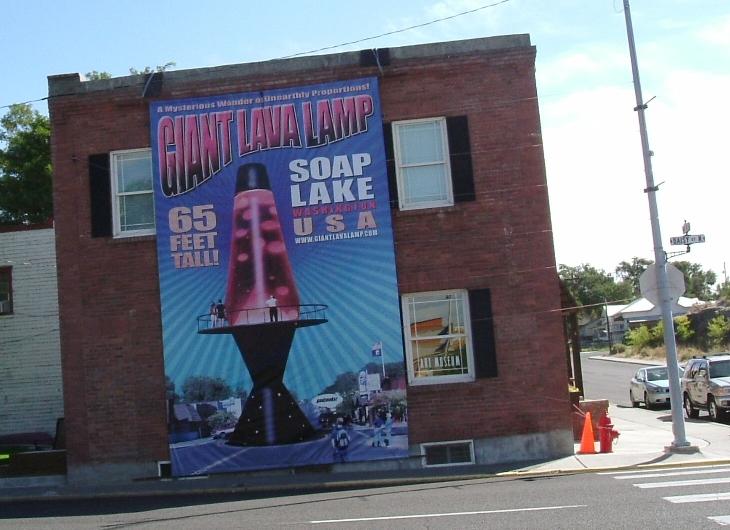
Guess where they plan to put it.
Soap Lake, Washington.
This is one of many tidbits I learned on my 2005 bicycle tour around in the Pacific Northwest. I think the idea to set this up has faded by now. Update 2025.
Tuesday, October 04, 2005
Another Reason To Vote NO on Washington State Initiative 912
I-912 would repeal a hike in the gas tax which was recently passed in the Washington State Legislature to pay for road and transportation improvements. Here is a letter I had in October 2 Bellingham Herald.
Some people wonder why gas taxes go up, while traffic still gets worse. They seem to think state highway departments are frittering away the money. Few stop to realize that land is getting too expensive for building roads. It takes a lot of land to build a highway or add new lanes to an existing road.
Back when the interstate freeways were first being built, traffic congestion could be solved by just adding more lanes to the highway. That was when one could still buy a house for under $20,000. Now, many of those same houses are selling for prices closer to the million dollar mark. Few stop to think about what effect real estate inflation has had on the cost of land for roads.
Many folks sit in homes that have inflated significantly in value over the past twenty years. They still wonder why roads cost more than they did twenty years ago.
Since land values do not seem to be going down in the near future, we need to reduce dependency on the automobiles. Cars take up too much space in our crowded and increasingly expensive world.
That was the letter, but I can add a bit more here.
Some of the gas tax money goes to fund alternative transit. Enough that I noticed, from a quick look at their web site, that a representative from the organization Transportation Choices is urging a no vote. Remember, NO means keeping the gas tax increase.
In the past, some alternative transit and bike advocates opposed certain gas tax hikes as they had tended to be perfectionists. They didn't want to have more roads built for cars.
Another constituency, besides traditional "no tax" Republican types, to come out against taxes for infrastructure are some anti growth advocates. They say, "if we don't build the roads, people will stop moving here." "Just starve the growth and the economy."
That would be painful if people keep having kids.
Supporting the gas tax that funds a balanced system of roads and alternative transit is good.
The whole transportation system is interdependent.
Busses help cars by reducing the traffic, but road improvements for cars also help the buses to get through. Currently, much of our alternative transit is busses that share the roads with cars. Also shoulder improvements are good for bicycles.
Some people wonder why gas taxes go up, while traffic still gets worse. They seem to think state highway departments are frittering away the money. Few stop to realize that land is getting too expensive for building roads. It takes a lot of land to build a highway or add new lanes to an existing road.
Back when the interstate freeways were first being built, traffic congestion could be solved by just adding more lanes to the highway. That was when one could still buy a house for under $20,000. Now, many of those same houses are selling for prices closer to the million dollar mark. Few stop to think about what effect real estate inflation has had on the cost of land for roads.
Many folks sit in homes that have inflated significantly in value over the past twenty years. They still wonder why roads cost more than they did twenty years ago.
Since land values do not seem to be going down in the near future, we need to reduce dependency on the automobiles. Cars take up too much space in our crowded and increasingly expensive world.
That was the letter, but I can add a bit more here.
Some of the gas tax money goes to fund alternative transit. Enough that I noticed, from a quick look at their web site, that a representative from the organization Transportation Choices is urging a no vote. Remember, NO means keeping the gas tax increase.
In the past, some alternative transit and bike advocates opposed certain gas tax hikes as they had tended to be perfectionists. They didn't want to have more roads built for cars.
Another constituency, besides traditional "no tax" Republican types, to come out against taxes for infrastructure are some anti growth advocates. They say, "if we don't build the roads, people will stop moving here." "Just starve the growth and the economy."
That would be painful if people keep having kids.
Supporting the gas tax that funds a balanced system of roads and alternative transit is good.
The whole transportation system is interdependent.
Busses help cars by reducing the traffic, but road improvements for cars also help the buses to get through. Currently, much of our alternative transit is busses that share the roads with cars. Also shoulder improvements are good for bicycles.
Friday, September 30, 2005
Thinking About Bill Bennett Abortion Comment
Abortion is really a "red herring" issue. It deflects us from discussing the true problem that there are too many people in the world. Over population. Abortion is not a good form of birth control, but there are some deeper demographic issues under the surface of this discussion.
Demographics was touched on during Bill Bennett's now infamous talk show, but emotional baggage around abortion and racism flairs up into a war of sound bytes. Deeper issues of population and demographics get ignored.
Some interesting questions were touched on in that show (from what I read, even though I didn't actually hear the show).
The question of, "how many people are around to pay into the Social Security Trust Fund?" started that whole ball rolling.
Some might argue that we need more births in order to have plenty of younger workers to pay into Social Security as the post war generation retires. This is an interesting thought for demographers and economists to debate.
Then there is the question of whether just "numbers of people" is sufficient as a solution to this equation. What about quality of environment and economic conditions for the next generation that will be paying into the fund?
A book called "FREAKONOMICS" was mentioned. Important questions about the quality of life, for people being born into this world, was brought up.
What if a bunch of unwanted children were born into poverty? Would they add to, or further distract from society and Social Security?
It's an old "quality versus quantity" argument.
There is the contention that crime is actually lower because quite a few of the people who would have been born into problem homes were never born. Do we really want a whole bunch of unwanted babies? These are very important questions.
Then, along came Bennett's "kicker" comment. The one that's got everyone buzzing.
"But I do know that it's true that if you wanted to reduce crime, you could -- if that were your sole purpose, you could abort every black baby in this country, and your crime rate would go down. That would be an impossible, ridiculous, and morally reprehensible thing to do, but your crime rate would go down. So these far-out, these far-reaching, extensive extrapolations are, I think, tricky."
Another valuable point can be discussed behind this comment.
Is there a danger that abortion can be used to "weed out" certain types of people that others might deem as undesirable? Would abortion be more prevalent weeding out children from poor, marginalized or minority peoples?
It reminds me of one day, when I was in college, sitting in the office of the Gay People's Alliance on campus. Someone from the so called "pro life" club got up the courage to wonder into our office with a very thought provoking question.
She ask, "if one could ever determine, before birth, that a fetus would turn out homosexual, wouldn't you worry that a lot of mothers would choose to abort their pregnancies?"
Most of the "politically correct" office staff blew her question off, but I took her question more seriously. We had a good dialog as most of the other office staffers left the room.
These are important ethical questions with out easy, sound byte answers.
It brings me back to my first point that there are too many people in this world, but abortion is a red herring issue.
Ideally, we should all be working toward the reduction of unwanted pregnancies. Birth control, lifestyle choices, family planning, even abstinence can all point to similar goals. Even more acceptance of "alternative lifestyles" can serve to reduce unwanted pregnancy.
In an ideal world, there wouldn't need to be abortions because unwanted pregnancy wouldn't be such a problem.
Abortion is, at best, a poor form of birth control. How one feels about whether it should be legal, or not, may not be as important an issue as the deeper demographic problems revolving around so many unwanted pregnancies.
I am reminded of a wonderful phrase that came from the early pro abortion rights movement. For some reason, the more recent abortion rights advocates hardly ever use this quote. Still, it transcends the contentious abortion debate to a deeper ideal that most folks should agree on.
"Every child should be wanted."
This phrase also can address the issues of neglect and poverty that so many children face in the world. For instance, one can say, "every child should have access to medical care."
Even some of the pro life movement can get on board with this ideal.
There is a similar phrase that President Bush has bounced around as he talks about education.
That phrase says, "No child should be left behind."
Of course one can certainly question whether the concept is working, or whether Bush administration policies will get us there.
Still, in an ideal world, we should be focusing on quality of life rather than just quantity of life. Churning out too many babies is a major world problem.
Demographics was touched on during Bill Bennett's now infamous talk show, but emotional baggage around abortion and racism flairs up into a war of sound bytes. Deeper issues of population and demographics get ignored.
Some interesting questions were touched on in that show (from what I read, even though I didn't actually hear the show).
The question of, "how many people are around to pay into the Social Security Trust Fund?" started that whole ball rolling.
Some might argue that we need more births in order to have plenty of younger workers to pay into Social Security as the post war generation retires. This is an interesting thought for demographers and economists to debate.
Then there is the question of whether just "numbers of people" is sufficient as a solution to this equation. What about quality of environment and economic conditions for the next generation that will be paying into the fund?
A book called "FREAKONOMICS" was mentioned. Important questions about the quality of life, for people being born into this world, was brought up.
What if a bunch of unwanted children were born into poverty? Would they add to, or further distract from society and Social Security?
It's an old "quality versus quantity" argument.
There is the contention that crime is actually lower because quite a few of the people who would have been born into problem homes were never born. Do we really want a whole bunch of unwanted babies? These are very important questions.
Then, along came Bennett's "kicker" comment. The one that's got everyone buzzing.
"But I do know that it's true that if you wanted to reduce crime, you could -- if that were your sole purpose, you could abort every black baby in this country, and your crime rate would go down. That would be an impossible, ridiculous, and morally reprehensible thing to do, but your crime rate would go down. So these far-out, these far-reaching, extensive extrapolations are, I think, tricky."
Another valuable point can be discussed behind this comment.
Is there a danger that abortion can be used to "weed out" certain types of people that others might deem as undesirable? Would abortion be more prevalent weeding out children from poor, marginalized or minority peoples?
It reminds me of one day, when I was in college, sitting in the office of the Gay People's Alliance on campus. Someone from the so called "pro life" club got up the courage to wonder into our office with a very thought provoking question.
She ask, "if one could ever determine, before birth, that a fetus would turn out homosexual, wouldn't you worry that a lot of mothers would choose to abort their pregnancies?"
Most of the "politically correct" office staff blew her question off, but I took her question more seriously. We had a good dialog as most of the other office staffers left the room.
These are important ethical questions with out easy, sound byte answers.
It brings me back to my first point that there are too many people in this world, but abortion is a red herring issue.
Ideally, we should all be working toward the reduction of unwanted pregnancies. Birth control, lifestyle choices, family planning, even abstinence can all point to similar goals. Even more acceptance of "alternative lifestyles" can serve to reduce unwanted pregnancy.
In an ideal world, there wouldn't need to be abortions because unwanted pregnancy wouldn't be such a problem.
Abortion is, at best, a poor form of birth control. How one feels about whether it should be legal, or not, may not be as important an issue as the deeper demographic problems revolving around so many unwanted pregnancies.
I am reminded of a wonderful phrase that came from the early pro abortion rights movement. For some reason, the more recent abortion rights advocates hardly ever use this quote. Still, it transcends the contentious abortion debate to a deeper ideal that most folks should agree on.
"Every child should be wanted."
This phrase also can address the issues of neglect and poverty that so many children face in the world. For instance, one can say, "every child should have access to medical care."
Even some of the pro life movement can get on board with this ideal.
There is a similar phrase that President Bush has bounced around as he talks about education.
That phrase says, "No child should be left behind."
Of course one can certainly question whether the concept is working, or whether Bush administration policies will get us there.
Still, in an ideal world, we should be focusing on quality of life rather than just quantity of life. Churning out too many babies is a major world problem.
Wednesday, September 28, 2005
Sunday, September 25, 2005
Riding Seattle's monorail in 2005.
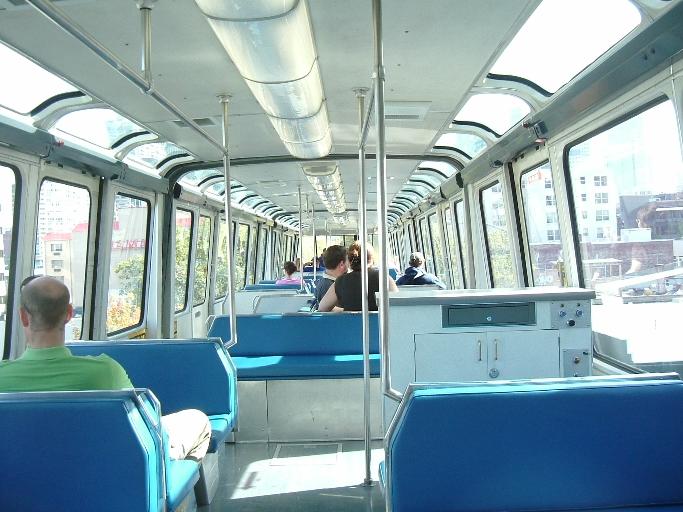 I recently rode the old monorail in Seattle. It looks like the new, larger monorail is in trouble. Mayor and city council don't think the financing plan is realistic. A scaled back monorail plan is on the ballot.
Here is an idea for the monorail, as if they don't have enough suggestions already.
Turn the new monorail into a "feeder line" for Sound Transit.
Sound Transit is Seattle's other light rail proposal. It has had problems and cost overruns as well. Sound Transit has also had to scale back it's original plan. The original "phase 1" plan called for going from the airport to University of Washington, possibly even on to Northgate. It has been scaled back to a line just from the airport to downtown.
At least Sound Transit is starting to build that line.
The original monorail plan sort of paralleled Sound Transit. It went from West Seattle, (down the airport direction) through downtown and up to Ballard District. That's sort of the direction toward University Of Washington.
Why can't they merge the two plans?
Let Sound Transit build it's line from the Airport to downtown. Then have a scaled back monorail line from downtown to University of Washington (where Sound Transit had originally planned to go).
Another short monorail line could link West Seattle to the Sound Transit line that comes up from the southwest, rather than having to go downtown.
The monorail could become a feeder line to Sound Transit. They should share a downtown station so passengers can easily transfer from one to the other.
Both lines could gradually branch out from that hub and connect with metro transit bus routes.
People tend to forget, but Sound Transit already has another rail service that links both Everett and Tacoma to Seattle. It's called the Sounder Train. Runs on existing BNSF right of way.
Tacoma already has a short Sound Transit light rail line in it's downtown area.
All these things should start connecting up, but people may have to transfer from bus to train to monorail, for instance. One fare should cover it all. Maybe it's not a perfect idea, but it's better than sitting in traffic.
Part of the problem, with any transportation system, is the staggering cost of land in Seattle area. Houses that sold for $20,000, not that many years ago, now sell for closer to the million mark. It must be next to impossible to do any public works project, such as building stations, that requires buying land. This problem especially makes adding lanes to the existing freeway impractical. If one thinks light rail is too expensive, just try adding another lane to I-5! It would take up so much room and displace so many homeowners that the bank breaks.
So, Sound Transit and Monorail should get together. It's just another one of my ideas.
Friday, September 16, 2005
Hurricane Katrina and Deficit Spending
While listening to the radio this morning, I briefly heard a comment by Republican Senator Trent Lott who's own house was destroyed by Hurricane Katrina. The comment went something like, Being a fiscal conservative ends with a natural disaster. I don't remember the exact wording however.
Anyway, it looks like hundreds of billions of dollars will be added to the national deficit recovering from Katrina. Even fiscal conservatives, who had been preaching "limited government on domestic affairs," are admitting that this recovery is beyond what just the "private market" can accomplish.
We may be paying for some miss guided fiscal conservatism of past years. If more money had been spent on the levies over, say the past 25 years, much of this clean up bill could have been avoided. Those old phrases like, "an ounce of prevention is worth a pound of cure," and "hindsight is better than foresight" apply.
It is important to invest in America's domestic needs. Many of these investments, like levies, transportation and even preventative health care for low income people are often more likely to come from government than private enterprise.
Still, private enterprise plays an important role also. Cutting through red tape carrying out many of the tasks after governments have provided the funding. Subcontractors versus government employees, for instance. Also there is a role for private markets and investments, charities and "thousand points of light," to quote George Bush Senior. It's just that government plays an important role and deserves respect.
As for the deficit, I would guess that being a fiscal conservative is not easy. It seems like even most conservatives cave in to the continual bombardment that nature and circumstances throw at the lives of their constituents.
Politicians talk "low taxes" and "less government" while delivering lots of government services to their constituents. Just put it on the credit card, and there seems to be no consequence. High deficits don't even push up interest rates! The past few years have enjoyed, or suffered depending on how one views this, from low interest rates. Last year, I read that housing prices went up, here in Bellingham, by 23 percent. That's good news for many home owners cashing in on the flood of money that low interest rates create. It is bad news for folks trying to save money the old fashioned way in bank deposits.
Where does all this money come from? It's a mystery to me.
Republicans often say that tax cuts create more, rather than less, revenue for the government. It's counter intuitive. They say that economic stimulation created by tax cuts creates so much business activity that total tax collection goes up rather than down.
Here is an important question.
Would this mechanism of tax cutting ones way to more government revenue actually work if the government couldn't run a deficit? If every tax cut had to be matched with an equal amount of spending cuts, would the tax cut actually stimulate the economy?
That's an important question. It seems like the Bush tax cuts have stimulated things because the government could also continue to spend lots of money. Both the record spending and tax cuts combined can stimulate the economy so much that one does see a slight increase in overall revenue collection by the government. If the spending had to be cut, along with the tax cuts, it seems like that revenue increase would not be there. Possibly those kind of drastic cuts to eliminate the deficit would also bring on a recession.
Who knows. but that is a good question for economists to ponder.
So, here we go sinking farther into debt, but maybe it doesn't matter.
One thing I do know. Hurricanes, and life in general, put a lot of things on our government's "to do" list.
By the way, in case folks are wondering, I am back from my 5 week long bicycle tour. More news about that later.
Anyway, it looks like hundreds of billions of dollars will be added to the national deficit recovering from Katrina. Even fiscal conservatives, who had been preaching "limited government on domestic affairs," are admitting that this recovery is beyond what just the "private market" can accomplish.
We may be paying for some miss guided fiscal conservatism of past years. If more money had been spent on the levies over, say the past 25 years, much of this clean up bill could have been avoided. Those old phrases like, "an ounce of prevention is worth a pound of cure," and "hindsight is better than foresight" apply.
It is important to invest in America's domestic needs. Many of these investments, like levies, transportation and even preventative health care for low income people are often more likely to come from government than private enterprise.
Still, private enterprise plays an important role also. Cutting through red tape carrying out many of the tasks after governments have provided the funding. Subcontractors versus government employees, for instance. Also there is a role for private markets and investments, charities and "thousand points of light," to quote George Bush Senior. It's just that government plays an important role and deserves respect.
As for the deficit, I would guess that being a fiscal conservative is not easy. It seems like even most conservatives cave in to the continual bombardment that nature and circumstances throw at the lives of their constituents.
Politicians talk "low taxes" and "less government" while delivering lots of government services to their constituents. Just put it on the credit card, and there seems to be no consequence. High deficits don't even push up interest rates! The past few years have enjoyed, or suffered depending on how one views this, from low interest rates. Last year, I read that housing prices went up, here in Bellingham, by 23 percent. That's good news for many home owners cashing in on the flood of money that low interest rates create. It is bad news for folks trying to save money the old fashioned way in bank deposits.
Where does all this money come from? It's a mystery to me.
Republicans often say that tax cuts create more, rather than less, revenue for the government. It's counter intuitive. They say that economic stimulation created by tax cuts creates so much business activity that total tax collection goes up rather than down.
Here is an important question.
Would this mechanism of tax cutting ones way to more government revenue actually work if the government couldn't run a deficit? If every tax cut had to be matched with an equal amount of spending cuts, would the tax cut actually stimulate the economy?
That's an important question. It seems like the Bush tax cuts have stimulated things because the government could also continue to spend lots of money. Both the record spending and tax cuts combined can stimulate the economy so much that one does see a slight increase in overall revenue collection by the government. If the spending had to be cut, along with the tax cuts, it seems like that revenue increase would not be there. Possibly those kind of drastic cuts to eliminate the deficit would also bring on a recession.
Who knows. but that is a good question for economists to ponder.
So, here we go sinking farther into debt, but maybe it doesn't matter.
One thing I do know. Hurricanes, and life in general, put a lot of things on our government's "to do" list.
By the way, in case folks are wondering, I am back from my 5 week long bicycle tour. More news about that later.
Thursday, August 25, 2005
Pat Robertson's comment
Suggesting the assassination of Venezuela's President? Sounds like something a fundamentalist would say. Whether it's an Islamic fundamentalist, Christian or what ever. They're telling others to go to hell.
I prefer more open minded and liberal religious people.
I prefer more open minded and liberal religious people.
Tuesday, August 23, 2005
Like going back in time when there was more elbow room
 I am on another bike trip. Just visited Wallowa Lake in North East Oregon. The Wallowa Mountains are obscure to most of the world, but quite impressive.
Out here there is plenty of space for the traditional American "family" lifestyle with big yards and ranch style homes. Not very many people. Folks drive trucks and there still isn't much traffic. They can get by with it here. In the big cities, such as in Western Washington state, space is so limited things have to change. Out here in Northeast Oregon, change is not as necessary. As people keep driving in crowded Western Washington, the traffic gets bad. Here in Enterprise, Oregon, there isn't much traffic because there aren't many people.
Lots of land for the number of people.
More elbow room allows for the more traditional American way of life. I see lots of horses.
Still, I like living in the city as I am a non traditional person. Enterprise is a nice place to visit, but wouldn't want to live here.
A few days ago I walked into a "supermarket" in Elgin, OR. that reminded me of my childhood. Low ceiling, no neon, plain shelves with canned goods. Not fancy. Like a throwback to the early 1960s before supermarkets became like Disney Lands.
Saturday, August 13, 2005
I am on the road
Traveling by bicycle, as usual for my summer vacation.
Posts may be farther apart. Look forward to more updates when I get back.
As gas prices keep going up, I don't have to worry. Bicycle is a great way to go. Seeing parts of the great Pacific Northwest. Not just whizzing by everything. It's a great way to savor my vacation.
Traveling by bicycle, as usual for my summer vacation.
Posts may be farther apart. Look forward to more updates when I get back.
As gas prices keep going up, I don't have to worry. Bicycle is a great way to go. Seeing parts of the great Pacific Northwest. Not just whizzing by everything. It's a great way to savor my vacation.
Tuesday, August 09, 2005
Fragrance Lake Rocks
A few days ago, I rode my bike up to Fragrance Lake in the Chuckanut Mountains near Bellingham. An old logging road from Clayton Beach's parking lot is blocked to motorized vehicles.
Makes a nice bike ride. Also a popular walk. Up hill, basically, all the way.
I put my bicycle in low gear and tuned my radio to Classic King FM as I peddled up the hill. Past cedar and douglas fir trees.
At the lake, another choice of music greeted me. Rock sound from the ghetto blaster of some young folks.
Young slim males with their shirts off. A mild erotic pleasure to the eye.
I didn't mind. I just slipped into the lake and pretended I was doing water aerobic in the pool. It was an energizing experience.
Some folks would complain about that music piercing lake tranquility, but I went with the flow. I didn't mind having an "urban experience."
Fragrance Lake is a popular place.
Another road and parking lot allows people to bring cars closer to the lake than Clayton Beach Parking lot. It's a shorter hike from "parking" when one takes the old road that is still open to cars above the lake.
Makes a nice bike ride. Also a popular walk. Up hill, basically, all the way.
I put my bicycle in low gear and tuned my radio to Classic King FM as I peddled up the hill. Past cedar and douglas fir trees.
At the lake, another choice of music greeted me. Rock sound from the ghetto blaster of some young folks.
Young slim males with their shirts off. A mild erotic pleasure to the eye.
I didn't mind. I just slipped into the lake and pretended I was doing water aerobic in the pool. It was an energizing experience.
Some folks would complain about that music piercing lake tranquility, but I went with the flow. I didn't mind having an "urban experience."
Fragrance Lake is a popular place.
Another road and parking lot allows people to bring cars closer to the lake than Clayton Beach Parking lot. It's a shorter hike from "parking" when one takes the old road that is still open to cars above the lake.
Sunday, August 07, 2005
Should Whatcom County limit building permits?
August 6 Bellingham Herald has an article about this proposal from a member of the Whatcom County Planning Commission.
The proposal goes as follows:
Set quotas on home-building permits allowed in Bellingham's urban fringe to control the number of people moving into the areas year to year. Also to force even more of the in filling with-in Bellingham city limits, rather than in the adjacent county areas.
Clark County, where Vancouver, Washington (not Vancouver BC) is located, has enacted a ban on any new development until roadways are built to support the growth.
Traffic is the biggest complaint about growth.
I have a better idea.
Instead of total bans on housing construction, maybe people should consider my ideas for limiting car ownership. Subdivisions for people who can live with out cars should be considered. This would address the traffic problem by shifting car trips to things like public transit and bicycles.
My idea is presented in an earlier blog post. Also was in one of my letters to the Herald (July 15). It got a good response as someone picked up the ball and took my ideas further in a July 28 letter.
Reducing car use might also help address the concerns of folks like Building Industry Association of Whatcom County vice president Bill Quehrn who feels building permit limits would just push up house prices even more.
As homelessness grows, afford ability of housing is a big issue. According to the article, Quehrn is concerned about the 25 year old starting out with a new family.
There are places where first time home buyers, as well as most renters, can't afford to live.
I say, "wouldn't it be nice if people didn't need so much space in order to live?" I don't have a family or an automobile. Basically I just live in something like a studio.
Unfortunately, "across the board bans" on housing construction tend to hurt low income people by driving up prices and rents.
Often the owners of already existing houses will see their values skyrocket while renters and first time buyers get chased out.
Are these the kind of people we want to chase out of the area?
The proposal in Whatcom County does try to focus development inside Bellingham city limits, but this city is full of strong "anti growth" neighborhood associations. That task is not politically easy.
Bellingham should grow up instead of out, but there is just about always opposition to something going in next door. Currently, there is a lot of construction visible around town so the flames of opposition are fanned.
Will people, like me, with simple needs be squeezed out when rents climb to the stratosphere?
I don't have kids who cause population growth or an automobile causing traffic. Why should I have to move out just because I don't have lots of money?
So far, my situation remains affordable, but I worry about the future.
I know some anti growth advocates have proposals to tax high income folks and subsidize low income housing.
Sounds okay, but that might be politically difficult as well. Like the in filling of Bellingham. Politically difficult.
Rather than banning all development, as some would want to do, both in town and in the county, here are some better ideas.
Discourage people from having kids. Especially too many kids. Discourage people from driving cars. Encourage high density and "smaller floor space" housing.
Also think about what kind of people we are attracting to this area.
Maybe we should say, "it will not be an affordable place to raise a family." Parts of eastern Washington are still affordable for family living.
Instead, Bellingham could be seen as a place for singles, people with out cars and folks who are into voluntary simplicity.
How's that for politically difficult?
The proposal goes as follows:
Set quotas on home-building permits allowed in Bellingham's urban fringe to control the number of people moving into the areas year to year. Also to force even more of the in filling with-in Bellingham city limits, rather than in the adjacent county areas.
Clark County, where Vancouver, Washington (not Vancouver BC) is located, has enacted a ban on any new development until roadways are built to support the growth.
Traffic is the biggest complaint about growth.
I have a better idea.
Instead of total bans on housing construction, maybe people should consider my ideas for limiting car ownership. Subdivisions for people who can live with out cars should be considered. This would address the traffic problem by shifting car trips to things like public transit and bicycles.
My idea is presented in an earlier blog post. Also was in one of my letters to the Herald (July 15). It got a good response as someone picked up the ball and took my ideas further in a July 28 letter.
Reducing car use might also help address the concerns of folks like Building Industry Association of Whatcom County vice president Bill Quehrn who feels building permit limits would just push up house prices even more.
As homelessness grows, afford ability of housing is a big issue. According to the article, Quehrn is concerned about the 25 year old starting out with a new family.
There are places where first time home buyers, as well as most renters, can't afford to live.
I say, "wouldn't it be nice if people didn't need so much space in order to live?" I don't have a family or an automobile. Basically I just live in something like a studio.
Unfortunately, "across the board bans" on housing construction tend to hurt low income people by driving up prices and rents.
Often the owners of already existing houses will see their values skyrocket while renters and first time buyers get chased out.
Are these the kind of people we want to chase out of the area?
The proposal in Whatcom County does try to focus development inside Bellingham city limits, but this city is full of strong "anti growth" neighborhood associations. That task is not politically easy.
Bellingham should grow up instead of out, but there is just about always opposition to something going in next door. Currently, there is a lot of construction visible around town so the flames of opposition are fanned.
Will people, like me, with simple needs be squeezed out when rents climb to the stratosphere?
I don't have kids who cause population growth or an automobile causing traffic. Why should I have to move out just because I don't have lots of money?
So far, my situation remains affordable, but I worry about the future.
I know some anti growth advocates have proposals to tax high income folks and subsidize low income housing.
Sounds okay, but that might be politically difficult as well. Like the in filling of Bellingham. Politically difficult.
Rather than banning all development, as some would want to do, both in town and in the county, here are some better ideas.
Discourage people from having kids. Especially too many kids. Discourage people from driving cars. Encourage high density and "smaller floor space" housing.
Also think about what kind of people we are attracting to this area.
Maybe we should say, "it will not be an affordable place to raise a family." Parts of eastern Washington are still affordable for family living.
Instead, Bellingham could be seen as a place for singles, people with out cars and folks who are into voluntary simplicity.
How's that for politically difficult?
Thursday, August 04, 2005
If scientists believed their understandings of truth were infallible, we might still be using vacuum tubes
 Some religious people think evolutionary theories are flawed because scientists often admit that they were wrong about an old explanation when a new explanation comes along. The theories keep evolving.
 Folks can see evolving truths as a sign of weakness. They seem to assume truths must always be unchanging. Others see the admission that understanding of truth can change as a sign of strength.
Science is more of a process of learning and changing, rather than a set of absolute principles or dogmas.
In the 1930s, vacuum tubes were considered orthodoxy for amplification devices.
Then along came the transistor.
If scientists of the 1930s were like religious fundamentalists, we would still be using vacuum tubes.
Understanding of truth, in science is always changing and that can be seen as a virtue rather than a weakness. Scientists are often more humble than fundamentalist religious people. They are willing to admit that their answers are open to scrutiny and modification is possible.
Here's an interesting aside.
Some folks still claim vacuum tubes sound better in amplifiers than solid state components. Especially for electric guitars.
Interesting that electric guitars often hold onto tube technology when rock music was once thought of as "cutting edge rebellion."
Then there is spin as in advertising. What is actually "better."
When I was a kid in the 1960s, there was an encyclopidia article about how transistors were better than vaccuum tubes. My dad read that article to me as I sat on his lap. Maybe I was in second grade then.
"Transistors better than tubes."
I looked up at him and ask,
"Is that true, or is that just a commercial?"
Couldn't figure out why that question made my dad crack up laughing.
Wednesday, August 03, 2005
Picture before and after, Fairhaven Village Green. Also the Bellingham that was.
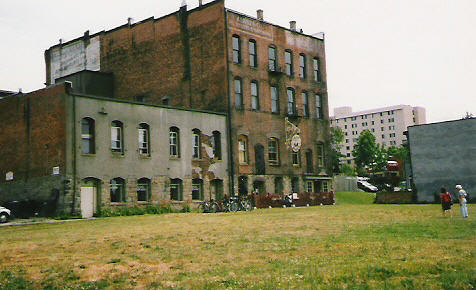
Not necessarily better than the Bellingham that is.
Village Green in Fairhaven District, before it was spruced up recently. Some miss the funkier old ways.
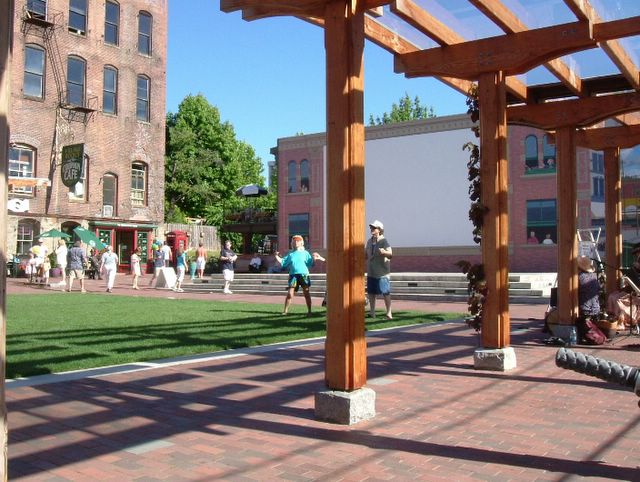
New Village Green in Fairhaven. A friend of mine read, in tourist guide books, that Fairhaven was kind of a hippy hang out. When he got here, he said, "where are the hippies?" They're in some guide books, but not really here.
In the Bellingham that was, my second day of college unfolded at Western Washington State College; WWU's name back in mid 1970s.
A sulfurous fog blew across campus causing mild eye irritation.
One campus newsletter was named, "Tuna Gas News" from the smell that often permeated the air from Georgia Pacific's pulp mill.
Pollution control technology all but eliminated that smell during the 1980s.
More recently, that pulp mill has closed, but it's air could be seen as a "preservative." It may have kept so many people from wanting to move here for retirement.
Not only are there more retirees now, but students are swelling the ranks as well.
Back in the mid 70s, Western's enrollment was declining.
Quite the opposite problem from today when enrollment ceilings must be imposed on the popular school.
Western grew in late 1960s with students seeking a deferment from being drafted. By mid 70s the draft was gone. Enrollment was going down.
Also the post war baby boom was graduating and a smaller generation of college students was arriving.
Faculty feared being laid off.
It was like a downward spiral.
Less students met less faculty.
Less faculty met less class offerings.
Less class offerings would attract even less students.
It was feared to be a spiral of decline.
There was a process called "Reduction In Force." Trying to trim the staff to meet lower enrollment levels. Someone nicknamed the whole thing, "Rip Off In Force," rather than "Reduction In Force."
It was easy for students to get in to Western, however.
The welcome mat was out.
One didn't have to have a high grade point. They were almost begging for students.
Soon after graduation, I rented a one bedroom apartment for $155 per month. It was a nice apartment. Could pay my rent from the few gardening and lawn mowing jobs I scrounged up. That was about the only work one could find.
Bellingham is now benefiting, or suffering, from a double boom in world population trends. Just as post war baby boomers look for places to retire, their kids are going to college. The welcome mat is being replaced with a "full" sign.
Things have been spruced up in town. Some fear it's been sanitized.
Downtown Bellingham was scruffier in the early 1980s.
It was "pragmatic." More traffic, before the mall was built.
Less trees.
Less desirable, but it got the job done.
Just past the bridge on prospect street, I remember noticing a view out over the bay. One had to squint between the bushes and a building to see it. Through tiny gaps among blackberry bushes, one could see a ship in port. Down below was an old sewage plant that is now Maritime Heritage Center.
A woman must have wondered what I was looking at as she sat in the building dispatching taxies. I was trying to find the best gap between the bushes for seeing out over that bluff. She had a puzzled look on her face as if to say, "what's he looking at."
Now, the area is a park and viewpoint.
The old garage, that served as a taxi dispatch and blocked the view, is gone.
Friday, July 22, 2005
Gay Marriage Legal In Canada
Congratulations to Canada. Some conservatives fear that allowing gay marriage will lead to the breakdown of the family and society. So maybe Canada can be seen as an experiment. People have often called "democracy" and experiment anyway. One often talks about the "great American experiment."
So the experiment is running. We'll see if Canadian society breaks down. My bet is, Canada will do very well. Canada is also an experiment in something called "multiculturalism." All these different ethnic groups, religions, lifestyles attempting to live together in a civil society. There are some rough spots, but Canada seems a lot more civil than most places. Less violence than even here in USA.
Congratulations for being willing to experiment. Nothing wrong with that. Experimentation can be good. Remember; USA is often called the great experiment. In this case, the Canadians have us beat.
So the experiment is running. We'll see if Canadian society breaks down. My bet is, Canada will do very well. Canada is also an experiment in something called "multiculturalism." All these different ethnic groups, religions, lifestyles attempting to live together in a civil society. There are some rough spots, but Canada seems a lot more civil than most places. Less violence than even here in USA.
Congratulations for being willing to experiment. Nothing wrong with that. Experimentation can be good. Remember; USA is often called the great experiment. In this case, the Canadians have us beat.
Monday, July 18, 2005
Scandals in Bush administration or where ever
Scandal news has now become background noise. When people say, "all politicians are crooks anyway," another scandal just becomes, "what else is new?"
But, be careful with cynicism, it can become like crying wolf.
I remember Watergate breaking new ground. A mood of trust in our public officials was breached.
Now there is less trust to breach.
Watergate was a watershed.
Since then, scandal after scandal has washed in. We are even unearthing affairs during the Kennedy years and (using genetic science) learning of Jefferson and a slave.
Ironically, the more vigilant we get about scandals, the more they are like background noise.
Then it becomes harder to make a big deal out of scandals or do anything about them.
Scandal news has now become background noise. When people say, "all politicians are crooks anyway," another scandal just becomes, "what else is new?"
But, be careful with cynicism, it can become like crying wolf.
I remember Watergate breaking new ground. A mood of trust in our public officials was breached.
Now there is less trust to breach.
Watergate was a watershed.
Since then, scandal after scandal has washed in. We are even unearthing affairs during the Kennedy years and (using genetic science) learning of Jefferson and a slave.
Ironically, the more vigilant we get about scandals, the more they are like background noise.
Then it becomes harder to make a big deal out of scandals or do anything about them.
Thursday, July 14, 2005
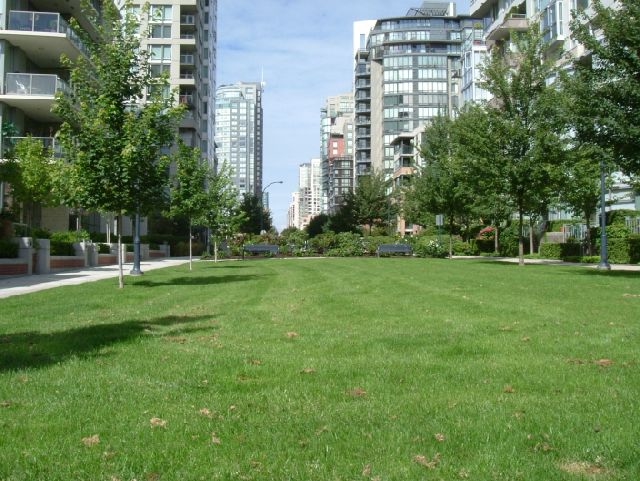
Sunday, July 10, 2005
Is it time to develop a car free subdivision?

Traffic calming circle near St. Joe's Hospital.
Is this a golden opportunity for some developer to plan a car free neighborhood in Bellingham, WA.?
Demand for residential real estate is at an all time high. People are concerned about traffic from new development. Even the mayor recently said,
"When people complain about growth, the're usually not talking about people." "What they are talking about is cars." July 1 Herald.
I say, if a subdivision was planned for folks who don't want to drive, it would still sell in a hot market. That's my guess at least.
Just say "no" to the automobile.
Turn the streets over to people, bicycles, public transit, emergency vehicles and, maybe, deliveries.
Why not?
The market is selling so fast, even this "perceived inconvenience" wouldn't stop it.
If the real estate market was almost dead, it would be another story, but this market has plenty of "give" to it.
Of course the city would have to make some changes also. Zoning that requires parking would have to be waved, changed or worked around.
It's something to think about.
Is this a radicle idea?
Not really.
Bellingham already has one neighborhood where automobiles are highly restricted. Can you guess where that is?
It's Western Washington University.
Much of the campus is "roadless." It's a roadless area.
Like wilderness?
Not unless one is thinking of wild parties at the dorms.
Much of the campus is pedestrian plazas. There are some buildings you can't drive to.
High Street, which runs in front of the Viking Union, is blocked off during the day. Turned over to pedestrians, bicycles, transit, emergency vehicles, deliveries.
Parking isn't that easy to find on campus, but there are a lot of bike racks and Western enjoys the most frequent bus service of any area in Bellingham; except for the transit terminal that is downtown.
Western is hard to negotiate by car but it remains a popular place. So popular that an enrollment ceiling must be imposed.
Limited state funding, rather than anti growth sentiment, brings the ceiling, but lack of roads hasn't killed Western.
Some say this will work for young students, but older people must have cars.
I don't know about that. Many friends in my age range (around 50) still bike over mountain passes. Also there is the bus.
Another "less car" kind of planning has come to our city as well.
Some areas near downtown allow apartments to be built with less parking required than before.
Less parking per unit.
This is a new zone designed to help preserve historic buildings and promote living with less cars.
Some people gripe that these developments are causing "overflow parking" along nearby streets. They also gripe about overflow parking from Western.
I guess people never stop complaining.
Maybe these folks should just stop driving if they are going to complain about traffic.
Are you part of "traffic?"
I live on a busy downtown street and don't really notice whether people are parking or not.
They've always parked here.
I haven't noticed any difference since new apartment buildings were built nearby.
Of course retailers tend to complain if they think there isn't enough parking in an area.
Maybe someday retailing can kick the car addiction also.
It seems like nothing will keep houses from selling, but retailing is a different story. Competition for retail customers is fierce in this city. Parking might be harder to do without.
The housing market is hotter than the hamburger market. They've built so many restaurants.
Someday, even retailing can kick the car habit. Especially in areas of high pedestrian concentration, but for now, someone could propose a car free residential area, at least.
If people will pay a fortune for cracker box houses, maybe they will do with out cars. They're that desperate to live here and maybe they'll discover they can do it.

Thursday, July 07, 2005
You sat in a logging truck on Earth Day?

A friend of mine didn't think that was "the politically correct" thing to do on Earth Day. He was kind of horrified, but I forgot it was Earth Day.
Senator Gaylord Nelson, credited for founding the day, passed away July 3 so lots of stories are being told. My story is about sitting in a logging truck on that day in 1991, and I don't even drive.
It was a bike ride to the Skagit Valley Tulips fields. A one day fitness class from the YMCA.
After peddling around in the tulips, I suggested dropping by the headquarters of Paccar International. Paccar was having an open house. Other class members liked the idea.
Often wondering what Paccar did, the open house would be an opportunity to find out.
It tests trucks, big ones.
We dropped in for the tour, free cookies also. It was another happening at the Skagit Valley Tulip Festival.
Paccar puts big trucks through the tests. Shakes them on hydraulic shakers, runs them around a track, puts all kinds of sensors in them.
Tour ended in the garage. A room full of trucks. Logging trucks, tractor trailers. Lots of trucks on display.
People were invited to climb into the cabs, look around, even honk the horn. Kids loved it.
I climbed into a logging truck even though I've never even driven a car. It felt powerful and yes the horn worked.
Then it was back to our bicycles for the trip to Bellingham where I got a phone call from a friend.
"What did you do today?" he ask. He was horrified and reminded me that this was Earth Day.
To me, it wasn't that inconsistent to be sitting in a logging truck. Earth Day was a great idea, but it's also symbolic. The one day each year that people think about environmentalism. Railing against logging trucks is another symbolic thing.
The true problem is consumptive lifestyles and overpopulation the rest of the year.
People who live in wooden houses, use paper products, depend on our economy might be able to appease their guilt by lashing out at the logging industry. It can be railed against, pushed out of sight, pushed overseas, but still exists as long as its products are in demand.
There is also the concept of "responsible logging." Yes, that industry is part of our lives, but (like so many things) dialog can be used to make it more responsible. That same dialog applies to our personal lives which create the need for the industries. Even though I had forgotten that it was Earth Day, I did spend the day bicycling. The bike trip was a great way to celebrate that day.
Some of the staff out at Paccar was impressed. They said, "you biked all the way here?" "Didn't know it could be so fun."
Liberate those loggers from their workaholic loads. Let's all work "part time." That's responsible stewardship of the environment. Just log part time for sustainable yield.
Picture: Display in Starker Demonstration Forest near Corvallis, Oregon. Seen on my 2004 bike tour.
Monday, July 04, 2005
Fireworks over old Yeager's warehouse building in Bellingham

Seen from many parts of the city. One year, fireworks could be viewed above old Yeager's warehouse building. A few years later, that building burned for an unrelated reason.
On another note: Congratulations to NASA for the smashing success of Deep Impact mission to that comet.
Saturday, July 02, 2005
Reflecting in old telescope mirror.
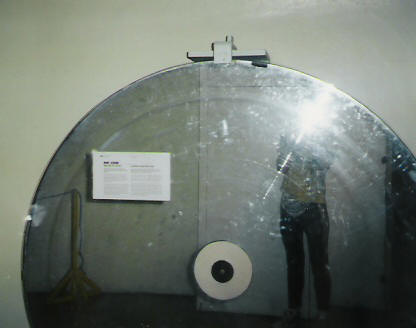
Reflecting in old telescope mirror. Taking picture of myself with a flash. Image from 1996 bicycle trip to Victoria, BC. Museum at base of Dominion Astrophysical Observatory.
What's Inside a Comet?
10:52 PM Pacific Daylight Time July 3 (+ or - 3 minutes), if all goes as planned. A probe from Deep Impact spacecraft smashes into comet Tempel 1 to kick up dust. Then the spacecraft can get a look at what kind of material is "deeper down" inside the head of a comet.
Tempel 1 is also being monitored by observatories around Earth such as the Hubble Space Telescope. Hopefully it will be a very educational blast. Learning more about comets may teach us about the first dust clouds that formed our solar system. Questioning more about creation, which to a large extent, we don't have a clue about still.
There's also, supposedly, the big bang which created this universe and many questions about how order and life evolved on our planet. Questions as to whether something like life exists elsewhere in the universe.
Religious dogmatists have thought they knew the answers to these questions for thousands of years. Many of them act like "know it alls" fighting over who's dogma is correct. Is it Islam, Christianity, Voodoo? Which interpretation?
Fighting over different religions, there are often blasts of another kind, car bombs, or bombing raids from military aircraft.
Religious dogmatists often repress those who offer new information, persecuting Galileo for instance. They thought they "knew it all" when the Sun went around the Earth.
In past times, comets could mean great fear. Signs from an angry god.
But, what about bothering to ask God? Not presuming we know it all. Not even knowing if God exists, or how do we define "God?"
Admitting that there are still more questions than answers can be seen as a sign of weakness, in the eyes of machismo warriors.
Questioning can also be seen as a sign of modesty, humbleness; true virtues.
It seems like scientists tend to be humble. Willing to question. To dialog. Scientists often using phrases like, "We need to go back to the drawing board." "Rewriting our understanding of..."
Asking the questions and not claiming to know all the answers yet. That is a quest which is pursued by scientists, among others.
Putting aside all the energy we spend on wars, arguing over who's right. Some folks are actually bothering to ask, "what's out there in the universe?"
If the deep impact succeeds it can be a blast. This blast for peaceful questioning of the cosmos.
Thursday, June 30, 2005
Eminent Domain
I am not a property owner so recent Supreme Court decision on eminent domain for a private development over a few "hold out homeowners" just passes me by. I don't really care, but it's interesting.
A conservative talk show host was railing against "big government," but this is actually "big corporations" using government as a tool. It's conservative's beloved "market place" in action. Big fish eat little fish. Office park versus gandma who lived there all those years in her little cottage.
Liberals might say this proves the point. Even government now serves corporations. The fox now runs the hen house. Republicans on the Supreme Court, in the White House and Congress.
I say it's not just government or corporations. It's "the people" in disguise. Marketplace behavior. There are small businesses, in that town, wanting to see the office complex built. Economic base, jobs, shoppers, survival. Teacher pay raises. Ruled by the almighty dollar. Some little people against other little people.
But be wary of "bigness."
I remember a line from former President Gerald Ford's 1976 state of the union speech, and he's even a Republican. Speaking about the year that had just past, Ford said:
"At the same time, Americans became increasingly alienated from big institutions." "They were steadily losing confidence, not just in big government but in big business, big labor, and big education, among others." "Ours was a troubled land."
A conservative talk show host was railing against "big government," but this is actually "big corporations" using government as a tool. It's conservative's beloved "market place" in action. Big fish eat little fish. Office park versus gandma who lived there all those years in her little cottage.
Liberals might say this proves the point. Even government now serves corporations. The fox now runs the hen house. Republicans on the Supreme Court, in the White House and Congress.
I say it's not just government or corporations. It's "the people" in disguise. Marketplace behavior. There are small businesses, in that town, wanting to see the office complex built. Economic base, jobs, shoppers, survival. Teacher pay raises. Ruled by the almighty dollar. Some little people against other little people.
But be wary of "bigness."
I remember a line from former President Gerald Ford's 1976 state of the union speech, and he's even a Republican. Speaking about the year that had just past, Ford said:
"At the same time, Americans became increasingly alienated from big institutions." "They were steadily losing confidence, not just in big government but in big business, big labor, and big education, among others." "Ours was a troubled land."
Monday, June 27, 2005
Exchange Citizens
There are exchange students from foreign countries. How about "exchange permanent citizens?" A friend of mine came up with this idea.
Lots of people want to come to America. Many think they can still make a fortune even though this is getting harder. At the same time, there are lots of Americans who wish to get away from the rat race. Chill out in the slower pace of some foreign nation. Many retired folks who would bring their retirement incomes with them. In some cases folks can no longer afford to live in America anyway. Look at real estate prices, health care costs.
How about exchanging places with someone from Costa Rica? An American moves there to slow down while a Costa Rican comes here. How about exchanging places with someone from New Zealand?
My friend is suffering from what some people might call "blue state blues." Not happy with the current direction of American society under George Bush. The so called blue states voted for John Kerry. Some have considered leaving America. Going to Canada, for instance. Problem is, Canada can not absorb all that population increase easily. Immigration to Canada is very limited.
This friend of mine suggested the "exchange citizens" idea.
It is worth thinking about, but would have some bugs. Some countries would be a lot more popular than others. It's an idea worth considering as immigration policy and quotas are negotiated between nations.
Also, I hope most of the blue state people stay here. We need them to keep America from jumping off the deep end.
Lots of people want to come to America. Many think they can still make a fortune even though this is getting harder. At the same time, there are lots of Americans who wish to get away from the rat race. Chill out in the slower pace of some foreign nation. Many retired folks who would bring their retirement incomes with them. In some cases folks can no longer afford to live in America anyway. Look at real estate prices, health care costs.
How about exchanging places with someone from Costa Rica? An American moves there to slow down while a Costa Rican comes here. How about exchanging places with someone from New Zealand?
My friend is suffering from what some people might call "blue state blues." Not happy with the current direction of American society under George Bush. The so called blue states voted for John Kerry. Some have considered leaving America. Going to Canada, for instance. Problem is, Canada can not absorb all that population increase easily. Immigration to Canada is very limited.
This friend of mine suggested the "exchange citizens" idea.
It is worth thinking about, but would have some bugs. Some countries would be a lot more popular than others. It's an idea worth considering as immigration policy and quotas are negotiated between nations.
Also, I hope most of the blue state people stay here. We need them to keep America from jumping off the deep end.
Friday, June 17, 2005
Snazzy Alternative Transportation

A few of the more colorful buses have been added to our transit fleet. That's snazzy enough for subdued Bellingham.
Down in Seattle, bicyclists go naked and paint their bodies in bright colors. It's part of the annual World Naked Bike Ride Day.
This year was cool and rainy.
Climate subdued the excitement, even in Seattle. I didn't go after seeing the forecast. Still, I read close to 63 participated. A few more than last year.
In 2004 some people tried to organize a similar event in Bellingham, but it was subdued, actually suppressed. There were more police than riders. See 2004
Protesting war and dependency on oil is a big motivation behind naked bike rides held in various cities. I like the images that populate various web pages after such rides. Just do a few searches.
The word "celebration" comes to mind rather than "protest" however.
Going naked doesn't really make sense as a protest of war, oil dependency, or what ever. Main stream America might look at this as the ultimate in silly ness. The connection to serious things such as foreign policy / transportation planning seems vague. Also, wouldn't riding a bike in the nude be uncomfortable? They don't make padding in bike shorts for nothing.
On the other hand, celebration does make sense.
Celebration, including mild eroticism.
To me, celebration makes more sense than protest. Otherwise, why go naked?
Cyclists tend to be erotically appealing. Effects of all that exercise on the body. This appeal can certainly be used as a motivation for getting more people cycling.
"You too can have a lean sexy body."
Think of the billions of dollars spent on weight loss clinics. Much of that ineffective. Diets, programs, therapy, multi step whatever.
Billions.
Save that money and just go bicycling.
Libido is a powerful motivator, more powerful than the tiny "drop in a bucket" that one cyclist might have on reducing global warming.
Reduce one's own waistline. That's results one can see with out the whole world having to change first.
Being in the company of other attractive cyclists can be a motivator. Bike clubs, group rides. Better than hanging out in bars.
What ever it takes.
If more people get cycling, the war, oil dependency, global warming become less. Like the brightly colored transit busses. Most people like a celebration.
In case you are wondering, in alarm, I am not really advocating an orgy.
There have been some nude dance parties, I have gone to, that were guided by the phrase, "sexy party, but not a sex party."
One such party is done as a fund raiser for charity.
Someday it would be fun to go on a group bike ride; most likely a clothed ride. Then have it end at a hot tub.
Or how about ending a ride with "cool down stretching" at a dance?
Dance with spandex clad cyclists.
Painted? Shirtless? Maybe even nude? Unthinkable.
Wednesday, June 15, 2005
Suspicious Of Urban Villages?

Somewhere behind all the parked cars is Barkley Village in Bellingham, WA. I still like it better than most retail developments because a bike trail goes past there.
Retail developers usually say, "we must provide parking to be viable."
That's America.
See if you can spot the "village" across that vast parking lot. See the "for sale" sign? No, that's not it.
European villages have charm, so they say, but I must admit, I have never been outside USA and Canada.
Now, a lot of urban planners, in America, are talking "villages," but some folks are wary. This skepticism has appeared in a few reader comments to some of my blog entries. Especially a recent entry related to Chuckanut Ridge, development proposed on Bellingham's south side.
Good points for dialog.
Maybe, most American developers can't be trusted to build true villages.
I once saw an article, in a Seattle paper, that discussed Barkley Village and a few other developments in the Puget Sound area. They were seen as examples of "new urbanism."
A great innovation, or is it just placing brick facade on the supermarket to make things look "quality?" Basically just the same old story? A glorified strip mall?
One difference between Barkley and the proposed development at Chuckanut Ridge is Barkley's retail focus. Chuckanut proposes "mixed use" with residential as the primary focus; from what I can gather.
That may, or may not, make much difference, but retailing does tend to "bring on the parking lots."
With automobiles, population growth and the profit motive so engrained in American society, maybe we can't create villages in a positive way. We might be stuck with "lesser evil" compromises.
Some would say that Bellis Fair Shopping Center is an urban village. It's pedestrian friendly inside the mall. One can walk from one end to the other with out having to cross streets or be in the rain.
On the other hand, try walking TO Bellis Fair. Pedestrian connection to everything else is treacherous.
Also, people would say that any village owned by one private entity is not a village. Try passing out leaflets in the village, or doing anything besides "shop till you drop." Private owners tend to "control" public life on their properties.
Many so called urban villages are owned by single proprietors. That means the "village space" doesn't really exist for public use. Therefore, the question of how we connect these developments is very important. How are these developments connected to one another?
Barkley Village does, at least, have the bike / pedestrian trail going past. Maybe that's not much, but it's something.
Connectivity between various developments. That is an important question.
The "village square" is usually a pedestrian place that is publicly owned.
Monday, June 13, 2005
Organizations who wish to slow growth in Bellingham ought to frame the front page
of June tenth Bellingham Herald and hang it up in the office.
Two unrelated headlines:
"17 Years For Park Murder." "Bandido Sweep Nets Dozens."
Less people want to move to a crime ridden city.
Lot of folks don't realize how many problems have been in this area.
I am not really an anti growth whiner. When I moved here (yes I moved here too) I didn't come to escape a big city. The town I came from was smaller than Bellingham.
Back in the mid 1970s, I came to Bellingham from Pullman, WA. for that "go away to college experience."
My sister was living in Bellingham at the time and I remember sitting in her apartment with a view out over Bellingham Bay. One could see rough looking factories around the bay. Something Pullman didn't have since that town was much smaller, basically no factories.
I said I was worried that there would be crime in Bellingham and my sister said, "there is crime most places unless you live in Pullman all your life."
Of course, Pullman had crime also, but it was familiar turf.
It is amazing what can happen in any city with out one being aware of things. Bellingham has had the Washington, D.C. Sniper, the Hillside Strangler and Ted Bundy all reside in our city at one time or another.
Someone suggested a bar should name sandwiches after all the serial killers that have frequented there. The Ted Bundy Deluxe.
And now, not far from where I live, the Bandido's with a few of the kingpins operating from here.
I wasn't aware.
Then, I have bicycled through Los Angeles and did not see crime. Along the bike paths, things were nice. The crime was elsewhere.
Below posted March, 2005.
I dropped into Pro Whatcom's public meeting last night. That's an organization working to curb excessive growth in Whatcom County.
One thing they keep saying worries me.
They say Bellingham and Whatcom County is one of the last (or last) unspoiled regions along I-5 corridor.
Basically, I don't think that's true. It's false advertising.
Be careful what one says. When people hear that this is a "last chance for quality living along I-5," they rush to buy. "Get it before everything's gone." "Closeout sale." Merchants know how to heat up demand by saying "Special offer ends soon." Ironically, this is the opposite response to what Pro Whatcom slow growth advocates want.
The message needs to sound different.
In many ways, this area isn't that great compared to the rest of I-5. We just tend to be provincial.
For open space and unspoiled scenery, there is still a lot of it along the I-5 corridor. Try the area south of Eugene, Oregon. Try around Roseburg and Canyonville, Oregon. Lumber country, but sort of a throwback to a bygone era.
For those who say I-5's large cities are all devastated, I have news. Portland, Oregon is quite nice.
Cities can be better for alternative lifestyle people. Single, gay, non car owner? Cities can offer something more than lifestyles for "breeders" in their suburbia with 2 car garages. In cities one isn't as alone being child free or car free.
Things like this are beginning to work here, as we "densify."
If we think of ourselves as another urban center, it could scare people off, prevent people from adding kids to the family.
Good.
At the same time, I am not totally anti growth. Let the alternative minded people come.
Two unrelated headlines:
"17 Years For Park Murder." "Bandido Sweep Nets Dozens."
Less people want to move to a crime ridden city.
Lot of folks don't realize how many problems have been in this area.
I am not really an anti growth whiner. When I moved here (yes I moved here too) I didn't come to escape a big city. The town I came from was smaller than Bellingham.
Back in the mid 1970s, I came to Bellingham from Pullman, WA. for that "go away to college experience."
My sister was living in Bellingham at the time and I remember sitting in her apartment with a view out over Bellingham Bay. One could see rough looking factories around the bay. Something Pullman didn't have since that town was much smaller, basically no factories.
I said I was worried that there would be crime in Bellingham and my sister said, "there is crime most places unless you live in Pullman all your life."
Of course, Pullman had crime also, but it was familiar turf.
It is amazing what can happen in any city with out one being aware of things. Bellingham has had the Washington, D.C. Sniper, the Hillside Strangler and Ted Bundy all reside in our city at one time or another.
Someone suggested a bar should name sandwiches after all the serial killers that have frequented there. The Ted Bundy Deluxe.
And now, not far from where I live, the Bandido's with a few of the kingpins operating from here.
I wasn't aware.
Then, I have bicycled through Los Angeles and did not see crime. Along the bike paths, things were nice. The crime was elsewhere.
Below posted March, 2005.
I dropped into Pro Whatcom's public meeting last night. That's an organization working to curb excessive growth in Whatcom County.
One thing they keep saying worries me.
They say Bellingham and Whatcom County is one of the last (or last) unspoiled regions along I-5 corridor.
Basically, I don't think that's true. It's false advertising.
Be careful what one says. When people hear that this is a "last chance for quality living along I-5," they rush to buy. "Get it before everything's gone." "Closeout sale." Merchants know how to heat up demand by saying "Special offer ends soon." Ironically, this is the opposite response to what Pro Whatcom slow growth advocates want.
The message needs to sound different.
In many ways, this area isn't that great compared to the rest of I-5. We just tend to be provincial.
For open space and unspoiled scenery, there is still a lot of it along the I-5 corridor. Try the area south of Eugene, Oregon. Try around Roseburg and Canyonville, Oregon. Lumber country, but sort of a throwback to a bygone era.
For those who say I-5's large cities are all devastated, I have news. Portland, Oregon is quite nice.
Cities can be better for alternative lifestyle people. Single, gay, non car owner? Cities can offer something more than lifestyles for "breeders" in their suburbia with 2 car garages. In cities one isn't as alone being child free or car free.
Things like this are beginning to work here, as we "densify."
If we think of ourselves as another urban center, it could scare people off, prevent people from adding kids to the family.
Good.
At the same time, I am not totally anti growth. Let the alternative minded people come.
Wednesday, June 08, 2005
Inclusive rainbow flag on All Pilgrims Christian Church in Seattle

Of the photos from my recent Seattle trip, this is likely my favorite. A rainbow banner proudly displayed on All Pilgrims Christian Church. It says, "You Are Welcome Here." "Come as you are." A good thing to see in a district of the city with so many different kinds of people. Gay, non gay, rich, poor, young, old, not to mention so many different races, nationalities, interests.
Looking on the web, I saw that this church was listed among the open and affirming congregations in Washington State for gay and lesbian people.
All Pilgrims
Tuesday, June 07, 2005
Exotic Weave dancing shoes in sidewalk on Broadway

Along Broadway in Seattle. This one called Exotic Weave.
Last weekend, I took Greyhound Bus to Seattle for a visit and to attend an exotic dance that wouldn't likely be happening here in Bellingham. A smoke free, alcohol free, clothing free, fund raiser called Romp Naked.
Saturday, June 04, 2005
Subscribe to:
Posts (Atom)