Sunday, March 30, 2008

Early spring snow

An early spring slushy snow came to Bellingham. Snow is rare near the bay, but cool weather often persists late into season. Fourth of Julys with doors shut and furnaces running can happen, but late July through Sept can get pretty dry.

Refreshing chill in air felt during bike ride after heated sauna at YMCA with warm conversation. Bike ride might be too chilly otherwise, unless I get a new jacket.

A pink and white world. Japanese Cherry in the snow.

Saturday, March 29, 2008

Lights out Earth Hour

On the radio I heard, "don't try this if you're driving." I guess you need your headlights. Wait a minute, who's driving if they are that concerned with the Earth?

Friday, March 28, 2008

Part of recently refurbished Lummi totem pole

With part of Whatcom County Court House in the background. Circles work together.

We're having an unusually cool (early) spring. It's too early to say all of spring will be unusual. I remember some other years with cooler than normal end of March weather. Snow mixed with rain. When I was a kid, my brother called this kind of weather "Snain."

A friend of mine from California is questioning global warming.

Is it global cooling?

There is always a lot of random fluctuation in weather from year to year. The weather is often weired because it's either warmer than normal or cooler than normal. Sometimes it hits "normal" right on the head.

Normal is just the average over many years. In global warming, the "normal" gets slightly warmer as years go by.

Sometimes cool weather feels cooler if one has been used to warmer than normal weather for a while. Also some of our recent migrants from California are thinking the weather is cool. Yes, it's probably cool compared to Sacramento.

Monday, March 24, 2008

Should Nuclear Power Enable Our Lifestyles?

Some folks see nuclear power as a great solution to the global warming / fossil fuel problem. It can be viewed as a convenient source of energy that doesn't emit CO2 gas into the atmosphere and also doesn't rely on declining fossil fuel resources.
Continued below.

Power lines near Enterprise, Oregon. Seen on my 2001 bike tour.

I often find my radio tuning to Bill Wattenburg (actually I'm tuning it myself). He's a weekend talk show host on KGO in San Francisco who often speaks the virtues of nuclear power in getting us out of our fossil fuel jam.
* KGO can be heard all up and down the west coast at night via ionospheric AM radio skip It's also on the web.

Sure, there's solar energy, wind power and some other "more idealistic" sources, but it seems like quite a few people feel that these things are not convenient enough to provide the vast amount of energy needed in our civilization; at least in the near future. Nuclear is already providing much of the electricity used in France, for instance.

I'm not against nuclear and I think it's likely to be part of the solution. On the other hand, here is a question I have been pondering.

"Is it better to fly across America in a jet plane, or ride your bicycle across America?"

Think about it for a bit. Fly across, or bicycle across?

Basically, there really isn't an absolute answer to this question.

It's better to fly across, if one is in a hurry and needs to get to the east coast with-in a few days to attend a wedding for instance.

On the other hand, what if someone wants to sample home cooking at various cafes all across Montana and North Dakota? Then the bicycle might be better. What if one is wishing to be in shape and fight the propensity toward obesity? What if one wants to take lots of pictures? What if one wants to have a good excuse to take several months break from the job routine?

I can think of a lot of reasons to favor bicycling. Still, I'll admit that the bicycle is a big part of my lifestyle. It wouldn't be the answer for everyone, nor probably most of the commerce that runs this society.

Still, much of this society seems like a rat race to me and it can be said that faster isn't necessarily always better.

It's time to have an honest dialog about many of the cultural assumptions we make. Is more consumption always better?

I know many folks who will say, "taking the train is better than flying, driving or bicycling."

Yes, I took the train home after bicycling across USA. Met many interesting people. Train is great for social life.

Continued below.

Spring budding along Interurban trail south of Bellingham.

The nuclear power debate is a good context to bring up these questions about our culture of speed and consumption because there are a lot of people who have trouble stomaching the idea of nuclear power.

There seems to be no magic answer where we can continue the consumptive culture with no lifestyle change, but at the same time, refuse to use technological means, such as nuclear energy, to power that culture.

Remember, solar is "technology also." I'm thinking about some friends who say there can't be a "technology fix."

So, how about a lifestyle fix? Are these friends addicted to their cars?

There's an old phrase that goes, "if you're not part of the solution, you're part of the problem."

Now you might be asking, "how can nuclear power run an airplane?"

There are several answers to that question as well. One being that nuclear could produce a lot of our electricity, rather than coal; thus freeing up more fossil fuel capacity (both in the atmosphere and the ground) to keep the planes running for a while at least. Keep things going for the next few decades.

Also, electricity can power vehicles directly (maybe not aircraft now days at least).

Hydrogen fuel can be made from an abundant source of power, such as nuclear. This can be a non carbon fuel for vehicles and aircraft.

Sure, I think wind, solar and other idealistic "green" technologies can offer more promise than some of the advocates of nuclear might be willing to admit; especially in the somewhat more distant future. On the other hand, it seems like nuclear will be part of the mix. A dialog about lifestyles and culture needs to be part of the mix as well.

Do we really need to live in such a fast paced, consumptive society? I hate to be dogmatic and say, "bicycling is better," but I think bicycling can play a bigger part of the mix. Also downsizing. Smaller houses, more compact neighborhoods, even shorter workweeks, less consumption, more quality social life and family time.

Many years ago, I heard another radio personality, Paul Harvey, speak disparaging about a possible future of "bearded bicyclists" versus the promise of some energy company.

I'm not too much of an alarmist against energy production, but show me where the bearded bicyclists are. I think they're sexy.

Worse fates can befall our society. I like slender cyclists, bearded or not.

Speaking of lifestyles and sexuality, let's not forget, reducing population growth. That's a big part of the equation that so often gets overlooked.

So many issues are interconnected, it's impossible for me to use compartmental thinking.

Solutions can come from quite a few different directions such as technology, but also cultural change.

Speaking of technology, radio is one of the more efficient things out there. KGO's signal, that brings me Bill Wattenburg's discussion of nuclear power, is 50,000 watts. At night (thanks to ionospheric skip) 50,000 watts can blanket the entire west coast of this nation. When I do the math and convert this to horsepower, 50,000 watts equals less horsepower than a lot of your average automobile engines.

Continued below.


Radio is an old example of very efficient technology.

In this age of changing technologies, how much energy does day to day commerce require?

Think about it for a while.

Sunday, March 23, 2008

Washington Mutual's ad in window. Whoo hoo

Boo hoo
Comment added in 2009 after bank failed.

Wednesday, March 19, 2008

Fifth anniversary of Iraq War

Actually it's "Iraq War Phase 2." Phase 1 started more like 17 years ago.

Remember Desert Shield? Then Desert Storm? Then the questions, "why didn't they go all the way and get Saddam Hussein?"

Well, now we know. It may even be worse after Saddam, if that's believable.

The more USA tries to fix things, the worse things get, it seems like.

Road to hell is paved with good intentions, or maybe tainted intentions.

Part of the problem is petrodollars going to dictators over the years. Going to terrorist groups. Seems like the situation is tainted by world demand for oil with it's heightened concern about the Persian Gulf.

Can our economy survive an interruption of Persian Gulf oil, or do we have to make sure, at all cost, that this never happens?

To some extent, maybe we need to address these issues domestically, rather than so much through foreign policy.

What type of transit and pedestrian planning do our local governments have?

I know people who have traveled the world by jet plane, but still haven't figured out how to get across their own town using alternative transportation.

Our domestic situation taints the way we deal with the world. Better domestic planing can lead to better foreign policy.

Hard time for horses

There was a recent show on the radio about how much harder it is to own horses as the price of fossil fuels rise.

Some folks might say, declining fossil fuel era could bring back horsepower, but I would think not.

It takes trucks to bring in the hay. Trucks to take horses around to shows, the vets and so forth.

Land is getting more expensive and more hay fields are turning into grain crops for bio fuel consumption, rather than feeding horses.

Prices for horses are going down and it's harder to unload them, if one is stuck with a horse.

Horses are not really used for energy anymore and they take a lot of energy to maintain. They are kind of a throwback to the past.

Another radio show about some big solar power farms is more likely a wave of the future. NPR Science Friday March 14, Solar Power Scales Up.

Solar farms instead of horse farms.

One time I was bicycling over White Pass (US Highway 12 in 1986) on a hot day. At one of my many rest stops, a truck with horse trailer was stuck along side the road.

Vapor lock.

The drivers marveled as I started to pass them on my bike. Then I stopped again for conversation.

I suggested they hitch up the horses and pull the rig.

That was just good for a few laughs.

Eventually I biked on.

To be totally fair, I am sure the truck and horse trailer got into Yakima well before me. Eventually they got it going again and passed me on down the road, but they expected to get into Yakima a lot sooner. I didn't expect to get there till late evening anyway.

For me, it was a fun day.

I guess one could say, "horses are a hassle."

Thursday, March 13, 2008

Peak Oil Coming, Don't Plant a Garden

Gardens are nice, but I bet a lot of people are struggling with gas prices and mortgage costs just so they can have a place with a garden.
Continued below.

I can bike to flowering trees. Spring is on it's way.

I live in a small rented room where there is no garden space, but it's just a short walk to the grocery store. Also a short walk to work.

Some survivalists fear that oil prices will cause a collapse down our food chain from fertilizers to the trucking industry. Oil does play a part in food production, but it's only a part. Prices at the grocery store have risen, due in part to energy costs, but energy is only a slice of the overall food cost pie.

At the grocery store, these price hikes are still mild compared to the relentless rise in health care costs that Americans have been enduring for years. Also the relentless rise in property values and in some cases rents that has taken place until just the last year.

Now property values are starting to drop to almost more reasonable levels. Southern California, still well over $400,000 single family home. Amazing how expensive home ownership can be.

As for energy costs, yes it does ad a bit to the cost of food. What's more devastating is the cost of commuting. Remember the phrase, "drive till you qualify?"

Those who live closer to jobs and errands might be less likely to have garden space, but the savings in automobile cost can be great.

Density.

Then there are community gardens that people can lease space in, if they have the time. If they have the time after working full time and trying to hang on to their health insurance.

Gardens are nice if one can afford the space to have one. Also I am glad someone is still farming so there can be food in the grocery store.

Also remember, there are people still planting flower gardens. Rather than always being practical, they are still bringing color to this world. That's nice, especially as I am biking and taking the time to smell the roses.

Glad I've never learned to drive a car and it's good to be healthy. Enjoy exercise.

Wednesday, March 12, 2008

Time to invest?

Every once in a while, I put a few hundred dollars into my broad based mutual fund. This might be a good time to buy as the stock portion of that fund is low, but who knows. It could fall still lower. At least I'm not putting a huge chunk of money in. Just contributing some now and then to see how it goes.

It's slowly building up. Even in these turbulent times, my mutual fund isn't doing that bad. Even if it does dip for a while, I know that a lot of folks are in the same boat. In the long run, it seems to go up slowly.

I don't have a lot of money, but something is probably better than nothing.

No, I don't think the end of the world is coming yet. Not in our lifetimes at least. I've been hearing about the collapse of civilization ever since I was in Middle School. That was clear back in the late 1960s. It hasn't happened yet.

I guess if we do get to a point where we run out of food, I can eat my words.

Sunday, March 09, 2008

Book and mortar instead of brick and mortar. Are large library buildings still needed?

Bellingham is outgrowing it's popular library.

Scott Ayer's column in Bellingham Herald has had some interesting thoughts about the proposal for a new city library.

There's the question, do we really need a new library since many functions of the library can be done on the Internet? Research, for instance. Quite a few books are now on-line. Libraries provide spaces for community gatherings with conference rooms, but there are chat rooms and other forms of interaction on the Internet.

One cost estimate for the new library would be around 54 million.

City of Bellingham has put the idea on hold for a while.

I say, thank God there is the Internet. The gathering of community in real space can get expensive as well as problematic. Still, like so many people, I do prefer face to face interaction. People also like real things, like books made out of paper that one can hold.

On the other hand, there are problems in society that prevent face to face community as well as access to a wide variety of real items such as books. Paper books take lots of space and real estate is expensive. The city does own the land under our proposed library, but 54 million for a new facility is a chunk of change.

"Real" can be expensive especially when real estate is expensive.

I'm sure they wonder if a new library bond would pass with all those other straws on the taxpayer's back. Also there's the higher cost of maintaining a larger facility. Something that would still have to be calculated into our city's ongoing budget.

Folks often blame the Internet for generations of Americans who don't interact much in person.

Well, I think this problem is more related to economics. Can taxpayers afford such things as libraries and community centers?

Continued below.


There are many forces in society that keep people isolated from one another. Isolated and insular; especially in the sprawling suburbs.

Many neighborhoods don't even have sidewalks. The amount of time folks spend alone in automobiles just getting to work is phenomenal.

Speaking of work, the lack of time for friends and conversation is a problem. Everyone seems so busy. Folks are often are kept busy with trivial pursuits, such as ringing up orders for soda pop at a cash register.

In our fast pace world, thank God there is the Internet. At least there's some interaction on the net and it is great to have such a wide variety of reading material at one's fingertips. More than a single library could afford.

Don't blame the Internet for the dumbing down of America, or people's lack of face to face community. There are a lot of trends in society that create this environment. Things like economic forces and even lack of sidewalks.

The automobile is a big culprit. Interesting to note that part of the cost of a new library is the parking garage. Estimated cost of 4.8 million for roughly 123 parking spaces. That's $39,000 per parking spot.

Maybe folks should be asked to meet their neighbors face to face on the bus.

I'm generally in favor of things like building a new library, but people sometimes call me a "tax and spend liberal."

Saturday, March 08, 2008

My old monitor

Was sitting in my closet, but I don't have much space. Haven't gotten around to bringing it to the Restore, or some spot for recycling. Also they charge to recycle old computers into precious metals. At least keeping it away from toxic landfills.

Then a friend needed a monitor, so I brought it to her. Still works, but the red isn't always there. Must be a faulty red on the electron gun. Good enough for her till she gets hers fixed. Then she can recycle it.

It was one of the more unusual loads on my bicycle. Rode carefully and used plenty of bungy cords. She lives about 2 miles from me, maybe not quite.


Monday, March 03, 2008

It's just money

The phrase "Money doesn't always buy happiness" may be worn out, but death of a top Microsoft Millionaire from suicide can underscore this point. Ric Weiland retired a rich man at age 35 in 1988, according to a Seattle Times article. More recently he suffered from depression and committed suicide in 2006.

At least he left lots of money to various causes. 160 million worth.

This included 65 million for several gay rights organizations. More than 19 million to the Seattle based Pride Foundation.

While "high finance" seems a long way from me, I do remember some local things that Pride Foundation is starting to effect.


Image from March 2005 Pride Foundation newsletter. Group photo of people who showed up at a meeting in Bellingham as the foundation discusses becoming more active in this area. I'm in that picture with my bicycle helmet.

Recently, even before that huge donation, Pride Foundation has been getting more active in Bellingham area as it works to build community beyond just the Seattle area.

It will be good to see this organization do more in various outlying parts of the Pacific Northwest such as Montana, Spokane, Yakima, Alaska and here in Bellingham. They sponsor a lot of community building events, educational activities and scholarships.

Backed by the full faith and credit of the United States government

Ironically, the most secure investments are said to be things like US savings bonds. Yet the US government is now around 9 trillion dollars in debt. If the government were a corporation, it's bonds would likely be in the "junk bond" category. If accountants were evaluating the government in terms of future liabilities versus future income, it would look scary. Future liabilities include things like Social Security, interest on the deficit, Medicare and all the other obligations of the US government. Future income would be the ability to raise money from taxes and other income sources such as user fees for services.

It sure looks like liabilities out pace potential revenue. Scary.

I guess US savings bonds are still about the most reliable investment out there because the government owns the mints where US dollars are printed.

This comment inspired after I listened to an interesting hour on the Bob Brinker Money Talk show about the problem of the deficit. He interviewed an interesting author, but of course I forgot some of the details. Still, my mind keeps spinning.

Friday, February 29, 2008

Voting with wheels

Automobile travel isn't just the American way of life, but it's often associated with American culture.

Now much of the rest of world population is also trying to adopt that way of life. Voting with their wheels so to speak in places like India and China. This pushes up worldwide demand for oil, faster than the supply can keep up.

As Americans kind of pat themselves on the back for having lifestyles which much of the world emulates, that "success" makes the lifestyle less affordable. Oil now pushing 103 dollars per barrel. The price of popularity. It's being on the "beaten path."

Now it's time to look for less beaten paths.

Monday, February 25, 2008

Leisurely bicycle pedal to Ferndale River Walk and back

Spring must be on it's way. Last Saturday was great. I biked up to Ferndale and checked out the River Walk. It's new. Nothing spectacular, but pleasant.

Strolling in the slow lane.


Nice view across Nooksack River.


From Ferndale, I rode to Hovander County Park. This is what a lot of outsiders picture Whatcom County being like. Pastoral with Mount Baker in background. More and more of the county is becoming sprawl as people tend to love the country to death. Baker is normally hidden in clouds or haze. Hoovander Homestead is saved because it's actually a park. However there is a growing farmland preservation movement in this area.


One can climb up this tower for more vista, plus the tower's shadow.


Hovander is nice, but more of the county is like this (below Main St. to Axton Way); traffic. Still tolerable if there's a shoulder.

Coming back home, I took a bike trail that follows the dike along Nooksack River. It went from Hovander Park to Slater Road. Path goes on south, but Slater is a better road to come back on since it has a shoulder even though it's full of casino traffic.


My favorite way back into town is down Bennett to Marine and Eldridge. Mountain still visible behind historic smokestack of Oeser Cedar. Some people think, "toxic site." Yes, I've read some things about that cedar mill, but I forget exactly what, except it does have some local history. Did I read that this was the oldest large smokestack in town? Or maybe I'm mixing up two articles.

Anyway, a leisurely Saturday on my bicycle.


Saturday, February 23, 2008

Over The Rainbow Festival, Mount Vernon, thought provoking

A friend gave me a ride down to Mount Vernon for the first part of Over The Rainbow Festival sponsored by Mount Vernon High School Gay/ Straight Alliance.

It was a showing of the film "For The Bible Tells Me So" in M.V. High School's ornate old theater. There was also a very thought provoking discussion afterwards.

It's great to see discussion of these issues in a high school setting. Congratulations to all the folks who put this ground breaking festival together.

I wasn't able to be there for the workshops on Saturday, but glad to see the Friday night kickoff.

While most of the audience was supportive of the film, there were a few folks who were critical of the film's viewpoint. The discussion was good as it went beyond just "preaching to the choir" so to speak. I sort of felt for the few opposing voices in the discussion as it must feel kind of funny being in a room of people who are mostly disagreeing with your views.

As a lot of different perspectives on religion were discussed, one person ask if folks believe in any absolutes at all.

Several folks offered some good responses, but I didn't say anything at all. There were a lot of ideas floating about and time was limited. Also, I'm kind of shy about raising my hand.

What I would have said about absolutes would have been my thought that it's kind of presumptuous of us humans to assume that our interpretations of things are necessarily the "absolutes." Yes, maybe there are absolutes, but fundamentalists of various religions tend to think their own interpretations of things are the absolutes. That seems kind of presumptuous to me.

I'd rather think we are all learning and evolving.

Also I often say to people who think they know what the absolutes are this humbling concept. There's an old phrase which says, "Christians are forgiven, but not perfect." To me, this can mean a lot of room for dialog, rather than just saying "We know the absolute." "End of discussion."

Another person pointed out an interesting theological point. It made an impression on me. He said (if I can paraphrase it properly).

"The past has a vote, but not a veto."

To me, that means when people say "the Bible says this or the Bible says that" (other religious documents also), it has input worth considering, but there's more to the equation than just "We read that you must do (or not do) such in the Bible."

Ideas about ethics, right and wrong and so forth are good food for dialog and a reason to put on one's thinking cap.

It was a thought provoking evening. The kind of thing I often enjoy while living my life in Theslowlane.

Wednesday, February 20, 2008

I missed the crowds at the Democratic caucuses

I've been dancing quite a bit and enjoying it a lot. Hard to put the experience into words.

On another note, I rested the day of the Democratic party caucuses in Washington State. Didn't have a strong opinion as to whether Obama or Clinton should get nomination.

Either is OK with me.

I am looking forward to a new Democratic president, if the Democrats win in November.

Was amused that some folks complain about lack of parking around caucus locations. Progressive people should be taking the bus or riding bikes, not using the Middle Eastern oil.

At least the lack of parking means that more folks than expected showed up to participate in the political process. Often Washingtonians think it's already a "done deal" before our state puts it's "two bits" in. Well, this year, it was still an open race. Now it looks like Obama has the momentum, or as was said during an earlier (I think 1988 Bush SR. campaign) "The big Mo."

Could be a new inspiration for jump starting the political landscape. I'll take either Obama or Clinton.

Figured there was a lot of people at the caucus anyway and I didn't want to face all those folks while getting over a slight cold.

Maybe I should have gone and suggested a plank in the platform about alternative transportation and bicycling to the caucus locations. The revolution starts at home.

I went to one caucus and then the county convention in 1988.

It was interesting.

1988 Whatcom County Convention was held in the Sehome High School Cafeteria.

As people were debating the fine points of some platform amendment at the end of the convention, cheerleaders were out in the hall waiting to use the room.

One person said,

"The last platform item is about to be determined by eviction."

It was time for the convention to vacate that room and turn it over to cheerleader practice.

That was 1988. Now, it's a new day.

Wednesday, February 13, 2008

Restaurants come and go in Bellingham

When a business closes, sometimes the implication is to "take it easy."

Can you still afford a place to reside? Housing has gotten so expensive over the past few years in many markets that it's hard for the economy to sustain it.

At least there's no shortage of chairs.

These chairs seen through a window of the old Boss Tweed's Restaurant. Building now used for catering.

Tuesday, February 12, 2008

Born too soon? Very interesting radio show about UW professor Lionel Pries

February 7th 2008 Sound Focus show on KUOW is worth hearing. The archives are permanent.

Architecture professor Lionel Pries was highly regarded at University of Washington. Many of his students went on to design things like the Space Needle. He received a standing ovation at some national convention in 1958, but 6 months later he was out of a job. It was found out that he was gay. In many ways, the social climate was really harsh back then.

The last 10 years of his life were lived in obscurity till his death in 1968; one year before Stonewall.

Now it's 40 years later and the story is finally coming out. Professor Jeffrey Ochsner spent the last 15, or so years piecing together the story that's been hidden all those years. Radio Interview tells it better than me, but I was practically glued to my radio.

It makes me think about how society has improved in many ways since the 1950s.

Imagine what life could be like for future generations.

February 22-23 2008 will be an Over the Rainbow Festival at Mount Vernon High School.

Mount Vernon, WA. is about 23 miles south of here.

The high school has a Gay / Straight Alliance which is sponsoring this festival along with Skagit Valley Parents and Friends of Lesbians and Gays. It will be a ground breaking weekend.

I often wonder what things would be like to be in high school these days.

When I was in school, back in the 1970s, the word gay was hardly mentioned.

Still, I went to a real progressive school and they actually did have a speaker who talked about gay rights. That speaker was invited to a civil rights and civil liberties class. For the 1970s, it was really progressive.

Yes, in some ways, society gets better, but one holdover from past thinking is sure affecting us. The adage about being fruitful and multiplying and subduing the Earth.

Today I pull up Yahoo News and see a story that Lake Meade may go dry in coming years. That's the big lake behind Hoover Dam on the Colorado River.

All those growing cities such as Las Vegas, Los Angeles and San Diego that tap water from the Colorado River. Their populations keep growing. Also global warming is predicted to mean dryer years in the American South West; at least according to a lot of scientists. That means there could be years when the lake pretty much goes totally dry by the end of the water season.

Combination of droughts and more demands for the water means trouble.

I keep saying we need more gay people, or at least less procreation to enter the future. Also, of course, we need innovation.

Where's Southern California going to get it's water from, in the future with the Colorado River about as tapped as it can be?

Nuclear power running desalinization from the Pacific Ocean?

Solar desalinization?

We will need a lot of creativity, flexibility and the ability to accept change in the future. Some of the old adages will need adjusting.

In many ways, it does seem like attitudes are getting better. We will need progressive thinking to survive in the future.

Sunday, February 10, 2008

Global warming, meat and pets

Some people think we shouldn't eat meat or dairy products because it takes a lot more fossil fuel to feed the cow first and then feed us. They think we should become vegetarian.

I still like my easy protein. Figuring out just the right vegetables to get all those essential amino acids is just another hassle. Most of my diet is fruits, vegetables and grains (don't forget nuts), but I do eat some meat. I also drink lots of milk; chocolate milk. No, I don't like the flavor of coffee or beer, so chocolate milk is my vise.

A diet high in vegetables is good for health, but meat and dairy ads a nice touch.

If folks are worried about the "global warming fossil fuel" consequences of feeding farm animals, what about pets?

Think of all the energy used in feeding all those cats and dogs. In the county, it seems like there's tons of horses. What are horses used for these days.

Think of all the horses out there and all those truckloads of hay. No wonder there so many pickup trucks on the road.

Back when I was in college, my class took a tour of the Safeway Distribution Center in Bellevue, WA. The tour guide pointed down an aisle in some huge warehouse and said, "There's 8 million dollars in pet food." 8 million dollars was a lot of money back in 1978. Must have also included collars, doggy dishes, toy bones, flea powder, and so forth? I don't even know.

That was stuff on it's way to being shipped out to Safeway stores throughout Western Washington.

Who throughout (threw out) Western Washington?

Monday, February 04, 2008

Bringing the war home to Home Depot

Staple gun.

Today, on KUOW's Sound Focus, I heard a very interesting poem by an Iraq War veteran named Brian Turner.

Poem was about merging memories from the distant war with experiences in Home Depot. Ceiling fans - helicopter blades. A lot of other connections. That show is available in the KUOW archives for Sound Focus Feb. 4.

Here's an interesting thing I saw at Home Depot. Actually this was a Home Base store, here in Bellingham. Now out of business.

My own somewhat related experience. Just listening to what transpired around me.

One day, I walked into Home Base. I seldom venture to home building stores not being a homeowner. I've never been to war either.

In Aisle 12, mother calls out for her son.

In Aisle 5, son starts looking for mother.

Mother looks down Aisles 11, 10, 9, 8, 7.

Son looks down Aisles 6, then 7.

Mother looks down 6 after son has gotten to Aisle 8.

Soon panic strikes mother.

"Call 911, my son's been abducted."

Police response is swift, they must have been in parking lot.

One can imagine, "cordoning off area, setting up a command post, bringing in the swat team?"

Mom finds son just as officers enter store.

Everyone is relieved.

Now, if only the war could end that quickly.

Hair trigger fear just beneath the surface at a home improvements store.

Getting lost among the stacks of products. Like the products intervene between us.

And a really big danger, domestically, is driving home. Around 40,000 Americans perishing each year on roadways.

Then there's the fear that the oil supply pipeline from Persian Gulf could be interrupted for one moment to harm the economy of soccer moms turned to security moms.

But it isn't just moms. Lots of folks are on edge these days.

Thursday, January 31, 2008

More interesting for kids than the family car

A friend of mine says his kids prefer riding the bus to going places in their family car. In the car, my friend says he has to ignore his small children and watch the road. On the bus, they get more of his undivided attention. Also there are other passengers and fun things to see on the bus.

I've often thought that families are used as the excuse to drive, rather than live a "low carbon footprint, car free life." Then I met this friend who tells the story of his kids preferring the bus.

He also says his small family (mom, dad, two kids) lives in an apartment, rather than a detached house.

It can be done, even for people living "family lifestyles."

Tuesday, January 29, 2008

When someone owns a mobile home, but rents the space in the mobile home lot, are they considered home owners?

People keep talking about how great it is to be a homeowner. For instance President Bush speaks about the "ownership society." Yet increasingly, home ownership is not available to folks of modest means.

Mobile homes are usually a lot cheaper.

So, when one rents the space in a mobile home park, is that "renting" or "owning?"

Unless the place is cheap, getting into a home usually requires one to earn lots of money.

"Push those products through your store and out to the customers and landfills."

I keep saying, in 1965, the store manager could pay a mortgage by selling roughly 85 televisions. If TVs cost around $300 and houses cost around $25,000.

These days, TVs cost less, but houses cost a lot more. One must push 1,000 TVs, or comparable products and services, through the pipeline to pay for their keep, or at least buy their house.

If it was a mobile home, it would be less expensive, thus creating less of a need for pushing products through the pipeline in order to earn one's keep.

No wonder everyone seems to be scratching their heads trying to figure out how to keep the American consumer going, but what about the environment or people's peace of mind?

Some folks thought they could join the homeowner ranks by purchasing houses with sub prime mortgages. That's the illusion of "affordable home ownership," at least until regular pricing kicks in. Then it's foreclosure time.

Also, the average American moves every few years anyway.

Mobile homes make more sense. The home can travel with you. Travel to the new job, the city you are transfered to or the new marriage.

It is kind of ironic that we are such a mobile society, yet there is so much interest in what is called "home and hearth."

Renting needs more respect also. If we are trying to lower our carbon footprint, living in dense urban settings with a lot of rentals is a good way to go.

For homeowners, clustered condominiums are better than sprawl, but why are condominiums so expensive?

If we were to price housing in terms of "carbon footprint," apartments and condominiums should be cheapest. Unfortunately they are not.

This leaves mobile homes for lower income, lower "carbon footprint" living.

That is, if the mobile home is in a park rather than sitting on one or more acres out in the middle of nowhere.

Since mobiles are often not allowed in the city, people move out into the county and set up on some acre. Unfortunately, that's what many folks do to find affordable housing.

"Buy a remote acre, set up a mobile and then drive everywhere."

"Drive, drive, drive." Ever heard the phrase "drive till you qualify?"

That's not good.

That's sprawl, but a mobile home park on the bus line can be considered infilling, rather than sprawl. It can even promote car free living.

One shouldn't have to be wealthy to live in clustered environments.

If you own a mobile home and rent in the court, are you a coveted owner, like Bush wants to see more of, or a renter?

Are mobile homes the reasonable person's gateway into an ownership society?

Are they good for the environment when clustered?

Most people don't talk about them in this way. Even low income housing advocates seem to ignore them, for the most part.

Monday, January 28, 2008

Biking on narrow road, should one take the lane or stay to the right?

Ideally, I try to avoid narrow roads altogether. I go out of my way for good shoulders or bike trails. Sometimes I use narrower roads with light traffic.

If I must use narrow roads with heavier traffic, I usually stay as far to the right as I can. Sometimes I do take the lane if the traffic is quite a distance behind me. Taking the lane tends to cause the cars that are quite a ways back to tap their breaks and at least slow down to the speed limit. Then, when the cars are closer behind me, I go over to the side to let them by.

I watch the traffic behind me carefully. Take the lane when the traffic is farther back so it slows down, then go to the edge as the traffic is right behind and going past.

That's how I do it at least. Seems to work pretty well.

Friday, January 25, 2008

Be careful in Whatcom County, Bellingham also

Night traffic along Sunset, near Sunset Mall.

In the last couple of months there has been news of 2 bicyclists killed on Whatcom County roadways. One on Portal Way just north of Grandview and the other on Haxton Road in the Lummi Reservation.

More details in other media.

There are a lot of inattentive drivers everywhere. Also quite a few county roads have no shoulder. I avoid many roads and sometimes go a bit out of the way to travel on a safer route. Most of Haxton and north part of Portal are roads I avoid.

I can't really speculate why these accidents happened. Circumstances are different in each case. I just read about it in the media and hear folks talking at local bike club meetings.

My own travels have seemed safe, but I prefer being in town to most of the rural county. Also I light up my bike with lots of LED flashing lights at night.

I try to wear a bright vest, but have recently misplaced my vest. I should get a new one. Of course, I always wear my helmet.

Last week, I rode up into the Meridian area on my normal "not the most direct, but safer" route.

Still, West Bakerview was nearly bumper to bumper.

Ironically, "bumper to bumper" isn't too bad because the traffic is going slower. There is a shoulder also.

I'm on the shoulder going about as fast as the cars. They think they are creeping along at 10 mph, but that's fine for me.

Slow moving traffic: For the cars, urban living takes patience. No breaking the speed limit when it's bumper to bumper.

Coming back, the cars were stopped, not just creeping, they were stopped all the way.

I carefully continued on the shoulder. It seemed like they were backed up all the way from the airport to Meridian.

Then, down the road I saw the blue and red lights.

It wasn't The Fourth Of July. It was police cars.

Rather than head right into the "scene," I rode back to the stoplight at Fred Meyers and went another way home.

When I got home, I read an update in the on-line Herald. There had been a bank robbery and a car was pulled over near Bakerview overpass. It looked like the get-away car, but it wasn't. Still, all that commotion snarls traffic.

Welcome to Bellingham and Whatcom County.

Monday, January 21, 2008

Thinking about solutions to the income gap on Martin Luther King Day

Possibly the biggest discrimination issue we face today is not really race, but income separation. Even the neighborhoods that people live in tend to discriminate based on income and housing type.

There's single family residential, which really should be called "single family ONLY residential." Entry into some of these neighborhoods now requires qualifying for a million dollar mortgage.

Then there's the idea of mixed use and mixed income zoning. An innovation that I think could do more to knit this segregated country back together better than all the rallies, speeches and "remember Martin Luther King" specials on the media.

Yes it's good to remember Martin Luther King, but what are people doing now?

Maybe this isn't the greatest example, but it's enough to impress me. Last weekend there was a feature in Bellingham Herald about the Waldron Hotel, now converted to condominiums. Yes, they're pretty expensive, like in the $900,000 to million range, but the slide show that went along with that article intrigued me. In the background of many Waldron fixtures was the red facade of Chuckanut Square; a low income housing project. Yes, basically right across the street (or really across a parking lot) are the Waldron and Chuckanut Square.

It's a mixed income Neighborhood.


Chuckanut Square. lamps at south end of Waldron in foreground.

I biked down to Fairhaven to take my own picture of that interesting mix. Also stepped inside one of the Waldron's units that was having an open house. No, I couldn't afford to buy, but it was interesting to step inside just so I could say I'd been inside the Waldron.

Actually, I kind of got bored in there. Yes, it's a fancy unit, but I've never paid that much attention to furnishings, fancy bedspreads, wine bottles and counter tops.

It was interesting, for about 5 minutes.

I have friends who would have stayed much longer. They often discuss differing counter tops and sofa spreads while my eyes gloss over during our Wednesday Gay Men's Dinner Gathering. Different interests for different folks. Are they wealthy, or just wealthy wannabes? Or maybe they work in the field of interior decorating?

So it takes quite a bit of money to restore such an old building as the Waldron. Until now, it never really recovered from the panic of 1892. Top floor was never finished and sat empty all those years till this recent renovation.

It's nice to see that building with a new lease on life.

Most of the interesting features are external, in my opinion. Basically the inside was totally redone, to modern earthquake codes and so forth. The old facade remains with a new lease on life and right down the street there's lower income housing. Within easy walking distance is shopping and some cultural life.

I've been to several planning discussions where the virtues of mixed income and mixed use zoning are discussed. A way to reduce some of the growing separation between the Haves and the Have-Nots.


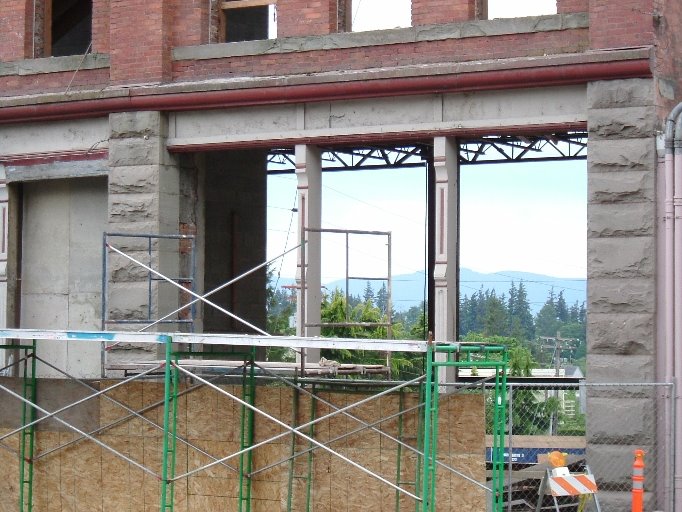
Earlier pictures during reconstruction of Waldron.


As they restore old Waldren Building in Bellingham's Fairhaven District, scenery is visible through the building. Old insides have been gutted as the facade is being preserved. Building was started, I think around 1890, but never totally recovered from economic panic of 1893. Top floor never finished.

Now, 2006, restoration is starting. it is being turned into condominiums and finally finished to the top.


Friday, January 18, 2008

They say "shop till you drop"

Cause it keeps the economy going and there's just a few paychecks between comfort and homelessness. For the sake of economy, people often neglect their health and their sanity. Remember, you're also only a few heartbeats away from dropping.

Thursday, January 17, 2008

Waterfront Theme Park: "The Pulp Mill From Hell"

I had a vision from the future of Bellingham's Central Waterfront. It wasn't as easy to find buyers / tenets for the waterfront redevelopment as many had hoped (or feared), so the port district decided to make the old pulp mill buildings into a haunted house.

A haunted for house for fund raising purposes.

Let's make it a scary theme park. Call it, "The Pulp Mill From Hell."

People came to from all over. The same folks who went to horror movies.

There was the chipper blade to avoid, so as not to get ground up.

Exhibit B: A monster cloud of chlorine gas wiping out the city.

Then, remember that skeleton found in one of the boiler chimneys, back in the 1980s, I think? Still no one knows who that was, as far as I have read, and the ghost can still roam the park.

There was even a tiger roaming around, on loan from the San Francisco Zoo.

Plenty of lore and some fantasy for a fantastic theme park. Ever tried conveyor belt rides?

The theme park was "world class," "extreme sports," but then I woke up from that nightmare.

Monday, January 14, 2008

Living in a room without a million dollar view, but contemplating astronomical things

I can still see fantastic views from space, on the Internet.

Back when I was in high school, I got this brochure about Pioneer 10 and 11 spacecrafts. First to fly past Jupiter.

Pioneer 11 went on to Saturn.

First artificial objects to pass out of solar system. Launched in the early 1970s.

Internet is so much richer than relying on mailed brochures, or a daily newspaper that would often hide space news behind the sports page.

Since Pioneer, two Voyager spacecrafts have ventured out following similar routes. Launched in the mid 1970s.

I think Voyagers are going faster so they are already farther out than the Pioneers.

Also the Voyagers are still sending back signals. They are now exploring the area where solar wind transitions into the "interstellar environment."

Other stars are far out there indeed.

Traveling at Voyager's speed, it would take around 80,000 years to get to another star, but we can still learn about other stars from the rapidly improving telescopes here at Earth.

People might call the astronomer an "ultimate voyeur." Yes, observing and things are often too far away for interaction.

Voyager and voyeur are similar sounding words anyway.

Nothing wrong with that, there is a passive aspect to contemplating things beyond everyday life. Interaction does happen, here on Earth, among scientists and people asking cosmic questions. Often that's "interaction at its best."


Full moon with my low end digital camera. Image taken at Central Ferry Park on Snake River of Eastern Washington during my 2007 bicycle tour.

Bush wants us to go to Mars. People on Mars, but I don't think it's a good idea. Less scientific "bang for the buck."

I'm more interested in spending money for new telescopes, here on Earth. Also in Earth orbit. New telescopes that might actually see planets like Earth around other stars.

Imagine what wonderful conversations might take place in the sauna about such discoveries.

A nicer way of uniting the nation than 911. Actually uniting the world.

Mars doesn't seem that interesting, except for exploration by unmanned and inexpensive robots. Rovers like Spirit and Opportunity that are now serving nobly on the Red Planet.

Colonizing Mars may not be much help. It's kind of a "cheap version" of Earth. Only about 1/3rd the size of Earth.

By the time we would colonize, population growth on Earth will likely be more than 1/3 larger.

We will have already outgrown Mars before we get there.

Someday we'll set human foot on Mars, but I'm not holding my breath.

Back home, we are entering an era of even more exciting astronomical discoveries.

Here in the state of Washington, they are working on LIGO; a gravity wave detector.

LIGO is opening up yet another frontier of discovery. Picturing the universe in gravity waves.

Our LIGO detector is inside the Hanford Reservation; a place noted for old nuclear reactors and the "Hanford Cleanup."

Hanford can mean more than just "cleanup after nuclear activity." It's also a research facility for the future.

Clean energy, solar energy, gravity waves.

There's a lot of dry space out there and potential for exciting projects.

There's also a LIGO detector near Livingston, Louisiana. More to Louisiana than Hurricane Katrina. More to Hanford than "oh what a mess."

We can still look forward to a brighter future.

Last weekend, I saw a great video about LIGO. Called "Einstein's Messengers." See LIGO page and video should be one of the links.

With so many wonderful views on my computer screen, who needs a million dollar view out the window. I can ride my bicycle to such a view in a matter of minutes anyway.

Many people buy telescopes.

Wealthy people can buy bigger telescopes.

I'm not motivated to buy my own telescope since it's images would pale in comparison to photos from something like the Hubble Space Telescope.

Small scopes might be good for watching things and people, here on Earth. Some might call that voyeurism.

Nothing wrong with that.

Years ago, I once had a scope that I used in the park. When I came home, I set it on a table near my window just to put it down somewhere. Wasn't using it in my home, but neighbors across the street saw it sitting by the window. They put a sign in their window reading:

"Hello Neighbor."

Some of the best interactions in the park come from people standing around telescopes. Astronomy clubs have outdoor gatherings. The passersby who stop for a look get into more discussion.


The moon with camera flash turned on to shorten time exposure; automatic camera, or I forgot how to do it manually.

When I was in college, our astronomy class met on top of Haggard Hall for a sky viewing session.

A small telescope was all Western Washington University could afford in those days.

It's usually cloudy here anyway.

Still, we saw some things.

The rings of Saturn, but they are actually more interesting in textbook photos.

Back then, there were textbook images from the 200 inch reflector on Palomar Mountain.

Our little telescope on Haggard Hall was no match. Still, we were seeing with our own eyes, what ever that's worth.

Now we have the Cassini Spacecraft orbiting Saturn.

From the top of Haggard Hall, I suggested we look at things on land. Was wondering what Bellingham would look like in a bigger telescope than, at least I, could afford.

We wouldn't have to peer in windows, let's just look down some street.

My classmates adjusted the scope so it pointed at a Bellingham neighborhood. Then they said, "We have discovered a pulsar!"

It was the beacon at Bellingham Airport.

Monday, January 07, 2008

Lights out in part of Bellingham

Opportunity for a different perspective on some familiar locations.


Bellingham Herald Building in the dark. Like the newspaper being in the dark, but they did get their January 7 edition out.

Must be a headlight from parking lot across street shining in left window.


Auto parts store lit up by car headlights.


Bellingham Food Co-op at corner of Forest and Holly. Some traffic lights were still working as they were on a different circuit.

For a few blocks, that outage lasted several hours. Not Y2K.

Remember Y2K?

A line came down feeding some substation. I notice they have been working on a few substations recently. Must be doing some upgrades. This day's weather was normal.

My workplace was out of power, but I was able to do some cleaning with the LED headlights from my bicycle. They slide off the handlebar mounts and work like flashlights.

It was a memorable day. Day of the downtown power outage.