Coincidentally, US Bank is my bank. Good to see this. I've always thought US Bank was okay. Yes, it's a commercial bank, but I tend to be okay about institutions.
I resisted suggestions for changing over to a credit union during the Occupy Wall Street anger against banks. I had no reason to not like my bank though I have a story that got me to open an account at a credit union, one time.
I used to have a few ads on my website and one of the advertisers was overseas. At that time, US Bank did have a high service charge for depositing an international check so I opened an account at a credit union with a lower charge to deposit that check.
I transferred a bit of money to the credit union and just left it there for several years. Just before the Occupy Wall Street protests started, by coincidence, that credit union suggested I remove the mostly inactive account or face a service charge.
Wanting to simplify my life (I don't have lots of money) I consolidated back to US Bank. My overseas advertiser suggested I use Paypal to deposit overseas checks, so I got a Paypal account.
During the Occupy protests, some friends were suggesting I go to "credit union" versus "commercial bank," but I had just, sort of been ask politely, by that credit union, to close that account.
Basically I've seen no reason to change banks as I tend to be more okay about institutions versus the people; so to speak. One of my favorite concepts is, "We've met the enemy and the enemy is us."
Now I am pleased to read that US Bank is quite friendly to LGBTQ folks.

Showing posts with label occupywallstreet. Show all posts
Showing posts with label occupywallstreet. Show all posts
Wednesday, December 06, 2023

Monday, December 15, 2014
Why blaming the one percent may not be that effective
Since Occupy Wall Street fame, the figure of 1% top income percentile has become a popular meme. Why 1% instead of 2 or even 10%?
1 is a small number so 1% is not that many voters. It's politically expedient to say you are for the 99%. After all, 99% is a mandate that will always win elections, supposedly, tho it often doesn't seem to work that way.
The one percent meme is another manifestation of our search for a painless solution to the problems of society. Government is one tool to solve problems, but taxes which fund the government tend to be unpopular. Therefore, the easiest political solution is to try and impose unpopular things, like taxes, on as few people as possible. If only the 1% has to pay a new tax, then the 99% of voters don't have to pay, so the tax should be able to pass. Right?
For some reason, that doesn't seem to be the case. Do the 1% have so much power that they influence media and voters to literally buy elections?
That's part of the problem, for sure.
Another part of the problem is the percentage of people in the lower 99%, and especially the lower say 50% of income distribution who actually vote. I hear that 2014 election saw the lowest percent of eligible voters to vote since 1942.
Blaming everything on the 1% is a way to absolve oneself of personal responsibility. If social change is to happen, we all have to do our part be it voting or what we support with our dollars in the marketplace. The wealth and power of the 1% still relies on the mass market of shoppers and voters.
What about the top 2%, 10% or even 20% income percentile? America's income gap keeps getting wider between all income classes. Upper middle class has gotten way out ahead of lower middle class and the poor. Why can't so many working people afford medical care, for instance? Are doctor and professional incomes way above what most working people can afford? There's nothing wrong with paying doctors more than average workers due to the education and skills required to be a doctor, but one must ask what's economically sustainable. As planning for affordable healthcare is considered, we have to take into account what is sustainable. What can the premiums, for insurance and/or the taxes for government based healthcare sustain?
Unaffordable housing is another issue that the income gap brings up. How can folks making minimum wage afford to live in a city like San Francisco? Is it the 1% who has bought up all the residences making buying and renting unaffordable for the bottom 50% in that city? San Francisco, supposedly a bastion of liberal politics yet about the most unaffordable city in America.
I'd say it's more than just the top 1% that creates the housing problem. How about the top 10%, or maybe even the top 20%? There are many high paid tech workers, and so forth, who can afford expensive housing. They have crowded lower income classes out of the housing market. Here, the problem is upper middle class. If there isn't enough housing, the upper middle class gets first dibs. That is except for subsidized housing and folks grandfathered into rent control.
So it looks like it's a broader problem than just the 1%. It's society as a whole; to some extent. Everyone has some responsibility. That doesn't let the 1% off the hook, but the problems can't be solved unless more folks take responsibility. Landlords, consumers and voters. We all can make the difference.
I've heard it said that if we just raise taxes on the 1%, there wouldn't be enough money to make that much of a dent in the federal budget. The 1% have lots of money, but there are not very many of them. What about raising taxes on the top 20%? That's a bigger chunk of money. That's what our graduated income tax did before the so called Reagan Revolution.
Maybe some liberals, not to mention conservatives, wouldn't like the idea of taxing the 20% because there is a lot of rhetoric, these days, about the need to strengthen the middle class. Quite a few folks talk about the need to support a large consuming class. As economist Paul Krugman says, mass consumer spending creates more jobs and jump starts the economy more than the wealth of the 1%. Still, I think the upper middle class could do more to bring a fairer society. Seems like the upper middle class is becoming wealthy while the lower middle class is becoming poor. The real middle, in the middle class, is getting a lot thinner. Income distribution is a problem within the middle class leading to affordability problems in things like education, healthcare and housing.
Even lower income people bear responsibility. How we treat one another and our voting patterns do make differences.
Another thing to think about is the natural environment. Middle class consumer spending isn't always a wonderful thing. One has to think about the the carbon footprint, for instance. Mass consumption of gasoline, cars, houses and products has to take the environment into account. Going more green is best in all these things.
Another consideration is not just how much money someone has, but what are they doing with their money. Is someone in the 1% donating millions to good causes, or buying Congress? Is someone in the top percentile building a business and developing new technologies or just buying luxury homes and bidding up the price of everything from real estate to paintings?
There is more to the equation of a better society than just deferring all responsibility to the 1%. Sure, the 1% should pay higher taxes, but it takes the rest of us voters to at least show up at the polls if we want that to happen.
1 is a small number so 1% is not that many voters. It's politically expedient to say you are for the 99%. After all, 99% is a mandate that will always win elections, supposedly, tho it often doesn't seem to work that way.
The one percent meme is another manifestation of our search for a painless solution to the problems of society. Government is one tool to solve problems, but taxes which fund the government tend to be unpopular. Therefore, the easiest political solution is to try and impose unpopular things, like taxes, on as few people as possible. If only the 1% has to pay a new tax, then the 99% of voters don't have to pay, so the tax should be able to pass. Right?
For some reason, that doesn't seem to be the case. Do the 1% have so much power that they influence media and voters to literally buy elections?
That's part of the problem, for sure.
Another part of the problem is the percentage of people in the lower 99%, and especially the lower say 50% of income distribution who actually vote. I hear that 2014 election saw the lowest percent of eligible voters to vote since 1942.
Blaming everything on the 1% is a way to absolve oneself of personal responsibility. If social change is to happen, we all have to do our part be it voting or what we support with our dollars in the marketplace. The wealth and power of the 1% still relies on the mass market of shoppers and voters.
What about the top 2%, 10% or even 20% income percentile? America's income gap keeps getting wider between all income classes. Upper middle class has gotten way out ahead of lower middle class and the poor. Why can't so many working people afford medical care, for instance? Are doctor and professional incomes way above what most working people can afford? There's nothing wrong with paying doctors more than average workers due to the education and skills required to be a doctor, but one must ask what's economically sustainable. As planning for affordable healthcare is considered, we have to take into account what is sustainable. What can the premiums, for insurance and/or the taxes for government based healthcare sustain?
Unaffordable housing is another issue that the income gap brings up. How can folks making minimum wage afford to live in a city like San Francisco? Is it the 1% who has bought up all the residences making buying and renting unaffordable for the bottom 50% in that city? San Francisco, supposedly a bastion of liberal politics yet about the most unaffordable city in America.
I'd say it's more than just the top 1% that creates the housing problem. How about the top 10%, or maybe even the top 20%? There are many high paid tech workers, and so forth, who can afford expensive housing. They have crowded lower income classes out of the housing market. Here, the problem is upper middle class. If there isn't enough housing, the upper middle class gets first dibs. That is except for subsidized housing and folks grandfathered into rent control.
So it looks like it's a broader problem than just the 1%. It's society as a whole; to some extent. Everyone has some responsibility. That doesn't let the 1% off the hook, but the problems can't be solved unless more folks take responsibility. Landlords, consumers and voters. We all can make the difference.
I've heard it said that if we just raise taxes on the 1%, there wouldn't be enough money to make that much of a dent in the federal budget. The 1% have lots of money, but there are not very many of them. What about raising taxes on the top 20%? That's a bigger chunk of money. That's what our graduated income tax did before the so called Reagan Revolution.
Maybe some liberals, not to mention conservatives, wouldn't like the idea of taxing the 20% because there is a lot of rhetoric, these days, about the need to strengthen the middle class. Quite a few folks talk about the need to support a large consuming class. As economist Paul Krugman says, mass consumer spending creates more jobs and jump starts the economy more than the wealth of the 1%. Still, I think the upper middle class could do more to bring a fairer society. Seems like the upper middle class is becoming wealthy while the lower middle class is becoming poor. The real middle, in the middle class, is getting a lot thinner. Income distribution is a problem within the middle class leading to affordability problems in things like education, healthcare and housing.
Even lower income people bear responsibility. How we treat one another and our voting patterns do make differences.
Another thing to think about is the natural environment. Middle class consumer spending isn't always a wonderful thing. One has to think about the the carbon footprint, for instance. Mass consumption of gasoline, cars, houses and products has to take the environment into account. Going more green is best in all these things.
Another consideration is not just how much money someone has, but what are they doing with their money. Is someone in the 1% donating millions to good causes, or buying Congress? Is someone in the top percentile building a business and developing new technologies or just buying luxury homes and bidding up the price of everything from real estate to paintings?
There is more to the equation of a better society than just deferring all responsibility to the 1%. Sure, the 1% should pay higher taxes, but it takes the rest of us voters to at least show up at the polls if we want that to happen.
Thursday, December 29, 2011
Occupy Bellingham camp evicted December 28
Bellingham's camp lasted longer than in some other cities, but eviction orders and police came on December 28. I think the occupation camps may have painted themselves into a corner where it looked like breaking camp would be akin to backing down. Unlike Egypt where people tried to keep occupying the square until Mubarak stepped down, changing USA culture is a longer process. The evolution of society keeps happening. Street protests in rainy weather will be hard to keep the momentum going, but come spring who knows.
Also, 2012 election is coming. While things in USA may not be that bad, like conditions in repressive Middle Eastern countries, the Republican House of Representatives, elected in 2010, is particularly bad. That election pushed things to the extreme, but this too shall pass if people vote.
Are Occupiers "happy campers?" like in the phrase "they were not happy campers."

Bellingham's "occupy camp" is becoming like an alternative community. The city is allowing it to exist, so far. Here's a tent with solar power.
 Composting and recycling. In Bellingham, even some supermarkets do this.
 Of course there is a bike rack.
I'm not in the tent city, but I toured it after the rally.

 After the October 28 rally, some Occupy Bellingham folks set up camp in Maritime Heritage Park. They may not be happy campers about the state of the economy, but hopefully they are happy campers about networking and doing other things that a camp out of social change minded people will do. Seems like some smiles on people's faces, at least the first day. So far, the city has been flexible and allowed them to remain even though camping is normally not permitted in city parks.
There are usually quite a few homeless people sleeping in various nooks and crannies of Maritime Heritage Park anyway. One person pointed out that having the camp out might provide some support for the already homeless around in the park. For instance someone has set up a porta potty. Regular restrooms in that park are usually closed at night, according to article in Bellingham Herald.
Hoover ville?
For several years, Seattle area has had some organized camps for the homeless.
* several blog posts compiled into this one.
Below posted earlier.
The sometimes cumbersome process of consensus governing
One of the "demands" being discussed in the Occupy Bellingham encampment is to make sure that Whatcom Transit Authority plans to give route 331 high priority for use of it's hybrid buses, when those buses become available to the fleet.
Some folks might ask, what does that have to do with Occupy Wall Street?
One of the chants I hear in the marches goes; "This is what democracy looks like."
When the request, about the 331 bus route, came up at an Occupy Bellingham meeting, it got "put on stack;" so to speak, in the lingo of the occupy meetings. A small show of hands came up for "ya" and hardly any hands came up for "nay."
After dropping by the meeting, I Later went home and looked up where the 331 route goes. That route is kind of like an "eclectic protest march in itself." From downtown, it meanders through the city to serve both the Barkley Village and Cordota areas.
According to an article, I read, in Bellingham Herald, the WTA plans to use it's new hybrid buses on routes with a lot of "stop and go." Hybrid vehicles are more advantageous for travel through city traffic than long distance highway application. The 331 seems to meet that criteria anyway; in my book at least.
So, what is the point of Occupy Wall Street? Aren't some of it's demands already resonating with common sense anyway? Aren't many of them already being met?
So far, the local police have allowed Occupy Bellingham's camp to remain in Maritime Heritage Park, as far as I know. I've only visited the camp twice with friends passing through. Noticed the hybrid bus suggestion on a list of proposals hanging from a wall made of plastic tarp.
Looks like the local camp is fairly clean compared to some of what I've been reading about from the media, at least, in other cities. On another wall of plastic tarp was a sign that says, "Drug Free Zone."
I don't know if the occupy movement, by itself, is pivotal to the social evolution that this country is going through. The occupy movement has been successful in getting people to think about problems, like the vast discrepancy of wealth in society. I see the OWS as just another part of the larger process of social evolution that takes place in society.
Also, 2012 election is coming. While things in USA may not be that bad, like conditions in repressive Middle Eastern countries, the Republican House of Representatives, elected in 2010, is particularly bad. That election pushed things to the extreme, but this too shall pass if people vote.
Are Occupiers "happy campers?" like in the phrase "they were not happy campers."

Bellingham's "occupy camp" is becoming like an alternative community. The city is allowing it to exist, so far. Here's a tent with solar power.
 Composting and recycling. In Bellingham, even some supermarkets do this.
 Of course there is a bike rack.
I'm not in the tent city, but I toured it after the rally.

 After the October 28 rally, some Occupy Bellingham folks set up camp in Maritime Heritage Park. They may not be happy campers about the state of the economy, but hopefully they are happy campers about networking and doing other things that a camp out of social change minded people will do. Seems like some smiles on people's faces, at least the first day. So far, the city has been flexible and allowed them to remain even though camping is normally not permitted in city parks.
There are usually quite a few homeless people sleeping in various nooks and crannies of Maritime Heritage Park anyway. One person pointed out that having the camp out might provide some support for the already homeless around in the park. For instance someone has set up a porta potty. Regular restrooms in that park are usually closed at night, according to article in Bellingham Herald.
Hoover ville?
For several years, Seattle area has had some organized camps for the homeless.
* several blog posts compiled into this one.
Below posted earlier.
The sometimes cumbersome process of consensus governing
One of the "demands" being discussed in the Occupy Bellingham encampment is to make sure that Whatcom Transit Authority plans to give route 331 high priority for use of it's hybrid buses, when those buses become available to the fleet.
Some folks might ask, what does that have to do with Occupy Wall Street?
One of the chants I hear in the marches goes; "This is what democracy looks like."
When the request, about the 331 bus route, came up at an Occupy Bellingham meeting, it got "put on stack;" so to speak, in the lingo of the occupy meetings. A small show of hands came up for "ya" and hardly any hands came up for "nay."
After dropping by the meeting, I Later went home and looked up where the 331 route goes. That route is kind of like an "eclectic protest march in itself." From downtown, it meanders through the city to serve both the Barkley Village and Cordota areas.
According to an article, I read, in Bellingham Herald, the WTA plans to use it's new hybrid buses on routes with a lot of "stop and go." Hybrid vehicles are more advantageous for travel through city traffic than long distance highway application. The 331 seems to meet that criteria anyway; in my book at least.
So, what is the point of Occupy Wall Street? Aren't some of it's demands already resonating with common sense anyway? Aren't many of them already being met?
So far, the local police have allowed Occupy Bellingham's camp to remain in Maritime Heritage Park, as far as I know. I've only visited the camp twice with friends passing through. Noticed the hybrid bus suggestion on a list of proposals hanging from a wall made of plastic tarp.
Looks like the local camp is fairly clean compared to some of what I've been reading about from the media, at least, in other cities. On another wall of plastic tarp was a sign that says, "Drug Free Zone."
I don't know if the occupy movement, by itself, is pivotal to the social evolution that this country is going through. The occupy movement has been successful in getting people to think about problems, like the vast discrepancy of wealth in society. I see the OWS as just another part of the larger process of social evolution that takes place in society.
Wednesday, December 14, 2011
Occupy KGO? Former listener via ionospheric skip writes from Bellingham, WA. Now using internet
 KGO transmitter looks like it's behind prison fences when seen from Dumbarton Bridge bike path. Image taken on my 2004 bicycle tour.
Update 2023, last I heard KGO is now a sports gambling station called "The Spread 810."
I've seen an "Occupy KGO" video. A video of that occupy rally, which has since been taken off Youtube. It included former KGO Host John Rothman addressing that rally in front of KGO studios. I remember him saying, "KGO just fired their listeners."
Video may have been taken down when Rothman was invited back on the air at KGO as the station attempted to resurrect some quality talk.
KGO was a popular talk show station in San Francisco that I remember since the late 1960s. I grew up in Pullman, WA. but KGO's signal is heard up and down the west coast at night. Talk shows were booth liberal and conservative. Locally produced; rather than packaged off the network. Quite a forum for many years.
Just a few weeks ago, the new corporation, Cumulus Media, that bought KGO changed the format. Most of the talk show hosts were laid off.
Maybe I should say they almost totally changed the format. Some of hosts have remained, but there's a lot more news and less discussion now. (update 2023. It's all sports talk now).
Constant news can be repetitive.
People are mad, thus the Occupy KGO uprising. There seems to be an occupy everything, these days anyway.
Rather than blowing my stack, I'm now using the internet. It's a relatively new source for talk radio. That's the great thing about the internet. So many choices and talk radio can still thrive. It's just thriving in new ways.
NPR is one of many talk sources available on the net as well as on the air. Since KGO's recent changes, I've started listening to a wonderful forum on KQED. It's hosted by former KGO talk host, Michael Krasney. (Update 2023 now retired, but the forum show continues). Krasney went off KGO years ago and is now on KQED, a listener supported public broadcast station in San Francisco. I've always appreciated Krasney's "nice guy" style. He's not a yeller. There are interesting guests and one can learn a lot.
I listen on-line to Krasney's podcasts. They are archived, by subject. Easy to find the shows that interest me from months of well documented archives.
NPR stations, and the national NPR network, do a good job with archives. Not just a list of show dates, but there are small blurbs on each show to accompany the download link. Who were the guests, what was the book about and so forth.
Working as a custodian, I have lots of time to listen to the radio, but radio waves have trouble penetrating the building I work in. KQED's FM signal didn't make it to Bellingham anyway. That's where the podcast comes in handy. If I'm organized, I can download a bunch of interesting shows from different sources and take them with me. Learn things as I mop the floor.
I hear that KQED is tops in the ratings for San Francisco Bay Area radio. Nice to know as it breaks that old adage "the nice guy finishes last." Krasney does have a "nice guy" sound. There's more to KQED than Krasney, but Krasney's Forum is the only show I've downloaded from so far on that station.
Another talk station I've discovered is Wisconsin Public Radio. WHA, Madison is a flagship for something called the Ideas Network. Plenty of good stuff there.
Commercial talk radio seems to be a dying art, but it has always had its drawbacks. Advertisements pay the bill. As greed gets worse, the time devoted to boring ads goes up while time devoted to interesting talk goes down. Ads were very repetitive. One gets tired of hearing the same ad over and over again. Couldn't they be creative and write more variety in copy?
Listener support and even corporate underwriting seems to be a better model. Classic KING FM, in Seattle, has recently switched to the "listener support underwriting" model of funding. They used to be commercial.
Back at KGO there's still some talk. Weekend host Karel is going strong; so far at least.
One interesting tidbit, Karel is openly gay and he's one of the few hosts they kept. No I don't think the sky is falling for alternative views on the media. I'll still listen to KGO, occasionally, for Karel at least.
Many of the other hosts will be missed. John Rothman with his knowledge of history, Gene Burns, with his formerly libertarian now more Democratic perspective, Bill Wattenburg with his fairly conservative, but uniquely scientific point of view.
Maybe I will not miss Ray Taliaferro as much as he tended to be more of a yeller, but occasionally I'd listen and often agreed with what he said. His liberal perspective was on KGO since the 1970s.
KGO's Cumulus management (Cumulus Corporation) has killed most of talk on that station, but many of these former hosts are, from what I gather, being courted by other stations.
KSCO radio, in Santa Cruz, CA. seems interested and has already had Bill Wattenburg on. It's broadcast range is quite small compared to KGO, but KSCO is also on the Internet.
Rothman, Taliaferro and Burns were recently (Dec. 19) on one of Karel's shows that's not on KGO. Karel is also syndicated on other stations as well as being on the web. On that show, Rothman pointed out that Cumulus didn't fire their hosts, they fired their audience!
The internet is a game changer and my ears remain open.
Saturday, October 29, 2011
Some creative signs from Occupy Wall Street protest in Bellingham
* Compiled from some of my earlier blog posts
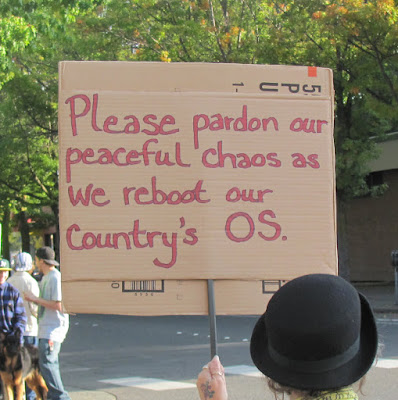 Good message about rebooting our country's operating system, held at Magnolia and Cornwall October 14.
So many issues interrelate. People often ask what Occupy Wall Street is about. I'm not even sure I'm a hundred percent "sold out" fan of Occupy Wall Street, but there is a whole "raft" of interrelated issues being discussed.
I see it as just another part of our cultural "paradigm shift."
Seeking an economy that's better than what we have now. An economy that's more sustainable, in terms of the planet and our own well being. An economy that's more fair, in terms of distribution of income in society.
The income distribution graph, in USA, has gotten out of balance over the past few decades. Continued below.
 Also Occupy Bellingham (the only one I've experienced) is kind of fun. Interesting people. A chance to see friends I haven't run into for a long time.
It's community building that is face to face.
Networking.
The process of culture that's an alternative to other uses of time. Other uses such as shopping, watching TV, fighting traffic and yes, I do spend some of my time at work. I still have a job. I'm not just watching folks on the street playing bongo drums all the time.
Sometimes folks play bongo drums in front of the building my job is in, but that's another story. It's living in Bellingham, our "blue state" (for the most part) city.
 Someone on NPR interviewed an employee who works inside a Wall Street firm in New York City. They ask what people's reaction, inside Wall Street, was to the protests on the outside.
Basically, that person said he thought folks were angry at the wrong thing. Rather than Wall Street, they should be angry at the Federal Reserve for printing too much money and devaluing the dollar, he said.
Federal Reserve has been trying to keep the economy going in face of high unemployment. Also to keep the government debt financed so Uncle Sam "appears" solvent, at least.
One can't really blame them for that.
Seems like the blame can just go round and round which is why I see this as a cultural issue.
It's a "paradigm shift" kind of thing.
In that blog post, I suggested other strategies to deal with unemployment, like job sharing and better distribution of the wealth. Maybe that's considered "spreading the misery," but really, we might do better, as a culture, if we used a bit less. If we had a bit less waste.
A somewhat more austere culture could continue to move forward, since new technology is always coming into the picture anyway. We could still progress toward more of a sense of prosperity.
Prosperity can be defined in different ways.
Much of our new technology points us in the direction of "smaller can be better." A big stereo system from the 1960s isn't necessarily better than an Ipod of 2011, just because it's larger. Smaller is sometimes just as good, if not better.
We need paradigm shifts toward an economy that's better than we've got now. Better, but not necessarily larger or more consuming. An economy that offers a fairer deal to more than just it's top people.
Much of it is about our overall sense of well being.
We may not all define our well being in the same way, but there can be some new consensus about what our priorities are.
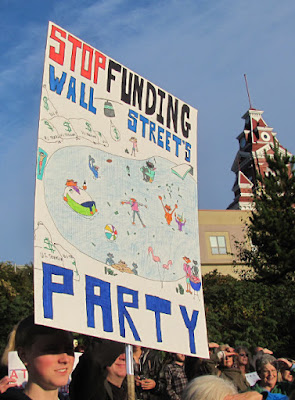
Some signs from Occupy Wall Street protest in Bellingham, October 14 2011.
Below is compilation from some of my posts about the Occupy Movement. I am consolidating blog entries.
One would think folks with savings accounts would march on banks to protest low interest rates
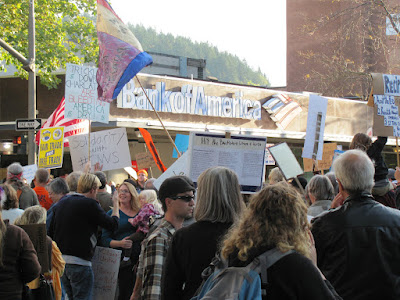 Protest in front of Bank Of America, Bellingham branch October 14 2011.
One would think savers should be marching on the banks demanding better return on savings; rather than just worrying about a $5 per month debit card fee. Maybe the fee is just a tipping point. People are mad at banks.
When I was a kid, banks often paid 5 1/4 interest on savings. Now, interest rates are rock bottom. Bad for savings, but cheap for borrowing; too cheap.
Of course it isn't really the fault of individual banks, it's the world banking system, and things like the Federal Reserve that set overall interest rates.
Part of the reason for the current financial crisis has been interest rates that are too low. When borrowing becomes too cheap, bubbles, such as the housing bubble, get inflated beyond what the normal economy can sustain. There's a disconnect if jobs don't pay much more then $10 per hour while single family homes sell for well over a quarter million.
Video taste of a People's Mike in Bellingham
Segment a bit over 2 minutes.
I see Occupy Wall Street as just another step in the evolution of society
Occupy Wall Street is not necessarily pivotal in the evolution/revolution of our society. It's just another part of the long term paradigm shift toward what can hopefully be a more equitable economy. Also a more sustainable economy.
Important steps, however.
It's good to see so many folks taking interest in the political process and the well being of the community as a whole. Not just personal profits and shortsighted self interests.
Maybe some key congressional races in 2012 will be another step.
It says People's Bank, but the people are protesting
 Another rally of Occupy Bellingham protesters. November 4Th at corner of Magnolia and Cornwall. Rallies have been weekly for the past few weeks.

 Good message about rebooting our country's operating system, held at Magnolia and Cornwall October 14.
So many issues interrelate. People often ask what Occupy Wall Street is about. I'm not even sure I'm a hundred percent "sold out" fan of Occupy Wall Street, but there is a whole "raft" of interrelated issues being discussed.
I see it as just another part of our cultural "paradigm shift."
Seeking an economy that's better than what we have now. An economy that's more sustainable, in terms of the planet and our own well being. An economy that's more fair, in terms of distribution of income in society.
The income distribution graph, in USA, has gotten out of balance over the past few decades. Continued below.
 Also Occupy Bellingham (the only one I've experienced) is kind of fun. Interesting people. A chance to see friends I haven't run into for a long time.
 It's community building that is face to face.
Networking.
The process of culture that's an alternative to other uses of time. Other uses such as shopping, watching TV, fighting traffic and yes, I do spend some of my time at work. I still have a job. I'm not just watching folks on the street playing bongo drums all the time.
Sometimes folks play bongo drums in front of the building my job is in, but that's another story. It's living in Bellingham, our "blue state" (for the most part) city.
 Someone on NPR interviewed an employee who works inside a Wall Street firm in New York City. They ask what people's reaction, inside Wall Street, was to the protests on the outside.
 Basically, that person said he thought folks were angry at the wrong thing. Rather than Wall Street, they should be angry at the Federal Reserve for printing too much money and devaluing the dollar, he said.
Federal Reserve has been trying to keep the economy going in face of high unemployment. Also to keep the government debt financed so Uncle Sam "appears" solvent, at least.
One can't really blame them for that.
Seems like the blame can just go round and round which is why I see this as a cultural issue.
It's a "paradigm shift" kind of thing.
In that blog post, I suggested other strategies to deal with unemployment, like job sharing and better distribution of the wealth. Maybe that's considered "spreading the misery," but really, we might do better, as a culture, if we used a bit less. If we had a bit less waste.
A somewhat more austere culture could continue to move forward, since new technology is always coming into the picture anyway. We could still progress toward more of a sense of prosperity.
Prosperity can be defined in different ways.
Much of our new technology points us in the direction of "smaller can be better." A big stereo system from the 1960s isn't necessarily better than an Ipod of 2011, just because it's larger. Smaller is sometimes just as good, if not better.
We need paradigm shifts toward an economy that's better than we've got now. Better, but not necessarily larger or more consuming. An economy that offers a fairer deal to more than just it's top people.
Much of it is about our overall sense of well being.
We may not all define our well being in the same way, but there can be some new consensus about what our priorities are.

Below is compilation from some of my posts about the Occupy Movement. I am consolidating blog entries.
One would think folks with savings accounts would march on banks to protest low interest rates
 Protest in front of Bank Of America, Bellingham branch October 14 2011.
One would think savers should be marching on the banks demanding better return on savings; rather than just worrying about a $5 per month debit card fee. Maybe the fee is just a tipping point. People are mad at banks.
When I was a kid, banks often paid 5 1/4 interest on savings. Now, interest rates are rock bottom. Bad for savings, but cheap for borrowing; too cheap.
Of course it isn't really the fault of individual banks, it's the world banking system, and things like the Federal Reserve that set overall interest rates.
Part of the reason for the current financial crisis has been interest rates that are too low. When borrowing becomes too cheap, bubbles, such as the housing bubble, get inflated beyond what the normal economy can sustain. There's a disconnect if jobs don't pay much more then $10 per hour while single family homes sell for well over a quarter million.
Video taste of a People's Mike in Bellingham
Segment a bit over 2 minutes.
I see Occupy Wall Street as just another step in the evolution of society
Occupy Wall Street is not necessarily pivotal in the evolution/revolution of our society. It's just another part of the long term paradigm shift toward what can hopefully be a more equitable economy. Also a more sustainable economy.
Important steps, however.
It's good to see so many folks taking interest in the political process and the well being of the community as a whole. Not just personal profits and shortsighted self interests.
Maybe some key congressional races in 2012 will be another step.
It says People's Bank, but the people are protesting
 Another rally of Occupy Bellingham protesters. November 4Th at corner of Magnolia and Cornwall. Rallies have been weekly for the past few weeks.

Thursday, October 06, 2011
Occupy Wall Street is in Bellingham also
 Even though there isn't a street named Wall Street in Bellingham, Occupy Wall Street is here.
 There's a rally planned for corner of Magnolia and Cornwall, Old Federal Building corner, Friday October 7 at 4 to 7 pm.
Someone handed me a flyer that says "all peaceful people and families welcome."
Old Federal Building has been the site of Friday peace vigils for years, since the late 1960s and more recently the location of Food Not Bombs, a free community food table.
Looks like there's going to be quite a turnout in Bellingham as well as other cities all across the nation as people are getting more frustrated with things like long term unemployment, growing disparity between super wealthy and the rest of society, decline of the middle class, cost of the state of war that never seems to end and looming threats of more budget cuts, lack of safety net and other things that folks can add to this list.
On Facebook, I saw an insightful cartoon showing Wall Street executives deciding to "occupy Main Street." On Main Street they found closed businesses, foreclosed houses and high unemployment so they said, "Well, now we know why they have all that free time."
The cartoon brilliantly cuts both ways addressing criticism that "protesters have a lot of time since they don't have to go to work." When unemployment goes up, people are likely to have more time for things like protests and civil disobedience. Executives, be advised.
Above: In front of Bank Of America on Thursday at Holly and Cornwall.
Below: At Holly and State.

 I cut it out of picture accidentally, but it's www.costofwar.com.
Below from a slightly later post.


Subscribe to:
Posts (Atom)