Who's going to pay for the road and transportation construction during Presidential candidate John McCain's proposal for a summer holiday from federal gas taxes?
Much of this revenue now goes to road construction. Will this construction just grind to a halt laying off all those workers? Will future traffic gridlock just get worse due to lack of funding for transportation infrastructure?
Or will construction continue and just be added to the federal debt?
It's so easy to just promise everyone the world and then add it to the debt. Maybe there is no consequence from adding to the debt. It's just like plucking money from the money tree.
Who is not thinking these things through all the way?

Saturday, May 03, 2008

Tuesday, April 29, 2008
Obama Yoga
Barack Obama is a different kind of name than past presidents. Getting used to this would be a stretch for mainstream society, but stretching can be healthy. It's the nation doing Obama Yoga.
Monday, April 28, 2008
Where will people of the city go in the world made by hand?
 Rural like mural on side of urban like apartment building.
Author James Howard Kunstler was recently interviewed on KUOW Radio about his novel titled "World Made By Hand."
Set after cheap oil basically runs out, the novel is about a future vision of society that's largely agrarian. People growing their own food in upstate New York.
Is this the life that follows our current world of suburban sprawl, interstate highways, box stores and Disnyworlds?
I doubt it, or at least I wonder what will happen to the people in places like New York City where there isn't that much land per person to grow food?
It's true that America's suburbs have a lot of problems. Over dependency on the automobile, encroachment on natural habitat, the list is endless, but part of what has driven suburban growth is nostalgia for a lost rural America.
Would Kunstler's "grow your own" vision just add to that nostalgia force for dumping more people into sensitive rural environments?
Suburbs provided the best of both worlds. Modern amenities, but still space for a garden, possibly even a horse. Some folks moved there so they could grow their own food, after collapse of society which has been predicted ever since I can remember, but hasn't happened so far.
It's time to retrofit our suburbs so they work more like the urban centers. The suburbs don't seem to be going away.
Now days, many are drawn to the suburbs by economics. They can't afford to live anywhere else. As traffic and other dysfunctional aspects of suburban life gets worse, the suburbs become less desirable and less expensive than urban settings.
"Less expensive" becomes their appeal.
In Kunstler's vision of a more agrarian society, I wonder what will happen to the urban dwellers who aren't currently spread out across the land and don't have access to soil. Rooftop gardens and vacant lots can help, but it's not enough.
Maybe I should write a "post cheap oil" novel.
My vision would be more recognizable to current American society, but consumption wouldn't be at such an extreme as it is in today's society. Taking the train more often, instead of flying, for instance.
Kunstler, himself, is a big fan of the railroad even though he seems to be flying all over the country promoting his book. While flying from one "book signing" to the next, he comments on the dismal state of America's airlines battered with rising fuel costs. He even suggests a future where electric power isn't even available so most of our high tech toys become trash.
From one extreme world to the next. Today's consumerism all the way back to the 18th century.
I'd say, "if we can have enough technology, organization and energy to run the train, we'll have enough electricity to run the Internet."
Trains can actually be quite impressive, technologically. Internet connections on board. GPS telling when the next train arrives. Good food on board.
It's true that air travel takes a lot more energy per passenger mile than railroads. Unless we can magically harness something like nuclear power and create some sort of hydrogen fuel, air travel is likely to remain in decline.
Maybe I should write a novel.
In my world, the suburbs would be retrofitted into denser, more urban worlds.
Automobiles would be rare while walking and bicycling would be the rage.
Public health would improve. People would be slimmer and sexier, in my opinion.
Public transit would be just about everywhere.
More trains and less planes.
Lifestyles would be less consumer oriented and more bohemian in nature. Folks would have more free time for artistic and cultural activities while living in modest spaces.
Automation could remain, but the human workweek becomes shorter.
"Work less, consume less, live more fully."
Percentage of the population raising families with kids would be smaller, but the fewer kids would inherit a friendlier somewhat quieter world. Eventually a less crowded world.
There would still be the kind of technology that doesn't use lots of energy. High tech electronics for the most part.
Food production would change to some extent, but most people would still shop for their food rather than grow it. Some folks would live on farms, but there would have to be quite a few farmland preservation rules.
Diets would become simpler in my post cheap oil world. Hopefully, people wouldn't be quite as obese as so many of today's folks are. Food from distant parts of the world would become somewhat more expensive, but it could still be available. Much of it would arrive in "sail assisted" cargo ships. Rooftop gardening would become popular, where roofs are strong enough to hold up the weight.
My vision of the world would kind of be like riding the train. Meeting lots of new friends in the dining car who marvel at how much friendlier people are on the train than on a plane.
I haven't had occasion to fly since the early 1980s. Haven't had any book tours with tight schedules.
Maybe I should write a novel.
Tuesday, April 22, 2008
My first Earth Day, 1970 at Pullman High School
1970, I was a freshman in Pullman High School, Pullman, WA. Art and humanities teachers led a tree planting day on the dry grassy bank down from the high school parking lot.
Pragmatic minded and I think more politically conservative, the biology teacher laughed and said he didn't think the trees would "take hold" there. Dry grassy bank was not quite the environment for that type of tree to thrive in; unless someone had time to constantly organize a "watering brigade." Leave it to the biology teacher to figure that out.
That Earth Day planting activity was a beautiful thought, but, sure enough, I think most of the trees died. Maybe a few took hold.
Pragmatic minded and I think more politically conservative, the biology teacher laughed and said he didn't think the trees would "take hold" there. Dry grassy bank was not quite the environment for that type of tree to thrive in; unless someone had time to constantly organize a "watering brigade." Leave it to the biology teacher to figure that out.
That Earth Day planting activity was a beautiful thought, but, sure enough, I think most of the trees died. Maybe a few took hold.
Bio fuel debacle
Yes, there are a wide variety of bio fuels, some better than others, but...
I've always been more excited about reducing dependency on automobiles all together rather than just fueling "car nation" with vegi-fuel.
Transit, bicycles, tele-commuting and denser urban living is the way to go.
In some third world countries, food is becoming real expensive due to competition between eating and driving. Fueling vegi-cars has taken food away from the mouths of people. This is a sad consequence of vegi-driving.
Here in USA, some environmentalists have predicted the demise of our food industry as well. High oil prices means less agri-business-trucking to the supermarkets.
Do they say we should all get cars and move out to the country where we can grow our own food, rather than living in the city where we can walk to work and the supermarket?
Here in the city, food prices have risen a bit, but it's not catastrophic, not here in America at least. We can adjust as we have a lot of agri-business-trucking infrastructure for wiggle room. Rural residents are struggling more with their high gas prices, but food prices go up more modestly.
In some third world countries, the food situation is far worse. Vegi-driving in USA and other places is literally robbing corn from the mouths of people in countries where there is less wiggle room in the "agri-business-trucking" economy to absorb the price.
I'd rather eat my vegetables and then ride my bicycle home from the supermarket.
I've always been more excited about reducing dependency on automobiles all together rather than just fueling "car nation" with vegi-fuel.
Transit, bicycles, tele-commuting and denser urban living is the way to go.
In some third world countries, food is becoming real expensive due to competition between eating and driving. Fueling vegi-cars has taken food away from the mouths of people. This is a sad consequence of vegi-driving.
Here in USA, some environmentalists have predicted the demise of our food industry as well. High oil prices means less agri-business-trucking to the supermarkets.
Do they say we should all get cars and move out to the country where we can grow our own food, rather than living in the city where we can walk to work and the supermarket?
Here in the city, food prices have risen a bit, but it's not catastrophic, not here in America at least. We can adjust as we have a lot of agri-business-trucking infrastructure for wiggle room. Rural residents are struggling more with their high gas prices, but food prices go up more modestly.
In some third world countries, the food situation is far worse. Vegi-driving in USA and other places is literally robbing corn from the mouths of people in countries where there is less wiggle room in the "agri-business-trucking" economy to absorb the price.
I'd rather eat my vegetables and then ride my bicycle home from the supermarket.
Saturday, April 19, 2008
Let the Sonics go to Oklahoma
 I'm not a sports fan anyway.
 I've often thought they should name professional sports teams after corporations rather than the cities they happen to be residing in for the moment. Players come from all over, teams don't really represent the cities they play in anyway. It's basically all about national TV revenue and so forth.
College teams tend to be more about the region and city they are based in. Publicly owned. UW Huskies are not likely to move.
I don't follow sports that much even though I grew up in Pullman, WA. Home of the WSU Cougars who supposedly had a good basketball year, 2007-08 season.
I'd rather ride my bike, go dancing, do aerobics; something more interesting that watching a game on TV. Wait a minute, I don't even have a TV. A computer, yes, but no TV.
* Image of reader board at Whatcom Community College.
Monday, April 14, 2008
Obama's Bitter small town Americans comment
Comments he made at a San Francisco fund raiser suggesting working class people are bitter about their economic circumstances and "cling to guns and religion" as a result.
I think it was a good analysis, at least for some people. That dynamic exists. Maybe not for the majority of folks, but it's out there.
I can see that folks worried about rising cost of gasoline, housing, water would likely blame immigrants, for instance.
More people fighting over scarce resources.
It's a politics of scarcity as Obama mentioned in his speech about race when his preacher's statements were stirring up media comment.
Folks often see the gains of one group at the expense of another. This is especially true when there isn't enough to go around for everyone.
Maybe this dynamic is not how all "small town America" thinks, but it's out there. Obama's comments are insightful, though they may only apply to part of the population.
Too bad it's become a political football rather than being put into perspective.
It's true that no one can paint everyone in small town America, or anywhere else with the same brush. No one can put everyone in a box. Maybe Obama's comments are not even true for the majority of small town folks. On the other hand, they do seem to apply for a fairly large number of people. His suggestions can be the beginnings of interesting discussion rather than political football.
Anyone remember the book "What's Wrong With Kansas?" I've heard some interesting reviews of that book. The issues have some connection.
They were doing a show about blogging on Weekday over KUOW today. The "Obama Bitter" topic was tossed around along with some other subjects. Bloggers were invited to blog about it. I was thinking of writing about this anyway, so here's also my belated contribution.
I think it was a good analysis, at least for some people. That dynamic exists. Maybe not for the majority of folks, but it's out there.
I can see that folks worried about rising cost of gasoline, housing, water would likely blame immigrants, for instance.
More people fighting over scarce resources.
It's a politics of scarcity as Obama mentioned in his speech about race when his preacher's statements were stirring up media comment.
Folks often see the gains of one group at the expense of another. This is especially true when there isn't enough to go around for everyone.
Maybe this dynamic is not how all "small town America" thinks, but it's out there. Obama's comments are insightful, though they may only apply to part of the population.
Too bad it's become a political football rather than being put into perspective.
It's true that no one can paint everyone in small town America, or anywhere else with the same brush. No one can put everyone in a box. Maybe Obama's comments are not even true for the majority of small town folks. On the other hand, they do seem to apply for a fairly large number of people. His suggestions can be the beginnings of interesting discussion rather than political football.
Anyone remember the book "What's Wrong With Kansas?" I've heard some interesting reviews of that book. The issues have some connection.
They were doing a show about blogging on Weekday over KUOW today. The "Obama Bitter" topic was tossed around along with some other subjects. Bloggers were invited to blog about it. I was thinking of writing about this anyway, so here's also my belated contribution.
Sunday, April 13, 2008
Twin Sisters near Highway 9 and Saxon Road

It was a nice day for a Saturday bike ride. Out Mount Baker Highway to Highway 9. Then south on 9 through Acme to Park Road. Took this image near Saxon Road. Then back into town along Lake Whatcom and Lake Louise Roads. Traffic wasn't too bad.
Along Mount Baker Highway, Rome Grange was celebrating it's 100 year anniversary. I got to talking to someone in Bellingham who suggested I go out there, rather than ride to Ferndale just to turn around and come back.
It was fun to stop by there on part of my loop and watch them record a radio drama for American Museum of Radio and Electricity. They also had another skit about the history of Rome Grange. A few antique cars were parked there as well.
Then it was on down the road for the rest of my leisurely route. I think around 45 miles, but I forgot to put on my odometer.

Saturday, April 05, 2008
Are Oil Company Profits Justified?
 Yes there really is an oil company in Idaho named Stinker. Billboard seen near Lewiston, ID. on my 2005 bike trip around the Pacific Northwest.
The best way to deal with excessive salaries of corporate executives in most industry (not just oil) is to increase income taxes for the top tax brackets.
Oil companies are a good example of where personal income taxes can help the public sort out the economics. An oil company can have lots of capital expenses, like building new refinery capacity to keep up with rising demand. Profits can be invested into new refinery capacity, but they can also be siphoned off into executive perks.
Personal income taxes can discourage the perks while still allowing profits to be used for capital investment in the company. This might help our cynical public determine where the money is really going.
Many of the rising expenses of oil companies are legitimate, but when one sees the huge salaries paid to executives it creates distrust.
There are a lot of legitimate reasons why gas prices are rising. The world is reaching so called "Peak Oil" production. After this, production falls but demand keeps rising. Prices go up.
The best way to reduce oil prices is to cut demand. Not just US, but China, India and other places keep using more oil.
I'm sure you've heard all this before.
If we go into a recession, prices are likely to come down as demand cools. Prices would come down for a while at least.
Some right wingers say, "don't tax the rich, it will reduce incentive to get rich and bring on a recession."
Well, a recession can lower prices.
Here's one interesting aside. Not everyone's work is motivated by money. There are business owners who make less than their employees, but they are still motivated by the challenge of having one's own show. Higher income taxes might not always mean less incentive for this reason.
Becoming less dependent on oil is the best long term strategy for controlling oil price hikes. Being less dependent on automobiles would be a great help.
I've never driven a car. The bicycle is my main means of transportation. I always have to throw that tidbit of information in here.
For those who insist on driving, nuclear power and electric cars is one possible scenario. Another scenario is more solar energy and windmills.
Speaking of taxes, with-in our oil/car based economy, I've been hearing about some bad tax policies.
For instance, big tax breaks for SUVs.
They were talking about the tax break for SUVs on Gene Burns evening talk show over KGO radio (April 3).
Amazing what lobbyists can dupe Congress into. Tax incentives to buy SUVs which burn up more gas and lead to higher fuel prices?
Bad idea, but it does create jobs for someone. Detroit unions, automakers?
I hear that some recent survey showed the majority of Californian's say it is a good idea to base the price of car registration on fuel consumption. Guzzling cars pay more, fuel efficient cars pay less.
That's good, but here in Washington State, voters did the opposite a few years back. Tim Eyman's Initiative 695 attempted to lower license tabs to $30 for everyone; thus eliminating any difference between cheaper and more expensive vehicles.
Many of the more expensive cars are SUVs. That initiative passed with flying colors, but it's been modified by legislatures and local governments since.
Voters often shoot themselves in the foot. Washington State has also never voted for an income tax, yet people keep grumbling about the wealthy.
Hopefully Washington voters will be more enlightened in the future. Maybe bigger cars should pay more for license tabs.
Rather than basing license fees on vehicle cost (like was done in pre I-695 days), base it on fuel efficiency? Charge the gas guzzlers more? That's what the survey of (at least) California residents indicated, according to that Gene Burns show.
Of course some poor folks drive gas guzzlers as they can't afford the more efficient cars; especially the hybrids.
Also, now that the used car market is being flooded with gas guzzlers that folks are trying to unload, poor people are buying them.
People should just ride the bus or bicycles in my opinion.
Sunday, March 30, 2008
Early spring snow
 An early spring slushy snow came to Bellingham. Snow is rare near the bay, but cool weather often persists late into season. Fourth of Julys with doors shut and furnaces running can happen, but late July through Sept can get pretty dry.
  Refreshing chill in air felt during bike ride after heated sauna at YMCA with warm conversation. Bike ride might be too chilly otherwise, unless I get a new jacket.
 A pink and white world. Japanese Cherry in the snow.
Saturday, March 29, 2008
Lights out Earth Hour
On the radio I heard, "don't try this if you're driving." I guess you need your headlights. Wait a minute, who's driving if they are that concerned with the Earth?
Friday, March 28, 2008
Part of recently refurbished Lummi totem pole
 With part of Whatcom County Court House in the background. Circles work together.
We're having an unusually cool (early) spring. It's too early to say all of spring will be unusual. I remember some other years with cooler than normal end of March weather. Snow mixed with rain. When I was a kid, my brother called this kind of weather "Snain."
A friend of mine from California is questioning global warming.
Is it global cooling?
There is always a lot of random fluctuation in weather from year to year. The weather is often weired because it's either warmer than normal or cooler than normal. Sometimes it hits "normal" right on the head.
Normal is just the average over many years. In global warming, the "normal" gets slightly warmer as years go by.
Sometimes cool weather feels cooler if one has been used to warmer than normal weather for a while. Also some of our recent migrants from California are thinking the weather is cool. Yes, it's probably cool compared to Sacramento.
Monday, March 24, 2008
Should Nuclear Power Enable Our Lifestyles?
Some folks see nuclear power as a great solution to the global warming / fossil fuel problem. It can be viewed as a convenient source of energy that doesn't emit CO2 gas into the atmosphere and also doesn't rely on declining fossil fuel resources.
Continued below.

Power lines near Enterprise, Oregon. Seen on my 2001 bike tour.
I often find my radio tuning to Bill Wattenburg (actually I'm tuning it myself). He's a weekend talk show host on KGO in San Francisco who often speaks the virtues of nuclear power in getting us out of our fossil fuel jam.
* KGO can be heard all up and down the west coast at night via ionospheric AM radio skip It's also on the web.
Sure, there's solar energy, wind power and some other "more idealistic" sources, but it seems like quite a few people feel that these things are not convenient enough to provide the vast amount of energy needed in our civilization; at least in the near future. Nuclear is already providing much of the electricity used in France, for instance.
I'm not against nuclear and I think it's likely to be part of the solution. On the other hand, here is a question I have been pondering.
"Is it better to fly across America in a jet plane, or ride your bicycle across America?"
Think about it for a bit. Fly across, or bicycle across?
Basically, there really isn't an absolute answer to this question.
It's better to fly across, if one is in a hurry and needs to get to the east coast with-in a few days to attend a wedding for instance.
On the other hand, what if someone wants to sample home cooking at various cafes all across Montana and North Dakota? Then the bicycle might be better. What if one is wishing to be in shape and fight the propensity toward obesity? What if one wants to take lots of pictures? What if one wants to have a good excuse to take several months break from the job routine?
I can think of a lot of reasons to favor bicycling. Still, I'll admit that the bicycle is a big part of my lifestyle. It wouldn't be the answer for everyone, nor probably most of the commerce that runs this society.
Still, much of this society seems like a rat race to me and it can be said that faster isn't necessarily always better.
It's time to have an honest dialog about many of the cultural assumptions we make. Is more consumption always better?
I know many folks who will say, "taking the train is better than flying, driving or bicycling."
Yes, I took the train home after bicycling across USA. Met many interesting people. Train is great for social life.
Continued below.

Spring budding along Interurban trail south of Bellingham.
The nuclear power debate is a good context to bring up these questions about our culture of speed and consumption because there are a lot of people who have trouble stomaching the idea of nuclear power.
There seems to be no magic answer where we can continue the consumptive culture with no lifestyle change, but at the same time, refuse to use technological means, such as nuclear energy, to power that culture.
Remember, solar is "technology also." I'm thinking about some friends who say there can't be a "technology fix."
So, how about a lifestyle fix? Are these friends addicted to their cars?
There's an old phrase that goes, "if you're not part of the solution, you're part of the problem."
Now you might be asking, "how can nuclear power run an airplane?"
There are several answers to that question as well. One being that nuclear could produce a lot of our electricity, rather than coal; thus freeing up more fossil fuel capacity (both in the atmosphere and the ground) to keep the planes running for a while at least. Keep things going for the next few decades.
Also, electricity can power vehicles directly (maybe not aircraft now days at least).
Hydrogen fuel can be made from an abundant source of power, such as nuclear. This can be a non carbon fuel for vehicles and aircraft.
Sure, I think wind, solar and other idealistic "green" technologies can offer more promise than some of the advocates of nuclear might be willing to admit; especially in the somewhat more distant future. On the other hand, it seems like nuclear will be part of the mix. A dialog about lifestyles and culture needs to be part of the mix as well.
Do we really need to live in such a fast paced, consumptive society? I hate to be dogmatic and say, "bicycling is better," but I think bicycling can play a bigger part of the mix. Also downsizing. Smaller houses, more compact neighborhoods, even shorter workweeks, less consumption, more quality social life and family time.
Many years ago, I heard another radio personality, Paul Harvey, speak disparaging about a possible future of "bearded bicyclists" versus the promise of some energy company.
I'm not too much of an alarmist against energy production, but show me where the bearded bicyclists are. I think they're sexy.
Worse fates can befall our society. I like slender cyclists, bearded or not.
Speaking of lifestyles and sexuality, let's not forget, reducing population growth. That's a big part of the equation that so often gets overlooked.
So many issues are interconnected, it's impossible for me to use compartmental thinking.
Solutions can come from quite a few different directions such as technology, but also cultural change.
Speaking of technology, radio is one of the more efficient things out there. KGO's signal, that brings me Bill Wattenburg's discussion of nuclear power, is 50,000 watts. At night (thanks to ionospheric skip) 50,000 watts can blanket the entire west coast of this nation. When I do the math and convert this to horsepower, 50,000 watts equals less horsepower than a lot of your average automobile engines.
Continued below.

Radio is an old example of very efficient technology.
In this age of changing technologies, how much energy does day to day commerce require?
Think about it for a while.
Continued below.

I often find my radio tuning to Bill Wattenburg (actually I'm tuning it myself). He's a weekend talk show host on KGO in San Francisco who often speaks the virtues of nuclear power in getting us out of our fossil fuel jam.
* KGO can be heard all up and down the west coast at night via ionospheric AM radio skip It's also on the web.
Sure, there's solar energy, wind power and some other "more idealistic" sources, but it seems like quite a few people feel that these things are not convenient enough to provide the vast amount of energy needed in our civilization; at least in the near future. Nuclear is already providing much of the electricity used in France, for instance.
I'm not against nuclear and I think it's likely to be part of the solution. On the other hand, here is a question I have been pondering.
"Is it better to fly across America in a jet plane, or ride your bicycle across America?"
Think about it for a bit. Fly across, or bicycle across?
Basically, there really isn't an absolute answer to this question.
It's better to fly across, if one is in a hurry and needs to get to the east coast with-in a few days to attend a wedding for instance.
On the other hand, what if someone wants to sample home cooking at various cafes all across Montana and North Dakota? Then the bicycle might be better. What if one is wishing to be in shape and fight the propensity toward obesity? What if one wants to take lots of pictures? What if one wants to have a good excuse to take several months break from the job routine?
I can think of a lot of reasons to favor bicycling. Still, I'll admit that the bicycle is a big part of my lifestyle. It wouldn't be the answer for everyone, nor probably most of the commerce that runs this society.
Still, much of this society seems like a rat race to me and it can be said that faster isn't necessarily always better.
It's time to have an honest dialog about many of the cultural assumptions we make. Is more consumption always better?
I know many folks who will say, "taking the train is better than flying, driving or bicycling."
Yes, I took the train home after bicycling across USA. Met many interesting people. Train is great for social life.
Continued below.

The nuclear power debate is a good context to bring up these questions about our culture of speed and consumption because there are a lot of people who have trouble stomaching the idea of nuclear power.
There seems to be no magic answer where we can continue the consumptive culture with no lifestyle change, but at the same time, refuse to use technological means, such as nuclear energy, to power that culture.
Remember, solar is "technology also." I'm thinking about some friends who say there can't be a "technology fix."
So, how about a lifestyle fix? Are these friends addicted to their cars?
There's an old phrase that goes, "if you're not part of the solution, you're part of the problem."
Now you might be asking, "how can nuclear power run an airplane?"
There are several answers to that question as well. One being that nuclear could produce a lot of our electricity, rather than coal; thus freeing up more fossil fuel capacity (both in the atmosphere and the ground) to keep the planes running for a while at least. Keep things going for the next few decades.
Also, electricity can power vehicles directly (maybe not aircraft now days at least).
Hydrogen fuel can be made from an abundant source of power, such as nuclear. This can be a non carbon fuel for vehicles and aircraft.
Sure, I think wind, solar and other idealistic "green" technologies can offer more promise than some of the advocates of nuclear might be willing to admit; especially in the somewhat more distant future. On the other hand, it seems like nuclear will be part of the mix. A dialog about lifestyles and culture needs to be part of the mix as well.
Do we really need to live in such a fast paced, consumptive society? I hate to be dogmatic and say, "bicycling is better," but I think bicycling can play a bigger part of the mix. Also downsizing. Smaller houses, more compact neighborhoods, even shorter workweeks, less consumption, more quality social life and family time.
Many years ago, I heard another radio personality, Paul Harvey, speak disparaging about a possible future of "bearded bicyclists" versus the promise of some energy company.
I'm not too much of an alarmist against energy production, but show me where the bearded bicyclists are. I think they're sexy.
Worse fates can befall our society. I like slender cyclists, bearded or not.
Speaking of lifestyles and sexuality, let's not forget, reducing population growth. That's a big part of the equation that so often gets overlooked.
So many issues are interconnected, it's impossible for me to use compartmental thinking.
Solutions can come from quite a few different directions such as technology, but also cultural change.
Speaking of technology, radio is one of the more efficient things out there. KGO's signal, that brings me Bill Wattenburg's discussion of nuclear power, is 50,000 watts. At night (thanks to ionospheric skip) 50,000 watts can blanket the entire west coast of this nation. When I do the math and convert this to horsepower, 50,000 watts equals less horsepower than a lot of your average automobile engines.
Continued below.

Radio is an old example of very efficient technology.
In this age of changing technologies, how much energy does day to day commerce require?
Think about it for a while.
Sunday, March 23, 2008

Wednesday, March 19, 2008
Fifth anniversary of Iraq War
Actually it's "Iraq War Phase 2." Phase 1 started more like 17 years ago.
Remember Desert Shield? Then Desert Storm? Then the questions, "why didn't they go all the way and get Saddam Hussein?"
Well, now we know. It may even be worse after Saddam, if that's believable.
The more USA tries to fix things, the worse things get, it seems like.
Road to hell is paved with good intentions, or maybe tainted intentions.
Part of the problem is petrodollars going to dictators over the years. Going to terrorist groups. Seems like the situation is tainted by world demand for oil with it's heightened concern about the Persian Gulf.
Can our economy survive an interruption of Persian Gulf oil, or do we have to make sure, at all cost, that this never happens?
To some extent, maybe we need to address these issues domestically, rather than so much through foreign policy.
What type of transit and pedestrian planning do our local governments have?
I know people who have traveled the world by jet plane, but still haven't figured out how to get across their own town using alternative transportation.
Our domestic situation taints the way we deal with the world. Better domestic planing can lead to better foreign policy.
Remember Desert Shield? Then Desert Storm? Then the questions, "why didn't they go all the way and get Saddam Hussein?"
Well, now we know. It may even be worse after Saddam, if that's believable.
The more USA tries to fix things, the worse things get, it seems like.
Road to hell is paved with good intentions, or maybe tainted intentions.
Part of the problem is petrodollars going to dictators over the years. Going to terrorist groups. Seems like the situation is tainted by world demand for oil with it's heightened concern about the Persian Gulf.
Can our economy survive an interruption of Persian Gulf oil, or do we have to make sure, at all cost, that this never happens?
To some extent, maybe we need to address these issues domestically, rather than so much through foreign policy.
What type of transit and pedestrian planning do our local governments have?
I know people who have traveled the world by jet plane, but still haven't figured out how to get across their own town using alternative transportation.
Our domestic situation taints the way we deal with the world. Better domestic planing can lead to better foreign policy.
Hard time for horses
 There was a recent show on the radio about how much harder it is to own horses as the price of fossil fuels rise.
 Some folks might say, declining fossil fuel era could bring back horsepower, but I would think not.
It takes trucks to bring in the hay. Trucks to take horses around to shows, the vets and so forth.
Land is getting more expensive and more hay fields are turning into grain crops for bio fuel consumption, rather than feeding horses.
Prices for horses are going down and it's harder to unload them, if one is stuck with a horse.
Horses are not really used for energy anymore and they take a lot of energy to maintain. They are kind of a throwback to the past.
Another radio show about some big solar power farms is more likely a wave of the future. NPR Science Friday March 14, Solar Power Scales Up.
Solar farms instead of horse farms.
One time I was bicycling over White Pass (US Highway 12 in 1986) on a hot day. At one of my many rest stops, a truck with horse trailer was stuck along side the road.
Vapor lock.
The drivers marveled as I started to pass them on my bike. Then I stopped again for conversation.
I suggested they hitch up the horses and pull the rig.
That was just good for a few laughs.
Eventually I biked on.
To be totally fair, I am sure the truck and horse trailer got into Yakima well before me. Eventually they got it going again and passed me on down the road, but they expected to get into Yakima a lot sooner. I didn't expect to get there till late evening anyway.
For me, it was a fun day.
I guess one could say, "horses are a hassle."
Thursday, March 13, 2008
Peak Oil Coming, Don't Plant a Garden
Gardens are nice, but I bet a lot of people are struggling with gas prices and mortgage costs just so they can have a place with a garden.
Continued below.

I can bike to flowering trees. Spring is on it's way.
I live in a small rented room where there is no garden space, but it's just a short walk to the grocery store. Also a short walk to work.
Some survivalists fear that oil prices will cause a collapse down our food chain from fertilizers to the trucking industry. Oil does play a part in food production, but it's only a part. Prices at the grocery store have risen, due in part to energy costs, but energy is only a slice of the overall food cost pie.
At the grocery store, these price hikes are still mild compared to the relentless rise in health care costs that Americans have been enduring for years. Also the relentless rise in property values and in some cases rents that has taken place until just the last year.
Now property values are starting to drop to almost more reasonable levels. Southern California, still well over $400,000 single family home. Amazing how expensive home ownership can be.
As for energy costs, yes it does ad a bit to the cost of food. What's more devastating is the cost of commuting. Remember the phrase, "drive till you qualify?"
Those who live closer to jobs and errands might be less likely to have garden space, but the savings in automobile cost can be great.
Density.
Then there are community gardens that people can lease space in, if they have the time. If they have the time after working full time and trying to hang on to their health insurance.
Gardens are nice if one can afford the space to have one. Also I am glad someone is still farming so there can be food in the grocery store.
Also remember, there are people still planting flower gardens. Rather than always being practical, they are still bringing color to this world. That's nice, especially as I am biking and taking the time to smell the roses.
Glad I've never learned to drive a car and it's good to be healthy. Enjoy exercise.
Continued below.

I live in a small rented room where there is no garden space, but it's just a short walk to the grocery store. Also a short walk to work.
Some survivalists fear that oil prices will cause a collapse down our food chain from fertilizers to the trucking industry. Oil does play a part in food production, but it's only a part. Prices at the grocery store have risen, due in part to energy costs, but energy is only a slice of the overall food cost pie.
At the grocery store, these price hikes are still mild compared to the relentless rise in health care costs that Americans have been enduring for years. Also the relentless rise in property values and in some cases rents that has taken place until just the last year.
Now property values are starting to drop to almost more reasonable levels. Southern California, still well over $400,000 single family home. Amazing how expensive home ownership can be.
As for energy costs, yes it does ad a bit to the cost of food. What's more devastating is the cost of commuting. Remember the phrase, "drive till you qualify?"
Those who live closer to jobs and errands might be less likely to have garden space, but the savings in automobile cost can be great.
Density.
Then there are community gardens that people can lease space in, if they have the time. If they have the time after working full time and trying to hang on to their health insurance.
Gardens are nice if one can afford the space to have one. Also I am glad someone is still farming so there can be food in the grocery store.
Also remember, there are people still planting flower gardens. Rather than always being practical, they are still bringing color to this world. That's nice, especially as I am biking and taking the time to smell the roses.
Glad I've never learned to drive a car and it's good to be healthy. Enjoy exercise.
Wednesday, March 12, 2008
Time to invest?
Every once in a while, I put a few hundred dollars into my broad based mutual fund. This might be a good time to buy as the stock portion of that fund is low, but who knows. It could fall still lower. At least I'm not putting a huge chunk of money in. Just contributing some now and then to see how it goes.
It's slowly building up. Even in these turbulent times, my mutual fund isn't doing that bad. Even if it does dip for a while, I know that a lot of folks are in the same boat. In the long run, it seems to go up slowly.
I don't have a lot of money, but something is probably better than nothing.
No, I don't think the end of the world is coming yet. Not in our lifetimes at least. I've been hearing about the collapse of civilization ever since I was in Middle School. That was clear back in the late 1960s. It hasn't happened yet.
I guess if we do get to a point where we run out of food, I can eat my words.
It's slowly building up. Even in these turbulent times, my mutual fund isn't doing that bad. Even if it does dip for a while, I know that a lot of folks are in the same boat. In the long run, it seems to go up slowly.
I don't have a lot of money, but something is probably better than nothing.
No, I don't think the end of the world is coming yet. Not in our lifetimes at least. I've been hearing about the collapse of civilization ever since I was in Middle School. That was clear back in the late 1960s. It hasn't happened yet.
I guess if we do get to a point where we run out of food, I can eat my words.
Sunday, March 09, 2008
Book and mortar instead of brick and mortar. Are large library buildings still needed?
 Bellingham is outgrowing it's popular library.
 Scott Ayer's column in Bellingham Herald has had some interesting thoughts about the proposal for a new city library.
There's the question, do we really need a new library since many functions of the library can be done on the Internet? Research, for instance. Quite a few books are now on-line. Libraries provide spaces for community gatherings with conference rooms, but there are chat rooms and other forms of interaction on the Internet.
One cost estimate for the new library would be around 54 million.
City of Bellingham has put the idea on hold for a while.
I say, thank God there is the Internet. The gathering of community in real space can get expensive as well as problematic. Still, like so many people, I do prefer face to face interaction. People also like real things, like books made out of paper that one can hold.
On the other hand, there are problems in society that prevent face to face community as well as access to a wide variety of real items such as books. Paper books take lots of space and real estate is expensive. The city does own the land under our proposed library, but 54 million for a new facility is a chunk of change.
"Real" can be expensive especially when real estate is expensive.
I'm sure they wonder if a new library bond would pass with all those other straws on the taxpayer's back. Also there's the higher cost of maintaining a larger facility. Something that would still have to be calculated into our city's ongoing budget.
Folks often blame the Internet for generations of Americans who don't interact much in person.
Well, I think this problem is more related to economics. Can taxpayers afford such things as libraries and community centers?
Continued below.

There are many forces in society that keep people isolated from one another. Isolated and insular; especially in the sprawling suburbs.
Many neighborhoods don't even have sidewalks. The amount of time folks spend alone in automobiles just getting to work is phenomenal.
Speaking of work, the lack of time for friends and conversation is a problem. Everyone seems so busy. Folks are often are kept busy with trivial pursuits, such as ringing up orders for soda pop at a cash register.
In our fast pace world, thank God there is the Internet. At least there's some interaction on the net and it is great to have such a wide variety of reading material at one's fingertips. More than a single library could afford.
Don't blame the Internet for the dumbing down of America, or people's lack of face to face community. There are a lot of trends in society that create this environment. Things like economic forces and even lack of sidewalks.
The automobile is a big culprit. Interesting to note that part of the cost of a new library is the parking garage. Estimated cost of 4.8 million for roughly 123 parking spaces. That's $39,000 per parking spot.
Maybe folks should be asked to meet their neighbors face to face on the bus.
I'm generally in favor of things like building a new library, but people sometimes call me a "tax and spend liberal."
Saturday, March 08, 2008
My old monitor
 Was sitting in my closet, but I don't have much space. Haven't gotten around to bringing it to the Restore, or some spot for recycling. Also they charge to recycle old computers into precious metals. At least keeping it away from toxic landfills.
 Then a friend needed a monitor, so I brought it to her. Still works, but the red isn't always there. Must be a faulty red on the electron gun. Good enough for her till she gets hers fixed. Then she can recycle it.
It was one of the more unusual loads on my bicycle. Rode carefully and used plenty of bungy cords. She lives about 2 miles from me, maybe not quite.

Monday, March 03, 2008
It's just money
The phrase "Money doesn't always buy happiness" may be worn out, but death of a top Microsoft Millionaire from suicide can underscore this point. Ric Weiland retired a rich man at age 35 in 1988, according to a Seattle Times article. More recently he suffered from depression and committed suicide in 2006.
At least he left lots of money to various causes. 160 million worth.
This included 65 million for several gay rights organizations. More than 19 million to the Seattle based Pride Foundation.
While "high finance" seems a long way from me, I do remember some local things that Pride Foundation is starting to effect.

Image from March 2005 Pride Foundation newsletter. Group photo of people who showed up at a meeting in Bellingham as the foundation discusses becoming more active in this area. I'm in that picture with my bicycle helmet.
Recently, even before that huge donation, Pride Foundation has been getting more active in Bellingham area as it works to build community beyond just the Seattle area.
It will be good to see this organization do more in various outlying parts of the Pacific Northwest such as Montana, Spokane, Yakima, Alaska and here in Bellingham. They sponsor a lot of community building events, educational activities and scholarships.
At least he left lots of money to various causes. 160 million worth.
This included 65 million for several gay rights organizations. More than 19 million to the Seattle based Pride Foundation.
While "high finance" seems a long way from me, I do remember some local things that Pride Foundation is starting to effect.

Image from March 2005 Pride Foundation newsletter. Group photo of people who showed up at a meeting in Bellingham as the foundation discusses becoming more active in this area. I'm in that picture with my bicycle helmet.
Recently, even before that huge donation, Pride Foundation has been getting more active in Bellingham area as it works to build community beyond just the Seattle area.
It will be good to see this organization do more in various outlying parts of the Pacific Northwest such as Montana, Spokane, Yakima, Alaska and here in Bellingham. They sponsor a lot of community building events, educational activities and scholarships.
Backed by the full faith and credit of the United States government
Ironically, the most secure investments are said to be things like US savings bonds. Yet the US government is now around 9 trillion dollars in debt. If the government were a corporation, it's bonds would likely be in the "junk bond" category. If accountants were evaluating the government in terms of future liabilities versus future income, it would look scary. Future liabilities include things like Social Security, interest on the deficit, Medicare and all the other obligations of the US government. Future income would be the ability to raise money from taxes and other income sources such as user fees for services.
It sure looks like liabilities out pace potential revenue. Scary.
I guess US savings bonds are still about the most reliable investment out there because the government owns the mints where US dollars are printed.
This comment inspired after I listened to an interesting hour on the Bob Brinker Money Talk show about the problem of the deficit. He interviewed an interesting author, but of course I forgot some of the details. Still, my mind keeps spinning.
It sure looks like liabilities out pace potential revenue. Scary.
I guess US savings bonds are still about the most reliable investment out there because the government owns the mints where US dollars are printed.
This comment inspired after I listened to an interesting hour on the Bob Brinker Money Talk show about the problem of the deficit. He interviewed an interesting author, but of course I forgot some of the details. Still, my mind keeps spinning.
Friday, February 29, 2008
Voting with wheels
Automobile travel isn't just the American way of life, but it's often associated with American culture.
Now much of the rest of world population is also trying to adopt that way of life. Voting with their wheels so to speak in places like India and China. This pushes up worldwide demand for oil, faster than the supply can keep up.
As Americans kind of pat themselves on the back for having lifestyles which much of the world emulates, that "success" makes the lifestyle less affordable. Oil now pushing 103 dollars per barrel. The price of popularity. It's being on the "beaten path."
Now it's time to look for less beaten paths.
Now much of the rest of world population is also trying to adopt that way of life. Voting with their wheels so to speak in places like India and China. This pushes up worldwide demand for oil, faster than the supply can keep up.
As Americans kind of pat themselves on the back for having lifestyles which much of the world emulates, that "success" makes the lifestyle less affordable. Oil now pushing 103 dollars per barrel. The price of popularity. It's being on the "beaten path."
Now it's time to look for less beaten paths.
Monday, February 25, 2008
Leisurely bicycle pedal to Ferndale River Walk and back
Spring must be on it's way. Last Saturday was great. I biked up to Ferndale and checked out the River Walk. It's new. Nothing spectacular, but pleasant.
Strolling in the slow lane.

Nice view across Nooksack River.

From Ferndale, I rode to Hovander County Park. This is what a lot of outsiders picture Whatcom County being like. Pastoral with Mount Baker in background. More and more of the county is becoming sprawl as people tend to love the country to death. Baker is normally hidden in clouds or haze. Hoovander Homestead is saved because it's actually a park. However there is a growing farmland preservation movement in this area.

One can climb up this tower for more vista, plus the tower's shadow.

Hovander is nice, but more of the county is like this (below Main St. to Axton Way); traffic. Still tolerable if there's a shoulder.
Coming back home, I took a bike trail that follows the dike along Nooksack River. It went from Hovander Park to Slater Road. Path goes on south, but Slater is a better road to come back on since it has a shoulder even though it's full of casino traffic.

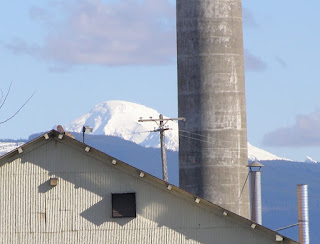
My favorite way back into town is down Bennett to Marine and Eldridge. Mountain still visible behind historic smokestack of Oeser Cedar. Some people think, "toxic site." Yes, I've read some things about that cedar mill, but I forget exactly what, except it does have some local history. Did I read that this was the oldest large smokestack in town? Or maybe I'm mixing up two articles.
Anyway, a leisurely Saturday on my bicycle.
Strolling in the slow lane.

Nice view across Nooksack River.

From Ferndale, I rode to Hovander County Park. This is what a lot of outsiders picture Whatcom County being like. Pastoral with Mount Baker in background. More and more of the county is becoming sprawl as people tend to love the country to death. Baker is normally hidden in clouds or haze. Hoovander Homestead is saved because it's actually a park. However there is a growing farmland preservation movement in this area.

One can climb up this tower for more vista, plus the tower's shadow.

Hovander is nice, but more of the county is like this (below Main St. to Axton Way); traffic. Still tolerable if there's a shoulder.
Coming back home, I took a bike trail that follows the dike along Nooksack River. It went from Hovander Park to Slater Road. Path goes on south, but Slater is a better road to come back on since it has a shoulder even though it's full of casino traffic.

My favorite way back into town is down Bennett to Marine and Eldridge. Mountain still visible behind historic smokestack of Oeser Cedar. Some people think, "toxic site." Yes, I've read some things about that cedar mill, but I forget exactly what, except it does have some local history. Did I read that this was the oldest large smokestack in town? Or maybe I'm mixing up two articles.
Anyway, a leisurely Saturday on my bicycle.

Saturday, February 23, 2008
Over The Rainbow Festival, Mount Vernon, thought provoking
 A friend gave me a ride down to Mount Vernon for the first part of Over The Rainbow Festival sponsored by Mount Vernon High School Gay/ Straight Alliance.
 It was a showing of the film "For The Bible Tells Me So" in M.V. High School's ornate old theater. There was also a very thought provoking discussion afterwards.
It's great to see discussion of these issues in a high school setting. Congratulations to all the folks who put this ground breaking festival together.
I wasn't able to be there for the workshops on Saturday, but glad to see the Friday night kickoff.
While most of the audience was supportive of the film, there were a few folks who were critical of the film's viewpoint. The discussion was good as it went beyond just "preaching to the choir" so to speak. I sort of felt for the few opposing voices in the discussion as it must feel kind of funny being in a room of people who are mostly disagreeing with your views.
As a lot of different perspectives on religion were discussed, one person ask if folks believe in any absolutes at all.
Several folks offered some good responses, but I didn't say anything at all. There were a lot of ideas floating about and time was limited. Also, I'm kind of shy about raising my hand.
What I would have said about absolutes would have been my thought that it's kind of presumptuous of us humans to assume that our interpretations of things are necessarily the "absolutes." Yes, maybe there are absolutes, but fundamentalists of various religions tend to think their own interpretations of things are the absolutes. That seems kind of presumptuous to me.
I'd rather think we are all learning and evolving.
Also I often say to people who think they know what the absolutes are this humbling concept. There's an old phrase which says, "Christians are forgiven, but not perfect." To me, this can mean a lot of room for dialog, rather than just saying "We know the absolute." "End of discussion."
Another person pointed out an interesting theological point. It made an impression on me. He said (if I can paraphrase it properly).
"The past has a vote, but not a veto."
To me, that means when people say "the Bible says this or the Bible says that" (other religious documents also), it has input worth considering, but there's more to the equation than just "We read that you must do (or not do) such in the Bible."
Ideas about ethics, right and wrong and so forth are good food for dialog and a reason to put on one's thinking cap.
It was a thought provoking evening. The kind of thing I often enjoy while living my life in Theslowlane.
Wednesday, February 20, 2008
I missed the crowds at the Democratic caucuses
I've been dancing quite a bit and enjoying it a lot. Hard to put the experience into words.
On another note, I rested the day of the Democratic party caucuses in Washington State. Didn't have a strong opinion as to whether Obama or Clinton should get nomination.
Either is OK with me.
I am looking forward to a new Democratic president, if the Democrats win in November.
Was amused that some folks complain about lack of parking around caucus locations. Progressive people should be taking the bus or riding bikes, not using the Middle Eastern oil.
At least the lack of parking means that more folks than expected showed up to participate in the political process. Often Washingtonians think it's already a "done deal" before our state puts it's "two bits" in. Well, this year, it was still an open race. Now it looks like Obama has the momentum, or as was said during an earlier (I think 1988 Bush SR. campaign) "The big Mo."
Could be a new inspiration for jump starting the political landscape. I'll take either Obama or Clinton.
Figured there was a lot of people at the caucus anyway and I didn't want to face all those folks while getting over a slight cold.
Maybe I should have gone and suggested a plank in the platform about alternative transportation and bicycling to the caucus locations. The revolution starts at home.
I went to one caucus and then the county convention in 1988.
It was interesting.
1988 Whatcom County Convention was held in the Sehome High School Cafeteria.
As people were debating the fine points of some platform amendment at the end of the convention, cheerleaders were out in the hall waiting to use the room.
One person said,
"The last platform item is about to be determined by eviction."
It was time for the convention to vacate that room and turn it over to cheerleader practice.
That was 1988. Now, it's a new day.
On another note, I rested the day of the Democratic party caucuses in Washington State. Didn't have a strong opinion as to whether Obama or Clinton should get nomination.
Either is OK with me.
I am looking forward to a new Democratic president, if the Democrats win in November.
Was amused that some folks complain about lack of parking around caucus locations. Progressive people should be taking the bus or riding bikes, not using the Middle Eastern oil.
At least the lack of parking means that more folks than expected showed up to participate in the political process. Often Washingtonians think it's already a "done deal" before our state puts it's "two bits" in. Well, this year, it was still an open race. Now it looks like Obama has the momentum, or as was said during an earlier (I think 1988 Bush SR. campaign) "The big Mo."
Could be a new inspiration for jump starting the political landscape. I'll take either Obama or Clinton.
Figured there was a lot of people at the caucus anyway and I didn't want to face all those folks while getting over a slight cold.
Maybe I should have gone and suggested a plank in the platform about alternative transportation and bicycling to the caucus locations. The revolution starts at home.
I went to one caucus and then the county convention in 1988.
It was interesting.
1988 Whatcom County Convention was held in the Sehome High School Cafeteria.
As people were debating the fine points of some platform amendment at the end of the convention, cheerleaders were out in the hall waiting to use the room.
One person said,
"The last platform item is about to be determined by eviction."
It was time for the convention to vacate that room and turn it over to cheerleader practice.
That was 1988. Now, it's a new day.
Wednesday, February 13, 2008
Restaurants come and go in Bellingham
 When a business closes, sometimes the implication is to "take it easy."
 Can you still afford a place to reside? Housing has gotten so expensive over the past few years in many markets that it's hard for the economy to sustain it.
At least there's no shortage of chairs.
These chairs seen through a window of the old Boss Tweed's Restaurant. Building now used for catering.
Tuesday, February 12, 2008
Born too soon? Very interesting radio show about UW professor Lionel Pries
February 7th 2008 Sound Focus show on KUOW is worth hearing. The archives are permanent.
Architecture professor Lionel Pries was highly regarded at University of Washington. Many of his students went on to design things like the Space Needle. He received a standing ovation at some national convention in 1958, but 6 months later he was out of a job. It was found out that he was gay. In many ways, the social climate was really harsh back then.
The last 10 years of his life were lived in obscurity till his death in 1968; one year before Stonewall.
Now it's 40 years later and the story is finally coming out. Professor Jeffrey Ochsner spent the last 15, or so years piecing together the story that's been hidden all those years. Radio Interview tells it better than me, but I was practically glued to my radio.
It makes me think about how society has improved in many ways since the 1950s.
Imagine what life could be like for future generations.
February 22-23 2008 will be an Over the Rainbow Festival at Mount Vernon High School.
Mount Vernon, WA. is about 23 miles south of here.
The high school has a Gay / Straight Alliance which is sponsoring this festival along with Skagit Valley Parents and Friends of Lesbians and Gays. It will be a ground breaking weekend.
I often wonder what things would be like to be in high school these days.
When I was in school, back in the 1970s, the word gay was hardly mentioned.
Still, I went to a real progressive school and they actually did have a speaker who talked about gay rights. That speaker was invited to a civil rights and civil liberties class. For the 1970s, it was really progressive.
Yes, in some ways, society gets better, but one holdover from past thinking is sure affecting us. The adage about being fruitful and multiplying and subduing the Earth.
Today I pull up Yahoo News and see a story that Lake Meade may go dry in coming years. That's the big lake behind Hoover Dam on the Colorado River.
All those growing cities such as Las Vegas, Los Angeles and San Diego that tap water from the Colorado River. Their populations keep growing. Also global warming is predicted to mean dryer years in the American South West; at least according to a lot of scientists. That means there could be years when the lake pretty much goes totally dry by the end of the water season.
Combination of droughts and more demands for the water means trouble.
I keep saying we need more gay people, or at least less procreation to enter the future. Also, of course, we need innovation.
Where's Southern California going to get it's water from, in the future with the Colorado River about as tapped as it can be?
Nuclear power running desalinization from the Pacific Ocean?
Solar desalinization?
We will need a lot of creativity, flexibility and the ability to accept change in the future. Some of the old adages will need adjusting.
In many ways, it does seem like attitudes are getting better. We will need progressive thinking to survive in the future.
Architecture professor Lionel Pries was highly regarded at University of Washington. Many of his students went on to design things like the Space Needle. He received a standing ovation at some national convention in 1958, but 6 months later he was out of a job. It was found out that he was gay. In many ways, the social climate was really harsh back then.
The last 10 years of his life were lived in obscurity till his death in 1968; one year before Stonewall.
Now it's 40 years later and the story is finally coming out. Professor Jeffrey Ochsner spent the last 15, or so years piecing together the story that's been hidden all those years. Radio Interview tells it better than me, but I was practically glued to my radio.
It makes me think about how society has improved in many ways since the 1950s.
Imagine what life could be like for future generations.
February 22-23 2008 will be an Over the Rainbow Festival at Mount Vernon High School.
Mount Vernon, WA. is about 23 miles south of here.
The high school has a Gay / Straight Alliance which is sponsoring this festival along with Skagit Valley Parents and Friends of Lesbians and Gays. It will be a ground breaking weekend.
I often wonder what things would be like to be in high school these days.
When I was in school, back in the 1970s, the word gay was hardly mentioned.
Still, I went to a real progressive school and they actually did have a speaker who talked about gay rights. That speaker was invited to a civil rights and civil liberties class. For the 1970s, it was really progressive.
Yes, in some ways, society gets better, but one holdover from past thinking is sure affecting us. The adage about being fruitful and multiplying and subduing the Earth.
Today I pull up Yahoo News and see a story that Lake Meade may go dry in coming years. That's the big lake behind Hoover Dam on the Colorado River.
All those growing cities such as Las Vegas, Los Angeles and San Diego that tap water from the Colorado River. Their populations keep growing. Also global warming is predicted to mean dryer years in the American South West; at least according to a lot of scientists. That means there could be years when the lake pretty much goes totally dry by the end of the water season.
Combination of droughts and more demands for the water means trouble.
I keep saying we need more gay people, or at least less procreation to enter the future. Also, of course, we need innovation.
Where's Southern California going to get it's water from, in the future with the Colorado River about as tapped as it can be?
Nuclear power running desalinization from the Pacific Ocean?
Solar desalinization?
We will need a lot of creativity, flexibility and the ability to accept change in the future. Some of the old adages will need adjusting.
In many ways, it does seem like attitudes are getting better. We will need progressive thinking to survive in the future.
Sunday, February 10, 2008
Global warming, meat and pets
Some people think we shouldn't eat meat or dairy products because it takes a lot more fossil fuel to feed the cow first and then feed us. They think we should become vegetarian.
I still like my easy protein. Figuring out just the right vegetables to get all those essential amino acids is just another hassle. Most of my diet is fruits, vegetables and grains (don't forget nuts), but I do eat some meat. I also drink lots of milk; chocolate milk. No, I don't like the flavor of coffee or beer, so chocolate milk is my vise.
A diet high in vegetables is good for health, but meat and dairy ads a nice touch.
If folks are worried about the "global warming fossil fuel" consequences of feeding farm animals, what about pets?
Think of all the energy used in feeding all those cats and dogs. In the county, it seems like there's tons of horses. What are horses used for these days.
Think of all the horses out there and all those truckloads of hay. No wonder there so many pickup trucks on the road.
Back when I was in college, my class took a tour of the Safeway Distribution Center in Bellevue, WA. The tour guide pointed down an aisle in some huge warehouse and said, "There's 8 million dollars in pet food." 8 million dollars was a lot of money back in 1978. Must have also included collars, doggy dishes, toy bones, flea powder, and so forth? I don't even know.
That was stuff on it's way to being shipped out to Safeway stores throughout Western Washington.
Who throughout (threw out) Western Washington?
I still like my easy protein. Figuring out just the right vegetables to get all those essential amino acids is just another hassle. Most of my diet is fruits, vegetables and grains (don't forget nuts), but I do eat some meat. I also drink lots of milk; chocolate milk. No, I don't like the flavor of coffee or beer, so chocolate milk is my vise.
A diet high in vegetables is good for health, but meat and dairy ads a nice touch.
If folks are worried about the "global warming fossil fuel" consequences of feeding farm animals, what about pets?
Think of all the energy used in feeding all those cats and dogs. In the county, it seems like there's tons of horses. What are horses used for these days.
Think of all the horses out there and all those truckloads of hay. No wonder there so many pickup trucks on the road.
Back when I was in college, my class took a tour of the Safeway Distribution Center in Bellevue, WA. The tour guide pointed down an aisle in some huge warehouse and said, "There's 8 million dollars in pet food." 8 million dollars was a lot of money back in 1978. Must have also included collars, doggy dishes, toy bones, flea powder, and so forth? I don't even know.
That was stuff on it's way to being shipped out to Safeway stores throughout Western Washington.
Who throughout (threw out) Western Washington?
Monday, February 04, 2008
Bringing the war home to Home Depot
 Staple gun.
Today, on KUOW's Sound Focus, I heard a very interesting poem by an Iraq War veteran named Brian Turner.
Poem was about merging memories from the distant war with experiences in Home Depot. Ceiling fans - helicopter blades. A lot of other connections. That show is available in the KUOW archives for Sound Focus Feb. 4.
Here's an interesting thing I saw at Home Depot. Actually this was a Home Base store, here in Bellingham. Now out of business.
My own somewhat related experience. Just listening to what transpired around me.
One day, I walked into Home Base. I seldom venture to home building stores not being a homeowner. I've never been to war either.
In Aisle 12, mother calls out for her son.
In Aisle 5, son starts looking for mother.
Mother looks down Aisles 11, 10, 9, 8, 7.
Son looks down Aisles 6, then 7.
Mother looks down 6 after son has gotten to Aisle 8.
Soon panic strikes mother.
"Call 911, my son's been abducted."
Police response is swift, they must have been in parking lot.
One can imagine, "cordoning off area, setting up a command post, bringing in the swat team?"
Mom finds son just as officers enter store.
Everyone is relieved.
Now, if only the war could end that quickly.
Hair trigger fear just beneath the surface at a home improvements store.
Getting lost among the stacks of products. Like the products intervene between us.
And a really big danger, domestically, is driving home. Around 40,000 Americans perishing each year on roadways.
Then there's the fear that the oil supply pipeline from Persian Gulf could be interrupted for one moment to harm the economy of soccer moms turned to security moms.
But it isn't just moms. Lots of folks are on edge these days.
Subscribe to:
Posts (Atom)