I just heard about a book titled, "Why; the purpose of the universe." The author was interviewed on CKNW Radio, a talk station I sometimes listen to from Vancouver, BC.
Interesting. The book is about the middle ground between a universe designed by a god and a universe with basically no meaning. Both extremes are problematic and leave lots of questions; like "if the universe just happened, why are the forces of nature so carefully balanced so as to allow this type of complex universe?"
On the other hand, the designer that so many religions describe, seems unlikely as well; I'd add especially fundamentalist religions that claim they know, for sure, how that god works.
I've always thought there must be some middle ground. The interview didn't mention liberal religions, but I did grow up in a liberal church. As far as I know, the liberal church, I grew up in, doesn't claim to know all those answers either, but the questions are still out there and worth thinking about.
I find the idea of a meaningless universe pretty disturbing, but I also think that most people's opinions about "why the universe is here" are not supported by real evidence.
I think the idea of purpose, in the universe, is comforting and sets better with human psychology. Discarding it, all together, could lead to more despair and mental illness.
The interview was short, but thought provoking. I like thinking about these big topics.
I must admit I don't attend church services, but I still like what goes on in some churches. The main reason why I don't attend is the same reason I don't often go to movies, theater or other things where I'm just in an audience. I like interactivity, rather than sitting watching figures on a stage; my same feeling about sporting events.
I do like discussion groups and other community activities that often happen in churches as well as in other places.

Friday, November 17, 2023

Friday, November 10, 2023
My first time in San Francisco. Spring 1974.
A trip down memory lane. My first visit to San Francisco, Spring 1974; my freshman year in college at Bellingham. Judith (my sister who, back then lived in Bellingham) and I went to visit a brother Jack (back then a grad student at Stanford; Palo Alto area).
On our way to the Bellingham Greyhound Station (then on State Street) I gave a dollar (maybe a quarter back then) to a pan handler. My sister implied that giving to pan handlers could be overwhelming in the big city, but ironically that was the only pan handler who approached us, as I remember at least.
Most of our time was spent in Palo Alto area for the visit, but we planned a sightseeing trip to San Francisco; often affectionately called "The City." Photo from old postcard showing downtown and Trans America Pyramid.
I forgot how we got up there; maybe by car or transit.
During my childhood, San Francisco seemed like a dream city by the Golden Gate Bridge. Home of some powerful 50,000 watt radio stations that provided a slight connection between my hometown life in Pullman and that city by the bay.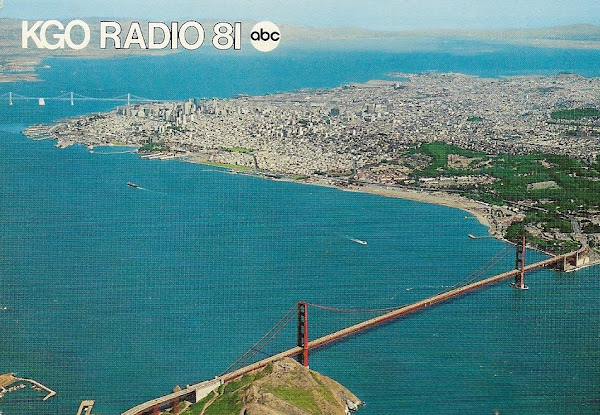 Old postcard from the 1970s. KGO is no longer a talk show station.
By the time I got to college, my view of that city became more tainted and a bit grimy, however. I had learned more about it's problems as well.
As I remember, we divided our sightseeing day into two parts. Morning at the De Young Museum and an afternoon of walking around looking at downtown buildings (my idea).
All I remember, from the museum, was some long lines, echoing spaces and lots of children on tour as if all the schools were taking field trips at once.
I remember snacking in a cafeteria and I guess the only display I remember was a moon rock. It was in a glass case guarded by a security guard.
The rest of the museum must have gone into my memory as a blur. Museums can be overwhelming with information overload; looking and reading quickly while moving on to the next.
Afternoon was walking around downtown. The buildings were quite fascinating, but there was a spooky, somewhat dangerous feel to the city.
As we passed the studios of one of the radio stations that I even had dreams about during childhood, the building looked small. It was KGO which was, back then, located in the somewhat scruffy Tenderloin District. As I remember, from lots of listening to that station it was at 277 Golden Gate Avenue.
Doors were locked tight, but my brother was able to find a doorbell, I think. A security guard only opened the door a slight crack and said, "no tours." He then shut the door quickly. Back then, a crime called the "Alphabet Bomber" was in Bay Area news.
The rest of our walk was more interesting with lots of beautiful vistas, art, architecture, cafes and so forth.
When we got to Trans America Pyramid the doors were open and a guard in the lobby said we could go up in an elevator to an office that wasn't leased so it was open for showing to potential tenants; I guess. That office was near the top; the actual top being a pinnacle, of course.
Another guard, in that lofty space, was quite friendly. We visited while taking in the panorama. The view was spectacular, but the windows only faced one direction, as I remember.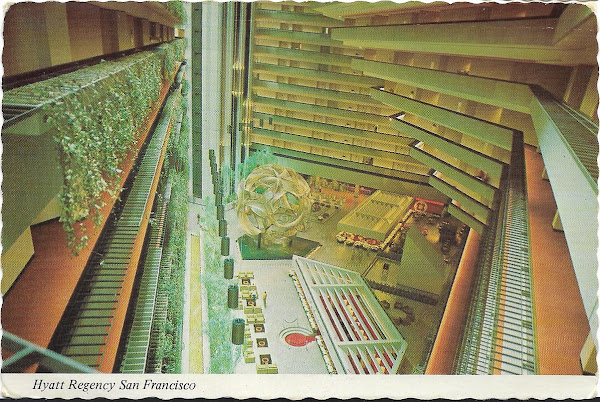 We stepped into the Hyatt Regency at Embarcadero and saw this impressive atrium. It was open to the public and full of shops and places to eat on the main floor. Picture from old postcard.
After our walk through downtown, I think we concluded that our walk around downtown was the most interesting part of the day.
I've been there a few other times in more recent years including passing through during bicycle trips down the coast.
On our way to the Bellingham Greyhound Station (then on State Street) I gave a dollar (maybe a quarter back then) to a pan handler. My sister implied that giving to pan handlers could be overwhelming in the big city, but ironically that was the only pan handler who approached us, as I remember at least.
Most of our time was spent in Palo Alto area for the visit, but we planned a sightseeing trip to San Francisco; often affectionately called "The City."

I forgot how we got up there; maybe by car or transit.
During my childhood, San Francisco seemed like a dream city by the Golden Gate Bridge. Home of some powerful 50,000 watt radio stations that provided a slight connection between my hometown life in Pullman and that city by the bay.

By the time I got to college, my view of that city became more tainted and a bit grimy, however. I had learned more about it's problems as well.
As I remember, we divided our sightseeing day into two parts. Morning at the De Young Museum and an afternoon of walking around looking at downtown buildings (my idea).
All I remember, from the museum, was some long lines, echoing spaces and lots of children on tour as if all the schools were taking field trips at once.
I remember snacking in a cafeteria and I guess the only display I remember was a moon rock. It was in a glass case guarded by a security guard.
The rest of the museum must have gone into my memory as a blur. Museums can be overwhelming with information overload; looking and reading quickly while moving on to the next.
Afternoon was walking around downtown. The buildings were quite fascinating, but there was a spooky, somewhat dangerous feel to the city.
As we passed the studios of one of the radio stations that I even had dreams about during childhood, the building looked small. It was KGO which was, back then, located in the somewhat scruffy Tenderloin District. As I remember, from lots of listening to that station it was at 277 Golden Gate Avenue.
Doors were locked tight, but my brother was able to find a doorbell, I think. A security guard only opened the door a slight crack and said, "no tours." He then shut the door quickly. Back then, a crime called the "Alphabet Bomber" was in Bay Area news.
The rest of our walk was more interesting with lots of beautiful vistas, art, architecture, cafes and so forth.
When we got to Trans America Pyramid the doors were open and a guard in the lobby said we could go up in an elevator to an office that wasn't leased so it was open for showing to potential tenants; I guess. That office was near the top; the actual top being a pinnacle, of course.
Another guard, in that lofty space, was quite friendly. We visited while taking in the panorama. The view was spectacular, but the windows only faced one direction, as I remember.

After our walk through downtown, I think we concluded that our walk around downtown was the most interesting part of the day.
I've been there a few other times in more recent years including passing through during bicycle trips down the coast.
Monday, November 06, 2023
On a note of optimism, the Gay Games 2023 are being held in Hong Kong.
Yes, Hong Kong that is pretty much controlled by Mainland China which rivals USA in economic stature. There is worry about how China deals with human rights, but at least the Gay Games can proceed in Hong Kong.
There are some issues, but the games can go forward. Strict covid shutdowns, in Hong Kong's recent past means that the Gay Games also had a backup plan; Guadalajara, Mexico. This year's games are taking place in two venues. Some Hong Kong human rights activists called for the Games to be cancelled saying organizers "have aligned themselves with pro-authoritarian figures responsible for widespread persecution against the people of Hong Kong".
Taiwan is not sending athletes to Hong Kong but to Guadalajara, citing concerns over the the National Security Law that China imposed on Hong Kong in 2020.
China's government did not send officials to the opening ceremony, warning the organizers, in August, that the Games must be conducted in a “lawful, safe and orderly manner”. Regina Ip, convener of the city’s top decision-making body the Executive Council, was the only pro-establishment figure at the opening ceremony, despite calls from anti-LGBTQ lawmakers for her to resign.
"The holding of the Gay Games in Hong Kong is strong testimony to the diversity, inclusion, and unity of our city," Ip said in her welcoming speech. "Equal opportunity and non-discrimination are highly treasured by our government and our people."
Opposition did not dampen the excitement, spectators chanted, cheered and waved before the opening ceremony.
“This is a good idea because especially China is not very fond of the gays. So this is to become visible in China as queer people,” said Gerrit Schulz, 80, a participant from Berlin.
My comment plus excerpts from article in Reuters.
There are some issues, but the games can go forward. Strict covid shutdowns, in Hong Kong's recent past means that the Gay Games also had a backup plan; Guadalajara, Mexico. This year's games are taking place in two venues. Some Hong Kong human rights activists called for the Games to be cancelled saying organizers "have aligned themselves with pro-authoritarian figures responsible for widespread persecution against the people of Hong Kong".
Taiwan is not sending athletes to Hong Kong but to Guadalajara, citing concerns over the the National Security Law that China imposed on Hong Kong in 2020.
China's government did not send officials to the opening ceremony, warning the organizers, in August, that the Games must be conducted in a “lawful, safe and orderly manner”. Regina Ip, convener of the city’s top decision-making body the Executive Council, was the only pro-establishment figure at the opening ceremony, despite calls from anti-LGBTQ lawmakers for her to resign.
"The holding of the Gay Games in Hong Kong is strong testimony to the diversity, inclusion, and unity of our city," Ip said in her welcoming speech. "Equal opportunity and non-discrimination are highly treasured by our government and our people."
Opposition did not dampen the excitement, spectators chanted, cheered and waved before the opening ceremony.
“This is a good idea because especially China is not very fond of the gays. So this is to become visible in China as queer people,” said Gerrit Schulz, 80, a participant from Berlin.
My comment plus excerpts from article in Reuters.
Thursday, November 02, 2023
Whatcom County does need a new jail. The old one is close to the breaking point in 2023
I plan to vote for the jail (new facility for incarceration and alternatives to incarceration services) this time around November 2023.
Update. The measure won. November 2023.
Update. The measure won. November 2023.
Some people's insistence on advocating use of chloroquine for corona virus is an example of refusal to update their thinking with newer, better science.
Science keeps advancing, but the thinking of many people will latch onto an idea and not update their thinking as the science evolves. Often religion latches onto old concepts as well.
One example of refusal to update is the idea, I heard on newscasts at the start of the pandemic, that a drug used to treat malaria could possibly be used as therapy for the corona virus.
A few days after those early newscasts, it looked like they were finding newer evidence that it wasn't effective for corona virus. It could even cause more harm than good, but some people stuck to that idea while others moved on to what now appears to be more effective treatments.
This is an example of folks sticking with an early idea that offered some hope, but later was superseded with better ideas.
I moved on, quickly though I will admit that those early newscasts offered some hope, back in the first few days after the shut down. My hope came more from the broad concept that both treatments and vaccines were on the way, but not specifically about any one product.
Today the pandemic seems all but totally over and we have good vaccines plus improving methods of treatment. The virus may be less deadly now, than it was in the first year as; especially the Delta Variant was scary.
We seemed to have come a long ways since 2020 as things like dancing and social gathering have come back.
One example of refusal to update is the idea, I heard on newscasts at the start of the pandemic, that a drug used to treat malaria could possibly be used as therapy for the corona virus.
A few days after those early newscasts, it looked like they were finding newer evidence that it wasn't effective for corona virus. It could even cause more harm than good, but some people stuck to that idea while others moved on to what now appears to be more effective treatments.
This is an example of folks sticking with an early idea that offered some hope, but later was superseded with better ideas.
I moved on, quickly though I will admit that those early newscasts offered some hope, back in the first few days after the shut down. My hope came more from the broad concept that both treatments and vaccines were on the way, but not specifically about any one product.
Today the pandemic seems all but totally over and we have good vaccines plus improving methods of treatment. The virus may be less deadly now, than it was in the first year as; especially the Delta Variant was scary.
We seemed to have come a long ways since 2020 as things like dancing and social gathering have come back.
Tuesday, October 31, 2023
Birth control is a better way to deal with the problem of too many people than other choices that are tried.
Birth control is a better way to deal with the problem of too many people than other choices that are tried.
Worse solutions would include things like building walls to keep people out, denying someone's critical needs just to save money, or killing off populations in warfare.
Friday, October 27, 2023
Fighting the battle between socialism and capitalism may be barking up the wrong tree.
Seems like the ongoing debate between socialism and capitalism misses the mark about quality of life in a society. The debate is about economics, jobs and material things. Other factors, such as religion and culture, may play far more significant roles related to human rights.
There can be oppressive regimes that lean toward capitalism, or socialism. I think today's Russia, under the oligarchs and anti gay religion, is probably worse than the Soviet Union in it's last years.
Of course, under Stalin, things were bad, but under Gorbachev things were going in better directions. Now it seems like Russia has taken a turn for the worse.
During glasnost and perestroika, human rights was making headway. Yes, the Soviet Union was also experimenting with more capitalism, such as the famous McDonalds at Pushkin Square.
I do believe that a mix of socialism and capitalism is the best way to go; rather than one extreme or the other. Still, that's just the economic system.
Seems like culture and interpretation of religion are more powerful forces shaping society. Some religious traditions are extremely strict while others are open to diversity of viewpoints.
Cultural factors, attitudes toward sexuality and societies under stress, such as war, are likely the major factors determining human rights and freedom of speech. Often societies that are stressed are in states of emergency and have things like military drafts. For instance the Soviet Union may have broken up prematurely creating the chaos that drives fear and now is leading to war between Russia and Ukraine. In the long run, breakup may be inevitable, but it seems like change is more lasting when it happens incrementally. Also the constant debate between socialist and capitalist economic models could be missing the boat all along.
I write these thoughts after hearing an interview, with someone from Bellingham Marxist School, on our local call in radio talk show KGMI Konnects. The guest was not defending Soviet oppression, but said it was likely better than Russia under the Czars.
I think in terms of how things started to get better toward the end of the Soviet Union, but now have gone down a less desirable road. Discussions get me thinking, but seems like just about everyone does bark up the wrong trees. I say culture is more important than the economic system.
There can be oppressive regimes that lean toward capitalism, or socialism. I think today's Russia, under the oligarchs and anti gay religion, is probably worse than the Soviet Union in it's last years.
Of course, under Stalin, things were bad, but under Gorbachev things were going in better directions. Now it seems like Russia has taken a turn for the worse.
During glasnost and perestroika, human rights was making headway. Yes, the Soviet Union was also experimenting with more capitalism, such as the famous McDonalds at Pushkin Square.
I do believe that a mix of socialism and capitalism is the best way to go; rather than one extreme or the other. Still, that's just the economic system.
Seems like culture and interpretation of religion are more powerful forces shaping society. Some religious traditions are extremely strict while others are open to diversity of viewpoints.
Cultural factors, attitudes toward sexuality and societies under stress, such as war, are likely the major factors determining human rights and freedom of speech. Often societies that are stressed are in states of emergency and have things like military drafts. For instance the Soviet Union may have broken up prematurely creating the chaos that drives fear and now is leading to war between Russia and Ukraine. In the long run, breakup may be inevitable, but it seems like change is more lasting when it happens incrementally. Also the constant debate between socialist and capitalist economic models could be missing the boat all along.
I write these thoughts after hearing an interview, with someone from Bellingham Marxist School, on our local call in radio talk show KGMI Konnects. The guest was not defending Soviet oppression, but said it was likely better than Russia under the Czars.
I think in terms of how things started to get better toward the end of the Soviet Union, but now have gone down a less desirable road. Discussions get me thinking, but seems like just about everyone does bark up the wrong trees. I say culture is more important than the economic system.
Wednesday, October 25, 2023
Picture of me as exercise participant of the month, 1988 at YMCA.

This picture and my sloppy, handwritten answers to a questionnaire were posted for a month on a bulletin by the door to the gym where the aerobics classes were. bulletin boards existed before social media.
Back then, aerobics was a big social thing. I likened it to dancing without the cigarette smoke. Dance bars, back then, were filled with cigarette smoke. That aerobics class often had over 50 people moving to the music and there were times when folks were invited to come in costume. At least 1/3 of the participants were men though aerobics was more popular among women. It was energetic, but gentle and non competitive.
Back in those days, the Y also had a sauna which was a gathering space.
Entering the ho hum work world after college.
Recent Ticktok video in the news. College graduate says hardly any time to live one's life. Long commute as living closer to the job is too expensive. 40 hour per week office job takes up too much time. Readers tend to be sympathetic and ideas about a shorter workweek circulate.
My personal story was different. Part time work. I graduated into a depressed economy; late 70s early 1980s. Rents in Bellingham were quite low, back then, but Jobs were hard to find. I was able to live within easy bicycling, or walking distance from what work I had.
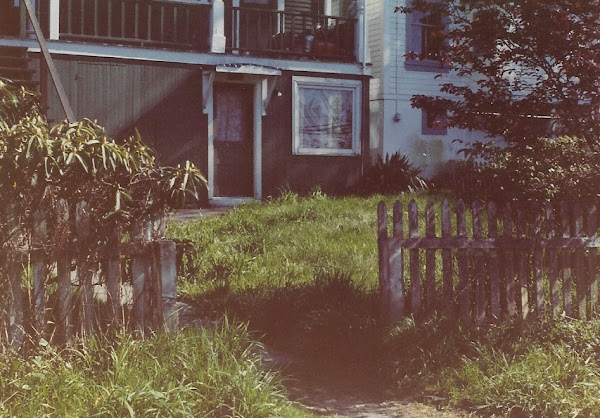 Door to my spacious basement apartment in a 9 unit building with a funky backyard. $155 per month before gentrification in Bellingham.
I looked for full time work, including custodial work for the state at Western Washington University, but the competition for those jobs was fierce. All I could find was part time gardening and a part time custodial shift at a place called Pizza Haven.
I did have plenty of free time, however. Got into writing, postal art, and letters to editors as well as politicians. I had time for many community things and bicycling. I was able to survive, but on a real shoestring budget.
My upstairs neighbor said I had found the healthy balance of working part time. I had stumbled upon it. She suggested I embrace it.
My neighbor had worked in offices for many years and was burned out. She also resented the vast population of freeloaders who seemed to live off inheritances or finding their way onto disability; even back then.
She saw the contrast between overwork and not working at all; herself struggling with burnout, health problems and teatoring toward going on welfare. Her brother was a hard worker / redneck leaning into right wing politics while some of her other aquoitences were hippy artists who found ways to not work 9-5. She often thought they were spoiled.
She talked about a concept called "job sharing" where people work less hours and share the existing jobs more equitably.
When hearing about job sharing, I got to thinking that job sharing would be a good strategy if the economy has to slow down due to environmental restraints. Back then, there was and still is the "jobs versus environment" issue. For instance; the logging industry, around Bellingham, was all but being shut down due to the controversy over preserving habitat for the Northern Spotted Owl.
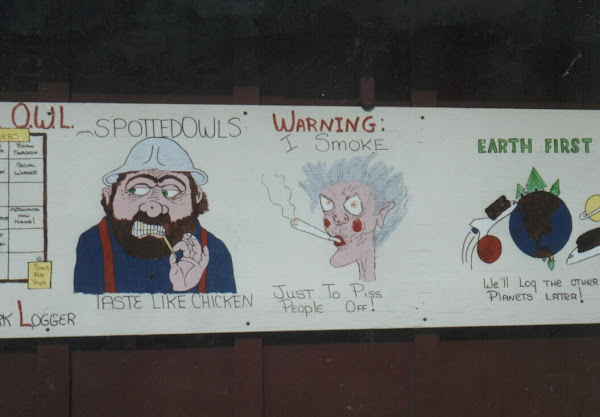 Logger art on Olympic Penisula hints at hunting spotted owl for food to rid the problem that its preservation rules were creating. Many T-shirts in logging country sported logos; "spotted owl tastes like chicken."
Today they talk about "work life balance," but the high cost of today's housing makes that less doable.
I worked part time for many years and eventually found a more full time custodial position that was still fairly laid back. I often didn't put in 8 hours per day, but maybe averaged 7 hours. The job had generous vacation and the ability to take leave of absence for my bicycle travel.
I worried about not having health insurance, but survived with good health. Today, many folks can now benefit from Obamacare reforms; at least in most states; except Texas and a few holdouts against the Medicaid expansion.
I was fortunate to always live quite close to my job. Not owning a car and living in small spaces helped, but that was an era when rents were lower, relative to the rest of the economy. I was living at below market rent, even for those days.
My personal story was different. Part time work. I graduated into a depressed economy; late 70s early 1980s. Rents in Bellingham were quite low, back then, but Jobs were hard to find. I was able to live within easy bicycling, or walking distance from what work I had.

I looked for full time work, including custodial work for the state at Western Washington University, but the competition for those jobs was fierce. All I could find was part time gardening and a part time custodial shift at a place called Pizza Haven.
I did have plenty of free time, however. Got into writing, postal art, and letters to editors as well as politicians. I had time for many community things and bicycling. I was able to survive, but on a real shoestring budget.
My upstairs neighbor said I had found the healthy balance of working part time. I had stumbled upon it. She suggested I embrace it.
My neighbor had worked in offices for many years and was burned out. She also resented the vast population of freeloaders who seemed to live off inheritances or finding their way onto disability; even back then.
She saw the contrast between overwork and not working at all; herself struggling with burnout, health problems and teatoring toward going on welfare. Her brother was a hard worker / redneck leaning into right wing politics while some of her other aquoitences were hippy artists who found ways to not work 9-5. She often thought they were spoiled.
She talked about a concept called "job sharing" where people work less hours and share the existing jobs more equitably.
When hearing about job sharing, I got to thinking that job sharing would be a good strategy if the economy has to slow down due to environmental restraints. Back then, there was and still is the "jobs versus environment" issue. For instance; the logging industry, around Bellingham, was all but being shut down due to the controversy over preserving habitat for the Northern Spotted Owl.

Today they talk about "work life balance," but the high cost of today's housing makes that less doable.
I worked part time for many years and eventually found a more full time custodial position that was still fairly laid back. I often didn't put in 8 hours per day, but maybe averaged 7 hours. The job had generous vacation and the ability to take leave of absence for my bicycle travel.
I worried about not having health insurance, but survived with good health. Today, many folks can now benefit from Obamacare reforms; at least in most states; except Texas and a few holdouts against the Medicaid expansion.
I was fortunate to always live quite close to my job. Not owning a car and living in small spaces helped, but that was an era when rents were lower, relative to the rest of the economy. I was living at below market rent, even for those days.
Monday, October 23, 2023
Happy Halloween.

One way that could reduce population and consumption. There are better ways.
It's not necessarily a forgone conclusion, but I think human tendencies toward tribalism and intolerance of diversity will cause more catastrophic death than climate change, itself. More tolorance of diversity, including LGBTQ diversity is a better way forward. Areas of the world where there is a trend toward more fundamentalist religious values seem to have societies that are more warlike and deadly.
So far, climate change has been a gradual thing, which, in the long run, can increase the death rate as well, but tribalist tendencies are likely to take a much larger toll in the near future. The catostrophic consequences of climate change may be less evident in the short run than our own prejudices and warlike tendencies. Climate change is more like a slow boil, for now at least.
At the same time, there will likely be many parts of the world where life remains quite good.
That's my prediction at least. It's not a forgone conclusion, but a possible scenario. No one knows, for sure of course, what the future brings.
So far, climate change has been a gradual thing, which, in the long run, can increase the death rate as well, but tribalist tendencies are likely to take a much larger toll in the near future. The catostrophic consequences of climate change may be less evident in the short run than our own prejudices and warlike tendencies. Climate change is more like a slow boil, for now at least.
At the same time, there will likely be many parts of the world where life remains quite good.
That's my prediction at least. It's not a forgone conclusion, but a possible scenario. No one knows, for sure of course, what the future brings.
Inflating property values can cause sticker shock about taxes, but it's actually just the local government budget sizes that determines the tax.
In the past few years, property values have shot way up in Bellingham and Whatcom County. When property tax assessments come out, it causes "sticker shock." People are worried that their taxes will skyrocket since their value has skyrocketed.
From my understanding of local government, taxes don't follow property values in lockstep.
Each year, the total amount of taxes is determined by the budgets of local governments; such as state, county and school districts. In some cases the tax, per thousand of valuation, can go down because there are many more thousands of dollars, in valuation, to tax from. If one's value goes way up relative to overall property values in the area, then their share of the taxes do go up, but if all the values go up in similar fashion, the tax just goes up, or down, depending on the size of government budgets.
The total taxes collected only goes up as much as the combined budgets of the taxing governments and districts.
Hopefully people will still vote in favor of quality things, such as the Bellingham Greenways Levy on November's ballot.
Total taxes do go up more gradually, determined by the budgets of the various taxing districts; such as the local school districts, cities and counties.
The state of Washington does impose some restrictions on how much local governments can impose in taxes. Remember Tim Eyman?
I've never been a fan of Tim Eyman since I do think taxes need to go up to maintain the quality of life.
Eyman's initiatives lost in court, but I remember that the State Legislature preserved some of his intent. There are state imposed limits to the total amount of growth in taxes that local governments can impose.
In the long run, taxes do go up as the cost of living, in an area, goes up. For instance; teachers, who work for the government, still need to be able to afford to live in the districts they serve.
In the long run, the inflating cost of real estate, in this area, does push up taxes as the budgets of governments go up. The total budgets of local governments and districts determines how much the taxes are.
I think the property values are just too high; artificially propped up by years of "low interest" printed money. That situation is likely to end in the future as interest rates have gone up.
The handful of years, since the pandemic (2020-2023) have seen property values shoot up even more than the inflation in property values during the 1990-2019 era (admittedly there was a little dip around 2008). The big 2020-2022 mega property value inflation was due to all that extra coronavirus stimulus money in the economy along with low interest rates and high demand for housing in moderate sized cities.
That's my political take for the day
From my understanding of local government, taxes don't follow property values in lockstep.
Each year, the total amount of taxes is determined by the budgets of local governments; such as state, county and school districts. In some cases the tax, per thousand of valuation, can go down because there are many more thousands of dollars, in valuation, to tax from. If one's value goes way up relative to overall property values in the area, then their share of the taxes do go up, but if all the values go up in similar fashion, the tax just goes up, or down, depending on the size of government budgets.
The total taxes collected only goes up as much as the combined budgets of the taxing governments and districts.
Hopefully people will still vote in favor of quality things, such as the Bellingham Greenways Levy on November's ballot.
Total taxes do go up more gradually, determined by the budgets of the various taxing districts; such as the local school districts, cities and counties.
The state of Washington does impose some restrictions on how much local governments can impose in taxes. Remember Tim Eyman?
I've never been a fan of Tim Eyman since I do think taxes need to go up to maintain the quality of life.
Eyman's initiatives lost in court, but I remember that the State Legislature preserved some of his intent. There are state imposed limits to the total amount of growth in taxes that local governments can impose.
In the long run, taxes do go up as the cost of living, in an area, goes up. For instance; teachers, who work for the government, still need to be able to afford to live in the districts they serve.
In the long run, the inflating cost of real estate, in this area, does push up taxes as the budgets of governments go up. The total budgets of local governments and districts determines how much the taxes are.
I think the property values are just too high; artificially propped up by years of "low interest" printed money. That situation is likely to end in the future as interest rates have gone up.
The handful of years, since the pandemic (2020-2023) have seen property values shoot up even more than the inflation in property values during the 1990-2019 era (admittedly there was a little dip around 2008). The big 2020-2022 mega property value inflation was due to all that extra coronavirus stimulus money in the economy along with low interest rates and high demand for housing in moderate sized cities.
That's my political take for the day
Friday, October 20, 2023
Why are Republicans in such a panic about the federal deficit?
I think one reason why the conservative caucus of the GOP is so impossible to deal with is that they are panicked about the federal debt. Yes, it's a daunting number.
There's another way to look at things where that huge debt isn't necessarily a problem. It's just money which is a human construct.
If we run out of money, we can print more. Problem is, too much money, chasing same goods and services, causes inflation so that's what we should think about. Not the debt, but inflation.
In the past few decades, inflation has been quite low in spite of (basically) printing money. Officially, the inflation rate has only been around 2%. No need to panic about this situation for several decades. Bush had his two wars and we still got our Medicare.
In reality, however that 2% figure has been a bit deceptive as home values and a few other things like health insurance costs, have been going up at a greater clip. Low interest rates, in spite of the federal debt being high, have fueled the housing bubble; low interest rates made possible by printing new money.
Quite a few people had been insulated from the true brunt of that inflation if they were homeowners grandfathered into owning a home when homes were a lot less expensive.
Renters have been hit harder from that inflation as well as young people trying to buy, if they haven't inherited money. Lots of people were also sheltered, from those decades of inflation in health insurance premiums, if they were on Medicare or a good employer provided health plan.
Since the pandemic, even more money has been created so overall inflation in wages, food costs and so forth have started to tick up. Things reached a tipping point.
This inflation, for instance in wages helps worker keep up with the rising costs of housing and healthcare. That stimulation of the economy was designed to keep it from going into depression due to the pandemic, but it also led to supply chain bottlenecks.
During the pandemic, the phrase "supply chain" entered my lexicon.
Inflation blipped up temporarily to over 8%, I think, for around 2 years. That heightened the panic that has been happening all along about the budget.
Now that overall inflation is subsiding again as the total rate is around 3%. The Federal Reserve has been tightening the money supply, rasing interest rates and attempting to cool the overheated housing bubble. We've backed off from the tipping point we were at just after the pandemic. Inflation seems to be going back down to where it's nothing to panic about, in my opinion, but some Republicans are still in a panic.
As far as I'm concerned, money is just a tool. It's not a god. We worry too much about money which is just a human created concept.
There's another way to look at things where that huge debt isn't necessarily a problem. It's just money which is a human construct.
If we run out of money, we can print more. Problem is, too much money, chasing same goods and services, causes inflation so that's what we should think about. Not the debt, but inflation.
In the past few decades, inflation has been quite low in spite of (basically) printing money. Officially, the inflation rate has only been around 2%. No need to panic about this situation for several decades. Bush had his two wars and we still got our Medicare.
In reality, however that 2% figure has been a bit deceptive as home values and a few other things like health insurance costs, have been going up at a greater clip. Low interest rates, in spite of the federal debt being high, have fueled the housing bubble; low interest rates made possible by printing new money.
Quite a few people had been insulated from the true brunt of that inflation if they were homeowners grandfathered into owning a home when homes were a lot less expensive.
Renters have been hit harder from that inflation as well as young people trying to buy, if they haven't inherited money. Lots of people were also sheltered, from those decades of inflation in health insurance premiums, if they were on Medicare or a good employer provided health plan.
Since the pandemic, even more money has been created so overall inflation in wages, food costs and so forth have started to tick up. Things reached a tipping point.
This inflation, for instance in wages helps worker keep up with the rising costs of housing and healthcare. That stimulation of the economy was designed to keep it from going into depression due to the pandemic, but it also led to supply chain bottlenecks.
During the pandemic, the phrase "supply chain" entered my lexicon.
Inflation blipped up temporarily to over 8%, I think, for around 2 years. That heightened the panic that has been happening all along about the budget.
Now that overall inflation is subsiding again as the total rate is around 3%. The Federal Reserve has been tightening the money supply, rasing interest rates and attempting to cool the overheated housing bubble. We've backed off from the tipping point we were at just after the pandemic. Inflation seems to be going back down to where it's nothing to panic about, in my opinion, but some Republicans are still in a panic.
As far as I'm concerned, money is just a tool. It's not a god. We worry too much about money which is just a human created concept.
More and more people fighting over limited amount of good land on this planet.
Some Republicans tend to blame problems related to immigration on Biden. I think the problem is beyond our country's politics. It's the world topic of "migration and population."
It's also the world problem of authoritarian governments, crime, gangs and poverty. An overwhelming number of people would love to come to USA; regardless of our politics, as long as USA is a better place to live than where they are from.
Lots of folks come in via our airports, not all from our land borders. Students over saying visas and so forth. It's a worldwide situation.
To try and stop it, at the national level, would likely require us to close our country and drive ourselves into poverty. Seal up our borders, restrict our airports, cut back on trade, tourism, education and things like agriculture that need labor. If we drive ourselves into poverty, less people would want to live here.
On a related thought, the world has a shortage of good places to live. Sure, there's a lot of empty land, but few people live in those spaces for a reason.
Irrigation has increased the amount of good land for agriculture; for instance Yakima County being top agricultural county in Washington State. That due to irrigation.
There is talk of trying to colonize Mars as we are running out of livable space on planet Earth. That idea has its problems; like Mars already being only 1/3 the size of Earth before we even get there.
I got to thinking that developing technology, for living on Mars, might end up being very useful for living on Earth. Indoor agriculture, for instance. It could be useful for living in much of the land we already have, on earth, such as the Sahara Desert or the area called the "Empty Quarter" in Saudi Arabia.
Colonizing those areas, with indoor agricultural technology, would still be easier than colonizing Mars, but the dream of colonizing Mars might be needed for getting us to develop that technology.
Even without climate change, we may need to terrafarm more areas of Earth, that are not now considered that livable, just to support all of Earth's people with our aspirations.
One idea might be to build new states on some big desert area; rather fighting over the tiny space that's now Israel / Palestine.
I tend to think "big picture" pretty much all the time.
It's also the world problem of authoritarian governments, crime, gangs and poverty. An overwhelming number of people would love to come to USA; regardless of our politics, as long as USA is a better place to live than where they are from.
Lots of folks come in via our airports, not all from our land borders. Students over saying visas and so forth. It's a worldwide situation.
To try and stop it, at the national level, would likely require us to close our country and drive ourselves into poverty. Seal up our borders, restrict our airports, cut back on trade, tourism, education and things like agriculture that need labor. If we drive ourselves into poverty, less people would want to live here.
On a related thought, the world has a shortage of good places to live. Sure, there's a lot of empty land, but few people live in those spaces for a reason.
Irrigation has increased the amount of good land for agriculture; for instance Yakima County being top agricultural county in Washington State. That due to irrigation.
There is talk of trying to colonize Mars as we are running out of livable space on planet Earth. That idea has its problems; like Mars already being only 1/3 the size of Earth before we even get there.
I got to thinking that developing technology, for living on Mars, might end up being very useful for living on Earth. Indoor agriculture, for instance. It could be useful for living in much of the land we already have, on earth, such as the Sahara Desert or the area called the "Empty Quarter" in Saudi Arabia.
Colonizing those areas, with indoor agricultural technology, would still be easier than colonizing Mars, but the dream of colonizing Mars might be needed for getting us to develop that technology.
Even without climate change, we may need to terrafarm more areas of Earth, that are not now considered that livable, just to support all of Earth's people with our aspirations.
One idea might be to build new states on some big desert area; rather fighting over the tiny space that's now Israel / Palestine.
I tend to think "big picture" pretty much all the time.
Tuesday, October 03, 2023
My bicycle tour to a gravity wave detector and more.

At top of this album on Flickr as of October 3 2023.
Monday, October 02, 2023
When the Pacific Northwest ran out of rivers

During my childhood, it was said that most of Washington's electricity came from hydroelectric dams. As I got older, population and economic growth, in the Pacific Northwest, outgrew the rivers. We basically ran out of good sites to build dams; the mighty Columbia River; turned to a series of slackwater lakes.
In the 1980s, nuclear power was seen as a way to keep up with the growth, but nuclear was pretty much put out of business by less expensive natural gas. Much of the power, in the northwest, comes from natural gas fired power plants today along with the hydro power. We even have a natural gas power plant on the Bellingham waterfront.

In the 1970s, several nuclear plants were planned by an organization called "Washington Public Power Supply System." The acronym was WPPS. By coincidence WPPSS sounds like Woops.
The cost of nuclear, plus worries about it's safety after 3 Mile Island incident, in Pennsylvania, led to the mothballing of all the WPPSS projects, except for one. WPPSS went bankrupt, which became the second largest municipal bond default in US history.
I think a big part of the problem was competition with natural gas fired power plants which were easier to construct. Gas turned out to be an abundant and inexpensive source of energy.
The one nuclear plant that was finished and is producing quite a bit of the northwest's power, today, was called WPPSS #2. It's on the Hanford Reservation and has since been renamed the Columbia River Generating Station. I passed that facility on my recent bicycle trip just a few weeks ago.
I think nuclear may make a comeback as smaller, less expensive reactors become available.
Back during my grade school years, dams on the Columbia and Snake Rivers were controversial. Even back then, talk of ecological problems and salmon habitat were in the news.
My dad was pretty much a New Deal liberal. He was a fan of the dams, for the most part. Many of the dams were New Deal projects.
I remember some debates, in our family, about the virtues and problems associated with dams. We would take Sunday drives down to the Snake River, near Pullman, where dad would follow the construction of two nearby dams.
One of my childhood memories, from growing up in Washington State, was the song "Roll on Columbia." "Your power is turning our darkness to dawn."
Monday, September 25, 2023
Soon to be added to my sharing. Pictures from September's bicycle tour to eastern Washington.

Above is photo I took in Zillah, WA. It's in the Yakima Valley. The famous teapot filling station now preserved by a park. Was built in the 1920s to point out an oil scandle during President Harding's administration. The so called "Teapot Dome Scandle."
Photos from this latest trip will soon be on Flickr as I organize them.
Here they are (October 2 2023). Click on arrows on sides of pictures to navigate at least for desktop version of Flickr.
The Republicans who wish to burn down the government. Sounds like they are for anarchy.
Oh the unnessesary budget impass again.
Interesting that Represenative McCarthy actually said, about the radical Republicans in his caucus, "they want to burn the place down."
Reminds me of a conversation I had with a friend when we were discussing the federal deficit. My friend said "they just want to burn down the government." Then he stood up and started shouting, "burn down the government," "burn down the government."
Social Security and Medicare would still continue, during a "shutdown," but if both those payments were on the table, maybe us senior citizens, an age group most likely to vote, would turn against the Republican Party?
Can we survive with less money? This reminds me of another friend who thinks money is an addiction. He belives that in an ideal society, money would not exist. We would all do what we need to do, for one another, out of the love and kindness in our hearts. Money addiction is evil, according to this friend. Money would not exist in an ideal world.
Speaking of love, or for that matter sex, he also believes that sexuality, for pleasure, is evil; even masturbation. He goes to various "12 step" groups; such as Alcohaulic's Annonomous. There are quite a few brands of these groops; such as Gambler's Anonomous, and Sex Addicts Anonomous.
I don't know if there is a Money or Greed Anonomous, but I do apprieciate that my friend lumps our love affair with the almighty dollar in with sex addiction.
We have our discussions as well as I don't totally go down his road. I tend to believe things like money and sex have their place in moderation.
It is true, however, that some people do have to go "cold turkey" or they fall back into an addictive pattern. This second friend seems to be in need to go cold turkey due to his own situation.
Thinking about that first conversation with that other friend who shouted that they just want to burn down the government, a point I was making in that conversation is that some Republicans think we can't get a handle on our deficit problems with business as usual. They are calling for radical steps, though I don't necessarily agree, I try and see inside their thinking.
As for radical steps, there are those who think we need to take radical steps to address the growing climate change problem. Time for another 12 step program?
Interesting that Represenative McCarthy actually said, about the radical Republicans in his caucus, "they want to burn the place down."
Reminds me of a conversation I had with a friend when we were discussing the federal deficit. My friend said "they just want to burn down the government." Then he stood up and started shouting, "burn down the government," "burn down the government."
Social Security and Medicare would still continue, during a "shutdown," but if both those payments were on the table, maybe us senior citizens, an age group most likely to vote, would turn against the Republican Party?
Can we survive with less money? This reminds me of another friend who thinks money is an addiction. He belives that in an ideal society, money would not exist. We would all do what we need to do, for one another, out of the love and kindness in our hearts. Money addiction is evil, according to this friend. Money would not exist in an ideal world.
Speaking of love, or for that matter sex, he also believes that sexuality, for pleasure, is evil; even masturbation. He goes to various "12 step" groups; such as Alcohaulic's Annonomous. There are quite a few brands of these groops; such as Gambler's Anonomous, and Sex Addicts Anonomous.
I don't know if there is a Money or Greed Anonomous, but I do apprieciate that my friend lumps our love affair with the almighty dollar in with sex addiction.
We have our discussions as well as I don't totally go down his road. I tend to believe things like money and sex have their place in moderation.
It is true, however, that some people do have to go "cold turkey" or they fall back into an addictive pattern. This second friend seems to be in need to go cold turkey due to his own situation.
Thinking about that first conversation with that other friend who shouted that they just want to burn down the government, a point I was making in that conversation is that some Republicans think we can't get a handle on our deficit problems with business as usual. They are calling for radical steps, though I don't necessarily agree, I try and see inside their thinking.
As for radical steps, there are those who think we need to take radical steps to address the growing climate change problem. Time for another 12 step program?
I think we may be heading to higher death rates around the world. A reduction in population is possible.
In some ways, it seems like the world is getting increasingly brutal and more chaotic. Could be a symptom of over population which can be dealt with by reducing population growth or increasing death rates.
We could be returning to more brutality as growing populations, consumption and climate change continue to stress civilizations. Seems like there are some folks who are going back toward old fashioned values and solutions; like from Biblical times when empires fought wars killing willy nilly and the victor kept the spoils.
Population growth wasn't seen as much of a problem, back then, before the days of modern technology and especially today's medicine. Tribalism was more in vouge back then as well. Life expectancy was shorter from all the threats to survival from crime, war and disease. Modern societies have brought us the "global village" due to technologies; such as instant worldwide communication and jet travel. Modern times brings more talk of tolerance, cultural diversity and lifestyle diversity for survival. Birth control has been gaining ground even in some of the third world, but especially in what's called the first world.
Much of society does seem to be moving forward to a kinder and more tolerant society, but I fear that there are many who are wishing to turn back the clock. This could be due to the increasing stress of our times.
Large parts of the world are in turmoil. Even in the west and here in USA, many folks want to turn back to old solutions.
Instead of stable population and sustainable living we may be reverting to increasing death rates around the world and even here in USA; a less desirable way to keep population at more sustainable levels.
Above is something I was thinking, but then wrote down after listening this program on NPR's The 1a. It's about donor fatigue. More money for war, such as between Russia and Ukraine, plus increasing things like the flood in Libya are draining aid money around the world.
We could be returning to more brutality as growing populations, consumption and climate change continue to stress civilizations. Seems like there are some folks who are going back toward old fashioned values and solutions; like from Biblical times when empires fought wars killing willy nilly and the victor kept the spoils.
Population growth wasn't seen as much of a problem, back then, before the days of modern technology and especially today's medicine. Tribalism was more in vouge back then as well. Life expectancy was shorter from all the threats to survival from crime, war and disease. Modern societies have brought us the "global village" due to technologies; such as instant worldwide communication and jet travel. Modern times brings more talk of tolerance, cultural diversity and lifestyle diversity for survival. Birth control has been gaining ground even in some of the third world, but especially in what's called the first world.
Much of society does seem to be moving forward to a kinder and more tolerant society, but I fear that there are many who are wishing to turn back the clock. This could be due to the increasing stress of our times.
Large parts of the world are in turmoil. Even in the west and here in USA, many folks want to turn back to old solutions.
Instead of stable population and sustainable living we may be reverting to increasing death rates around the world and even here in USA; a less desirable way to keep population at more sustainable levels.
Above is something I was thinking, but then wrote down after listening this program on NPR's The 1a. It's about donor fatigue. More money for war, such as between Russia and Ukraine, plus increasing things like the flood in Libya are draining aid money around the world.
Monday, August 28, 2023
My speculations about bankruptcy for WSU football.

I wonder who WSU athletics debt is owed too? Banks or internal university, state of Washington funds?
If to an outside bank, that could bring up the topic of potential bankruptcy. I wonder if bankruptcy could protect the rest of the university from having to fully pay off that debt?
Most officials would probably think these questions are premature. They are now focusing on the unknown future which involves probably moving to another conference now that the Pac 12 has broken apart. Also potential new sources of revenue from the constantly changing media landscape; internet media and so forth beyond ticket sales.
They are also focusing on this season with the Pac 12 still functioning. The changes in the conference start next year. I've never been a sports fan, myself and it does seem like an unnecessary burden to me.
Western Washington University, here in Bellingham, did away with it's football program during a round of state mandated cuts. Unlike at WSU, football at Western was never that large and I don't think it was ever seen as a net revenue generator. I don't think it ever payed it's own way like a business.
At WSU, I think football payed its own way till recent times when the stakes got higher and it became more expensive to to keep up with the Jones.
A few months ago, I got to thinking WSU should have gone to a less costly, "high stakes" conference before incurring that debt, but hindsight is better than foresight.
Now that situation has come to pass as it looks like WSU will find itself in a different football conference now that the big schools that are closer to big cities, like Seattle and Los Angeles, are planning to leave the Pac 12.
Friday, August 25, 2023
Most people worry about whether our southern border is too secure, or not secure enough. The bigger issue is that an overwhelming number of folks dream of living in USA.

I keep thinking of different angles on similar themes, like world population.
Conservatives make it sound like our southern border is totally out of control and being flooded with immigrants. I doubt that's the case, though I haven't seen it with my own eyes.
The media tells that story, but it also tells the story that liberals will say; it's really hard to cross the border. Enforcement is harsh. The truth is usually in the middle.
I would guess that it's hard to cross the border; even under Biden, there is plenty of enforcement. The factor that both sides overlook is not an issue of enforcement. It's just the overwhelming number of people wishing to come to USA. There are so many people wishing to be in USA that even with a fairly tight border, it's kind of an overwhelming situation.
I worry that much of the world is becoming unlivable. Ruled by authoritarian dictators that hate LGBTQ people; for instance. Wars, famine and climate change. Much of the land area of earth is under the iron fist of dictators.
Lots of people are dying just trying to live their lives, or get to places where they and their families are safer. Some parts of the world are getting more open minded, while other parts are under authoritarian regimes. Many parts of the world seem to be getting worse.
Here in USA, we have some folks who would like to push us back to a more authoritarian culture, but we still have a good degree of freedom and many parts of USA have been making good progress over recent years. Things seem to be pretty good here in Washington State.
In many ways, the world around me has seen lots of improvement. Some problems as well, but all in all there is progress, at least in some areas, but it would be better if there was progress, or at least basic livability, in most areas of the world.
Photo: World map on first floor of Webster Hall, WSU, Pullman.
Thursday, August 17, 2023
Government isn't the cause of the regulation gridlock. Today's world is just more crowded with more powerful technology and the environment is more vulnerable to harm.
Conservatives tend to blame government for the vast maze of environmental regulations that make doing things next to impossible. There is a deeper problem than government.
The modern world is different than the world of a century ago. The world has more people so it's more crowded. It's harder to do anything without someone complaining that it's too close to their backyard.
The technology we have, today, is a lot more powerful than in the past. Business can potentially do a lot more harm. A third factor is that safety and environmental expectations are higher today. In the past people lived with smog, unsafe working conditions and so forth with less complaint. Today's expectations are higher; except for maybe a glaring loophole caused by the automobile. People still take for granted the traffic death toll while other safety rules are more stringent. The automobile is grandfathered in.
Another thing that is different, today, than in centuries past, is how much awareness we have of things that could be harmful in our environments. Contaminants in the air and water can be measured in the "1 part per millions" range. Even trace amounts of things make modern people nervous.
These big changes, between modern society and the past, are the main factor. The government is mostly just a scapegoat; like folks barking up the wrong tree.
Yes, private enterprise can be more innovative than government, in some cases; for instance Space X (a private firm) has done some things in space that NASA hasn't been able to accomplish. Still, NASA has done some innovative stuff as well.
The way an organization is set up, whether private or government, is a factor, but the big factor is the fact that we live in a more modern and crowded world than we did in past centuries. Population, technologies, awareness and expectations are different these days.
The modern world is different than the world of a century ago. The world has more people so it's more crowded. It's harder to do anything without someone complaining that it's too close to their backyard.
The technology we have, today, is a lot more powerful than in the past. Business can potentially do a lot more harm. A third factor is that safety and environmental expectations are higher today. In the past people lived with smog, unsafe working conditions and so forth with less complaint. Today's expectations are higher; except for maybe a glaring loophole caused by the automobile. People still take for granted the traffic death toll while other safety rules are more stringent. The automobile is grandfathered in.
Another thing that is different, today, than in centuries past, is how much awareness we have of things that could be harmful in our environments. Contaminants in the air and water can be measured in the "1 part per millions" range. Even trace amounts of things make modern people nervous.
These big changes, between modern society and the past, are the main factor. The government is mostly just a scapegoat; like folks barking up the wrong tree.
Yes, private enterprise can be more innovative than government, in some cases; for instance Space X (a private firm) has done some things in space that NASA hasn't been able to accomplish. Still, NASA has done some innovative stuff as well.
The way an organization is set up, whether private or government, is a factor, but the big factor is the fact that we live in a more modern and crowded world than we did in past centuries. Population, technologies, awareness and expectations are different these days.
Tuesday, August 15, 2023
Why there are a lot of jobs in spite of rising interest rates
Some people are scratching their heads wondering why there are still so many jobs in spite of high interest rates. I just thought of a reason. Lowering interest rates is a bad way to increase the number of jobs.
Up until the pandemic, low interest has basically gone into inflating home values and other assets; not as much into creating jobs. Now that interest rates are higher, asset values are starting to calm down, but job creation remains strong; so far at least.
Conservatives tend to think private enterprise is better at creating jobs than government. That philosophy has been a big factor behind trying to create jobs via low interest rates. It hasn't worked that well. To a large extent, private entrepreneurs have held onto their money and acted to protect their asset values. This doesn't lead to that much job creation. More recently, there has been a surge in government spending, covid relief, infrastructure and stimulus spending. I think that might be a better way to create jobs; even in the private sector as private companies are often mostly just vendors supplying government contracts.
The true private market has been more sluggish in past years due to many factors; including caution about risking capital on new ventures. There's been some new ventures and innovation in private enterprise, but also a lot of aversion to risk. Conservatives would say that aversion to risk is mostly caused by layers and layers of government regulation. Yes, that's a big factor, but not everyone wants what private enterprise brings to their neighborhood. One example of a restrictive regulation, of course, is single family zoning.
Now that there's more talk about the housing shortage, I am noticing more multi family construction going on in the past 3, or so, years. This, being a factor leading to the boom in construction jobs and a shortage of skilled labor in the carpentry field.
Job creation has been pretty strong during the Biden Presidency. Conservatives are wondering "how can that be?" Some folks are predicting a crash to come soon due, in part, to the rising interest rates. They also don't trust "Bidenomics."
Who knows, but so far, the job picture still looks pretty rosy and I think rising interest rates hasn't detracted much from job creation. Rising interest rates may mean less people making a living by flipping real estate.
Up until the pandemic, low interest has basically gone into inflating home values and other assets; not as much into creating jobs. Now that interest rates are higher, asset values are starting to calm down, but job creation remains strong; so far at least.
Conservatives tend to think private enterprise is better at creating jobs than government. That philosophy has been a big factor behind trying to create jobs via low interest rates. It hasn't worked that well. To a large extent, private entrepreneurs have held onto their money and acted to protect their asset values. This doesn't lead to that much job creation. More recently, there has been a surge in government spending, covid relief, infrastructure and stimulus spending. I think that might be a better way to create jobs; even in the private sector as private companies are often mostly just vendors supplying government contracts.
The true private market has been more sluggish in past years due to many factors; including caution about risking capital on new ventures. There's been some new ventures and innovation in private enterprise, but also a lot of aversion to risk. Conservatives would say that aversion to risk is mostly caused by layers and layers of government regulation. Yes, that's a big factor, but not everyone wants what private enterprise brings to their neighborhood. One example of a restrictive regulation, of course, is single family zoning.
Now that there's more talk about the housing shortage, I am noticing more multi family construction going on in the past 3, or so, years. This, being a factor leading to the boom in construction jobs and a shortage of skilled labor in the carpentry field.
Job creation has been pretty strong during the Biden Presidency. Conservatives are wondering "how can that be?" Some folks are predicting a crash to come soon due, in part, to the rising interest rates. They also don't trust "Bidenomics."
Who knows, but so far, the job picture still looks pretty rosy and I think rising interest rates hasn't detracted much from job creation. Rising interest rates may mean less people making a living by flipping real estate.
Monday, July 31, 2023
Are there too many people on Earth?

Are there too many people on Earth? It depends on how people wish to live. If everyone were as consumptive as most Americans, there are too many, but we could reduce consumption and still have good lives depending on how we use technology. Micro electronics can go a long ways.
On the other hand, there are too many people for us to totally go back to our old ways. We need lots of natural space to survive if our survival is based on old style hunting, gathering and fishing.
I am glad they removed the two dams on the Elwha River, in Washington State, to bring back salmon habitat even though hydroelectic power is low carbon footprint. Thoes dams didn't generate that much power anyway.
Now there is a bigger dam removal project on the Klamath River in California. Might still be a good idea, I know less about it. Both dam removal projects have been promoted by Native American interests.
There is talk of removing dams on the Snake River in Washington for salmon recovery as well. Thoes are larger dams.
We can't have it all, I guess. Increasing prosperity, world population that is still growing, lowering carbon footprint and maintianing old ways. There are many tradeoffs and life can never be totally ideal for everyone.
Monday, July 10, 2023
Paying to reduce climate change. Cap and trade in Washington State.
Here in Washington, people are learning that taxing corporations does have consequences for ordinary consumers. Our new cap and trade rules are contributing to Washington's relatively high gas prices. oil companies pass the costs on to consumers.
Still, Washington gas prices are a bargain compared to Canada where taxes raise the price. Here in Whatcom County, we still see many Canadians come south of the border to fill up.
I still follow the news even though I don't drive.
Yes energy taxes, whether hidden by cap and trade or seen at the pump, are regressive, but most energy consumption is done by the millions and millions of rank and file consumers. The super wealthy and corporations are like the maestros leading the orchestra.
My article in Betty Pages about Cap and Trade, Carbon Taxes and Climate Change.
Still, Washington gas prices are a bargain compared to Canada where taxes raise the price. Here in Whatcom County, we still see many Canadians come south of the border to fill up.
I still follow the news even though I don't drive.
Yes energy taxes, whether hidden by cap and trade or seen at the pump, are regressive, but most energy consumption is done by the millions and millions of rank and file consumers. The super wealthy and corporations are like the maestros leading the orchestra.
My article in Betty Pages about Cap and Trade, Carbon Taxes and Climate Change.
Wednesday, June 28, 2023
Yahoo News; possibly a good model to pay for journalism without a paywall. Possible lessons for Facebook.
There is an attempt by the Canadian government to make Facebook pay more for news media content that appears on Facebook. This is seen as a way to help pay for newspapers and organizations that support professional journalism; a field who's revenue sources have been drying up.
Facebook is fighting back by removing some of the news content in Canada. I got to thinking that, somehow, Yahoo News works. Yahoo must pay for the rights to reprint certain stories from many sources; such as the New York Times. That's how I get around paywalls. Otherwise, who wants to subscribe to hundreds of publications, just to get past the paywalls? I don't have the time, or the money, to subscribe to hundreds of publications.
Somehow, Yahoo News seems to work. Maybe something like that could work with Facebook as well. Some sort of compromise. Much of the news I post on Facebook comes from Yahoo News. I try and share links that don't throw up paywalls. NPR Radio is another good source of journalism. KGMI Radio, in Bellingham, doesn't put up a paywall on their website. It seems like broadcast media works better, in the internet age, than newspapers even though newspapers have some of the best content. I've heard it said that "the truth goes behind paywalls while conspiracy theories, promotions and propaganda are free on the net."
Yahoo News does work pretty well and I think they pay for what they repost from publications with paywalls. Many of my Facebook posts come from links to Yahoo.
I also notice that posts with a link to news get less response. Facebook probably gives those posts less push in it's algorithms. Also news and politics may not be that popular compared to personal posts and photographs. The number of clicks and likes effects algorithms. People may be sick of politics, but, as the old saying goes, "a photo as worth a thousand words."
Facebook is fighting back by removing some of the news content in Canada. I got to thinking that, somehow, Yahoo News works. Yahoo must pay for the rights to reprint certain stories from many sources; such as the New York Times. That's how I get around paywalls. Otherwise, who wants to subscribe to hundreds of publications, just to get past the paywalls? I don't have the time, or the money, to subscribe to hundreds of publications.
Somehow, Yahoo News seems to work. Maybe something like that could work with Facebook as well. Some sort of compromise. Much of the news I post on Facebook comes from Yahoo News. I try and share links that don't throw up paywalls. NPR Radio is another good source of journalism. KGMI Radio, in Bellingham, doesn't put up a paywall on their website. It seems like broadcast media works better, in the internet age, than newspapers even though newspapers have some of the best content. I've heard it said that "the truth goes behind paywalls while conspiracy theories, promotions and propaganda are free on the net."
Yahoo News does work pretty well and I think they pay for what they repost from publications with paywalls. Many of my Facebook posts come from links to Yahoo.
I also notice that posts with a link to news get less response. Facebook probably gives those posts less push in it's algorithms. Also news and politics may not be that popular compared to personal posts and photographs. The number of clicks and likes effects algorithms. People may be sick of politics, but, as the old saying goes, "a photo as worth a thousand words."
Friday, June 23, 2023
Washington State tops the list for highest gas prices. Cap and trade a hidden tax? Way to go Washington on the road to lower carbon emissions, but I still think a carbon tax is more honest.
I hear that Washington State has the highest gas prices in USA. Since I ride a bicycle, I wouldn't notice except for the news media coverage.
Conservatives tend to blame our new cap and trade system for reducing carbon emissions. They do have a point. I don't think you can just tax corporations without them passing the cost on to consumers. Cap and trade is kind of complex. I'd prefer a straight forward carbon tax. Cap and trade is more like a hidden tax.
Even with a carbon tax, the government can still provide help to folks that are lower income and harder hit; like farm workers or folks who have to commute a long ways since they can't afford housing that's closer to jobs.
Still, if we really want to reduce our carbon footprint, the cost of fossil fuels needs to go up.
Conservatives tend to blame our new cap and trade system for reducing carbon emissions. They do have a point. I don't think you can just tax corporations without them passing the cost on to consumers. Cap and trade is kind of complex. I'd prefer a straight forward carbon tax. Cap and trade is more like a hidden tax.
Even with a carbon tax, the government can still provide help to folks that are lower income and harder hit; like farm workers or folks who have to commute a long ways since they can't afford housing that's closer to jobs.
Still, if we really want to reduce our carbon footprint, the cost of fossil fuels needs to go up.
At least it was probably a quick death. I still feel sorry for those who died on the Titan. Why so much news coverage?
There has been lots of news coverage about the attempts to rescue those wealthy adventurers who went down to look at the Titanic.
It does seem like they might have died quickly from the submersible imploding. It may have been a quick end.
While everyone surviving would be the best news, I would guess a quick death is better than suffering, while trapped in the sub running out of oxygen over several days.
On BBC Radio, there was a segment questioning why this rescue effort got so much media attention compared to the hundreds of refugees that recently drowned in the Mediterranean Sea as they were trying to reach Europe from deadly circumstances in places like Syria.
Wealth and class of the sub's occupants was mentioned as a factor, but also the uniqueness of the situation. Thousands, or even millions of refugees are dying so; what else is new?
Adventurers in the sub brought a new twist to the story and the media tends to only highlight certain things.
This brings back memories of 1988 when the media was full of news about 3 whales that were trapped under ice that was quickly forming, in the Arctic Ocean, at the start of that winter.
Would the confused whales suffocate under the ice, or could they find their way back out to open ocean?
An international effort of amateurs and eventually international militaries joined in an effort to save the whales. News about those 3 whales was riveting for several days, even though, I think, whales getting trapped under ice has happened many times at the start of winter as ice reforms in the Arctic.
Why was 1988 so special? Who knows. Maybe it's just randomness that certain stories take off while others don't. Once something gets started, we join in till the next thing captures the news cycle.
I remember that I was following that rescue effort with interest so I decided to look it up in Google and "sure enough," here's the first link that came up.
As for the class issue, I still prefer news of survival to death, but at least a quick death seems better than desperate suffering. We all will leave this planet at some point.
There is a lot of bitterness and hatred in this world, as well, so I am reminded of a joke that may be in bad taste.
“What do you call 500 lawyers at the bottom of the ocean?”
“A good start.”
In spite of that joke, I still prefer survival and a world where there is less hostility.
It does seem like they might have died quickly from the submersible imploding. It may have been a quick end.
While everyone surviving would be the best news, I would guess a quick death is better than suffering, while trapped in the sub running out of oxygen over several days.
On BBC Radio, there was a segment questioning why this rescue effort got so much media attention compared to the hundreds of refugees that recently drowned in the Mediterranean Sea as they were trying to reach Europe from deadly circumstances in places like Syria.
Wealth and class of the sub's occupants was mentioned as a factor, but also the uniqueness of the situation. Thousands, or even millions of refugees are dying so; what else is new?
Adventurers in the sub brought a new twist to the story and the media tends to only highlight certain things.
This brings back memories of 1988 when the media was full of news about 3 whales that were trapped under ice that was quickly forming, in the Arctic Ocean, at the start of that winter.
Would the confused whales suffocate under the ice, or could they find their way back out to open ocean?
An international effort of amateurs and eventually international militaries joined in an effort to save the whales. News about those 3 whales was riveting for several days, even though, I think, whales getting trapped under ice has happened many times at the start of winter as ice reforms in the Arctic.
Why was 1988 so special? Who knows. Maybe it's just randomness that certain stories take off while others don't. Once something gets started, we join in till the next thing captures the news cycle.
I remember that I was following that rescue effort with interest so I decided to look it up in Google and "sure enough," here's the first link that came up.
As for the class issue, I still prefer news of survival to death, but at least a quick death seems better than desperate suffering. We all will leave this planet at some point.
There is a lot of bitterness and hatred in this world, as well, so I am reminded of a joke that may be in bad taste.
“What do you call 500 lawyers at the bottom of the ocean?”
“A good start.”
In spite of that joke, I still prefer survival and a world where there is less hostility.
Thursday, June 08, 2023
Planned Parenthood protecting the right to life by providing healthcare
When I think of Planned Parenthood, I think of contraception. We still need to reduce population growth even though the growth rate of world population is slowing. With over 8 billion people on this planet, we really don't do well at protecting right to life. Folks die to to lack of access to healthcare, especially in states like Texas that still refuses Medicaid expansion. People die when they can't immigrate to countries that are safer than where they are from; for instance folks killed by the gangs in central America. Climate change is adding more refugees to world population. War and gun violence are killers, even unsafe highways are killers.
I think of contraception, but I hear ads, from Planned Parenthood, saying they provide healthcare. Yes, good point. Access to healthcare which can be difficult to find.
Back to my point about the difficulties in protecting right to life for all 8 billion on this limited planet. My mind first thinks of contraception when I think of Planned Parenthood, but also realizing their role in taking care of people who's life saving needs are often not provided for due to economics, or many other reasons.
Now we have a situation where even laws against abortion may be deadly. I hear that doctors are fleeing some states fearing that certain interpretations of anti abortion laws will prosecute them for practicing medicine in the gray area of difficult pregnancies. There are difficult situations dealing with miscarriages, possible threats to life of the mother and so forth. I read that hospitals, in some towns, can't deliver babies anymore as the doctors, who do this, have fled to other areas of this country where laws are less intrusive. Some people, having children, are having to travel farther to find a hospital with sufficient staff for delivery.
I think of contraception, but I hear ads, from Planned Parenthood, saying they provide healthcare. Yes, good point. Access to healthcare which can be difficult to find.
Back to my point about the difficulties in protecting right to life for all 8 billion on this limited planet. My mind first thinks of contraception when I think of Planned Parenthood, but also realizing their role in taking care of people who's life saving needs are often not provided for due to economics, or many other reasons.
Now we have a situation where even laws against abortion may be deadly. I hear that doctors are fleeing some states fearing that certain interpretations of anti abortion laws will prosecute them for practicing medicine in the gray area of difficult pregnancies. There are difficult situations dealing with miscarriages, possible threats to life of the mother and so forth. I read that hospitals, in some towns, can't deliver babies anymore as the doctors, who do this, have fled to other areas of this country where laws are less intrusive. Some people, having children, are having to travel farther to find a hospital with sufficient staff for delivery.
Monday, June 05, 2023
Trying to reduce the debt may next have to go after things like Medicare, the military and Social Security.
The biggest costs of government are things like Medicare and Social Security. To reduce the debt, it's hard to avoid touching these large expenses.
It's odd that I find myself agreeing with McCarthy who points out that only 11% of the budget was on the table for cuts. What I disagree with, in McCarthy's take, is that Biden walled off the rest of the budget. This article makes no mention of the option to increase taxes. Higher taxes could go a long ways toward shoring up Medicare and Social Security; for instance raising the income cap subject to Social Security taxes.
Article made no mention of how much is spent on the military as well.
Like gay people being in the closet. Most politicians, including Democrats, are closeted about raising taxes. It's dangerous talk on the campaign trail. Republicans pretty much refuse to even consider taxes. Democrats tremble at the thought as well, but democrats usually realize that taxes are needed to pay for what people want from government.
There are limits to what we can get, versus what people are willing to pay. There are limits imposed by pure mathematics and I'd add limits to what the natural environment will sustain in terms of human consumption.
Yes, we can have a good life and even better lives than in the past; counting all things beyond just money and materialism.
I think wealthy people should pay more taxes, including upper middle class. Maybe even everyone pay more, including even myself. Yes we can't have it all. Some things people demand can't always be met. Budgets can be tightened, to some extent.
What's most important, to me, is the quality of our lives and our communities. Trying to be fair and reasonable, but realizing that perfection is never attained.
It's odd that I find myself agreeing with McCarthy who points out that only 11% of the budget was on the table for cuts. What I disagree with, in McCarthy's take, is that Biden walled off the rest of the budget. This article makes no mention of the option to increase taxes. Higher taxes could go a long ways toward shoring up Medicare and Social Security; for instance raising the income cap subject to Social Security taxes.
Article made no mention of how much is spent on the military as well.
Like gay people being in the closet. Most politicians, including Democrats, are closeted about raising taxes. It's dangerous talk on the campaign trail. Republicans pretty much refuse to even consider taxes. Democrats tremble at the thought as well, but democrats usually realize that taxes are needed to pay for what people want from government.
There are limits to what we can get, versus what people are willing to pay. There are limits imposed by pure mathematics and I'd add limits to what the natural environment will sustain in terms of human consumption.
Yes, we can have a good life and even better lives than in the past; counting all things beyond just money and materialism.
I think wealthy people should pay more taxes, including upper middle class. Maybe even everyone pay more, including even myself. Yes we can't have it all. Some things people demand can't always be met. Budgets can be tightened, to some extent.
What's most important, to me, is the quality of our lives and our communities. Trying to be fair and reasonable, but realizing that perfection is never attained.
Subscribe to:
Posts (Atom)