Saturday, April 30, 2005

Remembering early 1980s tourism seminar for economic development in Bellingham


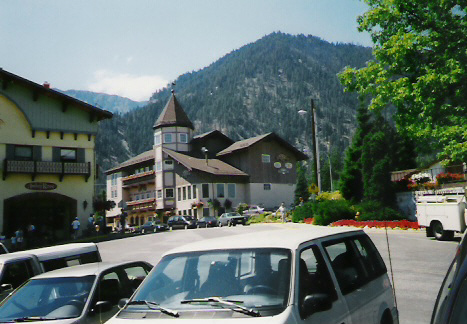
Picture snapped in Leavenworth, WA.

It was mid eighties recession, in Bellingham, WA.

I remember a rousing seminar at Holiday Inn Ballroom. On stage, this dynamic guest of honor from Leavenworth, WA.

He sensed, Bellingham people were hurting, needing money. Businesses, Churches, volunteer organizations, governments, schools, families, all. Thirsting for the ball.

Tourism, he said. You've got I-5 slicing through your town. Let's not frown. We can slow it down. Make em stop, spread their money around.

Proclaim your uniqueness. Recite the motto. Proclaim your uniqueness. Rousing group dynamic. This isn't hollow. Audience follow. Room standing. Chorus thundering. Exit signs rattling. Wait staff wondering.

You've got Mount Baker, the bay, history. Don't keep it a mystery.

Bellingham, just Before Canada. Let's try, "Bellingham BC."

Sing along. Bellingham, Bee See. Bellingham, Bee Seen.

And when they ask, is this "before Christ?" Start that conversation. Best in the nation. Anything for a twist. We're in the minst.

It was a rousing presentation. Standing, stamping, ballroom rumbling. No one mumbling. Give it a boost. You're ruling the roost.

Over in Leavenworth. Speaker said, "Here's how we did it."

It was just another clothing store, but we sported Bruce, the Moose. Hunter's trophy, by the door. So the people came to the store. Pet the nose. Everyone knows, Bruce the Moose. It became a town tradition. Everyone, sing along, Bruce the Moose. Kids got into the act.


Now, let's break up into small groups.

Inventory your assets. Possibilities.

Snow architecture festival? Mt. Baker area? Remember the Slush Cup?

How about this? Even a dorm dining hall, at Western Washington University, has panoramic view of the bay; Viking Commons. Worried look on group facilitator's face, "but, how's the food?"

Yes, the bay view is great, they didn't name Bay View Cemetery for nothing.

Why Bellingham even gets television, in French, from Vancouver, BC., Canada. On UHF, rabbit ears (remember the early eighties). Great place to practice your French. I see no one's sitting on that bench?

What, people leaving the room? Let's try harder for that boom.

How about, "A Saint Patrick's Day Parade" in Downtown Bellingham? It's not a charade.

Now, let's get back together in the big group.

On stage again, wipe the brow. Here's how. Pet the nose. Here goes. Test the microphone. Squeeeeeeeeeeeal, Ouch! Could someone turn down the speaker? 1, 2, 3 Tap, tap. Here at Holiday Inn ballroom.

Seminar dragged on a bit longer, made the local economy stronger.


Results:

Months later, a friend watched Bellingham's Saint Patrick's Day Parade. They talked the "big" radio station into coming to their aid.

Green shirts, green hats, green pants, But didn't allow rants. Poodles with green collars, green leashes.

"Bland," said friend.

Mostly about the green in the wallets. Tradition didn't last that long.

Then there was the big newspaper article about another seed nurtured by that seminar.

This relative of a local artist named Bergsma got inspired. If I remember correctly, here goes...

He ran out the door early. A few may have thought he was squirrely. He had a hunch and didn't even stay for the seminar's lunch. Instead, Leased a space near I-5 Lakeway Drive Exit.

I'll bet they never heard these jingles that crossed my mind, however.

"Bergsma Gallery." "Spend your salary." "Landscapes, beauty, more." "Even on the floor." "Visitor's center next door." "Just off I-5 at Lakeway Drive Exit." "Stop in for the show." "I'll take two Bergsma's and a coke to go?"

So that was revving up our motor some twenty years ago. Was Bellingham, grasping at straws? Waiting for thaws? And now, we're in the minst of a housing boom. Economy is cooking.

Friday, April 29, 2005

Thanks, Don for the good comment to my last post. Yes, Bob Keller's guest column in Bellingham Weekly 4/29/05 is very good. There may be more important places to preserve with limited conservation dollars than the 100 acre parcel near Fairhaven.

Thursday, April 28, 2005

Chuckanut Ridge. Large new subdivision or 100 acre woods?

Land that hasn't yet been developed, but is privately owned. Buying it for open space would be expensive.

Covering it with houses would be difficult due to wetlands and much opposition from neighbors.

I've read that developers plan to cluster the housing into duplexes, townhouses and so forth to build around wetlands and allow some open space to remain. Trails would be included and buffering along the Interurban Trail which passes near the property would be preserved.

Better than many existing neighborhoods.

Still, this isn't enough to satisfy folks who would like to preserve Chuckanut Ridge as open space.

One possible solution:

Build a few high rises in one corner of the property and leave the remainder as open space. That would be my kind of solution. Encourage non family and non car oriented folks who can live in small units. Provide bus service. Cluster the housing into mostly high rises in one corner of the land and preserve much of the remainder for open space.

Would this work?

Probably not in this society; especially on the outskirts of the city. Usually high rise living is closer to the core of a city. Still, it's an idea, if more people lived and thought like me.

I'm not real anti development out there. I've never walked back in there to fall in love with those woods. Maybe I wouldn't miss it and development has to go somewhere as long as people keep having kids and moving here.

Still, in some ways, it's sad that population keeps growing and land has become so expensive.


One of a bunch of "NO" signs along Chuckanut Drive in south part of Bellingham, WA.

Saturday, April 23, 2005


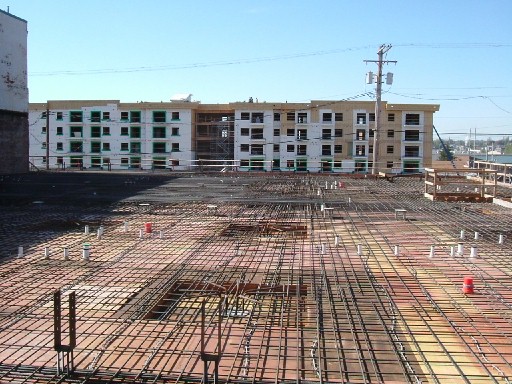
Condominium construction near downtown Bellingham, WA. Becoming a "city."

Friday, April 22, 2005

Bellingham / Whatcom County Rural Character; NOT

I came here from a much smaller community over in eastern Washington.

Pullman.

To me, Bellingham was a "big city."

It even had two Colonel Sander's Kentucky Fried Chicken places. Pullman had none, back in the mid 1970s when I came for college.

So much shopping in Bellingham. Hustle and bustle.

Pullman had practically nothing. Shoppers would go over to Moscow, Idaho for lower sales tax.

When I came to Bellingham, I thought I was moving to a city. Compared to Pullman, it was.

Now I find there are things I like about "city life;" like a better climate for gay people.

Working night shift, I also appreciate a city that doesn't close down at sundown. What happens if one wants to eat a normal meal during my working hours?

Some say ungodly hours?

Bellingham's got a ways to go, compared to 24 hour Vancouver, BC., but it's a lot bigger than Pullman.

In some ways, it feels like a big city with a small town mind set.

Some find it socially stifling, professionally stifling, yet still clogged with traffic.

The bad things about "small town" and "big city" life.

Stifling, limiting, but still hassled.

Pullman, on the other hand, is much smaller, and the rural area around the town - It really is rural.

Thousand acre wheat ranches. Roads with hardly a house in sight.

On Whatcom County roads one hardly ever looses sight of showboat homes everywhere. Mini marts galore.

Tiny Pullman was, and still is, kind of sophisticated for its size. A college town where WSU is located.

Bellingham has more than one college, but the college town feel is more diluted by tons and tons of commercial businesses all over the place.

Pullman has some new businesses now, but when I was a kid, one nearly had to travel to hustling Spokane in order to see neon.

Spokane, NEON.!

I enjoy living in Bellingham, but maybe I wouldn't if I hadn't sought out and developed lots of good friendships here.

Just about any place can be, in part, what one makes it.

Wednesday, April 20, 2005

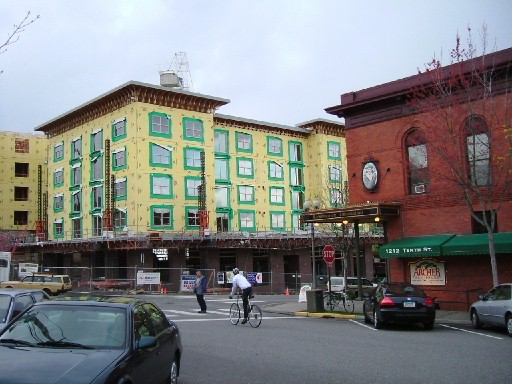
Condominium projects rise in Bellingham's Fairhaven District.


Also rising: attendance at neighborhood citizen forums on growth and planning.

Public mood changing against in fill? Maybe, but also likely just more and different voices coming to a meeting.

A belated geography lesson in the school.

500 neighbors, like angry bees, packed into a School cafeteria prompting one Bellingham Herald editorial to suggest this ...

Growth management plans that called for urban in filling, rather than county sprawl, were adopted in the 1990s. Perhaps public opinion is shifting away from the idea of in filling now that it is 2005 as people object to in fill in their neighborhoods?

I don't think that is the case.

People never speak with one voice such as, "we want in filling" or "we want sprawl."

Most people don't know that much about geography and urban planning. It hasn't had emphasis in American schools; K-12 schools. One of my geography professors, at Western Washington University, told me this, back when I was in school.

In filling and urban villages looked real good in the 1990s.

On paper.

When mostly "city planner junkies and followers, like me," showed up at the public forums.

It still looks good to me, but ...

Now that large buildings are rising, different people start coming to meetings.

More people.

Reacting.

Stirring up more muck in the pond. Different muck.

People are seeing buildings, construction, cranes, saying yikes!

Do they want county sprawl instead?

Not likely.

A lot of people haven't yet thought that far ahead.

They aren't connecting the dots.

Not connecting between the dots of population growth, sprawl or in filling.

These things city planning junkies think about more frequently.

Folks are just waking up, in some cases. Starting to connect the dots.

Geography hasn't been discussed enough, in the schools, during regular school hours, but it is sure coming up now. More concerned neighbors come out of the woodwork and start interacting with planners, about geography issues in places like that Fairhaven School Cafeteria. As the effects of population growth and prosperity appear in the cityscape more join the dialog.

Geography is now being discussed in a school.

Monday, April 18, 2005

Old Power House For Bellingham Street Cars


On Champion Street.

Some transit history memories.

As I was out walking in my neighborhood this backside view presented itself.

A friend was amazed it hasn't zuppified yet. No zesty coffee shops, ritzy art studios for wealthy faculty spouses.

An island of authentic life, preserved by the pragmatic storage of construction equipment, building those urban showcases elsewhere. Whatcom Creek Gurgles past.

I remember, years back, when this place had a low rent space for something called "Blackberry Printing Co-OP." Early 1980s when their motto was, "Freedom of the press belongs to those who OWN it, or SHARE IT." Emphasis on "share" for Blackberry's idealistic co-op members.

That was the days before Internet technology empowered so many little folks onto the World Wide Web.

What ever happened to Blackberry? I don't know.

Long before those days, this was the industrial heart of Bellingham's electrified street car system. Local historians give slide presentations about the cars that went nearly everywhere.

There was even a funeral car.

What happened to Bellingham's electric transit?

As in countless other cities, the automobile took over.

Conspiracy theorists say the oil companies plotted this, but I heard another twist on the story.

While I was bicycling across America, down a long lonely road in eastern Montana, the radio waves from Canada were keeping me company. Canadian National Broadcasting had a radio documentary on the demise of street car systems.

Public perception was to blame.

Old transit was seen as "The Big Guys." "The Crooked Guys." "Gruff Old Drivers." "City Hall."

The Automobile was new. Seen as "Empowerment For Individuals."

Empowerment.

"Don't rely on transit bosses." "Take charge yourself." "Drive your own car."

Transit fell into disrepair. Then oil companies bought, in some cases to try and salvage bankrupt systems, in other cases to dismantle and recycle used equipment.

Governments also took over dying transit systems.

I once heard that the owner of a private bus system, here in Bellingham, was going broke. Went before city council in 1960s and said, basically, "It's all yours or I'm shutting down." The city took over and birthed present days of "taxpayer subsidized transit in Bellingham."

I came on the scene, as a college student, in mid 1970s. My dad impressed that Bellingham Transit was only "a dime a ride." Sales taxes, of course, paid most of the cost.

Also there was, supposedly, the oldest continuously operating bus line in Washington State. It was still coming into Bellingham.

The Lynden Stage.

Started as horse and buggy. Went between Bellingham and Lynden each day.

Someone told me, "the old guy still drives the bus because the wife can't stand to have him around the house."

Riding in a friend's car, we got behind the Lynden bus one day.

Black smoke curling out the tailpipe. My friend said, "sure needs a ring job."

Not long after that, Lynden Stage was discontinued.

Also Bellingham City Transit was folded into Whatcom Transit Authority. "The WTA."

Runs have been extended out to Lynden and a few other county locations.

It's 75 cents per ride.

Nothing more said about the street car power plant, but it hasn't been yuppified, yet, at least.

Tuesday, April 12, 2005

Pioneer Plaza


In Ferndale?

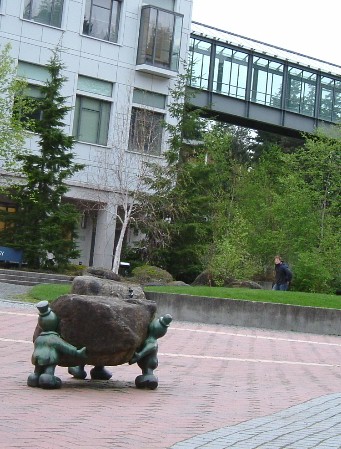
Another big center planned for Whatcom County. The above photo is not Pioneer Plaza as it hasn't been built yet. Photo shows a plaza at Western Washington University.

Around the time I graduated from Western, I thought the concept of a campus could be applied to a town for permanent residents. A "plaza city" complete with the gym, campus union building, and central heating system.

Dorms for transient students could be replaced with apartments and condos for permanent residents.

There could be shopping, parks and offices.

The academic program would be replaced with some sort of employer; such as a factory.

During college, I designed a "city in one building" as others were doodling in their class notes. My concept of a "campus city" was mentioned in May 1980 Council-Grams, a journal put out by National Council of Teachers of English.

Anyway, a similar planned unit development has been proposed for Ferndale over the years. Maybe not quite like my idea, but something with more variety than just a shopping center or residential subdivision.

Can something like that survive in this area?

Good question.

Since my college years, I have also marvelled at the amount of retailing in the greater Bellingham area. Seems like more stores than people. Of course I am from a much smaller town with few shopping alternatives. Bellingham seemed to be adding new centers and shopping everywhere.

With local industries laying off folks, I wondered, "where do the customers come from?"

Somehow many of these businesses thrive.

More recently, I concluded that the massive run up in California home prices is having a spill over effect in our local economy. Enough independently wealthy "recent home sellers" are moving into this area to keep up the consumer spending even though there doesn't seem to be much in the way of job producing industry.

Of course a big center like Pioneer Plaza could bring in it's own money generating industry, for instance if something like a Microsoft were to locate in it's office complexes.

Then there are the folks in this area who don't wish to see growth here. That's another commentary.

Anyway, it is interesting to see how this proposal will play out.

Notice, on the picture of that plaza at Western, the sculpture of people lifting a stone.

Can our local economy, region, world hold up to all the new people and things planned?

Of course one big center with the jobs, residents and recreation close by would be better for the environment than having to commute to things; that is if the people are being born and coming anyway.

Saturday, April 09, 2005


Thin green lines along a Whatcom Creek bike path near Cornwall Avenue, Bellingham, WA. Silhouetted against the ever present background of businesses, warehouses, homes, cars, whorehouses?

Wednesday, April 06, 2005

Tombstones for sale.


Selling to the end. It's the end game.

Out walking around the neighborhood. With camera. Fussner's Monuments near by.

People thinking, "death, taxes."

A friend in grocery line resents paying uncle Sam and the war.

I don't mind paying Uncle Sam's matching grant for bike paths, however.

Then I say, "good way to cut taxes is to not make much money." "Lower tax brackets."

Got home to a phone call from another friend excited about the upcoming conference, in Seattle.

"Take Back Your Time" conference.

All about shorter work weeks.

More time for creativity, maybe less money.

We only have so much time to spend, in this life at least.

Monday, April 04, 2005

Technology triumphs when tax simplification fails

For years, we have been hearing about "tax simplification."

One radio talk show host mentioned some 1,500 page document entitled "Tax Simplification."

1,500 pages, simplification? he ask.

Our society is just too complex. It is doubtful that the political process could ever boil everyone's divergent needs, exemptions, exclusions, what ever, into a simple process.

When people and politics can't solve a problem, technology often provides the fix.

E-filing one's income taxes on-line.

It's a lot easier.

When one files on-line, much of the complexity is "crunched" by computers behind the scene.

Number crunching other people's complexities away.

Imagine, a form tailored to just me.

It's already here.

Just answer questions to whittle down the forms. The answer isn't that hard, it's usually "no."

NO.

I don't have ...

A farm,

No, I don't have a business.

Kids, selling a house, blind, veteran, in a combat zone, claiming educational credits, recently divorced, married, remarried, paying alimony, had the vault from my bank fall on my head, what ever; bla, bla, bla.

No, No, No.

It's no.

No isn't too hard to say.

Any small amount of these things isn't too bad.

It's just when all of society's complexities comes at you, on one form (stack of forms), it is a bit much.

Just a handful of "yes's" doesn't create too much complexity.

The computer can tailor that filing experience to each individual. Reducing clutter.

Eventually, the computer eliminates the complexities of other people, and just retains my own complexities.

Yes, I do have a small amount of money in a mutual fund, for instance.

The system tailored to my situation.

It becomes a matter of just gathering one's statements, from mutual funds, W2s or what ever.

Then, plugging the numbers in where the computer says to do so.

It still pays to keep things organized, however.

Tax simplification has been, to a large extent, accomplished by technology.

Saturday, April 02, 2005


Sculpture of cross outside Assumption Church in Bellingham. Notice bird having dinner before flying away. Shards of glass are part of the sculpture. At base, it says sculpture was installed year 2000. I walked past after hearing news of Pope's death. Bell was ringing.

Friday, April 01, 2005

I've been on the web for ten years

Sometime around April 1 1995 I put up my first web site about bicycle touring, photos and alternative living. In 1999, it moved to my current donaim name

www.theslowlane.com

This blog and my Yahoo group were added more recently.

Before being on the web, I was making more trips to a local copy center and the post office.

Wednesday, March 30, 2005

Contradictions with-in Republican Party philosophy

The political fiasco around Terri Schiavo's feeding tube points out a contradiction in thinking among Republicans.

On the one hand there are the "right to lifer's" who always want to err on the side of life even if it means maintaining expensive medical care beyond any reasonable prospect of recovery.

On the other hand there are the "limit spending libertarians." These are folks who would say, "if you are sick and don't have private resources (insurance / savings) too bad. It is not government's job to help you. The world doesn't owe you a living or life.

With the cost of health care rising so fast that it is the main thing driving growth in government spending, this contradiction becomes more glaring.

When Republicans call for curbs in government spending, do they really mean pulling the plug on people?

Of course there are some ways to deliver medical care in more efficient ways, like reigning in liability costs. Still, things like tort reform can only solve part of spiraling health care costs.

The cost of health care bankrupts Republican thinking in more ways than one.

Tuesday, March 29, 2005

YMCA


Painting the pool. After small pool was drained and repainted at our local YMCA, I snapped this picture before water returned. Image sideways.

Wednesday, March 23, 2005

If eastern Washington were to secede?


If eastern Washington were to secede would WSU and Bryan Clock be left high and dry?

Splitting Washington State in half?

Written March 2005

What would happen to the higher education system?

Some West side "Blue Stators" will smugly point out that the state spends more, per capita, for roads in "tax cut" eastern Washington country than it does west of the Cascades.

More road miles to maintain per person in the wide open spaces of the east side.

It's true, if one ponders the duties of state government, the west side, with the economic engine of its urban areas, has a point.

This can certainly be seen in higher education; a major function of state government.

Splitting Washington would devastate both sides of the divide. More universities are on the east side while most of the students come from the west side.

Heavily populated Western Washington only has two universities while the east side enjoys three. Of course, University Of Washington, in Seattle (west side), has the largest enrollment, but the only other university is Western Washington University, here in Bellingham.

Evergreen State College, in Olympia (west side), is much smaller and not called a University.

With less population, eastern Washington has Eastern Washington University, in Cheney, Central Washington University, in Ellensburg and Washington State University, in Pullman. The latter often reports that King County, where Seattle is located, is the top "county of origin" for WSU Students.

Would those students come to WSU if they had to pay out of state tuition?

This situation could devastate the economy of Pullman, Washington which can be seen as an island of "blue state" in "red state" eastern Washington.

That college town, where I happen to be from (born and raised), is sometimes referred to as the "Athens of the Palouse."

If the west and the east were to divide, both sides would suffer higher education blues. College town economies of the east would be hurt by lack of students and the accompaniment of state funding. The west side would suffer from too many students with lack of classroom space. Enrollment ceilings, on the west side, are bad enough already.

Outside the business of state government, west side folks might have to swallow some of their smugness also. Much of the power that runs west side cities comes from dams on the Columbia River, in eastern Washington.

Some of western Washington's garbage goes east for disposal. Much of it goes all the way to eastern Oregon, to waste repositories around Arlington, Oregon.

Western Washington "blue state" people often boast about buying local, rather than supporting Walmart style corporate monsters.

Farmer's markets with local produce and musicians flourish on the west side, but where would the dairy farmers be with out hay from east of the mountains?

I once had a conversation with a truck driver who described what goes into milk, supposedly produced by Whatcom County (west side) dairy farms. Some grass is grown locally, but lots of hay is trucked in from eastern Washington. Feed corn comes from far afield. It is grown in places like southern Idaho and even the Dakotas. Dairy feed is even sweetened, sometimes, with cotton seed from places as far as Australia.

Yes, "local feel gooders," we live in a global economy. Global at least as long as people insist on living the way we do.

If eastern Washingtonians really wanted to play hardball and cut off some of the private commerce, this entire state would be devastated. However, that could not happen as long as both sides remain in USA where commerce crosses state lines easier than do local tax dollars or college students.

Friday, March 18, 2005

Terri Schiavo feeding tube culture of life?


Weren't the Republicans the ones trying to remove the feeding tube? My latest cartoon idea.

Democrats should use this controversy to point out Republican hypocrisy and advocate access to health care for all Americans.

Republicans have gotten themselves into a trap, but Democrats may not be smart enough to take advantage of this.

President Bush, and other Republican leaders, such as Representative Tom Delay, say things like;

"Always err on the side of life."

Democrats should use this to advocate better funding for health care access to low income and uninsured people. Democrats should use this to oppose cuts in the nation's "safety net."

Access to health care for all citizens should be advocated as a "right to life" issue.

My fear is that Democrats will miss this great opportunity.

As for weather the feeding tube should be replaced, or not, it should not be up to the politicians (unless they can't trust the doctors working on that case). Maybe an independent team of doctors could be put onto the case so Terri Schiavo, her parents and husband could have a second opinion.

If the doctors say she is (basically) dead, it is up to the doctors, and the families involved, to make the decisions. As long as the doctors are acting responsibly, including allowing for "second opinion," Congress and the President have no role; in my opinion.

Since Congress and the President have taken on this role to make pronouncements about erring on the side of life, Democrats should use this to advocate access to health care for all Americans.

Wednesday, March 16, 2005

Senate Approves Oil Drilling In Arctic National Wildlife Refuge

I am not surprised. More Republicans than Democrats in Senate.

Also, there was a recent survey, done here in Bellingham, about how people transport themselves. The survey concluded that people "talk green," but still rely on the automobile for a very high percentage of trips.

The "green means" of transportation, such as walking, bicycling or public transit, only account for a small percentage of trips.

In other words, talk is green, but not action.

The study also has funding to sit down with people and discuss transportation choices. It reported an increase in the use of "green travel," after people were counselled, one to one, on their options.

This second part of the study was encouraging.

Basically, many green talkers are hypocrites, before the study, but after the one on one counselling part of that study, people improved.

Buffer lands around Whatcom County refineries. Power lines seen here are going into Alcoa Intalco Aluminum Works. Two oil refineries are also located in this area.

Ironically, it's one of the best parts of the county to bike in. Not that many people live around the refineries so traffic sparse.

One might view this as an argument that drilling for oil in the Alaska Wildlife Refuge may not be the end of the world. Pollution control and buffers around large oil facilities make them appear green.

On the other hand, where people live and shop. That can appear totally hectic, paved over and polluted.

Speaking of oil, the bicycle trip I took, last weekend to Skagit County, brought me to a Crispy Cream Doughnut factory.

Had one doughnut for 89 cents.

Peddling 60 miles, round trip, relieved the guilt, but the flavor of the doughnuts is over hyped.

I guess it is doughnut "oil I can live with out."

Now chocolate milk, that is a different story. I must be addicted to that, but I drink the low fat variety.

That's the news from my personal "oil," or lack there of, economy.

Tuesday, March 15, 2005

With friends like Arafat, who would have needed enemies

Some encouraging news seems to be coming out of Lebanon, also the Palestinian Territories. Of course, President Bush will try to claim credit for much of this. He is a politician.

There may be some truth in what he says.

I have always considered myself a "fence sitter" on the question of whether the Iraq War could be justified. I'm still sitting on that fence.

I am sure there is more to these issues than just a simplistic "the war is fixing problems" analysis.

It is still possible that the war has been more of a hindrance than a solution.

Rather than relive some of those tired debates, I wish to contemplate another factor besides American politics.

This factor is the "passing of the guard."

People die.

New ideas evolve.

I am thinking, more particularly, about Yasser Arafat.

Things might improve now that Arafat is gone. He was somewhat of a belligerent stumbling block.

Hopefully, new leadership will be more committed to non violent change. They can get more concessions from Israel.

I have an interesting memory relating to news about Arafat back in the 1970s when I was attending Western Washington University. One of my classes was about the great non violent leader Mahatma Gandhi.

Gandhi was able to free India from the clutches of a powerful British Empire using nonviolent means.

Our class had a segment about some diplomatic trip that Gandhi took to London. The British government was just beginning to take him seriously and planned to put him up in elaborate diplomatic quarters.

Gandhi would have none of it.

He insisted on staying with a working class family in a poor part of London.

I remember how inspiring that story was.

Leaving the classroom on a cloud of inspiration, I next went to my dorm lobby where there was a television.

The cloud of inspiration vanished quickly.

News all over the TV was about Arafat coming to New York City for negotiating before the United Nations. The city, and UN officials, wanted to put him up on a military base where his safety could be protected. It would be comfortable, but easier to protect than a hotel.

Arafat would have none of it.

He insisted on staying at the Waldorf Astoria Hotel. He insisted on about the fanciest place in town. No working class quarters for him.

This created a major headache for those trying to protect his safety.

I remember thinking, "With friends like that, who needs enemies."

Monday, March 14, 2005

Washington State Auto Emission Standards

How about just getting people to drive less?

Interesting discussion about proposed clean air standards for the state on KUOW's show called "The Conversation." It aired today.

Several bills have been proposed trying to get vehicles to put out less carbon dioxide and other pollutants.

One such bill, SB5916, sponsored by Republican Dave Smitt, seems to have a major flaw in it. Smitt, who was one of KUOW's guests, proposed tax incentives for people to buy more fuel efficient cars; such as hybrids.

Isn't the state short of money? Can the state afford to cut sales taxes on new car purchases?

Smith feels the state would recoup the loss. If people drive more efficient cars, says Smitt, they would be spending less on gasoline. They would have more disposable income to spend on other items that have a sales tax; such as home furnishings for instance.

Sales tax is not collected on gas, but Smitt forgets about gas taxes.

Gas tax revenue is a big source of state funding. A big source of funding for highway construction.

Hybrid cars are great, but less money spent on gas means less "gas tax" money for road and transportation costs.

Rather than tax incentives for buying new cars, maybe we should just discourage people from driving as much. Then we would need less road construction money even though we would still need money for public transit.

I have nothing against hybrids.

Reducing pollution and consumption is a good thing, but the state also faces traffic gridlock. As wonderful as hybrids are, they still don't solve the gridlock in traffic and parking. Loss of gas tax revenue could hurt as road space is still needed by all the cars; even the fuel efficient ones.

Sunday, March 13, 2005

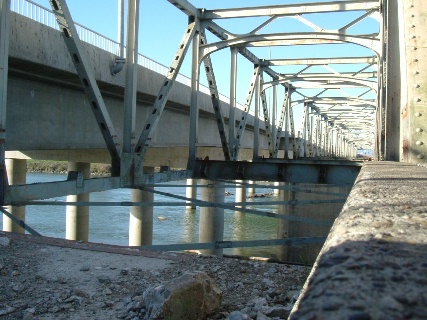
Picture of Highway 99 bridge being torn down; Mount Vernon


Old Highway 99 bridge across Skagit River is being dismantled. New span bypasses it. Plans call for recycling the steel beams. Bringing them 25 miles north to Bellingham for our new Farmer's Market shelter. That will be an interesting building to see when finished.

Saturday, I bicycled to Mt. Vernon and back. About 60 miles round trip.

One of the regular followers of my web site lives in Arlington and was planning to come up to Mount Vernon for the day. We arranged to meet on a sunny bench outside Outlet Cafe. Cafe is in Burlington Factory Outlet Mall where she was doing some shopping.

I rode back to Bellingham and then went dancing, for a short while, at the Bellingham Leathermen Kickoff Social. It's a new organization starting in town.

A lot of motorcyclists, but I am still the only "peddle bicyclist" at the party.

A good energetic day.

Saturday, March 12, 2005

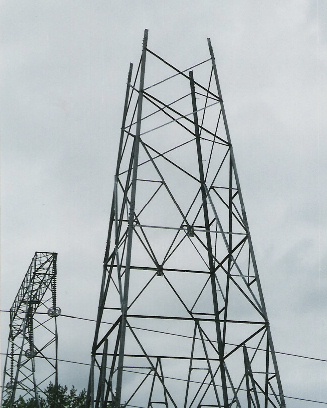
Power lines under construction near Bellingham


New power lines under construction north of Bellingham, WA. around 1996.

Thursday, March 10, 2005

Raising Retirement Age?

This proposal sets better with me than Bush's idea of carving private investment accounts out of Social Security.

I have already done some of my retirement.

Done much contemplation, spent time with friends, enjoyed bicycle travel.

For many years, I worked part time and dabbled in creativity the rest of the time. Much of my retirement is "already under my belt," so to speak.

I have already done some things that people look forward to retirement for.

If I must work past 65, and I am still healthy, it wouldn't be so bad.

Much of my life, right out of college, I only worked part time. Not easy to find full time work in this area. It was a nice balance between work and play, anyway.

If I must work, especially part time, after 65, the balance remains.

This is a better idea than personal savings accounts which require one to have money. I don't have much money, but have had a good time and can continue to have a good time.

The line between retirement, work, play, school and all those things should be fuzzy anyway.

Some folks might be mad if they slaved away all their lives, especially for low wages, and now feel that even their retirement years are being taken away.

They might be pissed.

I am in a better situation than that. I don't have lots of money, but I have had a good time, even before my retirement. A whole life in the slow lane.

Monday, March 07, 2005

12 Reasons not to live in Bellingham or Whatcom County

There are some individuals and organizations such as Pro Whatcom that are worried about rapid growth in this area.

I am not necessarily against growth, but here are some marketing suggestions that people who are against growth might consider. A list of bad things about this area that might discourage folks from moving here. Negative marketing suggestions.

Feel free to use items from this list, even though I am not normally this pessimistic about things. It's just something to think about.

1. The source of drinking water for Bellingham and some of Whatcom County, (Lake Whatcom) has been declared a polluted body of water.

2. Housing is among the most expensive in Washington State.

3. People with masters degrees are often found waiting tables. Competition for jobs beyond low level service / retail sector jobs is fierce.

4. Northern latitude means long dark winters (don't mention long light period in summer).

5. Cloudy climate, and some other factors, lead to high suicide rates in western Washington.

6. I-5 corridor and proximity to Canadian border, creates lots of drug traffic and law enforcement needs.

7. Many desperate folks trying to get into Canada, or headed to Alaska, end up homeless in Bellingham.

8. Emergency medical services levy failed in 2004. The only public facility levy to pass in Bellingham (2004 election) was a much needed new jailhouse.

9. Rapid population growth is causing traffic snarls, growing pains and some resentment of newcomers by local residents.

10. Un like California with it's miles of "public access" beaches, much of our local shoreline is "private property."

11. Bellingham is occasionally called "Boringham."

12. A popular hangout is a bar that is sometimes nicknamed "Tumor's." (If Washington State passes a smoking ban, in pubs, that nickname may cease to apply.)

Friday, March 04, 2005

Is the radio audience shrinking?


I recently read an article about broadcast radio suffering from the competition of Ipod's, Internet and Satellite Radio.

Not surprising.

Many local broadcasters are just relays for some regurgitated national talk show that's carried on hundreds of "look alike" stations.

Might as well get the network feed directly off a satellite. Why bother having local transmitters to repeat the same thing?

Stations who originate programs in their local studios may not be as seriously hurt by these changes as the network clones. The local station can still have a niche when it is based on the local community that surrounds the station.

If there are too many redundant outlets for a national network, in one area, maybe some of them should go off the air. Clear the crowded AM and FM dials for more interesting things.

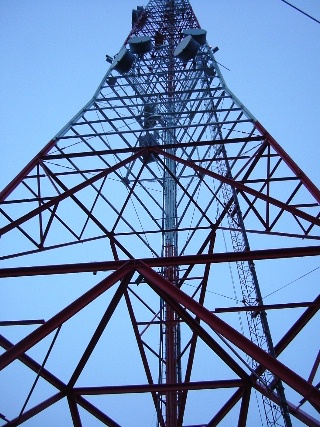
Picture, above, is looking up at one of the Queen Ann Hill Radio TV towers in Seattle. I am not sure which stations are on which towers. I walked near those towers when I was last in the city.

Thursday, March 03, 2005

Winds of democratic change across Middle East?

I recently had a conversation, in the sauna, with one of my deep thinking friends. He tends to be a follower of the blog Andrew Sullivan.

There is some encouraging news coming out of the new Palestinian leadership. Hopefully putting aside violence and opting for better tools to change society.

I remember an old quote that goes, "the pen is mightier than the sword."

There is also encouraging news from Lebanon, even though I don't always follow international events that closely.

Elections have taken place in a few spots around the Middle East. I hear that even Saudi Arabia has recently had local elections, but only men were allowed to vote. A tiny step at least.

Of course there has been quite a bit of fanfare made about the elections in Iraq. Some encouraging news, but it's still a bumpy road.

There is an "elephant in the room question." That is, "does the good news vindicate foreign policy of George Bush?"

Elephant has several meanings. It can mean large as well as being the Republican Party's mascot symbol.

Of course some would say the good news is a creation of "bias American media."

I would like to think that there can be, at least, some "good news" coming from the Middle East. There certainly has been a lot of "bad news" coming from that region over the decades.

I am not really a fan of George Bush, but I have never thought of him as being "the devil incarnate" either.

I do feel that stern policies and use of military force is often vindicated by environments where there is lots of anger and violence.

A harsh environment can be seen as "fertile ground" for the "George Bush" style thinking.

I remember another phrase that says, "he who lives by the sword, dies by the sword."

One can also say, "if the sword rules, the one with the biggest sword wins."

On the other hand, a less violent world could render someone like George Bush less effective. In another realm, he could be seen as a "fish out of water."

What seems vindicated, in a violent world, might become a burden in a more peaceful environment.

Will the large military bankrupt us in peace time?

Here in the USA, where battles are more apt to be fought by pen, rather than sword, Bush, and the Republican Party can still go down to defeat. Another election is usually around the corner. Bush is having a hard time convincing Americans of his scheme to privatize part of Social Security.

Future political landscapes may not be as "fertile ground" for the Bush agenda as the harsh world of past Middle Eastern news has been.

Hopefully the vicious cycle of violence and force will eventually subside and we can go beyond what some would call the "George Bush era."

Monday, February 28, 2005

Main Street improvements, Ferndale, WA.


Main Street Ferndale, Washington. Doesn't look bad on a Saturday (when I biked there), but choked with traffic weekdays according to a February 26 Herald article. Things usually look better from a bicyclist's perspective anyway.

Car and business owners are doing some fuming now that the 5.4 million dollar bridge and street improvements are complete.

It's still just 2 lanes.

To widen this section of Main into 4 lanes would likely require tearing down the businesses who's buildings abut the right of way.

Tear down Main Street businesses to make room for more cars, or try and survive with less cars. Bus service is gradually improving. The sidewalk and bike lane improvements, that were part of the recent work, take up less space than making everything 4 lanes, 6 lanes? 8 lanes?

Sunday, February 27, 2005


Eat your vegetables.

Not easy to do, as a single person, when lettuce comes in a big head that rots before one person can eat it. Radishes often come with the leafy tops attached. Leads to quicker wilting.

I like the way radishes are presented at the Bellingham Grocery Outlet. Topped and chopped from their rat tail like roots. Then washed and packed in an individual size package. Like eating potato chips. A nice snack pack.

Vegetables can be very good and easy to eat when presented this way.

Tuesday, February 22, 2005

Gay Environmentalism

I did a Google search with quotes and only two things came up!

One would think this should be an obvious connection. Over population partially the result of "family values" being pushed down everyone's throat.

Environmentalism should go beyond just saving some wetland or sitting in front of a logging truck. As population, in Washington State, increased around 20% in the last decade, that means 20% more houses, jobs, everything just to tread water.

Much of that population is migration to the state, but too many people are being born, somewhere.

Also, things are going to have to change for a sustainable future. Smaller lot sizes in housing, more people living in apartments and condominiums. Mass transit, bicycles.

They say alternative transportation is more likely to be used in dense urban environments; like Seattle's Capital Hill district.

Capital Hill also happens to be called the "gay ghetto."

Are people of gay lifestyles better adapted to living in close quarters? Treading lightly on mother nature?

One might not think that walking around on Capital Hill. A lot of SUV's are tucked away in parking garages. On the surface, it seems like there is a shallow and consumerism side of gay culture as well.

Couch potatoes spending all their time at department stores trying on mascara.

There is a disconnect here. A missed opportunity.

One would think more gay people would embrace the outdoors and bicycling lifestyles.

It helps one's figure.

At the same time one would think environmentalists would be pushing for gay rights; population reduction.

If these two social movements would come together, wonderful things could happen.

Part of the problem is, "compartmental thinking."

Here's for child free, car free living.

Gay agenda?

There really isn't one, but maybe there should be. I doubt most gay people would buy the entire thing. In reality, there are about as many gay agendas as there are gay people. We do need an agenda for lower carbon footprint living. Some of that may appear to be like a gay agenda of sorts.