It's an old law.
Going around that 1978 law requiring a court order before ordering wiretapping on US citizens.
Does this mean modern circumstances make old laws and prohibitions obsolete? Moral relativism?
I never thought I would hear someone, who allies himself with the religious right, advocate tossing the law just because it's old and possibly no longer useful in a modern situation.
I am not enough of an expert on that law to debate whether the President needed to bypass it, or not. Maybe the writers of that law put enough provisions it in so the court order could be obtained in a timely manner. Then the President was foolish to bypass it.
On the other hand, maybe that law means this. "When a terrorist is about to strike, you call the court and hear that you have to wait till the next business day, after 9." Too late.
I don't know, since I am not a legal expert, especially on that law.
Usually our nation's laws are more flexible and relevant to modern needs than so many of the old moral codes of religious fundamentalists.
It is interesting to hear Bush, who panders to the religious right, those guardians of rigid, laws and old morals, say, "it's an old law."
"Don't obey when it gets in the way."
That rhymes.
"Don't obey when it gets in the way." Could become the next Republican campaign slogan?
Moral relativism. It's getting some new converts.

Sunday, January 29, 2006

Saturday, January 28, 2006
Domestic partnership in Washington State

One piece of good news
Civil Rights legislation has just been extended to include sexual orientation and trans gender status in the state of Washington. It passed by 2 votes in Washington State Senate. Passed with a more comfortable margin in the state house. The governor plans to sign it. Good news.
Tuesday, January 24, 2006
Glut of highly educated career seekers, is America a doormat?
I once heard, on the radio, about someone from India coming to USA for a "better job." Soon after they got here, the better job was out sourced back to India.
They went back.
It seems like America can be a door mat. People coming here for opportunities and corporations sending jobs elsewhere.
Everyone just trying to make a buck.
Then I heard about another person who finds better job opportunities in Ecuador than USA (especially Bellingham). We have such a glut of educated people that his BA didn't mean much in this job market. In Ecuador, even though he isn't making a lot of money, his BA means more. He is writing, teaching and so forth. Things he would never qualify for in Bellingham with just a BA. Good place for him to start building a resume of experience at least.
It also helps to have roots there and speak the language, or better yet several languages.
They went back.
It seems like America can be a door mat. People coming here for opportunities and corporations sending jobs elsewhere.
Everyone just trying to make a buck.
Then I heard about another person who finds better job opportunities in Ecuador than USA (especially Bellingham). We have such a glut of educated people that his BA didn't mean much in this job market. In Ecuador, even though he isn't making a lot of money, his BA means more. He is writing, teaching and so forth. Things he would never qualify for in Bellingham with just a BA. Good place for him to start building a resume of experience at least.
It also helps to have roots there and speak the language, or better yet several languages.
Saturday, January 21, 2006
Brokeback Mountain Movie Review

Well written, thought provoking, a very sad and tragic story.
Still, today, I know of so many gay people who have gotten married, heterosexually, like the two characters in Brokeback Mountain, even though it isn't, what could be called, their true "bliss path." The term "living life as a lie" is so common.
Spouses and kids suffer as well in these "marriages that shouldn't be." It's sad all the way around.
One can't blame the Brokeback characters for not really knowing what they wanted, after all it was Wyoming in 1963, before Stonewall, even.
Their gay relationship was troubled also as they suffered a lot of internal ambivalence over it, not to mention the threat of getting one's head bashed in with a crowbar for not toeing society's line.
A friend of mine wondered why they didn't just "drive their trucks out to California," San Francisco for instance, to better lives. Back in 1963, it is easy to believe that they wouldn't know anything about gay life anywhere else on the planet. Also, once marriage and kids are involved, there are commitments that are hard to walk away from.
The film followed their unhappy existences for 20 years, basically up to 1983 when more open gay role models could be found, but there was no hint of this in the film. The two main characters led insular lives seeming to have no knowledge of a larger gay world, or the news outside their own little worlds. They were focused on making a living, families, relationships and so forth; like a lot of people I know.
Good thing it was just fiction as this was such a sad tale, but many real people do seem to live these kind of "shadow lives." Living in the closet can be hard.
Following one's true "bliss path" is better, but it isn't always easy to know what that is, or to live it given society's pressures.
* The natural scenery was fantastic, but living that stifling life of small town America? - Harsh. Just passing through can be better. Above photo: Wyoming's Big Horn Mountains, from my 1991 bicycle tour across USA.
Monday, January 16, 2006
On Martin Luther King Day

I woke up to speeches, by Dr. Martin Luther King on my local NPR station today.
Part of one speech was about revolutions in technology and the social order. King was marveling about how the world is being knitted closer together with technical achievements like the jet engine. I heard him say, it is now possible to travel from Tokyo to Seattle with-in a day.
Due to the international dateline, and the speed of jet travel, someone in Seattle can ask a person arriving from Tokyo when they started their journey. The person from Tokyo can say the journey started "Tomorrow!" Crossing the international dateline can mean starting the trip Monday, Japan time and ending Sunday, US time.
King was discussing how the smaller world created by things like jet travel can also necessitate revolutions in human thinking where the entire world should become more like one brotherhood.
This speech was given many years ago. Now, we even have the Internet.
It was interesting to hear especially the day after Stardust space mission's successful landing with dust from a comet.
As our technology opens up potential for networking the whole world, so can our social thinking be inspired to strive for more of a world wide brotherhood.
I find this thinking more comforting than the idea that technology is evil. Of course, technology is a tool that can be used for either good, or bad, but it can inspire revolutions and changes in human thinking. That was a spirit of optimism which permeated the 1960s.
Sunday, January 15, 2006
Stardust returns comet dust to Earth

Congratulations To NASA and the international scientists for successful return of Comet Dust to Earth
Screen shot from an old astronomy film and my flash.
The unmanned Stardust Mission has successfully returned it's sample of comet dust to Earth. This will help scientists explore cosmic questions about the formation of our solar system.
Asking cosmic questions brings the best out of humans.
Around the time of this great technical achievement, the news is also full of our failures here on Earth. A US missile hits house in Pakistan killing innocent people and missing the intended terrorist. Sometimes I feel like there is a war among fundamentalists. Traditional values "Christian capitalists," in the US, versus Islamic Fundamentalists.
I wish people would stop fighting over who has the best answers and look up at the stars more. Putting energy toward asking cosmic questions, with out already knowing the answers, is a step toward more peace in this world.
Monday, January 02, 2006
Tear Out Parking Lot, Put In Paradise? Proposed Bayview Tower in Bellingham

Playing the song "pave paradise put in a parking lot" backwards.
Picture shows balloon in parking lot where tall residential building is planned. Balloon was bringing a camera up to different levels, for "sneak previews" of what could be seen from various floors.
Some people will miss that parking lot. There was recently a meeting about the proposal to build a 23 story condominium building in downtown Bellingham.
Bay View Tower it's called.
Could be a paradise at least for the people living there and hopefully for folks around it as well.
I don't drive or park, so I wouldn't miss the parking lot.
Then there is another "Paradise," here in Whatcom County. It's a neighborhood, I hear, is sort of the opposite of true paradise. That area, called Paradise, is located out by Kendall. It's way out away from things like county sheriff services. Has had problems with crime and so forth.
Maybe that paradise is too far from what people call "Infra Structure." It's in an unincorporated area away from city services.
The building, planned for downtown, Bellingham would be where services are close by. "Building up," instead of "sprawling out," but some folks will miss that parking lot.
40 parking spaces would be removed.
The building will provide parking for it's tenants, but some of the businesses, around that neighborhood, are worried.
Maybe replacement parking can be built somewhere else; like in a downtown Bellingham parking project.
I keep wondering why people are so dependent on cars? Aren't we trying to live in a paradise? Wasn't it "parking" that took out Paradise?
The meeting was a mixture of comments about that building. Some favored while others opposed it.
Of course, to be fair, not all the opposition to that building was based on lost parking. Some people just think the place will be too tall. It could stick out like a sore thumb, but several other buildings are planned in the area. They would be farther south, along State Street.
I like tall buildings even though I would like to see some sort of observation deck, or restaurant open to the public. Something that a tall building can provide to the larger community.
Little is planned for public access yet, but plans are never totally cast in stone. One person, at the meeting, complained that the building might be just a, "vertical gated community."
Yes, I do think there is too much of that. Gated communities, that is. There is just too much fear and distrust between differing income groups in this society.
There is some low income housing planned across the street, also a bit north on State Street. A mix of housing types. That is what downtown is becoming.
I like that better than zoning all the rich folks in one neighborhood while the poor live in another, or the poor can't afford to live here at all.
I'm still fortunate to have affordable rent in Bellingham. I just take up one small room with a tiny bathroom. Room for my computer and bicycle. Wouldn't it be paradise if people could all live my way? It's easier if one has no pets. Just don't have too much stuff.
Building planners are trying to work with the neighborhood. They discussed things like bringing flex-car to Bellingham at that meeting. Also the builders plan to make it a model in "green building" architecture.
There would be a rooftop garden that is less of a drainage problem, for the city, than the asphalt parking lot that's there now. Trees and plantings actually absorb, and then slowly parcel out the run off. They do that better than the asphalt of old parking lots.
Plants growing on a building. Could that be putting paradise where the parking lot was before?
On the other hand, maybe population shouldn't be growing. We are more likely to be able to keep things the way they were if people, the world over, would just cut back on having kids. I remember when people could rent an apartment for $100 per month. They could buy a house for $20,000.
Now most houses are well over $300,000. Condos and apartments take up less yard space so they are a bit more reasonable.
We're just running out of space, here on planet Earth. North Dakota is still there, but we do need some space for wildlife, agriculture, watersheds and so forth.
I do hear that Whatcom County's growth rate has slowed down a bit in the past few years. It's a bit slower than it was in the late 1990s. Slowing down, and more of it is in-filling.
I also read that USA population growth rate between 2003 and 2025 is projected to be at around 1.33% each year. Bellingham's growth has been 1.6 % per year between 2000 and 2005. It's a bit higher than the national average, but not like "double the national average."
* Growth figures in Dec. 27 05 Herald.

Image I found from the net. Proposed Bay View Tower for Bellingham as visioned around 2006.
Thursday, December 29, 2005
Are Our Civil Liberties Being Eroded by Working Too Much?

"They that can give up essential liberty to obtain a little temporary safety deserve neither liberty nor safety." Ben Franklin.
That quote is quite popular these days. Floating all around the Internet as well as on various radio talk shows, letters to the editor and the like.
I recently heard one talk show host ask, "why aren't people more outraged?" "Why aren't folks marching in the streets?"
Well, this might not be your typical answer, but it's true.
People are just too busy, working full time, or overtime.
Folks are too busy just commuting to their jobs. Getting up early in the morning, fighting traffic, arriving at home real late. Were is the time, or the energy, for anything else?
It seems like many are willing to give up liberty in exchange for security and creature comfort. Nice homes, higher paying jobs, good retirement plans. Is the price our liberty? Is there any time left for living?
Of course some people love their work so much that doing the job can be pure liberation, but others spend much of their lives doing work just to pay the bills not to mention all that time spent sitting in traffic.
I recently went to a web page of Franklin Quotes. The first quote to come up was that famous one about essential liberty and temporary safety. The next quote to come up is this:
"Eat to live, not live to eat."
Have people sold out their lives to so called financial security? Are they working themselves to death?
There is a growing movement to "Take Back Your Time," or at least take back some of it. How about a shorter workweek? How about longer vacations? More time for family, friends and community and activism. More time for a better world.
Here is a link to this friend's new blog.
People For A Shorter Workweek.
Thursday, December 22, 2005
Demise of the Bellingham Weekly?

Update 2025. There is now the Cascadia Daily News
Bellingham has many publications.
Back when I was in college, I lived at a rooming house on High Street. The new publication called "YOU," "You Magazine," or something like that was around.
It must have felt that it was "The News Tailored To You."
Didn't last long, however.
One day, my rooming house manager found copies of "You" arranged in a fan on the floor. It was in front of the main door. Someone had distributed the paper in a fan, rather than a pile. There was one copy for each room in the house.
The manager said, "What on earth is this?" because it was in the way.
I said. "It's YOU!"
She gathered up the fan and said, "We only need one."
Sunday, December 18, 2005
This is one way to make a hydrogen bomb. Ask Thermo the magician
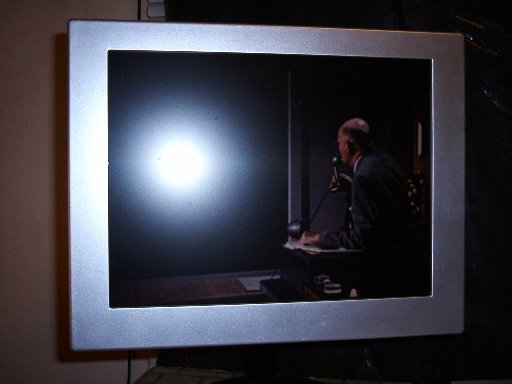
Thermo came to my grade school several times during the mid 1960s in the form of a magnificent film called "Our Mr. Sun." Thinking was different back then. Today's folks might shutter at what was presented in grade schools back then, but revisiting this film today has a comforting feel. Sort of a blast from the past, like they might say on oldies radio. Also very interesting script writing in this 1956 documentary about the sun covering history, religion, science even promoting solar energy.
See some other parts of my "time machine" experience (via ordering the DVD from Amazon) below.
Picture is one of my attempts at a screen shot before I remembered to turn off the flash. It's kind of neat. Hydrogen Fusion, the power of the stars.
Wednesday, December 14, 2005
Living with lower LOF (level of service) on Bellingham streets
Traffic planning lingo. Stands for Level Of Service. "F" basically means traffic jam conditions, at least during rush hours.
In this age of paperwork, Bellingham city planning staff is being ask to set LOS standards for various streets and intersections in the city. Level A would be the least congested.
The city is starting to accept the reality that many streets will become, or are already at, "level F."
This has citizen groups outraged; like they think city government can really do something about it. Similar to the Bellingham and Whatcom County's growth estimates, these are all guidelines that planners work with. The numbers become political footballs, as if governments can really control this.
The best laid plans are subject to market forces. One can talk city hall into adopting low population growth goals, but the market dictates anyway, if floods of folks keep moving in, having kids, and so forth.
Maybe we should adopt socialism, but I am not really advocating that.
So now there is a citizen ground swell against Level F, but I fear the city can't really do that much about it.
Adding more lanes to some arterials is one solution, but this costs tons of money. For instance, to widen a street, one often must "buy out" and tear down adjacent buildings. Since around 1975, the cost of buying property has gone up, possibly 14 fold. A $25,000 1970s house could be $350,000 today!
Taxes anyone?
Then there is another possible solution which I fear could be tried. Limiting the number of housing units built. Denying building permits. Creating a housing shortage.
Problem is, population keeps growing. Towns that limit housing units often become places where the billionaires are chasing out the millionaires. More realistically maybe the multi millionaires are chasing out the mere millionaires.
Is this the kind of city we want, where people like me, who never afforded home ownership, must leave? Currently I read that over 50% of Bellingham's people are renters.
Until socialism and nationwide population control comes (I'm not really advocating socialism at least) there isn't much the city can do about LOS F. Not much that wouldn't be painful at least.
It's up to the people, and market forces, to prevent traffic gridlock. The best way to avoid LOS F is for people to walk, bicycle or use public transit.
Also the city should, and is actually starting to, think about what kind of development is being encouraged. Building up, instead of sprawling out, makes it easier for people to avoid dependency on the automobile.
In this age of paperwork, Bellingham city planning staff is being ask to set LOS standards for various streets and intersections in the city. Level A would be the least congested.
The city is starting to accept the reality that many streets will become, or are already at, "level F."
This has citizen groups outraged; like they think city government can really do something about it. Similar to the Bellingham and Whatcom County's growth estimates, these are all guidelines that planners work with. The numbers become political footballs, as if governments can really control this.
The best laid plans are subject to market forces. One can talk city hall into adopting low population growth goals, but the market dictates anyway, if floods of folks keep moving in, having kids, and so forth.
Maybe we should adopt socialism, but I am not really advocating that.
So now there is a citizen ground swell against Level F, but I fear the city can't really do that much about it.
Adding more lanes to some arterials is one solution, but this costs tons of money. For instance, to widen a street, one often must "buy out" and tear down adjacent buildings. Since around 1975, the cost of buying property has gone up, possibly 14 fold. A $25,000 1970s house could be $350,000 today!
Taxes anyone?
Then there is another possible solution which I fear could be tried. Limiting the number of housing units built. Denying building permits. Creating a housing shortage.
Problem is, population keeps growing. Towns that limit housing units often become places where the billionaires are chasing out the millionaires. More realistically maybe the multi millionaires are chasing out the mere millionaires.
Is this the kind of city we want, where people like me, who never afforded home ownership, must leave? Currently I read that over 50% of Bellingham's people are renters.
Until socialism and nationwide population control comes (I'm not really advocating socialism at least) there isn't much the city can do about LOS F. Not much that wouldn't be painful at least.
It's up to the people, and market forces, to prevent traffic gridlock. The best way to avoid LOS F is for people to walk, bicycle or use public transit.
Also the city should, and is actually starting to, think about what kind of development is being encouraged. Building up, instead of sprawling out, makes it easier for people to avoid dependency on the automobile.
Saturday, December 10, 2005
Our Mr. Sun, the movie revisited
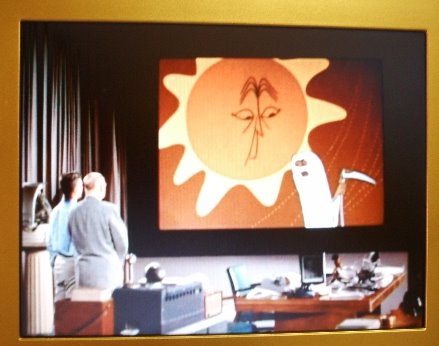 It's quite the film and a part of my formative childhood years. I saw it in grade school several times back in the mid 1960s. It was a 1956 classic with Bell Telephone Company backing.
On Youtube. 56 minutes.
Such a film would not likely be shown in public schools today as it mentions religion, but only in some gentle ways. Such as saying, Science is one way of reaching for the light beyond.
Not being much into movies, I surprised myself by ordering the DVD after discovering it's available at Amazon. Haven't seen this for almost 40 years, but still remember it well.
A great story about two film makers trying to put together a documentary about the sun. They want some splash to make it interesting. The fiction writer conjures up a magic screen and invents some characters; "Father Time" and "Mr. Sun." These imaginary characters just about take over the studio as they argue with the film makers about how to proceed.
Mr. Sun does not want his story told as nothing but a bunch of facts, figures, charts and numbers. He's a romantic, says Father Time. The Sun's ego tells a story of being worshiped as a god. From the ancient Egyptians to the Greeks, worshiping the Sun God.
There seems to be even a hint of gay script writing. Remember this was 1956, but Mr. Sun liked the Greek perceptions of him best.
Apollo the handsome sun god.
It even showed a frontal nude statue of that god. Mr. Sun proclaimed, "Oh, that was for me, I loved it." Going across the sky playing beautiful music, but then along came someone to spoil it all. Anaxagoras, a Greek philosopher who felt that the sun was not a god, but a hot stone. He was imprisoned for that belief, and Mr. Sun was not at all sorry for him. However man (remember this is before modern feminism) was starting to fall for his mind. Thinking began spreading like the measles. To the Arabs with their numbers and so forth.
As the story goes on, much of the interesting science is described, as much as they knew in 1956.
Hydrogen fusion, the mystery of chlorophyll.
Animation shows this fussy cook mysteriously using sunlight, to make sugar from carbon dioxide and water molecules. Proclaiming, "and the Russians didn't invent me either, I invented myself" Mr. Chlorophyll seems to not like being filmed.
Quite far sighted, for 1956, there is a discussion of world population growth. Also a segment about how we are depleting our storehouse of fossil fuels. Stored wealth that Mr. Sun has showered down on us over billions of years.
 Like depleting a giant bank account there wasn't that much worry when the average withdrawal was modest, in the 1500's, but by 1975, look how large the withdrawal bags will be. We'll have to learn how to use Mr. Sun's energy more directly. Quite a few early solar energy projects are shown, including a solar heated home in Massachusetts.
History, science, religion and our constant sense of wonder are stirred into a great mix.
I feel very blessed to have had this in my childhood. Now it is a treat to see again after all these years.
Monday, December 05, 2005
Isolationism; a case for some of it
Here in America, there are folks who's minds are occupied by Middle Eastern politics, yet they don't know how to get across their own city with out going on the freeway.
They can argue the affairs of Palestinians and Israelis, complain about greedy oil companies, or talk about the need to maintain stable oil supplies from the Persian Gulf, but they don't know which bus to catch, in their own neighborhoods. They don't know what surface streets are good for bicycling or walking in their own back yards.
There are both "red state" and "blue state" folks who jet around the world, seek enlightenment from the mountains of Nepal, but haven't paid enough attention to finding that path right here in the good old USA.
Some folks have written off the USA as a hopeless rat race. They rejoin, reluctantly, after getting off the jet from some "third world" paradise.
It doesn't have to be that way.
Put your psychological energy into the world around you. Start your trip at your front door.
Ride a bike, take the bus, support alternative living in your own place. It's closer than Nepal.
This can also make a world wide difference.
They can argue the affairs of Palestinians and Israelis, complain about greedy oil companies, or talk about the need to maintain stable oil supplies from the Persian Gulf, but they don't know which bus to catch, in their own neighborhoods. They don't know what surface streets are good for bicycling or walking in their own back yards.
There are both "red state" and "blue state" folks who jet around the world, seek enlightenment from the mountains of Nepal, but haven't paid enough attention to finding that path right here in the good old USA.
Some folks have written off the USA as a hopeless rat race. They rejoin, reluctantly, after getting off the jet from some "third world" paradise.
It doesn't have to be that way.
Put your psychological energy into the world around you. Start your trip at your front door.
Ride a bike, take the bus, support alternative living in your own place. It's closer than Nepal.
This can also make a world wide difference.
Sunday, December 04, 2005
Falling off the fence
Before the second Iraq war that toppled Saddam Hussein, I was sitting on the fence. Sitting on the fence as to whether it was an okay idea or not.
Now, it looks more and more like a bad idea to have started that war.
For many years, I have had a sneaking suspicion that this nation's fundamentalist "traditional values" folks have had a fascination with their "like kind" in other parts of the world. Our "Moral Majority" folks seem to be drawn to the affairs of similar folks in the Middle East. Our fundamentalists seem to have an interest in similar attitudes about family, religion and so forth in Islamic countries. Maybe they have some sort of respect for "bull headedness."
Trying to "fix" the Middle East is something that the US government has been involved in for years. To tweak it away from it's more extreme versions of fundamentalism; bring "democracy" there.
It doesn't seem to be working.
I hear that Saddam Hussein's brutal rule may now be replaced with a brutal Shiite theocracy.
We have played a role in bringing that on. It may be no better than Hussein. It could expand the influence of Iranian Shiite fundamentalists. Maybe we have helped to create another monster.
The "Christian Right," in USA, has entertained a fascination with trying to "fix" fundamentalist cultures in the middle east. The problems seem beyond our capability and each year high birth rates bring more and more angry young folks into the situation. Few are even discussing the "population" aspect of this situation. One can't expect fundamentalists to care about problems related to population. It's just not in their dogma, both here in the US, or abroad.
The problems just get bigger and bigger and eventually we could become overwhelmed.
Some say, "a fool is born each day." One can also say, "more terrorists are born each day."
We might be better off finding a way out of this growing quagmire.
One talk show host, I listen to, says "you can not occupy an Arab country." "It just doesn't work." He suggests withdrawing.
Also, to protect the USA, this talk show host suggests having a rapid deployment force that can still "take out" (so to speak) serious dangers if they arise in the world. Still being able to prevent weapons of mass destruction, or large terrorist camps, if they arise.
Of course, this means, for the most part, except for the possibility of a rapid deployment, we withdraw.
This could also mean a period of less stability in world oil supplies.
I think we are better off putting our efforts into making USA energy independent. We need to pay more attention to our domestic front. There are a lot of things that need improving in this society. We have enough of our own hang ups so we aren't in a very good position to try and solve all the world's problems.
We are like someone who can't swim trying to save someone who is drowning.
This may sound somewhat pessimistic, but here is a "light at the end of the tunnel" kind of thought. This war seems like another Vietnam. Remember what happened when we finally gave up on the Vietnam War?
There was a period of infighting between different factions of "Communism." Vietnam and Cambodia fought one another. Unfortunately, innocent people died, but after a while, the problems sorted themselves out. Vietnam seems to be at peace now.
Maybe we are just trying too hard to solve problems beyond our capabilities. There are a lot of things we need to do for our own country; like finding ways to more happiness with less consumption of world resources. Newer, "better" technologies, reinventing urban planning, alternative transportation.
Think of all the Americans who die each year in automobile accidents. Things can be better here.
If we pay more attention to our "home front," we might put ourselves in a better position to be a model to the world.
Now, it looks more and more like a bad idea to have started that war.
For many years, I have had a sneaking suspicion that this nation's fundamentalist "traditional values" folks have had a fascination with their "like kind" in other parts of the world. Our "Moral Majority" folks seem to be drawn to the affairs of similar folks in the Middle East. Our fundamentalists seem to have an interest in similar attitudes about family, religion and so forth in Islamic countries. Maybe they have some sort of respect for "bull headedness."
Trying to "fix" the Middle East is something that the US government has been involved in for years. To tweak it away from it's more extreme versions of fundamentalism; bring "democracy" there.
It doesn't seem to be working.
I hear that Saddam Hussein's brutal rule may now be replaced with a brutal Shiite theocracy.
We have played a role in bringing that on. It may be no better than Hussein. It could expand the influence of Iranian Shiite fundamentalists. Maybe we have helped to create another monster.
The "Christian Right," in USA, has entertained a fascination with trying to "fix" fundamentalist cultures in the middle east. The problems seem beyond our capability and each year high birth rates bring more and more angry young folks into the situation. Few are even discussing the "population" aspect of this situation. One can't expect fundamentalists to care about problems related to population. It's just not in their dogma, both here in the US, or abroad.
The problems just get bigger and bigger and eventually we could become overwhelmed.
Some say, "a fool is born each day." One can also say, "more terrorists are born each day."
We might be better off finding a way out of this growing quagmire.
One talk show host, I listen to, says "you can not occupy an Arab country." "It just doesn't work." He suggests withdrawing.
Also, to protect the USA, this talk show host suggests having a rapid deployment force that can still "take out" (so to speak) serious dangers if they arise in the world. Still being able to prevent weapons of mass destruction, or large terrorist camps, if they arise.
Of course, this means, for the most part, except for the possibility of a rapid deployment, we withdraw.
This could also mean a period of less stability in world oil supplies.
I think we are better off putting our efforts into making USA energy independent. We need to pay more attention to our domestic front. There are a lot of things that need improving in this society. We have enough of our own hang ups so we aren't in a very good position to try and solve all the world's problems.
We are like someone who can't swim trying to save someone who is drowning.
This may sound somewhat pessimistic, but here is a "light at the end of the tunnel" kind of thought. This war seems like another Vietnam. Remember what happened when we finally gave up on the Vietnam War?
There was a period of infighting between different factions of "Communism." Vietnam and Cambodia fought one another. Unfortunately, innocent people died, but after a while, the problems sorted themselves out. Vietnam seems to be at peace now.
Maybe we are just trying too hard to solve problems beyond our capabilities. There are a lot of things we need to do for our own country; like finding ways to more happiness with less consumption of world resources. Newer, "better" technologies, reinventing urban planning, alternative transportation.
Think of all the Americans who die each year in automobile accidents. Things can be better here.
If we pay more attention to our "home front," we might put ourselves in a better position to be a model to the world.
Wednesday, November 30, 2005
County Connector buses, the 80X
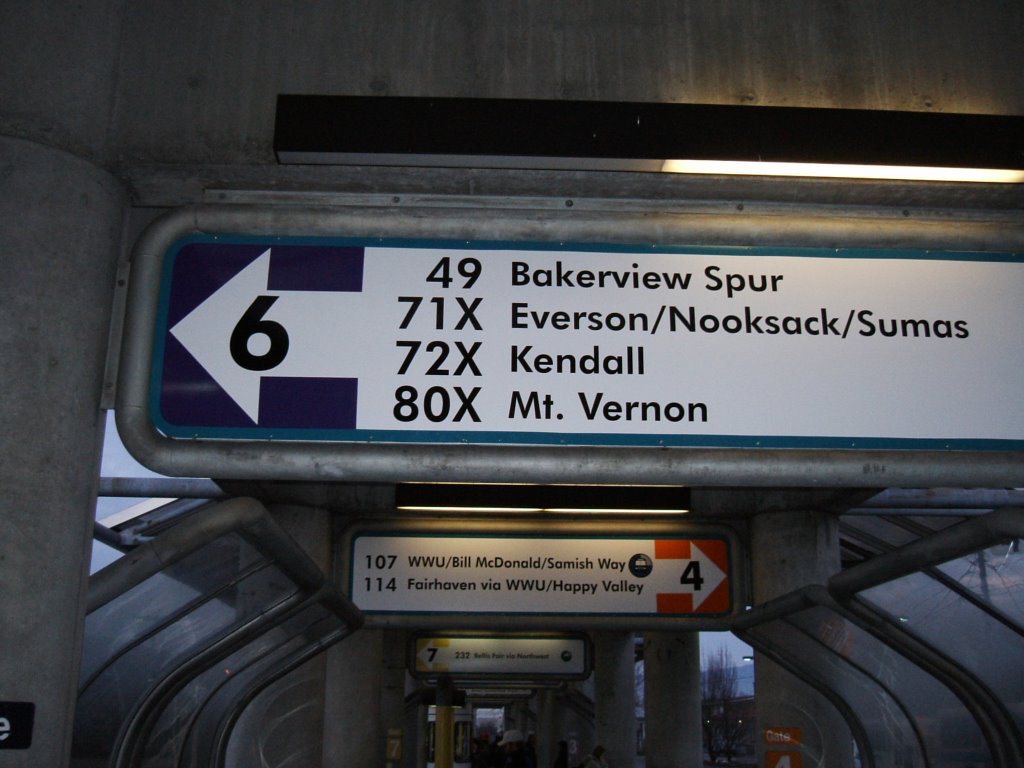
Gate sign at old downtown Bellingham WTA terminal announcing destination Mount Vernon (2005).
Since September 05, there has been a transit link between Bellingham and Mount Vernon. Called the "County Connector," but maybe it's better to say "Tri County Connector." It's a co-operative service linking transit systems in Whatcom, Skagit and Island Counties.
Only costs 50 cents from Bellingham to Mount Vernon! That's about 24 miles. Can't beat the price. * (Now $2 general, $1 senior rate This note added May. 2025).
Takes around 42 minutes with only 3 stops in between. This state funded service was designed with students in mind, but it's becoming very popular among working commuters as well. Quite a few folks live in Whatcom County, but work in Skagit County, or visa versa. It has become more popular than expected.
Some "libertarian and free market folks" might object because they could see this as unfair "taxpayer supported" competition with private enterprise. Here, the private market has brought us Greyhound bus service between Bellingham and Mount Vernon.
Is government really less glamorous than private enterprise?
Yes, private enterprise brings us Greyhound; not top of most people's perception of glamor, but it works. I've taken Greyhound to Seattle fairly often. Usually gets one there in 2 hours. It's not bad for 90 miles.
Now that Whatcom and Skagit transit sytems are connected, it's possible to ride transit buses all the way to Seattle also; if one knows what they are doing. A friend of mine did it. He had to take buses, from several systems, and spend time waiting for connections. It took him around 4 1/2 hours going by transit. For going that distance, Greyhound is more direct, but my friend had plenty of time.
Linking the transit buses is also, of course, a lot less expensive.
One of Greyhound's problems is the bus being late leaving Bellingham. That's because it often starts in Vancouver, BC and gets delayed at the border. Sometimes more than an hour.
One gets penalized by border delays even if one is not crossing the border!
Still, that bus is usually fairly close to being on time. Greyhound is okay. It's still better than all those cars, one hears about on I-5, getting into accidents.
"Canada border B.S." doesn't affect County Connector buses which start their trips locally.
Another thing that's nice about government provided transit services is the bike racks. Each bus can take up to 3 bicycles. There is a rack in front of the bus.
Greyhound doesn't have bike rack service. One can dismantle a bike and ship it in a box. It goes as luggage, but this is much less convenient.
One would think Greyhound could look into bike racks on front of their buses thus making some extra money. They could charge for use of the rack space, like selling a seat inside.
Where is "innovation" in free enterprise when we need it?
That's one thing I like about government transit agencies. They are innovating with different services. Recently the WTA has gone to "3 bike" racks, rather than the old "2 bike" versions. And even bringing one's bike, it's just 50 cents.
* (Now more expensive. This note added Jan. 09).
Of course private enterprise couldn't compete with a taxpayer subsidized service on price, but Greyhound is still useful, especially for the more direct service to Seattle. It just could innovate a bit more. In this society, governments are often the best crucibles of innovation.
To learn more about County Connector, find it under schedules at the WTA web site.
Sunday, November 27, 2005
Macho Flagpole?
 Has a missile look. Macho flagpoles these days?
 Not really.
It's just a thick pole that also serves as cell phone tower. These are quite common.
No the nation's not going crazy, or maybe it is. People drive too much while talking on the phone. Maybe they should stop driving and just keep talking.
Instead of "hang up and drive" we could say "park it and talk."
Macho folks might say, "but what does talk accomplish?"
One could answer, "talk burns few resources." Also, "talking can be less costly than fighting traffic, fighting wars."
Talk and walk rhyme. Say, "walk the talk."
Think about it. Walk the talk.
Or how about "walk and talk." Then there is "walkie-talkie."
Talk, even if you don't have a cell phone.
Monday, November 21, 2005
Toy Cameras
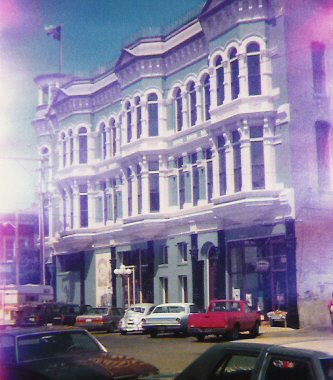
Some folks would say that all cameras I have had over the years have been toys. They haven't been "high end" cameras.
Last Sunday (Nov. 20) All Things Considered news magazine, on NPR, did a segment called "Loving imperfections of toy cameras." Good for them. Much of the segment dealt with the effects of light leaks.
I say, light leaks can be redefined as "serendipitous enhancements to the artistic statement of a photo." It can be seen as an alternative to "setting the bar so high" in that world of professionalism where everything becomes subjugated to refinement of technique and equipment.
This light leak photo was taken during my 1987 bike tour along Pacific Coast as I passed through Port Townsed, WA. Image of that ornate building was enhanced because my roll of film got exposed to some light as I took it out of the camera.
Oh no, I guess that doesn't qualify as a "light leak" since it didn't come from the camera itself, but maybe I should get a medal for having a sharp memory.
I remember the circumstances.
It was from taking the film out of the camera. My fingers must have fumbled so a few frames toward the outside of the roll got hit. Other images from that camera had no leakage, so it wasn't the camera.
I don't have a big collection of light leak photos even though this phenomena may become the next imaging fad.
I'm not a specialist in any one style.
What I do have is an eclectic selection photos and commentary from years of bicycle touring.
Pictures about interesting subjects.
To me, the subject is what really matters, not the various fads in technique or expense in camera.
See some of my Touring Albums.
Saturday, November 19, 2005
Aftermath of Chaos Theory ball drop when Bond Hall at WWU had an atrium

Do I really know what I am talking about with a blog post about chaos theory? Does it look impressive soon after one titled Is evolution intelligent design?
I wouldn't try to impress folks by discussing chaos theory, I really don't know that much about it.
Found a picture from the demonstration of said theory that was held last year. (Maybe two years ago).
Up at Western Washington University, just a few blocks from my home, there was a demonstration of chaos theory. Thousands of rubber balls were dropped in the atrium of a classroom building.
They fell and bounced all the heck around.
Quite a sight, for several seconds.
I was too shy, or forgot, to bring my camera, but another drop was planned in a few days.
Drops were in the atrium of Bond Hall. Some folks call it "Bondage Hall" after hearing about long homework assignments.
Next time, I brought my camera.
A drop was planned, but I miss read the time in the newspaper. As I walked across Red Square I heard the rushing sound. Thousands of balls bouncing around. I hadn't gotten to the building yet.
After that crucial moment, I stepped inside with my camera, anyway.
Got above image of balls strewn about the atrium floor. Maybe this image is just as good as the blur of bouncing balls.
Lots of cute college students were around to witness the event. Math majors and so forth.
Since those days, Bond Hall has been remodeled and the atrium has been filled in.
Wednesday, November 16, 2005
Bus Rapid Transit
I found a Seattle Times from November 13 2005 with this great article about using dedicated bus lanes for mass transit.
Monorail has been voted down. Sound Transit light rail is proceeding so slowly that most of us will be dead before there is very much mileage. Dedicated bus lanes could be a magic, or almost magic, answer. Like walking, it may not be some "block buster" fantasy, but it is something; actually something quite impressive.
Often people will overlook the things right under their noses. It's our "throw away and start over" society. Building a whole new transit system from scratch often means we get "just about nothing" as the plans must be scaled back for cost.
Rather than trying to be so revolutionary and then falling back to nothing, it might be better to stick closer to what's already built; the massive highway system. It can be modified. Putting some dedicated bus lanes on a few cross metro area routes could make a real big difference in the not too distant future.
Here is a link to the web site for that proposal. Better explained than I could do.
The case for bus rapid transit
Monorail has been voted down. Sound Transit light rail is proceeding so slowly that most of us will be dead before there is very much mileage. Dedicated bus lanes could be a magic, or almost magic, answer. Like walking, it may not be some "block buster" fantasy, but it is something; actually something quite impressive.
Often people will overlook the things right under their noses. It's our "throw away and start over" society. Building a whole new transit system from scratch often means we get "just about nothing" as the plans must be scaled back for cost.
Rather than trying to be so revolutionary and then falling back to nothing, it might be better to stick closer to what's already built; the massive highway system. It can be modified. Putting some dedicated bus lanes on a few cross metro area routes could make a real big difference in the not too distant future.
Here is a link to the web site for that proposal. Better explained than I could do.
The case for bus rapid transit
Monday, November 14, 2005
Is Evolution Intelligent Design?
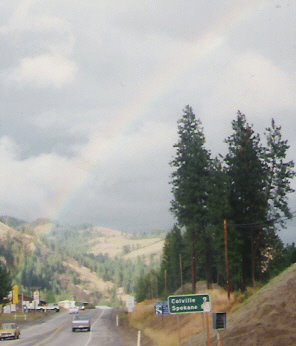
Is Evolution Intelligent Design?
Also, is intelligent design evolving?
A rainbow can be described in different ways. It's a colorful rainbow, but it's also just light refracting through water droplets.
This analogy can apply to our bodies as well. Are we just complex electrochemical reactions, or intelligent human beings with consciousness and feelings?
Take this analogy farther and think about processes that developed the great variety of life on this planet.
Is it just stuff like interacting molecules, random chance and natural selection or is it intelligent?
I believe it can be both.
The rainbow is both "rainbow" and "water droplets." We are both "biochemical reactions" and "human beings." The natural processes that lead to our existence are both "mechanical," in some ways, and "intelligent" in other ways.
A related question might be. "What is intelligence?"
Some folks might wonder if those of us who ponder these questions are truly intelligent. Of course, being intelligent is not necessarily the same thing as being pragmatic.
Some people say that the Earth, itself, is intelligent. The Earth could even be conscious.
Why not? It's a complex system, like our bodies.
Can an ecosystem, or a forest, be conscious? How about a nation or economy?
Sometimes these things are said to "take on lives of their own."
How about the house remodling project you might be working on? These are often said to "take on lives of their own."
Where does one draw the line in calling something intelligent? Does a line have to be drawn?
Then there is the entire universe. Maybe it's intelligent.
Evolutionary theories and intelligence need not conflict.
This doesn't really answer the question about what should be taught in biology classes. It's just my thinking that what is currently taught, in it's mechanical workings, can also be intelligent. Possibly it's more intelligent than so called "intelligent design" curriculum; what ever that is.
I admit that I just took biology 101, but I was amazed at how the molecules in a cell just happen to be in the right places at the right times for the cell to work. It's truly amazing how this all fits together. No one had to mention a God for me to get the feeling of awe.
That doesn't mean I don't believe in something people could call a God. It's just that my biology class didn't have to mention it for me to be awestruck by the intelligence and the intricacy of it all.
Similar to seeing a rainbow. I didn't have to learn about that beauty in a Sunday school room.
Not that I didn't learn some valuable things in Sunday school rooms as well.
The whole picture seems intelligent, to me, but at the same time it seems to work like some machine.
It can be both.
Maybe the reality of this question can even be influenced by the observer's "frame of reference." Look at the rainbow from one angle and it's a rainbow. Change angles and it disappears into mere water droplets.
Reality, influenced by the observer. A difficult concept for most of our rigid minds to fathom.
This is talked about some, in relativity theory, but I am not going to pretend to be an expert on that.
Unlike what fundamentalists teach, understanding of truth can be flexible .
By the way, photo is a rainbow taken in 1995 on my bike trip through Colville, WA. Maybe not the most spectacular, but it was handy.
Monday, November 07, 2005
I-90 leading to Snoqualmie Pass down there in the valley
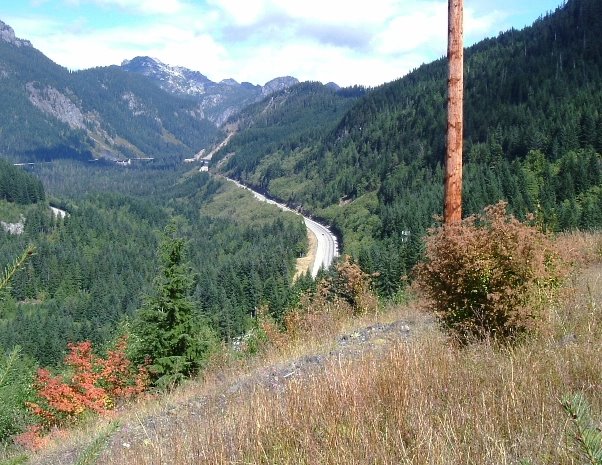
Seen on my 2005 trip from Iron Horse Bike Trail.
Today's news says pass is closed again. Another rock slide. This time just east of the pass. They don't know when highway will be reopened.
Last summer, during my trip, a rock slide closed west bound lanes just west of the pass. 3 people died when rocks crushed their car. I had no idea what had happened until I stopped in a store along US 97 which connects I-90 to US 2. Wondered why there was so much traffic headed north on 97 as I was going south. Turns out they were diverting I-90 traffic to Stevens Pass (US 2).
Except for seeing streams of traffic detouring over 97, my trip was not effected. I took the Iron Horse Trail across Snoqualmie Pass anyway, so I wasn't planning to take I-90.
That was September. Now it's happened again, only no one killed, luckily. Rock slide east of Snoqualmie Pass has closed freeway in both directions. I just hear about it on the radio.
Yes they do need to put money into maintaining highways. Hope Initiative 912 fails. It would cut gas taxes for our transportation system.
Of course I could be smug and say it doesn't matter. The Iron Horse Bike Trail is still available. Actually, I think that closes for winter.
While I don't drive or use gasoline, I do drink plenty of chocolate milk. Much of the hay that fuels our local dairy farms is trucked over the mountains from eastern Washington. Hay trucks use I-90.
It's all part of the interconnected web of our economy.

Approaching light at west end of 2 mile long Snoqualmie Tunnel. It's a part of the Iron Horse Bike Trail east of North Bend, Washington.
Tuesday, November 01, 2005
Libby Indictment. Some memories of Watergate
News of Vice Presidential aid I. Lewis (Scooter) Libby's indictment and resignation reminds me of an earlier time.
Mrs. Bertleson (I think that was her name) ran out to a car I was sitting in and proclaimed, "Ehrlichman and Haldeman just resigned!"
Excitement in her voice.
It was April 30th, 1973 and someone was giving me a ride home from Pullman High School TV Production class. Watergate was in the news. Careers in media were "the thing."
A TV was set up in our school's "people pit." It was tuned to Watergate hearings. Students could mill around and see American history unfold.
Great for civics class.
Even the people pit was an innovation. Steps that went nowhere. Carpeted steps for sitting, lounging. Architects noticed what students liked to do. It was a brand new building.
President Nixon was not popular in that school. The Vietnam war was dragging on.
There were still some conservatives. They would point out that people had better be careful not to trash the President too much. The Russians were still coming and they didn't allow any criticism of their leaders.
Now there is talk of threats from Iran. Threatening to wipe Israel off the map and possibly getting a nuclear weapon.
Does anyone remember the "Domino Theory?" That was a big worry during Vietnam War. "If we let down our guard, the Communists will take over Laos, Cambodia, Thailand, eventually America."
Stepping stones, but not the friendly carpeted steps of our people pit.
Did that ever happen? Did the domino stepping stones ever fall?
Not that I remember, but we did get "Domino's Pizza." And Russia got the Big Mac.
The communists started quarreling among one another and their empires crumbled. Vietnam invaded Cambodia, after we got out of the way, and the Soviet Union kind of fell apart from its own weight. Or did it take Reagan (Nixon reborn?) to push them over?
Will the youth of Iran throw out the old guard religious zealots? Do they need us to help them, or are they better off with out us? Are we doing more harm than good; in Iraq, around the world?
Is our empire about to crumble?
These are both exciting and scary times. Some glee and jubilation over the problems of Bush (I never voted for him), but also a lot of worry.
America did survive Watergate and Vietnam.
Mrs. Bertleson (I think that was her name) ran out to a car I was sitting in and proclaimed, "Ehrlichman and Haldeman just resigned!"
Excitement in her voice.
It was April 30th, 1973 and someone was giving me a ride home from Pullman High School TV Production class. Watergate was in the news. Careers in media were "the thing."
A TV was set up in our school's "people pit." It was tuned to Watergate hearings. Students could mill around and see American history unfold.
Great for civics class.
Even the people pit was an innovation. Steps that went nowhere. Carpeted steps for sitting, lounging. Architects noticed what students liked to do. It was a brand new building.
President Nixon was not popular in that school. The Vietnam war was dragging on.
There were still some conservatives. They would point out that people had better be careful not to trash the President too much. The Russians were still coming and they didn't allow any criticism of their leaders.
Now there is talk of threats from Iran. Threatening to wipe Israel off the map and possibly getting a nuclear weapon.
Does anyone remember the "Domino Theory?" That was a big worry during Vietnam War. "If we let down our guard, the Communists will take over Laos, Cambodia, Thailand, eventually America."
Stepping stones, but not the friendly carpeted steps of our people pit.
Did that ever happen? Did the domino stepping stones ever fall?
Not that I remember, but we did get "Domino's Pizza." And Russia got the Big Mac.
The communists started quarreling among one another and their empires crumbled. Vietnam invaded Cambodia, after we got out of the way, and the Soviet Union kind of fell apart from its own weight. Or did it take Reagan (Nixon reborn?) to push them over?
Will the youth of Iran throw out the old guard religious zealots? Do they need us to help them, or are they better off with out us? Are we doing more harm than good; in Iraq, around the world?
Is our empire about to crumble?
These are both exciting and scary times. Some glee and jubilation over the problems of Bush (I never voted for him), but also a lot of worry.
America did survive Watergate and Vietnam.
Saturday, October 29, 2005
Why Halloween is safer than Christmas

Halloween edition of our local Weekly in news stands. Gas can be ghastly.
If one isn't part of a family, one can feel left out for Christmas and Thanksgiving. People will "move Heaven and Earth" just to go over the meadow and through the woods to family gatherings. They often span many treacherous miles over icy roads.
Halloween is friendlier to a wider diversity of lifestyles. One is less likely to feel left out if separated from family; thus less travel.
There is the family side of it; kids tricker treating and so forth, but there's also a lot more.
People wear costumes at work, go to parties. It can be a wonderful creative outlet right where you live.
Some of it might get a bit too crazy, especially if drinking is involved, but possibly not as out of control as New Year's.
At least Halloween encourages one to celebrate where they are, even at work, for instance. There is less need to travel to family gatherings far away. This holiday can give one's "here and now" life a creative twist.
Of course, part of the difference may be that Halloween is not recognized as an official holiday. It doesn't provide enough time for folks to get as far away from their everyday lives in this society where family ties tend to be scattered across the globe.
An ASCII art Christmas tree.
Sunday, October 23, 2005
Bayview Tower. 24 Story Building Planned For Downtown Bellingham.

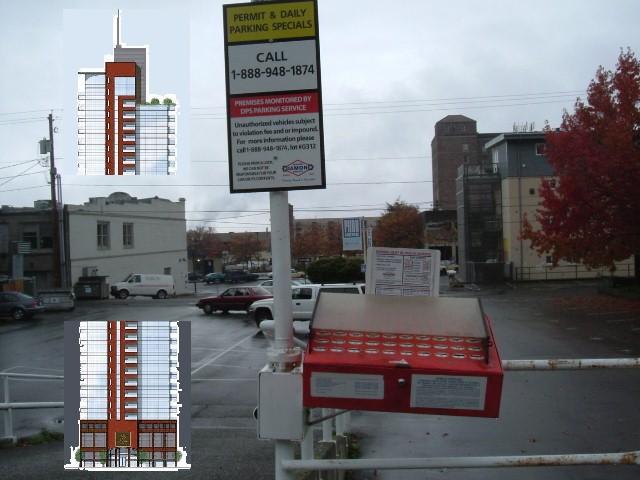
Picture is a collage I pasted from photo of the site in it's current state and an image of the proposed building from October 20 Bellingham Herald.
It's okay with me. I look forward to watching construction.
It's density, in filling and so forth.
You've probably heard the arguments for density versus sprawl already.
I am sure some folks will be a bit rattled at the prospect of a 20 story building in Bellingham. Same paper spoke of two 18 story proposals for the old Morse Hardware site down State Street from this location.
Basically all condominiums. Some office and retail space as well.
Bellingham is popular.
I do worry about over population as a world problem. All those families, I see at places like the Bellingham Food Co-op; with baby strollers.
The people are coming. And the money is coming too. Quite a few retired folks are bringing their "home equity" to Bellingham.
Building up, instead of out, is better. Problem is we are likely to be building both up and out. That's what seems to usually happen.
One thing that will result is Bellingham getting a more urban skyline.
For folks that are worried about growth, that could be a blessing in disguise. Some of the flow of recent transplants is people trying to escape cities. Part of that flow might think twice about moving near a city with a skyline. A lot of sprawl is driven by hoards of folks wanting to move into rural settings.
So, the prospect of a 24 story building can be kind of exciting. I do hope the city and developers plan things well. One thing I look for is a building "giving back" something to the community. Not all just private spaces that most of us can't afford.
Tall buildings often provide things like observation decks that are open to the public for at least an affordable fee. One great example of that is the Smith Tower observation deck in downtown Seattle.
What new restaurants might be coming to town? Hope they aren't too snooty.
Friday, October 21, 2005
Ever evolving gas tax debate
New twists could mean death nail to typical "Republican Party" thought
In the past, "no new taxes" mantra was chanted by Republicans. They said, "low taxes, keep business rolling in the private sector."
Now, some new types of people are chanting that mantra as well; folks that are uncomfortable bedfellows to typical Republicans. These new folks say, "don't raise the gas tax, we shouldn't be building roads." "Cripple highway construction budget." "Force traffic to gridlock and a standstill." "That will cut sprawl, slow growth and maybe force people to get out of their cars."
Yes, it's not the typical "no new taxes" argument, but it is a perspective that has increasing following.
The gas tax debate is said to be among the most divisive issues with-in Republican Party circles. Some party loyalists still cling to the "less government" mantras, but others are getting scared. Scared by their new bedfellows who typically hail from more left wing sides of the political spectrum. What some people might consider radicle advocates of mass transit and dismantling America's suburbia culture can join the "no new tax" bandwagon also. "Stop the sprawl, don't build roads."
These new bedfellows have actually scared a few Republicans into support of increasing the gas tax. Yes, government investment in infrastructure can keep the status quo rolling.
Since I am not a Republican, I enjoy watching this discussion unnerve the Republicans.
I still support the increase in gas tax (the NO on Washington State Initiative 912 position), but I see a lot of validity in the anti road building argument. I am just not willing to go that far as I feel mass transit and bicycling needs good roads also.
In the past, "no new taxes" mantra was chanted by Republicans. They said, "low taxes, keep business rolling in the private sector."
Now, some new types of people are chanting that mantra as well; folks that are uncomfortable bedfellows to typical Republicans. These new folks say, "don't raise the gas tax, we shouldn't be building roads." "Cripple highway construction budget." "Force traffic to gridlock and a standstill." "That will cut sprawl, slow growth and maybe force people to get out of their cars."
Yes, it's not the typical "no new taxes" argument, but it is a perspective that has increasing following.
The gas tax debate is said to be among the most divisive issues with-in Republican Party circles. Some party loyalists still cling to the "less government" mantras, but others are getting scared. Scared by their new bedfellows who typically hail from more left wing sides of the political spectrum. What some people might consider radicle advocates of mass transit and dismantling America's suburbia culture can join the "no new tax" bandwagon also. "Stop the sprawl, don't build roads."
These new bedfellows have actually scared a few Republicans into support of increasing the gas tax. Yes, government investment in infrastructure can keep the status quo rolling.
Since I am not a Republican, I enjoy watching this discussion unnerve the Republicans.
I still support the increase in gas tax (the NO on Washington State Initiative 912 position), but I see a lot of validity in the anti road building argument. I am just not willing to go that far as I feel mass transit and bicycling needs good roads also.
Sunday, October 16, 2005
Over the hill at ten years of age
I have often thought "Over the hill at ten" would make a good book title.
What does it mean?
If someone wanted to be an Olympic class athlete, they would have to start refining that skill by at least age ten, most likely. That means, if you haven't started yet, and you are over ten, chances are you're out of the running.
Over the hill, already, at ten. That's sad.
It's a burden, but don't worry.
"Second best" is less stressful to obtain.
Second best can mean being physically fit and still having enough talent to do more good than harm.
Don't do what too many folks do. They throw in the towel because they aren't first place.
When I was a kid, I heard that every American can have the dream of being President.
On the other hand, people say when you type the word "failure" and click on the Google search button that says, "I'm feeling lucky," you get the biography of the President.
So much for being top dog, when people call you a failure.
Of course I haven't yet researched how Google's "I'm feeling lucky" search results are determined.
The word "excellence" is often bantered about.
What pressure.
Think schools, workplaces, resumes. Then think of the name for Rush Limbaugh's radio network;
"The Excellence In Broadcasting Network" (E.I.B. Radio Network).
Is Rush Limbaugh excellent? What "top drawer" and "excellence" means is debatable.
Don't throw in the towel if you can't make the top; what ever way the "top" is defined. Being reasonably good is ...
Good enough.
What does it mean?
If someone wanted to be an Olympic class athlete, they would have to start refining that skill by at least age ten, most likely. That means, if you haven't started yet, and you are over ten, chances are you're out of the running.
Over the hill, already, at ten. That's sad.
It's a burden, but don't worry.
"Second best" is less stressful to obtain.
Second best can mean being physically fit and still having enough talent to do more good than harm.
Don't do what too many folks do. They throw in the towel because they aren't first place.
When I was a kid, I heard that every American can have the dream of being President.
On the other hand, people say when you type the word "failure" and click on the Google search button that says, "I'm feeling lucky," you get the biography of the President.
So much for being top dog, when people call you a failure.
Of course I haven't yet researched how Google's "I'm feeling lucky" search results are determined.
The word "excellence" is often bantered about.
What pressure.
Think schools, workplaces, resumes. Then think of the name for Rush Limbaugh's radio network;
"The Excellence In Broadcasting Network" (E.I.B. Radio Network).
Is Rush Limbaugh excellent? What "top drawer" and "excellence" means is debatable.
Don't throw in the towel if you can't make the top; what ever way the "top" is defined. Being reasonably good is ...
Good enough.
Monday, October 10, 2005
The world's largest lava lamp
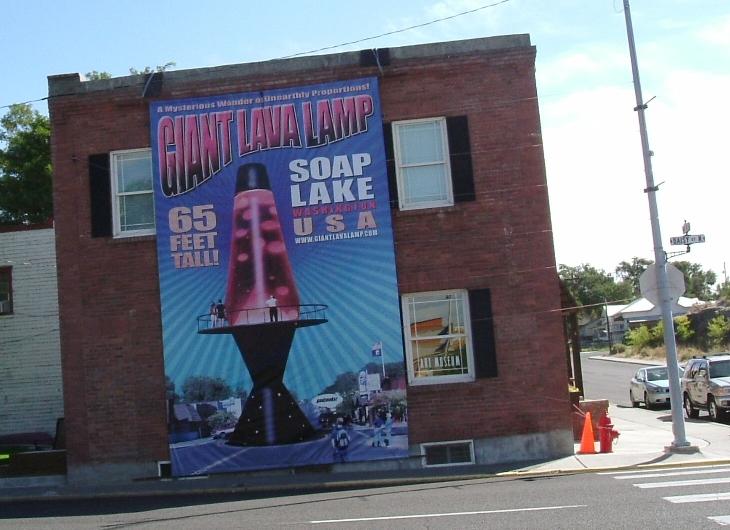
Guess where they plan to put it.
Soap Lake, Washington.
This is one of many tidbits I learned on my 2005 bicycle tour around in the Pacific Northwest. I think the idea to set this up has faded by now. Update 2025.
Tuesday, October 04, 2005
Another Reason To Vote NO on Washington State Initiative 912
I-912 would repeal a hike in the gas tax which was recently passed in the Washington State Legislature to pay for road and transportation improvements. Here is a letter I had in October 2 Bellingham Herald.
Some people wonder why gas taxes go up, while traffic still gets worse. They seem to think state highway departments are frittering away the money. Few stop to realize that land is getting too expensive for building roads. It takes a lot of land to build a highway or add new lanes to an existing road.
Back when the interstate freeways were first being built, traffic congestion could be solved by just adding more lanes to the highway. That was when one could still buy a house for under $20,000. Now, many of those same houses are selling for prices closer to the million dollar mark. Few stop to think about what effect real estate inflation has had on the cost of land for roads.
Many folks sit in homes that have inflated significantly in value over the past twenty years. They still wonder why roads cost more than they did twenty years ago.
Since land values do not seem to be going down in the near future, we need to reduce dependency on the automobiles. Cars take up too much space in our crowded and increasingly expensive world.
That was the letter, but I can add a bit more here.
Some of the gas tax money goes to fund alternative transit. Enough that I noticed, from a quick look at their web site, that a representative from the organization Transportation Choices is urging a no vote. Remember, NO means keeping the gas tax increase.
In the past, some alternative transit and bike advocates opposed certain gas tax hikes as they had tended to be perfectionists. They didn't want to have more roads built for cars.
Another constituency, besides traditional "no tax" Republican types, to come out against taxes for infrastructure are some anti growth advocates. They say, "if we don't build the roads, people will stop moving here." "Just starve the growth and the economy."
That would be painful if people keep having kids.
Supporting the gas tax that funds a balanced system of roads and alternative transit is good.
The whole transportation system is interdependent.
Busses help cars by reducing the traffic, but road improvements for cars also help the buses to get through. Currently, much of our alternative transit is busses that share the roads with cars. Also shoulder improvements are good for bicycles.
Some people wonder why gas taxes go up, while traffic still gets worse. They seem to think state highway departments are frittering away the money. Few stop to realize that land is getting too expensive for building roads. It takes a lot of land to build a highway or add new lanes to an existing road.
Back when the interstate freeways were first being built, traffic congestion could be solved by just adding more lanes to the highway. That was when one could still buy a house for under $20,000. Now, many of those same houses are selling for prices closer to the million dollar mark. Few stop to think about what effect real estate inflation has had on the cost of land for roads.
Many folks sit in homes that have inflated significantly in value over the past twenty years. They still wonder why roads cost more than they did twenty years ago.
Since land values do not seem to be going down in the near future, we need to reduce dependency on the automobiles. Cars take up too much space in our crowded and increasingly expensive world.
That was the letter, but I can add a bit more here.
Some of the gas tax money goes to fund alternative transit. Enough that I noticed, from a quick look at their web site, that a representative from the organization Transportation Choices is urging a no vote. Remember, NO means keeping the gas tax increase.
In the past, some alternative transit and bike advocates opposed certain gas tax hikes as they had tended to be perfectionists. They didn't want to have more roads built for cars.
Another constituency, besides traditional "no tax" Republican types, to come out against taxes for infrastructure are some anti growth advocates. They say, "if we don't build the roads, people will stop moving here." "Just starve the growth and the economy."
That would be painful if people keep having kids.
Supporting the gas tax that funds a balanced system of roads and alternative transit is good.
The whole transportation system is interdependent.
Busses help cars by reducing the traffic, but road improvements for cars also help the buses to get through. Currently, much of our alternative transit is busses that share the roads with cars. Also shoulder improvements are good for bicycles.
Friday, September 30, 2005
Thinking About Bill Bennett Abortion Comment
Abortion is really a "red herring" issue. It deflects us from discussing the true problem that there are too many people in the world. Over population. Abortion is not a good form of birth control, but there are some deeper demographic issues under the surface of this discussion.
Demographics was touched on during Bill Bennett's now infamous talk show, but emotional baggage around abortion and racism flairs up into a war of sound bytes. Deeper issues of population and demographics get ignored.
Some interesting questions were touched on in that show (from what I read, even though I didn't actually hear the show).
The question of, "how many people are around to pay into the Social Security Trust Fund?" started that whole ball rolling.
Some might argue that we need more births in order to have plenty of younger workers to pay into Social Security as the post war generation retires. This is an interesting thought for demographers and economists to debate.
Then there is the question of whether just "numbers of people" is sufficient as a solution to this equation. What about quality of environment and economic conditions for the next generation that will be paying into the fund?
A book called "FREAKONOMICS" was mentioned. Important questions about the quality of life, for people being born into this world, was brought up.
What if a bunch of unwanted children were born into poverty? Would they add to, or further distract from society and Social Security?
It's an old "quality versus quantity" argument.
There is the contention that crime is actually lower because quite a few of the people who would have been born into problem homes were never born. Do we really want a whole bunch of unwanted babies? These are very important questions.
Then, along came Bennett's "kicker" comment. The one that's got everyone buzzing.
"But I do know that it's true that if you wanted to reduce crime, you could -- if that were your sole purpose, you could abort every black baby in this country, and your crime rate would go down. That would be an impossible, ridiculous, and morally reprehensible thing to do, but your crime rate would go down. So these far-out, these far-reaching, extensive extrapolations are, I think, tricky."
Another valuable point can be discussed behind this comment.
Is there a danger that abortion can be used to "weed out" certain types of people that others might deem as undesirable? Would abortion be more prevalent weeding out children from poor, marginalized or minority peoples?
It reminds me of one day, when I was in college, sitting in the office of the Gay People's Alliance on campus. Someone from the so called "pro life" club got up the courage to wonder into our office with a very thought provoking question.
She ask, "if one could ever determine, before birth, that a fetus would turn out homosexual, wouldn't you worry that a lot of mothers would choose to abort their pregnancies?"
Most of the "politically correct" office staff blew her question off, but I took her question more seriously. We had a good dialog as most of the other office staffers left the room.
These are important ethical questions with out easy, sound byte answers.
It brings me back to my first point that there are too many people in this world, but abortion is a red herring issue.
Ideally, we should all be working toward the reduction of unwanted pregnancies. Birth control, lifestyle choices, family planning, even abstinence can all point to similar goals. Even more acceptance of "alternative lifestyles" can serve to reduce unwanted pregnancy.
In an ideal world, there wouldn't need to be abortions because unwanted pregnancy wouldn't be such a problem.
Abortion is, at best, a poor form of birth control. How one feels about whether it should be legal, or not, may not be as important an issue as the deeper demographic problems revolving around so many unwanted pregnancies.
I am reminded of a wonderful phrase that came from the early pro abortion rights movement. For some reason, the more recent abortion rights advocates hardly ever use this quote. Still, it transcends the contentious abortion debate to a deeper ideal that most folks should agree on.
"Every child should be wanted."
This phrase also can address the issues of neglect and poverty that so many children face in the world. For instance, one can say, "every child should have access to medical care."
Even some of the pro life movement can get on board with this ideal.
There is a similar phrase that President Bush has bounced around as he talks about education.
That phrase says, "No child should be left behind."
Of course one can certainly question whether the concept is working, or whether Bush administration policies will get us there.
Still, in an ideal world, we should be focusing on quality of life rather than just quantity of life. Churning out too many babies is a major world problem.
Demographics was touched on during Bill Bennett's now infamous talk show, but emotional baggage around abortion and racism flairs up into a war of sound bytes. Deeper issues of population and demographics get ignored.
Some interesting questions were touched on in that show (from what I read, even though I didn't actually hear the show).
The question of, "how many people are around to pay into the Social Security Trust Fund?" started that whole ball rolling.
Some might argue that we need more births in order to have plenty of younger workers to pay into Social Security as the post war generation retires. This is an interesting thought for demographers and economists to debate.
Then there is the question of whether just "numbers of people" is sufficient as a solution to this equation. What about quality of environment and economic conditions for the next generation that will be paying into the fund?
A book called "FREAKONOMICS" was mentioned. Important questions about the quality of life, for people being born into this world, was brought up.
What if a bunch of unwanted children were born into poverty? Would they add to, or further distract from society and Social Security?
It's an old "quality versus quantity" argument.
There is the contention that crime is actually lower because quite a few of the people who would have been born into problem homes were never born. Do we really want a whole bunch of unwanted babies? These are very important questions.
Then, along came Bennett's "kicker" comment. The one that's got everyone buzzing.
"But I do know that it's true that if you wanted to reduce crime, you could -- if that were your sole purpose, you could abort every black baby in this country, and your crime rate would go down. That would be an impossible, ridiculous, and morally reprehensible thing to do, but your crime rate would go down. So these far-out, these far-reaching, extensive extrapolations are, I think, tricky."
Another valuable point can be discussed behind this comment.
Is there a danger that abortion can be used to "weed out" certain types of people that others might deem as undesirable? Would abortion be more prevalent weeding out children from poor, marginalized or minority peoples?
It reminds me of one day, when I was in college, sitting in the office of the Gay People's Alliance on campus. Someone from the so called "pro life" club got up the courage to wonder into our office with a very thought provoking question.
She ask, "if one could ever determine, before birth, that a fetus would turn out homosexual, wouldn't you worry that a lot of mothers would choose to abort their pregnancies?"
Most of the "politically correct" office staff blew her question off, but I took her question more seriously. We had a good dialog as most of the other office staffers left the room.
These are important ethical questions with out easy, sound byte answers.
It brings me back to my first point that there are too many people in this world, but abortion is a red herring issue.
Ideally, we should all be working toward the reduction of unwanted pregnancies. Birth control, lifestyle choices, family planning, even abstinence can all point to similar goals. Even more acceptance of "alternative lifestyles" can serve to reduce unwanted pregnancy.
In an ideal world, there wouldn't need to be abortions because unwanted pregnancy wouldn't be such a problem.
Abortion is, at best, a poor form of birth control. How one feels about whether it should be legal, or not, may not be as important an issue as the deeper demographic problems revolving around so many unwanted pregnancies.
I am reminded of a wonderful phrase that came from the early pro abortion rights movement. For some reason, the more recent abortion rights advocates hardly ever use this quote. Still, it transcends the contentious abortion debate to a deeper ideal that most folks should agree on.
"Every child should be wanted."
This phrase also can address the issues of neglect and poverty that so many children face in the world. For instance, one can say, "every child should have access to medical care."
Even some of the pro life movement can get on board with this ideal.
There is a similar phrase that President Bush has bounced around as he talks about education.
That phrase says, "No child should be left behind."
Of course one can certainly question whether the concept is working, or whether Bush administration policies will get us there.
Still, in an ideal world, we should be focusing on quality of life rather than just quantity of life. Churning out too many babies is a major world problem.
Wednesday, September 28, 2005
Subscribe to:
Posts (Atom)