I still eat a variety of fruits that sometimes come from distant lands. Eating local is easier to do in summer, but not so easy in winter. How much energy does it take to can? How much space. I live in a small urban space with little place to store things.
Some folks would move to a rural area so they can have their own apple tree. Then they can end up commuting farther than the average city dweller thus having more, rather than less of a carbon footprint.
How much energy does it take to ship small pieces of fruit from afar? Probably not as much as it would take if everyone lived much farther from their work and errands so each of them could try to have a garden.
"Drive till you qualify." Qualify for a mortgage that is. A mantra of sprawl.

Friday, July 27, 2007

Sunday, July 22, 2007
Alternative Lifestyles Can Reduce Global Warming
It's either "lifestyle changes" or "technology" that can be the solution to global warming.
Lifestyle changes, technology, or a little of both.
Nuclear power anyone? At least it's not fossil fuel. That's an example of "technology to the rescue." I'm not against this, but lifestyle changes are needed also.
Balance.
When people think of "alternative lifestyles" they often think "the gay community." Actually, alternative is a much broader term than just gay people, but gay lifestyles can be part of the concept.
Alternative also means things that are different from mainstream. Things like "alternative transportation" rather than cars, or "alternative energy" rather than fossil fuels.
As for gay people, there is a great, but often missed opportunity to tie sexual politics with environmental politics.
The big issue of population growth is one of the connections.
Often the opportunity to make this tie is missed. It's missed, in part, because the orthodoxy in gay politics is to say, "we're family too."
It's true, many gay people do have kids and there's nothing wrong with that. It's just that gay relationships don't lead to procreation. Most of the kids are from previous marriages and there are also things like adoption. Much of the gay movement talks about being family and not really being that different from mainstream society. Even consumptive society.
Still, lower birth rates is an important part of the solution to global warming.
Another way to tie sexual politics and the environment has to do with neighborhood density.
Yes, in filling the towns and cities, rather than permitting sprawl to spread out across rural areas. This is a lifestyle issue also. For instance it seems like people cite their "families and kids" as the main reason why they can't live without their cars. Living in a denser environment tends to favor walking, bicycling and public transit over cars. Often people are most "car free" when they live in the dense inner neighborhoods of large cities. There is a big correlation between "neighborhood density" and success in making public transit a large percentage of trips.
It seems to be more than just a coincidence that the dense neighborhoods toward the heart of cities are often thought of as the "gay districts." For instance, "Capital Hill," in Seattle, or "The West End" in Vancouver, BC.
At the same time, one can see a lot of wealth and conspicuous consumption in these neighborhoods. Lots of big SUVs parked in condominium garages. On the surface, it might look like much of urban life is not into the environment. Also, people who can afford to live on this prime real estate will also be able to afford things like big cars.
Somehow, it seems like there are a lot of missed opportunities here.
A better connection could be made between the popular concepts of alternative lifestyle and the environment. Also dense neighborhoods could become more affordable, if more of them were built. For instance denser zoning in more areas.
Families can live in dense environments as well. It's just that in American culture, families tend to spread out to where there is yard space. In the denser city, "yard space" can be "the city park."
If we are to solve global warming, we really need to think in terms of alternative lifestyles. Alternative in a broad sense. This includes accepting gay culture, but it also goes way beyond just that. It means accepting change in many lifestyles. Also, a dose of new technology. Yes, we have to be able to accept change. Change can come in many forms.
People can be set in their ways, but people can also be innovative. The challenge is here and the future will tell if we are up to this task.
Lifestyle changes, technology, or a little of both.
Nuclear power anyone? At least it's not fossil fuel. That's an example of "technology to the rescue." I'm not against this, but lifestyle changes are needed also.
Balance.
When people think of "alternative lifestyles" they often think "the gay community." Actually, alternative is a much broader term than just gay people, but gay lifestyles can be part of the concept.
Alternative also means things that are different from mainstream. Things like "alternative transportation" rather than cars, or "alternative energy" rather than fossil fuels.
As for gay people, there is a great, but often missed opportunity to tie sexual politics with environmental politics.
The big issue of population growth is one of the connections.
Often the opportunity to make this tie is missed. It's missed, in part, because the orthodoxy in gay politics is to say, "we're family too."
It's true, many gay people do have kids and there's nothing wrong with that. It's just that gay relationships don't lead to procreation. Most of the kids are from previous marriages and there are also things like adoption. Much of the gay movement talks about being family and not really being that different from mainstream society. Even consumptive society.
Still, lower birth rates is an important part of the solution to global warming.
Another way to tie sexual politics and the environment has to do with neighborhood density.
Yes, in filling the towns and cities, rather than permitting sprawl to spread out across rural areas. This is a lifestyle issue also. For instance it seems like people cite their "families and kids" as the main reason why they can't live without their cars. Living in a denser environment tends to favor walking, bicycling and public transit over cars. Often people are most "car free" when they live in the dense inner neighborhoods of large cities. There is a big correlation between "neighborhood density" and success in making public transit a large percentage of trips.
It seems to be more than just a coincidence that the dense neighborhoods toward the heart of cities are often thought of as the "gay districts." For instance, "Capital Hill," in Seattle, or "The West End" in Vancouver, BC.
At the same time, one can see a lot of wealth and conspicuous consumption in these neighborhoods. Lots of big SUVs parked in condominium garages. On the surface, it might look like much of urban life is not into the environment. Also, people who can afford to live on this prime real estate will also be able to afford things like big cars.
Somehow, it seems like there are a lot of missed opportunities here.
A better connection could be made between the popular concepts of alternative lifestyle and the environment. Also dense neighborhoods could become more affordable, if more of them were built. For instance denser zoning in more areas.
Families can live in dense environments as well. It's just that in American culture, families tend to spread out to where there is yard space. In the denser city, "yard space" can be "the city park."
If we are to solve global warming, we really need to think in terms of alternative lifestyles. Alternative in a broad sense. This includes accepting gay culture, but it also goes way beyond just that. It means accepting change in many lifestyles. Also, a dose of new technology. Yes, we have to be able to accept change. Change can come in many forms.
People can be set in their ways, but people can also be innovative. The challenge is here and the future will tell if we are up to this task.
Monday, July 16, 2007
Bellingham Pride Parade and Festival 2007
Youtube videos.
Rainbow City Band
After Bellingham's Gay Pride March down Cornwall Avenue, the band preformed at Depot Market Square where over 1,000 people from many walks of life gathered for a festival that day. There were over 40 booths from various organizations and churches showing solidarity for gay rights.
Betty Desire Preforms
Small town drag show that's not in a bar. Kids in the audience. Has a family, folksy feel with a lot of heart in the community. It's at the Bellingham Gay Pride Festival in Depot Market Square; also home for Farmer's Market on other days. The Gay Pride Parade and Festival brought people from many walks of life. Betty Desire was one of several performers that day. Betty's son was also in the audience (from an earlier marriage) and believe it or not he has a grand child in California. 1 minute 15 seconds.
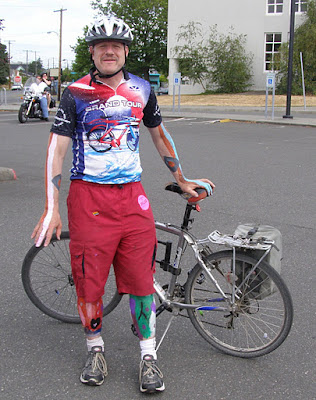 Of course, I rode my bike in the parade. Notice painted legs.
Rainbow City Band
After Bellingham's Gay Pride March down Cornwall Avenue, the band preformed at Depot Market Square where over 1,000 people from many walks of life gathered for a festival that day. There were over 40 booths from various organizations and churches showing solidarity for gay rights.
Betty Desire Preforms
Small town drag show that's not in a bar. Kids in the audience. Has a family, folksy feel with a lot of heart in the community. It's at the Bellingham Gay Pride Festival in Depot Market Square; also home for Farmer's Market on other days. The Gay Pride Parade and Festival brought people from many walks of life. Betty Desire was one of several performers that day. Betty's son was also in the audience (from an earlier marriage) and believe it or not he has a grand child in California. 1 minute 15 seconds.
 Of course, I rode my bike in the parade. Notice painted legs.
Thursday, July 12, 2007
After Supreme Court decision Making it harder to Integrate Schools
Talk shows have been buzzing. John Rothman expressed outrage about the ruling on his KGO show. I often feel like talking back to the radio, but I'm not very articulate on the phone.
Really, the best way to create racial balance in the schools is to better integrate the neighborhoods.
I've never been a big fan of busing, or other "band aid" solutions that attempt to integrate society on the backs of the children. We really need to mix the neighborhoods more.
Restrictive "single family" zoning can be a problem. Maybe racial integration would be easier, if we attempted "income integration."
Allow more of a mix in housing types in residential neighborhoods. Single family homes, apartments, low income housing, mother-in-law units. If there was more of a mix of housing types in each neighborhood, society would be less stratified by class. This would also lead to more racial integration because there is still an income disparity between races.
Rather than taking kids away from neighborhood schools, so they can't stay for after school activities, it's better to create a mix in the neighborhoods around the schools. Also complies with the current mood of Supreme Court which seems to be nixing the idea of using race as a criteria for determining school enrollment.
I'm not a fan of the conservative Supreme Court, but I do think there is a better way to integrate our society, than just tossing the entire burden on the schools, or trying to do this solely on the backs of the children.
Saves energy if there is less "busing" also.
There are environmental reasons for more mixed use zoning as well.
Pedestrian advocates talk a lot about this. Being able to walk to destinations.
If there is nothing but "single family homes" as far as the eye can see, it doesn't make for an interesting walk. How about having a small business, where one can stop for refreshments along the way? How about being able to walk to one's job, rather than having to drive?
Allowing more of a mix of densities and uses, with-in residential neighborhoods, creates options for affordable housing.
With houses starting at 1 million dollars in many neighborhoods that were considered "average middle class" not that long ago, something needs to change.
If the cleaning lady can live in the neighborhood where she works, she can trust the "upper class" more. Also she saves time in commuting.
Who knows, she can participate in your community, take classes and even be on your board of directors. She just has to be able to afford living in your community.
Really, the best way to create racial balance in the schools is to better integrate the neighborhoods.
I've never been a big fan of busing, or other "band aid" solutions that attempt to integrate society on the backs of the children. We really need to mix the neighborhoods more.
Restrictive "single family" zoning can be a problem. Maybe racial integration would be easier, if we attempted "income integration."
Allow more of a mix in housing types in residential neighborhoods. Single family homes, apartments, low income housing, mother-in-law units. If there was more of a mix of housing types in each neighborhood, society would be less stratified by class. This would also lead to more racial integration because there is still an income disparity between races.
Rather than taking kids away from neighborhood schools, so they can't stay for after school activities, it's better to create a mix in the neighborhoods around the schools. Also complies with the current mood of Supreme Court which seems to be nixing the idea of using race as a criteria for determining school enrollment.
I'm not a fan of the conservative Supreme Court, but I do think there is a better way to integrate our society, than just tossing the entire burden on the schools, or trying to do this solely on the backs of the children.
Saves energy if there is less "busing" also.
There are environmental reasons for more mixed use zoning as well.
Pedestrian advocates talk a lot about this. Being able to walk to destinations.
If there is nothing but "single family homes" as far as the eye can see, it doesn't make for an interesting walk. How about having a small business, where one can stop for refreshments along the way? How about being able to walk to one's job, rather than having to drive?
Allowing more of a mix of densities and uses, with-in residential neighborhoods, creates options for affordable housing.
With houses starting at 1 million dollars in many neighborhoods that were considered "average middle class" not that long ago, something needs to change.
If the cleaning lady can live in the neighborhood where she works, she can trust the "upper class" more. Also she saves time in commuting.
Who knows, she can participate in your community, take classes and even be on your board of directors. She just has to be able to afford living in your community.
Tuesday, July 10, 2007
Celebrating in July

Notice the dim dot on right near tree. That's Venus! (I think).
Just got around to putting my images on-line, from Bellingham 4th of July fireworks.
I know, lots of people upload fireworks this time of year.
The 4th is over for another year, but there is still celebration. Bellingham's Gay Pride Festival is coming this weekend.
Sunday, July 15, Noon to 5 PM at Depot Market Square (where Farmer's Market is held on Saturdays).
Actually there are events for Pride this entire weekend. Bellingham is coming more of age when it comes to the "urban trait of exhibiting diversity."
Celebrating freedom and open mindedness.
Sunday, July 08, 2007
Just Before Roll Out Day for the Boeing 787 Dreamliner
Someone calls talk show and says this new light weight plane which is made using carbon composite material will not reduce the greenhouse gas emissions that it is touted for.
Why?
Because even more people will fly.
Lower fuel costs can make air travel less expensive so there will be more air travel, thus wiping out any savings in greenhouse gas.
I guess that's population growth. More people, so more flying.
Step forward, slide back.
It also depends on what the people would be doing if they weren't flying.
The 787 saves energy if people are flying, instead of driving across country. It doesn't save energy if the people fly instead of taking the train, or biking across country.
The main reason why I biked across USA was to see more of America than the in flight movie, but I am not against flying.
I have flown before. Several times, but not since the 1980s.
One flight was on a small plane with "every seat a window seat." Seattle to Pullman, WA. Clear day and Cascade snow cones were visible from Canada to Oregon.
Fantastic, but that joyous trip only lasted a bit over 1 hour.
Since then, I haven't had occasion to fly. Living in the slow lane.
By bicycle, the scenery can last 6 days, but it's not quite so intense. Takes patience.
I ask someone what it was like to fly over a blanket of thick clouds. To be in sunshine, but look down on nothing but clouds. He said, "it's very interesting, for about 5 minutes."
Still, I do like most technology. It's kind of exciting to have the first, basically non metal plane. Actually, I guess there was the wooden Spruce Goose.
Why?
Because even more people will fly.
Lower fuel costs can make air travel less expensive so there will be more air travel, thus wiping out any savings in greenhouse gas.
I guess that's population growth. More people, so more flying.
Step forward, slide back.
It also depends on what the people would be doing if they weren't flying.
The 787 saves energy if people are flying, instead of driving across country. It doesn't save energy if the people fly instead of taking the train, or biking across country.
The main reason why I biked across USA was to see more of America than the in flight movie, but I am not against flying.
I have flown before. Several times, but not since the 1980s.
One flight was on a small plane with "every seat a window seat." Seattle to Pullman, WA. Clear day and Cascade snow cones were visible from Canada to Oregon.
Fantastic, but that joyous trip only lasted a bit over 1 hour.
Since then, I haven't had occasion to fly. Living in the slow lane.
By bicycle, the scenery can last 6 days, but it's not quite so intense. Takes patience.
I ask someone what it was like to fly over a blanket of thick clouds. To be in sunshine, but look down on nothing but clouds. He said, "it's very interesting, for about 5 minutes."
Still, I do like most technology. It's kind of exciting to have the first, basically non metal plane. Actually, I guess there was the wooden Spruce Goose.
Friday, July 06, 2007
In-filling is good, but it doesn't automatically curb sprawl
Here in Bellingham, in-filling the city is being advocated to reduce sprawl in Whatcom County. At the same time, many anti growth advocates fear that we will get both in-filling and sprawl.
I am an advocate for density, but I realize these anti growth naysayers might have a point. In-filling and sprawl can happen simultaneously.
To curb sprawl, there would need to be strict land use laws in the county. Watershed preservation, farmland preservation and so forth.
That could reduce new housing construction in the county. Then Bellingham would need to do in-filling in order to maintain some affordability of housing in this area. Otherwise there could be a shortage of housing if population keeps growing.
Also the county could do a version of in-filling itself. By encouraging clustered housing. Pockets of density rather than sparsely scattered 1 and 5 acre lots filling up the entire area.
The towns in the county can in-fill as well.
County and city planners talk about this, but the hardest part of this task is getting average people to cooperate.
People are slowly changing and the lifestyles that go with in-filling are getting more popular. Things like "car free" living are gaining appeal.
I am an advocate for density, but I realize these anti growth naysayers might have a point. In-filling and sprawl can happen simultaneously.
To curb sprawl, there would need to be strict land use laws in the county. Watershed preservation, farmland preservation and so forth.
That could reduce new housing construction in the county. Then Bellingham would need to do in-filling in order to maintain some affordability of housing in this area. Otherwise there could be a shortage of housing if population keeps growing.
Also the county could do a version of in-filling itself. By encouraging clustered housing. Pockets of density rather than sparsely scattered 1 and 5 acre lots filling up the entire area.
The towns in the county can in-fill as well.
County and city planners talk about this, but the hardest part of this task is getting average people to cooperate.
People are slowly changing and the lifestyles that go with in-filling are getting more popular. Things like "car free" living are gaining appeal.
Wednesday, June 27, 2007
A Christian Immigration Dilemma (some other religions too)

"Be fruitful and multiply, and fill the earth, and subdue the immigration office."
One liner for a cartoon I thought of, but I'm not very good at drawing pictures.
People seem to ignore population growth as an issue behind so many topics, such as immigration. More could be done to slow population growth, but after people are born, it's best to just accommodate us (including my generation of native born "post war baby boomers"). They say us baby boomers will need immigration to pay our Social Security. America has always been a nation of immigrants, it's just that world population keeps growing. One baby boom begets another.
Years ago, water used to flow from the US to Mexico, in the form of the Colorado River. Now I hear it's all spoken for. All, but merely a trickle is spoken for before reaching the Gulf of California in Mexico.
Oil is next. Oil may not be able to flow north from Mexico to USA for long. I read that growth on the Mexican side of the border will tap that entire supply for Mexico's domestic economy.
Our world is reaching Peak Oil. It's having to find (hopefully) better alternatives. All these things flow together for me. Alternative lifestyles, alternative transportation. We're getting more crowded so we must innovate and also curb our procreation.
A contractor calls KUOW's Conversation show on the topic of immigration. Mentions people building houses with views and then complaining when more houses are built that block, or alter part of the view. Says, everyone wants to be, "the last one in."
Monday, June 25, 2007
216 Grand Avenue Art and Children's Museum planned

Reflection from my camera lens creates some art as I pressed it against the window of 216 Grand. Trying to show a "bland and unoccupied" office inside.
Plans are to tear the current building down and put an arts center in its place.
An Art and Children's Museum.
It will be partially funded by "Bellingham Public Facilities District." Also there is money from private and other sources.
A curving glass wall will reach to the sky and shimmer with reflection. This is part of the new plans for 216 Grand that have recently been revealed.
Not quite Centre Pompidou in Paris, France, but for Bellingham, WA. a step loftier than the building that is now occupying this space.
Our often called "City of Subdued Excitement" is (as usual) ambivalent about an arts center.
"Is this really what the taxpayers should be funding?" reads a chorus of comments.
Others look forward to something beyond the "drabness of day to day survival."
Memories of a different kind abound from the present building at 216 Grand
For many years, it was the "Washington State Employment Security Office."
Since those days, that office has changed names and moved to smaller quarters. Much of it's work is now done with the magic of Internet technology. Back in the old days, it was "bulletin boards."
Hoards of people could be seen pondering job notices pinned to the board. Folks looked depressed. Many would walk away muttering, "nothing, nothing."
There was a recession in the early 1980s and that board was nearly blank. Most of the time, it was a flow of "part time nursing home assistant," "fish cannery work" or "taxi driver."
Once, there was a posting for "executive secretary to Western Washington University's President." The list of prerequisites was so long, it could have been from another planet as far as folks standing in line were concerned.
One could hear people muttering, "must be smiling and energetic" with disgust.
Then there was the forms to fill out. The dispatching of unemployment checks, the debates between clients and office workers over "fine print of eligibility." Everyone's "life story" trying to be compressed onto forms in the file cabinet.
"Can you write all this in that tiny space provided?"
That was the employment office.

There were some artists inhabiting that space, but I doubt very many would advocate preserving the present building for it's "artistic character."
Our jury is still out on how much the new building will serve and inspire people. I don't have a strong "yes," or "no" opinion here.
It will be "public space" which is better than an economy that just cranks out a bunch of showboat homes. When effort goes to space that everyone can benefit from, I'm less critical.
On the other hand, construction of a building doesn't really create employment for artists. It creates jobs for engineers and contractors. Meanwhile a lot of unknown artists still work as waiters and taxi drivers. Maybe there's nothing wrong with that. Experiencing life as a waiter could be "source material" for good art.
When the center gets built, I hope it doesn't become too snooty. I hope that a wide range of expression can use the pallet.
There is a creativity movement at the grass roots called Mail Art. It really flourished "big time" in "pre Internet" days of the 1980s. Much of that art phenomenon was outside of established galleries. Artists went around the "system" sending creativity to one another in the mails.
In Mail Art there is a phrase which goes,
"Mail Art is not fine arts, it's the artists who are fine."
Like the job listings that used to be confined to cards on the bulletin board, much of mail art is now just "the norm" of the Internet. One could ask, "has the Internet killed Mail Art?" Or "Has Mail Art grown and turned into the Internet?"
Back in old times, circa 1980s, it was said that most job listings didn't go through Washington State Employment Security. They usually went around that system as well.

Working on old museum building that was once a fancy city hall. Plans are to continue preserving it for historic displays. They say the 1892 building gets passed up by travelling exhibits who fear things like uncontrolled humidity; thus leading to a "wish list" for more museum space in Bellingham.
Below posted June 13 2009.
 With curving glass wall. Should be open some time in September, so I see on a sign at the old children's museum location. It's quite a change from what was there before.
Friday, June 22, 2007
McMansion McMania

In Seattle, they are considering limiting house height and trying to control McMansion McMania where people are buying a lot, then tearing down the modest sized house and filling the lot with a gargantuan house.
McMansions tend to appear in low density residential areas. Around Bellingham, they are drawn to county areas that are zoned for one and five acre lots like magnets. These lots are basically too small to be real farms yet too large to be affordable for the modest. They are prime candidates for mansion mania.
For many reasons one to five acre plots are a bad idea.
Up here, we don't yet seem to have the phenomena of tearing down modest size homes for the big ones. There's still some elbow room where the new monsters can go on new lots.
In Seattle, where population is larger and there is less space, monster homes squeeze into smaller city lots tearing out the existing house. They may as well be apartment buildings as they can be similar in size.
People are sometimes annoyed by such blatant wealth, plus the natural resources consumed in building for one household. I hear that restrictions are being considered.
Rather than restrictions, a libertarian solution could be bumping up the zoning density where McMansions proliferate. They might as well be apartments and business buildings anyway. Why not? In some of Bellingham's older neighborhoods, big mansions are now being used for apartments and rooming houses. Many old mansions have evolved into student housing near the university.
I'm not necessarily a libertarian, but that way of thinking is a good tool; sort of like asking, "what would Jesus drive, if in fact Jesus would drive."
Allowing apartments and mixed use zoning in the McMansion areas would end a form of corporate welfare that protects these giant homes with single family zones. It would create more neighborhoods of mixed use and "income diversity."
Some argue that increased density adds traffic, but it can also spur better bus service and more pedestrian destinations.
* Picture I happened to have in my collection of some fairly large houses in a new part of Pullman, WA.
Saturday, June 16, 2007
My Own Computer Journey From Grade School To Youtube
Emphasis on the early years.
1960s grade school
Teacher hands out test to be taken with a #2 pencil. The "Step Test." It's sent to California and graded in a new way; by computer!
Washington State University is in my home town of Pullman, WA. It has a science fair. On display, an out of date (even at that time) computer with vacuum tubes. Took up one entire classroom.
"My Weekly Reader," a children's magazine, had article on something even smaller than the transistor. Thousands of these tiny transistors could fit on a chip.
Late 1960s JR. high
Students in Mr. Nick's social studies class pick stocks to follow for an assignment. Those who have "IBM stock" get the most points at end of semester. Luckily, it didn't effect the grade.
Early 1970s high school

Below, schematic diagram of IF stage in Astronaut 8 radio with integrated circuit.
 My new radio features an integrated circuit. Part of the circuitry that is called the "IF stage" is mostly on one chip. "Astronaut 8" multi-band radio from Realistic.
An electronic calculator at my father's lab replaces mechanical adding machine. Keypad and numeric display is connected to a central processor that serves 4 offices and is located downstairs.

Not me, but someone else standing by teletype machine pictured in high school annual.
Teletype terminal connects high school to Washington State University computer. It used the phone line. A bunch of whiz kids in mathematics hang out around it. Pictured in annual. I didn't spend time there as I figured I wasn't very good at math.
Mid 1970s college
At Western Washington University, Bellingham, I buy an electronic calculator for $89. Texas Instrument SR 10.
Signed up for computer science because it was required for my major, but figured I might have to drop out. I wasn't good at math, but it was easier than I thought. Surprised myself and got an A.
There was a room full of "key punch" machines where we typed our programs into stacks of cards. These were handed to the control desk at the computer center. Printout could be picked up next day; like getting film back from the developer.
Western Washington University installs terminals for instant "turn around" from computer. One could sign up for an "account" on the system. Each account access some disk space and 8K of memory in the computer. Somewhere around 32 terminals shared the mini computer.
I wrote programs in a computer language called "Basic."
My senior project tabulated a survey from Bellingham city buses. It created a "rank order" table. Ranked bus stops by number of "passenger boardings" at each stop that were counted in the survey.
Back in my home town of Pullman, I tour Washington State University computer center. That multi million dollar facility features massive computer with 2.5 megabytes of RAM! Wow! 2.5 megabytes. (Laugh).
Phone lines connect WSU computer with users in various parts of the state to make most use of the system. Not only WSU uses it, but also Everett City government, for some reason, and a few other agencies around the state. "Must make best use of such a large system."
On a tour, I learn that WSU students have to get funding approved, or be in a computer science class, before they can use WSU system. No "open access terminals" like the smaller computers at WWU allowed. I was horrified.
Tour guide says WSU doesn't believe in "funny money." Students must apply for real money; like funding from their departments, which can be transfered over to computer center. Guide explains that, "students usually don't have problems getting the money approved."
I ask, what if one just wants to learn by "playing" on the computer? WWU has smaller system, but access is much easier. A better system for learning by play.
Back in Bellingham, graduation from WWU means loosing access to computers. At least loosing access until the much talked about "age of home computers," arrives.
The bank I use gets it's first ATM machine.
Early 1980s working as a custodian in Bellingham
I buy an Ohio Scientific "home computer" with 8K memory. Used an old B&W TV for monitor. Cassette tape recorder served as long term memory. $500.
Next year, I bought the printer for another $500. An Epson MX 80 dot matrix printer.
Bellingham Computer Users Group (BUG) meets at Georgia Pacific offices next to the Pulp Mill.
OSI computer and Epson printer. Not that great a picture and I gave items away in the 1990s. Click image to enlarge.

Hear sound of data from OSI computer. See video with sound from OSI. Also see Texas Instruments calculator at work. About 1 minute.
Late 1980s the Commodore 64
A coworker gets an "IBM compatible" with modem. He is sharing messages with "bulletin board services" over phone lines. Bellingham's Micro Madness BBS is going. Coworker dials across country to several BBS services including one in Boca Raton Florida.
I buy a Commodore 64. Coworker thinks it's a mistake and suggests "take it back, get an IBM instead." I keep Commodore and get a modem for it.
Try to send message to coworker, but something is goofy with the modem. He can see my type, but I can't see his.
Someone from Commodore Users Group visits and we try cleaning crud off the phone connection at the old house I'm living in. See if that helps the modem. It doesn't make any difference.
Commodore helps me organize my scrapbook of writings and letters to the editor by topic. Beginnings of the menus that are now on my site.
Brothers and sisters are sending emails to one another for free. Clear across USA. They are using a mystical system called "Internet" which connects up universities and various institutions. Messages are sent from their university or city library workplaces.
1992 getting an IBM Compatible
New custodial job, new coworker.
Coworker takes me shopping to buy an IBM compatible. Also a 2400 baud modem.
I dial my first BBS service. It's a gay oriented message board located in Seattle. Called "28 Barbary Lane." Long distance call.
Coworker, a fellow custodian, explains the concept of "hypertext" to me.
Buy my first optical scanner. It's B&W.
I put one of the stories from my bicycle trips into "electronic book" form. To be shared on BBS services and eventually the Internet.
WWU Alumni Association offers access to the Internet. I join and dial up a computer called "Henson."
View email in a program called "Pine."
My coworker has no ties to university. He is using America On-line. We await the much talked about "gateway" when AOL users get to exchange emails with other Internet users, Compuserve users and so forth.
1994 almost to the web
I try a function called "Telnet." This uses WWU computer to access other systems on the net, in "real time." I try Cornell University in upstate New York. Amazed at how fast it answers. I use Telnet to access several sites including NASA Spacelink.
Fellow at a local potluck explains the World Wide Web and Mozilla to me.
Waiter at Tokyo House Restaurant explains how I can trick Western's computer into thinking I have a "slip account" thus being able to look at the world wide web. My first browser is Netscape.
1995 start of my web page
WWU announces that Alumni will no longer be served by it's over burdened computers. Memo states there are several private companies providing Internet access now days. This isn't related to alumni accessing the slip account. It's just a sign of the times. One of the private companies is called "Pacific Rim Network," in Bellingham.
Spring 1995, I set up my own web page at Pacific Rim Network. All fits inside 2 megabytes. My web address: http://www.pacificrim.net/~robert/ (no longer active).
Start sending my "gay potluck newsletters" via email. It was a xeroxed and "snail mail" publication since about 1992. Circulation, around 100.
Some friend of mine tries to access weather maps on-line, but computer says, "missing packet driver." We're baffled and jokingly look around Lake Padden Park for a missing packet driver.
1999 my own domain name
Pacific Rim is purchased by Verio and the domain is discontinued. I decide to register my own domain name www.theslowlane.com
After 2000 more things
2002. Gay potluck newsletter becomes a Yahoo Group and then in 2019 swithces to Groups.io Newsletter. Now there is the more active "Friends of Gay Bellingham group on Facebook. I also started an account at Blogger.
2004. Start posting prolifically to my blog.
2007. Upload my first Youtube videos. Hopefully, I'll get better at video.
2008, I'm on Facebook. This part added after 2008.
1960s grade school
Teacher hands out test to be taken with a #2 pencil. The "Step Test." It's sent to California and graded in a new way; by computer!
Washington State University is in my home town of Pullman, WA. It has a science fair. On display, an out of date (even at that time) computer with vacuum tubes. Took up one entire classroom.
"My Weekly Reader," a children's magazine, had article on something even smaller than the transistor. Thousands of these tiny transistors could fit on a chip.
Late 1960s JR. high
Students in Mr. Nick's social studies class pick stocks to follow for an assignment. Those who have "IBM stock" get the most points at end of semester. Luckily, it didn't effect the grade.
Early 1970s high school

Below, schematic diagram of IF stage in Astronaut 8 radio with integrated circuit.
 My new radio features an integrated circuit. Part of the circuitry that is called the "IF stage" is mostly on one chip. "Astronaut 8" multi-band radio from Realistic.
 An electronic calculator at my father's lab replaces mechanical adding machine. Keypad and numeric display is connected to a central processor that serves 4 offices and is located downstairs.

Not me, but someone else standing by teletype machine pictured in high school annual.
Teletype terminal connects high school to Washington State University computer. It used the phone line. A bunch of whiz kids in mathematics hang out around it. Pictured in annual. I didn't spend time there as I figured I wasn't very good at math.
Mid 1970s college
At Western Washington University, Bellingham, I buy an electronic calculator for $89. Texas Instrument SR 10.
Signed up for computer science because it was required for my major, but figured I might have to drop out. I wasn't good at math, but it was easier than I thought. Surprised myself and got an A.
There was a room full of "key punch" machines where we typed our programs into stacks of cards. These were handed to the control desk at the computer center. Printout could be picked up next day; like getting film back from the developer.
Western Washington University installs terminals for instant "turn around" from computer. One could sign up for an "account" on the system. Each account access some disk space and 8K of memory in the computer. Somewhere around 32 terminals shared the mini computer.
I wrote programs in a computer language called "Basic."
My senior project tabulated a survey from Bellingham city buses. It created a "rank order" table. Ranked bus stops by number of "passenger boardings" at each stop that were counted in the survey.
Back in my home town of Pullman, I tour Washington State University computer center. That multi million dollar facility features massive computer with 2.5 megabytes of RAM! Wow! 2.5 megabytes. (Laugh).
Phone lines connect WSU computer with users in various parts of the state to make most use of the system. Not only WSU uses it, but also Everett City government, for some reason, and a few other agencies around the state. "Must make best use of such a large system."
On a tour, I learn that WSU students have to get funding approved, or be in a computer science class, before they can use WSU system. No "open access terminals" like the smaller computers at WWU allowed. I was horrified.
Tour guide says WSU doesn't believe in "funny money." Students must apply for real money; like funding from their departments, which can be transfered over to computer center. Guide explains that, "students usually don't have problems getting the money approved."
I ask, what if one just wants to learn by "playing" on the computer? WWU has smaller system, but access is much easier. A better system for learning by play.
Back in Bellingham, graduation from WWU means loosing access to computers. At least loosing access until the much talked about "age of home computers," arrives.
The bank I use gets it's first ATM machine.
Early 1980s working as a custodian in Bellingham
I buy an Ohio Scientific "home computer" with 8K memory. Used an old B&W TV for monitor. Cassette tape recorder served as long term memory. $500.
Next year, I bought the printer for another $500. An Epson MX 80 dot matrix printer.
Bellingham Computer Users Group (BUG) meets at Georgia Pacific offices next to the Pulp Mill.
OSI computer and Epson printer. Not that great a picture and I gave items away in the 1990s. Click image to enlarge.

Hear sound of data from OSI computer. See video with sound from OSI. Also see Texas Instruments calculator at work. About 1 minute.
Late 1980s the Commodore 64
A coworker gets an "IBM compatible" with modem. He is sharing messages with "bulletin board services" over phone lines. Bellingham's Micro Madness BBS is going. Coworker dials across country to several BBS services including one in Boca Raton Florida.
I buy a Commodore 64. Coworker thinks it's a mistake and suggests "take it back, get an IBM instead." I keep Commodore and get a modem for it.
Try to send message to coworker, but something is goofy with the modem. He can see my type, but I can't see his.
Someone from Commodore Users Group visits and we try cleaning crud off the phone connection at the old house I'm living in. See if that helps the modem. It doesn't make any difference.
Commodore helps me organize my scrapbook of writings and letters to the editor by topic. Beginnings of the menus that are now on my site.
Brothers and sisters are sending emails to one another for free. Clear across USA. They are using a mystical system called "Internet" which connects up universities and various institutions. Messages are sent from their university or city library workplaces.
1992 getting an IBM Compatible
New custodial job, new coworker.
Coworker takes me shopping to buy an IBM compatible. Also a 2400 baud modem.
I dial my first BBS service. It's a gay oriented message board located in Seattle. Called "28 Barbary Lane." Long distance call.
Coworker, a fellow custodian, explains the concept of "hypertext" to me.
Buy my first optical scanner. It's B&W.
I put one of the stories from my bicycle trips into "electronic book" form. To be shared on BBS services and eventually the Internet.
WWU Alumni Association offers access to the Internet. I join and dial up a computer called "Henson."
View email in a program called "Pine."
My coworker has no ties to university. He is using America On-line. We await the much talked about "gateway" when AOL users get to exchange emails with other Internet users, Compuserve users and so forth.
1994 almost to the web
I try a function called "Telnet." This uses WWU computer to access other systems on the net, in "real time." I try Cornell University in upstate New York. Amazed at how fast it answers. I use Telnet to access several sites including NASA Spacelink.
Fellow at a local potluck explains the World Wide Web and Mozilla to me.
Waiter at Tokyo House Restaurant explains how I can trick Western's computer into thinking I have a "slip account" thus being able to look at the world wide web. My first browser is Netscape.
1995 start of my web page
WWU announces that Alumni will no longer be served by it's over burdened computers. Memo states there are several private companies providing Internet access now days. This isn't related to alumni accessing the slip account. It's just a sign of the times. One of the private companies is called "Pacific Rim Network," in Bellingham.
Spring 1995, I set up my own web page at Pacific Rim Network. All fits inside 2 megabytes. My web address: http://www.pacificrim.net/~robert/ (no longer active).
Start sending my "gay potluck newsletters" via email. It was a xeroxed and "snail mail" publication since about 1992. Circulation, around 100.
Some friend of mine tries to access weather maps on-line, but computer says, "missing packet driver." We're baffled and jokingly look around Lake Padden Park for a missing packet driver.
1999 my own domain name
Pacific Rim is purchased by Verio and the domain is discontinued. I decide to register my own domain name www.theslowlane.com
After 2000 more things
2002. Gay potluck newsletter becomes a Yahoo Group and then in 2019 swithces to Groups.io Newsletter. Now there is the more active "Friends of Gay Bellingham group on Facebook. I also started an account at Blogger.
2004. Start posting prolifically to my blog.
2007. Upload my first Youtube videos. Hopefully, I'll get better at video.
2008, I'm on Facebook. This part added after 2008.
Friday, June 08, 2007
Palm Trees Above Arctic Circle
Yes, the Earth has seen other periods of global warming. Still, we should worry about this "human effected" period of global warming. We weren't there to worry about the other periods.
The main reason why we should worry about this one is the fact that we are here to be affected by it.
The Earth survived it's other periods of global warming, but we weren't there to worry about it.
Back then there were no ski resorts lacking snow. There was no Columbia River hydroelectric plants worrying about lack of water from a low snow pack. There was no stock market to drop on talk of crop failures, property damage and coastal flooding.
We weren't there to worry.
If a tree falls in the forest and no one is there, does it make a sound?
We are here now, with our fragile economic needs. That's why we should worry.
In the past, there were significant periods of global warming that the Earth survived. The Earth is always changing, but our economy rides Earth like she's a good horse. When Earth starts changing, she's like a bucking bronco. We don't want to slap her because we don't want her bucking while we're riding. We're slapping her with our carbon emissions.
We are riding during the short period of evolution that we are here.
Millions of years ago, Earth saw huge lava flows pour out onto the surface. Many of these flows released carbon dioxide into the atmosphere leading to significant global warming. I recently heard a radio interview with some geologist about this topic. They described palm trees growing above the arctic circle.
Here in the Bellingham area, there are fossils of palm leaf in Chuckanut sandstone. Evidence of warmer eras in the past.
Much of the eastern part of this state is covered with lava flows. Flows that created the Columbia Plateau, often called the Columbia Basalt. Many of these flows crept out during the so called Miocene Era, millions of years ago.

Layers of basalt rock are visible in this coulee near Grand Coulee Dam and the Banks Reservoir. Seen on my 2005 bike tour.
We weren't around to worry the global warming back then and the Earth survived just fine. Maybe plants and animals suffered, but I am not hearing their cries.
The main reason why we need to worry about climate change now, is the fact that we are here. Our stock market doesn't want to take too big of a hit. Our economy is a fragile rider, so we hope that Earth remains a steady horse, at least for this moment in geological history.
The main reason why we should worry about this one is the fact that we are here to be affected by it.
The Earth survived it's other periods of global warming, but we weren't there to worry about it.
Back then there were no ski resorts lacking snow. There was no Columbia River hydroelectric plants worrying about lack of water from a low snow pack. There was no stock market to drop on talk of crop failures, property damage and coastal flooding.
We weren't there to worry.
If a tree falls in the forest and no one is there, does it make a sound?
We are here now, with our fragile economic needs. That's why we should worry.
In the past, there were significant periods of global warming that the Earth survived. The Earth is always changing, but our economy rides Earth like she's a good horse. When Earth starts changing, she's like a bucking bronco. We don't want to slap her because we don't want her bucking while we're riding. We're slapping her with our carbon emissions.
We are riding during the short period of evolution that we are here.
Millions of years ago, Earth saw huge lava flows pour out onto the surface. Many of these flows released carbon dioxide into the atmosphere leading to significant global warming. I recently heard a radio interview with some geologist about this topic. They described palm trees growing above the arctic circle.
Here in the Bellingham area, there are fossils of palm leaf in Chuckanut sandstone. Evidence of warmer eras in the past.
Much of the eastern part of this state is covered with lava flows. Flows that created the Columbia Plateau, often called the Columbia Basalt. Many of these flows crept out during the so called Miocene Era, millions of years ago.

Layers of basalt rock are visible in this coulee near Grand Coulee Dam and the Banks Reservoir. Seen on my 2005 bike tour.
We weren't around to worry the global warming back then and the Earth survived just fine. Maybe plants and animals suffered, but I am not hearing their cries.
The main reason why we need to worry about climate change now, is the fact that we are here. Our stock market doesn't want to take too big of a hit. Our economy is a fragile rider, so we hope that Earth remains a steady horse, at least for this moment in geological history.
Sunday, June 03, 2007
Sailboat from Boulevard Park

Friday, June 01, 2007
Standard of living for average American. Rising? Falling? Unchanged?
Can progress be measured in technology, rather than consumption?
A feeling that one is making progress seems to be very important to people.
Future generations having it better than past generations. Our own lives getting better and better. Going somewhere. Progressing toward a goal.
Since childhood, the virtue of PROGRESS has been instilled in me.
A lot is written about the American standard of living. Is it rising, falling or remaining the same? Of course this depends on who you are, but more interestingly, it depends on what you define as "standard of living."
How does one measure the standard of living?
That is a very important question.
Does more consumption always mean a higher standard of living?
If that's the case, American living standards are likely to fall as more people consuming more resources can't be sustained indefinitely on this planet.
On the other hand, maybe more consumption is not necessary for a higher standard of living.
Here is one thing that we do keep getting more and more of all the time.
Technology.
Future generations have more technology than past generations. Our lives keep getting more sophisticated, or some might say more complicated with each new advance in computers, products, concepts.
Maybe we should get our needed sense of progress from the inevitable progress in technology that we see around us.
I was recently talking to a friend, who lives in Ecuador. That's in South America. We were talking for free using Skype. It seemed like he was next door.
Amazing.
20 years ago, such conversations would have been unimaginable. Today, it's taken for granted with "voice over Internet" technology.
That conversation revolved around how expensive housing is getting in USA. How the average American wage has certainly not kept up with spiraling real estate values. Yes, I remember when you could work close to minimum wage and still be able to afford an apartment in an urban area. I knew someone who sold a house in Seattle for $18,000 back in the mid 1970s. Looking up that same house on Zillow.com shows the price well over half a million. Wages haven't kept pace with that, for most people.
This friend of mine has a dual citizenship and moved back to Ecuador in part due to the high cost of housing in USA. Meanwhile, in Ecuador his career has taken off in a positive direction. Positive in terms of doing interesting work at least, not necessarily making a fortune.
What brings happiness and fulfillment? Not necessarily more consumption.
We concluded our conversation saying that future generations may be homeless, but able to talk around the world for free.

The average American home takes a lot of land and resources. Yard space, blacktop to get to and fro by car, heating bills, water, sewage. You name it.
As the Earth gets more populated, our housing choices will need to get smaller. If not becoming homeless, future generations will most likely live in environments of higher density. Apartments, rooms, townhouses, high rises, condominiums.
At the same time, does that necessarily constitute a lower standard of living?
It all depends on how one defines standard of living. For instance, living in a small space and being with-in walking distance of good culture might be as important as owning a huge yard, but having to drive everywhere.
Of course the close-in places tend to be expensive, these days, but with future planning, there can be a bigger supply of "close-in" places.
There's only so much space around the hearts of our largest cities. There's only one San Francisco, but as more of our smaller cities get large, we have more cities.
Population growth is sure putting a crimp on our consumption of land and resources, but as we get smarter, the standard of living doesn't have to fall; not for a while at least.
I am assuming we're getting smarter of course.
Progress in technology and better planning can more than compensate for loss of consumption.
Future generations can have a better life, with more culture, better planning, more "pedestrian oriented neighborhoods," and most predictably, lots of new technology.
Yes, lots of new technology, but consuming less space, energy and natural resources.
I often say it's like going from the vacuum tube to the transistor to the microchip.
Of course some would argue that the microchip isn't always better. I hear that some rock bands still prefer vacuum tubes in their amplifiers.
Rock and Roll: was "the new generation," now it can be nostalgia.
Will "high tech / low consumption" be a high standard of living?
I see you cringing at how far removed our lives are becoming from nature. You say, "technology, but no more yard space?"
Well, I guess we're getting too crowded to own our own yard space. We can still preserve great areas and agricultural lands, but we can't all buy up the last remaining rural areas as private non-farming properties.
We just have to consume less and count our progress in terms of a great society and all that new technology.
You are shaking your head in disbelief.
So, maybe future generations will have to shrink themselves down to a size that allows for living in a cell phone.
A feeling that one is making progress seems to be very important to people.
Future generations having it better than past generations. Our own lives getting better and better. Going somewhere. Progressing toward a goal.
Since childhood, the virtue of PROGRESS has been instilled in me.
A lot is written about the American standard of living. Is it rising, falling or remaining the same? Of course this depends on who you are, but more interestingly, it depends on what you define as "standard of living."
How does one measure the standard of living?
That is a very important question.
Does more consumption always mean a higher standard of living?
If that's the case, American living standards are likely to fall as more people consuming more resources can't be sustained indefinitely on this planet.
On the other hand, maybe more consumption is not necessary for a higher standard of living.
Here is one thing that we do keep getting more and more of all the time.
Technology.
Future generations have more technology than past generations. Our lives keep getting more sophisticated, or some might say more complicated with each new advance in computers, products, concepts.
Maybe we should get our needed sense of progress from the inevitable progress in technology that we see around us.
I was recently talking to a friend, who lives in Ecuador. That's in South America. We were talking for free using Skype. It seemed like he was next door.
Amazing.
20 years ago, such conversations would have been unimaginable. Today, it's taken for granted with "voice over Internet" technology.
That conversation revolved around how expensive housing is getting in USA. How the average American wage has certainly not kept up with spiraling real estate values. Yes, I remember when you could work close to minimum wage and still be able to afford an apartment in an urban area. I knew someone who sold a house in Seattle for $18,000 back in the mid 1970s. Looking up that same house on Zillow.com shows the price well over half a million. Wages haven't kept pace with that, for most people.
This friend of mine has a dual citizenship and moved back to Ecuador in part due to the high cost of housing in USA. Meanwhile, in Ecuador his career has taken off in a positive direction. Positive in terms of doing interesting work at least, not necessarily making a fortune.
What brings happiness and fulfillment? Not necessarily more consumption.
We concluded our conversation saying that future generations may be homeless, but able to talk around the world for free.

The average American home takes a lot of land and resources. Yard space, blacktop to get to and fro by car, heating bills, water, sewage. You name it.
As the Earth gets more populated, our housing choices will need to get smaller. If not becoming homeless, future generations will most likely live in environments of higher density. Apartments, rooms, townhouses, high rises, condominiums.
At the same time, does that necessarily constitute a lower standard of living?
It all depends on how one defines standard of living. For instance, living in a small space and being with-in walking distance of good culture might be as important as owning a huge yard, but having to drive everywhere.
Of course the close-in places tend to be expensive, these days, but with future planning, there can be a bigger supply of "close-in" places.
There's only so much space around the hearts of our largest cities. There's only one San Francisco, but as more of our smaller cities get large, we have more cities.
Population growth is sure putting a crimp on our consumption of land and resources, but as we get smarter, the standard of living doesn't have to fall; not for a while at least.
I am assuming we're getting smarter of course.
Progress in technology and better planning can more than compensate for loss of consumption.
Future generations can have a better life, with more culture, better planning, more "pedestrian oriented neighborhoods," and most predictably, lots of new technology.
Yes, lots of new technology, but consuming less space, energy and natural resources.
I often say it's like going from the vacuum tube to the transistor to the microchip.
Of course some would argue that the microchip isn't always better. I hear that some rock bands still prefer vacuum tubes in their amplifiers.
Rock and Roll: was "the new generation," now it can be nostalgia.
Will "high tech / low consumption" be a high standard of living?
I see you cringing at how far removed our lives are becoming from nature. You say, "technology, but no more yard space?"
Well, I guess we're getting too crowded to own our own yard space. We can still preserve great areas and agricultural lands, but we can't all buy up the last remaining rural areas as private non-farming properties.
We just have to consume less and count our progress in terms of a great society and all that new technology.
You are shaking your head in disbelief.
So, maybe future generations will have to shrink themselves down to a size that allows for living in a cell phone.
Tuesday, May 29, 2007

Saturday, May 26, 2007
Bicycle gear principle used to move heavy book shelves in library by hand
Think you have to own a car to move? Watch me bicycle tons of books. It's how libraries create new aisles and, as always, doing more with less.
Thursday, May 24, 2007
Innovation: a solution to global warming

Innovation in lifestyles and technology.
It may take both, but innovation in technology will definitely be necessary if people aren't innovative enough in lifestyles.
Our survival may be a contest between innovation and desperation.
Examples of lifestyle innovation:
Reduce population growth through increase in percentage of population living "child free" lifestyles. Growing acceptance for gay lifestyles is one example.
Reduce consumption. Voluntary simplicity, shorter workweek. Valuing more free time over buying power.
Alternative transportation. Less dependency on automobiles. More bicycling, walking and public transit.
More compact residential development. Planning that grows up instead of out. Smaller lot sizes, more people living in apartments and condominiums. More things with-in walking and biking distance. More density for greater viability of public transit. Hopefully urban lifestyles can be made affordable.
Planting forests.
Examples of technological innovation:
Use Internet to tele-commute rather than driving to work.
Alternative energy from wind, solar, dare I say nuclear power.
Sequestering carbon from fossil fuel such as burning coal for electricity, but capturing the CO2 so it doesn't go out the stack.
Seeding ocean plankton so it sequesters more carbon and sends that to the bottom of the ocean.
More efficient appliances such as the progression from vacuum tube to transistor to microchip.
Reflecting back some of the sun's rays before they reach Earth. Scattering dust into stratosphere. Orbiting a large set of Levolor Blinds in space between Earth and Sun. Remember, they must be Levolor.
To whom do we hand the rod for adjusting the mini blinds?
The UN? President Bush?
Some people might say, "this is really keeping the blinders on."
Still, I believe both lifestyle and technological innovation will be needed.
Friday, May 18, 2007
Be part of the solution and the celebration
Volunteers at one of several Bike To Work and School Day stations. Celebration stations. This one located at Railroad and Holly in downtown Bellingham.

Someone baked a cake. 2007 is the tenth anniversary of this festive event.

Meet lots of interesting folks as people get out of the isolation of their cars and bicycle more. Celebration stations cheer on the bike commuters as they pass. Some will stop for refreshments and conversation on the annual Bike To Work and School Day which was May 18 this year. It encourages people to do more biking throughout the year.
See a video of celebration station. Approx. 1 minute.
Banner at after party in courtyard of Boundary Bay Pub.


Someone baked a cake. 2007 is the tenth anniversary of this festive event.

Meet lots of interesting folks as people get out of the isolation of their cars and bicycle more. Celebration stations cheer on the bike commuters as they pass. Some will stop for refreshments and conversation on the annual Bike To Work and School Day which was May 18 this year. It encourages people to do more biking throughout the year.
See a video of celebration station. Approx. 1 minute.
Banner at after party in courtyard of Boundary Bay Pub.

Tuesday, May 15, 2007
Gas Out Day Today

Refinery near Richmond, CA. seen from passing Greyhound Bus 1987 upon returning from my first west coast bicycle tour.
Gas Out Day May 15? Better to celebrate Bike To Work and School Day on May 18. 07
Monday, May 14, 2007
When the house owns you
In many regions, buying a house has gotten so expensive that it's time to turn around the terminology.
You don't own the house. The house owns you.
People that I know who have bought houses seem like they have fallen into black holes. They disappear from community activities for the most part. Having to work two jobs to pay the mortgage, all the repairs around the house, painting, yard work, gardening. The house owns you.
It's kind of like going back to the time of the native Americans when there was more of a tendency to feel like the land owned you, rather than you owning the land.
Now home ownership is bounded more by environmental regulations than before, burning bans, noxious weeds, noise ordinances, water issues, building permits, zoning, you name it. The world is getting more crowded and these things must come to pass. More pressure to be stewards of the land. Also renting isn't so bad after all.
You don't own the house. The house owns you.
People that I know who have bought houses seem like they have fallen into black holes. They disappear from community activities for the most part. Having to work two jobs to pay the mortgage, all the repairs around the house, painting, yard work, gardening. The house owns you.
It's kind of like going back to the time of the native Americans when there was more of a tendency to feel like the land owned you, rather than you owning the land.
Now home ownership is bounded more by environmental regulations than before, burning bans, noxious weeds, noise ordinances, water issues, building permits, zoning, you name it. The world is getting more crowded and these things must come to pass. More pressure to be stewards of the land. Also renting isn't so bad after all.
Wednesday, May 09, 2007
Sign says wear your helmet

Along a popular road for bicycling, Lake Samish Fire District reminds folks to wear their helmets. Good idea. I've got mine.
Oops, the "I" has dropped in bike.
Saturday, May 05, 2007
Welding art at Bellingham Technical College

Amazing what can be found serendipitously when bicycling. Not that far from where I live. Looking through fish scales at the technical college. Sculptures all over so I took a few photos. Just caught the tip of the iceberg, but it's my favorite tip.
Decided to add some photos from that relaxing peddle in the afternoon to my Flicker account.
Thursday, May 03, 2007
Abandoned filling station sign says ride your bike

Filling station torn down, but sign remained for a while. Site now has leaking tank mitigation.
I have seen some posts that there's a don't buy gas "Gas Out Day" on May 15 to protest high gas prices. Guess what, May 18 is Bike To Work And School Day. Maybe the two days should merge.
Monday, April 30, 2007
Bike Away From Work

Budding lilacs with pine in the background.
May 18 is Bike To Work Day in Bellingham, but some people might feel it's another obligation.
"As if work isn't enough, now they expect me to bike there after working overtime and so forth," some will say.
So, bike away from work.
For some people, piling a bike trip on top of an already overburdened day is just another "should do." For others it's a relaxing and refreshing change from sitting at work. A breath of fresh air and a way to stretch one's legs. For some, biking will be a treat to and from work, but it isn't the same for everyone.
Biking away from work is an answer also. That means using the bike for recreational trips such as weekends or after work. Biking when there isn't as much pressure to "get there on time" can be a joy.
Americans tend to be overworked anyway. For some, the bike would just be another task. For others it's a welcome break from the tasks.
As a culture, we could also use more vacation time and break from the work-a-day world. If nothing else, better health could be justified in terms of increased productivity and lower medical costs, but why turn all our choices over to the bean counters?
Maybe we should just bike for the fun of it. If one finds it too much of a burden to bike to work, how about biking more on your time off? As long as it's biking, it's good.
Personally, I live so close to my job that there is no point carrying my bike down the stairs to ride it that short distance. I just walk to work.
My biking is during time off work. I've biked across America, but one doesn't even have to be capable of that. Just biking anywhere is worth while. Spring is starting to unfold.
Saturday, April 28, 2007
Cell Phones and The Slow Lane
Some people complain about cell phones, but before cell phones, I didn't like regular phones.
Preferring to think about what I am saying, I write letters. The phone forces one to think on the fly.
Even before cell phones, I would write a letter to another person in town, rather than pick up the phone. People may have thought I was strange. The phone was just too fast for me.
Email still allows me to think about my letter. Delivery is just faster. The best of both worlds.
It's not technology that's the problem, it's "the speed of business."
Phones are always interrupting. They turn face to face conversation into disjointed sound bytes between the phone calls. When ever you get a good conversation going with a friend, the phone rings.
Phones often lead to multitasking. One reason why I am reluctant to phone people is it seems like you get the quick brush off from about half the folks you call. Everyone's multitasking with a second call on line two.
Cell phones bring the phone to more places, like trails and the wilderness. That can be good for safety reasons, but it also can mean the work world is just a ding-a-ling away.
I do bring a prepaid cell phone with me on my long bicycle tours. It is fun to share the tour, as it happens, with friends and family. No, I am not against cell phones. They can be kind of fun.
It is best to be stopped when your talking. Even on a bicycle, multitasking and driving isn't good.
When I make a call, I like to talk a long time, but I don't wish to interrupt my contemplative life to make lots of little calls.
During my childhood, people used to complain about "transistor radios" in the forest. Contaminating the natural experience with used car ads was not considered PC. Youth camps often had bans on radios.
These days, about the only "phone free zones" where people can meet face to face for uninterrupted conversations are in saunas, steam rooms and hot tubs. That is until they develop cell phones which can be cooked in an oven and submerged in water.
I don't really have anything against cell phones compared to regular phones. I just don't use either that often. When I do use them, I try to not be hurried.
Preferring to think about what I am saying, I write letters. The phone forces one to think on the fly.
Even before cell phones, I would write a letter to another person in town, rather than pick up the phone. People may have thought I was strange. The phone was just too fast for me.
Email still allows me to think about my letter. Delivery is just faster. The best of both worlds.
It's not technology that's the problem, it's "the speed of business."
Phones are always interrupting. They turn face to face conversation into disjointed sound bytes between the phone calls. When ever you get a good conversation going with a friend, the phone rings.
Phones often lead to multitasking. One reason why I am reluctant to phone people is it seems like you get the quick brush off from about half the folks you call. Everyone's multitasking with a second call on line two.
Cell phones bring the phone to more places, like trails and the wilderness. That can be good for safety reasons, but it also can mean the work world is just a ding-a-ling away.
I do bring a prepaid cell phone with me on my long bicycle tours. It is fun to share the tour, as it happens, with friends and family. No, I am not against cell phones. They can be kind of fun.
It is best to be stopped when your talking. Even on a bicycle, multitasking and driving isn't good.
When I make a call, I like to talk a long time, but I don't wish to interrupt my contemplative life to make lots of little calls.
During my childhood, people used to complain about "transistor radios" in the forest. Contaminating the natural experience with used car ads was not considered PC. Youth camps often had bans on radios.
These days, about the only "phone free zones" where people can meet face to face for uninterrupted conversations are in saunas, steam rooms and hot tubs. That is until they develop cell phones which can be cooked in an oven and submerged in water.
I don't really have anything against cell phones compared to regular phones. I just don't use either that often. When I do use them, I try to not be hurried.
Thursday, April 26, 2007
Bellingham YMCA Building Turns 100 Years Old

Construction site with large steel columns and foundation walls, 100 years ago. If you look real closely, there's a horse cart parked by the old Bergs Pharmacy across what is now called State Street. The view across Holly has changed also. Click on image for larger version.
Sometime around 2006, 2007 someone can say that Bellingham's main YMCA building turns 100. It depends on whether one counts from start of construction, grand opening or what ever.
The building didn't start as a YMCA. It was an office building. At first, it was called The Exchange Building. Back then, the Y was across Holly Street in a building that later became the Odd Fellows. That place still stands as apartments today.

Before becoming a Y, the Exchange Building was offices and stores. State Street was called Elk Street back then. Notice the horse carriage headed up Holly St.
Next the Exchange Building became "Hotel Henry." That was in the mid 1920s. The 1940s saw that building become a Y. From what I read, the building was donated, to a large extent, for the Y.

Hotel seen from alley before gym was added. Image taken from an inventory book that was produced around 1927.
The gym and pool was added around 1951. There has been many remodeling projects over the years; including quite a few recent projects. They are always doing something.
After the year 2000, a second climbing wall was added to the south side. Newest climbing wall is 65 feet tall. First climbing wall was added during the mid 1990s.
On March 6, 2006, Bellingham Herald did a historic feature on the building. That's still available in archives.
There are quite a few old photos around. These images are two of my favorite that I scanned while working on the custodial crew.
Tuesday, April 24, 2007
Is God Hiding in the Dark Matter or the Dimensions of String Theory?

Our perception of the universe keeps getting larger and larger. In ancient times, it seemed like Earth was "center of it all" and not even all of Earth was known about. The Romans had no idea that the Americas existed.
There were also many things, like thunder, that were unexplained. They were attributed to the gods.
As our knowledge grew, we started explaining things in more mundane terms. We could make statements like, "thunder is not angry gods, but more explainable events in the atmosphere."
Science has a tendency to demystify things. It tends to push the idea that "something is caused by a god" farther from the picture as understanding advances.
Does that mean science can explain God totally out of the picture?
Not really, at least in my opinion.
Here's a reason why.
While scientific understanding tends to explain God out of our little world, it also tends to expand our world. As the known world grows, the unknown world grows also.
The unknown world may even be growing faster than the known world.
The universe that we try and comprehend is much larger today than the Romans would have imagined. Not only is Earth larger than the Romans thought, it's also just a tiny speck in something even bigger. Billions and billions of stars, planets and galaxies, as Carl Sagan would have said.
There's still plenty of room for mystery. Plenty of room for God, or even gods, to hide in.
Just in case you thought the billions of stars and galaxies aren't enough mystery, I read that possibly 95 percent of the stuff in our universe is totally invisible to us. It's the so called "dark matter" and "dark energy."
What is dark matter and / or dark energy?
No one knows.
We don't see the light from it, but many astronomers think it's got to be there because they see the effects of its gravity on the stuff that we do see.
Dark energy seems to be repelling the galaxies apart at an ever increasing rate while dark matter is arranging and tugging the galaxies around in various ways.
It's like invisible hands pushing and pulling things around, but we don't see what's doing this.
For now, we can leave dark matter and dark energy in the pile of unknown. That's the pile where we toss God also.
Even without that 95 percent of the universe people call the dark stuff, there's still a lot of the visible universe that's mysterious. Billions and billions of galaxies and lots of unexplained stuff. Even unexplained stuff right here on earth. Unexplained stuff in our ecosystems, brains, what ever.
As soon as we pull some new understanding out of the pile, we find that pile of "unknown" just gets even larger. We never seem to explain God into a corner or out of existence. The universe is far too large for that.
If our world was as small as the Romans must have perceived it to be, we would be well on our way to explaining away God. We would have explained thunder, much of weather, the flowing of streams, the chemical reactions that cause fire, evolutionary theory leading to the variety of species and so forth. Basically, we would eventually run out of mystery.
Still thinking inside the box of the Romans, God's corner is getting quite small.
As it is, we are no where near running out of mystery as our perception of the size of the universe just keeps growing along with our understanding of certain things around us.

Falling off the edge yet? Image from one of my bicycle trips down the Oregon coast.
There is a phrase that goes something like:
"The more we know, the more we know that we don't know."
There is still plenty of "place," on this huge stage we call reality, for God. More place all the time as the pile of unknown seems to grow faster than the pile of known.
It's like we're loosing ground.
It's also kind of like we are getting more humble all the time.
Yes, more humble.
In many ways, we seem to be less arrogant than the ancients who thought that man (for the most part not even women included) was the center of the universe.
Here's an analogy that I thought about this while I was mopping the floor. My custodial job gives me time for contemplation.
Ancient man sat in a room of darkness. He kept hearing a rustling sound that he thought was a mouse in the room.
"Mouse" means "God" for the terms of this analogy.
He kept hearing the rustling, but couldn't see anything due to the darkness. He thought, "it's got to be a mouse till he turned on a light."
No mouse visible.
"So, the mouse must be around the corner, behind the dresser, under the bed?"
He turns on more lights. He lights up a bigger area.
He sees under the bed. No mouse. Behind the dresser, no mouse.
Soon the entire room is lit up. No mouse can be seen and he realizes that the rustling is coming from a window shade.
Yes, there's a window shade. It's making a rattling sound in the wind.
Seeing the window for the first time is when ancient man first gains the concept that there is such a thing as an "outdoors."
In the dark room, he thought the little room was all of reality. Now he sees more. "There's such a thing as an outdoors!"
Now there's more room for mystery to lurk.
He can now ask questions like, "where does the wind come from?"
Yes, science tends to demystify a lot of things, but at the same time, it keeps pushing the frontiers of knowledge out into much larger worlds. Bigger worlds where mystery still abounds.
As the world of unknown keeps growing, I also read about many scientists describe the world that we do know in poetic and even artistic terms. Sort of like, "even the world that we do know is not really that totally mechanical either." It can be described more like a work of art than just the grinding of some impersonal machine, at least according to many scientists who I read about.
That's another whole tangent of thinking and it's quite fascinating.
It seems to me like we may have all but "proven out of existence" the god of the small world that fundamentalist religion was born out of.
That god, who is said to have "created the Earth in 6 days." Now days, he seems to be just about folk tale. That's the god who's "6 day creation special" defies geological findings.
A little while ago, I heard that, "on the 7th day, God ordered pizza."
It's believable, especially when the priest owns stock in a pizza delivery company.
The true universe is much larger and more mystical than folks living in that small world of Biblical times even imagined. Maybe they had some useful insights that we can still benefit from today, but the world is much larger and even more mysterious than that.
Now, as if that unseen 95 percent of our universe, we call dark matter and dark energy, isn't enough, there is String Theory.
Folks working on "String Theory" could be opening yet another "picture window" on the great unknown.
More dimensions.
10, or maybe even 11 dimensions!
More dimensions than just the familiar "up / down," "this side, that side" of a cube.
We can picture 3 dimensions. We can even (almost) picture the fourth dimension.
Yes, the fourth dimension.
That's the dimension which "relativity folks" describe as being "Time."
We have 3 spacial dimensions and a 4th dimension we call time.
Einstein talked about "Space Time."
Hard to imagine, but I can almost wrap my brain around it. Well not really.
String theorists even talk about something called "Brains." Yes, brains, like in our heads? Or maybe more like membranes?
No, I don't really know what the concept of "brains" means either.
So, what about the 4, or even 5 additional dimensions?
It's dimensions beyond our current conceptions.
Yes, String Theory seems to explain a lot of things in this universe that are now, you guessed it, mysteries.
String Theory is supposed to unify the world of "Quantum Physics" to the world of "Relativistic Physics."
Don't ask me why. I just know that for String Theory to work, "they" say it has to have 10 or 11 dimensions.
10 or 11 dimensions. Wow.
Then we ask, "why?"
All these dimensions have to be there because some physicists say so. A lot of physicists. Theoretical physicists with mathematical equations that look like gobble-de-gook to me.
Well, I take their word for it. That's all I can say. I got a "D" in basic algebra.
So far, String Theory, or even dark energy and dark matter have not been totally proven. It's just that a lot of scientists think we are really on to something. On to something rather profound in explaining more of this universe.
We just keep asking more and more questions. Our world keeps getting larger and larger and there always seems to be plenty of room for something folks can call a god.
I guess one can say, "it can truly be seen as an artistic, fantastic and mysterious world out there."
Friday, April 13, 2007
Liberal talk may not work on radio since people listen in their cars. Driving brings out the conservative in folks

A tower I drew while I was in college, probably while I should have been taking notes in class.
Media full of news about Imus firing from CBS.
Also people full of questions, "why is radio talk so mean spirited?" "Why don't liberal talkers do as well in the ratings on commercial radio?"
Well, maybe it's because a big share of the radio audience is driving. Yes, driving and fighting traffic. People often say that they become a different person when they get behind the wheel of their cars. More angry, mean spirited, hurried. "Move it buster, don't take all day."
That may influence which stations get tuned in.
I know some drivers who want soothing programs, but maybe they are more apt to go for music, rather than talk radio. Classic KING FM (in Seattle) for instance.
As for me, I listen to radio a lot, but I don't drive.
My dial is often set to gentle and educational talk. Talk like one finds on NPR and Seattle's KUOW.
Also on some other stations like Canada's kind and gentle CBC Radio One with CBU out of Vancouver, BC. Even KGO out of San Francisco, CA. has some good talkers, but being a commercial station they do have some yellers as well.
Thursday, April 12, 2007
Drive till you qualify drives sprawl

Qualify for a mortgage that is, and or just an affordable place to live.
One of the most senseless realities of economics in regards protecting the environment.
Drive out from the city till you find an affordable place to live. Drive out till you qualify for a mortgage. Lower income people having to move farther out usually means more driving and sprawl into rural environments.
This may be one of the biggest environmental problems we face. Things need to be done to remedy this bad economic reality.
Solutions include:
* In-filling in the cities and towns to provide more affordable housing for both renters and owners.
* Population control.
* Public transit, rather than automobiles, out to some of the hinterlands so people who live out there don't have to drive so much.
* The Internet and tele-commuting to cut down on that long commute to work.
* Clustered development in the hinterlands.
* People not expecting to live in such large houses or yards.
* Higher gas prices and / or lower property values, thus creating a different market environment so "drive till you qualify" no longer makes economic sense.
Economic sense and environmental sense need to match up in a better way.
Here is a cartoon idea about low and moderate income people facing two monsters.
Monster in the city is high property values / rents and mortgages.
Monster in the country is rising gas prices.
Monday, April 09, 2007
My favorite kind of socialism / welfare state
Let the machines do the work and pay the taxes while humans enjoy the "welfare state."
Of course maybe us humans need balance, rather than not working at all. We can let the machines do most of the work and let us work "part time."
It's my kind of socialism and I am not really a socialist.
Actually, I would consider myself a part socialist. I believe in a large public sector, but also advocate a more or less "free market" economy.
"More or less," that's balance.
My scale is tipped toward calling myself a socialist when the prospect of having the machines do most of the work is suggested.
Maybe we should still work part time for balance, but really ... The machines can do a lot of mundane and repetitive tasks better.
Why have human bank tellers when machines can do it? Miss that human smile at the bank? Well, that smile is short lived when there's a long line of customers that have to be hurried through the line.
Hurried, harried?
Can't we just do our mundane banking by machine and then head to the beach where our former "bank teller now artist" hangs out? On the beach we might have more time for long philosophical conversations.
Yes, my kind of welfare state. Machines do the work and people enjoy a benevolent society.
We can even program the machines so that they don't grumble when they pay the taxes.
Of course maybe us humans need balance, rather than not working at all. We can let the machines do most of the work and let us work "part time."
It's my kind of socialism and I am not really a socialist.
Actually, I would consider myself a part socialist. I believe in a large public sector, but also advocate a more or less "free market" economy.
"More or less," that's balance.
My scale is tipped toward calling myself a socialist when the prospect of having the machines do most of the work is suggested.
Maybe we should still work part time for balance, but really ... The machines can do a lot of mundane and repetitive tasks better.
Why have human bank tellers when machines can do it? Miss that human smile at the bank? Well, that smile is short lived when there's a long line of customers that have to be hurried through the line.
Hurried, harried?
Can't we just do our mundane banking by machine and then head to the beach where our former "bank teller now artist" hangs out? On the beach we might have more time for long philosophical conversations.
Yes, my kind of welfare state. Machines do the work and people enjoy a benevolent society.
We can even program the machines so that they don't grumble when they pay the taxes.
Subscribe to:
Posts (Atom)