I see quite a few posts about economics by Robert Reich, secretary of labor for president Clinton a while back. He has a fairly standard left leaning take on things. Recently he has taken on inflation. Blaming most of it on corporate monopolies.
Seems like he has, along with many others, overlooked the role that rising home values and costs play in pushing inflation. 16% jump in home prices, nationwide, last year. I don't think he's even mentioned that. Overall inflation is just 7% versus 16% for homes.
Housing costs must be pushing up other inflation as wages and other prices need to go up so people can afford a place to live.
One wonders why there is such a blind spot about that.
Maybe because home price increases benefits a lot of people as well. Homes are owned by people whereas corporations are non person entities; easier to pin blame on.
Easy money and low interest rates has lead to inflation in asset values of many kinds, including homes and stocks. In the case of stocks, this largely benefits corporate executives who own large shares of stock.
Asset inflation does relate to the problem of corporations as well. Yes, there are a lot of rich corporate executives.
I guess if one wants to target the problem, one should talk about asset inflation. If you own assets you get richer, in inflationary times, than if you don't.
As for the corporation, some of them are still operating on a thin margin so it isn't necessarily the corporation that's the problem. It's a problem if the executives make too much and / or get too wealthy just from owning assets. Stocks, housing or whatever.
Reich seem to think the problem is monopoly corporations, but usually bigger corporations have lower prices. Economy of scale. Think Walmart and Amazon. His argument doesn't seem convincing.
Yes, monopoly power is a problem. I guess Amazon and Walmart aren't monopolies as they compete with each other. I don't know of very many monopolies. Corporations are big, however, but not often total monopolies. Bigger corporations do often bring the lowest prices if they aren't monopolies.
For low price, maybe size isn't the problem. Economy of scale. On the other hand, size is a problem when it comes to other things besides just price; like the value we place on local business versus multinational / impersonal corporations.
Sometimes it's worth paying more for a higher quality community.
Seems like mainstream left thinking doesn't quite get the true picture, at least in my opinion. Neither does right wing thinking.
Much of the problem is run away asset values, but people also benefit from that so it's harder to criticize.

Wednesday, January 26, 2022

Sunday, January 23, 2022
Abandoned WSU steam plant they were hoping to renovate. Turns out it's still in use. Left hand must have not known what the right hand was doing?
Exiting plans had started to move forward for renovating Washington State University's old heating plant. Turn it into meeting spaces, offices and eateries. A joint project between WSU and the Port of Whitman County. Some grants were applied for and approved. Some money was spent.
Turns out the plant is still in use! WSU pulled the plug on the project when they determined that the plant wasn't abandoned after all, I guess. Continued below.
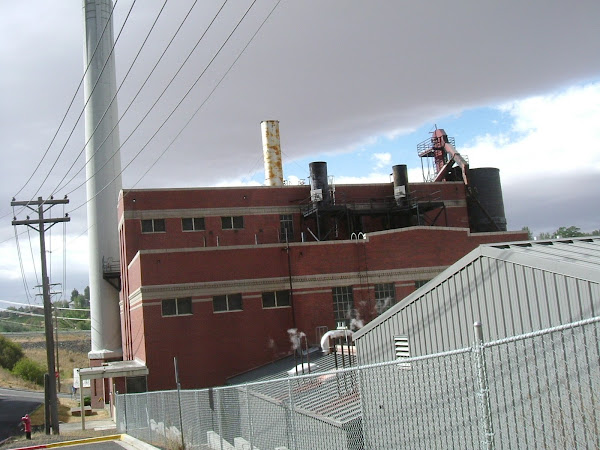 WSU steam plant in the Twilight Zone.
It's strange. Somehow communication wasn't happening. My hypothesis is that somewhere in administration, they hadn't checked with the physical plant staff that runs the WSU heating system. Who knows. How could this plan have gone on for nearly 2 years before someone said, wait a minute?
It is kind of disappointing. Just following the news from my home town, I was looking forward to the renovation. Folks from one of the partners, Port of Whitman County, are disappointed also and there is some news of legal action.
An old steam plant, in Spokane, was turned into a great venue for dining, offices and so forth. I visited during a bicycle trip around 2012. Back then, it was called Steam Plant Square and Steam Plant Grill. In it's earlier incarnation it heated parts of downtown Spokane.
 Steam plant renovation in Spokane as of my visit 2011.
In Pullman, there must have been kind of a communications screw up, I guess. Did people higher up in administrations forget to talk to lower down staff who are actually running the heating system? That seems to be a common screw up in big organizations. Lack of communication? Talk is often thought of as cheap, as in the phrase "talk is cheap," but talking can be very useful.
Turns out there is an interesting history that predates this situation.
Around early the 2000s, WSU was considering building a new heating plant in conjunction with a power company called Duke Energy. The new plant would generate electricity and provide steam to WSU as part of a cogeneration plant, if I remember correctly.
I thought the plan was with Avista, the local utility, but someone looked it up and remembered better than me. It was Duke Energy, I guess. Anyway.
 The old plant, built in the 1920s, would have been renovated into a new WSU Art Gallery. It's in a good location on the edge of campus facing downtown Pullman.
That plan was scrapped when, apparently, it didn't pencil out.
 Instead, WSU opted for a less exciting compromise. They needed to expand their steam operations so a new plant was built on the east end of campus along a road called "Grime's Way." The road named after someone, I guess. Back when I was growing up in Pullman, that road was named "Farm Way."
 The new plant was built and (I think) an addition was built to the old plant. Some boilers at the east end of campus and other boilers near the old plant at the west side of campus.
The new art gallery was built in another location. It's by the WSU Art Building. They tore down and relocated the old campus police / fire station.
During my years growing up in Pullman, the WSU steam plant burned coal at least in the winter. I toured it, back then and they said it could burn coal, natural gas or oil if need be. Different boilers, burners and so forth.
 Older picture of the plant taken during my college years when I was home for the summer. Coal pile seen to the right.
I also heard that they could generate, maybe 20% of the campus electricity from a steam turbine in the front room of of the plant that overlooks the notorious "Power House Hill;" a hill I felt accomplished if I could ride my bike to the top. I'd have to be in the lowest gear.
 Image taken 2003 after coal operation had ended.
Coal operation was discontinued in the early 2000s when the current steam heating configuration was built. I think it's all powered by natural gas.
They must still have quite a bit of operating equipment in the old plant. Pumps, steam tunnel entrances, feed water treatment, electrical, maintenance; whatever.
I'm thinking, maybe they could do something on a smaller scale with the front room of that plant; where the steam turbine used to be. I wouldn't know, it's just a guess. Maybe some of the money already approved in the grant can still be used in cleanup or something. It isn't that much money yet. The rennovation idea would ahve cost in the millions.
 Image I took around 1973, my senior year in high school. Original look before a somewhat ugly (utilitarian) addition was added.
 2003 image with the yellow addition. Someone said it holds old baghouse type pollution control equipment to reduce dust from coal burning? I think that addition came in the 1980s.
 One more image from west side of plant, 2003.
 Meanwhile, here in Bellingham, Western Washington University has an interesting steam plant with display windows.
 Down on Bellingham's waterfront there is a power plant with a fairly boring wall, but they did paint a mural on that wall more recently.
 Near Bellingham's waterfront power plant was an old pulp mill, Georgia Pacific West. Most of it has been torn down and that area is slowly turning into a redevelopment district. A partnership between Port of Bellingham and the city. Some of that planning has been rocky as well. It's been a long time in coming.
They are trying to retain some artificts from the old mill for the sake of art. An old granery building has been restored, some condos are under construction, there is a jump track for bikes at least until they find something else to do with that space. It's quite popular. Also there's an outdoor beer garden and some other things.
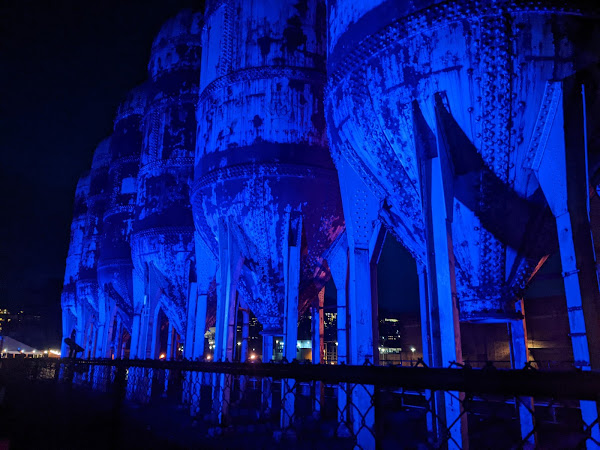 Old digester tanks, from the pulp mill, can now be lit up in various colors.
My article on WWU steam plant in Bellingham. Published in The Betty Pages.
Turns out the plant is still in use! WSU pulled the plug on the project when they determined that the plant wasn't abandoned after all, I guess. Continued below.
It's strange. Somehow communication wasn't happening. My hypothesis is that somewhere in administration, they hadn't checked with the physical plant staff that runs the WSU heating system. Who knows. How could this plan have gone on for nearly 2 years before someone said, wait a minute?
It is kind of disappointing. Just following the news from my home town, I was looking forward to the renovation. Folks from one of the partners, Port of Whitman County, are disappointed also and there is some news of legal action.
An old steam plant, in Spokane, was turned into a great venue for dining, offices and so forth. I visited during a bicycle trip around 2012. Back then, it was called Steam Plant Square and Steam Plant Grill. In it's earlier incarnation it heated parts of downtown Spokane.
In Pullman, there must have been kind of a communications screw up, I guess. Did people higher up in administrations forget to talk to lower down staff who are actually running the heating system? That seems to be a common screw up in big organizations. Lack of communication? Talk is often thought of as cheap, as in the phrase "talk is cheap," but talking can be very useful.
Turns out there is an interesting history that predates this situation.
Around early the 2000s, WSU was considering building a new heating plant in conjunction with a power company called Duke Energy. The new plant would generate electricity and provide steam to WSU as part of a cogeneration plant, if I remember correctly.
I thought the plan was with Avista, the local utility, but someone looked it up and remembered better than me. It was Duke Energy, I guess. Anyway.
That plan was scrapped when, apparently, it didn't pencil out.
The new art gallery was built in another location. It's by the WSU Art Building. They tore down and relocated the old campus police / fire station.
During my years growing up in Pullman, the WSU steam plant burned coal at least in the winter. I toured it, back then and they said it could burn coal, natural gas or oil if need be. Different boilers, burners and so forth.
I also heard that they could generate, maybe 20% of the campus electricity from a steam turbine in the front room of of the plant that overlooks the notorious "Power House Hill;" a hill I felt accomplished if I could ride my bike to the top. I'd have to be in the lowest gear.
Coal operation was discontinued in the early 2000s when the current steam heating configuration was built. I think it's all powered by natural gas.
They must still have quite a bit of operating equipment in the old plant. Pumps, steam tunnel entrances, feed water treatment, electrical, maintenance; whatever.
I'm thinking, maybe they could do something on a smaller scale with the front room of that plant; where the steam turbine used to be. I wouldn't know, it's just a guess. Maybe some of the money already approved in the grant can still be used in cleanup or something. It isn't that much money yet. The rennovation idea would ahve cost in the millions.
They are trying to retain some artificts from the old mill for the sake of art. An old granery building has been restored, some condos are under construction, there is a jump track for bikes at least until they find something else to do with that space. It's quite popular. Also there's an outdoor beer garden and some other things.
My article on WWU steam plant in Bellingham. Published in The Betty Pages.
Tuesday, January 18, 2022
Most worry about 5G has been barking up the wrong tree. It's aviation safety, not the human body that folks should have worried about.
For years, I've heard people worry about 5G phone signals effect on the human body.
Seems like just about all real scientists were not worried about that, but now it seems like scientists ARE worried about conflict with airline flight control signals. Why haven't I heard about this worry until just the last few weeks?
Seems like there was so much static in the air from the other worries that the airline issue went unnoticed.
Like crying wolf, sometimes the real worries get buried under a clutter of concerns as so many worries seems to be just barking up the wrong tree.
US airline officials warn of ‘catastrophic’ crisis in aviation with new 5G service.
Seems like just about all real scientists were not worried about that, but now it seems like scientists ARE worried about conflict with airline flight control signals. Why haven't I heard about this worry until just the last few weeks?
Seems like there was so much static in the air from the other worries that the airline issue went unnoticed.
Like crying wolf, sometimes the real worries get buried under a clutter of concerns as so many worries seems to be just barking up the wrong tree.
US airline officials warn of ‘catastrophic’ crisis in aviation with new 5G service.
Bans on natural gas could be missing the real climate change problems
Something I've been thinking. Since much of our electricity, these days, comes from natural gas, I've been thinking it might not reduce fossil fuel consumption to have a ban.
Turns out, according to this article, gas burned in a home furnace can be 90% efficient, but when burned in a powerplant and then sent by transmission lines to electric heating in a home, only 45% efficient? I think really? Apparently power plants aren't that efficient. Lots of the waste heat goes up the cooling towers.
One of the problems is that modern homes tend to be bigger so more energy is used anyway, whether electricity or gas. That's closer to the real problem. If electricity, the grid is still too reliant on fossil fuels and (in this area, the US Pacific Northwest) hydro power. Hydro power is low carbon footprint, but does have an impact. Just ask the salmon.
Heat pumps can help, versus resistance electric heating, but they can be expensive.
We just need to use less in buildings, cars and so forth. We also need to speed up the greening of our energy sources.
My article in The Betty Pages about proposals to ban natural gas heating. I think, maybe a carbon tax would work better, but we do need to find ways to reduce fossil fuel dependency.
Turns out, according to this article, gas burned in a home furnace can be 90% efficient, but when burned in a powerplant and then sent by transmission lines to electric heating in a home, only 45% efficient? I think really? Apparently power plants aren't that efficient. Lots of the waste heat goes up the cooling towers.
One of the problems is that modern homes tend to be bigger so more energy is used anyway, whether electricity or gas. That's closer to the real problem. If electricity, the grid is still too reliant on fossil fuels and (in this area, the US Pacific Northwest) hydro power. Hydro power is low carbon footprint, but does have an impact. Just ask the salmon.
Heat pumps can help, versus resistance electric heating, but they can be expensive.
We just need to use less in buildings, cars and so forth. We also need to speed up the greening of our energy sources.
My article in The Betty Pages about proposals to ban natural gas heating. I think, maybe a carbon tax would work better, but we do need to find ways to reduce fossil fuel dependency.
Monday, January 17, 2022
Seems like home value inflation is overlooked, but it can lead to other inflation as wages try to catch up with the cost of living.
Lots of talk about inflation, today, which could be bad political news for Biden and the Democrats.
Yes, inflation is here and in home values and housing costs, it's been reality for a long time. Wages are trying to catch up and that can push up other prices.
Then there's the cost of gas. It's a fossil fuel so it may need to get more expensive for the planet. Still, there is a lot of grumbling about that, adding to misfortune for the Democrats.
It's not Biden's fault, but they aren't explaining things very well.
Yes, inflation is here and in home values and housing costs, it's been reality for a long time. Wages are trying to catch up and that can push up other prices.
Then there's the cost of gas. It's a fossil fuel so it may need to get more expensive for the planet. Still, there is a lot of grumbling about that, adding to misfortune for the Democrats.
It's not Biden's fault, but they aren't explaining things very well.
Tuesday, January 11, 2022
Even in a world of zero population growth, some areas would still grow; areas where people want to live.
Some folks worry about declining population. Populations are shrinking in some countries, like Russia. It's still growing worldwide, but growth is slowing.
Less population would be desirable. There would be some adjustments to make in our current economic system that relies on growth of consumption.
Even in a world of no growth, some areas would still grow; areas where people want to live. There are many parts of the world that people are desperately trying to get out of.
Here in Bellingham, there is quite a bit of vibrancy related to people wanting to live here. New grade schools being built. I see cranes for a big grade school upgrade out my window. Sunnyland School.
Immigration to USA is said to have slowed significantly in the last year. This ought to calm the wall building fears of Republicans, but I'm not holding my breath.
Even with immigration slowed, I would guess that for every immigrant, who comes to USA either legally or illegally, there are many more who's dream it is to come to America.
Many more who dream of coming to Canada, certain European nations and Australia as well.
I doubt very many people wish to go to Putin's Russia.
There was recent news about someone who snuck into North Korea. Probably someone out of their mind.
Much of Bellingham's continued population growth comes from migration from other parts of USA, rather than immigration to USA which, at least temporarily, is said to be slowing down.
If the world weren't overwhelmed with population, various regions and nations could compete on the grounds of being good places to live. They would compete for attracting new residents and vibrancy.
It could mean that the good places to live would be in the ascendency. Good news for democracies and places that respect human rights.
Democracies would have an advantage if there was ever a shortage of people because they would have less shortage of people when people choose where they would prefer to live. Betty Pages Article.
Less population would be desirable. There would be some adjustments to make in our current economic system that relies on growth of consumption.
Even in a world of no growth, some areas would still grow; areas where people want to live. There are many parts of the world that people are desperately trying to get out of.
Here in Bellingham, there is quite a bit of vibrancy related to people wanting to live here. New grade schools being built. I see cranes for a big grade school upgrade out my window. Sunnyland School.
Immigration to USA is said to have slowed significantly in the last year. This ought to calm the wall building fears of Republicans, but I'm not holding my breath.
Even with immigration slowed, I would guess that for every immigrant, who comes to USA either legally or illegally, there are many more who's dream it is to come to America.
Many more who dream of coming to Canada, certain European nations and Australia as well.
I doubt very many people wish to go to Putin's Russia.
There was recent news about someone who snuck into North Korea. Probably someone out of their mind.
Much of Bellingham's continued population growth comes from migration from other parts of USA, rather than immigration to USA which, at least temporarily, is said to be slowing down.
If the world weren't overwhelmed with population, various regions and nations could compete on the grounds of being good places to live. They would compete for attracting new residents and vibrancy.
It could mean that the good places to live would be in the ascendency. Good news for democracies and places that respect human rights.
Democracies would have an advantage if there was ever a shortage of people because they would have less shortage of people when people choose where they would prefer to live. Betty Pages Article.
Long lines at polling places in some states decreases right to vote, but Washington State has done much better.
Biden is pushing for laws to preserve voter access today. I'm not following this issue closely, but got to thinking that we are pretty fortunate, here in Washington State. We have mail in voting rather than cumbersome polling places one has to stand in line at for voting.
Some states still have the old polling systems. For years, I keep hearing news about long waits at the polls in other states. Waits so long that voting becomes difficult and many working people have to choose between casting their vote or making a living.
Even when we did have the polling places, here in Washington, I don't remember long waits. We seem to have a better voting system than a lot of other states even back when we had polling places.
Other states need to fix those problems in their state or I agree, the Federal Government will need to step in to preserve access to the ballot.
Then there is the whole problem of gerrymandering. Another big topic.
Some states still have the old polling systems. For years, I keep hearing news about long waits at the polls in other states. Waits so long that voting becomes difficult and many working people have to choose between casting their vote or making a living.
Even when we did have the polling places, here in Washington, I don't remember long waits. We seem to have a better voting system than a lot of other states even back when we had polling places.
Other states need to fix those problems in their state or I agree, the Federal Government will need to step in to preserve access to the ballot.
Then there is the whole problem of gerrymandering. Another big topic.
Monday, January 10, 2022
With home values and prices going up so fast across America, of course there's inflation. These costs create the need to push up wages and other prices.
According to an article, I just read, about a poll, it says Americans are more worried about inflation coming back than about threats to democracy. Poll indicates that Democratic Party' s strategy of campaigning on worries about democracy might not, as the old phrase goes, "play in Peoria;" as in will it play in places like Peoria, Illinois.
Yes, I say we do have inflation with home values going up around 20% here in Bellingham; 16% nationwide in the last year. That's got to spread to other inflation in wages, as people need to pay more for rents, first time homebuying and so forth. Then other prices go up as businesses charge more to pay the higher wages.
I guess people need to understand inflation better. It is happening, but it isn't necessarily the end of the world if wages can keep up with other prices.
Problem is, most people's wages usually don't keep up. Maybe they keep up with some prices, but certain things, like housing and medical insurance, can be outliers.
Inflation is not necessarily Biden's fault, but it needs to be better explained, I guess.
Lots of people benefit when assets, such as houses and stocks, go up so one hardly ever hear politicians, or the media, talk about this as a root of the dastardly "inflation" that so many people say they don't like.
The Fed creating so much money and low interest rates helps to drive this situation. Still, we have to print money to fund government, the military, police, civil society, disaster relief, Medicare, coronavirus relief and so forth.
It's going to happen, but if we can stay calm, it's manageable. One way to cool inflation is to raise taxes. One way to cool inflation is to send the economy into a recession. Cause asset values to plummet.
We can't "have it all" and I'd also say, "be careful what you ask for as you might get it."
Yes, I say we do have inflation with home values going up around 20% here in Bellingham; 16% nationwide in the last year. That's got to spread to other inflation in wages, as people need to pay more for rents, first time homebuying and so forth. Then other prices go up as businesses charge more to pay the higher wages.
I guess people need to understand inflation better. It is happening, but it isn't necessarily the end of the world if wages can keep up with other prices.
Problem is, most people's wages usually don't keep up. Maybe they keep up with some prices, but certain things, like housing and medical insurance, can be outliers.
Inflation is not necessarily Biden's fault, but it needs to be better explained, I guess.
Lots of people benefit when assets, such as houses and stocks, go up so one hardly ever hear politicians, or the media, talk about this as a root of the dastardly "inflation" that so many people say they don't like.
The Fed creating so much money and low interest rates helps to drive this situation. Still, we have to print money to fund government, the military, police, civil society, disaster relief, Medicare, coronavirus relief and so forth.
It's going to happen, but if we can stay calm, it's manageable. One way to cool inflation is to raise taxes. One way to cool inflation is to send the economy into a recession. Cause asset values to plummet.
We can't "have it all" and I'd also say, "be careful what you ask for as you might get it."
So many Americans are in poor health anyway. The virus was the straw that broke the camel's back.
Omicron variant of the virus is surging, but symptoms seem to be less severe for most people; especially folks who are vaccinated.
Problem is, there is still a surge in hospitalizations with hospital staff near breaking point. I just got to thinking that part of the problem is just poor health in general. The post war baby boom is aging. The virus is the straw that broke the camel's back.
Yes, precautions and vaccinations are important, but this problem and shortage of healthcare staff may persist. Lifestyle choices, age and other factors matter also.
All through this pandemic, I've heard that heart disease is still the number one killer. Problem with the virus is that it can lead to premature death and it's a big new disease that's been added to the stack.
Problem is, there is still a surge in hospitalizations with hospital staff near breaking point. I just got to thinking that part of the problem is just poor health in general. The post war baby boom is aging. The virus is the straw that broke the camel's back.
Yes, precautions and vaccinations are important, but this problem and shortage of healthcare staff may persist. Lifestyle choices, age and other factors matter also.
All through this pandemic, I've heard that heart disease is still the number one killer. Problem with the virus is that it can lead to premature death and it's a big new disease that's been added to the stack.
Saturday, January 08, 2022
Do we need this proposed law in Washington State since distrust of elections is less of a problem here than in some other states?
Washington Gov. Inslee said that he wants lawmakers to pass legislation making it a gross misdemeanor for elected officials and candidates to spread lies about election results.
One wonders if this is necessary here in Washington State as I think the problem of distrust of the election process is much worse in other states.
Here in Washington, our election processes seem to work well and there is less distrust of government functioning. Such a proposal, in Washington, could be seen as overkill and it could create unnecessary political blowback to Inslee.
The fate of such a bill is dubious given court challenges.
One wonders if it is worth the political capital Inslee might be spending to get this bill passed.
On the other hand, lies, distrust of elections and even violence is a serious problem, nationwide. I think it is more serious in states where politics tends to lean more Republican. Such a bill as this proposal would not likely get to first base in those states.
It does seem like disdain for government is strong; especially among Republicans. I think to the point of anarchy.
I make a connection between severe anti government sentiment and anarchy. Anarchy is, basically, no government.
Even small government, like the famous concept from Grover Norquist, of making government so small one can "drown it in a bathtub," is a dangerous sentiment.
Many of the people who complain the most about government do rely on government for public safety, the military, veteran's benefits, Medicare and so forth.
Too much government and beaurocracy can be a problem, but government is part of the balance along with the private sector.
It does seem strange when people, who wave the flag and call themselves patriots, also say that our (state, federal and local) governments are evil. Kind of a strange irony; especially when it comes from politicians who are in power in the government.
I see this as more of a problem in states that tend to lean Republican. It's hard to say what the best solution to this problem would be. Is passing a law the best solution? It's worth consideration, but the proposal does bring up a lot of questions.
Meanwhile, here in Washington State, it does seem like we have a good election process. Other states may have honest election processes also, but public trust of those processes is more in question.
Remember, I do think outright hatred of government can lead to anarchy. Yes, we did have the Chopp anti police zone that came from the far left in Seattle, Washington, but I tend to think that is part of the action and reaction between right and left extremes.
The Chopp Zone happened in Washington State, but it happened while Trump's extreme presidency was stirring up divisiveness; almost for the fun of it; Trump being a better comedian than president.
Divisiveness and derisive comments about other types of people can be good for media ratings, but calmer tempers and civil society is more to my liking.
For the most part, we do seem to have civil society, here in the state of Washington.
We have mail in balloting in Washington. I like it, but I know some folks don't trust it. Some other states still have polling places complete with the problems of long lines, I'll have to say. We also seem to have a tradition of moderate, responsible Republican Secretaries of State who hold the office overseeing our elections. Our recent Secretary of State, Republican Kim Wyman, was chosen by Democrat Joe Biden for a job related to election security at the national level. By partisanship still alive, I guess.
Years ago, we had Ralph Munro, also a Republican, who I had some personal correspondence with.
That office also over sees state archives and Munro noticed a self published (by photocopy machine) book I did on my 1989 bicycle tour around Washington State. It was on display at the local branch of our State Archives. He was here for a visit and picked up my book. I wasn't there at the time, but people, I know, who work there mentioned that to me. I wrote him, after hearing that and it started a personal correspondence. I sent him some of the books I did about later bicycle trips and he always wrote back appreciating my sharing.
He had a reputation for good relations with the public.
One wonders if this is necessary here in Washington State as I think the problem of distrust of the election process is much worse in other states.
Here in Washington, our election processes seem to work well and there is less distrust of government functioning. Such a proposal, in Washington, could be seen as overkill and it could create unnecessary political blowback to Inslee.
The fate of such a bill is dubious given court challenges.
One wonders if it is worth the political capital Inslee might be spending to get this bill passed.
On the other hand, lies, distrust of elections and even violence is a serious problem, nationwide. I think it is more serious in states where politics tends to lean more Republican. Such a bill as this proposal would not likely get to first base in those states.
It does seem like disdain for government is strong; especially among Republicans. I think to the point of anarchy.
I make a connection between severe anti government sentiment and anarchy. Anarchy is, basically, no government.
Even small government, like the famous concept from Grover Norquist, of making government so small one can "drown it in a bathtub," is a dangerous sentiment.
Many of the people who complain the most about government do rely on government for public safety, the military, veteran's benefits, Medicare and so forth.
Too much government and beaurocracy can be a problem, but government is part of the balance along with the private sector.
It does seem strange when people, who wave the flag and call themselves patriots, also say that our (state, federal and local) governments are evil. Kind of a strange irony; especially when it comes from politicians who are in power in the government.
I see this as more of a problem in states that tend to lean Republican. It's hard to say what the best solution to this problem would be. Is passing a law the best solution? It's worth consideration, but the proposal does bring up a lot of questions.
Meanwhile, here in Washington State, it does seem like we have a good election process. Other states may have honest election processes also, but public trust of those processes is more in question.
Remember, I do think outright hatred of government can lead to anarchy. Yes, we did have the Chopp anti police zone that came from the far left in Seattle, Washington, but I tend to think that is part of the action and reaction between right and left extremes.
The Chopp Zone happened in Washington State, but it happened while Trump's extreme presidency was stirring up divisiveness; almost for the fun of it; Trump being a better comedian than president.
Divisiveness and derisive comments about other types of people can be good for media ratings, but calmer tempers and civil society is more to my liking.
For the most part, we do seem to have civil society, here in the state of Washington.
We have mail in balloting in Washington. I like it, but I know some folks don't trust it. Some other states still have polling places complete with the problems of long lines, I'll have to say. We also seem to have a tradition of moderate, responsible Republican Secretaries of State who hold the office overseeing our elections. Our recent Secretary of State, Republican Kim Wyman, was chosen by Democrat Joe Biden for a job related to election security at the national level. By partisanship still alive, I guess.
Years ago, we had Ralph Munro, also a Republican, who I had some personal correspondence with.
That office also over sees state archives and Munro noticed a self published (by photocopy machine) book I did on my 1989 bicycle tour around Washington State. It was on display at the local branch of our State Archives. He was here for a visit and picked up my book. I wasn't there at the time, but people, I know, who work there mentioned that to me. I wrote him, after hearing that and it started a personal correspondence. I sent him some of the books I did about later bicycle trips and he always wrote back appreciating my sharing.
He had a reputation for good relations with the public.
Friday, December 31, 2021
Happiness. Low expectations can make satisfaction more attainable
There is a lot of talk about Nordic countries being the happiest places. Social services are good, but there is another side of the coin that makes it work. Reasonable expectations about life.
I've often thought that happiness is a function of two things. Expectations versus reality. If expectations are too high, folks can be disappointed. One can be happy with less.
I would guess this also allows people, like the Fins, to accept things like higher taxes, smaller homes and so forth so that their egalitarian society is more feasible. Here in USA, we seem to want it all.
Here is an interesting article from Slate. The Grim Secret of Nordic Happiness.
I've often thought that happiness is a function of two things. Expectations versus reality. If expectations are too high, folks can be disappointed. One can be happy with less.
I would guess this also allows people, like the Fins, to accept things like higher taxes, smaller homes and so forth so that their egalitarian society is more feasible. Here in USA, we seem to want it all.
Here is an interesting article from Slate. The Grim Secret of Nordic Happiness.
Tuesday, December 28, 2021
Environmentalists need to go after consumers as much as they go after producers
The traditional left tends to attack producers versus consumers.
Warren wants to crack down on banks that invest in fossil fuel production. At the same time, I think something like a carbon tax or less incentives to drive and more incentives for public transit could work better.
I guess people, on the left, shouldn't grumble when gas prices go up since I hear that fuel production is slowed by the disinvestment in fossil fuel that has happened so far. Warren seems to want to ramp up this disinvestment more.
Hurray for higher fossil fuel prices, but this may not be that well understood by the consumer. One danger is return of Republicans to Congress in the next election from angry consumers.
We need to think in terms of the "big picture;" not just each of our selfish little pieces of it.
Some of these reforms, that she is proposing, might not be a bad idea, however. Transparency, so we can see where our financial institutions are still investing in fossil fuels. Yes, it's good to have eyes open.
Eventually this has to effect the consumer. It's naive to think the consumer can avoid consequences. This is where everyone, from consumers to big business to government needs to transition to more walking, bicycling, public transit, electric vehicles, smaller more efficient living spaces, better city planning and so forth.
Business needs to be pushed in this direction, of course. Just pulling some fossil fuel production cards out from under the delicate card house of American society is problematic. It's problematic if people don't see these things in context of the big picture. The big picture being everyone being less dependent of fossil fuels.
Warren wants to crack down on banks that invest in fossil fuel production. At the same time, I think something like a carbon tax or less incentives to drive and more incentives for public transit could work better.
I guess people, on the left, shouldn't grumble when gas prices go up since I hear that fuel production is slowed by the disinvestment in fossil fuel that has happened so far. Warren seems to want to ramp up this disinvestment more.
Hurray for higher fossil fuel prices, but this may not be that well understood by the consumer. One danger is return of Republicans to Congress in the next election from angry consumers.
We need to think in terms of the "big picture;" not just each of our selfish little pieces of it.
Some of these reforms, that she is proposing, might not be a bad idea, however. Transparency, so we can see where our financial institutions are still investing in fossil fuels. Yes, it's good to have eyes open.
Eventually this has to effect the consumer. It's naive to think the consumer can avoid consequences. This is where everyone, from consumers to big business to government needs to transition to more walking, bicycling, public transit, electric vehicles, smaller more efficient living spaces, better city planning and so forth.
Business needs to be pushed in this direction, of course. Just pulling some fossil fuel production cards out from under the delicate card house of American society is problematic. It's problematic if people don't see these things in context of the big picture. The big picture being everyone being less dependent of fossil fuels.
Thursday, December 23, 2021
Pfizer's new pill for COVID 19 could be an important breakthrough as for some people, cure is an easier sell that prevention.
Pfizer's new pill, approved yesterday, that can significantly reduce the risk of hospitalization after coming down with COVID 19 could be a significant step toward reducing the pandemic.
Some people who are reluctant to do something, like a vaccine for prevention, might be more apt to seek a cure, if it's available, after catching the disease.
Prevention is often a harder sell.
Medical intervention for prevention can be analogous to the concept of a colonoscopy. When one is healthy, it can be a harder sell. Compared to a colonoscopy, it seems like the vaccination is easy. I had practically no side effects from the vaccine. Risk is low.
A colonoscopy is also low risk, but I didn't go for the colonoscopy until many years after I turned 50. It is more involved, with the prep to clean out the colon and so forth. The process is kind of a strange thought, though painless. Eventually I did the colonoscopy and it turned out okay.
There are some reasons why a colonoscopy may be unecessary. Other cancer screening technologies, for instance.
Seems like the vaccination is more of what they call a "no brainer." Benefits far outweigh the almost non existant downside.
At the same time, a surprising number of people are reluctant to take the vaccine. Due to that situation, an effective treatment for COVID seems like significant news for controling the pandemic.
I guess quite a few people are more apt to take action when actually faced with the disease. This, versus prevention when faced with the risk. Risk tends to be a concept that is more theoretical, I guess.
Some people who are reluctant to do something, like a vaccine for prevention, might be more apt to seek a cure, if it's available, after catching the disease.
Prevention is often a harder sell.
Medical intervention for prevention can be analogous to the concept of a colonoscopy. When one is healthy, it can be a harder sell. Compared to a colonoscopy, it seems like the vaccination is easy. I had practically no side effects from the vaccine. Risk is low.
A colonoscopy is also low risk, but I didn't go for the colonoscopy until many years after I turned 50. It is more involved, with the prep to clean out the colon and so forth. The process is kind of a strange thought, though painless. Eventually I did the colonoscopy and it turned out okay.
There are some reasons why a colonoscopy may be unecessary. Other cancer screening technologies, for instance.
Seems like the vaccination is more of what they call a "no brainer." Benefits far outweigh the almost non existant downside.
At the same time, a surprising number of people are reluctant to take the vaccine. Due to that situation, an effective treatment for COVID seems like significant news for controling the pandemic.
I guess quite a few people are more apt to take action when actually faced with the disease. This, versus prevention when faced with the risk. Risk tends to be a concept that is more theoretical, I guess.
Elon Musk owes much of his success to government.
Interesting article from 2015 came up on my Facebook feed from LA Times. Yes, government has played a big role in the work of Elon Musk's enterprises.
In my opinion, this is not necessarily a bad thing. Often it does take a partnership of public and private enterprise to accomplish things.
Much of our public debate seems to be about which is better; private enterprise, or government. Often the two are intertwined for better, or for worse. It's much of the way our society functions. No one can fully take credit; like in the phrase, "it takes a village."
In my opinion, this is not necessarily a bad thing. Often it does take a partnership of public and private enterprise to accomplish things.
Much of our public debate seems to be about which is better; private enterprise, or government. Often the two are intertwined for better, or for worse. It's much of the way our society functions. No one can fully take credit; like in the phrase, "it takes a village."
In Washington's 42nd Legislative District where I happen to live.
There has been quite a bit of national news about death rates from COVID 19 being higher among Republican leaning areas versus areas that vote Democrat. This due to lower vaccination rates among Republicans and other factors such as more resistance to mask wearing.
The spotlight of this news has come closer to home recently, here in Washington State's 42 Legislative district with the recent death of our state Senator, Republican Doug Erikson.
It isn't publically known whether Erikson was vaccinated, or not, but has been reported that he had Covid 19 during a trip to Elsalvador. He was medivacted to Florida where he was reported to be improving, but later reported to have passed away.
Wishing the best for him and his family.
I live in the 42nd district so he was my state Senator, even though I didn't vote for him.
Some people reading this wouldn't be familior with the 42nd District so here is a part of the story.
The city of Bellingham, where I live, is divided into two legislative districts; the 40th and the 42nd districts. The district line runs down certain city streets. Urban areas tend to be more liberal than rural areas.
40th district tends to go south from mid Bellingham while the 42nd district goes north. 42nd district includes rural northwest regions of Whatcom County.
Over the years, the 40th district usually sends Democrats to Olympia (our state capital) while the 42nd tends to vote more Republican. Erikson had held a state House of Represenatives seat from 1998 till 2010 when he ran for the state Senate and held that seat ever since.
Democrats have tried to elect a Democrat in that District, but Erikson was able to hold the seat. In 2018, the election was close, I think within a few hundred votes.
Next election will be in 2022.
Meanwhile, according to Washington State Constitution, the Republican Party is to pick a field of candidates to serve out the end of Erikson's term and the County Council chooses the final candidate from that field.
I'm remembering one year when it seemed like there was a huge difference between the 40th and the 42nd districts. That was the year when the top two candidates from the 40th district were from the Green Party and the Democratic Party.
Washington has a system where the top two candidates from the primary ballot go on to the general election. While the 42nd elected Republican Erikson, in the general, no Republican was in the general election from the 40th district. In the 40th district, the Democrat beat the Green Party Candidate that year.
I was living in the 40th district at that time.
In reality, the two districts have more in common than it looked that year, but races are often fairly close.
I've lived in both districts since the line bisects Bellingham. Not that I've moved real often, but I have moved across that line so I am currently in the 42nd district.
The spotlight of this news has come closer to home recently, here in Washington State's 42 Legislative district with the recent death of our state Senator, Republican Doug Erikson.
It isn't publically known whether Erikson was vaccinated, or not, but has been reported that he had Covid 19 during a trip to Elsalvador. He was medivacted to Florida where he was reported to be improving, but later reported to have passed away.
Wishing the best for him and his family.
I live in the 42nd district so he was my state Senator, even though I didn't vote for him.
Some people reading this wouldn't be familior with the 42nd District so here is a part of the story.
The city of Bellingham, where I live, is divided into two legislative districts; the 40th and the 42nd districts. The district line runs down certain city streets. Urban areas tend to be more liberal than rural areas.
40th district tends to go south from mid Bellingham while the 42nd district goes north. 42nd district includes rural northwest regions of Whatcom County.
Over the years, the 40th district usually sends Democrats to Olympia (our state capital) while the 42nd tends to vote more Republican. Erikson had held a state House of Represenatives seat from 1998 till 2010 when he ran for the state Senate and held that seat ever since.
Democrats have tried to elect a Democrat in that District, but Erikson was able to hold the seat. In 2018, the election was close, I think within a few hundred votes.
Next election will be in 2022.
Meanwhile, according to Washington State Constitution, the Republican Party is to pick a field of candidates to serve out the end of Erikson's term and the County Council chooses the final candidate from that field.
I'm remembering one year when it seemed like there was a huge difference between the 40th and the 42nd districts. That was the year when the top two candidates from the 40th district were from the Green Party and the Democratic Party.
Washington has a system where the top two candidates from the primary ballot go on to the general election. While the 42nd elected Republican Erikson, in the general, no Republican was in the general election from the 40th district. In the 40th district, the Democrat beat the Green Party Candidate that year.
I was living in the 40th district at that time.
In reality, the two districts have more in common than it looked that year, but races are often fairly close.
I've lived in both districts since the line bisects Bellingham. Not that I've moved real often, but I have moved across that line so I am currently in the 42nd district.
Tuesday, December 21, 2021
US population still growing, but easing quite a bit. Slowest growth rate since founding of USA.
I just heard on PBS Newshour that the rate of population growth in USA has been the slowest since the founding of our country during a year long period that ended July 2021. The pandemic has led to several changes including an increased death rate. Not happy news.
Other less disturbing news has been a slow down in birth rates and a slow down of immigration. Some Republicans still say that the border is "out of control," but that contention doesn't seem consistent with the data. Depends on how one would define out of control.
In that period of time, overall US population still grew by 400,000, but that's a lower growth rate than other periods.
A 400,000 increase, across this big country with a current population of around 325 million, is a fairly small percentage growth rate. The population is still growing, but I would guess not at an alarming rate.
Toward the founding of USA, the overall population was lower, but the rate of growth, compared to existing population, was higher. That wasn't such good news for the Native Americans, indigenous peoples back then.
Other less disturbing news has been a slow down in birth rates and a slow down of immigration. Some Republicans still say that the border is "out of control," but that contention doesn't seem consistent with the data. Depends on how one would define out of control.
In that period of time, overall US population still grew by 400,000, but that's a lower growth rate than other periods.
A 400,000 increase, across this big country with a current population of around 325 million, is a fairly small percentage growth rate. The population is still growing, but I would guess not at an alarming rate.
Toward the founding of USA, the overall population was lower, but the rate of growth, compared to existing population, was higher. That wasn't such good news for the Native Americans, indigenous peoples back then.
Maybe Build Back Better can still be modified and eventually pass in 2022?
Tighten up eligability for the child tax credit. Some of the higher income families may not need it as much. Lower the income ceiling for eligability?
Sunday, December 19, 2021
Child tax credit big stumbling block for Joe Manchin. Children are expensive. Being child free has some virtue.
From what I've heard, the biggest stumbling block preventing Joe Manchin from supporting Biden's Build Back Better plan is the child tax credit. It has a big price tag. Without that, it seems like Manchin could have supported the rest of the bill.
Yes, I guess children are expensive.
I'm for taking good care of children (who wouldn't be). At the same time, the cost of having children is something to think about. Fiscal conservatism may go against "family values."
I'm not a big fan of family values; especially the way conservatives push it. Ironically, it's usually conservatives who are fiscally conservative. This irony is something to think about.
In this overpopulated world, it's a good idea to think carefully before jumping into the act of having children. Ironically, we owe that to the children.
The most important gift we can give to future generations is a world that is not overburdened with too many children and not enough resources, be it fiscal resources or natural resources.
Yes, I guess children are expensive.
I'm for taking good care of children (who wouldn't be). At the same time, the cost of having children is something to think about. Fiscal conservatism may go against "family values."
I'm not a big fan of family values; especially the way conservatives push it. Ironically, it's usually conservatives who are fiscally conservative. This irony is something to think about.
In this overpopulated world, it's a good idea to think carefully before jumping into the act of having children. Ironically, we owe that to the children.
The most important gift we can give to future generations is a world that is not overburdened with too many children and not enough resources, be it fiscal resources or natural resources.
Saturday, December 18, 2021
Healthy lifestyles are good, but evidence tested, scientifically based medicine is sometimes necessary.
As for low tech natural remedies, versus higher tech medicine, one of my favorite phrases (since childhood) is "an apple a day keeps the doctor away."
Still, I think technological medicine is needed at times. I'm not much for folk remedies; especially if they are also for sale.
As for a regular doctor, one of my regular doctors would often quote that phrase himself. He is an advocate of bicycling and healthy lifestyles, but he also uses technology when it's needed.
Still, I think technological medicine is needed at times. I'm not much for folk remedies; especially if they are also for sale.
As for a regular doctor, one of my regular doctors would often quote that phrase himself. He is an advocate of bicycling and healthy lifestyles, but he also uses technology when it's needed.
Tuesday, December 14, 2021
Metaverse. They say that the best defense is a good offense.
When Facebook announced Metaverse during the news about the whistleblower, I remembered this phrase; "the best defense is a good offence." A common strategy in business, politics and sports. Donald Trump used that strategy repeatedly. Sometimes called "doubling down."
My guess is, behind the scenes, Facebook may be working, some, to fix a few of those algorithm issues, but once someone goes on the defensive, publicly, like the Democratic Party often does, it's easier to get pushed around by the competition.
It's the game, it's business and its politics, unfortunately.
I think one of the big problems that drive algorithm design is the push to be on top.
Often a business is more responsible if it finds it's niche. When it knows it's limits, finds it's niche and serves that well.
There is pressure to go beyond. Pressure from having to pay the bills or just the ego of being top dog.
I do think that Facebook does some things very well. There can be a lot of good communication here that isn't as easy to find elsewhere. As with pretty much everything in society, oil companies or whatever, it's a mixed bag.
My guess is, behind the scenes, Facebook may be working, some, to fix a few of those algorithm issues, but once someone goes on the defensive, publicly, like the Democratic Party often does, it's easier to get pushed around by the competition.
It's the game, it's business and its politics, unfortunately.
I think one of the big problems that drive algorithm design is the push to be on top.
Often a business is more responsible if it finds it's niche. When it knows it's limits, finds it's niche and serves that well.
There is pressure to go beyond. Pressure from having to pay the bills or just the ego of being top dog.
I do think that Facebook does some things very well. There can be a lot of good communication here that isn't as easy to find elsewhere. As with pretty much everything in society, oil companies or whatever, it's a mixed bag.
Monday, December 13, 2021
Elon Musk person of the year, a mixed bag
Time Magazine has chosen Elon Musk as person of the year for 2021.
Time's choice tends to be based on having a big impact, not necessarily virtue.
Musk is now richest person in the world and one thing I will say in his favor, he isn't just parking his money in a safe haven. He's investing it in things that could be transforming society. Electric cars, batteries and pushing private enterprise to space.
If it wasn't for government and NASA, however, private enterprise wouldn't be into space as much. NASA could still be Musk's most lucrative customer for putting payloads into space.
Yes, accomplishments like reusable rocket boosters are valuable for improving access to space with it's scientific and economic value.
I still wonder about the goal of colonizing Mars, however. At least in the foreseeable future.
Mars is still only 1/3rd the size of Earth. By comparison, it's a poor substitute.
In our solar system, for the time being, there's no place like home - Planet Earth, but science and discovery can help us preserve and live better on Earth.
 Mars. By ESA & MPS for OSIRIS Team MPS/UPD/LAM/IAA/RSSD/INTA/UPM/DASP/IDA, CC BY-SA IGO 3.0, CC BY-SA 3.0 igo, https://commons.wikimedia.org/w/index.php?curid=5648
Earth. By NASA/Apollo 17 crew; taken by either Harrison Schmitt or Ron Evans - https://web.archive.org/web/20160112123725/http://grin.hq.nasa.gov/ABSTRACTS/GPN-2000-001138.html (image link); see also https://www.nasa.gov/multimedia/imagegallery/image_feature_329.html, Public Domain, https://commons.wikimedia.org/w/index.php?curid=43894484
Time's choice tends to be based on having a big impact, not necessarily virtue.
Musk is now richest person in the world and one thing I will say in his favor, he isn't just parking his money in a safe haven. He's investing it in things that could be transforming society. Electric cars, batteries and pushing private enterprise to space.
If it wasn't for government and NASA, however, private enterprise wouldn't be into space as much. NASA could still be Musk's most lucrative customer for putting payloads into space.
Yes, accomplishments like reusable rocket boosters are valuable for improving access to space with it's scientific and economic value.
I still wonder about the goal of colonizing Mars, however. At least in the foreseeable future.
Mars is still only 1/3rd the size of Earth. By comparison, it's a poor substitute.
In our solar system, for the time being, there's no place like home - Planet Earth, but science and discovery can help us preserve and live better on Earth.

Earth. By NASA/Apollo 17 crew; taken by either Harrison Schmitt or Ron Evans - https://web.archive.org/web/20160112123725/http://grin.hq.nasa.gov/ABSTRACTS/GPN-2000-001138.html (image link); see also https://www.nasa.gov/multimedia/imagegallery/image_feature_329.html, Public Domain, https://commons.wikimedia.org/w/index.php?curid=43894484
Monday, December 06, 2021
I think that more than just the Reagan Revolution lead to wage stagnation, but that was a factor.

Still, I also remember thinking that part of the economic stall, that was starting at that time, had to do with environmental limits on middle class American consumption. That was the era of the energy crisis and other limits on land development, waste disposal, mining, logging and so forth.
Another factor is that world economic growth has continued in spite of the stall in USA wage growth. Much of that has to due with people rising out of poverty in places like China. USA is less "top dog" in the world.
Much of the growth in climate change has to do with the world starting to catch up with the way things were being done in USA.
A shift away from US based manufacturing has depressed wages, but it has also led to an abundance of inexpensive goods for the American consumer market.
As I remember, back in the days of the stronger middle class, products, such as shoes and electronics, were quite expensive relative to other things that people took for granted; like being able to afford health insurance and a place to live.
No doubt the Reagan revolution added significantly to income inequality. Much of the foundations for that revolution were laid in the 1970s and are still in effect today. Tax cuts that have mostly helped the already wealthy and upper middle class.
Case in point is California's Proposition 13. It passed in the 1970s to keep property taxes low. This was seen as a "shot heard around the world" leading to the Reagan Revolution.
An unexpected consequence of Prop 13 was that during the massive rise in property values, over the next few decades, home values went up into the millions of dollars while property taxes could not keep pace. Services, such as schools, suffered and some of that burden of taxes was shifted to other taxes as well.
From what I understand, in California, long term homeowners are grandfathered in with low taxes, but new residents, first time homebuyers and renters are priced out of the market.
These kinds of problems happen in other states as well, but California is a glaring example making housing, for many folks, unaffordable.
That's one of the big barriers leading to the demise of the middle class.
I never supported Reagan, but even if Democrats had held majorities during that period, I doubt middle class wage growth would have continued on that same postwar trek.
There are a lot of things "baked into the cake" that led to this change, including things like increased building costs related to concern about the environment.
In many ways, we have been spoiled by our economy. We expect so much in terms of cheap products, low taxes and a clean environment. Given the turn back to the right, politically, and the persistence of "traditional values," we have not adapted well to the changing needs for a more sustainable economy.
We can't really go back to the rising wage era when single family homes were the norm. That's the era when single occupancy vehicles, long commutes and big freeways were pushing forward. These trends were starting to hit their "limits of space" at about that time. Cities running out of space for freeways, rivers running out of space for dams.
That was the world we were building in the 1950s, 60s and 70s.
Since then, things haven't changed enough for an environmentally sustainable economy and that world we were building is becoming increasingly hard to enter and increasingly dysfunctional.
We need to build a different type of world for the future.
Sunday, November 28, 2021
The Dollar Store costs 25 cents more, but Motel 6 has added a lot more to it's original cost.

Another business, with a price in it's name, is Motel 6. That used to be only $6, but much, much more expensive today.
Rents for things like a motel room have gone way up over the years compared to the inexpensive flow of many goods in our economy.
MRNA vaccine technology gives the hens a break
One good thing MRNA vaccines is that they don't need chicken eggs to grow the vaccine materials; like so many of the old style vaccines.
Think of all the laying hens that were kept in captivity. One wonders about the conditions. Chicken farms can be notorious. I still eat eggs, however. I usually try and find eggs from "free range" chickens. They do cost a little more, but worth it.
Newer technologies for making vaccines seem to be more humane, as far as I can tell.
Think of all the laying hens that were kept in captivity. One wonders about the conditions. Chicken farms can be notorious. I still eat eggs, however. I usually try and find eggs from "free range" chickens. They do cost a little more, but worth it.
Newer technologies for making vaccines seem to be more humane, as far as I can tell.
Friday, November 26, 2021
WSU's November 26 2021 Apple Cup victory may have message for corporations about executive pay
WSU Cougars have just won the Apple Cup against the UW Huskies. WSU 40, UW 13.
Normally I don't follow sports, but this game has some unique twists. The Cougars can still win even though they let go of their former Coach Rolovich when he didn't comply with Washington State's vaccine mandate. That might have been a hard parting since they thought they had to pay top dollar. His salary was 3.5 million per year; the highest paid public official in the state. They thought he was crucial, but the team is winning anyway.
One lesson learned is that maybe it's not the coach, but the team that wins the game. I don't know how much their interim coach, Jake Dikert, is paid, but my guess is not as much. He seems to be doing well anyway.
Corporations could learn that lesson as they often feel compelled to retain their top executives for top dollar. One could only hope corporations are taking heed. I know, I am an idealist.
As for the game, they say it's the largest Apple Cup point margin in the history of the Apple Cup. 40 to 13 in favor of WSU. Game was played in Seattle and usually the Cougars have a hard time winning that game when it's in Seattle at UW Stadium, rather than in Pullman at Martin Stadium.
Normally I don't follow sports, but this was a big win tonight and I am sure my home town of Pullman is celebrating.
Normally I don't follow sports, but this game has some unique twists. The Cougars can still win even though they let go of their former Coach Rolovich when he didn't comply with Washington State's vaccine mandate. That might have been a hard parting since they thought they had to pay top dollar. His salary was 3.5 million per year; the highest paid public official in the state. They thought he was crucial, but the team is winning anyway.
One lesson learned is that maybe it's not the coach, but the team that wins the game. I don't know how much their interim coach, Jake Dikert, is paid, but my guess is not as much. He seems to be doing well anyway.
Corporations could learn that lesson as they often feel compelled to retain their top executives for top dollar. One could only hope corporations are taking heed. I know, I am an idealist.
As for the game, they say it's the largest Apple Cup point margin in the history of the Apple Cup. 40 to 13 in favor of WSU. Game was played in Seattle and usually the Cougars have a hard time winning that game when it's in Seattle at UW Stadium, rather than in Pullman at Martin Stadium.
Normally I don't follow sports, but this was a big win tonight and I am sure my home town of Pullman is celebrating.
Thursday, November 18, 2021
Walking Bellis Fair Mall with Betty

One of my friends, an old drag queen named Betty Desire, (one month older than me) does a mall walk pretty much each weekday at Bellis Fair Mall here in Bellingham.
I wanted to try it, but kept forgetting till today. It was fun and also good conversation. There were 3 of us today, counting me. Only so many hours in a day and I get quite a bit of exercise from many sources so I may not do it real often. Still, it was a good thing to check out.
It's one mile to walk around inside each wing of the mall. Turns out Betty does 5 laps with 1 rest stop. It adds up to 5 miles. A good workout. Easy terrain for walking as it's indoors on level floors.
Mall walks were a thing when Bellis Fair was new in the 1980s. Today, the mall has some empty storefronts as downtown and online shopping are giving it a "run for it's money."
As we walked, we talked about a lot of things; including the possible future of malls. Downtown thrives, partially, because lots of people live there now. Downtown has seen somewhat of a boom in residential construction.
Maybe malls could add residences and other diverse uses. Some malls have closed while others are transitioning.
As we walked, we passed a small high school that's now on the mall. High school kids used to like hanging out at the mall so that can make sense.
We also passed a non profit organization named Maker Space. They teach manufacturing skills and provide use of things like 3D printers. A good fit for having a school nearby.
I often think that malls could get into light manufacturing which can be associated with custom retailing. With 3D printing, some of the supply chain can come back from China.
Walking in the mall can be an interesting, urban experience. Colored lights and people to wave at as they prepare meals in the food court.
Betty said that just as the walk starts to get weary, the music comes on. For me, part of the exercise was bicycling there from my home and it isn't that far away from where I live.
Wednesday, November 17, 2021
Vaccine hesitancy can arise from a general climate for mistrust of institutions, versus the idea that we have met the enemy and the enemy is us.
Seems like much of the suspicion about the vaccine is rooted in distrust of institutions. Distrust of government, corporations, pharmaceutical companies and the so called medical establishment.
I tend to trust institutions, but not blindly. Still, I do tend to trust them for the most part. Instead, I think much of our problems is people as in, we have met the enemy and the enemy is us.
Yes, institutions exert a lot of power, advertising, buying Congress and so forth.
I am in favor of fairly progressive economic policies such as taxation. At least a balance where taxation is not always seen as the boogeyman. I'm for creating a more fair society, but that issue is somewhat separate from my understanding of science.
I don't think it's a good idea to shoot oneself in the foot by rejecting good science just because it's being promoted by people that may be a bit more wealthy than they need to be.
Science isn't always right either, but it's usually better than snake oil sales pitches. One problem with snake oil is that it is still, for the most part, a product for sale.
I tend to trust institutions, but not blindly. Still, I do tend to trust them for the most part. Instead, I think much of our problems is people as in, we have met the enemy and the enemy is us.
Yes, institutions exert a lot of power, advertising, buying Congress and so forth.
I am in favor of fairly progressive economic policies such as taxation. At least a balance where taxation is not always seen as the boogeyman. I'm for creating a more fair society, but that issue is somewhat separate from my understanding of science.
I don't think it's a good idea to shoot oneself in the foot by rejecting good science just because it's being promoted by people that may be a bit more wealthy than they need to be.
Science isn't always right either, but it's usually better than snake oil sales pitches. One problem with snake oil is that it is still, for the most part, a product for sale.
How the desire to have children can jeopardize future children
One irony about climate change is that the act of raising children often creates pressure on people to live in such a way as to jeopardize the future of children.
Moving out to a house with a yard, for instance, having to get a car, having to get a higher paying job.
Moving out to a house with a yard, for instance, having to get a car, having to get a higher paying job.
If we push the supply chain too hard, it breaks.
I don't normally think of sound bytes short enough to remain in large font in Facebook at least on my desktop. This one seemed to work, however.
Canada could be called land of stranded assets. Trans Mountain pipeline could be a white elephant.
Canada could be called "the land of stranded assets." Oil assets in the ground that are problematic if still banked on as assets.
Lots of oil in Alberta and still an oil thirsty world, but the world is thinking, "oil is a killer."
A while ago, a big oil company backed out of it's plan to expand Trans Mountain Pipeline. The plan was to expand a smaller pipeline that goes from from Alberta to Burnaby, BC.
Close to home, Trans Mountain has a branch to Whatcom County Refineries though the expansion plan was just to Burnaby.
The company backed out due to political obstacles, but Canada's government bought the stalled project, a few years back, to keep it alive.
Canada's Liberal Party Prime Minister, Pierre Trudeau, was walking the tightrope between Alberta's "family wage jobs" and environmentalists.
"Just one more pipeline, then we'll be done," but now it looks like that's not a good idea. Canada's government may have blown billions of dollars on a white elephant pipeline project.
I still see that many of these dilemmas are caused by so much focus on opposing production without opposing consumption. In this case, much of the oil would be for export to Asia and around the world, but consumption is still the issue along with the need for family wage jobs at the production end.
Yes, it's safer to ship oil by pipeline than rail, if oil must be consumed. Yes, maybe it's better to use Canadian oil than from the Middle East, though I hear that Alberta tar sands are about as dirty as it gets.
Scraping the bottom of the barrel.
I think the main focus of activism needs to be on changing the way we plan our living habitats to make them less dependent on fossil fuels. Changing technology, changing lifestyle assumptions and changing neighborhoods.
If we just attack the supply chain, we pull cards out of the foundation of the card house we are living in. It falls on our precarious political situation and (if in USA) could even bring another Trump, if not Trump himself. - Inflation worries. Loss of family wage jobs before alternatives are in place.
My own lifestyle is somewhat minimalistic and not family oriented, however.
In the end, the card house falls on mother Earth which will survive in some form, but not necessarily good news for us.
A while ago, a big oil company backed out of it's plan to expand Trans Mountain Pipeline. The plan was to expand a smaller pipeline that goes from from Alberta to Burnaby, BC.
Close to home, Trans Mountain has a branch to Whatcom County Refineries though the expansion plan was just to Burnaby.
The company backed out due to political obstacles, but Canada's government bought the stalled project, a few years back, to keep it alive.
Canada's Liberal Party Prime Minister, Pierre Trudeau, was walking the tightrope between Alberta's "family wage jobs" and environmentalists.
"Just one more pipeline, then we'll be done," but now it looks like that's not a good idea. Canada's government may have blown billions of dollars on a white elephant pipeline project.
I still see that many of these dilemmas are caused by so much focus on opposing production without opposing consumption. In this case, much of the oil would be for export to Asia and around the world, but consumption is still the issue along with the need for family wage jobs at the production end.
Yes, it's safer to ship oil by pipeline than rail, if oil must be consumed. Yes, maybe it's better to use Canadian oil than from the Middle East, though I hear that Alberta tar sands are about as dirty as it gets.
Scraping the bottom of the barrel.
I think the main focus of activism needs to be on changing the way we plan our living habitats to make them less dependent on fossil fuels. Changing technology, changing lifestyle assumptions and changing neighborhoods.
If we just attack the supply chain, we pull cards out of the foundation of the card house we are living in. It falls on our precarious political situation and (if in USA) could even bring another Trump, if not Trump himself. - Inflation worries. Loss of family wage jobs before alternatives are in place.
My own lifestyle is somewhat minimalistic and not family oriented, however.
In the end, the card house falls on mother Earth which will survive in some form, but not necessarily good news for us.
Subscribe to:
Posts (Atom)