As the much credited, or hated, private sector struggles with recession and doesn't seem to have much job creation spunk, the volunteer sector is overlooked.
Volunteering isn't as likely to help us put food on the table, or maybe it can. There's volunteer gardening communities and the barter system. What volunteering does do well is allow people to follow their bliss path. Folks tend to volunteer for what they enjoy most and often it's the best fit for their skill sets.
In the marketplace of the business world, folks are often trapped in jobs they don't really like as they can't find what they really want to do.
An ideal world would seek the balance between private enterprise, volunteer efforts and the public sector.
I know that some folks are starving, loosing their homes and so forth, but high unemployment can also create some opportunities, if basic needs are still met. More time for participating in the volunteer sector. It's time for a paradigm shift and a rethinking of our entire economy.
Future generations may even enjoy a shorter workweek with more time for volunteering, among other joys of life.
Many people in Bellingham do seem to have a fairly healthy mindset of balance between the various sectors. Folks who live here often work at jobs that are way below their skill levels, but are the jobs they can find. We have folks with masters degrees and even PHDs who are waiting tables. At the same time, many of these people turn their skills loose volunteering. Volunteering in the community as well as on the internet.
Doing things like waiting tables isn't all bad anyway.
These trends seem to be happening nationwide. On the internet, and elsewhere, there are concepts like "crowd sourcing," and being a "prosumer." Prosumer derived from mixing the words producer and consumer. Think booking your own trips on-line rather than paying for a travel agency.
Healthy volunteerism can have feedback into the private sector. For instance, artists can add color to life in a town even though their crafts often go unpaid. That color can promote tourism and other economic activity where things like restaurants can thrive. It all kind of works together and the public sector is part of that equation as well.

Thursday, August 04, 2011

Wednesday, August 03, 2011
Slow Clap For Congress
My brother Jack's son named Chris Ashworth has started a web site called Slow Clap for Congress. A few of the claps from his new site made it into a sound byte on MSNBC national news. Slow Clap For Congress site went viral and then back to normal.
Some aspects of the debt ceiling deal are starting to hit, or clap, closer to home.
There is my site called "Theslowlane" and now my brother's son has started something called Slow as well. Does it run in the family?
Here's my contribution.
Some aspects of the debt ceiling deal are starting to hit, or clap, closer to home.
There is my site called "Theslowlane" and now my brother's son has started something called Slow as well. Does it run in the family?
Here's my contribution.
Pit stop at my home
Was in Bellingham for a few days between my trip to Vancouver and my trip south.
Worldwide economic news sounds so bad, some folks would be tempted to barricade themselves in their homes with a hoard of food and ammunition, but the world around me looks fine. Supermarkets are still as abundant as ever. Bank machines, laundromats, hotels, campgrounds, it's all still working.
As always, I think it's a good time to hoard your health, rather than food and ammo. Healthcare costs are among the biggest burdens in our economy. Who knows how available healthcare services might be in the future. Hopefully, they will figure out a way to keep things somewhat available.
Also now is a good time to go ahead and live one's life. A lot of promises have been made for retirements. With all the debt in the world, who knows what future retirement earnings will bring. Retirement savings are based on economies in the future paying back debt obligations. Planning for the future isn't bad, but living for the here and now makes sense as well. Keeping a balance. Some people sacrifice their lives for a fancy job hoping to have a great retirement. Well, some of my retirement is here and now as my work isn't super high paying, but vacations are sure nice. I do have some retirement assuming the world keeps upright.
Worldwide economic news sounds so bad, some folks would be tempted to barricade themselves in their homes with a hoard of food and ammunition, but the world around me looks fine. Supermarkets are still as abundant as ever. Bank machines, laundromats, hotels, campgrounds, it's all still working.
As always, I think it's a good time to hoard your health, rather than food and ammo. Healthcare costs are among the biggest burdens in our economy. Who knows how available healthcare services might be in the future. Hopefully, they will figure out a way to keep things somewhat available.
Also now is a good time to go ahead and live one's life. A lot of promises have been made for retirements. With all the debt in the world, who knows what future retirement earnings will bring. Retirement savings are based on economies in the future paying back debt obligations. Planning for the future isn't bad, but living for the here and now makes sense as well. Keeping a balance. Some people sacrifice their lives for a fancy job hoping to have a great retirement. Well, some of my retirement is here and now as my work isn't super high paying, but vacations are sure nice. I do have some retirement assuming the world keeps upright.
Tuesday, August 02, 2011
Escape to Vancouver Gay Pride. That economy is huming
 While the US was mired in it's debt ceiling fight, I escaped 23 miles north to Canada. No, I wasn't trying to escape USA. It was the gay pride parade in Vancouver and I have vacation time.
My pictures of parade.
Ironically, as USA teeters on bankruptcy, it might be better to head for USA than Canada since the Canadian dollar is now more valuable (last I checked) than US currency. Unless our society breaks down so we actually start shooting at each other, USA offers travel bargains, but I survived Canada's strong dollar for just 2 days. The difference isn't that much.
Main problem is, or let's call it a virtue, gay pride is big business in Vancouver. Try finding a motel room that isn't booked, or priced off the planet. An estimated 750,000 people showed up for pride, if I heard that correctly. CBC Radio was estimating impact on traffic with road closures and so forth. Were they also counting folks who live in the effected neighborhoods?
I stayed way out in Surrey in an affordable motel. That wasn't bad, just take the elevated Skytrain and feel like you're able to fly right downtown in minutes. Getting to Surrey was a bike ride for me. Only about 35 sunny miles from Bellingham.
Some folks invited us Bellinghamsters to join Vancouver Polyamory contingent in the parade. I got lots of pictures. The Vancouver Sun even mentioned our contingent. They said people were looking for their dictionaries when we passed by. What is polyamory?
Out of all the mass of folks, the god of coincidence was shining on me. A friend of mine happened to be waiting at the same Skytrain stop as I. What are the chances of us running into each other with 750,000 in the milling crowds?
As the Skytrain whisked us back out of the city, we had a good talk. My friend says the recession seems less evident in the "Lower Mainland" than most of USA, or even a lot of Canada for that matter.
Lower Mainland is basically the Vancouver metro area. Economy is humming, tho I'm sure it has some problems.
What's happening?
Innovation. It's like a blue state economy. Of course, it's all because of gay pride. Don't you know, I've heard several economists say that gay people are good for the economy.
 Well also BC benefits from abundant natural resources. In an overpopulated world hungry for stuff like energy, it helps to have lots resources in the ground (for some reason, Canadians seem to pronounce it REZORCES). Natural gas, oil, hydro power, (or sometimes they just say HYDRO instead of calling it power). They also seem to enjoy good planning with less blatant conflict between government and private enterprise.
We can learn a lot from examples north of the border.
Saturday, July 30, 2011
Suggestion detecting bicycles at intersections
 How does a bicyclist know if they have activated the light at an intersection?
 ?????
Once in a blue moon, you will find a sign, like here on the WWU campus, assuring cylists that there is a bicycle detector in pavement, but how does one know if they've tripped it or not? Maybe they could paint a sign on the pavement indicating where the detector is located showing the best place to put the bike so it can activate the detector. Pedestrians often have an audio cue to let them know when the walk button has been pushed. For instance the tone of a beeping button changes pitch. Then when the walk light comes on, some of them even say, "walk light is on," "walk light is on." How about connecting the bicycle detector to that system so one can hear the change in tone when the detector has been activated?
Maybe someone has already thought of this, but I might as well suggest it.
Some walk light buttons have an LED light that changes color to indicate when the button is activated. That could be connected to the bicycle detector also. A cyclist can see this from the road without having to go over to the walk button.
In some cities, bicyclists even have their own button to push right by the bike lane without having to cross to the sidewalk and push the walk button. This is real nice, but more expensive to install. It's rare to find that sort of set up. More commonly, the pedestrian walk button is not very accessible to cyclists, but the detection system that works for cars is supposed to apply to the bike also. Problem is, it's hard to tell if you, with your small bike, have actually been detected.
Thursday, July 28, 2011
Conservative Christians an oxymoron?
Dilemma that Christians, especially conservative Christians face as right wing policies often contradict Sermon On The Mount. I saw an interesting article, "Catholic Bishops Blast Boehner's Debt Plan" from Faith In Public Life. Toward end of article is the phrase, "Keeping in mind that House Speaker John Boehner is Catholic, and is under enormous pressure from the Tea Party to move in the opposite direction, the bishops' position complicates his position even more."
I'm glad to see the mean spirited Republicans put in their place even by some of their own fellow, for the most part, conservatives.
I'm glad to see the mean spirited Republicans put in their place even by some of their own fellow, for the most part, conservatives.
Monday, July 25, 2011
Good question to ask Republicans. Would they roll back the Medicare prescription drug benefit that passed during the Bush administration?
Roll back Medicare Part D? That specific of a proposal would go over like a led balloon. That's why it hasn't been discussed. Instead Republican Congressman Ryan's proposed budget calls for turning Medicare into block grants.
Hmm.
Folks might say, "okay," they don't understand what block grant means anyway. They'll say, between cans of beer with the football game playing in the background, "whatever."
Block grants. Kind of an esoteric topic. The Ryan budget did go over like a led balloon anyway.
Rolling back a specific benefit, like the drug benefit, or raising the copay would certainly make people upset. They'd understand that even better.
Hmm.
Folks might say, "okay," they don't understand what block grant means anyway. They'll say, between cans of beer with the football game playing in the background, "whatever."
Block grants. Kind of an esoteric topic. The Ryan budget did go over like a led balloon anyway.
Rolling back a specific benefit, like the drug benefit, or raising the copay would certainly make people upset. They'd understand that even better.
The person who is alleged to have done the mass shooting in Norway is said to be a fundamentalist
An extreme outcome of fundamentalism run amok. Fundamentalist religion can lead to so much intolerance and fighting. He's said to be a Christian fundamentalist, which isn't any better than any other kind of fundamentalist.
Sunday, July 24, 2011
Canada is probably more financially sound than USA
Yes I think Canada is better managed and more worthy of being a "safe haven" for money than USA. It's finally getting recognized in money circles.
Lots of energy and natural resources plays a role. Canada is second largest country in the world in terms of land area. They have a lot of resources that the rest of the world uses, but they also have some sound policies when it comes to civil society and economics. It's about time Canada gets recognized in economic circles.
This also means an uptick in retail sales in places like Bellingham along the Canadian border. Kind of a side effect. Bellingham is in USA, just south of the metropolitan area of Vancouver, BC. Cross border retailing becomes a bright spot in the local economy when the Canadian dollar is strong.
Still, it means low pay retail jobs. Jobs are hard to find in Bellingham, but the city seems alive. Being alive is not just from economic issues. Being a "blue state" kind of town, Bellingham people try not to sink with our dollar. People continue smiling and going about their business of concerts in the park, art openings, jogging, bicycling, friends, political causes and so forth. There's often a lot of energy in Bellingham even among people who call themselves broke.
Lots of energy and natural resources plays a role. Canada is second largest country in the world in terms of land area. They have a lot of resources that the rest of the world uses, but they also have some sound policies when it comes to civil society and economics. It's about time Canada gets recognized in economic circles.
This also means an uptick in retail sales in places like Bellingham along the Canadian border. Kind of a side effect. Bellingham is in USA, just south of the metropolitan area of Vancouver, BC. Cross border retailing becomes a bright spot in the local economy when the Canadian dollar is strong.
Still, it means low pay retail jobs. Jobs are hard to find in Bellingham, but the city seems alive. Being alive is not just from economic issues. Being a "blue state" kind of town, Bellingham people try not to sink with our dollar. People continue smiling and going about their business of concerts in the park, art openings, jogging, bicycling, friends, political causes and so forth. There's often a lot of energy in Bellingham even among people who call themselves broke.
Monday, July 18, 2011
Keith and me at the Bellingham Food Coop

Keith and his wife were visiting the Pacific Northwest from Arizona. Bellingham was one of their destinations. They have been following my web site for several years so they looked me up. We had a great visit. Nice to meet readers of my site.
 Bicyclists, only this time they didn't have lots of time so they came in this small rental car. A Fiat. We took the car to some areas in Bellingham, but spent most of a lovely afternoon walking. One of the places we visited was a resident owned mobile home park. Lots of interesting discussion about sustainable living.
Earlier this year.
 My mailbox is not at the end of a long lonely driveway, but at the City Center postal station in old Federal Building downtown. Often encountering friends while walking, especially Fridays while Zack and other folks have their weekly Food Not Bombs table. I'm at left, Zack at right. The music, on that street corner, was nice also.
Sunday, July 17, 2011
Obama should have allowed middle class taxes to go up
Letting the Bush tax cuts expire would have been better for the economy, but difficult from a political prospective. Republicans had Obama cornered where he had to keep the tax cuts for the wealthy in order to keep the middle class part of the Bush tax cut. Really, he should have just allowed the whole thing to expire.
Tax cuts are said to create jobs, but this isn't happening. Where are the jobs? There's more to job creation than just tax policy.
Even if the middle class pays more taxes, it isn't that big a price to pay for having the wealthy pay more.
Without some tax increases, the government has to borrow too much money to pay for things that people seem to want. Medicare, veterans benefits, your grandmother in a nursing home, the military.
Maybe we should cut all these things, but I don't see many people jumping in support of big Medicare cuts, for instance.
When Congressman Ryan came out with his prototype of a "no new taxes, big spending cuts" budget, Republicans seemed to be slipping in the polls. Medicare is popular and senior citizens tend to be more likely to vote than other age groups.
Now we've got the budget impasse. Seems like taxes will have to go up.
Tax cuts are said to create jobs, but this isn't happening. Where are the jobs? There's more to job creation than just tax policy.
Even if the middle class pays more taxes, it isn't that big a price to pay for having the wealthy pay more.
Without some tax increases, the government has to borrow too much money to pay for things that people seem to want. Medicare, veterans benefits, your grandmother in a nursing home, the military.
Maybe we should cut all these things, but I don't see many people jumping in support of big Medicare cuts, for instance.
When Congressman Ryan came out with his prototype of a "no new taxes, big spending cuts" budget, Republicans seemed to be slipping in the polls. Medicare is popular and senior citizens tend to be more likely to vote than other age groups.
Now we've got the budget impasse. Seems like taxes will have to go up.
Why the Bush plan to privatize part of Social Security was bad. It would add too much to the deficit
Glad the Bush Social Security plan is dead. It's really old news, but I did hear these ideas come up again on a radio talk show. Most people criticize it for other reasons, but my main problem with the Bush Social Security plan was the added deficit it would create.
The plan would have allowed young people to divert part of their Social Security taxes away from the Social Security trust fund and into private retirement accounts. This would mean that during a long transition period, money would have to be borrowed to pay full Social Security benefits to people over a certain age who would still be retiring under the old system. Borrowing, even just for the transition period, would be quite hefty.
I'm glad that plan is not really being discussed that often anymore. That plan came out before 2008 when it looked like America was such a "safe haven" for money that we could borrow for everything. Borrow for the wars, borrow for the Bush prescription drug benefit.
The crash of 2008 spooked people. Most folks were spooked about relying on private investments for retirement savings, but more importantly, in my book, the national debt started ballooning more after 2008. Many private investments have recovered (so far at least) while the debt is still mounting.
I'll admit part of the ballooning of the debt was Obama's stimulus package. With this much debt from so many sources, the added borrowing for "transitioning" Social Security looks real foolhardy today.
The plan would have allowed young people to divert part of their Social Security taxes away from the Social Security trust fund and into private retirement accounts. This would mean that during a long transition period, money would have to be borrowed to pay full Social Security benefits to people over a certain age who would still be retiring under the old system. Borrowing, even just for the transition period, would be quite hefty.
I'm glad that plan is not really being discussed that often anymore. That plan came out before 2008 when it looked like America was such a "safe haven" for money that we could borrow for everything. Borrow for the wars, borrow for the Bush prescription drug benefit.
The crash of 2008 spooked people. Most folks were spooked about relying on private investments for retirement savings, but more importantly, in my book, the national debt started ballooning more after 2008. Many private investments have recovered (so far at least) while the debt is still mounting.
I'll admit part of the ballooning of the debt was Obama's stimulus package. With this much debt from so many sources, the added borrowing for "transitioning" Social Security looks real foolhardy today.
Saturday, July 16, 2011
Mobile home park is road to affordable home ownership
Some friends of mine live in a mobile home park that is owned by the resident owners as a co-op. This could be a solution to affordable home ownership since even condominiums in the Bellingham area are usually well over $100,000. Buying a share in their mobile home park only costs $17,500. That's almost like owning the land under your home, but not quite. It's a share in the cooperatively owned park which allows one a space for their home, access to the central clubhouse and other benefits.
Each month members pay dues as well, but the dues are around $160 per month. That's quite reasonable compared to rent in most mobile home parks, let alone renting an apartment. The dues cover ongoing expenses such as water and sewer as well each resident's share of the property taxes that the park pays on all the land.
One also buys their mobile home unit which can be as low as $15,000. Most of the mobile homes are more than $15,000, but $25,000 - $60,000 is a likely range.
When one thinks about it, this is an affordable way to have home ownership, if ownership is desired. For instance, a mobile home for around $20,000 plus the park "buy in" share for $17,500 means buying a house for $37,500. For Bellingham, that's not bad.
Another affordable housing option in the Bellingham area is an organization called Kulshan Community Land Trust. They have some partial ownership schemes also, but I've noticed that the cheapest condominium, currently in their listing, is around $116,000!
$116,000!
That's Bellingham for you. They also work with owners who are buying houses, but these are usually even more expensive, tho I saw a house listed in their office window for $104,000.
Looks like mobile homes are less expensive, but Kulshan doesn't deal with those kind of properties. Mostly, I hear, because financing institutions basically overlook the mobile home option.
With lack of affordable housing such a big problem, I think mobile homes need to be taken more seriously. Problem is, urban zoning doesn't usually allow them. The park that my friends live in is near the city limits. It's still on the bus line tho. Mobile home parks aren't as dense as condominiums and density is good for environmental reasons, but they do tend to be denser than single family zones.
 Pictured: One of my friend's neighbors has raised beds for gardening.
The park that my friends live in is quite nice with a small lake in the center, quite a bit of space between the units and a nice clubhouse.
Speaking of clubhouse, that brings up the topic of "community." People I know, that live in mobile home parks, seem to have lots of community. Talking to folks around the mailboxes, going to "Meet your neighbor" meals at the clubhouse and so forth.
My friends, who live in that park, think about it in terms of "intentional communities." They have interest in things like home gardening and sustainable communities. Mobile homes might be a good way to bring this about that is not super expensive.
Below posted December, 2005.
But they are a good form of housing for mobile American society. Average American moves every 5 1/2 years? (maybe even more). We're nomadic. Maybe our houses need to move with us; like American Indian teepees. It's better than commuting, for instance if one owns a house in Everett, works for Boeing in Everett and then gets transferred down to the Renton Boeing facility.
Also mobile homes might do well for answering the question, "should New Orleans be rebuilt?" Make it mobile. Let it move around with the shifting wetlands. Put it where the changing river and coastline wants it, rather than locking it into one spot. Flexibility.
Mobiles might adapt better to floating also. A while back, I heard, on the Clark Howard Show (a radio financial affairs counsellor), a suggestion of making New Orleans homes float. This might solve much of the flooding problems. Radio said they do this in much of Holland. When the 50 year flood comes, the houses just float. Minimizes the damage.
Each month members pay dues as well, but the dues are around $160 per month. That's quite reasonable compared to rent in most mobile home parks, let alone renting an apartment. The dues cover ongoing expenses such as water and sewer as well each resident's share of the property taxes that the park pays on all the land.
One also buys their mobile home unit which can be as low as $15,000. Most of the mobile homes are more than $15,000, but $25,000 - $60,000 is a likely range.
When one thinks about it, this is an affordable way to have home ownership, if ownership is desired. For instance, a mobile home for around $20,000 plus the park "buy in" share for $17,500 means buying a house for $37,500. For Bellingham, that's not bad.
Another affordable housing option in the Bellingham area is an organization called Kulshan Community Land Trust. They have some partial ownership schemes also, but I've noticed that the cheapest condominium, currently in their listing, is around $116,000!
$116,000!
That's Bellingham for you. They also work with owners who are buying houses, but these are usually even more expensive, tho I saw a house listed in their office window for $104,000.
Looks like mobile homes are less expensive, but Kulshan doesn't deal with those kind of properties. Mostly, I hear, because financing institutions basically overlook the mobile home option.
With lack of affordable housing such a big problem, I think mobile homes need to be taken more seriously. Problem is, urban zoning doesn't usually allow them. The park that my friends live in is near the city limits. It's still on the bus line tho. Mobile home parks aren't as dense as condominiums and density is good for environmental reasons, but they do tend to be denser than single family zones.
 Pictured: One of my friend's neighbors has raised beds for gardening.
 The park that my friends live in is quite nice with a small lake in the center, quite a bit of space between the units and a nice clubhouse.
Speaking of clubhouse, that brings up the topic of "community." People I know, that live in mobile home parks, seem to have lots of community. Talking to folks around the mailboxes, going to "Meet your neighbor" meals at the clubhouse and so forth.
My friends, who live in that park, think about it in terms of "intentional communities." They have interest in things like home gardening and sustainable communities. Mobile homes might be a good way to bring this about that is not super expensive.
Below posted December, 2005.
But they are a good form of housing for mobile American society. Average American moves every 5 1/2 years? (maybe even more). We're nomadic. Maybe our houses need to move with us; like American Indian teepees. It's better than commuting, for instance if one owns a house in Everett, works for Boeing in Everett and then gets transferred down to the Renton Boeing facility.
Also mobile homes might do well for answering the question, "should New Orleans be rebuilt?" Make it mobile. Let it move around with the shifting wetlands. Put it where the changing river and coastline wants it, rather than locking it into one spot. Flexibility.
Mobiles might adapt better to floating also. A while back, I heard, on the Clark Howard Show (a radio financial affairs counsellor), a suggestion of making New Orleans homes float. This might solve much of the flooding problems. Radio said they do this in much of Holland. When the 50 year flood comes, the houses just float. Minimizes the damage.
Thursday, July 14, 2011
Slowing population growth in Mexico is one factor reducing illegal immigration
At least there's some good news out there. Birth rates in Mexico have been going down and that is one of many factors reducing illegal immigration. Diane Rehms, on NPR Radio, did an interesting show about recent immigration trends.
While decline in population growth wasn't the only factor, I find it interesting that it was mentioned.
Other factors include the worsening job market in USA creating less incentive to head north. Also improving economy in Mexico so more people feel they can stay put. Increased border enforcement has played a role also.
 Picture of containment fences along streets within USA, not at, but just near Mexican border south of San Diego, CA. Taken on my 2003 bicycle tour.
Looking at the demographics is a useful perspective. Immigration, both legal and illegal, has provided both good and bad effects to the US economy.
USA has been getting more crowded, but one of the good effects of immigration has been adding to the the supply of young people paying into our Social Security system. This helps offset the retiring bulge of our post war baby boom that is now reaching retirement age.
Come to think about it, the post war baby boom is a demographic issue also. A bulge in the population which, when retired, can use another bulge of young people to pay the Social Security taxes.
This brings up the topic of 12 million, or so, people already here in the US illegally. Many of these people have been paying into Social Security, but will not be able to legally get the retirement benefits when they reach old age, if they are still in USA. What will happen to this segment of the population? 12 million people without a livelihood can be a volatile situation. Something to worry about.
Here's where discussion of a path to citizenship for the millions already in this country illegally comes up. In the past, it has been a political no no. One of the worries against a path to citizenship has always been, "it will just open the floodgates so more folks will come in." Well, now that the flow of illegal immigration has slowed down, maybe that worry can subside thus allowing the political climate for a path to citizenship to improve.
Population growth has a lot to do with these issues. When population growth slows down, things begin to seem less overwhelming.
Below picture, 2006 May Day immigration reform rally in Bellingham.
While decline in population growth wasn't the only factor, I find it interesting that it was mentioned.
Other factors include the worsening job market in USA creating less incentive to head north. Also improving economy in Mexico so more people feel they can stay put. Increased border enforcement has played a role also.
 Picture of containment fences along streets within USA, not at, but just near Mexican border south of San Diego, CA. Taken on my 2003 bicycle tour.
Looking at the demographics is a useful perspective. Immigration, both legal and illegal, has provided both good and bad effects to the US economy.
USA has been getting more crowded, but one of the good effects of immigration has been adding to the the supply of young people paying into our Social Security system. This helps offset the retiring bulge of our post war baby boom that is now reaching retirement age.
Come to think about it, the post war baby boom is a demographic issue also. A bulge in the population which, when retired, can use another bulge of young people to pay the Social Security taxes.
This brings up the topic of 12 million, or so, people already here in the US illegally. Many of these people have been paying into Social Security, but will not be able to legally get the retirement benefits when they reach old age, if they are still in USA. What will happen to this segment of the population? 12 million people without a livelihood can be a volatile situation. Something to worry about.
Here's where discussion of a path to citizenship for the millions already in this country illegally comes up. In the past, it has been a political no no. One of the worries against a path to citizenship has always been, "it will just open the floodgates so more folks will come in." Well, now that the flow of illegal immigration has slowed down, maybe that worry can subside thus allowing the political climate for a path to citizenship to improve.
Population growth has a lot to do with these issues. When population growth slows down, things begin to seem less overwhelming.
Below picture, 2006 May Day immigration reform rally in Bellingham.

Wednesday, July 13, 2011
I got some photos at the Bellingham Pride Parade, Festival and Picnic
 Someone took my picture at Pride Picnic. Rainbow hat, rainbow glasses that I found along a bike trail and tie-dye shirt.
 During the parade, I danced down Cornwall Avenue in the Faerie contingent. We were right behind Rainbow City Band which was playing YMCA by the Village People as we crossed Holly Street where a video camera was located.
It was a great weekend. I went to most things, but skipped out on a Saturday evening drag show at Rumors Cabaret. It was indoors on such a nice day so I rode my bike around Lake Padden instead and went to Rumors at sundown.
My video at festival.
It was another fun time.
Tuesday, July 12, 2011
Plastic shopping bags will soon be banned in Bellingham
 Reusable bags have sure improved over the years. They are preferable to the plastic or paper. Reusable bag pictured above.
 Back in the 1980s, when plastic bags were fairly new, people started worrying about their environmental impact. I remember writing a letter to the editor defending plastic bags against paper bags. As a non driver, I liked the plastic over paper since paper crumbled in rain and tore easily. That was from the perspective of a non driver. Most environmentalists who worried about the bags still drove cars.
Back then, reusable bags were coming out also, but I think I remember some were $10. Now the reusable bags have gotten cheaper and better so I can withdraw my support for plastic bags.
Monday, July 11, 2011
Obama deficit?
Okay, maybe they shouldn't have had a stimulus program to try and reduce unemployment after the 2008 crash. If the private sector doesn't create the jobs, tough. Can't the people eat cake? If the infrastructure is crumbling, tough. Just let the bridges fall where they may.
Just kidding.
Just kidding.
Saturday, July 09, 2011
2011 Pride Picnic on Saturday
 Pride picnic had belly dancers and more. Hamburgers, vegetables and so forth. An appetizer for the big day of Bellingham's GLBTA Pride Celebration. Parade starts at Bellingham High School parking lot before noon and heads down Cornwall Avenue to Chestnut, then up to Depot Market Square (location of Farmer's Market) for the festival which goes till 5pm.
Added July 15 more pictures and video.
Friday, July 08, 2011
When first space shuttle flew, I thought, for a moment, Columbia River had flooded
 "The Columbia's up." exclaimed my boss at the restaurant I was a janitor at in 1981, when Shuttle Columbia made its first flight. For a moment, I thought the Columbia River was flooding since I'd given up on keeping track of shuttle news after all it's delays. Earlier space missions had held my attention, but the shuttle seemed like it could never get off the ground.
German stamp commemorating shuttle.
Since then, it's been 30 years of triumphs and problems. In some ways, it's a relief that this is the last mission, but the Shuttle did accomplish quite a bit.
Hopefully, future space vehicles will be even better for reliability, affordability and adventure. Spaceship 2 is one of the many promising steps toward continuing of space technology. It's being developed by private enterprise.
Here are some of the things I remember about the shuttle.
Someone on TV holding a large stack of papers saying that "each tile in the heat shield has a stack of specifications this thick."
Cheering the successful upgrades of Hubble Space Telescope.
Morning the loss of life during the two shuttle disasters.
The Radar Topography Mission of 2000 that mapped the Earth with extreme accuracy. It obtained elevation data on a near-global scale to generate the most complete high-resolution digital topographic database of Earth.
The Shuttle Tether Experiment in 1996 dragging a long tether behind the shuttle.
Launch of the Chandra X-ray Telescope in 1999 which is still bringing back X-ray pictures of the universe. That was the first shuttle mission commanded by a woman astronaut, so I remember.
Launch of the Galileo space probe that went to Jupiter. Galileo faced many delays. When it finally headed off to Jupiter, the high gain radio antenna didn't open properly so the spacecraft had to send it's pictures back at a much slower rate through the low gain antenna. Speculation said that the antenna was stuck because it had to wait on the ground too long before launch thus getting corroded, or something. Waiting for its place in the way behind shuttle schedule. Still the mission was a success since after they got to Jupiter, they had plenty of time to send back the data even at the slower baud rate.
The time they decided to go back to launching unmanned space missions on rockets, rather than the shuttle as the rockets are more efficient.
Second to last shuttle flight which put the Alpha Magnetic Spectrometer onto the space station to look at cosmic rays from the vantage point of space. That instrument is preforming well.
So far, this last mission is going well. Hopefully a smooth "good by" to this piece of history. Then I can stop holding my breath for a little while.
Monday, July 04, 2011
Fantasy land and Fourth Of July around Regents Hill Dorms
 When I was a child in late 1960s, we set off our "Safe and Sane" fireworks from this small parking lot that looks like it has an island in the center. Looking down on the lot was a grassy hillside where folks would watch from lawn chairs after the neighborhood picnic on the hill. This was my childhood Fourth Of July in Pullman, WA. where there was no city celebration back then. We all fended for ourselves.
 The neighborhood I grew up in would organize a picnic on Regents Hill which was right behind our dead end streets. The hillside looked down onto this parking lot where kids would light off fireworks after dark. Parking lot was for Regents Hill dorm complex.
This was in the 1960s and 70s. I took these pictures in 1999. Picnic is no longer happening. At Easter, a few times, the dorms would have an Easter egg hunt all around those fairy tale grounds for neighborhood kids.
 Regents hillside where picnic took place. Streit Perham dorms to the east.
  Before dark, we would climb up onto this decorative wall at bottom of hill to light off snakes and glowworms. They would drop down over the sides of the wall. The bushes were shorter back then. Come to think about it, that wall is no longer there.
 Regents Hill dorms offered a fantasy world of interesting spaces. My childhood was in a small town, but a neighborhood of high rise dorms and urban density. A college town.
  Happy Fourth.
Thursday, June 30, 2011
Budget impasse, Democrats more likely to win in court of public opinion
If both the Republicans and the Democrats present budgets in Congress, the Republicans tend to loose popular support. Republican "no new taxes all cuts" budgets spook people. The Ryan Budget, for instance was what a Republican budget is about. Things like the huge cuts in Medicare and Medicaid spooked the public. After the Ryan budget was presented, it was said that Democrats gained a seat in Congress that normally votes Republican. That seat from a district in New York State happened to be up for election soon after the Ryan Budget was unveiled.
Democratic plans for balancing milder budget cuts with tax increases on the wealthy seem more popular when the dust settles and the actual figures are presented.
Democratic plans for balancing milder budget cuts with tax increases on the wealthy seem more popular when the dust settles and the actual figures are presented.
Monday, June 27, 2011
Old wagon wheels decorate the gate
 Biking out by Tennant Lake and Hovander Homestead county parks last Saturday.
Riding along listening to "NBC Monitor 69" on my time machine MP3 player. I use speakers rather than headphones. Show recorded in 1969. Recently downloaded from a web site. Joe Garagiola was host, Vietnam war was in the news. Music mellow. Advertisement touting the new Plymouth Fury featuring many things including an electric clock.
Sunday, June 26, 2011
New apartment contruction
 In Bellingham near State and Railroad. I read there is a housing shortage for apartments so new construction is needed. Otherwise rents are trending upwards again. Construction has been slow due to the financial panic of 2008 and a shortage of land zoned for high density. A few new places are starting to be built to try and catch up with the continued population growth. Hopefully more land can be zoned for density to support lifestyles of simplicity. Studio apartments seem to always be needed.
 As for the single family housing market, it's still considered in the doldrums. Unlikely that most people who work in the local economy could qualify for mortgages on single family homes that still are priced around a quarter million. That's our housing market.
The percentage of US population that is single seems to be rising from year to year so "family" homes make less sense. Also that's good as we are entering, if we are smart, a low footprint economy.
Maybe detached housing makes sense for dividing part of the house up into "mother in law" apartments.
Hopefully, we are adapting to a lower footprint world.
I'm glad to still rent my reasonable room and be within walking distance from work.
Wednesday, June 22, 2011
Liberal arts education worked better when college was less expensive
 Pictured: Noguchi Sky Viewing Sculpture at WWU.
liberal arts can have a lot of value, but everything isn't counted in dollars and cents. Stuff like learning how to have a good life while living a low carbon footprint can have great value to individuals as well as society as a whole. Being able to network with other people is a valuable skill. Having interesting hobbies, political interests and volunteer activities can enrichen life.
The there's the question of paying bills. Back when I was in college, people joked about taking courses in underwater basket weaving. What the hell good is that? I got to thinking that underwater basket weaving might translate into a lucrative career for assembling things underwater; like plumbing or welding under offshore oil drilling platforms? Aside from poking more holes in the bottom of the sea, there was less pressure to make liberal arts pay back when college was less expensive and people didn't graduate with huge loans to pay back. Sure, the value of a liberal arts degree has long been questioned, but these days, the steaks are much higher than before.
Back when I was in school, my mom could afford to have the attitude that learning was more about enhancing the quality of life than just getting a job. Back then, the state paid around 2/3rds of the cost of my education while tuition was barely one third. My folks were able to pay my bills without too much sacrifice. We could afford the luxury of not having everything be about getting a job. When I graduated, I had no student loans to pay off.
A lot has changed since the late 1970s when I went to college. The growing gap between the wealthy and the rest of society has taken its toll. During much of the 1980s and beyond, colleges were playing catchup. They were striving to raise salaries for key faculty and administrative positions in a game of one up mans ship. Colleges were comparing themselves with so called “peer institutions” in other states as well as private corporations who's salaries for top professionals were spiraling through the roof. Being left behind in this spiral exposed one's institution to the dreaded “brain drain.” Good faculty might leave for greener pastures rendering one's school and state to be the dreaded "second rate." Even as this was happening, rising health insurance and housing costs made the situation like running on an ever quickening treadmill to nowhere.
Then for the vast number of students who attend state supported institutions, another monster lurked. State financial problems and budget cuts. This means the schools have to keep shifting more and more of the cost of running their institutions on to tuition rather than having the state pay most of the bill. When one does the math, one sees that this means huge tuition increases. No wonder students are graduating under the burden of huge loans to pay off. No wonder folks are starting to question even more, the value of any educational pursuit that is not directly related to high earning power soon after college.
For all but high income Americans, the virtue of college for the sake of learning may be all but a thing of the past. Luckily, there are other sources of learning where costs are lower and one can still pursue interests for the sake of learning. The Internet is one place that provides many of these opportunities, not even heard of back in my college days. Other opportunities for this would be in things like educational broadcasting, volunteer organizations, libraries and museums.
Being on campus is a great experience not necessarily gained through a computer screen Hopefully, the economics of this can balance out better so it can still be part of the cultural mix.
 Photo taken several years ago when ivy was still on Old Main. Ivy has been removed more recently as it was damaging building.
Monday, June 13, 2011
After the fun ride
 Some hours after our local WNBR ride went through, I found this chalk drawing on Taylor Dock. The ride was naked and partially naked.
 I found this drawing later that afternoon when I was coming back from Lake Padden where I washed some of my paint off in the water. Or maybe it was later that evening coming back from an art opening in Fairhaven. There was a lot to go to that day. Then I went dancing that night. Saturday was quite the day zipping around on my bike.
It was a protest against global warming and things like that, but for me it was also fun and erotic. Living a low carbon footprint has to be fun for it to stick.
Part of the appeal, of course, was that I know a lot of the people involved. This also means that I'm not likely to share quite a few of the pictures because I see those same folks around town quite a bit. Knowing the people, even somewhat remotely makes a difference. It's like they are my family, even though really extended family. The family of humankind, but close enough that hardly a few days go by without one of their smiles.
Who knows, 20 years from now some of these folks might want to run for Congress. Would they want images to surface?
I do plan to share some of the experiences when I get things organized. So far, from sharing a bit during past years, everything's been cool.
Friday, June 10, 2011
Unemployment too high, our economy is like a growing plant that's become pot bound
We're getting so efficient at what we do that if everyone was working full tilt, there would be be no more room on Earth for all the products, services and new developments being created. Our economy is like a growing plant that's become pot bound. There's little place to grow, without running into environmental concern.
Growth is like a journey, a narrative. It gives the economy purpose and direction. It provides an understandable focus. Building the new landscape. Without it, we're floundering.
What's America's purpose for the next 10 years? Where are we going?
A new frontier to expand into makes that question easier to answer. Without it, we have to figure out a new way to justify our endeavours.
Part of the problem is that population keeps expanding and billions of folks around the world are being lifted out of poverty. Is there enough space on Earth for every one's aspirations?
Here are some possible answers to this dilemma.
Create a focus of transitioning to a greener more sustainable economy. President Obama talks about this quite often. This includes the things people keep hearing about like green energy, green cars (which may be an oxymoron), clean coal (carbon sequestration) solar power, wind, and even nuclear power.
This could keep us busy, but it's hard to get the fires of green energy lighted, especially using the matches of free market economics. Will wind power pay when dirty coal is still cheaper?
Green energy is kind of like green wood. It's hard to get the fire lit.
This transition goes beyond just green energy. Back in the 1990s, the internet opened up a frontier of information technology. Suddenly there were new jobs in services such as Google that no one had heard of before.
New types of products and services that have lower footprints on the environment are coming from the advances of science. We are seeing the miniaturization of things. Libraries that once filled entire buildings can now be stuffed into flash memory and placed on one bookshelf. Less footprint.
Still, many of these technologies will also make us more efficient, thus eliminating jobs. For instance more "pro summer" opportunities. Instead of using a travel agent, people can book their own travels via web sites.
Big changes need to come to our culture as well. Maybe we should learn to put less emphasis on economic wealth and value other things that can bring a different kind of value to life. More free time, for instance. Possibly not striving to produce so much in terms of marketable goods and services, but other qualities in life like friendships and contemplation. Learning how to let the grass grow under our wheels.
Maybe that's what our goal should be. Learn to let grass grow under wheels. In some ways, it could be almost as important as inventing the wheel.
I don't want people to think I'm just a lazy hippie, so I can also suggest finding a new frontier. How about building more stuff in space? There's plenty of room.
As we outgrow Earth, how about building things in space that can keep us employed.
Keep us busy.
Now we have things like GPS, thanks to satellites in space. We can figure out more stuff to do using space. Large telescopes to satisfy our couriosity about the universe. More jobs for college graduates. More topics to write papers on.
Still, can the free market pay for this? We are building the James Webb Telescope, but it's still "government work" and we need a lot more of this to keep all our minds active.
With long term unemployment as high as it is, we need to think about where we are going next for the new jobs and opportunities. If we had another earth to expand into, the answer to that question would be more straight forward.
Without a new Earth, we need to think creatively. No one solution will do it all. It's a combination of things. Greening of our economy, new frontiers in science, space, but also new frontiers in culture, like learning that it's not a crime to slow down. It will take a combination of all these things. This may seem contradictory, but one size doesn't fit all 7 billion folks on Earth.
We just have to start thinking about unemployment in terms of how do we go beyond the pot bound economy.
Growth is like a journey, a narrative. It gives the economy purpose and direction. It provides an understandable focus. Building the new landscape. Without it, we're floundering.
What's America's purpose for the next 10 years? Where are we going?
A new frontier to expand into makes that question easier to answer. Without it, we have to figure out a new way to justify our endeavours.
Part of the problem is that population keeps expanding and billions of folks around the world are being lifted out of poverty. Is there enough space on Earth for every one's aspirations?
Here are some possible answers to this dilemma.
Create a focus of transitioning to a greener more sustainable economy. President Obama talks about this quite often. This includes the things people keep hearing about like green energy, green cars (which may be an oxymoron), clean coal (carbon sequestration) solar power, wind, and even nuclear power.
This could keep us busy, but it's hard to get the fires of green energy lighted, especially using the matches of free market economics. Will wind power pay when dirty coal is still cheaper?
Green energy is kind of like green wood. It's hard to get the fire lit.
This transition goes beyond just green energy. Back in the 1990s, the internet opened up a frontier of information technology. Suddenly there were new jobs in services such as Google that no one had heard of before.
New types of products and services that have lower footprints on the environment are coming from the advances of science. We are seeing the miniaturization of things. Libraries that once filled entire buildings can now be stuffed into flash memory and placed on one bookshelf. Less footprint.
Still, many of these technologies will also make us more efficient, thus eliminating jobs. For instance more "pro summer" opportunities. Instead of using a travel agent, people can book their own travels via web sites.
Big changes need to come to our culture as well. Maybe we should learn to put less emphasis on economic wealth and value other things that can bring a different kind of value to life. More free time, for instance. Possibly not striving to produce so much in terms of marketable goods and services, but other qualities in life like friendships and contemplation. Learning how to let the grass grow under our wheels.
Maybe that's what our goal should be. Learn to let grass grow under wheels. In some ways, it could be almost as important as inventing the wheel.
I don't want people to think I'm just a lazy hippie, so I can also suggest finding a new frontier. How about building more stuff in space? There's plenty of room.
As we outgrow Earth, how about building things in space that can keep us employed.
Keep us busy.
Now we have things like GPS, thanks to satellites in space. We can figure out more stuff to do using space. Large telescopes to satisfy our couriosity about the universe. More jobs for college graduates. More topics to write papers on.
Still, can the free market pay for this? We are building the James Webb Telescope, but it's still "government work" and we need a lot more of this to keep all our minds active.
With long term unemployment as high as it is, we need to think about where we are going next for the new jobs and opportunities. If we had another earth to expand into, the answer to that question would be more straight forward.
Without a new Earth, we need to think creatively. No one solution will do it all. It's a combination of things. Greening of our economy, new frontiers in science, space, but also new frontiers in culture, like learning that it's not a crime to slow down. It will take a combination of all these things. This may seem contradictory, but one size doesn't fit all 7 billion folks on Earth.
We just have to start thinking about unemployment in terms of how do we go beyond the pot bound economy.

Tuesday, June 07, 2011
Back when the world was going to hell in a hand basket
When smoking was allowed in conference rooms of Viking Union at Western Washington University in the 1970s there were little cardboard ashtrays with a foil surface. Printed on each ashtray was the phrase, "If the glass ashtrays had not been stolen, I wouldn't be here."
Friday, June 03, 2011
Chairs that look like hands
 Some might say, "why didn't I think of that?" Made from a Styrofoam like plastic. People could sit in them. I saw these set up a last week's Ski To Sea car show.
 Why would I go to a car show?
I was just biking through.
 Then I saw this tiny economy car from 1957. Entered by a friend of mine who's, for the most part, a bicycle advocate. She's selling it.
 This old picnic style radio was most interesting. Brings back memories.
Wednesday, June 01, 2011
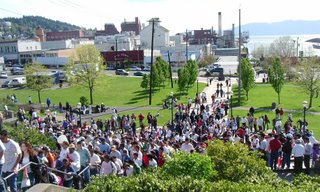
Crowd gathered to hear Bill Mckibben speak in Fairhaven's Village Green
 Concern about global warming from increasing use of fossil fuel including the burning of coal. Some of that coal is coming through Bellingham on it's way to Asian markets. More may be on it's way. McKibben was brought to Bellingham on May 31 to speak about the coal issue and global warming. See some of my thoughts on that topic.
Subscribe to:
Posts (Atom)