I am afraid that the reforms in the Soviet Union that lead to more openness could bring a similar story as the Weimar Republic, in Germany between the two world wars.
From what I gather, Germany's former enemies didn't respond that well to the country's struggles. There were some brief attempts at openness in Germany during that period, but the hardships are said to have fueled the rise of Adolph Hitler.
To some extent the western nations have fumbled the ball. There were attempts to try and help Russia and the former Soviet Republics, but also mistakes. Expansion of NATO was possibly a mistake.
Even breakup of Soviet Union was probably premature. I remember when Soviet leader Gorbachev was trying to reform the Soviet Union. He traveled to one of the Baltic Republics to try and convince them to stay in the union.
Not long after that, the union broke up with some increased economic turmoil. This can lead to the push for someone who can "get the trains running on time" again.

Friday, March 18, 2022

Thursday, March 17, 2022
To anxiety from the news. I try an steer my media diet toward analysis of various interesting topics, rather than day to day reporting.
Due to the distressing news that is bombarding us these days, my anxiety has been up and I haven't been sleeping as well. Probably something a lot of folks are experiencing.
So far, I feel mostly okay, in part, by using a strategy for absorbing media. I tend to avoid the painful pictures and stories of war and focus, instead, on issues of interest such as the effects on economics.
The internet helps a lot allowing me to navigate to what I need, so to speak. I try and keep my mind engaged with discussion while avoiding the more distressing and repetitive "news on the hour" type stuff.
I also like to discuss things with people, both in person and online.
My habit of falling asleep to NPR Radio (which runs the BBC at night) has had to change. Radio can be like white noise, or like being read a bed time story.
These days, the story can be more distressing so I am finding various talk shows, podcasts and lectures over the internet.
I am also on my bike a lot which is exercise. Good for reducing anxiety. Sometimes I forget to bring my phone with me.
When I do remember to bring my phone, which is most of the time, it doesn't seem to send me notifications or I don't bother checking them. I assume most of the notifications are either spam, or things I don't have to respond to right now.
So far, I feel mostly okay, in part, by using a strategy for absorbing media. I tend to avoid the painful pictures and stories of war and focus, instead, on issues of interest such as the effects on economics.
The internet helps a lot allowing me to navigate to what I need, so to speak. I try and keep my mind engaged with discussion while avoiding the more distressing and repetitive "news on the hour" type stuff.
I also like to discuss things with people, both in person and online.
My habit of falling asleep to NPR Radio (which runs the BBC at night) has had to change. Radio can be like white noise, or like being read a bed time story.
These days, the story can be more distressing so I am finding various talk shows, podcasts and lectures over the internet.
I am also on my bike a lot which is exercise. Good for reducing anxiety. Sometimes I forget to bring my phone with me.
When I do remember to bring my phone, which is most of the time, it doesn't seem to send me notifications or I don't bother checking them. I assume most of the notifications are either spam, or things I don't have to respond to right now.
Sunday, March 13, 2022
LGBTQ education in the schools
On a talk show some callers are in support of Florida's new law about early grade school. The new law is sometimes called the "don't say gay bill." The callers said early grades are too early to learn about certain things.
I realize that my first memory about gay and transgender topics was from early grade school. The learning didn't come from the teacher. It came from other kids. My classmates were not that accurate of a source for information. In most cases, I think the teacher would do a better job if allowed. If nothing else, at least respect for folks who are different from mainstream ought to be encouraged.
I realize that my first memory about gay and transgender topics was from early grade school. The learning didn't come from the teacher. It came from other kids. My classmates were not that accurate of a source for information. In most cases, I think the teacher would do a better job if allowed. If nothing else, at least respect for folks who are different from mainstream ought to be encouraged.
Friday, March 11, 2022
A lust for prosperity and consumption, but not the open minded society needed to make it all work and to make life worth living.
Patriarch Kirill, a leader of the Russian Orthodox Church says there's a metaphysical struggle against a godless international order which offers excess consumption and visible freedom to any nation that proves its loyalty by holding a gay parade.
Oh, the decadence, but it seems like the excess consumption part is something most of the rest of the world aspires to. Oligarchs from Russia to China to much of the Third World as well as USA, Europe and so forth.
Free thinking and gay parades is what matters most to me. Wealth is often just a byproduct of the freedom to be innovative. Without the freedom, one can be killing the goose that lays the golden egg; especially in an information, technological world.
Too much lust for wealth, without other innovation, can lead to environmental destruction. We need more innovation than just for wealth. I've noticed many parts of the world strive for wealth, but not necessarily for open and diversified society.
Oh, the decadence, but it seems like the excess consumption part is something most of the rest of the world aspires to. Oligarchs from Russia to China to much of the Third World as well as USA, Europe and so forth.
Free thinking and gay parades is what matters most to me. Wealth is often just a byproduct of the freedom to be innovative. Without the freedom, one can be killing the goose that lays the golden egg; especially in an information, technological world.
Too much lust for wealth, without other innovation, can lead to environmental destruction. We need more innovation than just for wealth. I've noticed many parts of the world strive for wealth, but not necessarily for open and diversified society.
Monday, March 07, 2022
Rare Earth metals from recycling old electronics.
A segment of March 5 2022 CBC science show "Quirks and Quarks" is about recycling rare earth metals. It was interesting. If you go to that link scroll down.
Rare earth's are important in electronics. China is a major supplier, but the US could produce more of it's own.
Apparently, when rare earths are mined, it also tends to bring up lots of radioactive elements, such as uranium. The US has such strict laws regarding disposal of radioactive waste that most of that mining isn't allowed. China has less concern about radioactive waste disposal so it's a major source of rare earth metals.
We could loosen those waste disposal rules, but there are some other workarounds, such as the main point in that segment of Quirks and Quarks. Recycling from sources of rare earth metals already on the surface. Electronic waste and other sources such as already existing coal fire powerplant fly ash waste.
The process involves quick heating up (to high temperatures) and then quick cooling the waste. After that, some other processes involving a wash with hydrochloric acid.
From childhood, I learned that hydrochloric acid is one of the main components of digestive juices in our stomachs. Stomach acid. It can also be manufactured artificially.
Rare earth's are important in electronics. China is a major supplier, but the US could produce more of it's own.
Apparently, when rare earths are mined, it also tends to bring up lots of radioactive elements, such as uranium. The US has such strict laws regarding disposal of radioactive waste that most of that mining isn't allowed. China has less concern about radioactive waste disposal so it's a major source of rare earth metals.
We could loosen those waste disposal rules, but there are some other workarounds, such as the main point in that segment of Quirks and Quarks. Recycling from sources of rare earth metals already on the surface. Electronic waste and other sources such as already existing coal fire powerplant fly ash waste.
The process involves quick heating up (to high temperatures) and then quick cooling the waste. After that, some other processes involving a wash with hydrochloric acid.
From childhood, I learned that hydrochloric acid is one of the main components of digestive juices in our stomachs. Stomach acid. It can also be manufactured artificially.
Europe's dependency on Russian energy, compared to US, not necessarily fault of greener society. US does have more oil and gas supplies, however.
Europe has been more dependent on natural gas and oil from Russia than USA. From what I hear around 1/3 of Europe's natural gas and 1/4th the oil that Europe uses.
In general Europe is better at conservation, alternative energy, city planning, transportation and so forth than USA. USA is less dependent on Russian supplies mostly because USA produces a lot more of it's own oil and gas than Europe.
Maybe that's the luck of geography. I wouldn't know. USA is a big oil and gas producer. Thankyou fracking, I guess, but also it could be the geology that happens to be underground in USA compared to Europe.
UK and Norway produce a lot from the North Sea.
My major, in college, was Geography. One of my favorite classes was Economic Geography.
In general Europe is better at conservation, alternative energy, city planning, transportation and so forth than USA. USA is less dependent on Russian supplies mostly because USA produces a lot more of it's own oil and gas than Europe.
Maybe that's the luck of geography. I wouldn't know. USA is a big oil and gas producer. Thankyou fracking, I guess, but also it could be the geology that happens to be underground in USA compared to Europe.
UK and Norway produce a lot from the North Sea.
My major, in college, was Geography. One of my favorite classes was Economic Geography.
The pottery barn rule should apply to Russia
The humanitarian safe passage corridors that Russia has proposed leading from Ukraine to Russia and Belarus makes me think of the famous "pottery barn rule" of "you break it, you own it."
One of the outcomes of this horrible invasion and war is the millions of refugees. Also the heavy damage that's caused. It has been thought that Russia would shirk responsibility and foist the cleanup onto the West. In reality, Russia should pay a heavy price for this. Ironically, refugee corridors, leading to Russia, makes me think of this even though most Ukrainian people would not want to flee to Russia.
One of the outcomes of this horrible invasion and war is the millions of refugees. Also the heavy damage that's caused. It has been thought that Russia would shirk responsibility and foist the cleanup onto the West. In reality, Russia should pay a heavy price for this. Ironically, refugee corridors, leading to Russia, makes me think of this even though most Ukrainian people would not want to flee to Russia.
Maybe I'm just passive versus being a true pacifist.
Should we (US & NATO) have a no fly zone and/or send troops into Ukraine to try and protect against the slaughter?
I don't have an answer to this. One thing I will say is that I am glad I don't have to make that decision.
Sometimes, I am almost envious of powerful politicians, like the US president, but they do face responsibilities I would not want to have.
I got to thinking that I tend to be "passive," but I am not necessarily a "pacifist." In my personal life, I try and find ways to function that avoids conflict. This usually works for me.
Avoiding things can also mean shirking out of responsibilities, not taking charge and possibly running away. For better, or worse, that does describe much of my style; to be perfectly honest.
I'm not necessarily a pacifist in theory as I think there are times, both in international politics as well as dealing with crime, where force is needed.
I just know that avoiding conflict has worked quite well in my own life.
I don't have an answer to this. One thing I will say is that I am glad I don't have to make that decision.
Sometimes, I am almost envious of powerful politicians, like the US president, but they do face responsibilities I would not want to have.
I got to thinking that I tend to be "passive," but I am not necessarily a "pacifist." In my personal life, I try and find ways to function that avoids conflict. This usually works for me.
Avoiding things can also mean shirking out of responsibilities, not taking charge and possibly running away. For better, or worse, that does describe much of my style; to be perfectly honest.
I'm not necessarily a pacifist in theory as I think there are times, both in international politics as well as dealing with crime, where force is needed.
I just know that avoiding conflict has worked quite well in my own life.
Saturday, March 05, 2022
Confronting evil head on, or maybe another strategy can work instead?
Ukrainian President Zelenskyy can certainly be admired for his courage and honesty. On the other hand one might question the strategy of confronting evil head on. Unfortunately, it looks like Russia's military has such an advantage over Ukrainian forces that Russia's short term victory seems inevitable.
Another story in the long run, however. The Ukrainians can mount an insurgency making conquest a nightmare for Russia. Civil disobedience is one of many tools that can be used.
Russia's occupation of Afghanistan did not go well for Russia, in the long run. The powerful US military has learned lessons from attempts to "nation build" in Iraq and Afghanistan.
I am remembering the famous saying during a speech, on the aircraft carrier by former US President George W Bush. "Mission accomplished."
Those were famous last words as we have now withdrawn from both Iraq and Afghanistan.
Western economic sanctions can remain in place, though there is the worry that complacency will set in with vigilance lost in the name of easing economic hardship. I would hope for sure the sanctions would remain strong along with aid for Ukraine.
On a personal note, bravery and direct confrontation are not my strong suites, but I do try and find a way to not totally give-in to the "system."
Some people might think I tend to be acquiescent toward authorities, corporations and governments. I fear being a troublemaker, but I do tend to chart a different course than the mainstream.
I feel fortunate to have been able to do this in USA. Other parts of the world have different circumstances, but I offer these ideas for thought.
In all of this, I have to admit I have no idea what the best strategy is. I'm basically just looking for a silver lining. Given the darkness and what seems like likely defeat, in the short run, I keep hoping democracy and human dignity can still find ways to prevail.
Another story in the long run, however. The Ukrainians can mount an insurgency making conquest a nightmare for Russia. Civil disobedience is one of many tools that can be used.
Russia's occupation of Afghanistan did not go well for Russia, in the long run. The powerful US military has learned lessons from attempts to "nation build" in Iraq and Afghanistan.
I am remembering the famous saying during a speech, on the aircraft carrier by former US President George W Bush. "Mission accomplished."
Those were famous last words as we have now withdrawn from both Iraq and Afghanistan.
Western economic sanctions can remain in place, though there is the worry that complacency will set in with vigilance lost in the name of easing economic hardship. I would hope for sure the sanctions would remain strong along with aid for Ukraine.
On a personal note, bravery and direct confrontation are not my strong suites, but I do try and find a way to not totally give-in to the "system."
Some people might think I tend to be acquiescent toward authorities, corporations and governments. I fear being a troublemaker, but I do tend to chart a different course than the mainstream.
I feel fortunate to have been able to do this in USA. Other parts of the world have different circumstances, but I offer these ideas for thought.
In all of this, I have to admit I have no idea what the best strategy is. I'm basically just looking for a silver lining. Given the darkness and what seems like likely defeat, in the short run, I keep hoping democracy and human dignity can still find ways to prevail.
Friday, March 04, 2022
Should we bring back gasoline rationing?
Given inflation in gas prices, I've seen the idea of gas rationing being floated again. I remember the days of gas rationing in the 1970s. There was even price and wage controls tried back then; under President Nixon; a Republican! Imagine that.
Those ideas have lost popularity, but could be worth reconsidering as a more fair way to allocate limited resources than just having them go to the highest bidder. Before my time, there was rationing during World War II.
Rationing fell out of favor as free market advocates argued that more oil could be produced if the price was allowed to rise. Rising prices would lead to more drilling, fracking and other innovations in oil production.
That idea worked, to some extent, as supply increased and the price of oil went down relative to overall inflation.
Besides the war, now we face a different problem. Not so much supply and demand, but global warming. We still have lots of oil shale, tar sands and coal that can even be gasified, but now we face an atmosphere that is warming.
The atmosphere doesn't give us an upfront cost, like an oil well that goes dry. Carbon can be dumped into the atmosphere at little cost, but the long term cost is devastating.
Maybe the concept of creating an artificial cost; such as a carbon tax, or rationing is needed.
Ideas, like rationing, do crimp freedom and prosperity so that is part of the reason why they have fallen from favor. It's the god of prosperity.
We may have become slaves to the god of prosperity.
I'm remembering the 1970s with some nostalgia. Not just the music and my days at Western Washington University's Gay People's Alliance. I was younger back then, but in many ways, my life and my health hasn't changed much since then. I sometimes feel like a Peter Pan.
I'm still remembering the pre Ronald Reagan times with some nostalgia. Back then, I thought we were running out of oil. The idea of rising prices bringing more supply had not entered my mind, that much, during the days when President Carter was in the White House.
It seemed like the solar panels and bicycles being demonstrated at a solar energy fair were the wave of the future. Carter was on board with his famous call for wearing Cardigan Sweaters; rather than turning up the thermostat.
A time of idealism versus realism, but there was also the "Carter Synfuel Program." I think, Synfuel was getting more of the lion's share of Federal money, versus a few solar panels. Synfuels were seen as a road to American Energy independence.
Back then, it was thought that oil shale had to be mined, brought to the surface and cooked in ovens to get out the oil. Prices would have to rise.
Then innovators came up with the invention of sideways drilling where the shale could be fracked in the ground for less bother. Oil drips out, via gravity, to sideways pipes under the shale; like collecting water in drain tile.
The free market economists held sway as oil production rose again.
Those ideas have lost popularity, but could be worth reconsidering as a more fair way to allocate limited resources than just having them go to the highest bidder. Before my time, there was rationing during World War II.
Rationing fell out of favor as free market advocates argued that more oil could be produced if the price was allowed to rise. Rising prices would lead to more drilling, fracking and other innovations in oil production.
That idea worked, to some extent, as supply increased and the price of oil went down relative to overall inflation.
Besides the war, now we face a different problem. Not so much supply and demand, but global warming. We still have lots of oil shale, tar sands and coal that can even be gasified, but now we face an atmosphere that is warming.
The atmosphere doesn't give us an upfront cost, like an oil well that goes dry. Carbon can be dumped into the atmosphere at little cost, but the long term cost is devastating.
Maybe the concept of creating an artificial cost; such as a carbon tax, or rationing is needed.
Ideas, like rationing, do crimp freedom and prosperity so that is part of the reason why they have fallen from favor. It's the god of prosperity.
We may have become slaves to the god of prosperity.
I'm remembering the 1970s with some nostalgia. Not just the music and my days at Western Washington University's Gay People's Alliance. I was younger back then, but in many ways, my life and my health hasn't changed much since then. I sometimes feel like a Peter Pan.
I'm still remembering the pre Ronald Reagan times with some nostalgia. Back then, I thought we were running out of oil. The idea of rising prices bringing more supply had not entered my mind, that much, during the days when President Carter was in the White House.
It seemed like the solar panels and bicycles being demonstrated at a solar energy fair were the wave of the future. Carter was on board with his famous call for wearing Cardigan Sweaters; rather than turning up the thermostat.
A time of idealism versus realism, but there was also the "Carter Synfuel Program." I think, Synfuel was getting more of the lion's share of Federal money, versus a few solar panels. Synfuels were seen as a road to American Energy independence.
Back then, it was thought that oil shale had to be mined, brought to the surface and cooked in ovens to get out the oil. Prices would have to rise.
Then innovators came up with the invention of sideways drilling where the shale could be fracked in the ground for less bother. Oil drips out, via gravity, to sideways pipes under the shale; like collecting water in drain tile.
The free market economists held sway as oil production rose again.
Wednesday, March 02, 2022
My thoughts after Joe Biden's first state of the union speech
I listened to Biden's state of the union address last night. Some good points and some obvious omissions. It was good to hear him cheer on Ukraine and criticize the wealthy Russian oligarchs. This brought applause from both sides of the aisle.
Missing from the speech was much mention of climate change. That is an inconvenient truth. Al Gore's film, An Inconvenient Truth was well named. Too much discussion of that wouldn't play well as the president uses the speech, in part, to bolster his sagging poll numbers.
On climate change, he has put much of his eggs in the basket of the "Build Back Better" legislation now stuck in Congress.
I'm still voting for Democrats, however.
Climate change needs to be dealt with by the people. It's not something politicians can take a real bold lead on if they fear being voted out. I hope Democrats can weather the inevitable storm of rising gas prices.
As for rallying people against oligarchs, that plays well politically. The obvious problems of putting greed ahead of human dignity. I'm onboard with that.
I remember a conversation, I had a few years back, with someone who had recently lived in New York City. He said, of the housing market, "one is competing with Russian oligarchs and others in the mix as everything is bid up and up in price."
I gather that this is a big problem in major cities around the world; for instance London, UK. Investment money flooding in buying up homes and condos; in some cases just holding the homes empty as a way to "park" money. Money from Russian Oligarchs and others. Vancouver, BC has the problem and now has something called "the empty condos tax" to try and discourage that.
Wealth can often be the enemy of a reasonable community. It can be a stumbling block on the path of a more sustainable climate; for instance pricing people out of cities and into the longer commute radius from work.
Wealth can also be a friend if it is applied to innovations for reducing carbon footprint. Technological innovations as well as helping people live more sustainably. These days, a lot of people need to have things subsidized for life to work. If one isn't wealthy, one is likely to need subsidized housing, public transit, childcare, healthcare and so forth.
It's almost like most people need charity, or government spending, to survive in the shark tank. The world has become, too much, like the shark tank.
Missing from the speech was much mention of climate change. That is an inconvenient truth. Al Gore's film, An Inconvenient Truth was well named. Too much discussion of that wouldn't play well as the president uses the speech, in part, to bolster his sagging poll numbers.
On climate change, he has put much of his eggs in the basket of the "Build Back Better" legislation now stuck in Congress.
I'm still voting for Democrats, however.
Climate change needs to be dealt with by the people. It's not something politicians can take a real bold lead on if they fear being voted out. I hope Democrats can weather the inevitable storm of rising gas prices.
As for rallying people against oligarchs, that plays well politically. The obvious problems of putting greed ahead of human dignity. I'm onboard with that.
I remember a conversation, I had a few years back, with someone who had recently lived in New York City. He said, of the housing market, "one is competing with Russian oligarchs and others in the mix as everything is bid up and up in price."
I gather that this is a big problem in major cities around the world; for instance London, UK. Investment money flooding in buying up homes and condos; in some cases just holding the homes empty as a way to "park" money. Money from Russian Oligarchs and others. Vancouver, BC has the problem and now has something called "the empty condos tax" to try and discourage that.
Wealth can often be the enemy of a reasonable community. It can be a stumbling block on the path of a more sustainable climate; for instance pricing people out of cities and into the longer commute radius from work.
Wealth can also be a friend if it is applied to innovations for reducing carbon footprint. Technological innovations as well as helping people live more sustainably. These days, a lot of people need to have things subsidized for life to work. If one isn't wealthy, one is likely to need subsidized housing, public transit, childcare, healthcare and so forth.
It's almost like most people need charity, or government spending, to survive in the shark tank. The world has become, too much, like the shark tank.
Tuesday, March 01, 2022
The arbitrary "truths" of religion are not convincing.
I recently had a conversation with a friend who has studied various religions. As he has learned more about religion, he has become less convinced that there is any validity to religion at all.
Yes, it does seem like religions bring a grab bag of beliefs. Arbitrary creation stories, the so called truths of astrology and so forth.
My own thinking and background is more from science than the humanities, I guess. Ironically, I still hold some hope for a larger reality beyond what we see. This might be partially because science doesn't make claims about that "beyond." Basically, scientists tend to just admit that there is always more to learn.
To me, it seems like the mystery of not knowing is more comforting than a grab bag of what seems to be bogus answers.
Yes, it does seem like religions bring a grab bag of beliefs. Arbitrary creation stories, the so called truths of astrology and so forth.
My own thinking and background is more from science than the humanities, I guess. Ironically, I still hold some hope for a larger reality beyond what we see. This might be partially because science doesn't make claims about that "beyond." Basically, scientists tend to just admit that there is always more to learn.
To me, it seems like the mystery of not knowing is more comforting than a grab bag of what seems to be bogus answers.
Wednesday, February 23, 2022
The Russia situation is another reason why it's better to curb fossil fuel consumption than just trying to curb US fossil fuel production
I often think that it's better to curb fossil fuel demand than restrict fossil fuel production in our attempts to stop climate change. Rather than stopping wells or a pipeline, try and reduce traffic.
Now that Russia is misbehaving, much of the west's oil consumption is still dependent on Russia. Maybe we should ramp up our oil and gas production. If we had extra, we could sell it to Europe. That ramp up in production wouldn't necessarily mean more worldwide carbon emissions if it met far less oil production in Russia.
Now that Russia is misbehaving, much of the west's oil consumption is still dependent on Russia. Maybe we should ramp up our oil and gas production. If we had extra, we could sell it to Europe. That ramp up in production wouldn't necessarily mean more worldwide carbon emissions if it met far less oil production in Russia.
Thursday, February 17, 2022
As interest rates rise, could the federal government "lock in" low interest on it's 30 trillion dollars of past debt?
Interest rates need to rise to cool the inflating asset and housing markets. Problem is, it could make the 30 trillion dollar federal debt more expensive to maintain. The government might need to cut back on needed services as it's interest bill on the debt goes up.
Maybe they should allow the government to "lock in" it's low interest rates on past debt the way a lot of homeowners are allowed to do. If interest rates were low, when the debt was incurred, that rate can be "locked in" permanently. Use new money from Federal Reserve to allow the government to lock in low interest on, at least, past debt.
Maybe they should allow the government to "lock in" it's low interest rates on past debt the way a lot of homeowners are allowed to do. If interest rates were low, when the debt was incurred, that rate can be "locked in" permanently. Use new money from Federal Reserve to allow the government to lock in low interest on, at least, past debt.
Is the Consumer Price Index a truly accurate measure of inflation?
I have often thought that the inflation rate; specifically the Consumer Price Index, has been under estimated for several decades. Now, I hear some economists in the media saying the same thing.
Official inflation indexes have not adequately factored in the cost of housing in the overall mix. If housing were weighted more accurately, inflation would have been higher over the last 30, or so, years.
I would think the inflation, that we have now, is not as shocking as some folks think since, in a way, it's nothing new.
How data is figured depends, a lot, on who's doing the figuring. For instance; if the standard household was a large family who had already paid off most of their mortgage, the price of groceries would weigh higher. More mouths to feed and the house already almost fully purchased.
On the other hand, a single person just starting out buying a house today, or renting an apartment, would encounter a totally different situation. Grocery prices might not be that big a deal compared to rising rent. The nature of inflation largely depends on what type of household is being considered.
Official inflation indexes have not adequately factored in the cost of housing in the overall mix. If housing were weighted more accurately, inflation would have been higher over the last 30, or so, years.
I would think the inflation, that we have now, is not as shocking as some folks think since, in a way, it's nothing new.
How data is figured depends, a lot, on who's doing the figuring. For instance; if the standard household was a large family who had already paid off most of their mortgage, the price of groceries would weigh higher. More mouths to feed and the house already almost fully purchased.
On the other hand, a single person just starting out buying a house today, or renting an apartment, would encounter a totally different situation. Grocery prices might not be that big a deal compared to rising rent. The nature of inflation largely depends on what type of household is being considered.
Falsely low inflation rate, over the past 25, or so years, has allowed mostly Republican administrations to get by with big federal deficits
Over the past 25, or so years, it seems like the official Consumer Price Index has underestimated the cost of housing in the overall mix of inflation.
This falsely low inflation figure allowed more reckless spending, over those years. Large Republican based tax cuts, increases in military spending and the two wars in Afghanistan and Iraq. Much of this during Republican administrations; such as George Bush II and Donald Trump. Since inflation wasn't, supposedly, a problem the tax cuts and spending could go on without media noticing the consequences. High government debt less consequential, due to expanded money supply.
The consequences were things like housing costs going up, not noticed in the official numbers. Former presidents, especially Republicans, got off easy.
This falsely low inflation figure allowed more reckless spending, over those years. Large Republican based tax cuts, increases in military spending and the two wars in Afghanistan and Iraq. Much of this during Republican administrations; such as George Bush II and Donald Trump. Since inflation wasn't, supposedly, a problem the tax cuts and spending could go on without media noticing the consequences. High government debt less consequential, due to expanded money supply.
The consequences were things like housing costs going up, not noticed in the official numbers. Former presidents, especially Republicans, got off easy.
Tuesday, February 15, 2022
It wasn't that long ago there were uprisings in Belarus & Kazakhstan. Now silenced. Maybe that's why Russia feels threatened by Ukraine?
Not that long before the current Russia / Ukraine crisis, there was lots of news; especially on BBC, about human rights protests in Belarus. Belarus's dictator is friendly with Russia's Putin, but people were rising up for weeks. Then it seems like that uprising was crushed and has dropped out of the news.
A similar uprising was put down in Kazakhstan. Both former Soviet Republics. It's said that Putin fears encroachment of the west and restive populations in areas that were given up by the Russians when the Soviet Union dissolved.
What can we do about this? I don't know.
It seems like sending US troops to eastern NATO countries doesn't really help Ukraine since they say they will not enter Ukraine. They are just there to protect former eastern block countries that are now part of NATO; like Poland. They are there to protect the former Soviet Republics that, unlike Ukraine, are in NATO as well; Lithuania, Latvia and Estonia.
I doubt Russia would be a threat to those places, at least in the short run. If Russia does invade Ukraine, it will have a lot on the plate. A lot to digest so I doubt it would turn to other places; such as Estonia, for quite some time. Troops may not be the best answer as troops tend to respond to short term things.
As for arming Ukraine, itself, that might be an okay strategy, but it did kind of backfire on the US, over the long run; in Afghanistan. When we backed Afghanistan's militias, after the Soviets invaded Afghanistan in 1979, it was said to push the Soviets out, but later some of those militias turned against us contributing to the 911 attacks.
Economic sanctions are discussed as well, but could be hard to make stick with Europe still quite dependent on oil and natural gas from Russia.
Meanwhile both US and Russian scientists are still cooperating on the International Space Station and in various other research projects including vessels at sea. I note that scientists often cooperate when politicians can't.
I don't have a clear answer, but these are things to think about.
A similar uprising was put down in Kazakhstan. Both former Soviet Republics. It's said that Putin fears encroachment of the west and restive populations in areas that were given up by the Russians when the Soviet Union dissolved.
What can we do about this? I don't know.
It seems like sending US troops to eastern NATO countries doesn't really help Ukraine since they say they will not enter Ukraine. They are just there to protect former eastern block countries that are now part of NATO; like Poland. They are there to protect the former Soviet Republics that, unlike Ukraine, are in NATO as well; Lithuania, Latvia and Estonia.
I doubt Russia would be a threat to those places, at least in the short run. If Russia does invade Ukraine, it will have a lot on the plate. A lot to digest so I doubt it would turn to other places; such as Estonia, for quite some time. Troops may not be the best answer as troops tend to respond to short term things.
As for arming Ukraine, itself, that might be an okay strategy, but it did kind of backfire on the US, over the long run; in Afghanistan. When we backed Afghanistan's militias, after the Soviets invaded Afghanistan in 1979, it was said to push the Soviets out, but later some of those militias turned against us contributing to the 911 attacks.
Economic sanctions are discussed as well, but could be hard to make stick with Europe still quite dependent on oil and natural gas from Russia.
Meanwhile both US and Russian scientists are still cooperating on the International Space Station and in various other research projects including vessels at sea. I note that scientists often cooperate when politicians can't.
I don't have a clear answer, but these are things to think about.
Monday, February 14, 2022
The universe may have not started from something small; like an atom. Maybe it started from something bigger?
As I was riding around town, I came up with an idea about the big bang. Yes, the big bang that is said to have created the universe; no less.
Astronomers might dispute my intuitive hunch and they are free to respond, if any of them are reading this.
Most astronomers seem to think the universe started as an infinitely (or near infinitely) dense. tiny speck. All the universe crammed into a little speck that has since been expanding to the present universe.
I thought, maybe it wasn't just a speck. How about something larger that's still at the very start of space and time? Something larger that still popped into existence. Space still expanded and time started with the universe as lots of astronomers think, but the start was bigger than a speck.
It still came from "who knows," but at the start, it was just something larger than a tiny speck. This would eliminate the need to invoke infinity, or near infinite density; a troublesome concept.
Astronomers have, basically, had to patch up the concept of the universe starting as a speck. That patch is called "inflation theory." One of our most important forms of evidence, about the big bang, is the cosmic background radiation. Microwave radiation that permeates the universe. It's said to originate from the primordial fireball (for lack of a better term). Detecting that background radiation is like measuring the heat from that fireball when it was around 300,000 years after the very start. By then, the universe is said to be many lightyears across.
Astronomers scratch their heads wondering how that fireball, which by then was many lightyears across, could remain so consistent in character. It's nature, temperature and so forth is pretty consistent in every direction. This is measured by looking at the microwave background radiation across the entire sky.
I think our best satellite, that takes the temperature of this radiation, is the European Space Agency's Plank Satellite. It measures only very slight differences, across the sky, in the temperature of this radiation.
Such consistency, supposedly, cannot happen across many light years so that is one reason why they say that the very start had to be a smaller speck.
To solve this problem, they came up with "inflation theory." The universe started as a speck and then bounded out faster than the speed of light during an early period of inflation that may have only lasted mere seconds.
Yes, they say the universe, itself (space and time) can travel faster than light, but things inside the universe cannot travel faster than light. The universe, itself, can break it's own rules.
Well, I just got to thinking, maybe the universe started as a larger space. A giant neutron star, for instance. It didn't need to have inflation. It just popped into existence as a larger object that was still consistent in temperature. Consistant from some unknown reason still not explained. Rather than Inflation Theory, some other mechanism could have led to consistency of temperature across a larger object that was the start of the universe.
Who knows, I am sure astronomers would poke plenty of holes in my speculation, if any of them were reading this.
Now I am remembering that I may have seen this idea somewhere in the science media so it's not necessarily my idea.
Here is a similar idea I remember hearing for sure.
Maybe the center of a blackhole is not a singularity of infinite density. Some scientists have said that center was infinite density (a singularity) just because we know of no force strong enough to push back and counteract gravity in that situation. The math just goes toward infinity then.
On the other hand, I've heard some scientists say that maybe there is something that does provide the "pushback" preventing the blackhole from going all the way to a singularity.
A reason why they say this might be true is that something "pushed" the universe, itself, out to the original big bang to begin with. It pushed the universe out in spite of great density at that time. Maybe that same thing is providing the "push" to keep a blackhole in equilibrium. Maybe at the center of a blackhole, there is a sphere of some kind; like a slightly smaller version of a neutron star.
This, I didn't make up. I read, or heard, it somewhere.
Astronomers might dispute my intuitive hunch and they are free to respond, if any of them are reading this.
Most astronomers seem to think the universe started as an infinitely (or near infinitely) dense. tiny speck. All the universe crammed into a little speck that has since been expanding to the present universe.
I thought, maybe it wasn't just a speck. How about something larger that's still at the very start of space and time? Something larger that still popped into existence. Space still expanded and time started with the universe as lots of astronomers think, but the start was bigger than a speck.
It still came from "who knows," but at the start, it was just something larger than a tiny speck. This would eliminate the need to invoke infinity, or near infinite density; a troublesome concept.
Astronomers have, basically, had to patch up the concept of the universe starting as a speck. That patch is called "inflation theory." One of our most important forms of evidence, about the big bang, is the cosmic background radiation. Microwave radiation that permeates the universe. It's said to originate from the primordial fireball (for lack of a better term). Detecting that background radiation is like measuring the heat from that fireball when it was around 300,000 years after the very start. By then, the universe is said to be many lightyears across.
Astronomers scratch their heads wondering how that fireball, which by then was many lightyears across, could remain so consistent in character. It's nature, temperature and so forth is pretty consistent in every direction. This is measured by looking at the microwave background radiation across the entire sky.
I think our best satellite, that takes the temperature of this radiation, is the European Space Agency's Plank Satellite. It measures only very slight differences, across the sky, in the temperature of this radiation.
Such consistency, supposedly, cannot happen across many light years so that is one reason why they say that the very start had to be a smaller speck.
To solve this problem, they came up with "inflation theory." The universe started as a speck and then bounded out faster than the speed of light during an early period of inflation that may have only lasted mere seconds.
Yes, they say the universe, itself (space and time) can travel faster than light, but things inside the universe cannot travel faster than light. The universe, itself, can break it's own rules.
Well, I just got to thinking, maybe the universe started as a larger space. A giant neutron star, for instance. It didn't need to have inflation. It just popped into existence as a larger object that was still consistent in temperature. Consistant from some unknown reason still not explained. Rather than Inflation Theory, some other mechanism could have led to consistency of temperature across a larger object that was the start of the universe.
Who knows, I am sure astronomers would poke plenty of holes in my speculation, if any of them were reading this.
Now I am remembering that I may have seen this idea somewhere in the science media so it's not necessarily my idea.
Here is a similar idea I remember hearing for sure.
Maybe the center of a blackhole is not a singularity of infinite density. Some scientists have said that center was infinite density (a singularity) just because we know of no force strong enough to push back and counteract gravity in that situation. The math just goes toward infinity then.
On the other hand, I've heard some scientists say that maybe there is something that does provide the "pushback" preventing the blackhole from going all the way to a singularity.
A reason why they say this might be true is that something "pushed" the universe, itself, out to the original big bang to begin with. It pushed the universe out in spite of great density at that time. Maybe that same thing is providing the "push" to keep a blackhole in equilibrium. Maybe at the center of a blackhole, there is a sphere of some kind; like a slightly smaller version of a neutron star.
This, I didn't make up. I read, or heard, it somewhere.
Thursday, February 10, 2022
We may need non tangible concepts, like Karma, to motivate us toward better behavior. The tangible payoffs, we get, are not sufficient.
It seems obvious that fundamentalism and too much certainty, in religion, causes great social harm.
On the other hand, it does seem like some metaphysical ideas are needed for a more just society. A vague concept, like Karma, seems to provide more motivation for doing good. Without something like Karma, we are just relying on the feedback from a purely physical world for motivation. Just the payment, or "payback" from the material world isn't enough.
When I talk about Karma, I'm thinking about more universal concepts of morality that invoke metaphysical ideas, not necessarily just Karma itself. I'm mentioning Karma as just a metaphysical feedback system that's somewhat easy to understand.
Without some kind of metaphysical like concepts, the other feedback loops, that come from society and even nature, don't seem to be sufficient. We have the economy which doesn't always reward what is usually thought of as virtue. Often the economy rewards the opposite of virtue.
Another feedback loop is the idea of "what goes around, comes around." Being nice to others usually means they are nicer to you. Basically what we often call "The Golden Rule."
Another virtuous feedback loop is our own health. Healthy living usually enhances health, but that alone doesn't seem to be a powerful enough feedback loop. Not powerful enough, in most people, to overcome the allure of junk food or sedentary lifestyles.
Another non metaphysical feedback loop is the good feeling we get if we know we have helped another person. As for that good feeling, there is some recent science that leans toward explaining it in terms of mirror neurons.
Yes, there are said to be special neurons that bring us empathy. They tend to react to feelings we see in other people. Mirror neurons may have evolved to enhance our survival as they help us function as a social species.
Still, even with our mirror neurons and all the other material feedback loops such as economics, it seems like all of this isn't enough.
I'd think we need yet another "bank account" like concept. A concept such as Karma or other metaphysical ideas to push us over the top toward a more virtuous society.
Karma, or something like the Golden Rule, can provide payback in a secret way. It doesn't even have to wait till an afterlife, it can pay us back in this life. Clean up some litter and good fortune may come your way. It's kind of a loose promise.
In our material society, we have invented various versions of Karma that are more defined. For instance credit scores. There are various theoretical "bank accounts," we create, to try and incentivize useful behavior. Prison can do that as a disincentive for bad behavior.
In China, I hear they are developing a very elaborate system of crediting social good. Beyond just one's financial credit score, everything is watched. Help someone across the street or clean up the park and one gets brownie points. Buck the established system and one gets demerits.
China may be turning into the ultimate "surveillance state."
Personally, I would prefer a less artificial surveillance state, like a vague concept of Karma. If the universe is watching us, it's probably a bit less rigid than the feeling that the government is watching.
It isn't even known, for sure, that the universe is watching, so that may be what gives the concept of Karma more wiggle room.
As for mirror neurons, it reminds me of hearing about "field effect transistors" during my childhood. I often thought of neurons as the "transistors" of our brains.
Back during high school, I got a fancy radio that had a few "field effect" transistors among it's many transistors. That was something quite special, but I never quite figured out what made them so special. My thought, back then, was that field effect transistors helped with sensitivity to faint radio signals.
Might be related. Our empathy and sensitivity; the result of mirror neurons?
It does, though, seem like just these material things don't quite give us enough push toward a more virtuous society. Metephysical concepts; especially from liberal, open minded religions, seem to be important motivations for a virtuous society.
This concept in on of my articles in the Betty Pages.
On the other hand, it does seem like some metaphysical ideas are needed for a more just society. A vague concept, like Karma, seems to provide more motivation for doing good. Without something like Karma, we are just relying on the feedback from a purely physical world for motivation. Just the payment, or "payback" from the material world isn't enough.
When I talk about Karma, I'm thinking about more universal concepts of morality that invoke metaphysical ideas, not necessarily just Karma itself. I'm mentioning Karma as just a metaphysical feedback system that's somewhat easy to understand.
Without some kind of metaphysical like concepts, the other feedback loops, that come from society and even nature, don't seem to be sufficient. We have the economy which doesn't always reward what is usually thought of as virtue. Often the economy rewards the opposite of virtue.
Another feedback loop is the idea of "what goes around, comes around." Being nice to others usually means they are nicer to you. Basically what we often call "The Golden Rule."
Another virtuous feedback loop is our own health. Healthy living usually enhances health, but that alone doesn't seem to be a powerful enough feedback loop. Not powerful enough, in most people, to overcome the allure of junk food or sedentary lifestyles.
Another non metaphysical feedback loop is the good feeling we get if we know we have helped another person. As for that good feeling, there is some recent science that leans toward explaining it in terms of mirror neurons.
Yes, there are said to be special neurons that bring us empathy. They tend to react to feelings we see in other people. Mirror neurons may have evolved to enhance our survival as they help us function as a social species.
Still, even with our mirror neurons and all the other material feedback loops such as economics, it seems like all of this isn't enough.
I'd think we need yet another "bank account" like concept. A concept such as Karma or other metaphysical ideas to push us over the top toward a more virtuous society.
Karma, or something like the Golden Rule, can provide payback in a secret way. It doesn't even have to wait till an afterlife, it can pay us back in this life. Clean up some litter and good fortune may come your way. It's kind of a loose promise.
In our material society, we have invented various versions of Karma that are more defined. For instance credit scores. There are various theoretical "bank accounts," we create, to try and incentivize useful behavior. Prison can do that as a disincentive for bad behavior.
In China, I hear they are developing a very elaborate system of crediting social good. Beyond just one's financial credit score, everything is watched. Help someone across the street or clean up the park and one gets brownie points. Buck the established system and one gets demerits.
China may be turning into the ultimate "surveillance state."
Personally, I would prefer a less artificial surveillance state, like a vague concept of Karma. If the universe is watching us, it's probably a bit less rigid than the feeling that the government is watching.
It isn't even known, for sure, that the universe is watching, so that may be what gives the concept of Karma more wiggle room.
As for mirror neurons, it reminds me of hearing about "field effect transistors" during my childhood. I often thought of neurons as the "transistors" of our brains.
Back during high school, I got a fancy radio that had a few "field effect" transistors among it's many transistors. That was something quite special, but I never quite figured out what made them so special. My thought, back then, was that field effect transistors helped with sensitivity to faint radio signals.
Might be related. Our empathy and sensitivity; the result of mirror neurons?
It does, though, seem like just these material things don't quite give us enough push toward a more virtuous society. Metephysical concepts; especially from liberal, open minded religions, seem to be important motivations for a virtuous society.
This concept in on of my articles in the Betty Pages.
Friday, February 04, 2022
Long term memory: more robust in old age than short term, yet evolution has had more time to perfect short term.
I've noticed lots of deer like to hang out in a vacant lot below my window. Simple pleasures; like apples on the ground from an abandoned apple tree.
It's a private lot, still vacant in Bellingham's hot market. Must be a story there, but I don't know that story.
My mind (thinking of big, distance issues like that instead of just apples) wonders how boring it might be to be a deer. Boring, compared to being a human.
Just finding enough to eat might be enough, but not for us. One wonders, what do deer think about all day?
Then I remember that most animals don't really have long term memory; so at least I hear. Maybe some, like elephants, do, but that's another story.
Long term memory gives us more ability to contemplate complex and distant subjects; like economics. Other animals seem more in the moment; like "Mindfulness," I guess.
I've never been that much a fan of mindfulness. To me, it seems like day to day things are not that interesting, compared to the larger issues.
Then I got to thinking about this. As humans age, it is said that short term memory is usually the first to go. Long term memory lasts longer.
Nature has a lot more practice with short term memory in so many species and not as much practice with long term memory, but seems like the long term memory is more lasting in us.
Interesting difference.
For some reason, it seems like nature has figured out how to make long term memory more robust, in us, than short term memory. In just about all other animals, it seems the opposite.
Hurray for our long term memory and big thoughts. In us, at least, it is the most robust part of our memory. No wonder a lot of older people like to tell lots of stories.
Then we also have the ability to write things down, but even without that, our long term memory seems to work better than our short term memory as time goes on.
One possible sidebar to mindfulness could also be accepting one's life as it is. I don't even know if that is a tenant of mindfulness, or not, but it works for me.
Accepting life as it comes is something I strive for. I don't always feel it, but I do strive for that. Accepting life as it is makes us less demanding for something more, I guess.
We often compare ourselves to others, or to perceived messages in society about better careers, relationships, financial status and so forth.
Accepting life may make us less ambitious and less troublesome, but it's easier, at least.
For the most part, it seems to make us happier. I think it's all part of the balance.
Again, aside from accepting life for what it is, I am intrigued by the bias our human memory system seems to give to big ideas, or at least to long term memories.
It's interesting that nature has figured out how to make that work in us, while long term memory seems to be rare among species. Nature hasn't had that much evolutionary practice in making long term memory work, but in us, it's the most robust part of memory; from what I understand.
With short term memory, a memory doesn't have to last as long as with long term memory. It just has to last long enough to get the job done; like after opening the cupboard door, remembering which item to grab.
As we age, even that gets less functional, so I hear, but the long term memories, like from our childhoods, remain accessible. That seems like a unique thing, given the amount of time nature has had, in other species, to practice getting short term memory to work.
It's a private lot, still vacant in Bellingham's hot market. Must be a story there, but I don't know that story.
My mind (thinking of big, distance issues like that instead of just apples) wonders how boring it might be to be a deer. Boring, compared to being a human.
Just finding enough to eat might be enough, but not for us. One wonders, what do deer think about all day?
Then I remember that most animals don't really have long term memory; so at least I hear. Maybe some, like elephants, do, but that's another story.
Long term memory gives us more ability to contemplate complex and distant subjects; like economics. Other animals seem more in the moment; like "Mindfulness," I guess.
I've never been that much a fan of mindfulness. To me, it seems like day to day things are not that interesting, compared to the larger issues.
Then I got to thinking about this. As humans age, it is said that short term memory is usually the first to go. Long term memory lasts longer.
Nature has a lot more practice with short term memory in so many species and not as much practice with long term memory, but seems like the long term memory is more lasting in us.
Interesting difference.
For some reason, it seems like nature has figured out how to make long term memory more robust, in us, than short term memory. In just about all other animals, it seems the opposite.
Hurray for our long term memory and big thoughts. In us, at least, it is the most robust part of our memory. No wonder a lot of older people like to tell lots of stories.
Then we also have the ability to write things down, but even without that, our long term memory seems to work better than our short term memory as time goes on.
One possible sidebar to mindfulness could also be accepting one's life as it is. I don't even know if that is a tenant of mindfulness, or not, but it works for me.
Accepting life as it comes is something I strive for. I don't always feel it, but I do strive for that. Accepting life as it is makes us less demanding for something more, I guess.
We often compare ourselves to others, or to perceived messages in society about better careers, relationships, financial status and so forth.
Accepting life may make us less ambitious and less troublesome, but it's easier, at least.
For the most part, it seems to make us happier. I think it's all part of the balance.
Again, aside from accepting life for what it is, I am intrigued by the bias our human memory system seems to give to big ideas, or at least to long term memories.
It's interesting that nature has figured out how to make that work in us, while long term memory seems to be rare among species. Nature hasn't had that much evolutionary practice in making long term memory work, but in us, it's the most robust part of memory; from what I understand.
With short term memory, a memory doesn't have to last as long as with long term memory. It just has to last long enough to get the job done; like after opening the cupboard door, remembering which item to grab.
As we age, even that gets less functional, so I hear, but the long term memories, like from our childhoods, remain accessible. That seems like a unique thing, given the amount of time nature has had, in other species, to practice getting short term memory to work.
Wednesday, January 26, 2022
One big reason for inflation that is often over looked is the rising cost of housing. That pushes up wages and thus other prices.
I see quite a few posts about economics by Robert Reich, secretary of labor for president Clinton a while back. He has a fairly standard left leaning take on things. Recently he has taken on inflation. Blaming most of it on corporate monopolies.
Seems like he has, along with many others, overlooked the role that rising home values and costs play in pushing inflation. 16% jump in home prices, nationwide, last year. I don't think he's even mentioned that. Overall inflation is just 7% versus 16% for homes.
Housing costs must be pushing up other inflation as wages and other prices need to go up so people can afford a place to live. One wonders why there is such a blind spot about that.
Maybe because home price increases benefits a lot of people as well. Homes are owned by people whereas corporations are non person entities; easier to pin blame on.
Easy money and low interest rates has lead to inflation in asset values of many kinds, including homes and stocks. In the case of stocks, this largely benefits corporate executives who own large shares of stock.
Asset inflation does relate to the problem of corporations as well. Yes, there are a lot of rich corporate executives.
I guess if one wants to target the problem, one should talk about asset inflation. If you own assets you get richer, in inflationary times, than if you don't.
As for the corporation, some of them are still operating on a thin margin so it isn't necessarily the corporation that's the problem. It's a problem if the executives make too much and / or get too wealthy just from owning assets. Stocks, housing or whatever.
Reich seem to think the problem is monopoly corporations, but usually bigger corporations have lower prices. Economy of scale. Think Walmart and Amazon. His argument doesn't seem convincing.
Yes, monopoly power is a problem. I guess Amazon and Walmart aren't monopolies as they compete with each other. I don't know of very many monopolies. Corporations are big, however, but not often total monopolies. Bigger corporations do often bring the lowest prices if they aren't monopolies.
For low price, maybe size isn't the problem. Economy of scale. On the other hand, size is a problem when it comes to other things besides just price; like the value we place on local business versus multinational / impersonal corporations.
Sometimes it's worth paying more for a higher quality community.
Seems like mainstream left thinking doesn't quite get the true picture, at least in my opinion. Neither does right wing thinking. Much of the problem is run away asset values, but people also benefit from that so it's harder to criticize.
Seems like he has, along with many others, overlooked the role that rising home values and costs play in pushing inflation. 16% jump in home prices, nationwide, last year. I don't think he's even mentioned that. Overall inflation is just 7% versus 16% for homes.
Housing costs must be pushing up other inflation as wages and other prices need to go up so people can afford a place to live. One wonders why there is such a blind spot about that.
Maybe because home price increases benefits a lot of people as well. Homes are owned by people whereas corporations are non person entities; easier to pin blame on.
Easy money and low interest rates has lead to inflation in asset values of many kinds, including homes and stocks. In the case of stocks, this largely benefits corporate executives who own large shares of stock.
Asset inflation does relate to the problem of corporations as well. Yes, there are a lot of rich corporate executives.
I guess if one wants to target the problem, one should talk about asset inflation. If you own assets you get richer, in inflationary times, than if you don't.
As for the corporation, some of them are still operating on a thin margin so it isn't necessarily the corporation that's the problem. It's a problem if the executives make too much and / or get too wealthy just from owning assets. Stocks, housing or whatever.
Reich seem to think the problem is monopoly corporations, but usually bigger corporations have lower prices. Economy of scale. Think Walmart and Amazon. His argument doesn't seem convincing.
Yes, monopoly power is a problem. I guess Amazon and Walmart aren't monopolies as they compete with each other. I don't know of very many monopolies. Corporations are big, however, but not often total monopolies. Bigger corporations do often bring the lowest prices if they aren't monopolies.
For low price, maybe size isn't the problem. Economy of scale. On the other hand, size is a problem when it comes to other things besides just price; like the value we place on local business versus multinational / impersonal corporations.
Sometimes it's worth paying more for a higher quality community.
Seems like mainstream left thinking doesn't quite get the true picture, at least in my opinion. Neither does right wing thinking. Much of the problem is run away asset values, but people also benefit from that so it's harder to criticize.
Sunday, January 23, 2022
Abandoned WSU steam plant they were hoping to renovate. Turns out it's still in use. Left hand must have not known what the right hand was doing?
Exiting plans had started to move forward for renovating Washington State University's old heating plant. Turn it into meeting spaces, offices and eateries. A joint project between WSU and the Port of Whitman County. Some grants were applied for and approved. Some money was spent.
Turns out the plant is still in use! WSU pulled the plug on the project when they determined that the plant wasn't abandoned after all, I guess. Continued below.
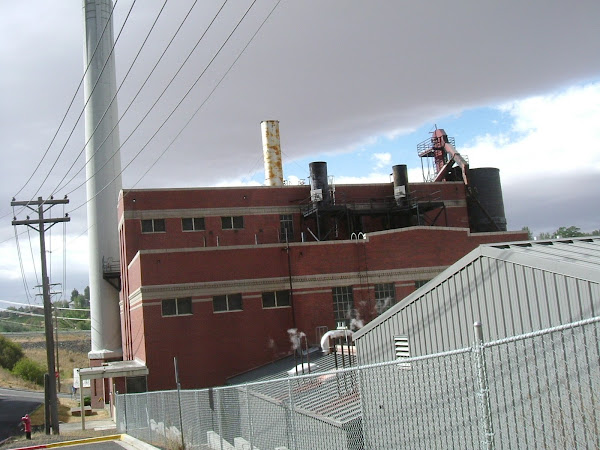 WSU steam plant in the Twilight Zone.
It's strange. Somehow communication wasn't happening. My hypothesis is that somewhere in administration, they hadn't checked with the physical plant staff that runs the WSU heating system. Who knows. How could this plan have gone on for nearly 2 years before someone said, wait a minute?
It is kind of disappointing. Just following the news from my home town, I was looking forward to the renovation. Folks from one of the partners, Port of Whitman County, are disappointed also and there is some news of legal action.
An old steam plant, in Spokane, was turned into a great venue for dining, offices and so forth. I visited during a bicycle trip around 2012. Back then, it was called Steam Plant Square and Steam Plant Grill. In it's earlier incarnation it heated parts of downtown Spokane.
 Steam plant renovation in Spokane as of my visit 2011.
In Pullman, there must have been kind of a communications screw up, I guess. Did people higher up in administrations forget to talk to lower down staff who are actually running the heating system? That seems to be a common screw up in big organizations. Lack of communication? Talk is often thought of as cheap, as in the phrase "talk is cheap," but talking can be very useful.
Turns out there is an interesting history that predates this situation.
Around early the 2000s, WSU was considering building a new heating plant in conjunction with a power company called Duke Energy. The new plant would generate electricity and provide steam to WSU as part of a cogeneration plant, if I remember correctly.
I thought the plan was with Avista, the local utility, but someone looked it up and remembered better than me. It was Duke Energy, I guess. Anyway.
 The old plant, built in the 1920s, would have been renovated into a new WSU Art Gallery. It's in a good location on the edge of campus facing downtown Pullman.
That plan was scrapped when, apparently, it didn't pencil out.
 Instead, WSU opted for a less exciting compromise. They needed to expand their steam operations so a new plant was built on the east end of campus along a road called "Grime's Way." The road named after someone, I guess. Back when I was growing up in Pullman, that road was named "Farm Way."
 The new plant was built and (I think) an addition was built to the old plant. Some boilers at the east end of campus and other boilers near the old plant at the west side of campus.
The new art gallery was built in another location. It's by the WSU Art Building. They tore down and relocated the old campus police / fire station.
During my years growing up in Pullman, the WSU steam plant burned coal at least in the winter. I toured it, back then and they said it could burn coal, natural gas or oil if need be. Different boilers, burners and so forth.
 Older picture of the plant taken during my college years when I was home for the summer. Coal pile seen to the right.
I also heard that they could generate, maybe 20% of the campus electricity from a steam turbine in the front room of of the plant that overlooks the notorious "Power House Hill;" a hill I felt accomplished if I could ride my bike to the top. I'd have to be in the lowest gear.
 Image taken 2003 after coal operation had ended.
Coal operation was discontinued in the early 2000s when the current steam heating configuration was built. I think it's all powered by natural gas.
They must still have quite a bit of operating equipment in the old plant. Pumps, steam tunnel entrances, feed water treatment, electrical, maintenance; whatever.
I'm thinking, maybe they could do something on a smaller scale with the front room of that plant; where the steam turbine used to be. I wouldn't know, it's just a guess. Maybe some of the money already approved in the grant can still be used in cleanup or something. It isn't that much money yet. The rennovation idea would ahve cost in the millions.
 Image I took around 1973, my senior year in high school. Original look before a somewhat ugly (utilitarian) addition was added.
 2003 image with the yellow addition. Someone said it holds old baghouse type pollution control equipment to reduce dust from coal burning? I think that addition came in the 1980s.
 One more image from west side of plant, 2003.
 Meanwhile, here in Bellingham, Western Washington University has an interesting steam plant with display windows.
 Down on Bellingham's waterfront there is a power plant with a fairly boring wall, but they did paint a mural on that wall more recently.
 Near Bellingham's waterfront power plant was an old pulp mill, Georgia Pacific West. Most of it has been torn down and that area is slowly turning into a redevelopment district. A partnership between Port of Bellingham and the city. Some of that planning has been rocky as well. It's been a long time in coming.
They are trying to retain some artificts from the old mill for the sake of art. An old granery building has been restored, some condos are under construction, there is a jump track for bikes at least until they find something else to do with that space. It's quite popular. Also there's an outdoor beer garden and some other things.
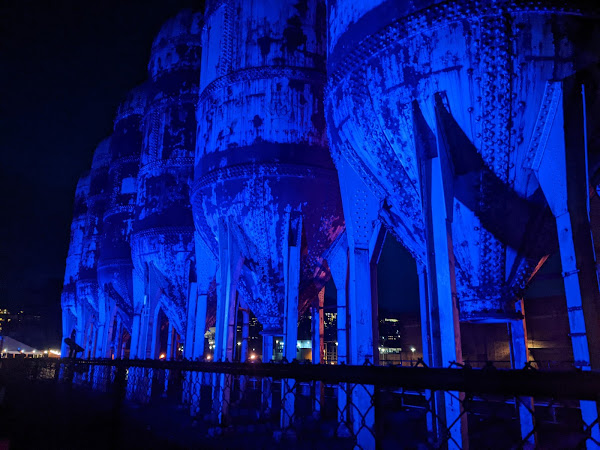 Old digester tanks, from the pulp mill, can now be lit up in various colors.
My article on WWU steam plant in Bellingham. Published in The Betty Pages.
Turns out the plant is still in use! WSU pulled the plug on the project when they determined that the plant wasn't abandoned after all, I guess. Continued below.
It's strange. Somehow communication wasn't happening. My hypothesis is that somewhere in administration, they hadn't checked with the physical plant staff that runs the WSU heating system. Who knows. How could this plan have gone on for nearly 2 years before someone said, wait a minute?
It is kind of disappointing. Just following the news from my home town, I was looking forward to the renovation. Folks from one of the partners, Port of Whitman County, are disappointed also and there is some news of legal action.
An old steam plant, in Spokane, was turned into a great venue for dining, offices and so forth. I visited during a bicycle trip around 2012. Back then, it was called Steam Plant Square and Steam Plant Grill. In it's earlier incarnation it heated parts of downtown Spokane.
In Pullman, there must have been kind of a communications screw up, I guess. Did people higher up in administrations forget to talk to lower down staff who are actually running the heating system? That seems to be a common screw up in big organizations. Lack of communication? Talk is often thought of as cheap, as in the phrase "talk is cheap," but talking can be very useful.
Turns out there is an interesting history that predates this situation.
Around early the 2000s, WSU was considering building a new heating plant in conjunction with a power company called Duke Energy. The new plant would generate electricity and provide steam to WSU as part of a cogeneration plant, if I remember correctly.
I thought the plan was with Avista, the local utility, but someone looked it up and remembered better than me. It was Duke Energy, I guess. Anyway.
That plan was scrapped when, apparently, it didn't pencil out.
The new art gallery was built in another location. It's by the WSU Art Building. They tore down and relocated the old campus police / fire station.
During my years growing up in Pullman, the WSU steam plant burned coal at least in the winter. I toured it, back then and they said it could burn coal, natural gas or oil if need be. Different boilers, burners and so forth.
I also heard that they could generate, maybe 20% of the campus electricity from a steam turbine in the front room of of the plant that overlooks the notorious "Power House Hill;" a hill I felt accomplished if I could ride my bike to the top. I'd have to be in the lowest gear.
Coal operation was discontinued in the early 2000s when the current steam heating configuration was built. I think it's all powered by natural gas.
They must still have quite a bit of operating equipment in the old plant. Pumps, steam tunnel entrances, feed water treatment, electrical, maintenance; whatever.
I'm thinking, maybe they could do something on a smaller scale with the front room of that plant; where the steam turbine used to be. I wouldn't know, it's just a guess. Maybe some of the money already approved in the grant can still be used in cleanup or something. It isn't that much money yet. The rennovation idea would ahve cost in the millions.
They are trying to retain some artificts from the old mill for the sake of art. An old granery building has been restored, some condos are under construction, there is a jump track for bikes at least until they find something else to do with that space. It's quite popular. Also there's an outdoor beer garden and some other things.
My article on WWU steam plant in Bellingham. Published in The Betty Pages.
Tuesday, January 18, 2022
Most worry about 5G has been barking up the wrong tree. It's aviation safety, not the human body that folks should have worried about.
For years, I've heard people worry about 5G phone signals effect on the human body.
Seems like just about all real scientists were not worried about that, but now it seems like scientists ARE worried about conflict with airline flight control signals. Why haven't I heard about this worry until just the last few weeks?
Seems like there was so much static in the air from the other worries that the airline issue went unnoticed.
Like crying wolf, sometimes the real worries get buried under a clutter of concerns as so many worries seems to be just barking up the wrong tree.
US airline officials warn of ‘catastrophic’ crisis in aviation with new 5G service.
Seems like just about all real scientists were not worried about that, but now it seems like scientists ARE worried about conflict with airline flight control signals. Why haven't I heard about this worry until just the last few weeks?
Seems like there was so much static in the air from the other worries that the airline issue went unnoticed.
Like crying wolf, sometimes the real worries get buried under a clutter of concerns as so many worries seems to be just barking up the wrong tree.
US airline officials warn of ‘catastrophic’ crisis in aviation with new 5G service.
Bans on natural gas could be missing the real climate change problems
Something I've been thinking. Since much of our electricity, these days, comes from natural gas, I've been thinking it might not reduce fossil fuel consumption to have a ban.
Turns out, according to this article, gas burned in a home furnace can be 90% efficient, but when burned in a powerplant and then sent by transmission lines to electric heating in a home, only 45% efficient? I think really? Apparently power plants aren't that efficient. Lots of the waste heat goes up the cooling towers.
One of the problems is that modern homes tend to be bigger so more energy is used anyway, whether electricity or gas. That's closer to the real problem. If electricity, the grid is still too reliant on fossil fuels and (in this area, the US Pacific Northwest) hydro power. Hydro power is low carbon footprint, but does have an impact. Just ask the salmon.
Heat pumps can help, versus resistance electric heating, but they can be expensive.
We just need to use less in buildings, cars and so forth. We also need to speed up the greening of our energy sources.
My article in The Betty Pages about proposals to ban natural gas heating. I think, maybe a carbon tax would work better, but we do need to find ways to reduce fossil fuel dependency.
Turns out, according to this article, gas burned in a home furnace can be 90% efficient, but when burned in a powerplant and then sent by transmission lines to electric heating in a home, only 45% efficient? I think really? Apparently power plants aren't that efficient. Lots of the waste heat goes up the cooling towers.
One of the problems is that modern homes tend to be bigger so more energy is used anyway, whether electricity or gas. That's closer to the real problem. If electricity, the grid is still too reliant on fossil fuels and (in this area, the US Pacific Northwest) hydro power. Hydro power is low carbon footprint, but does have an impact. Just ask the salmon.
Heat pumps can help, versus resistance electric heating, but they can be expensive.
We just need to use less in buildings, cars and so forth. We also need to speed up the greening of our energy sources.
My article in The Betty Pages about proposals to ban natural gas heating. I think, maybe a carbon tax would work better, but we do need to find ways to reduce fossil fuel dependency.
Monday, January 17, 2022
Seems like home value inflation is overlooked, but it can lead to other inflation as wages try to catch up with the cost of living.
Lots of talk about inflation, today, which could be bad political news for Biden and the Democrats.
Yes, inflation is here and in home values and housing costs, it's been reality for a long time. Wages are trying to catch up and that can push up other prices.
Then there's the cost of gas. It's a fossil fuel so it may need to get more expensive for the planet. Still, there is a lot of grumbling about that, adding to misfortune for the Democrats.
It's not Biden's fault, but they aren't explaining things very well.
Yes, inflation is here and in home values and housing costs, it's been reality for a long time. Wages are trying to catch up and that can push up other prices.
Then there's the cost of gas. It's a fossil fuel so it may need to get more expensive for the planet. Still, there is a lot of grumbling about that, adding to misfortune for the Democrats.
It's not Biden's fault, but they aren't explaining things very well.
Tuesday, January 11, 2022
Even in a world of zero population growth, some areas would still grow; areas where people want to live.
Some folks worry about declining population. Populations are shrinking in some countries, like Russia. It's still growing worldwide, but growth is slowing.
Less population would be desirable. There would be some adjustments to make in our current economic system that relies on growth of consumption.
Even in a world of no growth, some areas would still grow; areas where people want to live. There are many parts of the world that people are desperately trying to get out of.
Here in Bellingham, there is quite a bit of vibrancy related to people wanting to live here. New grade schools being built. I see cranes for a big grade school upgrade out my window. Sunnyland School.
Immigration to USA is said to have slowed significantly in the last year. This ought to calm the wall building fears of Republicans, but I'm not holding my breath.
Even with immigration slowed, I would guess that for every immigrant, who comes to USA either legally or illegally, there are many more who's dream it is to come to America.
Many more who dream of coming to Canada, certain European nations and Australia as well.
I doubt very many people wish to go to Putin's Russia.
There was recent news about someone who snuck into North Korea. Probably someone out of their mind.
Much of Bellingham's continued population growth comes from migration from other parts of USA, rather than immigration to USA which, at least temporarily, is said to be slowing down.
If the world weren't overwhelmed with population, various regions and nations could compete on the grounds of being good places to live. They would compete for attracting new residents and vibrancy.
It could mean that the good places to live would be in the ascendency. Good news for democracies and places that respect human rights.
Democracies would have an advantage if there was ever a shortage of people because they would have less shortage of people when people choose where they would prefer to live. Betty Pages Article.
Less population would be desirable. There would be some adjustments to make in our current economic system that relies on growth of consumption.
Even in a world of no growth, some areas would still grow; areas where people want to live. There are many parts of the world that people are desperately trying to get out of.
Here in Bellingham, there is quite a bit of vibrancy related to people wanting to live here. New grade schools being built. I see cranes for a big grade school upgrade out my window. Sunnyland School.
Immigration to USA is said to have slowed significantly in the last year. This ought to calm the wall building fears of Republicans, but I'm not holding my breath.
Even with immigration slowed, I would guess that for every immigrant, who comes to USA either legally or illegally, there are many more who's dream it is to come to America.
Many more who dream of coming to Canada, certain European nations and Australia as well.
I doubt very many people wish to go to Putin's Russia.
There was recent news about someone who snuck into North Korea. Probably someone out of their mind.
Much of Bellingham's continued population growth comes from migration from other parts of USA, rather than immigration to USA which, at least temporarily, is said to be slowing down.
If the world weren't overwhelmed with population, various regions and nations could compete on the grounds of being good places to live. They would compete for attracting new residents and vibrancy.
It could mean that the good places to live would be in the ascendency. Good news for democracies and places that respect human rights.
Democracies would have an advantage if there was ever a shortage of people because they would have less shortage of people when people choose where they would prefer to live. Betty Pages Article.
Long lines at polling places in some states decreases right to vote, but Washington State has done much better.
Biden is pushing for laws to preserve voter access today. I'm not following this issue closely, but got to thinking that we are pretty fortunate, here in Washington State. We have mail in voting rather than cumbersome polling places one has to stand in line at for voting.
Some states still have the old polling systems. For years, I keep hearing news about long waits at the polls in other states. Waits so long that voting becomes difficult and many working people have to choose between casting their vote or making a living.
Even when we did have the polling places, here in Washington, I don't remember long waits. We seem to have a better voting system than a lot of other states even back when we had polling places.
Other states need to fix those problems in their state or I agree, the Federal Government will need to step in to preserve access to the ballot.
Then there is the whole problem of gerrymandering. Another big topic.
Some states still have the old polling systems. For years, I keep hearing news about long waits at the polls in other states. Waits so long that voting becomes difficult and many working people have to choose between casting their vote or making a living.
Even when we did have the polling places, here in Washington, I don't remember long waits. We seem to have a better voting system than a lot of other states even back when we had polling places.
Other states need to fix those problems in their state or I agree, the Federal Government will need to step in to preserve access to the ballot.
Then there is the whole problem of gerrymandering. Another big topic.
Monday, January 10, 2022
With home values and prices going up so fast across America, of course there's inflation. These costs create the need to push up wages and other prices.
According to an article, I just read, about a poll, it says Americans are more worried about inflation coming back than about threats to democracy. Poll indicates that Democratic Party' s strategy of campaigning on worries about democracy might not, as the old phrase goes, "play in Peoria;" as in will it play in places like Peoria, Illinois.
Yes, I say we do have inflation with home values going up around 20% here in Bellingham; 16% nationwide in the last year. That's got to spread to other inflation in wages, as people need to pay more for rents, first time homebuying and so forth. Then other prices go up as businesses charge more to pay the higher wages.
I guess people need to understand inflation better. It is happening, but it isn't necessarily the end of the world if wages can keep up with other prices.
Problem is, most people's wages usually don't keep up. Maybe they keep up with some prices, but certain things, like housing and medical insurance, can be outliers.
Inflation is not necessarily Biden's fault, but it needs to be better explained, I guess.
Lots of people benefit when assets, such as houses and stocks, go up so one hardly ever hear politicians, or the media, talk about this as a root of the dastardly "inflation" that so many people say they don't like.
The Fed creating so much money and low interest rates helps to drive this situation. Still, we have to print money to fund government, the military, police, civil society, disaster relief, Medicare, coronavirus relief and so forth.
It's going to happen, but if we can stay calm, it's manageable. One way to cool inflation is to raise taxes. One way to cool inflation is to send the economy into a recession. Cause asset values to plummet.
We can't "have it all" and I'd also say, "be careful what you ask for as you might get it."
Yes, I say we do have inflation with home values going up around 20% here in Bellingham; 16% nationwide in the last year. That's got to spread to other inflation in wages, as people need to pay more for rents, first time homebuying and so forth. Then other prices go up as businesses charge more to pay the higher wages.
I guess people need to understand inflation better. It is happening, but it isn't necessarily the end of the world if wages can keep up with other prices.
Problem is, most people's wages usually don't keep up. Maybe they keep up with some prices, but certain things, like housing and medical insurance, can be outliers.
Inflation is not necessarily Biden's fault, but it needs to be better explained, I guess.
Lots of people benefit when assets, such as houses and stocks, go up so one hardly ever hear politicians, or the media, talk about this as a root of the dastardly "inflation" that so many people say they don't like.
The Fed creating so much money and low interest rates helps to drive this situation. Still, we have to print money to fund government, the military, police, civil society, disaster relief, Medicare, coronavirus relief and so forth.
It's going to happen, but if we can stay calm, it's manageable. One way to cool inflation is to raise taxes. One way to cool inflation is to send the economy into a recession. Cause asset values to plummet.
We can't "have it all" and I'd also say, "be careful what you ask for as you might get it."
So many Americans are in poor health anyway. The virus was the straw that broke the camel's back.
Omicron variant of the virus is surging, but symptoms seem to be less severe for most people; especially folks who are vaccinated.
Problem is, there is still a surge in hospitalizations with hospital staff near breaking point. I just got to thinking that part of the problem is just poor health in general. The post war baby boom is aging. The virus is the straw that broke the camel's back.
Yes, precautions and vaccinations are important, but this problem and shortage of healthcare staff may persist. Lifestyle choices, age and other factors matter also.
All through this pandemic, I've heard that heart disease is still the number one killer. Problem with the virus is that it can lead to premature death and it's a big new disease that's been added to the stack.
Problem is, there is still a surge in hospitalizations with hospital staff near breaking point. I just got to thinking that part of the problem is just poor health in general. The post war baby boom is aging. The virus is the straw that broke the camel's back.
Yes, precautions and vaccinations are important, but this problem and shortage of healthcare staff may persist. Lifestyle choices, age and other factors matter also.
All through this pandemic, I've heard that heart disease is still the number one killer. Problem with the virus is that it can lead to premature death and it's a big new disease that's been added to the stack.
Saturday, January 08, 2022
Do we need this proposed law in Washington State since distrust of elections is less of a problem here than in some other states?
Washington Gov. Inslee said that he wants lawmakers to pass legislation making it a gross misdemeanor for elected officials and candidates to spread lies about election results.
One wonders if this is necessary here in Washington State as I think the problem of distrust of the election process is much worse in other states.
Here in Washington, our election processes seem to work well and there is less distrust of government functioning. Such a proposal, in Washington, could be seen as overkill and it could create unnecessary political blowback to Inslee.
The fate of such a bill is dubious given court challenges.
One wonders if it is worth the political capital Inslee might be spending to get this bill passed.
On the other hand, lies, distrust of elections and even violence is a serious problem, nationwide. I think it is more serious in states where politics tends to lean more Republican. Such a bill as this proposal would not likely get to first base in those states.
It does seem like disdain for government is strong; especially among Republicans. I think to the point of anarchy.
I make a connection between severe anti government sentiment and anarchy. Anarchy is, basically, no government.
Even small government, like the famous concept from Grover Norquist, of making government so small one can "drown it in a bathtub," is a dangerous sentiment.
Many of the people who complain the most about government do rely on government for public safety, the military, veteran's benefits, Medicare and so forth.
Too much government and beaurocracy can be a problem, but government is part of the balance along with the private sector.
It does seem strange when people, who wave the flag and call themselves patriots, also say that our (state, federal and local) governments are evil. Kind of a strange irony; especially when it comes from politicians who are in power in the government.
I see this as more of a problem in states that tend to lean Republican. It's hard to say what the best solution to this problem would be. Is passing a law the best solution? It's worth consideration, but the proposal does bring up a lot of questions.
Meanwhile, here in Washington State, it does seem like we have a good election process. Other states may have honest election processes also, but public trust of those processes is more in question.
Remember, I do think outright hatred of government can lead to anarchy. Yes, we did have the Chopp anti police zone that came from the far left in Seattle, Washington, but I tend to think that is part of the action and reaction between right and left extremes.
The Chopp Zone happened in Washington State, but it happened while Trump's extreme presidency was stirring up divisiveness; almost for the fun of it; Trump being a better comedian than president.
Divisiveness and derisive comments about other types of people can be good for media ratings, but calmer tempers and civil society is more to my liking.
For the most part, we do seem to have civil society, here in the state of Washington.
We have mail in balloting in Washington. I like it, but I know some folks don't trust it. Some other states still have polling places complete with the problems of long lines, I'll have to say. We also seem to have a tradition of moderate, responsible Republican Secretaries of State who hold the office overseeing our elections. Our recent Secretary of State, Republican Kim Wyman, was chosen by Democrat Joe Biden for a job related to election security at the national level. By partisanship still alive, I guess.
Years ago, we had Ralph Munro, also a Republican, who I had some personal correspondence with.
That office also over sees state archives and Munro noticed a self published (by photocopy machine) book I did on my 1989 bicycle tour around Washington State. It was on display at the local branch of our State Archives. He was here for a visit and picked up my book. I wasn't there at the time, but people, I know, who work there mentioned that to me. I wrote him, after hearing that and it started a personal correspondence. I sent him some of the books I did about later bicycle trips and he always wrote back appreciating my sharing.
He had a reputation for good relations with the public.
One wonders if this is necessary here in Washington State as I think the problem of distrust of the election process is much worse in other states.
Here in Washington, our election processes seem to work well and there is less distrust of government functioning. Such a proposal, in Washington, could be seen as overkill and it could create unnecessary political blowback to Inslee.
The fate of such a bill is dubious given court challenges.
One wonders if it is worth the political capital Inslee might be spending to get this bill passed.
On the other hand, lies, distrust of elections and even violence is a serious problem, nationwide. I think it is more serious in states where politics tends to lean more Republican. Such a bill as this proposal would not likely get to first base in those states.
It does seem like disdain for government is strong; especially among Republicans. I think to the point of anarchy.
I make a connection between severe anti government sentiment and anarchy. Anarchy is, basically, no government.
Even small government, like the famous concept from Grover Norquist, of making government so small one can "drown it in a bathtub," is a dangerous sentiment.
Many of the people who complain the most about government do rely on government for public safety, the military, veteran's benefits, Medicare and so forth.
Too much government and beaurocracy can be a problem, but government is part of the balance along with the private sector.
It does seem strange when people, who wave the flag and call themselves patriots, also say that our (state, federal and local) governments are evil. Kind of a strange irony; especially when it comes from politicians who are in power in the government.
I see this as more of a problem in states that tend to lean Republican. It's hard to say what the best solution to this problem would be. Is passing a law the best solution? It's worth consideration, but the proposal does bring up a lot of questions.
Meanwhile, here in Washington State, it does seem like we have a good election process. Other states may have honest election processes also, but public trust of those processes is more in question.
Remember, I do think outright hatred of government can lead to anarchy. Yes, we did have the Chopp anti police zone that came from the far left in Seattle, Washington, but I tend to think that is part of the action and reaction between right and left extremes.
The Chopp Zone happened in Washington State, but it happened while Trump's extreme presidency was stirring up divisiveness; almost for the fun of it; Trump being a better comedian than president.
Divisiveness and derisive comments about other types of people can be good for media ratings, but calmer tempers and civil society is more to my liking.
For the most part, we do seem to have civil society, here in the state of Washington.
We have mail in balloting in Washington. I like it, but I know some folks don't trust it. Some other states still have polling places complete with the problems of long lines, I'll have to say. We also seem to have a tradition of moderate, responsible Republican Secretaries of State who hold the office overseeing our elections. Our recent Secretary of State, Republican Kim Wyman, was chosen by Democrat Joe Biden for a job related to election security at the national level. By partisanship still alive, I guess.
Years ago, we had Ralph Munro, also a Republican, who I had some personal correspondence with.
That office also over sees state archives and Munro noticed a self published (by photocopy machine) book I did on my 1989 bicycle tour around Washington State. It was on display at the local branch of our State Archives. He was here for a visit and picked up my book. I wasn't there at the time, but people, I know, who work there mentioned that to me. I wrote him, after hearing that and it started a personal correspondence. I sent him some of the books I did about later bicycle trips and he always wrote back appreciating my sharing.
He had a reputation for good relations with the public.
Subscribe to:
Posts (Atom)