I keep thinking that a lot of our "traditional values" need to be updated and in many cases changed. Our technology has changed since ancient times while many of our old moral values have not.
Much of our values have come from times of austerity, like ancient times, when life expectancy was much shorter. There needed to be lots of procreation to maintain the population as death often came early.
Hard work and hoarding material things was a survival skill in difficult times when food and basic needs were hard to come by.
Now we have technology that can make life easier, but many people still act as if running on a treadmill. People are working themselves to burnout while eating to obesity. Some folks are building and hoarding in a time when our footprint on the planet is so strong that we threaten our survival with too much abundance and overpopulation.
We are still running a rat race as if we have to do this for our mere survival, As if basic needs require this. With today's technology and over 7 billion people on the planet, we do need to change.
Conditions in the wealthier parts of the world, such as USA, are still different than much of the Third World, which also adds to the problem. Survival needs in much of the world are still spartan which continues to drive ethics based on running the treadmill for survival. At the same time, some folks, in the Third World, are extremely wealthy; such as oligarchs in both poor and rich nations alike. Oligarchs so often set the pace, where ever they reside.
In some ways, we need to relax more, but society, and some say capitalism, is set up to keep us on that treadmill.
Looking back, I think we needed to be on that treadmill more as things didn't come as easy in pre technological times, but today, we have a different set of problems.
Even abolishing capitalism isn't really the answer. As long as our old values and cultures remain, we will find a way to run the rat race, whatever system we create. We need to look deeper. It's our cultures based on ancient times that are the problem.
Some old ideas and traditions are fine, but we need to update, somehow. I also believe that achievement, work and things like scientific progress are good. Our constant curiosity and wish to make a better life for ourselves and future generations is good, but we need to update cultural assumptions, traditions and our expectations. I keep thinking about quality of life versus lots of possessions.
Technology does often allow for sophistication with less consumption. I think of the transistor versus burning wood or needing to have a horse. How much hay does the horse eat compared to the electricity used in a transistor? Think about comparing the transistor to the vacuum tube in terms of power consumption.
We need to let go of so much of our baggage that came from times before most lifespans were as long as they are now. We need to update our ethics to beyond the era where it required more brute force to survive.

Tuesday, May 03, 2022

The leak that "fast tracked" the Supreme Court
A flap about that document leak from the Supreme Court is allover the news today.
I've been thinking, if they really think abortion is murder, maybe they should have announced the verdict real soon after they heard the case. Save more lives? Instead, I think they tried to follow the normal procedure, but now the leak has "fast tracked" it a bit.
I am, of course, in favor of keeping Roe vs Wade.
I've been thinking, if they really think abortion is murder, maybe they should have announced the verdict real soon after they heard the case. Save more lives? Instead, I think they tried to follow the normal procedure, but now the leak has "fast tracked" it a bit.
I am, of course, in favor of keeping Roe vs Wade.
The need to pay high housing costs keeps the work / consume / waste treadmill going.
Labor saving technologies could mean a shorter workweek. Less time at work would certainly help a lot of stretched and stressed people.
One problem is that the increased efficiency of labor leads to more prosperity which leads to inflation in property values and the cost of living.
If one can afford the cost of living, in an area, it's not that much more to be able to afford other things; like airline travel and fancy electronics.
If one is paying thousands of dollars a month for a place to live, who wants to live like a church mouse? Might as well go a few steps farther and have these other things that are available at bargain prices; relative to the basics.
It is kind of like a treadmill. The more we produce, the more we consume, but part of the problem is that the fastest belt on the treadmill is the basic cost of rent, or first time home purchase. Another fast moving belt, that is considered a basic, is health insurance.
If one is keeping up with the treadmill, to begin with, it's almost stupid to not reward oneself with these other joys in life.
In my case, I did have affordable housing. I was fortunate to have landlords who rented, to me, below market. I spent much of my working years working part time so I did have the luxury of time. The belts on the treadmill were never going too fast for me. I didn't have a family either. I was able to enjoy the luxury of just having time.
My guess is, if people are less able to enjoy the luxury of time, they need something to enjoy. Few folks just want to run on a fast treadmill for nothing. Might as well book that jet flight or buy that big screen TV for just a little bit more.
Consumption is also pushed by business and advertising as the economy does need the jobs that consumption creates; so people can afford the cost of living.
If one can afford the cost of living, in an area, it's not that much more to be able to afford other things; like airline travel and fancy electronics.
If one is paying thousands of dollars a month for a place to live, who wants to live like a church mouse? Might as well go a few steps farther and have these other things that are available at bargain prices; relative to the basics.
It is kind of like a treadmill. The more we produce, the more we consume, but part of the problem is that the fastest belt on the treadmill is the basic cost of rent, or first time home purchase. Another fast moving belt, that is considered a basic, is health insurance.
If one is keeping up with the treadmill, to begin with, it's almost stupid to not reward oneself with these other joys in life.
In my case, I did have affordable housing. I was fortunate to have landlords who rented, to me, below market. I spent much of my working years working part time so I did have the luxury of time. The belts on the treadmill were never going too fast for me. I didn't have a family either. I was able to enjoy the luxury of just having time.
My guess is, if people are less able to enjoy the luxury of time, they need something to enjoy. Few folks just want to run on a fast treadmill for nothing. Might as well book that jet flight or buy that big screen TV for just a little bit more.
Consumption is also pushed by business and advertising as the economy does need the jobs that consumption creates; so people can afford the cost of living.
Twitter Don't Litter.

I hardly ever use Twitter, but it's in the news today. For some reason, there was this sign in a field out along Washington State Highway 23 between Davenport and Harrington, WA. I passed it in 2017.
Monday, April 18, 2022
Maybe Ferndale aluminum refinery should include in it's restart plan the ability to mothball the plant temporarily during periods of low aluminum prices.

Main issue now is negotiating a new electric power contract with BPA. Aluminum refining uses lots of power and usually gets it at a cheap, bulk rate.
I got to thinking that the plant may only be able to operate while aluminum prices are high. If the price goes down, the plant could have to be mothballed again. As they negotiate the power contract, they might be hoping to set a lower power cost as they take periods of lower aluminum price into account.
Instead, maybe they could agree to a higher power price, assuming the plant mothballs again, if aluminum prices drop.
I realize I don't know that much about running such a plant and power contracts. People might say I don't know what I am talking about, but this is my blog. I can toss out an idea for what it's worth.
A somewhat higher cost of electricity could be seen as being like buying power at the "green power rate." Sometimes rate payers, like the city of Bellingham, voluntarily agree to pay a bit more for so called "green power." This puts money toward green sources, such as solar and wind, which can be a bit more expensive.
I know that the refinery would still get a bulk rate, cheaper than smaller users, like the city government of Bellingham, but this concept could be considered as they negotiate the deal. It might mean the plant has to operate with a business plan that takes mothballing into account, during times of low aluminum prices.
Mothballed, of course, means layoff for workers again.
Due to world economics and climate change, it seems like things need to be more flexible. Plants closing and reopening, given conditions.
That would also imply more flexible housing, in this area, for workers who would have to come and go with the price of aluminum.
More things like mobile home courts, RV parks and what they call "man camps" (non gender specific) in the county. More flexible housing arrangements than the standard American dream.
This might be good for some personalities, who like change. Americans have been somewhat of a nomadic people, in past decades, but high housing costs and low vacancy rates have been making it harder for people to follow their jobs and dreams during more recent times.
Sometimes, when a mill closes and jobs end temporarily, folks can take advantage of those times for career change, vacations, schooling, or whatever.
Back in the 1980s, it seemed like corporations transferred people a lot. Maybe, due to less mobility, these days, this happens less often now?
The Pizza Place, I worked at right out of college, had a reputation for transferring the managers to Burian, WA.; for some reason. Moving around can be bad for establishing roots in a community, but some people like it. Folks often look forward to change. A new location and a new adventure.
At a time when so many folks are hanging onto old versions of the American Dream; hanging on with fear, we might need to plan for more flexibility; especially due to things like climate change.
Wednesday, April 13, 2022
Inflation may be the inevitable price for our quick economic recovery from the pandemic.
Seems like inflation is almost an inevitable price for prosperity.
The problem of income inequality still persists so some folks have trouble just keeping a roof over their heads, but prosperous times have come back since the pandemic.
Here in the US, government relief saved a lot of businesses and people's well being during the pandemic. It's brought prosperity back, to some extent, but new money does push inflation. Home values, wages and all that. An alternative would be deeper recession. We can't have it all.
Gas prices go up again as travel and commuting is returning to pre pandemic levels and beyond. There are natural limits to how much fossil fuels we should be burning.
The problem of income inequality still persists so some folks have trouble just keeping a roof over their heads, but prosperous times have come back since the pandemic.
Here in the US, government relief saved a lot of businesses and people's well being during the pandemic. It's brought prosperity back, to some extent, but new money does push inflation. Home values, wages and all that. An alternative would be deeper recession. We can't have it all.
Gas prices go up again as travel and commuting is returning to pre pandemic levels and beyond. There are natural limits to how much fossil fuels we should be burning.
Birth control would be better, but a higher death rate might bring the silver lining of a more stable world population.
Warning. Some morbid thinking.
Headlines say US death toll is highest in history. I would guess that it's partially because our population is highest in history. All the numbers are bigger.
I would think that there were times, in the past, when the death rate, per thousand, was higher. Times before modern medicine and safety standards, back during the Civil War and so forth.
At the same time, our death rate, per thousand, has increased in the past few years. Worse than in some other countries. This, because of the pandemic, vaccine hesitancy, income inequality, general cultural things; including mental health and the opioid problem.
Worldwide, I fear that humankind is in for higher death rates as well. Less wheat production, due to the war against Ukraine, is likely to be among factors increasing world hunger.
World population has been projected to reach 10 or even 11 billion in the near future before eventually stabilizing. Given the state of the world, we are having trouble just keeping our 7 to 8 billion current inhabitants alive and thriving.
Increasing deaths may keep the world from reaching 10 billion which, in a morbid way, may be sort of a blessing in disguise.
Russia's anti GLBT attitudes and it's attempts to increase it's population, is backfiring. It's population is already more sparse than other countries, due to less people per land area, but people are dying from the war and fleeing both Russia and Ukraine. Less people to innovate and work. Less to pay into whatever Social Security they have.
Meanwhile, here in much of the West, we still see no shortage of refugees seeking a better life in our societies. No shortage of potential workers to pay into our Social Security who are, at least, chomping at the borders hoping to get in, if only we could accommodate them with affordable housing and so forth. Plus we have our worries about the impact on the environment, that so many folks with their aspirations, can bring; especially if they try and live the traditional old American dream as unmodified.
Headlines say US death toll is highest in history. I would guess that it's partially because our population is highest in history. All the numbers are bigger.
I would think that there were times, in the past, when the death rate, per thousand, was higher. Times before modern medicine and safety standards, back during the Civil War and so forth.
At the same time, our death rate, per thousand, has increased in the past few years. Worse than in some other countries. This, because of the pandemic, vaccine hesitancy, income inequality, general cultural things; including mental health and the opioid problem.
Worldwide, I fear that humankind is in for higher death rates as well. Less wheat production, due to the war against Ukraine, is likely to be among factors increasing world hunger.
World population has been projected to reach 10 or even 11 billion in the near future before eventually stabilizing. Given the state of the world, we are having trouble just keeping our 7 to 8 billion current inhabitants alive and thriving.
Increasing deaths may keep the world from reaching 10 billion which, in a morbid way, may be sort of a blessing in disguise.
Russia's anti GLBT attitudes and it's attempts to increase it's population, is backfiring. It's population is already more sparse than other countries, due to less people per land area, but people are dying from the war and fleeing both Russia and Ukraine. Less people to innovate and work. Less to pay into whatever Social Security they have.
Meanwhile, here in much of the West, we still see no shortage of refugees seeking a better life in our societies. No shortage of potential workers to pay into our Social Security who are, at least, chomping at the borders hoping to get in, if only we could accommodate them with affordable housing and so forth. Plus we have our worries about the impact on the environment, that so many folks with their aspirations, can bring; especially if they try and live the traditional old American dream as unmodified.
Sunday, April 10, 2022
A cross Bellingham bicycle route I like. Part trail. Part road. To be used in conjunction with a map, or Google map of Bellingham.


Cross Ohio Street. Follow bike path across little bridge over whatcom Creek.


If one is in more of a hurry, one can skip South Bay Trail and Boulevard Park. Take the Boulevard Street with it's shoulder.
Follow 10th Street to another trail segment.


My Interurban Trail map.
Saturday, April 09, 2022
The way climate change is discussed may not be that convincing to some economics minded Americans.
Some conservatives don't believe climate change is much of a problem. A 1.5 degree C temperature rise since, pre industrial revolution, doesn't seem that much. Here in USA, we use Fahrenheit scale so it's actually 2.7, in our degrees. A bigger number. Maybe scientists should describe it in our "American" terms.
Still, only 2.7 doesn't seem that much to us. The change comes in well over 100 years, but there are more tangible effects, from this change; such as severe drought in the American Southwest.
California is America's most productive agricultural state. Droughts, for year after year, are likely to end much of California agriculture.
Drought with forest fires threaten to destroy the California redwoods. Those in the Sierra Mountains at least. Loss of a national treasure.
Lake Mead and Lake Powell, on the Colorado River, are running so low of water that 5 states, they serve, have to cut way back on water use. Lake levels, at the dams, are getting so low that there may not be enough "water drop," at the dam, to generate power.
The Southwest could see a few more wet years, but most scientists think the long term trend is "dry" because of climate change. In the recent past, there has been several dry years in a row. This trend may continue well into the future.
Yes, the Earth will survive and it's seen climate change before. The main difference is that we have not seen this type of climate change since the start of modern civilization.
It's the continuation of our way of life and our economy that we should be worried about.
Things can change. California's Sierra Nevada Mountains will survive, but they might become more like dry mountain ranges of Nevada's deserts. The Sierra might become more like mountains of the Mojave Desert farther south.
We, humans, might be able to adapt. I already hear of farmers, in California's Central Valley, who can no longer get irrigation water. They are giving up on food crops and turning the fields over to solar panels.
The world is changing, but conservatives and others alike tend to try and hang onto the status quo.
Still, only 2.7 doesn't seem that much to us. The change comes in well over 100 years, but there are more tangible effects, from this change; such as severe drought in the American Southwest.
California is America's most productive agricultural state. Droughts, for year after year, are likely to end much of California agriculture.
Drought with forest fires threaten to destroy the California redwoods. Those in the Sierra Mountains at least. Loss of a national treasure.
Lake Mead and Lake Powell, on the Colorado River, are running so low of water that 5 states, they serve, have to cut way back on water use. Lake levels, at the dams, are getting so low that there may not be enough "water drop," at the dam, to generate power.
The Southwest could see a few more wet years, but most scientists think the long term trend is "dry" because of climate change. In the recent past, there has been several dry years in a row. This trend may continue well into the future.
Yes, the Earth will survive and it's seen climate change before. The main difference is that we have not seen this type of climate change since the start of modern civilization.
It's the continuation of our way of life and our economy that we should be worried about.
Things can change. California's Sierra Nevada Mountains will survive, but they might become more like dry mountain ranges of Nevada's deserts. The Sierra might become more like mountains of the Mojave Desert farther south.
We, humans, might be able to adapt. I already hear of farmers, in California's Central Valley, who can no longer get irrigation water. They are giving up on food crops and turning the fields over to solar panels.
The world is changing, but conservatives and others alike tend to try and hang onto the status quo.
Friday, April 08, 2022
Microwaves are not really that micro compared to light waves. Our evolving language about the electromagnetic spectrum can be confusing and frightening.
I just got to thinking that much of the fear about the radiation, that we are exposed to each day, comes from the the ways we think about "radiation."
Heat and light are "radiation." They are part of the electromagnetic spectrum of radiation, but we are less worried about them because we can see light and we feel heat.
Other forms of radiation we don't see so they can seem more spooky.
As for cancer danger, from what I gather, the only forms of radiation that are dangerous are the very high frequency (shortest wave) forms.
These frequencies are higher than both heat and light. This would be ultraviolet light, X-rays and gamma rays.
They call these the "ionizing" forms of radiation. That's why sunlight can cause skin cancer. It's not the lower frequency light from the sun, but it's the ultraviolet light that causes skin cancer.
Windows tend to block ultraviolet light so the danger is more from being outside in the sun. That's why we need sunscreen.
Radiant heat is basically radiation. If we call it heat, it's less scary, but when we call it "infrared radiation," it can sound more scary.
Some forms of radiation can travel, spookily, through objects; including our bodies. X-rays for instance. Gamma rays also. These are real high frequency waves that can be cancer causing. The ionizing part of the electromagnetic spectrum.
Light doesn't travel through most objects, but it can travel through glass. Light seems less scary, but we are exposed to lots of that radiation on a sunny day.
The lower end of the electromagnetic spectrum gets real confusing.
The lower end is radio waves and microwaves. These can travel through objects, like our bodies. That can make them spooky, but they are such low frequencies that they are not cancer risk; from what I understand.
Cellphones use these lower frequencies.
These lower frequencies of electromagnetic waves can cause heating; like the heating in a microwave oven. This can be dangerous as it can cook tissue, but only if exposed to lots of power from being too close to a strong transmitter; like putting one's hand inside a microwave oven when it's running.
In the radio industry, they call that heating the "RF burn," meaning "radio frequency burn." Something you have to think about when climbing a big radio, or TV tower, to do repairs.
Cellphones have less power so even close to the body, they don't cook you. They may heat up a bit, but not enough to cause dangerous overheating; from what I understand.
They say cancer risk is not a factor with the low frequency waves that even 5G cellphones use. It's all still lower frequencies than heat and light.
Still, these waves are invisible and they can travel through us, so they seem spooky.
The language we use to describe radio waves is spooky also, in a way. When radio was invented, it was all real low frequency. Basically the AM band.
Then they figured out how to transmit some higher frequencies that they called "short wave." We still call these low frequency waves, shortwaves, however.
Now we know about much shorter waves so "shortwave" is actually "long" by comparison. FM and television signals are shorter than so called shortwave.
Shortwave bands aren't used that much, these days. They were the international broadcast bands of years past.
Next we figured out how to transmit microwaves. Microwave towers, radar and cellphones. Microwaves are still "long" compared to heat and light waves, however.
Our definitions of short and long have evolved since the early days of radio, but the old ways of referring to these waves remain. We still call shortwave radio, "shortwave." We still think of microwaves as small, but they are big compared to light waves.
Another thing that's confusing is how we talk about "high" and "short" in the same breath. The higher the frequency, the shorter the wave. Short means smaller, but it also means a bigger number for frequency.
I know, it's complicated, but I have found it very interesting as well.
The magic magnetic waves that travel through us all the time bringing so many radio, TV and cellphone signals. All that information passing through us all the time, but they say not hurting us.
The dangerous waves; X-rays and gamma rays are more rare unless one is close to the source, like when having an X-ray.
We have gamma rays going through us all the time from space. I guess low enough power that it doesn't really effect us that much; unless we are living on the space station. Our Earth's atmosphere filters lots of that stuff out.
A very good graphic about the spectrum that I found via Google image search. It's from Encyclopedia Britanica.
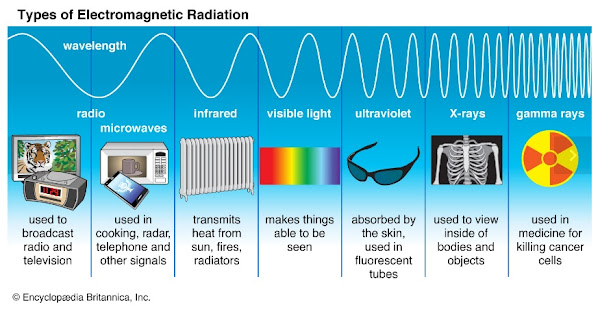
My only complaint, about the graphic, is the ultraviolet description. I'd say, "used in black lights," like for black light posters. Fluorescent tubes produce visible light, but that light is created from the ultraviolet light inside the tube being turned into visible light by the phosphorescent paint on the inside surfaces of the tube's glass.
Old style florescent lights used mercury also, inside the tube. Most of these old style lights are now being replace by LED that look the same, but my guess is much safer.
My article about this topic in The Betty Pages.
Heat and light are "radiation." They are part of the electromagnetic spectrum of radiation, but we are less worried about them because we can see light and we feel heat.
Other forms of radiation we don't see so they can seem more spooky.
As for cancer danger, from what I gather, the only forms of radiation that are dangerous are the very high frequency (shortest wave) forms.
These frequencies are higher than both heat and light. This would be ultraviolet light, X-rays and gamma rays.
They call these the "ionizing" forms of radiation. That's why sunlight can cause skin cancer. It's not the lower frequency light from the sun, but it's the ultraviolet light that causes skin cancer.
Windows tend to block ultraviolet light so the danger is more from being outside in the sun. That's why we need sunscreen.
Radiant heat is basically radiation. If we call it heat, it's less scary, but when we call it "infrared radiation," it can sound more scary.
Some forms of radiation can travel, spookily, through objects; including our bodies. X-rays for instance. Gamma rays also. These are real high frequency waves that can be cancer causing. The ionizing part of the electromagnetic spectrum.
Light doesn't travel through most objects, but it can travel through glass. Light seems less scary, but we are exposed to lots of that radiation on a sunny day.
The lower end of the electromagnetic spectrum gets real confusing.
The lower end is radio waves and microwaves. These can travel through objects, like our bodies. That can make them spooky, but they are such low frequencies that they are not cancer risk; from what I understand.
Cellphones use these lower frequencies.
These lower frequencies of electromagnetic waves can cause heating; like the heating in a microwave oven. This can be dangerous as it can cook tissue, but only if exposed to lots of power from being too close to a strong transmitter; like putting one's hand inside a microwave oven when it's running.
In the radio industry, they call that heating the "RF burn," meaning "radio frequency burn." Something you have to think about when climbing a big radio, or TV tower, to do repairs.
Cellphones have less power so even close to the body, they don't cook you. They may heat up a bit, but not enough to cause dangerous overheating; from what I understand.
They say cancer risk is not a factor with the low frequency waves that even 5G cellphones use. It's all still lower frequencies than heat and light.
Still, these waves are invisible and they can travel through us, so they seem spooky.
The language we use to describe radio waves is spooky also, in a way. When radio was invented, it was all real low frequency. Basically the AM band.
Then they figured out how to transmit some higher frequencies that they called "short wave." We still call these low frequency waves, shortwaves, however.
Now we know about much shorter waves so "shortwave" is actually "long" by comparison. FM and television signals are shorter than so called shortwave.
Shortwave bands aren't used that much, these days. They were the international broadcast bands of years past.
Next we figured out how to transmit microwaves. Microwave towers, radar and cellphones. Microwaves are still "long" compared to heat and light waves, however.
Our definitions of short and long have evolved since the early days of radio, but the old ways of referring to these waves remain. We still call shortwave radio, "shortwave." We still think of microwaves as small, but they are big compared to light waves.
Another thing that's confusing is how we talk about "high" and "short" in the same breath. The higher the frequency, the shorter the wave. Short means smaller, but it also means a bigger number for frequency.
I know, it's complicated, but I have found it very interesting as well.
The magic magnetic waves that travel through us all the time bringing so many radio, TV and cellphone signals. All that information passing through us all the time, but they say not hurting us.
The dangerous waves; X-rays and gamma rays are more rare unless one is close to the source, like when having an X-ray.
We have gamma rays going through us all the time from space. I guess low enough power that it doesn't really effect us that much; unless we are living on the space station. Our Earth's atmosphere filters lots of that stuff out.
A very good graphic about the spectrum that I found via Google image search. It's from Encyclopedia Britanica.

My only complaint, about the graphic, is the ultraviolet description. I'd say, "used in black lights," like for black light posters. Fluorescent tubes produce visible light, but that light is created from the ultraviolet light inside the tube being turned into visible light by the phosphorescent paint on the inside surfaces of the tube's glass.
Old style florescent lights used mercury also, inside the tube. Most of these old style lights are now being replace by LED that look the same, but my guess is much safer.
My article about this topic in The Betty Pages.
Tuesday, April 05, 2022
Suburban style subdivisions becoming less viable in recent years
As population in Whatcom County keeps growing and detached homes with yards remain popular, we have a history large new subdivisions being proposed. I just learned about a new one called Semiahmoo Highlands.
Many of these proposals, in the past, haven't been built due in part to strong opposition as well as things like the housing bubble burst of 2008.
Where Hundred Acre Woods is, in south part of Bellingham, was once proposed to be "Chuckanut Ridge;" a large housing development. Balfour was another one out Mount Baker Highway. Larabee Springs, north of Bellingham has been scaled back at least. Parts of it are there, but that big development wasn't built as originally proposed.
I think our aspirations need to turn toward denser development which is often fought as well. Reducing worldwide population growth matters as well.
Some of the new developments do plan some density, like townhouses in the mix. Bike paths and parks in the mix, better than the older developments, from decades past like the 1950s, where so many people live today. Some of these older neighborhoods are being retrofitted with trails and other changes.
Still, the future and affordability of single family development is in question for sure; especially in popular areas.
Many of these proposals, in the past, haven't been built due in part to strong opposition as well as things like the housing bubble burst of 2008.
Where Hundred Acre Woods is, in south part of Bellingham, was once proposed to be "Chuckanut Ridge;" a large housing development. Balfour was another one out Mount Baker Highway. Larabee Springs, north of Bellingham has been scaled back at least. Parts of it are there, but that big development wasn't built as originally proposed.
I think our aspirations need to turn toward denser development which is often fought as well. Reducing worldwide population growth matters as well.
Some of the new developments do plan some density, like townhouses in the mix. Bike paths and parks in the mix, better than the older developments, from decades past like the 1950s, where so many people live today. Some of these older neighborhoods are being retrofitted with trails and other changes.
Still, the future and affordability of single family development is in question for sure; especially in popular areas.
1965 or 66 view from Streit Perham dorms
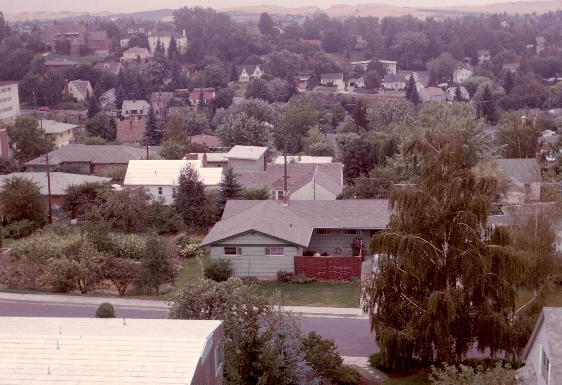
Out over my paper route in the shadow of a university
View out over my childhood neighborhood in Pullman, WA. This image was taken by my older brother sometime in the mid 1960s. From a nearby dormitory. He recently shared some of his old slides.
I grew up in a college town. A compact little town of neighborhoods, sidewalks and back fences. Hardly any sprawl. There were tall buildings at the university that sprang up practically next to thousand acre ranches. One could really tell when one was "out of town."
The area shown was basically my "paper route."
Large Castile like structure in upper left is the Theta Ki Fraternity. It was on my route for a while.
One time as I went to collect the bill, it's halls were ankle deep in leaves. Leaf rakers were doing a "frat house prank."
Struggling for 2 and 1/2 years, I eventually gave up the paper route in 8th grade. Hardly made any money at it, but I wasn't a very good book keeper. I didn't keep the route book up to date and ended up delivering papers after people had dropped subscriptions and moved.
I fantasized that my little route would be the start of some big "communications enterprise" in my adult life. Little did I know said "communications empire" would be a web page.
Hardly an enterprise. It still doesn't make much money, but money isn't everything. I am not really that motivated by money.

Monday, April 04, 2022
The thousand mile salad may actually help us adapt to climate change.
There is news about a very good crop of potatoes, from Maine, headed west to fill-in for poor harvests, in western states, due to the ongoing drought. Traveling west by rail. More than 500 truckloads worth.
I got to thinking the opposite of what a lot of people think. Climate change may increase, rather than decrease, the distance food travels from farm to table.
Food can travel fairly cheaply; especially by rail. Shipping in food can create a lower carbon footprint than having people try to grow their own food by living in rural settings and then having to commute to their real jobs and errands.
Droughts and floods, in various areas, are likely to mean foods travel farther to complete the diet. Foods from farther afield mean more diversity and redundancy of supply. Conditions vary in different areas around the world. If drought hits one area, better conditions in another area can even out the supply.
What's often called the "thousand mile salad," with components from far afield, continues to feed us.
My thoughts, often the opposite of popular opinion.
For most people, it seems like reducing the carbon footprint tends to favor urban living. Rural folks tend to be more dependent on fossil fuel vehicles to live their lives with longer commutes. Urban dwellers are less apt to be living in detached residences. Easer to heat and cool.
Urban living usually means less space for growing food, so a low carbon footprint urban life can mean food still travels a long ways. The food travels instead of the people.
There can be some food growing space in urban areas. There can be community gardens, indoor, vertical and rooftop gardens. The economics of bringing food in from long distances can still pencil out more faverably, however.
The tendency to want to grow one's own food could actually increase overall carbon footprint if it pushes residences out into more rural settings. Food by itself can be shipped long distances at fairly low enenrgy cost versus people having to commute long distances, each day, to maintain their lives and pay the bills.
As climate change reduces agricultural production in certain areas, the ability to source food from a diversity of regions can come in handy.
In some ways, this is nothing new as large parts of the American west has such a dry climate that the main "local" agriculture is grazing beef cattle. One does not live by beef alone.
I got to thinking the opposite of what a lot of people think. Climate change may increase, rather than decrease, the distance food travels from farm to table.
Food can travel fairly cheaply; especially by rail. Shipping in food can create a lower carbon footprint than having people try to grow their own food by living in rural settings and then having to commute to their real jobs and errands.
Droughts and floods, in various areas, are likely to mean foods travel farther to complete the diet. Foods from farther afield mean more diversity and redundancy of supply. Conditions vary in different areas around the world. If drought hits one area, better conditions in another area can even out the supply.
What's often called the "thousand mile salad," with components from far afield, continues to feed us.
My thoughts, often the opposite of popular opinion.
For most people, it seems like reducing the carbon footprint tends to favor urban living. Rural folks tend to be more dependent on fossil fuel vehicles to live their lives with longer commutes. Urban dwellers are less apt to be living in detached residences. Easer to heat and cool.
Urban living usually means less space for growing food, so a low carbon footprint urban life can mean food still travels a long ways. The food travels instead of the people.
There can be some food growing space in urban areas. There can be community gardens, indoor, vertical and rooftop gardens. The economics of bringing food in from long distances can still pencil out more faverably, however.
The tendency to want to grow one's own food could actually increase overall carbon footprint if it pushes residences out into more rural settings. Food by itself can be shipped long distances at fairly low enenrgy cost versus people having to commute long distances, each day, to maintain their lives and pay the bills.
As climate change reduces agricultural production in certain areas, the ability to source food from a diversity of regions can come in handy.
In some ways, this is nothing new as large parts of the American west has such a dry climate that the main "local" agriculture is grazing beef cattle. One does not live by beef alone.
Sunday, April 03, 2022
Short term versus commitments to long term oil facilities.
Ramping up US oil production with hardly a worry about climate change is seen by some Republican politicians as a solution to current geopolitical problems. Biden accused of standing in the way.
I think it's more than just Biden standing in the way. Worry about climate change is widespread.
We produce most of our huge domestic demand these days and ramping up more production could conceivably help Europe, but there still are the bottlenecks in capacity of LNG ports, for natural gas, between US and Europe. Increasing port and pipeline capacity would be long term commitments in the billions of dollars. Mostly private investments, but still long term commitments in an era of climate change.
Conservation could be promoted more.
For the short term solution, some folks aren't happy that Keystone Pipeline isn't being built from Canada to the US Gulf Coast ports. Pipelines are safer than oil by railroad tanker cars, but a pipeline is a long term investment. I hear that more oil is being sent by rail, from Canada and probably US oil production as well. Being sent by rail along the route that Keystone would have gone without committing billions into building that pipeline.
I think it's more than just Biden standing in the way. Worry about climate change is widespread.
We produce most of our huge domestic demand these days and ramping up more production could conceivably help Europe, but there still are the bottlenecks in capacity of LNG ports, for natural gas, between US and Europe. Increasing port and pipeline capacity would be long term commitments in the billions of dollars. Mostly private investments, but still long term commitments in an era of climate change.
Conservation could be promoted more.
For the short term solution, some folks aren't happy that Keystone Pipeline isn't being built from Canada to the US Gulf Coast ports. Pipelines are safer than oil by railroad tanker cars, but a pipeline is a long term investment. I hear that more oil is being sent by rail, from Canada and probably US oil production as well. Being sent by rail along the route that Keystone would have gone without committing billions into building that pipeline.
Strategic oil reserve may serve a different purpose now than in the 1970s. Different circumstances today.
I'm remembering the 1970s when the US was very dependent on foreign oil. The Strategic Oil Reserve was seen as a way to keep fuel going incase we were cut off from unfriendly foreign suppliers; especially if we were at war and needed to keep the tanks and planes running.
Now it is a different situation since we produce most of the oil we use. We still use a huge amount, but we produce a huge amount also. The reserve seems to be used, these days, more as an attempt to stabilize prices.
Biden will get flack for this from some Republicans, probably. Seems like the circumstances have changed since the reserve was in the news in the 1970s, but the situation of us using lots of oil remains. We use even more now, but at least we have more of our own oil production than we did back in the late 1970s.
Maybe the government can make some money if it buys oil to fill the reserve when prices are low and sells when prices are high.
Now it is a different situation since we produce most of the oil we use. We still use a huge amount, but we produce a huge amount also. The reserve seems to be used, these days, more as an attempt to stabilize prices.
Biden will get flack for this from some Republicans, probably. Seems like the circumstances have changed since the reserve was in the news in the 1970s, but the situation of us using lots of oil remains. We use even more now, but at least we have more of our own oil production than we did back in the late 1970s.
Maybe the government can make some money if it buys oil to fill the reserve when prices are low and sells when prices are high.
Wednesday, March 30, 2022
If there is a spiritual realm, it's likely very different from the claims that religions have made for thousands of years.
Here is a common question. Why would there be such a diversity of Christians who worship the same all-powerful deity? Why would so many of them be contradicting each other not to mention the other religions in this world as well?
My answer would be. There is a big difference between what reality actually is and what various traditions and people think reality is. Even if there is something akin to a spiritual realm, our limited perceptions of that truth's nature are likely very different than what that reality actually is.
Even traditional beliefs that have been held for thousands of years could be wrong. Just because they have stood the test of time doesn't mean they could stand the test of science. Modern science is fairly new so beliefs held for thousands of years, before science, could easily be debunked by something new and much more accurate; modern scientific evidence.
The concept of the sun going around the earth stood the test of time longer than the concept of the earth going around the sun, but the second concept has better stood the test of modern science.
Seems like many of our old beliefs, that have been dividing us for centuries, do need to be discarded.
If there is a spiritual reality, which I still believe is possible, we've had it pretty much wrong for all of human history. What reality is and what our perceptions of what reality is are likely to be quite different.
There still is a lot more that we can learn.
See
Bad religion does more to kill people's belief in God than does science
My article in April 2022 The Betty Pages.
My answer would be. There is a big difference between what reality actually is and what various traditions and people think reality is. Even if there is something akin to a spiritual realm, our limited perceptions of that truth's nature are likely very different than what that reality actually is.
Even traditional beliefs that have been held for thousands of years could be wrong. Just because they have stood the test of time doesn't mean they could stand the test of science. Modern science is fairly new so beliefs held for thousands of years, before science, could easily be debunked by something new and much more accurate; modern scientific evidence.
The concept of the sun going around the earth stood the test of time longer than the concept of the earth going around the sun, but the second concept has better stood the test of modern science.
Seems like many of our old beliefs, that have been dividing us for centuries, do need to be discarded.
If there is a spiritual reality, which I still believe is possible, we've had it pretty much wrong for all of human history. What reality is and what our perceptions of what reality is are likely to be quite different.
There still is a lot more that we can learn.
See
Bad religion does more to kill people's belief in God than does science
My article in April 2022 The Betty Pages.
Monday, March 28, 2022
Given the transgender issue, maybe people take competitive sports too seriously.
On political talk shows, there is quite a bit of talk about the fairness of competition is sports given transgender, or non gender specific people in the population. Is this unfair competition in women's sports, for instance.
I haven't paid that much attention to that issue as competitive sports isn't a big factor in my life. I'm more into non competitive recreation. Things like dancing and bicycling without worrying about keeping score.
I know quite a few transgender people.
I haven't paid that much attention to that issue as competitive sports isn't a big factor in my life. I'm more into non competitive recreation. Things like dancing and bicycling without worrying about keeping score.
I know quite a few transgender people.
Sunday, March 27, 2022
A desire for relationships can cause a pressure to conform.
Over the years, I have tried to live my life in a way that is consistent with my political views. Consistent with my ideas about reducing climate change and so forth.
In some ways, this could isolate me from mainstream society, but I have found alternative ways to make connections with people. Not being that much into romantic relationships has helped. My way of thinking about companionship and eroticism is different.
I'm less family and relationship oriented than the norm. That seems to make it easier to not be pulled into the need to look like one has money. In the world of relationships, people are often judged by the car they drive, their clothing and their ability to have the home with a white picket fence. I've avoided that pressure.
Having to provide for a family with kids adds more responsibility. I'd guess, it's possible to have those things without joining the main stream rat race, but seems like it's more difficult.
I seem to have different expectations and desires than the majority of people.
In some ways, this could isolate me from mainstream society, but I have found alternative ways to make connections with people. Not being that much into romantic relationships has helped. My way of thinking about companionship and eroticism is different.
I'm less family and relationship oriented than the norm. That seems to make it easier to not be pulled into the need to look like one has money. In the world of relationships, people are often judged by the car they drive, their clothing and their ability to have the home with a white picket fence. I've avoided that pressure.
Having to provide for a family with kids adds more responsibility. I'd guess, it's possible to have those things without joining the main stream rat race, but seems like it's more difficult.
I seem to have different expectations and desires than the majority of people.
Friday, March 25, 2022
The Doomsday Clock has been crying wolf for years. Folks are callus to the alarm. It has little room, but to only inch closer to Midnight.
The doomsday clock has been near midnight for so long that a move closer to midnight would have to be only a slight move. Otherwise it's at midnight. Such a slight move is not really noticed on a clock face.
Being near midnight, all these years, has been like crying wolf. Back during the peace dividend of the 1990s, maybe it should have been at a comfortable margin of hours before midnight.
Being near midnight, all these years, has been like crying wolf. Back during the peace dividend of the 1990s, maybe it should have been at a comfortable margin of hours before midnight.
Getting off dependency on fossil fuels. Temporary fixes for fuel price surges and replacing oil from Russia. Balancing contradictory goals.
Listening to Canadian Radio, news related to oil comes to mind.
British Columbia has a carbon tax which adds to it's high gas prices. Now that there is talk about gas tax holidays, in some US states, there is talk in BC as well. Could it be a temporary rebate from part of the carbon tax? If there is a carbon tax to begin with, there can be something to rebate.
Now I hear it is a rebate in BC's ICBC insurance rates. In BC, the province runs the vehicle insurance system. That system is said to be on sound financial footing.
BC taxes, including the carbon tax, can provide a cushion so there can still be money for things like transit and road maintanence. Here in USA, there is talk of gas tax cuts, but the taxes are used for infrastructure. Who pays for the roads?
I was thinking about my idea of a variable rate carbon tax. Raise the carbon tax, when fossil fuel prices are low, but bring it down when prices are high in order to stabilize fossil fuel prices somewhat. I think this would provide a more stable price footing for alternative energy. In much of the 2020 downturn, fossil fuel prices were too low leading to less push toward alternatives.
Someone commenting on my Facebook wall did suggest, however a different strategy. Rather than temporarily lowering carbon taxes during periods of high gas prices, use money to lower overall sales taxes which tend to be regressive taxes. There was an initiative to do that, several years back, here in Washington State, but it didn't pass at ballot box.
In other news. Canada is talking about temporarily increasing oil production to help Europe reduce it's use of Russian oil. How would that oil get to Europe? Much would travel by rail to the US Gulf Coast for shipment, from those ports, to Europe; the same route that Keystone Pipeline would have gone.
Oil trains might be better as a temporary solution. If Keystone Pipeline were built, it would be more permanent infrastructure. If we want to cut back on using fossil fuels, in the long run, we still shouldn't need that pipeline.
Conservatives still think we should have built, or should still build, that pipeline. Another pipeline to climate change. I think less consumer use of fossil fuels can help us as various countries scramble to help Europe. Countries are scrambling to patch up holes in supply. Holes related to increased demand after the pandemic and the situation with Russia.
British Columbia has a carbon tax which adds to it's high gas prices. Now that there is talk about gas tax holidays, in some US states, there is talk in BC as well. Could it be a temporary rebate from part of the carbon tax? If there is a carbon tax to begin with, there can be something to rebate.
Now I hear it is a rebate in BC's ICBC insurance rates. In BC, the province runs the vehicle insurance system. That system is said to be on sound financial footing.
BC taxes, including the carbon tax, can provide a cushion so there can still be money for things like transit and road maintanence. Here in USA, there is talk of gas tax cuts, but the taxes are used for infrastructure. Who pays for the roads?
I was thinking about my idea of a variable rate carbon tax. Raise the carbon tax, when fossil fuel prices are low, but bring it down when prices are high in order to stabilize fossil fuel prices somewhat. I think this would provide a more stable price footing for alternative energy. In much of the 2020 downturn, fossil fuel prices were too low leading to less push toward alternatives.
Someone commenting on my Facebook wall did suggest, however a different strategy. Rather than temporarily lowering carbon taxes during periods of high gas prices, use money to lower overall sales taxes which tend to be regressive taxes. There was an initiative to do that, several years back, here in Washington State, but it didn't pass at ballot box.
In other news. Canada is talking about temporarily increasing oil production to help Europe reduce it's use of Russian oil. How would that oil get to Europe? Much would travel by rail to the US Gulf Coast for shipment, from those ports, to Europe; the same route that Keystone Pipeline would have gone.
Oil trains might be better as a temporary solution. If Keystone Pipeline were built, it would be more permanent infrastructure. If we want to cut back on using fossil fuels, in the long run, we still shouldn't need that pipeline.
Conservatives still think we should have built, or should still build, that pipeline. Another pipeline to climate change. I think less consumer use of fossil fuels can help us as various countries scramble to help Europe. Countries are scrambling to patch up holes in supply. Holes related to increased demand after the pandemic and the situation with Russia.
Wednesday, March 23, 2022
This over populated world's population growth could be stalling soon, well shy of the 10 billion predicted due to increasing famine and Russia's war in Ukraine
I am beginning to think that world population may not reach the 10 or 11 billion projected by 2050. Increasing starvation, due to climate change and other factors; most notably due to the folly of war between Russia and Ukraine, are predicted to take their tolls.
Ukraine and Russia have both been large wheat producers growing much of the food used, especially in countries like Egypt and Sudan; according to a recent article in New York Times. Recent flooding in China has harmed crops.
There is an irony in the conservative theology of Russia that passed anti gay propaganda laws to supposedly protect children. Many children are now dying in the war.
Unlike most of this crowded world, Russia has been loosing population while taking measures to try and increase childbirth in that country.
Ironically, there is now a mass migration of people trying to escape the war in Ukraine and the strict crackdown on freedom of information in Russia.
Countries in Europe, plus USA and a few others, are worried about more and more refugees that are knocking at our doors. In some cases, the refugees are the more creative, "think outside the box" folks who are escaping more strict and stifling societies.
Ukraine and Russia have both been large wheat producers growing much of the food used, especially in countries like Egypt and Sudan; according to a recent article in New York Times. Recent flooding in China has harmed crops.
There is an irony in the conservative theology of Russia that passed anti gay propaganda laws to supposedly protect children. Many children are now dying in the war.
Unlike most of this crowded world, Russia has been loosing population while taking measures to try and increase childbirth in that country.
Ironically, there is now a mass migration of people trying to escape the war in Ukraine and the strict crackdown on freedom of information in Russia.
Countries in Europe, plus USA and a few others, are worried about more and more refugees that are knocking at our doors. In some cases, the refugees are the more creative, "think outside the box" folks who are escaping more strict and stifling societies.
Sunday, March 20, 2022
Thoughts about my presence on the web. Flickr's new and more open policy is likely a good idea.
My mind is always bubbling with ideas. Sometimes I try to hold back on posting to Facebook as I'm sure folks can be made weary from information overload.
I think people's general weariness to news can cause less likes and responses.
This, amplified by algorithms that try to decipher and filter for what types of posts folks are engaging with.
Still, I hope that my mood isn't too dependent on the likes of Facebook. It's still good and therapeutic to share. Good for archival use as well; especially things on my blog and Flickr.
On Facebook, there is a search function. Years ago, it was called "Graph Search;" for some reason. I don't think personal walls on Facebook, get to Google due to the "walled garden" effect. Google bots are said not to enter if content is not on the open web.
Things on my Blog and Flickr are available to the Google search bots, but they are sometimes buried deep down in the listings.
Flickr's new terms of service seems like a good idea
Besides Facebook and my blog, I use Flickr. Recent changes that are planned for their Terms of Service seem reasonable. Something to think about in terms of alternatives to Facebook.
As I understand, Flickr plans to limit the number of photos that non subscribing users can set to private only viewing. Photos totally available to the public are more welcomed.
I think folks who wish to find alternatives to Facebook ought to think about this strategy. Part of the reason why alternatives to Facebook don't get off the ground is that content behind privacy or "friend only" walls are not available to new users. This means if the new platforms don't have the momentum of all your friends being there, it's hard to get things started.
The more public content of Flickr is easier to find and it does come up in Google Search as well.
Paid subscribers, to Flickr, can still post more private content if they wish, but public content is what helps a platform bring in users.
There is also quite a bit of nudity on Flickr which admittedly I enjoy. Photos of naked bike rides and so forth. This too is restricted to "age appropriate" audience. The number of "restricted" photos, in this category that can be posted by non paid users, will also be limited. The platform is still welcoming to nudity, however.
I am a paid user anyway. Yearly dues are quite reasonable.
Even though I am a paid user, most of my content is totally open except for some "adult" photos related to the local naked bike ride.
I think people's general weariness to news can cause less likes and responses.
This, amplified by algorithms that try to decipher and filter for what types of posts folks are engaging with.
Still, I hope that my mood isn't too dependent on the likes of Facebook. It's still good and therapeutic to share. Good for archival use as well; especially things on my blog and Flickr.
On Facebook, there is a search function. Years ago, it was called "Graph Search;" for some reason. I don't think personal walls on Facebook, get to Google due to the "walled garden" effect. Google bots are said not to enter if content is not on the open web.
Things on my Blog and Flickr are available to the Google search bots, but they are sometimes buried deep down in the listings.
Flickr's new terms of service seems like a good idea
Besides Facebook and my blog, I use Flickr. Recent changes that are planned for their Terms of Service seem reasonable. Something to think about in terms of alternatives to Facebook.
As I understand, Flickr plans to limit the number of photos that non subscribing users can set to private only viewing. Photos totally available to the public are more welcomed.
I think folks who wish to find alternatives to Facebook ought to think about this strategy. Part of the reason why alternatives to Facebook don't get off the ground is that content behind privacy or "friend only" walls are not available to new users. This means if the new platforms don't have the momentum of all your friends being there, it's hard to get things started.
The more public content of Flickr is easier to find and it does come up in Google Search as well.
Paid subscribers, to Flickr, can still post more private content if they wish, but public content is what helps a platform bring in users.
There is also quite a bit of nudity on Flickr which admittedly I enjoy. Photos of naked bike rides and so forth. This too is restricted to "age appropriate" audience. The number of "restricted" photos, in this category that can be posted by non paid users, will also be limited. The platform is still welcoming to nudity, however.
I am a paid user anyway. Yearly dues are quite reasonable.
Even though I am a paid user, most of my content is totally open except for some "adult" photos related to the local naked bike ride.
Worry about 5G's effect on human body could be a distraction, but there may be other problems with the rollout.
Seems like folks who worried about 5G's effects on the human body were barking up the wrong tree, but now we are learning about other problems with 5G.
Interference with other technologies that use airwaves in the microwave spectrum. Weather forecasting, satellite communications, research and the recent safety concerns about certain aircraft altimeters.
Stepping on the economic accelerator to roll out 5G causes some problems. I like science and technology, but the pressure to keep up with rising living costs and to keep jobs going can cause problems; like the phrase "don't let the grass grow under your wheels."
Then there is the worry that astronomers have about so many satellites, from Elon Musk and other sources, bringing interference to dark skys for astronomy. Interference in both the microwave spectrum for radio astronomy and reflected light for optical astronomy.
Interesting article How 5G wireless networks could send weather forcasting back 50 years. From Grist.
Interference with other technologies that use airwaves in the microwave spectrum. Weather forecasting, satellite communications, research and the recent safety concerns about certain aircraft altimeters.
Stepping on the economic accelerator to roll out 5G causes some problems. I like science and technology, but the pressure to keep up with rising living costs and to keep jobs going can cause problems; like the phrase "don't let the grass grow under your wheels."
Then there is the worry that astronomers have about so many satellites, from Elon Musk and other sources, bringing interference to dark skys for astronomy. Interference in both the microwave spectrum for radio astronomy and reflected light for optical astronomy.
Interesting article How 5G wireless networks could send weather forcasting back 50 years. From Grist.
The times they are a changing. Less water in Colorado River. Likely to be the new normal.

A large region of the US has built an economy on the assumption that there would be sufficient water in the Colorado River. Now it looks like the "new normal" means the river could be nearly drying up.
Not enough water height behind dams to run the turbines. Not enough water for agriculture and populations of the American Southwest.
Hydro electric power was not a huge source of the south west's power mix, but it's non fossil fuel nature will be missed as power demand could be made up by switching on other sources; such as coal plants, if solar and wind is not built quickly enough.
If dams have to be removed, I've heard that covering much of the of the area, that was submerged by the reservoir, in solar panels could generate more power than the dam itself.
I've heard it said that they should never have built Gen Canyon Dam, up stream from Hoover Dam. Evaporation from the surface and leakage out of that reservoir makes the water shortage worse downstream at Lake Mead behind Hoover Dam. Lake mead is also very low.
There are proposals to drain Glen Canyon Reservoir to consolidate storage of the water in Lake Mead. Putting all the water in one lake, instead of two, means less lake surface area for evaporation.
Low lake level at Glen Canyon Dam has already brought back a lot of beautiful canyonlands that were submerged when Glen Canyon Dam was built.
My, Robert Ashworth's opinion at least.
Saturday, March 19, 2022
Russia is a "Christian Nation." Not a style of Christianity I would value.
I remember, years ago, when the Soviet Union was "godless communism." Now, like much of the Middle East, it's more religious.
A combination of anti gay style, "traditional" values, lust for power and the wealth of oligarchs. Makes me think of much of the Christian Right in parts of the world; including even here in USA.
I watched an interesting little clip from German documentary television recently.
I watched an interesting little clip from German documentary television recently.
As pandemic eases, Bellingham is starting to crack down on a low end, affordable class of housing; RV encampments on the street.
This is kind of too bad since housing is so expensive in Bellingham. I've thought that allowing people to live in RVs and even tents is, at least, a partial solution.
It is a problem when the encampments get too large or confrontational. Otherwise, I think we do need to recognize a new class of housing as reality for lower income people.
There are problems with things like urine smells, but partial solutions, such as composting toilets can be used when sewer and water service isn't easily available.
Personally, I don't own property so I am not real worried about property loosing value. I just bike through areas where there are homeless people and it seems okay, unless there is crime. Law enforcement is not a bad thing, but there is a serious problem with home costs going up.
I can understand why some people still don't wish to live in congregate shelters. Maybe it's not the rules that are the main problem. I can see why some folks wouldn't want to sleep in a room with a lot of other people who might be snoring, for instance.
It is a problem when the encampments get too large or confrontational. Otherwise, I think we do need to recognize a new class of housing as reality for lower income people.
There are problems with things like urine smells, but partial solutions, such as composting toilets can be used when sewer and water service isn't easily available.
Personally, I don't own property so I am not real worried about property loosing value. I just bike through areas where there are homeless people and it seems okay, unless there is crime. Law enforcement is not a bad thing, but there is a serious problem with home costs going up.
I can understand why some people still don't wish to live in congregate shelters. Maybe it's not the rules that are the main problem. I can see why some folks wouldn't want to sleep in a room with a lot of other people who might be snoring, for instance.
Friday, March 18, 2022
Why we should worry about climate change even though the earth's climate would keep changing anyway without us?
Some people think climate change isn't a big deal. The area that is now Seattle was under a mile of ice 13,000 years ago. So I guess it doesn't matter if much of Florida is under water in 30 years?
Wait a minute. It should matter to us. People alive today will probably still be living in 30 years.
It's a matter of time scales. It should matter to civilization, insurance companies, investors, parents with kids and so forth as climate change is bringing big changes now and in the next few decades.
Drought in the American Southwest seems like an even more imediate problem than rising sea levels. That's why folks are worried about climate change. It isn't about 13,000 years, or millions of years when we think there were palm trees at the north pole. Do you want that to possibly happen in the near future, while we are still on this planet? It's mostly about us.
Wait a minute. It should matter to us. People alive today will probably still be living in 30 years.
It's a matter of time scales. It should matter to civilization, insurance companies, investors, parents with kids and so forth as climate change is bringing big changes now and in the next few decades.
Drought in the American Southwest seems like an even more imediate problem than rising sea levels. That's why folks are worried about climate change. It isn't about 13,000 years, or millions of years when we think there were palm trees at the north pole. Do you want that to possibly happen in the near future, while we are still on this planet? It's mostly about us.
Controversial sources of content can be taken off cable, but if the internet is open, the websites can still be accessed.
On a Facebok thread, there is an article in New York Times by someone who used to work for RT Television; Russia's international TV channel. She was unhappy that it has been blocked by so many cable companies as there is still some useful content on it.
I pointed out that RT is still available on the internet, by going to it's own website.
One thing I like about USA is that we don't have much censorship on the internet, itself. Unlike China, where I hear there is something called "The Great Firewall of China." Suppression of the internet is also a problem in Russia and many other countries these days. I've also heard that even in China, computer savvy locals talk about ways to "climb the firewall," meaning finding a way to surf the web beyond it.
There are some advantages to using the open web versus always relying on large providers, such as cable companies and media sources; even Facebook, that can edit content.
In some cases, editing is needed, versus non professional journalism, such as fake news about the pandemic. Professional media does have an editing role, but it's still good to have internet, itself, available.
I'm a non professional journalist, myself, meaning I don't get paid, but I do try and be mindful of what I put out.
I felt a bit guilty visiting the RT site as I also understand the concept of boycott. At least we (US) are, supposedly, not buying oil from Russia with money that goes, in part, to a war machine.
We are, however, buying oil from Saudi Arabia who recently executed a bunch of people. I saw an article about that on RT, when I surfed to it's website.
I have also seen news about the bad human rights and executions in Saudi Arabia on American media. NPR, BBC (BBC carried on NPR at night), Democracy Now; we do have a variety in news media.
Free flow of ideas remains important to me, but too bad so much of everyone's economy fuels the militaries.
The free flow of information can be useful but the flow of things like money and oil can be problematic.
I pointed out that RT is still available on the internet, by going to it's own website.
One thing I like about USA is that we don't have much censorship on the internet, itself. Unlike China, where I hear there is something called "The Great Firewall of China." Suppression of the internet is also a problem in Russia and many other countries these days. I've also heard that even in China, computer savvy locals talk about ways to "climb the firewall," meaning finding a way to surf the web beyond it.
There are some advantages to using the open web versus always relying on large providers, such as cable companies and media sources; even Facebook, that can edit content.
In some cases, editing is needed, versus non professional journalism, such as fake news about the pandemic. Professional media does have an editing role, but it's still good to have internet, itself, available.
I'm a non professional journalist, myself, meaning I don't get paid, but I do try and be mindful of what I put out.
I felt a bit guilty visiting the RT site as I also understand the concept of boycott. At least we (US) are, supposedly, not buying oil from Russia with money that goes, in part, to a war machine.
We are, however, buying oil from Saudi Arabia who recently executed a bunch of people. I saw an article about that on RT, when I surfed to it's website.
I have also seen news about the bad human rights and executions in Saudi Arabia on American media. NPR, BBC (BBC carried on NPR at night), Democracy Now; we do have a variety in news media.
Free flow of ideas remains important to me, but too bad so much of everyone's economy fuels the militaries.
The free flow of information can be useful but the flow of things like money and oil can be problematic.
Was Russia in the 1990s the new Weimar Republic?
I am afraid that the reforms in the Soviet Union that lead to more openness could bring a similar story as the Weimar Republic, in Germany between the two world wars.
From what I gather, Germany's former enemies didn't respond that well to the country's struggles. There were some brief attempts at openness in Germany during that period, but the hardships are said to have fueled the rise of Adolph Hitler.
To some extent the western nations have fumbled the ball. There were attempts to try and help Russia and the former Soviet Republics, but also mistakes. Expansion of NATO was possibly a mistake.
Even breakup of Soviet Union was probably premature. I remember when Soviet leader Gorbachev was trying to reform the Soviet Union. He traveled to one of the Baltic Republics to try and convince them to stay in the union.
Not long after that, the union broke up with some increased economic turmoil. This can lead to the push for someone who can "get the trains running on time" again.
From what I gather, Germany's former enemies didn't respond that well to the country's struggles. There were some brief attempts at openness in Germany during that period, but the hardships are said to have fueled the rise of Adolph Hitler.
To some extent the western nations have fumbled the ball. There were attempts to try and help Russia and the former Soviet Republics, but also mistakes. Expansion of NATO was possibly a mistake.
Even breakup of Soviet Union was probably premature. I remember when Soviet leader Gorbachev was trying to reform the Soviet Union. He traveled to one of the Baltic Republics to try and convince them to stay in the union.
Not long after that, the union broke up with some increased economic turmoil. This can lead to the push for someone who can "get the trains running on time" again.
Thursday, March 17, 2022
To anxiety from the news. I try an steer my media diet toward analysis of various interesting topics, rather than day to day reporting.
Due to the distressing news that is bombarding us these days, my anxiety has been up and I haven't been sleeping as well. Probably something a lot of folks are experiencing.
So far, I feel mostly okay, in part, by using a strategy for absorbing media. I tend to avoid the painful pictures and stories of war and focus, instead, on issues of interest such as the effects on economics.
The internet helps a lot allowing me to navigate to what I need, so to speak. I try and keep my mind engaged with discussion while avoiding the more distressing and repetitive "news on the hour" type stuff.
I also like to discuss things with people, both in person and online.
My habit of falling asleep to NPR Radio (which runs the BBC at night) has had to change. Radio can be like white noise, or like being read a bed time story.
These days, the story can be more distressing so I am finding various talk shows, podcasts and lectures over the internet.
I am also on my bike a lot which is exercise. Good for reducing anxiety. Sometimes I forget to bring my phone with me.
When I do remember to bring my phone, which is most of the time, it doesn't seem to send me notifications or I don't bother checking them. I assume most of the notifications are either spam, or things I don't have to respond to right now.
So far, I feel mostly okay, in part, by using a strategy for absorbing media. I tend to avoid the painful pictures and stories of war and focus, instead, on issues of interest such as the effects on economics.
The internet helps a lot allowing me to navigate to what I need, so to speak. I try and keep my mind engaged with discussion while avoiding the more distressing and repetitive "news on the hour" type stuff.
I also like to discuss things with people, both in person and online.
My habit of falling asleep to NPR Radio (which runs the BBC at night) has had to change. Radio can be like white noise, or like being read a bed time story.
These days, the story can be more distressing so I am finding various talk shows, podcasts and lectures over the internet.
I am also on my bike a lot which is exercise. Good for reducing anxiety. Sometimes I forget to bring my phone with me.
When I do remember to bring my phone, which is most of the time, it doesn't seem to send me notifications or I don't bother checking them. I assume most of the notifications are either spam, or things I don't have to respond to right now.
Subscribe to:
Posts (Atom)