I'd participate in America's pastime more often if the traffic wasn't so bad.
There are clothing bargains at Goodwill, but I let my wardrobe look like nearly rags and procrastinate when it comes to shopping.
Would rather bike up the hills to Lake Padden. Ride around the lake in a glow of autumn color.
Road to Goodwill is paved in traffic with turn lanes and stoplights. Eventually, I'll get there, but Padden offers colorful tranquility.
More obese folks procrastinate their exercise.
I could buy a new digital camera, but that's another road with traffic.
I am distracted with cute clerks who I'd rather see naked in a hot spring.
Forgetting my glasses when I go to a store, the type on camera descriptions is too small.
I'm farsighted.
My $3 reading glasses are handy to this computer, so the excuse of forgotten glasses doesn't work for home shopping. I could bring up some web sites for cameras, but would rather ramble on about my political views, in this blog.
Anyway, the longer I procrastinate, the better digital camera technology gets.
Prices come down, mega pixels increase.
There's no rush.
I don't have a lot of money, but at least I'm not broke.

Thursday, October 30, 2008

I hope Obama wins

Most of my friends are toward the left of the political spectrum. If Obama were to loose, I'd be around a bunch of depressed people.
The "Blue Staters" would be blue. Blue as in singing the blues.
There would be folks wanting to move to Canada, some congregating here in Bellingham close to the border. Canadian immigration wouldn't necessarily open the floodgates.
It could be a dismal end to the year.
I'm voting for Obama even though I realize that no president wields a magic wand. It's up to the people to participate in a paradigm shift for this country.
Also, really the whole world.
Greener and more sustainable lifestyles, less greed and materialism, stronger emphasis on community good.
Obama is most likely to set a stage in which these transitions can occur.
Still, people are easily disappointed if folks keep wanting to have their cakes and eat them to. Promises can lead to disappointments, especially if the math doesn't add up.
We can bring back a sense of prosperity, but prosperity will have to be defined in new ways.
Monday, October 27, 2008
Loving the orcas to death
 Recent news that seven orca whales are missing from the count in Puget Sound adds to worry over the health of the whales. It's presumed the whales may be dying out from various factors including starvation from lack of salmon.
 No one knows for sure. It's another thing to worry about.
Looks like people watching is more beneficial than whale watching in this crowded and increasingly developed Puget Sound region.
Also in the adjacent waters of Canada.
Enjoying the company of cute naked guys was one of the goals of a boat trip I took several years back. I was headed out to the San Juan Islands for a dip in Doe Bay Resort's "clothing optional" hot tubs. No shortage of people in this region of growing population. Might as well celebrate humanity.
I didn't really care that much about seeing whales, but the boat I was on had a dual purpose. It's a ferry run from Bellingham out to the islands. Then it does a whale watching loop after leaving regular passengers off at the islands.
I didn't do the whale watching loop, it costs extra.
I spent the day and night camped on the island and then took the boat back to Bellingham next day.
On my way back, the boat was full of disappointed passengers. No whales had been seen during the whale watching loop that took place earlier that afternoon.
Hard to predict where whales will be.
I'm sure they tried to make the best of it. Plenty of snacks on board. Lots of historic sights, geology and interesting stories to relate over the boat's PA system, but no whales were to be seen.
I was just on board for the return trip to Bellingham, my goal being the hot tubs and some bike riding on the islands rather than whale watching.
Well, wouldn't you know, like a watched pot that never boils, whales started jumping all around the boat.
Wow.
The PA came on to announce this unexpected treat. Engines turned off and we sat in the bay watching the whales play.
It was just icing on the cake for me.
We were a bit late getting back into Bellingham Bay, but that was OK. Quite a spectacular show.
Whales aren't always where people expect them to be. Whale watching loop saw nothing that day, but on the way back to harbor, where people didn't expect to see it, the whales were jumping.
It can be like a watched pot that never boils.
Some folks fear the effects of shipping on whale populations. Many years ago, I read a story, in the newspaper, about some study of the effects Puget Sound shipping has on whale populations. Study concluded that ships going about their normal business weren't a big problem, but there was some worry about the boats that chase the whales trying to get a better look.
 Painted wall of Parberry's in Bellingham near recycling yard.
From what I hear, the whale watching industry is aware of this problem and there are guidelines to try and protect the whales.
Keeping a distance, shutting off the motors when near whale pods and so forth.
Still, it's a worry as there are lots of boats chasing around in the sound. Not just the whale watching cruises, but many private vessels as well.
Another problem is loss of salmon habitat on rivers that drain into the sound. Since whales feed on salmon, good streams are needed. Rivers can be damaged from development that spreads out into local watersheds.
Maybe the people should just embrace the cities and live in high rises rather than spreading out into nature.
Watch other people.
This way they can leave whales to their habitat and not pollute the more rural watersheds. Keep the natural areas free of their cars, houses, driveways.
There's never a shortage of people to watch.
If one does travel into nature, go by bicycle or at least have a light footprint.
I'd guess the whale watching industry does, for the most part try to be careful and not destroy it's reason for being.
Related article in Betty Pages.
Saturday, October 25, 2008
Would they drop Sarah Palin from the ticket? McGovern dropped Eagleton in 72.
For various reasons. Scandals, clothing expenses, qualifications?
Well, it happened to the Democrats, back in 1972.
Democratic presidential candidate George McGovern picked Senator Eagleton for his running mate in 1972. Later it was discovered, Eagleton was taking medication for a psychological problem. Campaign handlers would say "some mental illness liabilities" even if the problem wasn't real serious.
McGovern had to "reluctantly," I guess, drop Eagleton from the ticket and run with someone named Sargent Shriver.
That's my look down memory lane.
Democratic party was embarrassed by this turn of events. Laundry out in the open.
McGovern lost "big time" to Nixon in November of 72. Watergate wasn't "big time" in the public lexicon yet.
Republicans often have a smoother looking machine.
In some ways, Sarah Palin is refreshing for being outside the box. Reminds me of someone one might meet working behind a lunch counter in Minot, North Dakota or somewhere. Refreshing in style, but not necessarily in substance, unless one is a conservative.
I doubt they'll drop Palin, this late in the game.
Since there was consternation among Democrats in 72 over a vice presidential pick, same thing can happen to Republicans.
Oh, I forget, Dan Quayle.
I'll admit, I couldn't spell potato if I didn't have spell checker.
Well, it happened to the Democrats, back in 1972.
Democratic presidential candidate George McGovern picked Senator Eagleton for his running mate in 1972. Later it was discovered, Eagleton was taking medication for a psychological problem. Campaign handlers would say "some mental illness liabilities" even if the problem wasn't real serious.
McGovern had to "reluctantly," I guess, drop Eagleton from the ticket and run with someone named Sargent Shriver.
That's my look down memory lane.
Democratic party was embarrassed by this turn of events. Laundry out in the open.
McGovern lost "big time" to Nixon in November of 72. Watergate wasn't "big time" in the public lexicon yet.
Republicans often have a smoother looking machine.
In some ways, Sarah Palin is refreshing for being outside the box. Reminds me of someone one might meet working behind a lunch counter in Minot, North Dakota or somewhere. Refreshing in style, but not necessarily in substance, unless one is a conservative.
I doubt they'll drop Palin, this late in the game.
Since there was consternation among Democrats in 72 over a vice presidential pick, same thing can happen to Republicans.
Oh, I forget, Dan Quayle.
I'll admit, I couldn't spell potato if I didn't have spell checker.
Let people rent their homes, help renters
Best homeowner bailout idea I've heard so far is to rent foreclosed homes back to the former owners. That's the best idea, if government bails out homeowners.
Since many homeowners are in a larger place than they can afford (often large carbon footprint) government can also encourage these people to take in other renters.
Mother in law apartments.
Helps pay the mortgage and utilities. Also provides more space for renters who tend to be "lower footprint" than owners.
Some zoning will oppose this in single family zones, but maybe it's time to reduce the amount of space devoted to single family; especially as our population and sprawl keep growing.
We need to encourage lower footprint lifestyles. Especially now since it's on the credit card; the federal deficit.
Here in Bellingham, there's a new "toolkit" that's been worked out by city government to manage things like mother in law apartments in single family zones. It provides some guidelines to facilitate a compromise between allowing more flexibility and protecting single family.
Problem is, I just read that a city planer has ruled this toolkit will not be used in single family unless the city council approves each application.
Toolkit may be rendered almost useless since it's application is restricted to higher density zones that already have that flexibility, even without the toolkit.
Since many homeowners are in a larger place than they can afford (often large carbon footprint) government can also encourage these people to take in other renters.
Mother in law apartments.
Helps pay the mortgage and utilities. Also provides more space for renters who tend to be "lower footprint" than owners.
Some zoning will oppose this in single family zones, but maybe it's time to reduce the amount of space devoted to single family; especially as our population and sprawl keep growing.
We need to encourage lower footprint lifestyles. Especially now since it's on the credit card; the federal deficit.
Here in Bellingham, there's a new "toolkit" that's been worked out by city government to manage things like mother in law apartments in single family zones. It provides some guidelines to facilitate a compromise between allowing more flexibility and protecting single family.
Problem is, I just read that a city planer has ruled this toolkit will not be used in single family unless the city council approves each application.
Toolkit may be rendered almost useless since it's application is restricted to higher density zones that already have that flexibility, even without the toolkit.
Thursday, October 23, 2008
Inflation may be least painful way out of federal deficit
Several ways out of the deficit sound painful.
One way is to cut federal spending drastically. This would disrupt the economy for sure. Drastic cuts in medicare, veterans benefits, infrastructure, law enforcement. Actually, many will say we should drastically cut our military.
Maybe we should ax the military.
That's the meat ax approach.
Another possibility is to renege on paying the interest of the federal debt. Just don't pay the interest.
That would send banks into even more of a tailspin.
So to keep it all going, federal spending is needed.
Just add to the deficit.
Hopefully, they can just print money so things can keep going.
This eventually leads to inflation, but inflation is the least painful of the above solutions.
Double digit inflation is all that's needed. Not necessarily having to bring a wheelbarrow of coins to the market to buy a loaf of bread. That's the extreme.
Double digit isn't that bad.
I think I remember we had double digit inflation in the 1970s. We survived.
In the 1990s and the early 2000s we had double digit inflation in housing and health care. It's already been the reality in those sectors at least; until just this latest "bubble deflate."
If one is low income, housing can be well over 50% of personal budget. I'm glad I have a nice landlord so that isn't the case for me, but I hear the stories of other people. Scary.
Housing and health care are survival things. If these have been already inflating "double digit style," I don't think it will kill us if toys, restaurant meals and other products in the economy start inflating also.
One way is to cut federal spending drastically. This would disrupt the economy for sure. Drastic cuts in medicare, veterans benefits, infrastructure, law enforcement. Actually, many will say we should drastically cut our military.
Maybe we should ax the military.
That's the meat ax approach.
Another possibility is to renege on paying the interest of the federal debt. Just don't pay the interest.
That would send banks into even more of a tailspin.
So to keep it all going, federal spending is needed.
Just add to the deficit.
Hopefully, they can just print money so things can keep going.
This eventually leads to inflation, but inflation is the least painful of the above solutions.
Double digit inflation is all that's needed. Not necessarily having to bring a wheelbarrow of coins to the market to buy a loaf of bread. That's the extreme.
Double digit isn't that bad.
I think I remember we had double digit inflation in the 1970s. We survived.
In the 1990s and the early 2000s we had double digit inflation in housing and health care. It's already been the reality in those sectors at least; until just this latest "bubble deflate."
If one is low income, housing can be well over 50% of personal budget. I'm glad I have a nice landlord so that isn't the case for me, but I hear the stories of other people. Scary.
Housing and health care are survival things. If these have been already inflating "double digit style," I don't think it will kill us if toys, restaurant meals and other products in the economy start inflating also.
Monday, October 20, 2008
Designing a city without knowing what is going to be in the city
 That's what the city of Bellingham, the port district and the public have been doing for several years with the waterfront land being vacated by Georgia Pacific West.
 There has been quite a bit of debate over density of buildings on the site after redevelopment.
Also debate over street layout.
Well, no one knows what's going to be there yet.
What will the streets be going to or around?
Planning is good, but I fear that a lot of effort and money is going to "planning in a vacuum."
Consultant fees, studies.
Reams of copy paper and truckloads of tonner, as I once read in an article.
Lots of studies.
Of course it's good to have public input.
In the private sector, a lot of things are planned around their uses. Shopping malls that don't take shape until the "anchor stores" at least show some interest.
Form following function.
Still, this often ends up in something rather ugly.
Allowing the market to drive things.
The term "market driven."
Often planning will cave in to the convenience of consumers. Consumers governed by their automobiles.
Malls with the largest land use being parking.
Being proactive in the planning, like city of Bellingham and port district are trying to do, should lead to a more environmentally friendly result.
Biggest use that they've talked about so far is relocating Huxley College of environmental studies from Western Washington University's main campus to a "waterfront" campus.
Government use.
State government; education.
Don't knock it. In these "bank crisis days," government is looking like the "enterprise of last resort." Possibly the only enterprise available to bail out the economy.
Historic buildings that are currently on the site influence plans as well. There are quite a few of them. Old industrial buildings.
A recent news headline reads that city is suing the port district over plans that the port has to tear down 3 of the buildings.
What do these buildings look like?
I think I know what the bleach plant looks like at least.
The other 2 ?
They are tucked back in there, I guess.
That bland looking tissue mill is being torn down now. Port wanted to demolish these other 3 buildings before demolition crew leaves the site.
Hum, I'm not sure what buildings they are talking about.
Really, I am not too picky about what goes on down there. Maybe I should be.
As long as there are bike lanes, I'm not hard to please.
Hope something nice can emerge in that waterfront space before I pass from this planet.
Also hope they don't spend too much money on consultants laying out plans that might just get tossed out as future plans take shape around the new uses.
One good reason to hope there is life after death. It might take more than one lifetime to get through the entire process leading to an exciting new neighborhood on Bellingham's central waterfront.
 Draft Environmental Impact Statement of New Whatcom Redevelopment Project is now available for free on two CDs, but if you want the printed (Luddite) version, it will cost you $120 and you'd better bring a forklift.
 This, according to a front page article in January 17 Whatcom Independent.
Photo: books I found in my place scanned edge on.
I say, yes, the "high tech CD" takes less space and paper, but you might ask, "why the hell does there have to be such a massive document?"
Population growth and cultural / political / business expectations can add to complexity in life. While technology might help to enable this, it can also save us from such things as the onslaught of that paper mountain.
Written July 9 2008
 Not real long after the last toilet paper rolls leave former Georgia Pacific warehouse in Bellingham, a new use for most of that facility has been found; a temporary use at least.
Unpacking baby furniture for a Canadian company called Stork Craft.
Pretty impressive that they found a new use that soon. Other parts of the old GP site will take a long time for cleanup and redevelopment. Warehouse is more ready to go.
Port of Bellingham is taking over management of the facility as part of waterfront redevelopment after closure of GP.
* several blog posts consolidated here.
Friday, October 17, 2008
One of the most highly paid history professors in the US. Steven Hoch.
My home town of Pullman, WA. is in the news where a someone was hired by Washington State University in a top administrative position. It didn't work out so he is leaving that position, but returning as a faculty member and promised 9/11ths of his former salary. As a professor he would make $245,000 a year or about 3 times what other professors in that department would make.
Golden Parachutes are not just in banking and corporations. This one is in education.
Often politicians will talk about cutting government budgets, but not touching something deemed important, like education. I'm remembering a radio ad "soundbyte" from Dino Rossi who is running for governor. Ad says he plans to cut waste in state government, but also says, he wouldn't touch education.
Well, in another article, I read about that golden parachute situation at WSU, it looks like the university is attempting to prevent this sort of thing from happening in the future. Good news. Rethinking the contracts that are offered prospective administrators.
Golden parachutes can happen anywhere, including education.
Golden Parachutes are not just in banking and corporations. This one is in education.
Often politicians will talk about cutting government budgets, but not touching something deemed important, like education. I'm remembering a radio ad "soundbyte" from Dino Rossi who is running for governor. Ad says he plans to cut waste in state government, but also says, he wouldn't touch education.
Well, in another article, I read about that golden parachute situation at WSU, it looks like the university is attempting to prevent this sort of thing from happening in the future. Good news. Rethinking the contracts that are offered prospective administrators.
Golden parachutes can happen anywhere, including education.
Wednesday, October 15, 2008
My two bits added to Blog Action Day

Reader board I passed on a bicycle trip through Milton-Freewater, Oregon in 2002. I travel by bicycle.
"Live simply so others may simply live."
Tuesday, October 14, 2008
Efforts to help homeowners should include renters
One way to help both homeowners and renters would be to allow struggling homeowners to rent out space in their house for renters. This would provide more places for rent to help renters. Also help pay the homeowner's mortgage.
I'm sure this is happening a lot, but it runs amok of local zoning rules in many cases. Here's where zoning rules should be rethought. Federal government could encourage local communities to allow these solutions to happen.
The entire economy can benefit from availability of more affordable housing. In some cases this could mean higher neighborhood densities which also means shorter commutes.
I'm remembering "carbon footprint," "energy independence" as goals of an economy as well. Not just maximizing prosperity.
If the government ends up taking over foreclosed properties, here is one idea.
They could allow HUD to manage these properties and use them as rentals.
I hear people groaning. Stereotypes of welfare moms moving into neighborhoods and sinking property values still further.
Not that I wish to put people into poverty, but remember, many middle class and upper middle class have made out quite well on selling their home over the past years of this bubble. Here in Bellingham, we see affects of this wealth in the many retired and "retired early" folks moving here.
55 is the new 65.
Retire early if you sold at the right time. Sold, not just in California, but many markets.
The good news is, the spending power of these new retirees keeps our retailing economy strong in spite of the fact that we have lost much of our local industrial base, including Georgia Pacific, for instance.
The bad news is, it's harder to get onto that bandwagon for people entering the housing market, or even just finding an affordable place to rent.
Is the "home seller retire early economy" sustainable? Is this a distortion of our economy?
Much of this housing bubble has had the assistance of the federal government.
Programs have helped people get into homes over the years. After getting help, people have often sold their house for a huge profit. In some cases a profit created by the formation of this price bubble.
Assistance for being a homeowner could be rethought and turned into a "partial ownership" solution. Since it looks like political candidates are suggesting a raft of new proposals to assist home owners in the wake of the recent crisis it's time to have this kind of discussion.
Both McCain and Obama have various proposals.
Homeowner assistance programs should be redesigned to expect something back from people that get assistance.
Give something back, years down the road when the house sells.
This could help reign in those house value bubbles that damage the economy.
More than just wealthy bankers have profited from the bubbles. A lot of lucky homeowners profited if they sold at the right time.
I'm sure this is happening a lot, but it runs amok of local zoning rules in many cases. Here's where zoning rules should be rethought. Federal government could encourage local communities to allow these solutions to happen.
The entire economy can benefit from availability of more affordable housing. In some cases this could mean higher neighborhood densities which also means shorter commutes.
I'm remembering "carbon footprint," "energy independence" as goals of an economy as well. Not just maximizing prosperity.
If the government ends up taking over foreclosed properties, here is one idea.
They could allow HUD to manage these properties and use them as rentals.
I hear people groaning. Stereotypes of welfare moms moving into neighborhoods and sinking property values still further.
Not that I wish to put people into poverty, but remember, many middle class and upper middle class have made out quite well on selling their home over the past years of this bubble. Here in Bellingham, we see affects of this wealth in the many retired and "retired early" folks moving here.
55 is the new 65.
Retire early if you sold at the right time. Sold, not just in California, but many markets.
The good news is, the spending power of these new retirees keeps our retailing economy strong in spite of the fact that we have lost much of our local industrial base, including Georgia Pacific, for instance.
The bad news is, it's harder to get onto that bandwagon for people entering the housing market, or even just finding an affordable place to rent.
Is the "home seller retire early economy" sustainable? Is this a distortion of our economy?
Much of this housing bubble has had the assistance of the federal government.
Programs have helped people get into homes over the years. After getting help, people have often sold their house for a huge profit. In some cases a profit created by the formation of this price bubble.
Assistance for being a homeowner could be rethought and turned into a "partial ownership" solution. Since it looks like political candidates are suggesting a raft of new proposals to assist home owners in the wake of the recent crisis it's time to have this kind of discussion.
Both McCain and Obama have various proposals.
Homeowner assistance programs should be redesigned to expect something back from people that get assistance.
Give something back, years down the road when the house sells.
This could help reign in those house value bubbles that damage the economy.
More than just wealthy bankers have profited from the bubbles. A lot of lucky homeowners profited if they sold at the right time.
Sunday, October 12, 2008
Yesterday, National Coming Out Day
Time to think about something beyond the economy.
I wasn't paying attention till National Coming Out Day was being talked about on the Karel Show over KGO Radio in San Francisco.
Jogged my memory.
Back in the 1970s; Coming Out Day goes back that far at least; Western Washington University, here in Bellingham, was scene of an interesting experiment.
Western Front Newspaper had a column about this experiment for counting gay people on campus. It suggested that gay people wear jeans. Then the newspaper staff could count the number of gays by counting the people wearing denim.
Well, just about everyone wore jeans anyway. Gay or straight.
Letters poured into the editor. People said, "what a stupid, unscientific experiment since most folks wear jeans anyway."
Folks that normally wore jeans started desperately looking around in their closets for anything, besides denim to wear. The suite coats their mothers insisted they take to college, but thought they would never wear.
Some folks had nothing but denim to wear. I saw two people with a signs saying "straight" across their backs.
Soon the newspaper did a follow up article.
Experiment was successful. It wasn't intended to be a serious count of the number of gay people on campus. The experiment was really to get people talking. Bring the gay issue out of the closet a bit. See if it made folks uncomfortable. Maybe do a count to see if less jeans were being worn.
My memory of that day may be a bit fuzzy in exact details, but it was a good time and it got people talking. That's what it was about.
Talk it out.
I wasn't paying attention till National Coming Out Day was being talked about on the Karel Show over KGO Radio in San Francisco.
Jogged my memory.
Back in the 1970s; Coming Out Day goes back that far at least; Western Washington University, here in Bellingham, was scene of an interesting experiment.
Western Front Newspaper had a column about this experiment for counting gay people on campus. It suggested that gay people wear jeans. Then the newspaper staff could count the number of gays by counting the people wearing denim.
Well, just about everyone wore jeans anyway. Gay or straight.
Letters poured into the editor. People said, "what a stupid, unscientific experiment since most folks wear jeans anyway."
Folks that normally wore jeans started desperately looking around in their closets for anything, besides denim to wear. The suite coats their mothers insisted they take to college, but thought they would never wear.
Some folks had nothing but denim to wear. I saw two people with a signs saying "straight" across their backs.
Soon the newspaper did a follow up article.
Experiment was successful. It wasn't intended to be a serious count of the number of gay people on campus. The experiment was really to get people talking. Bring the gay issue out of the closet a bit. See if it made folks uncomfortable. Maybe do a count to see if less jeans were being worn.
My memory of that day may be a bit fuzzy in exact details, but it was a good time and it got people talking. That's what it was about.
Talk it out.
Thursday, October 09, 2008
Tearing down old Georgia Pacific West paper mill in Bellingham
* Compilation of blog posts with pictures from tearing down of Gerogia Pacific pulp and paper mill in Bellingham.
Below picture, November 26, 2008.

Creating a blank slate.

It's been interesting to watch them dismantle and recycle most of the paper mill.
Recycled paper, recycled paper mill.
Some people still think it's quite a waste to build a mill and then tear it down.
The sidewalk along Chestnut Street as it crosses the railroad tracks down to Roeder Avenue is a good place to look out over what's happening down there.
Now that the tearing down of the paper mill is almost done, activity may be subdued for a while.


Written October 9, 2008
 Old Georgia Pacific paper mill being torn down. Image taken a few weeks back.
Pulp mill closed several years ago, in part do to an electricity price bubble. Prices for power gradually go up in Pacific Northwest as population and economic growth means a lower percentage of our power can come from our cheap hydroelectric resource. The hydro electric resource is only so big. God didn't build us enough rivers.
Exasperating that problem was a "power panic bubble" of around 1999 and early 2000s. Enron was a big part of that. Prices spiked and then came down again.
Our economy has it's underlying problems such as limited supplies of energy and land. People often want to buy houses when they say, "no more land is being made." These problems are gradual, but on top of this situation comes speculation. Companies like Enron take advantage of this to fuel panic.
The bubbles and bursts become exaggerated and worse than the underlying situation.
Increasing cost of wood chips in this area was another reason cited for GP to close. Wood chips from forest lands were the raw material in the paper making process.
Those were the big picture, long term reasons for GP's demise, in my opinion, but there was also a big drama toward the end. A drama over the pulp mill's attempt to generate it's own power using portable diesel generators. This brought up air quality concerns. GP was located in the heart of Bellingham; practically downtown.
Picture isn't that good as my camera was starting to die. Sand got in the mechanism for adjusting focus and exposure. Time to get a new camera. Luckily digital cameras aren't that expensive and they keep improving.
GP used to get flack for using chlorine in the paper bleaching process. Some of that paper went to into photography. Most of it went to toilet paper, but pulp for photo grade paper was also made. Now days, digital cameras don't require all that paper and chemicals for developing the image. At least technology keeps moving forward.
Photo taken April 22, 2008
 Picture of ivy growing in the shape of a heart in Bellingham. On the side of the Old Granery Building, Bellingham Central Waterfront. Fate of that building is still to be determined as part of the old GP / Central Waterfront rehabilitation process.

Below photo taken February, 2012.
Slow process.
Trailer says "scrap it."
Next on the ever evolving list of old factory buildings to come down is the bleach plant. This process has been taking place for a few years.
While much of the mill site has been torn down, they plan to preserve a few buildings; including the tile tanks pictured here.
May 25, 2006.
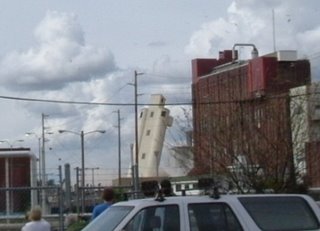 Surprise, I actually got it in a picture.
Two concrete towers were imploded this afternoon at the old Georgia Pacific West Pulp Mill. Part of a long term waterfront renovation process.
Bang, Bang, the towers came down and then a cloud of dust that was less impressive than I thought it would be.
I remember "boom, boom" when those towers were in use. Something like rail cars were filed with a material that would drop into the silos, which (I think) were actually giant kilns. This created a toxic sulfur substance that was then pumped into the digester building for cooking wood chips into paper pulp. Digester building is just to the right of where the two towers stood.
Residents of Bellingham would hear the booms when the material dropped into those kilns. It sounded like two rail cars coupling.
Now the towers are gone as our waterfront continues to evolve.
See More of my memories about GP.
Below picture, November 26, 2008.

Creating a blank slate.

It's been interesting to watch them dismantle and recycle most of the paper mill.
Recycled paper, recycled paper mill.
Some people still think it's quite a waste to build a mill and then tear it down.
The sidewalk along Chestnut Street as it crosses the railroad tracks down to Roeder Avenue is a good place to look out over what's happening down there.
Now that the tearing down of the paper mill is almost done, activity may be subdued for a while.


Written October 9, 2008
 Old Georgia Pacific paper mill being torn down. Image taken a few weeks back.
 Pulp mill closed several years ago, in part do to an electricity price bubble. Prices for power gradually go up in Pacific Northwest as population and economic growth means a lower percentage of our power can come from our cheap hydroelectric resource. The hydro electric resource is only so big. God didn't build us enough rivers.
Exasperating that problem was a "power panic bubble" of around 1999 and early 2000s. Enron was a big part of that. Prices spiked and then came down again.
Our economy has it's underlying problems such as limited supplies of energy and land. People often want to buy houses when they say, "no more land is being made." These problems are gradual, but on top of this situation comes speculation. Companies like Enron take advantage of this to fuel panic.
The bubbles and bursts become exaggerated and worse than the underlying situation.
Increasing cost of wood chips in this area was another reason cited for GP to close. Wood chips from forest lands were the raw material in the paper making process.
Those were the big picture, long term reasons for GP's demise, in my opinion, but there was also a big drama toward the end. A drama over the pulp mill's attempt to generate it's own power using portable diesel generators. This brought up air quality concerns. GP was located in the heart of Bellingham; practically downtown.
Picture isn't that good as my camera was starting to die. Sand got in the mechanism for adjusting focus and exposure. Time to get a new camera. Luckily digital cameras aren't that expensive and they keep improving.
GP used to get flack for using chlorine in the paper bleaching process. Some of that paper went to into photography. Most of it went to toilet paper, but pulp for photo grade paper was also made. Now days, digital cameras don't require all that paper and chemicals for developing the image. At least technology keeps moving forward.
Photo taken April 22, 2008
 Picture of ivy growing in the shape of a heart in Bellingham. On the side of the Old Granery Building, Bellingham Central Waterfront. Fate of that building is still to be determined as part of the old GP / Central Waterfront rehabilitation process.

Below photo taken February, 2012.
Slow process.
Trailer says "scrap it."
Next on the ever evolving list of old factory buildings to come down is the bleach plant. This process has been taking place for a few years.
While much of the mill site has been torn down, they plan to preserve a few buildings; including the tile tanks pictured here.
May 25, 2006.
 Surprise, I actually got it in a picture.
 Two concrete towers were imploded this afternoon at the old Georgia Pacific West Pulp Mill. Part of a long term waterfront renovation process.
Bang, Bang, the towers came down and then a cloud of dust that was less impressive than I thought it would be.
I remember "boom, boom" when those towers were in use. Something like rail cars were filed with a material that would drop into the silos, which (I think) were actually giant kilns. This created a toxic sulfur substance that was then pumped into the digester building for cooking wood chips into paper pulp. Digester building is just to the right of where the two towers stood.
Residents of Bellingham would hear the booms when the material dropped into those kilns. It sounded like two rail cars coupling.
Now the towers are gone as our waterfront continues to evolve.
See More of my memories about GP.
Not putting all eggs in retirement basket
Economic news keeps getting scarier, but local business is still strong, around here at least. My job is going strong.
Glad I've done a lot of bike trips and put energy into hobby interests over the years. Some people look forward to these things in retirement, but it's good to enjoy them during one's work life as well.
Who knows what retirement will bring. Maybe just more work life.
I figure, some of my retirement is already under my belt so to speak.
Right out of college, I worked part time for many years. Looked for full time, but the recession that climaxed in early 1980s was gaining ground. Full time wasn't easily available. Then an upstairs neighbor talked about the virtue of balance between work and play. Rather than working too hard and then burning out and going on disability, or something, she talked about finding the balance. Could mean working part time.
After hearing her advice, I didn't look that hard for full time.
Finally in more prosperous times, I got a full time custodial position, but the job is fairly laid back. Having a nice boos is important. Also the job is within an easy walk from the room I rent. It even has a small retirement plan that's invested conservatively.
Who knows what the future will bring, but the past and the present has been OK. I've tried not to worry about money too much.
Glad I've done a lot of bike trips and put energy into hobby interests over the years. Some people look forward to these things in retirement, but it's good to enjoy them during one's work life as well.
Who knows what retirement will bring. Maybe just more work life.
I figure, some of my retirement is already under my belt so to speak.
Right out of college, I worked part time for many years. Looked for full time, but the recession that climaxed in early 1980s was gaining ground. Full time wasn't easily available. Then an upstairs neighbor talked about the virtue of balance between work and play. Rather than working too hard and then burning out and going on disability, or something, she talked about finding the balance. Could mean working part time.
After hearing her advice, I didn't look that hard for full time.
Finally in more prosperous times, I got a full time custodial position, but the job is fairly laid back. Having a nice boos is important. Also the job is within an easy walk from the room I rent. It even has a small retirement plan that's invested conservatively.
Who knows what the future will bring, but the past and the present has been OK. I've tried not to worry about money too much.
Wednesday, October 08, 2008
Construction crane arrived
About a week or two ago, this big construction crane arrived in my neighborhood. Kind of reassuring to see it go up with all the dismal economic news around. In spite of the news, this towering crane is starting work. Building Walton Place. It will be a mixed income residential development with much of the funding, I think from HUD. Bellingham Housing Authority. I read, in an earlier article, that some units will be market priced while others will be below market for affordability. Mixed income.
HUD is part of the government and these days it can look like the government is the only game in town. Several other private high rise developments that were planned for Bellingham are now on hold or in foreclosure. I like density as opposed to single family or several acre plots that create sprawl. These big projects were designed for density, but the banking crisis got in the way. Still the HUD project is happening and it's crane was just set up. Crane is now towering over neighborhood and looks like its working.
Some thing's working at least.
Also, not far from there, work continues on the big new art and children's museum. Some of the funding for that comes from Bellingham Arts District. State funding. I think a certain percentage of sales tax diverted to the formation of a "culture district." Kind of an answer to something similar that built those big sports stadiums in Seattle. Like it our not, it's happening. It does look kind of neat. A "curve wall" is taking shape.
We're getting a new plaza downtown as well. There was once a turn lane at Holly and Bay Streets. Traffic whipped around that corner in an alienating way. Zoom, zoom.
Now the lane is being torn out and traffic will have to stop at light rather than making the cheating right turn. A little plaza is going where that lane was. Not far from the American Museum of Radio and Electricity. It will make a nice little space. They will even be able to dim some streetlights for things like slide shows.
Little by little, the pieces of "blue state" are coming in. Maybe it isn't all blue state. I know people often grumble. They say the business of our city is government. Well, government is a driving force in the economy.
On the national level, government also seems to be the banker of last resort.
I guess government is always an important part of the equation. Not the only part, but these days, it's reassuring to see the government is still working. Or at least that's where much of the construction around downtown is coming from.
Oh, I forgot, there's a new bank going in also. Key Bank at corner of Holly and State. Lot sat empty for a while. I was wondering if plans were scuttled in banking mess, but no. Construction of the new Key Bank has finally begun.
HUD is part of the government and these days it can look like the government is the only game in town. Several other private high rise developments that were planned for Bellingham are now on hold or in foreclosure. I like density as opposed to single family or several acre plots that create sprawl. These big projects were designed for density, but the banking crisis got in the way. Still the HUD project is happening and it's crane was just set up. Crane is now towering over neighborhood and looks like its working.
Some thing's working at least.
Also, not far from there, work continues on the big new art and children's museum. Some of the funding for that comes from Bellingham Arts District. State funding. I think a certain percentage of sales tax diverted to the formation of a "culture district." Kind of an answer to something similar that built those big sports stadiums in Seattle. Like it our not, it's happening. It does look kind of neat. A "curve wall" is taking shape.
We're getting a new plaza downtown as well. There was once a turn lane at Holly and Bay Streets. Traffic whipped around that corner in an alienating way. Zoom, zoom.
Now the lane is being torn out and traffic will have to stop at light rather than making the cheating right turn. A little plaza is going where that lane was. Not far from the American Museum of Radio and Electricity. It will make a nice little space. They will even be able to dim some streetlights for things like slide shows.
Little by little, the pieces of "blue state" are coming in. Maybe it isn't all blue state. I know people often grumble. They say the business of our city is government. Well, government is a driving force in the economy.
On the national level, government also seems to be the banker of last resort.
I guess government is always an important part of the equation. Not the only part, but these days, it's reassuring to see the government is still working. Or at least that's where much of the construction around downtown is coming from.
Oh, I forgot, there's a new bank going in also. Key Bank at corner of Holly and State. Lot sat empty for a while. I was wondering if plans were scuttled in banking mess, but no. Construction of the new Key Bank has finally begun.
Tuesday, October 07, 2008
Capital Gains tax cuts can create the economic equivalent of run away generator
I hear that old power plants used to experience something called "run away generator" at times. When several generators were in a power grid, one might start functioning like a motor, rather than a generator. A motor without a governor to keep it from spinning too fast. The generator would go so fast that it would fall apart, basically. There may be more safeguards against this phenomenon happening now.
Our economy could be seen in the same way. Cuts in capital gains taxes that allow such things as huge profits from selling a home can fuel bubbles such as the recent real estate bubble that's now bursting.
Many Republicans and even a few Democrats will say tax cuts are good to speed up the economy. They even argue that total tax revenue collected can increase in spite of the tax cut because of increased economic activity that would be taxed by the remaining taxes.
Revving up the economy, but can the economy go too fast?
Economic bubbles create problems as we are now experiencing.
Also one must consider environmental problems created by increased consumption.
Quality of life issues come to bare as well. As we speed the rat race up, our lives can become little more than keeping up with the Jones' in that frantic chase for goods and services.
Taxes are not only used to fund the government, they can also be seen as a needed breaking mechanism on economic growth. Like run away generators, a run away economy can cause problems.
Our economy could be seen in the same way. Cuts in capital gains taxes that allow such things as huge profits from selling a home can fuel bubbles such as the recent real estate bubble that's now bursting.
Many Republicans and even a few Democrats will say tax cuts are good to speed up the economy. They even argue that total tax revenue collected can increase in spite of the tax cut because of increased economic activity that would be taxed by the remaining taxes.
Revving up the economy, but can the economy go too fast?
Economic bubbles create problems as we are now experiencing.
Also one must consider environmental problems created by increased consumption.
Quality of life issues come to bare as well. As we speed the rat race up, our lives can become little more than keeping up with the Jones' in that frantic chase for goods and services.
Taxes are not only used to fund the government, they can also be seen as a needed breaking mechanism on economic growth. Like run away generators, a run away economy can cause problems.
Monday, October 06, 2008
Other lifestyles, better than home ownership fad
Blame it on Community Reinvestment Act?
Some conservatives will blame this housing bubble/crisis on government policies that pressured banks into loaning money to "marginal people." Folks with poor credit, spotty work history, various cultural and lifestyle issues that make them riskier candidates for "life on the cul-da-sac with 2.1 kids, backyard barbecue and 2 cars in the garage."
There's some truth in that critique. Not everyone is cut out for the so called "American dream" when it has been narrowly defined in that way.
On the other hand, what are the alternatives?
There are plenty of alternatives, but these alternate paths have not gotten enough respect from mainstream thinking.
Remaining in an apartment is one alternative. It can be better, especially if one is single, doesn't have plans to raise a family and wants to be close to urban social life. How about the lifestyle of the so called "swinging single?"
In the same vain, how about a monastic lifestyle? Voluntary simplicity, living with less. Putting much of one's energy into volunteer work, or even meditation, rather than earning a fortune.
It's all valid, but there hasn't been much support in society, both from peer group pressure and government programs for living these alternatives. Home buyers get tax breaks while renters often just live in fear that their rents will go up in times of prosperity, pricing them out of any home.
Family values are often pushed on people. Everything from peer group pressure to eligibility for social services seems to look down on single folks. Also look down on non home owners. Social services will let someone keep equity, if it comes in the form of home ownership, but what if it comes in the form of savings? Spend all your savings before becoming eligible for, say, medical assistance.
To get into the housing ownership market, it often takes two or more incomes. Marriage, or at least being in a stable committed couple is advantageous.
What if one is not suited to be in a couple?
There are a lot of unstable marriages of convenience.
Some marriages work fine, but not everyone is cut out for that lifestyle.
People will often work more than one job, just so they can get into home ownership. They will commute longer distances to afford this as well.
Relax.
Maybe everyone isn't met to go down that path in life.
Ironically, the average American moves every few years. Maybe we would be better off if more of us embraced nomadic lifestyles.
Living in RVs? Some folks do it.
Living in a small apartment? A commune? A dorm room?
There are lots of alternative lifestyles besides everyone wanting to have that "white picket fence."
When too many people want something, the price goes up.
Government and public thinking needs to embrace more alternatives to the home and it's 2 car garage.
Some conservatives will blame this housing bubble/crisis on government policies that pressured banks into loaning money to "marginal people." Folks with poor credit, spotty work history, various cultural and lifestyle issues that make them riskier candidates for "life on the cul-da-sac with 2.1 kids, backyard barbecue and 2 cars in the garage."
There's some truth in that critique. Not everyone is cut out for the so called "American dream" when it has been narrowly defined in that way.
On the other hand, what are the alternatives?
There are plenty of alternatives, but these alternate paths have not gotten enough respect from mainstream thinking.
Remaining in an apartment is one alternative. It can be better, especially if one is single, doesn't have plans to raise a family and wants to be close to urban social life. How about the lifestyle of the so called "swinging single?"
In the same vain, how about a monastic lifestyle? Voluntary simplicity, living with less. Putting much of one's energy into volunteer work, or even meditation, rather than earning a fortune.
It's all valid, but there hasn't been much support in society, both from peer group pressure and government programs for living these alternatives. Home buyers get tax breaks while renters often just live in fear that their rents will go up in times of prosperity, pricing them out of any home.
Family values are often pushed on people. Everything from peer group pressure to eligibility for social services seems to look down on single folks. Also look down on non home owners. Social services will let someone keep equity, if it comes in the form of home ownership, but what if it comes in the form of savings? Spend all your savings before becoming eligible for, say, medical assistance.
To get into the housing ownership market, it often takes two or more incomes. Marriage, or at least being in a stable committed couple is advantageous.
What if one is not suited to be in a couple?
There are a lot of unstable marriages of convenience.
Some marriages work fine, but not everyone is cut out for that lifestyle.
People will often work more than one job, just so they can get into home ownership. They will commute longer distances to afford this as well.
Relax.
Maybe everyone isn't met to go down that path in life.
Ironically, the average American moves every few years. Maybe we would be better off if more of us embraced nomadic lifestyles.
Living in RVs? Some folks do it.
Living in a small apartment? A commune? A dorm room?
There are lots of alternative lifestyles besides everyone wanting to have that "white picket fence."
When too many people want something, the price goes up.
Government and public thinking needs to embrace more alternatives to the home and it's 2 car garage.
Friday, October 03, 2008
Summer conversation with the personal banker at my bank
Last summer, not that long ago, things were chugging along normally in the economy, if there's a normal.
I was quite fortunate to receive a chunk of money. Several thousand dollars.
It was a gift that was part of an estate sale. Gifts went to a wide variety of places. I got my part as a "thank you" for years of volunteer work revolving around my web site gaybellingham.org
Anyway, it was a nice gift. Not enough to buy a house / condo. Doghouse in this market.
Still a nice gift.
What to do with it?
Personal banker suggests putting it in the stock market. That bank also manages a portfolio of mutual funds.
Stocks, that's where it grows since interest rates are so low, regular bank accounts and money market funds offer little growth even though they have the safety of FDIC.
He said, "if you want to invest in the long run, buy stock funds."
I was leery, and also not sure what my goal was.
Maybe I should spend the money, rather than save it.
How about a super vacation bike trip across USA? Take leave of absence from my job. Spend the money on something meaningful, like a bike trip. What a way to remember my deceased acquaintance.
The banker smiled and said, "That sounds like a lot of fun." "Then an FDIC account is a good place to park money for the short term, in spite of low interest." "Send me a postcard."
I parked the money, but didn't do that big trip after all. Not this year at least for various reasons. I did do some smaller trips, but the money is still saved. A nice, "rainy day fund."
Well, not long after that conversation, the stock market lost lots of money.
I'm glad I didn't invest that money in the stock market just before the crash.
Just thinking about going on a bike trip, thinking about spending, rather than investing the money, saved me quite a bit of money; ironically.
I was quite fortunate to receive a chunk of money. Several thousand dollars.
It was a gift that was part of an estate sale. Gifts went to a wide variety of places. I got my part as a "thank you" for years of volunteer work revolving around my web site gaybellingham.org
Anyway, it was a nice gift. Not enough to buy a house / condo. Doghouse in this market.
Still a nice gift.
What to do with it?
Personal banker suggests putting it in the stock market. That bank also manages a portfolio of mutual funds.
Stocks, that's where it grows since interest rates are so low, regular bank accounts and money market funds offer little growth even though they have the safety of FDIC.
He said, "if you want to invest in the long run, buy stock funds."
I was leery, and also not sure what my goal was.
Maybe I should spend the money, rather than save it.
How about a super vacation bike trip across USA? Take leave of absence from my job. Spend the money on something meaningful, like a bike trip. What a way to remember my deceased acquaintance.
The banker smiled and said, "That sounds like a lot of fun." "Then an FDIC account is a good place to park money for the short term, in spite of low interest." "Send me a postcard."
I parked the money, but didn't do that big trip after all. Not this year at least for various reasons. I did do some smaller trips, but the money is still saved. A nice, "rainy day fund."
Well, not long after that conversation, the stock market lost lots of money.
I'm glad I didn't invest that money in the stock market just before the crash.
Just thinking about going on a bike trip, thinking about spending, rather than investing the money, saved me quite a bit of money; ironically.
Sunday, September 28, 2008
Fiscal conservatism died a long time ago
Add "bank bailout" to the long list of things the Federal Government can't afford, but supposedly can't afford NOT to do either.
Add this on top of hurricane relief, veteran's benefits, military and security needs and interest on the debt. The list goes on and on.
Government is essential, I guess.
Hope there's still money for affordable housing, medical care, rebuilding America's infrastructure, dealing with climate change, clean energy, Social Security for post war baby boom generation and beyond plus other unforeseen crisis's the future will toss our way.
Private enterprise can do a lot of these things, but it seems like the private sector's track record isn't as good as it should be. Government is where people turn for solutions regardless of whether it's Republicans or Democrats in control.
Bush is often accused of "spending like a drunken sailor," but does he have any other choice?
Hope they don't cut something I might need in the future, like affordable housing or health care.
At the Federal level, they do have the printing presses for creating money. Our Federal Reserve can print up money, I guess. This leads to inflation, but inflation may be the least painful outcome. Budget slashing can be scary.
Of course the right wing does not have a monopoly on budget cutting ideas. The left can propose budget cuts also.
How about an end to enforcement of drug laws? Save money on incarceration and enforcement.
I'm not necessarily advocating these "radical" solutions, myself, though they might be good ideas. This is just for the discussion.
Political left has some budget cutting proposals that would make other folks nervous, for sure.
Slash the military, pull out of Iraq right away, layoff border guards, dismantle homeland security, end the war on drugs. These are examples of potentially scary budget cutting thoughts on the left. Also most libertarians, on the right or left, will think this way.
State Governments
At the state level, here in Washington State, budget making has a somewhat different dynamic. The state must balance it's budget, I guess because it doesn't own money printing presses; unlike the Feds. Our state constitution requires a balanced budget.
Luckier than most states, we still have a fiscal surplus, here in Washington State, but that enviable situation is ending quickly. If all continues statuesque, there is a projected 3 billion dollar deficit for Washington State government in the near future.
Budget balancing strategies are entering our governor's race.
Republican Dino Rossi is running for governor. Rossi has an ad out on the radio saying he will go through the budget line by line and find the fat. Then he promises not to touch education funding. Well, education is nearly 60% of state budget. I'm sure there is as much fat in education as there is in other parts of state budget.
You can't really cut a budget very effectively by taking most of the budget off the table.
Both with state and federal governments, people want and need the spending.
I guess it's hard to find stuff that isn't "high priority" for large segments of the population. Your retirement and money in the bank, for instance.
Add this on top of hurricane relief, veteran's benefits, military and security needs and interest on the debt. The list goes on and on.
Government is essential, I guess.
Hope there's still money for affordable housing, medical care, rebuilding America's infrastructure, dealing with climate change, clean energy, Social Security for post war baby boom generation and beyond plus other unforeseen crisis's the future will toss our way.
Private enterprise can do a lot of these things, but it seems like the private sector's track record isn't as good as it should be. Government is where people turn for solutions regardless of whether it's Republicans or Democrats in control.
Bush is often accused of "spending like a drunken sailor," but does he have any other choice?
Hope they don't cut something I might need in the future, like affordable housing or health care.
At the Federal level, they do have the printing presses for creating money. Our Federal Reserve can print up money, I guess. This leads to inflation, but inflation may be the least painful outcome. Budget slashing can be scary.
Of course the right wing does not have a monopoly on budget cutting ideas. The left can propose budget cuts also.
How about an end to enforcement of drug laws? Save money on incarceration and enforcement.
I'm not necessarily advocating these "radical" solutions, myself, though they might be good ideas. This is just for the discussion.
Political left has some budget cutting proposals that would make other folks nervous, for sure.
Slash the military, pull out of Iraq right away, layoff border guards, dismantle homeland security, end the war on drugs. These are examples of potentially scary budget cutting thoughts on the left. Also most libertarians, on the right or left, will think this way.
State Governments
At the state level, here in Washington State, budget making has a somewhat different dynamic. The state must balance it's budget, I guess because it doesn't own money printing presses; unlike the Feds. Our state constitution requires a balanced budget.
Luckier than most states, we still have a fiscal surplus, here in Washington State, but that enviable situation is ending quickly. If all continues statuesque, there is a projected 3 billion dollar deficit for Washington State government in the near future.
Budget balancing strategies are entering our governor's race.
Republican Dino Rossi is running for governor. Rossi has an ad out on the radio saying he will go through the budget line by line and find the fat. Then he promises not to touch education funding. Well, education is nearly 60% of state budget. I'm sure there is as much fat in education as there is in other parts of state budget.
You can't really cut a budget very effectively by taking most of the budget off the table.
Both with state and federal governments, people want and need the spending.
I guess it's hard to find stuff that isn't "high priority" for large segments of the population. Your retirement and money in the bank, for instance.
Tuesday, September 23, 2008
Two factors that led to the housing bubble now bursting
Factor 1. Low interest rates, irresponsible lending practices that made it look like more money was available for home purchasing than the regular economy of jobs, products and services could support.
Factor 2. Basic population growth versus supply of land. Growth versus protecting the environment. Supply and demand of build able lots is an aspect of this issue.
Both factors caused home values and prices to go beyond what our economy can sustain.
When people have to use more than 1/3rd of their income just to pay the rent, or mortgage, watch out. We've got economic problems.
Factor 1, the banking issue is a morass. Many are writing about it so my thoughts are just more for the pile. Here's my two bits.
If the bailout happens, I think the Federal Reserve will eventually be forced into printing lots of money to avoid default on the Federal debt. This will likely lead to strong inflation in which the economy of wages, goods and services will inflate and eventually catch up with high housing costs. Eventually a balance of sorts might be restored to the economy. Yes, inflation could bring us back into balance. Higher wages for workers, but also higher prices for lots of things outside the housing sector.
One of the problems of the past few years has been inflation in certain sectors of the economy, such as health care and housing, which have outpaced wages and other sectors of the economy. Remember, there are some sectors of the economy where prices have even been dropping. Think digital cameras.
Now think journalism. Professions such as journalism are now being largely turned over to things like "crowd sourcing."
Think "outsourcing" also.
As for factor 2, demand and supply of build able lots versus population growth, there are many solutions here which I have written about in past blog entries.
Reducing Population growth for instance. Also we need to increase the density of zoning, allowing more mixed income neighborhoods and other things to improve planning. We need to better accommodate the population that's here now and the projected population growth that's already in the pipeline.
Basically, we need planning and lifestyles for a more sustainable society.
Factor 2. Basic population growth versus supply of land. Growth versus protecting the environment. Supply and demand of build able lots is an aspect of this issue.
Both factors caused home values and prices to go beyond what our economy can sustain.
When people have to use more than 1/3rd of their income just to pay the rent, or mortgage, watch out. We've got economic problems.
Factor 1, the banking issue is a morass. Many are writing about it so my thoughts are just more for the pile. Here's my two bits.
If the bailout happens, I think the Federal Reserve will eventually be forced into printing lots of money to avoid default on the Federal debt. This will likely lead to strong inflation in which the economy of wages, goods and services will inflate and eventually catch up with high housing costs. Eventually a balance of sorts might be restored to the economy. Yes, inflation could bring us back into balance. Higher wages for workers, but also higher prices for lots of things outside the housing sector.
One of the problems of the past few years has been inflation in certain sectors of the economy, such as health care and housing, which have outpaced wages and other sectors of the economy. Remember, there are some sectors of the economy where prices have even been dropping. Think digital cameras.
Now think journalism. Professions such as journalism are now being largely turned over to things like "crowd sourcing."
Think "outsourcing" also.
As for factor 2, demand and supply of build able lots versus population growth, there are many solutions here which I have written about in past blog entries.
Reducing Population growth for instance. Also we need to increase the density of zoning, allowing more mixed income neighborhoods and other things to improve planning. We need to better accommodate the population that's here now and the projected population growth that's already in the pipeline.
Basically, we need planning and lifestyles for a more sustainable society.
Monday, September 22, 2008
I just got back from the future
Something like the future we could have if we had the political will. Vancouver public transit Skytrain gliding over the traffic of surface streets. Kind of reminds me of 1960s images from "city of the future" with monorails snaking past mushroom shaped buildings.
I'm now back from my bicycle tour around to interesting things in this greater Northwest Washington, lower BC region. Parked my bike in a motel and took the Skytrain a few times.
I've thought of getting a shirt to wear when I'm bicycling that says, "my other vehicle is the Skytrain." Then folks might think I'm Canadian. I just live close to our peaceful border. Really, here in USA, we could do it also.
If you really want a great video showing how it works with some behind the scenes stuff, check out This great video I just discovered from MetroVancouver.
I also rode some regular buses and saw GPS at work. A sign at the front of the bus tells what street the bus is crossing and which stop is coming next. This info can likely be sent to cellphones so folks waiting at bus stops can learn where the bus they are waiting for is.
Global positioning technology. Amazing.
Gruesome economic cartoon idea
As the elderly post war baby boomer is hobbling off to the nursing home, Chinese debt masters close nursing home demanding repayment of national debt.
Sort of like future USA crippled and old will not be in any position to pay back all this debt. Young folks might rebel and just refuse to.
During the Reagan years, people said the debt was so bad then that kids would be saddled with huge debt. Now those kids are adults and they aren't having to pay off the debt. Maybe it can just keep being pushed into the future till it melts away in some kind of magical paradigm shift.
Sort of like future USA crippled and old will not be in any position to pay back all this debt. Young folks might rebel and just refuse to.
During the Reagan years, people said the debt was so bad then that kids would be saddled with huge debt. Now those kids are adults and they aren't having to pay off the debt. Maybe it can just keep being pushed into the future till it melts away in some kind of magical paradigm shift.
Friday, September 19, 2008
Hoard your health instead of food. Before we starve medical care may run out first
Quite a few people are saying, "hoard food now, the financial meltdown is coming."
Well, I don't think it's quite that dire. Food is still pretty affordable and available for most people here in USA. Hoarding one's health, if you've still got it, is more to the point.
Health care is really expensive. Will we be able to pay for health care in the future? Will we be able to pay, especially with these mounting federal deficits?
The prospect for ever paying down the debt gets lower as we head into the future and postwar baby boom generation ages. Governments will just have to keep spending more and more for health care, social security and so forth. Wonder if it can be done?
Hang onto your health, you may need it. Ride your bike. It's likely to be more imperative than hoarding cans of food.
If your health is already gone, I hope for the best. Maybe they'll (or we'll) figure a way out of this "over consuming, financial instability, global warming, economic obesity" morass eventually.
Well, I don't think it's quite that dire. Food is still pretty affordable and available for most people here in USA. Hoarding one's health, if you've still got it, is more to the point.
Health care is really expensive. Will we be able to pay for health care in the future? Will we be able to pay, especially with these mounting federal deficits?
The prospect for ever paying down the debt gets lower as we head into the future and postwar baby boom generation ages. Governments will just have to keep spending more and more for health care, social security and so forth. Wonder if it can be done?
Hang onto your health, you may need it. Ride your bike. It's likely to be more imperative than hoarding cans of food.
If your health is already gone, I hope for the best. Maybe they'll (or we'll) figure a way out of this "over consuming, financial instability, global warming, economic obesity" morass eventually.
What happens when the whole economy does debt consolidation?
These bad private debts are now being consolidated into one place; the federal debt. It's like paying off a bunch of credit cards with one super loan from some credit card counseling agency. Debt consolidation.
When the federal government bails out all these banks, insurance companies, bad home loans and so forth, people say the taxpayers are picking up the tab. Actually the tab is being added to the federal deficit, rather than being picked up by taxpayers. Unless taxes increase, or increased economic activity leads to growing revenue collection, new spending and risk just gets added to the federal debt. Taxpayers are not likely to see it in next year's taxes, for instance.
What happens when this is all added to the debt? Will that debt ever need to be paid back?
Good questions.
Except for some brief periods when there was a slight federal surplus, we never even start paying off that debt.
We had federal budget surpluses one year under the Johnson administration during the 1960s, if I remember correctly, and a few years under the Clinton administration.
Both Johnson and Clinton were Democrats in the White house.
Most years, including some years that Democrats and all years that Republicans were in the White House, during my lifetime, the debt keeps piling higher.
When Clinton ran a surplus and paid down a tiny fraction of the accumulated debt, I thought, "this is a rare and fragile situation." It didn't last long.
Now, consolidating so much of this private debt under the "one roof" of federal debt is uncharted territory. The deficit is likely to balloon even faster.
What happens when people realize that it may never be paid back?
Who knows.
Now might be a good time to try and not think about money and material wealth too much. There are other aspects to life than our culture's obsession with material wealth.
About now, right before it looks like we're falling over the precipice, Garrison Keillor from A Prairie Home Companion might transition us to "it's time for some Beebop Areebop A Rhubarb Pie." Or maybe it's catsup. Yes, catsup comes to the rescue with it's mellowing agents.
When the federal government bails out all these banks, insurance companies, bad home loans and so forth, people say the taxpayers are picking up the tab. Actually the tab is being added to the federal deficit, rather than being picked up by taxpayers. Unless taxes increase, or increased economic activity leads to growing revenue collection, new spending and risk just gets added to the federal debt. Taxpayers are not likely to see it in next year's taxes, for instance.
What happens when this is all added to the debt? Will that debt ever need to be paid back?
Good questions.
Except for some brief periods when there was a slight federal surplus, we never even start paying off that debt.
We had federal budget surpluses one year under the Johnson administration during the 1960s, if I remember correctly, and a few years under the Clinton administration.
Both Johnson and Clinton were Democrats in the White house.
Most years, including some years that Democrats and all years that Republicans were in the White House, during my lifetime, the debt keeps piling higher.
When Clinton ran a surplus and paid down a tiny fraction of the accumulated debt, I thought, "this is a rare and fragile situation." It didn't last long.
Now, consolidating so much of this private debt under the "one roof" of federal debt is uncharted territory. The deficit is likely to balloon even faster.
What happens when people realize that it may never be paid back?
Who knows.
Now might be a good time to try and not think about money and material wealth too much. There are other aspects to life than our culture's obsession with material wealth.
About now, right before it looks like we're falling over the precipice, Garrison Keillor from A Prairie Home Companion might transition us to "it's time for some Beebop Areebop A Rhubarb Pie." Or maybe it's catsup. Yes, catsup comes to the rescue with it's mellowing agents.
Thursday, September 18, 2008
One thing politicians are not likely to say about the housing bubble
We've heard a lot about irresponsible bankers making fortunes running their companies into the ground.
It's true, but there's also a lot of ordinary people who have made out well from rising real estate prices in recent years. School teachers, police officers, factory workers. If you bought your house when the buying was good and sold after hefty appreciation, you made out like bandits.
Politicians wouldn't implicate ordinary folks since they want their votes and there are a lot more ordinary folks than Wall Street brokers.
Selling a house at the right time has met a lot of early retirements, trips abroad, SUVs, furnishings, fine wines and meals, you name it. Life has been pretty lucrative for a large chunk of middle income Americans.
I don't have the figures, but I wouldn't be surprised if it was a good 25 percent of the population living high on the hog. On my bike tours, I notice the big homes, the nice yards, the businesses that cater to luxuries from salons for your pouch to fine coffees.
Even seemingly ordinary people need to consider how sustainable the lifestyles that folks take for granted are.
While many on the good side of the real estate boom have done well, sold at the right time, retired early and so forth. Others have not done so well.
As the escalator of living went up for many, another huge chunk of our general population found things increasingly difficult. Trying to find a job that paid enough to get into that first home, having health insurance, making ends meet. Possibly this group of have-nots is another 25 percent of the population.
Now it looks like enough people are at the bottom, having trouble getting onto the escalator that the whole thing is jamming up. Some banks tried to make it look easier for these marginal people with no money down offers and so forth. These banks are now finding a lot of folks defaulting.
I still hear radio ads for mortgage stuff. Often the ads start with the phrase "homeowners." Being a renter, I tune out. Figure it doesn't apply to me.
Then there's those "lucky" homeowners who took too much cash out of their perceived fortunes. Home equity loans for joys, but also the things life throws at you. Medical expenses and our nation's lack of a good safety net. Divorce comes up, just when you think you've had it made and the house is paid off. Life has it's twists and turns.
More folks get stuck at the bottom of the escalator and eventually the whole thing grinds to a halt.
It's true, but there's also a lot of ordinary people who have made out well from rising real estate prices in recent years. School teachers, police officers, factory workers. If you bought your house when the buying was good and sold after hefty appreciation, you made out like bandits.
Politicians wouldn't implicate ordinary folks since they want their votes and there are a lot more ordinary folks than Wall Street brokers.
Selling a house at the right time has met a lot of early retirements, trips abroad, SUVs, furnishings, fine wines and meals, you name it. Life has been pretty lucrative for a large chunk of middle income Americans.
I don't have the figures, but I wouldn't be surprised if it was a good 25 percent of the population living high on the hog. On my bike tours, I notice the big homes, the nice yards, the businesses that cater to luxuries from salons for your pouch to fine coffees.
Even seemingly ordinary people need to consider how sustainable the lifestyles that folks take for granted are.
While many on the good side of the real estate boom have done well, sold at the right time, retired early and so forth. Others have not done so well.
As the escalator of living went up for many, another huge chunk of our general population found things increasingly difficult. Trying to find a job that paid enough to get into that first home, having health insurance, making ends meet. Possibly this group of have-nots is another 25 percent of the population.
Now it looks like enough people are at the bottom, having trouble getting onto the escalator that the whole thing is jamming up. Some banks tried to make it look easier for these marginal people with no money down offers and so forth. These banks are now finding a lot of folks defaulting.
I still hear radio ads for mortgage stuff. Often the ads start with the phrase "homeowners." Being a renter, I tune out. Figure it doesn't apply to me.
Then there's those "lucky" homeowners who took too much cash out of their perceived fortunes. Home equity loans for joys, but also the things life throws at you. Medical expenses and our nation's lack of a good safety net. Divorce comes up, just when you think you've had it made and the house is paid off. Life has it's twists and turns.
More folks get stuck at the bottom of the escalator and eventually the whole thing grinds to a halt.
Tuesday, September 16, 2008
Summer 2008 only comes once
 Taking Blackball Ferry from Port Angeles, WA. to Victoria, BC.
Decided to head back toward central city of Vancouver for one more sightseeing day.
Picture taken at downtown public library.
My ride in from Abbotsford was good along shoulder of Fraser Highway. Better than going east on north side of Fraser River where there was construction and so forth. North side gets better farther east past Mission, as I remember from an earlier trip.
South side of river is OK as much of the traffic "rat race" can use Trans Canada Highway rather than Fraser Highway.
More highway choices on south side of river.
I was thinking of coming back to Bellingham a day early, but missed my turn south to the border at Aldergrove. Also thought one more day in Canada would be fun. Motel in Surrey and Skytrain back to downtown Vancouver.
I had another dream that encouraged me to continue my trip. Dream was about stopping into my place of work and discovering I was needed back at work earlier than expected. Our vacation fill-in help must have miss read the calendar in my dream. They left earlier than planned.
While my boss was trying to explain this to me, several other people were talking to him all at once. He was also trying to serve whole wheat bread from a vendor's cart in the lobby. Doing this while running all over the building troubleshooting maintenance things. People were lining up at the cart waiting for their bread while he was needed upstairs to fix pluming problems. His skin looked mighty wrinkled.
I'm glad that was just a dream and when I do go back to work, it shouldn't be that hectic; hopefully.
Is the ownership society sustainable?
As more financial institutions falter, here is a factor to keep in mind.
I keep hearing that the median wage is not enough to qualify for a mortgage to buy the median priced house. That's true in so many regions.
When people can't afford home ownership and at the same time home ownership is being held up as a holy grail of life, "ownership society," there is a disconnect.
In trying to afford homes via fancy financing from unregulated banks, rather than wages and house values in better balance, we get the default situation being faced today.
We need less emphasis on home ownership as the holy grail of living, or we will need to inflate the rest of the economy to catch everything from wages to candy bars up with home values.
$10 candy bars?
Either people stretch too far and buy, or have to give up that dream.
What we need is a more sustainable dream than buying over our means.
Less expensive housing, like mobile home courts for instance, Smaller houses and more apartment living may be in the future.
Is it a sacrifice, or maybe just making things more convenient? Maybe it's better.
My bike touring version of "American Dream" is now visiting Canada. Might not be that sustainable either. Exploring around Vancouver has meant some motel stays for me. More expensive than camping.
Now I am out east of Vancouver in the sprawl around Abbotsford. Yes, Canada has sprawl too, but maybe not as much as Washington State.
Single family homes all spread out. Narrow rural roads crammed with traffic. I'm confined to bigger highways that have shoulder, but "gritty" along side all those noisy dusty trucks. Not a lot to see except mountains and farms in the distance.
Time to head back. The camping is still too far out and the riding is a bit boring. Heading back into beautiful central city Vancouver would be better scenery, but more motel stays. I have to think about what's sustainable for my bank account also.
The city is pretty, but more of the outskirts need to be like the city. The city is rare, making it more expensive. People pay a high price for convenience, yet most of the sprawl around large cities doesn't build for convenience. Convenience needs to be more common and affordable. They should build the outlying areas with more density and smaller homes. A more sustainable version of of both the American and Canadian dreams.
Out here in the sprawl, it's still too urban for camping, but still too rural for convenience. Motels near attractions like Midas Muffler shop. Wow. The worst of both city and country?
I keep hearing that the median wage is not enough to qualify for a mortgage to buy the median priced house. That's true in so many regions.
When people can't afford home ownership and at the same time home ownership is being held up as a holy grail of life, "ownership society," there is a disconnect.
In trying to afford homes via fancy financing from unregulated banks, rather than wages and house values in better balance, we get the default situation being faced today.
We need less emphasis on home ownership as the holy grail of living, or we will need to inflate the rest of the economy to catch everything from wages to candy bars up with home values.
$10 candy bars?
Either people stretch too far and buy, or have to give up that dream.
What we need is a more sustainable dream than buying over our means.
Less expensive housing, like mobile home courts for instance, Smaller houses and more apartment living may be in the future.
Is it a sacrifice, or maybe just making things more convenient? Maybe it's better.
My bike touring version of "American Dream" is now visiting Canada. Might not be that sustainable either. Exploring around Vancouver has meant some motel stays for me. More expensive than camping.
Now I am out east of Vancouver in the sprawl around Abbotsford. Yes, Canada has sprawl too, but maybe not as much as Washington State.
Single family homes all spread out. Narrow rural roads crammed with traffic. I'm confined to bigger highways that have shoulder, but "gritty" along side all those noisy dusty trucks. Not a lot to see except mountains and farms in the distance.
Time to head back. The camping is still too far out and the riding is a bit boring. Heading back into beautiful central city Vancouver would be better scenery, but more motel stays. I have to think about what's sustainable for my bank account also.
The city is pretty, but more of the outskirts need to be like the city. The city is rare, making it more expensive. People pay a high price for convenience, yet most of the sprawl around large cities doesn't build for convenience. Convenience needs to be more common and affordable. They should build the outlying areas with more density and smaller homes. A more sustainable version of of both the American and Canadian dreams.
Out here in the sprawl, it's still too urban for camping, but still too rural for convenience. Motels near attractions like Midas Muffler shop. Wow. The worst of both city and country?
Sunday, September 14, 2008


Wednesday, September 10, 2008
Back from the beach

Where others have come back from the beach and gutted fish, I've used Internet WIFI and dreamed about the Hadron Collider. More and more resorts are getting WIFI now.
This Asus PC has worked well and has been small enough for my bike pannier.
I'm using Linux.
Click on image to enlarge and see Google front page celebration of Hadron. Also see signs about proper etiquette for cleaning fish in the campground.

This bicycle trip has taken me to Pacific Ocean at Rialto Beach. Today is the much looked forward to start up Hadron collider in Europe. Exploring deeper into the nature of matter and the universe.
In 1999, I was passing through Wenatchee, WA. when the Chandra X-Ray satellite was launched.
2003 saw Spitzer Infrared Observatory launch while I was biking through Marin County, CA.
Exploration.
Last night, around the time of Hadron start up, I dreamed the collider was, for some reason, in Hope, BC. Now there is a big collider at UBC Campus in Vancouver, BC, but the Hadron isn't in the mountains around Hope. It's in Europe under parts of France and Switzerland.
In the dream, I met up with a bunch of other cyclists on the road. I kept talking about the Hadron so the cyclists I just met said, "we're close, let's all go there."
We went down the road and turned off to Hadron, near Hope, BC.
Remember, this is a dream.
Entering a building, there was a big reception lobby filled with tourists. Someone came out from a back office and started explaining things. Then he began berating us for ruining his busy day. He said he felt obligated to show us around.
We wondered what that was about as lobby was full of tourists who just dropped by. Remember, this is only a dream.
So we went outside and the nice day turned to a heavy rain. So heavy that we could see cars hydroplaning on the road and throwing up muddy water on the shoulder. Our stuff was drenched so we had to take refuge inside the lobby again to wait out the rain squall.
About then I woke up. Glad it was just a somewhat unpleasant dream.
Weather has been great on this trip. Sunny except for some overcast on the beach.
I am excitedly awaiting news of new discoveries at Hadron over the next years and no it's not in Hope, BC. where my dream took place. I'm not there either. Nothing wrong with Hope. I do plan to go back to Bellingham via Victoria and Vancouver, BC.
In 1989, I biked to Vancouver and went to an open house at the TRIUMF Particle Physics Lab. It was very interesting and the people were great. Not like my dream.
Monday, September 08, 2008
Along Olympic Discovery Trail

Old railroad bridges around Sequim, WA. Having a great time riding out toward Crescent Lake and possibly the Pacific. Then headed back to Bellingham later in the week via Victoria, BC and the Blackball Ferry from Port Angeles. Great sunny weather so far. Nice bicycling on these trails and roads.
Wednesday, September 03, 2008
Electric Transit

Windmill painted on side of Max Train as I passed by in another Max Train.
One of the goals of this summers travels was riding Portland's Max Train. Staying in a motel room in Portland, OR. I just took the Max out to Beaverton and back.
A driver ask, "where's your umbrella?" Portland was experiencing a shower. I said, "The train is my umbrella."

Sitting a short while in Beaverton waiting to pick up a new load of passengers. I just stayed on the train and headed back downtown.
The means of transit was the destination.
Stay tuned for more about this summer's travels via bicycle, train and so forth.
Subscribe to:
Posts (Atom)