Some people say that electric cars are just as bad, if not worse, than fossil fuel cars due to things like chemicals, mining and manufacturing. If that's the case, I would say we have to reduce the use of private cars altogether. Go to more walking, bicycling and public transit.
On the other hand, I think that electric cars are much better than fossil fuel cars. I wonder what motivates so much pushback against electric cars? Is it conservatives who just want to play the devil's advocate? As much of society is pushing toward electrification, there will be naysayers.
On the other hand, I do think there are big problems with a society so dependent on automobiles. Electrification does present some logistical challenges. Some of the worry about chemicals and batteries may have merit even though there are ways to address these issues.
People often say that reducing automobile dependency is impractical. I think we need to make changes on many fronts. Electrification and reducing automobile dependency.
If we listen to the naysayers, I guess there is nothing we can do.
If the battery is a big problem, we already have a solution. The trolley buses, in Seattle and other cities run directly from the power grid through overhead wires; no need for the onboard battery.
It's another argument for denser development to make transit lines more viable, plus smaller residences would cut down on heating and air conditioning demand as well as material consumption; no place to store too much junk at home.
Private cars might even be able to run on a system of trolley wires, or even getting their electricity from the road itself. If the battery is even that big of a problem, there are solutions, but we do need big changes in the way we plan our living arrangements.

Sunday, December 31, 2023

Tuesday, December 26, 2023


Things might be looking better for WSU Cougars.

Looks like WSU and Oregon State have won control of the former PAC 12 Confrerence; now the PAC 2 Conference. The courts have backed the two remaining schools right to decide what to do with the conference.
Little did I know that there's quite a bit of money in the old conference so that can play a role in the future of both teams as conferences are reconfigured. I was thinking that the debt run up by Cougar Football would really be hard to pay off. As I see it, that debt was run up as WSU was spending a lot of facilities, coaches and so forth to try and keep up with other schools in the PAC 12 Conference.
Now, with the demise of the PAC 12, WSU still has the debt, but little did I realize, there's also money in the PAC 12. Maybe the situation isn't so dire for WSU, but I don't know how that all connects. I'm just drawing connections in my mind. I hear little talk about the money in relation to WSU's debt, but I'm putting two and two together. I'm not sure how this all plays out.
There is lots of media coverage about this situation, but I haven't heard much talk connecting the money and the debt situation.
We'll just have to see what transpires. It looks like things might not be as dire for the Cougars as I had earlier thought.
Friday, December 22, 2023
How long will the next dark ages of human civilization last, if it happens at all? Hopefully less than a decade.
To many Republicans, it seems like the sanctity of life only applies before birth.
Meanwhile, after birth, the troubles of this world seem to be getting more and more overwhelming to just about everyone, regardless of political orientation.
The number of people seeking safety by crossing borders and the number of troubled people needing assistance, both here in USA and abroad, seems so overwhelming that there have been many recent radio interviews about "charity fatigue."
As for climate change, the last few decades have seen huge numbers of people in India, China and other places around the world, rise out of poverty. This has contributed to the rising carbon footprint. There are slightly over 8 billion people on the planet.
We can make it work better, but a good question is, "do we have the political will to create a sustainable world and maintain societies that are not too authoritarian?"
Reducing population growth and accepting alternative lifestyles can play an important role as mainstream population growth and addiction to wealth seem destine to conflict.
Alternative can be defined in many ways such as simpler lifestyles in terms of consumption. Another definition of "alternative" comes to mind regarding sexuality and family situations. Alternative is a broad topic and much needed in today's world.
If the world does teeter into another dark age, one possible silver lining is that modern dark ages can be short lived. Europe went through the holocaust in a matter of just a decade followed by a period of greater idealism.
I was born into that era of idealism as my first memories of news are out of the 1960s. Yes, the cold war worries and pollution worries were there, but most of the decades of my life have seen a great deal of peace activism, civil rights progress, scientific progress, talk of a more sustainable world and rising standards of living in many parts of the world.
My early childhood memories, about Europe, was the rise of the Beetles in UK. I was in 3rd grade when the Beetles were on Ed Sullivan. World War II seemed like it was long over by then.
Meanwhile, after birth, the troubles of this world seem to be getting more and more overwhelming to just about everyone, regardless of political orientation.
The number of people seeking safety by crossing borders and the number of troubled people needing assistance, both here in USA and abroad, seems so overwhelming that there have been many recent radio interviews about "charity fatigue."
As for climate change, the last few decades have seen huge numbers of people in India, China and other places around the world, rise out of poverty. This has contributed to the rising carbon footprint. There are slightly over 8 billion people on the planet.
We can make it work better, but a good question is, "do we have the political will to create a sustainable world and maintain societies that are not too authoritarian?"
Reducing population growth and accepting alternative lifestyles can play an important role as mainstream population growth and addiction to wealth seem destine to conflict.
Alternative can be defined in many ways such as simpler lifestyles in terms of consumption. Another definition of "alternative" comes to mind regarding sexuality and family situations. Alternative is a broad topic and much needed in today's world.
If the world does teeter into another dark age, one possible silver lining is that modern dark ages can be short lived. Europe went through the holocaust in a matter of just a decade followed by a period of greater idealism.
I was born into that era of idealism as my first memories of news are out of the 1960s. Yes, the cold war worries and pollution worries were there, but most of the decades of my life have seen a great deal of peace activism, civil rights progress, scientific progress, talk of a more sustainable world and rising standards of living in many parts of the world.
My early childhood memories, about Europe, was the rise of the Beetles in UK. I was in 3rd grade when the Beetles were on Ed Sullivan. World War II seemed like it was long over by then.
Sunday, December 17, 2023
It's better to decrease the birth rate than increase the death rate as the way to stabilize world population, but world cultures may be inadvertently choosing the latter.
One way to stabilize world population is to reduce the birthrate via better birth control and more liberal attitudes about sexual alternatives.
Another way is for the death rate to increase from famine, war, poverty and even genocide. The first way is more desirable.
Even a small amount of population growth could possibly still happen if our consumption of resources were sustainable for climate stability and so forth. This can be achieved with technological innovation as well as the type of economics that would promote less consumption. Quality of life can, conceivably, improve; depending on how people define quality of life.
A good question to ask, worldwide, is whether humanity has the political will to develop a sustainable world.
Another way is for the death rate to increase from famine, war, poverty and even genocide. The first way is more desirable.
Even a small amount of population growth could possibly still happen if our consumption of resources were sustainable for climate stability and so forth. This can be achieved with technological innovation as well as the type of economics that would promote less consumption. Quality of life can, conceivably, improve; depending on how people define quality of life.
A good question to ask, worldwide, is whether humanity has the political will to develop a sustainable world.
Thursday, December 14, 2023
When Joseph and Mary got to the border, there was no room at the inn. They regretted that they didn't use birth control.
Given population growth, migration, border issues and the Christmas season, these conflicting concepts come to mind when following the news. I don't draw cartoons well, but here is my attempt at a political collage.
 My thanks to Mark Allyn for helping me with the couple, could be Joseph and Mary. I'm really bad at drawing people.

Tuesday, December 12, 2023
If the world can comply with the COP28 goals is a more important factor than the level of the goals themselves.
Setting carbon emission goals at COP28 may matter less than whether we can follow those goals. The world usually seems put out more carbon that what the goals are set for anyway. If we can even stick to the goals, that would be an accomplishment. That will be the bigger story, in my opinion.
Monday, December 11, 2023
US produces lots of oil and natural gas. The problem is not that it's produced, the problem is that it's consumed.
Some countries think USA is hypocritical for seeking long term phase out of carbon in COP28 while US is the biggest oil and gas producer. Problem is US is, I think, the biggest oil consumer. I think consumption is more the problem than production.
We produce oil for ourselves and some of our natural gas goes to help Europe ween itself off of Russian gas. Our own oil production helps keep US gas prices from going so high that the cost of gasoline tank's Biden in the polls.
If Trump were to win, in 2024, I would guess he would go before the media and laughingly tear up any COP28 agreement in front of the cameras.
We produce oil for ourselves and some of our natural gas goes to help Europe ween itself off of Russian gas. Our own oil production helps keep US gas prices from going so high that the cost of gasoline tank's Biden in the polls.
If Trump were to win, in 2024, I would guess he would go before the media and laughingly tear up any COP28 agreement in front of the cameras.
Is there hate speech on college campuses? Could USA benefit from something like Canada's law against hate speech?
Those 3 college presidents called before Congress about anti anti sematic, pro genocide speech on their campuses were kind of stumbling around for answers in our nation of free speech.
In Canada, they have federal laws against something called "Hate Speech." Maybe we could consider learning how Canada deals with this sort of thing.
I'll admit I haven't been following this topic closely either in USA, or Canada, though I do follow Canadian media.
My memory for news can be fairly sharp. Canada's hate speech laws seem to be enforced very sparingly. Canada is also a nation that respects free speech, though they do have some kind of hate speech law that USA doesn't have. Such a law might be useful, though folks fear the slippery slope toward censorship.
I remember, back in the 1990s, there was an author named Salman Rushdie who got famous for writing a book related to Islam titled The Satanic Versus. The Iranian government put a bounty out for him and he had to go into hiding for years.
During that time, I remember that Canada's mechanism for enforcing rules against hate speech had his books temporarily pulled from circulation in Canada as they were seen as a possible violation of hate speech. The books were quickly put back on the shelves when it was determined that they did not violate Canada's hate speech law; if my memory is correct here.
On another note, if folks are mad at Israel, I would guess there is much more support for Israel's military among conservative Christians, in USA, than among Jewish people who are often critical of certain things about Israel.
In Canada, they have federal laws against something called "Hate Speech." Maybe we could consider learning how Canada deals with this sort of thing.
I'll admit I haven't been following this topic closely either in USA, or Canada, though I do follow Canadian media.
My memory for news can be fairly sharp. Canada's hate speech laws seem to be enforced very sparingly. Canada is also a nation that respects free speech, though they do have some kind of hate speech law that USA doesn't have. Such a law might be useful, though folks fear the slippery slope toward censorship.
I remember, back in the 1990s, there was an author named Salman Rushdie who got famous for writing a book related to Islam titled The Satanic Versus. The Iranian government put a bounty out for him and he had to go into hiding for years.
During that time, I remember that Canada's mechanism for enforcing rules against hate speech had his books temporarily pulled from circulation in Canada as they were seen as a possible violation of hate speech. The books were quickly put back on the shelves when it was determined that they did not violate Canada's hate speech law; if my memory is correct here.
On another note, if folks are mad at Israel, I would guess there is much more support for Israel's military among conservative Christians, in USA, than among Jewish people who are often critical of certain things about Israel.
Of all the emotions we have, whether sex or whatever, anger is, by far, the emotion that is on the shakiest ethical grounds.
Worth repeating. Of all the emotions we have, whether sex or whatever, I think anger is, by far, the emotion that is on the shakiest ethical grounds.
Wednesday, December 06, 2023
Even the Holy Land of the 3 major Abrahamic religions is full of holes; bullet holes and bomb craters.
A part of the Middle East is considered the Holy Land for the Abrahamic religions of Christianity, Islam and Judaism. Looking at the news, one can also call it the holy land as it's full of bullet holes.
Ever since my childhood, I've thought that the fundamental interpretations of Abrahamic religions were more dogmatic, out dated and rigid than most other religious traditions around the world. Some other religions seem more comfortable with modernity and science. Ironically, it's our western culture that has developed powerful technology and pretty much subdued the earth.
In the west, it seems like more and more people are adopting secularism to the point of not believing in any form of spirituality. That's not surprising, though it seems like that is a bleak way of thinking as well.
I like the idea of open minded thinking when it comes to questions of a spiritual nature. Even within the Abrahamic religions that so many westerners are used to; like comfort food, there can be open mindedness and less war like rigidity. Regardless of our religious traditions, or lack there of, we need to open ourselves to new ways of thinking.
Ever since my childhood, I've thought that the fundamental interpretations of Abrahamic religions were more dogmatic, out dated and rigid than most other religious traditions around the world. Some other religions seem more comfortable with modernity and science. Ironically, it's our western culture that has developed powerful technology and pretty much subdued the earth.
In the west, it seems like more and more people are adopting secularism to the point of not believing in any form of spirituality. That's not surprising, though it seems like that is a bleak way of thinking as well.
I like the idea of open minded thinking when it comes to questions of a spiritual nature. Even within the Abrahamic religions that so many westerners are used to; like comfort food, there can be open mindedness and less war like rigidity. Regardless of our religious traditions, or lack there of, we need to open ourselves to new ways of thinking.
Stable housing could provide a public that is more optimistic about the American economy.
With the US economy seeming to do well, many economists are scratching their heads as to why many people say we are in bad economic times and Biden's popularity is soft.
It might make a big difference if one has affordable housing or not. Many economists might be long term homeowners who have been somewhat sheltered from the spiraling cost of renting, or first time home purchase. This could skew their perception. The high cost leaves less money for other things like food which has also gone up in cost, but still not as much as housing. Maybe this situation is under the radar for most economists.
I heard some on NPR discussing this very situation today.
Where someone is in their lifespan can make a difference. Younger people often struggle more trying to rent or pay newer mortgages. This could mean that the voting trends, among younger people, are less predictable.
The millennial generation now struggling with young families and the cost of establishing a home, plus having to make payments on student debt again after pandemic relief may not be able to be counted on for Biden. Of course Trump is worse, but voter apathy sometimes determines an election.
It might make a big difference if one has affordable housing or not. Many economists might be long term homeowners who have been somewhat sheltered from the spiraling cost of renting, or first time home purchase. This could skew their perception. The high cost leaves less money for other things like food which has also gone up in cost, but still not as much as housing. Maybe this situation is under the radar for most economists.
I heard some on NPR discussing this very situation today.
Where someone is in their lifespan can make a difference. Younger people often struggle more trying to rent or pay newer mortgages. This could mean that the voting trends, among younger people, are less predictable.
The millennial generation now struggling with young families and the cost of establishing a home, plus having to make payments on student debt again after pandemic relief may not be able to be counted on for Biden. Of course Trump is worse, but voter apathy sometimes determines an election.
Empty land, absentee speculative landlords, homeless encampments near Walmart.
There has been quite a bit of worry about homeless encampments in downtown Bellingham, but I hear that, by far, the biggest and most crime ridden encampment is out by Walmart.
From what I hear, much of that encampment is on some parcels of private property and in at least one case, the owner was (so I hear) unresponsive to the city.
Private property can make it harder for police to enter without following more rules such as getting search warrants, I guess. Meanwhile the downtown encampments are small and mostly on public property. Police keep a good eye on things. There aren't even that many encampments.
Seems like some people hold onto empty property for speculation, or maybe even tax write off. When the land value is too high, the property can sit unused and attract problems.
On the radio, from San Francisco, I've heard someone suggest increasing taxes on land so private individuals cannot profit as much from speculation. This could drive down the value of vacant land which would make it easier to finance putting a building on that land, or finding other uses for the land.
High land values can stifle more responsible use of land.
I remember that my dad was a fan of an economist named John Galbraith, back in the 1970s. I think Galbraith suggested that land inside a city should not be owned, but instead leased. Buildings, homes and businesses could be privately owned, however. I think there is too much profit from vacant land speculation.
I've seen some posts on Reddit about Bellingham's encampment near Walmart. Some say it's the worst in Western Washington. I don't know, but that could be the case.
I'm sure Walmart and apartment building owners near there are not happy with it, but large areas of vacant, private land can be problematic.
I seldom go to that neighborhood anyway as it's quite a ways out north and not as pleasant for bicycling.
From what I hear, much of that encampment is on some parcels of private property and in at least one case, the owner was (so I hear) unresponsive to the city.
Private property can make it harder for police to enter without following more rules such as getting search warrants, I guess. Meanwhile the downtown encampments are small and mostly on public property. Police keep a good eye on things. There aren't even that many encampments.
Seems like some people hold onto empty property for speculation, or maybe even tax write off. When the land value is too high, the property can sit unused and attract problems.
On the radio, from San Francisco, I've heard someone suggest increasing taxes on land so private individuals cannot profit as much from speculation. This could drive down the value of vacant land which would make it easier to finance putting a building on that land, or finding other uses for the land.
High land values can stifle more responsible use of land.
I remember that my dad was a fan of an economist named John Galbraith, back in the 1970s. I think Galbraith suggested that land inside a city should not be owned, but instead leased. Buildings, homes and businesses could be privately owned, however. I think there is too much profit from vacant land speculation.
I've seen some posts on Reddit about Bellingham's encampment near Walmart. Some say it's the worst in Western Washington. I don't know, but that could be the case.
I'm sure Walmart and apartment building owners near there are not happy with it, but large areas of vacant, private land can be problematic.
I seldom go to that neighborhood anyway as it's quite a ways out north and not as pleasant for bicycling.
US Bank opens first LGBTQ+ flagship branch in Arizona
Coincidentally, US Bank is my bank. Good to see this. I've always thought US Bank was okay. Yes, it's a commercial bank, but I tend to be okay about institutions.
I resisted suggestions for changing over to a credit union during the Occupy Wall Street anger against banks. I had no reason to not like my bank though I have a story that got me to open an account at a credit union, one time.
I used to have a few ads on my website and one of the advertisers was overseas. At that time, US Bank did have a high service charge for depositing an international check so I opened an account at a credit union with a lower charge to deposit that check.
I transferred a bit of money to the credit union and just left it there for several years. Just before the Occupy Wall Street protests started, by coincidence, that credit union suggested I remove the mostly inactive account or face a service charge.
Wanting to simplify my life (I don't have lots of money) I consolidated back to US Bank. My overseas advertiser suggested I use Paypal to deposit overseas checks, so I got a Paypal account.
During the Occupy protests, some friends were suggesting I go to "credit union" versus "commercial bank," but I had just, sort of been ask politely, by that credit union, to close that account.
Basically I've seen no reason to change banks as I tend to be more okay about institutions versus the people; so to speak. One of my favorite concepts is, "We've met the enemy and the enemy is us."
Now I am pleased to read that US Bank is quite friendly to LGBTQ folks.
I resisted suggestions for changing over to a credit union during the Occupy Wall Street anger against banks. I had no reason to not like my bank though I have a story that got me to open an account at a credit union, one time.
I used to have a few ads on my website and one of the advertisers was overseas. At that time, US Bank did have a high service charge for depositing an international check so I opened an account at a credit union with a lower charge to deposit that check.
I transferred a bit of money to the credit union and just left it there for several years. Just before the Occupy Wall Street protests started, by coincidence, that credit union suggested I remove the mostly inactive account or face a service charge.
Wanting to simplify my life (I don't have lots of money) I consolidated back to US Bank. My overseas advertiser suggested I use Paypal to deposit overseas checks, so I got a Paypal account.
During the Occupy protests, some friends were suggesting I go to "credit union" versus "commercial bank," but I had just, sort of been ask politely, by that credit union, to close that account.
Basically I've seen no reason to change banks as I tend to be more okay about institutions versus the people; so to speak. One of my favorite concepts is, "We've met the enemy and the enemy is us."
Now I am pleased to read that US Bank is quite friendly to LGBTQ folks.
3 ways that population growth has a significant effect on climate change.
2 of the ways increase climate change while the third factor can reduce it.
#1 Population growth creates more consumers.
#2 More population can increase land values so people become more driven to work harder to afford a place to live. This can mean working more than one job, promoting more sales and consumption so the bills can be paid and so forth.
#3 Population growth can increase urban density, which might help reduce climate change. In denser developments, folks are less apt to drive cars, for instance due to traffic and difficulty in finding parking. Density can bring better public transit and more walkable, bike able neighborhoods. Density means more people living in shared buildings easier to heat and cool versus as many detached structures. Lots of other advantages of density including sewage disposal versus maintaining so many septic tanks. Density can help the environment, depending on how we plan for it.
#1 Population growth creates more consumers.
#2 More population can increase land values so people become more driven to work harder to afford a place to live. This can mean working more than one job, promoting more sales and consumption so the bills can be paid and so forth.
#3 Population growth can increase urban density, which might help reduce climate change. In denser developments, folks are less apt to drive cars, for instance due to traffic and difficulty in finding parking. Density can bring better public transit and more walkable, bike able neighborhoods. Density means more people living in shared buildings easier to heat and cool versus as many detached structures. Lots of other advantages of density including sewage disposal versus maintaining so many septic tanks. Density can help the environment, depending on how we plan for it.
The biggest case of buyer's remorse in US history. Musk's purchase of Twitter.
I would say that Musk's purchase of Twitter (now X) is the biggest case of buyer's remorse in American history.
A problem with Twitter is that it is too much about sound bytes brevity and speed. Not a good environment for nuance.
I've been somewhat of a fan of Space X and hope that Musk and the Twitter debacle didn't bring down Space X as well. Who knows. Space X has some good achievements, but there is also increasing worry about it's prolific launches and satellites interfering with astronomy.
I've been somewhat of a fan of Space X and hope that Musk and the Twitter debacle didn't bring down Space X as well. Who knows. Space X has some good achievements, but there is also increasing worry about it's prolific launches and satellites interfering with astronomy.
Saturday, December 02, 2023
A Libertarian, free market solution to paying for a college education. Instead of government Pell Grants, preform on Only Fans website and call it Porn Grants.
George Santos has been expelled from Congress for many reasons. One small reason was alleged use of campaign funds to buy from the the Only Fans website.
Eroticism is often sold by that site so it reminds me of a Libertarian, "free market" solution to paying for a college education. Sexy folks selling videos on Only Fans. It's likely already happening. Instead of calling this "Pell Grants," one can call it "Porn Grants."
Is that a Republican way to trim the budget?
Eroticism is often sold by that site so it reminds me of a Libertarian, "free market" solution to paying for a college education. Sexy folks selling videos on Only Fans. It's likely already happening. Instead of calling this "Pell Grants," one can call it "Porn Grants."
Is that a Republican way to trim the budget?
Sunday, November 26, 2023
The only part of modernity that some people like is prosperity, but the rest of modernity is needed.
There are quite a few folks around the world, as well as here in the US, who seem to dislike modernity except for only one thing; they like prosperity.
They may be suspicious of modern technology, or changing cultural and religious values, but they still strive to have prosperity. I like prosperity also, but the struggle for it can be a rat race made worse by the refusal to accept most modern technology and changing cultural values.
I'm somewhat of a minimalist, related to money and consumption, but I do like most of what's called modernity.
They may be suspicious of modern technology, or changing cultural and religious values, but they still strive to have prosperity. I like prosperity also, but the struggle for it can be a rat race made worse by the refusal to accept most modern technology and changing cultural values.
I'm somewhat of a minimalist, related to money and consumption, but I do like most of what's called modernity.
Saturday, November 25, 2023
Environmentalists may be framing the climate change issue the wrong way.
I keep hearing some conservatives say that climate change is no big deal as the earth has seen it before; like during the ice ages.
I think the environmental movement may have made a mistake in saying that we are "harming" earth as if earth wasn't harmed when the area we call Seattle was under a mile of ice.
Maybe we should discuss things in more human, economic centric terms. Do we want big climate changes today and in the next few decades as mortgages are due and businesses are signing long term leases?
If one owns property in Florida, do they want it under seawater before their 30 year mortgage is paid off? Insurance companies are already asking these questions and they are powerful voices in our economy.
The climate change, that we need to think about, is related to us and our time frames that aren't tens of thousands of years. Our time frames are more about the decades that businesses are signing long terms leases for. For instance a hotel, being built in an area of ski resorts, needs to ask, will that ski area still have snow while we still owe the mortgage?
Like it our not, we are human and economic centric in our thinking, but that can still be used as a motivation to think about what we are doing to the climate.
I think the environmental movement may have made a mistake in saying that we are "harming" earth as if earth wasn't harmed when the area we call Seattle was under a mile of ice.
Maybe we should discuss things in more human, economic centric terms. Do we want big climate changes today and in the next few decades as mortgages are due and businesses are signing long term leases?
If one owns property in Florida, do they want it under seawater before their 30 year mortgage is paid off? Insurance companies are already asking these questions and they are powerful voices in our economy.
The climate change, that we need to think about, is related to us and our time frames that aren't tens of thousands of years. Our time frames are more about the decades that businesses are signing long terms leases for. For instance a hotel, being built in an area of ski resorts, needs to ask, will that ski area still have snow while we still owe the mortgage?
Like it our not, we are human and economic centric in our thinking, but that can still be used as a motivation to think about what we are doing to the climate.
Tuesday, November 21, 2023
Should they raise user taxes on air travel to improve US air traffic control system? I would guess yes.

As for the national issue, they say our air traffic system is stretched nearly to the breaking point. As for the need for more money, a simple fix is to increase the user taxes that airlines and the flying public pay to run and expand the system. That could cut down on the growing demand addressing the problem that way. It could also help fund the staff and equipment needed to upgrade the system.
Cutting demand does mean disruption to some plans and local economies so it wouldn't happen without it's critics, but seems like the best way to go.
I've wondered how much the government subsidizes air travel, but tried to look that up and my eyes gloss over. Yes, it's complicated. I think most of the system is paid for by user taxes that airlines and the flying public pay, but some is subsidized; especially smaller airports to prop up more rural parts of the country where there is less "economy of scale."
Friday, November 17, 2023
Why, the purpose of the universe
I just heard about a book titled, "Why; the purpose of the universe." The author was interviewed on CKNW Radio, a talk station I sometimes listen to from Vancouver, BC.
Interesting. The book is about the middle ground between a universe designed by a god and a universe with basically no meaning. Both extremes are problematic and leave lots of questions; like "if the universe just happened, why are the forces of nature so carefully balanced so as to allow this type of complex universe?"
On the other hand, the designer that so many religions describe, seems unlikely as well; I'd add especially fundamentalist religions that claim they know, for sure, how that god works.
I've always thought there must be some middle ground. The interview didn't mention liberal religions, but I did grow up in a liberal church. As far as I know, the liberal church, I grew up in, doesn't claim to know all those answers either, but the questions are still out there and worth thinking about.
I find the idea of a meaningless universe pretty disturbing, but I also think that most people's opinions about "why the universe is here" are not supported by real evidence.
I think the idea of purpose, in the universe, is comforting and sets better with human psychology. Discarding it, all together, could lead to more despair and mental illness.
The interview was short, but thought provoking. I like thinking about these big topics.
I must admit I don't attend church services, but I still like what goes on in some churches. The main reason why I don't attend is the same reason I don't often go to movies, theater or other things where I'm just in an audience. I like interactivity, rather than sitting watching figures on a stage; my same feeling about sporting events.
I do like discussion groups and other community activities that often happen in churches as well as in other places.
Interesting. The book is about the middle ground between a universe designed by a god and a universe with basically no meaning. Both extremes are problematic and leave lots of questions; like "if the universe just happened, why are the forces of nature so carefully balanced so as to allow this type of complex universe?"
On the other hand, the designer that so many religions describe, seems unlikely as well; I'd add especially fundamentalist religions that claim they know, for sure, how that god works.
I've always thought there must be some middle ground. The interview didn't mention liberal religions, but I did grow up in a liberal church. As far as I know, the liberal church, I grew up in, doesn't claim to know all those answers either, but the questions are still out there and worth thinking about.
I find the idea of a meaningless universe pretty disturbing, but I also think that most people's opinions about "why the universe is here" are not supported by real evidence.
I think the idea of purpose, in the universe, is comforting and sets better with human psychology. Discarding it, all together, could lead to more despair and mental illness.
The interview was short, but thought provoking. I like thinking about these big topics.
I must admit I don't attend church services, but I still like what goes on in some churches. The main reason why I don't attend is the same reason I don't often go to movies, theater or other things where I'm just in an audience. I like interactivity, rather than sitting watching figures on a stage; my same feeling about sporting events.
I do like discussion groups and other community activities that often happen in churches as well as in other places.
Friday, November 10, 2023
My first time in San Francisco. Spring 1974.
A trip down memory lane. My first visit to San Francisco, Spring 1974; my freshman year in college at Bellingham. Judith (my sister who, back then lived in Bellingham) and I went to visit a brother Jack (back then a grad student at Stanford; Palo Alto area).
On our way to the Bellingham Greyhound Station (then on State Street) I gave a dollar (maybe a quarter back then) to a pan handler. My sister implied that giving to pan handlers could be overwhelming in the big city, but ironically that was the only pan handler who approached us, as I remember at least.
Most of our time was spent in Palo Alto area for the visit, but we planned a sightseeing trip to San Francisco; often affectionately called "The City." Photo from old postcard showing downtown and Trans America Pyramid.
I forgot how we got up there; maybe by car or transit.
During my childhood, San Francisco seemed like a dream city by the Golden Gate Bridge. Home of some powerful 50,000 watt radio stations that provided a slight connection between my hometown life in Pullman and that city by the bay.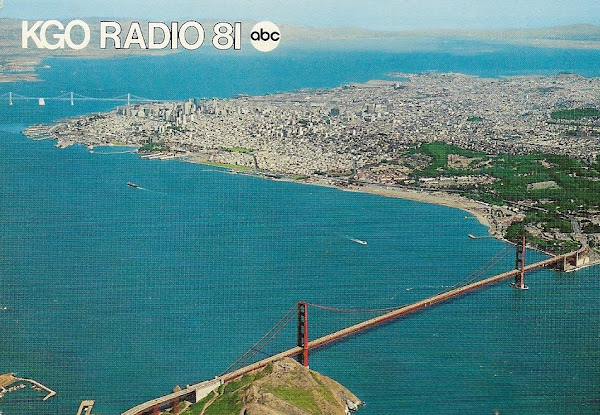 Old postcard from the 1970s. KGO is no longer a talk show station.
By the time I got to college, my view of that city became more tainted and a bit grimy, however. I had learned more about it's problems as well.
As I remember, we divided our sightseeing day into two parts. Morning at the De Young Museum and an afternoon of walking around looking at downtown buildings (my idea).
All I remember, from the museum, was some long lines, echoing spaces and lots of children on tour as if all the schools were taking field trips at once.
I remember snacking in a cafeteria and I guess the only display I remember was a moon rock. It was in a glass case guarded by a security guard.
The rest of the museum must have gone into my memory as a blur. Museums can be overwhelming with information overload; looking and reading quickly while moving on to the next.
Afternoon was walking around downtown. The buildings were quite fascinating, but there was a spooky, somewhat dangerous feel to the city.
As we passed the studios of one of the radio stations that I even had dreams about during childhood, the building looked small. It was KGO which was, back then, located in the somewhat scruffy Tenderloin District. As I remember, from lots of listening to that station it was at 277 Golden Gate Avenue.
Doors were locked tight, but my brother was able to find a doorbell, I think. A security guard only opened the door a slight crack and said, "no tours." He then shut the door quickly. Back then, a crime called the "Alphabet Bomber" was in Bay Area news.
The rest of our walk was more interesting with lots of beautiful vistas, art, architecture, cafes and so forth.
When we got to Trans America Pyramid the doors were open and a guard in the lobby said we could go up in an elevator to an office that wasn't leased so it was open for showing to potential tenants; I guess. That office was near the top; the actual top being a pinnacle, of course.
Another guard, in that lofty space, was quite friendly. We visited while taking in the panorama. The view was spectacular, but the windows only faced one direction, as I remember.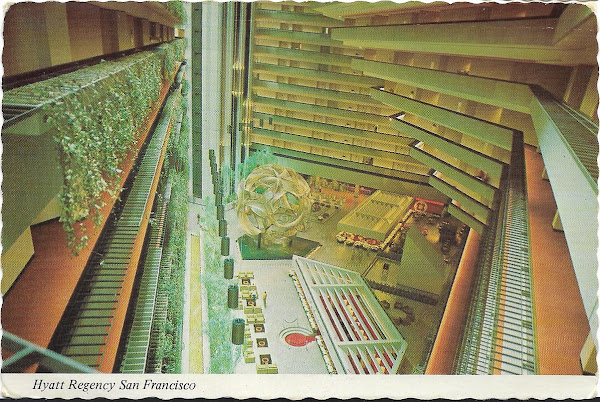 We stepped into the Hyatt Regency at Embarcadero and saw this impressive atrium. It was open to the public and full of shops and places to eat on the main floor. Picture from old postcard.
After our walk through downtown, I think we concluded that our walk around downtown was the most interesting part of the day.
I've been there a few other times in more recent years including passing through during bicycle trips down the coast.
On our way to the Bellingham Greyhound Station (then on State Street) I gave a dollar (maybe a quarter back then) to a pan handler. My sister implied that giving to pan handlers could be overwhelming in the big city, but ironically that was the only pan handler who approached us, as I remember at least.
Most of our time was spent in Palo Alto area for the visit, but we planned a sightseeing trip to San Francisco; often affectionately called "The City."

I forgot how we got up there; maybe by car or transit.
During my childhood, San Francisco seemed like a dream city by the Golden Gate Bridge. Home of some powerful 50,000 watt radio stations that provided a slight connection between my hometown life in Pullman and that city by the bay.

By the time I got to college, my view of that city became more tainted and a bit grimy, however. I had learned more about it's problems as well.
As I remember, we divided our sightseeing day into two parts. Morning at the De Young Museum and an afternoon of walking around looking at downtown buildings (my idea).
All I remember, from the museum, was some long lines, echoing spaces and lots of children on tour as if all the schools were taking field trips at once.
I remember snacking in a cafeteria and I guess the only display I remember was a moon rock. It was in a glass case guarded by a security guard.
The rest of the museum must have gone into my memory as a blur. Museums can be overwhelming with information overload; looking and reading quickly while moving on to the next.
Afternoon was walking around downtown. The buildings were quite fascinating, but there was a spooky, somewhat dangerous feel to the city.
As we passed the studios of one of the radio stations that I even had dreams about during childhood, the building looked small. It was KGO which was, back then, located in the somewhat scruffy Tenderloin District. As I remember, from lots of listening to that station it was at 277 Golden Gate Avenue.
Doors were locked tight, but my brother was able to find a doorbell, I think. A security guard only opened the door a slight crack and said, "no tours." He then shut the door quickly. Back then, a crime called the "Alphabet Bomber" was in Bay Area news.
The rest of our walk was more interesting with lots of beautiful vistas, art, architecture, cafes and so forth.
When we got to Trans America Pyramid the doors were open and a guard in the lobby said we could go up in an elevator to an office that wasn't leased so it was open for showing to potential tenants; I guess. That office was near the top; the actual top being a pinnacle, of course.
Another guard, in that lofty space, was quite friendly. We visited while taking in the panorama. The view was spectacular, but the windows only faced one direction, as I remember.

After our walk through downtown, I think we concluded that our walk around downtown was the most interesting part of the day.
I've been there a few other times in more recent years including passing through during bicycle trips down the coast.
Monday, November 06, 2023
On a note of optimism, the Gay Games 2023 are being held in Hong Kong.
Yes, Hong Kong that is pretty much controlled by Mainland China which rivals USA in economic stature. There is worry about how China deals with human rights, but at least the Gay Games can proceed in Hong Kong.
There are some issues, but the games can go forward. Strict covid shutdowns, in Hong Kong's recent past means that the Gay Games also had a backup plan; Guadalajara, Mexico. This year's games are taking place in two venues. Some Hong Kong human rights activists called for the Games to be cancelled saying organizers "have aligned themselves with pro-authoritarian figures responsible for widespread persecution against the people of Hong Kong".
Taiwan is not sending athletes to Hong Kong but to Guadalajara, citing concerns over the the National Security Law that China imposed on Hong Kong in 2020.
China's government did not send officials to the opening ceremony, warning the organizers, in August, that the Games must be conducted in a “lawful, safe and orderly manner”. Regina Ip, convener of the city’s top decision-making body the Executive Council, was the only pro-establishment figure at the opening ceremony, despite calls from anti-LGBTQ lawmakers for her to resign.
"The holding of the Gay Games in Hong Kong is strong testimony to the diversity, inclusion, and unity of our city," Ip said in her welcoming speech. "Equal opportunity and non-discrimination are highly treasured by our government and our people."
Opposition did not dampen the excitement, spectators chanted, cheered and waved before the opening ceremony.
“This is a good idea because especially China is not very fond of the gays. So this is to become visible in China as queer people,” said Gerrit Schulz, 80, a participant from Berlin.
My comment plus excerpts from article in Reuters.
There are some issues, but the games can go forward. Strict covid shutdowns, in Hong Kong's recent past means that the Gay Games also had a backup plan; Guadalajara, Mexico. This year's games are taking place in two venues. Some Hong Kong human rights activists called for the Games to be cancelled saying organizers "have aligned themselves with pro-authoritarian figures responsible for widespread persecution against the people of Hong Kong".
Taiwan is not sending athletes to Hong Kong but to Guadalajara, citing concerns over the the National Security Law that China imposed on Hong Kong in 2020.
China's government did not send officials to the opening ceremony, warning the organizers, in August, that the Games must be conducted in a “lawful, safe and orderly manner”. Regina Ip, convener of the city’s top decision-making body the Executive Council, was the only pro-establishment figure at the opening ceremony, despite calls from anti-LGBTQ lawmakers for her to resign.
"The holding of the Gay Games in Hong Kong is strong testimony to the diversity, inclusion, and unity of our city," Ip said in her welcoming speech. "Equal opportunity and non-discrimination are highly treasured by our government and our people."
Opposition did not dampen the excitement, spectators chanted, cheered and waved before the opening ceremony.
“This is a good idea because especially China is not very fond of the gays. So this is to become visible in China as queer people,” said Gerrit Schulz, 80, a participant from Berlin.
My comment plus excerpts from article in Reuters.
Thursday, November 02, 2023
Whatcom County does need a new jail. The old one is close to the breaking point in 2023
I plan to vote for the jail (new facility for incarceration and alternatives to incarceration services) this time around November 2023.
Update. The measure won. November 2023.
Update. The measure won. November 2023.
Some people's insistence on advocating use of chloroquine for corona virus is an example of refusal to update their thinking with newer, better science.
Science keeps advancing, but the thinking of many people will latch onto an idea and not update their thinking as the science evolves. Often religion latches onto old concepts as well.
One example of refusal to update is the idea, I heard on newscasts at the start of the pandemic, that a drug used to treat malaria could possibly be used as therapy for the corona virus.
A few days after those early newscasts, it looked like they were finding newer evidence that it wasn't effective for corona virus. It could even cause more harm than good, but some people stuck to that idea while others moved on to what now appears to be more effective treatments.
This is an example of folks sticking with an early idea that offered some hope, but later was superseded with better ideas.
I moved on, quickly though I will admit that those early newscasts offered some hope, back in the first few days after the shut down. My hope came more from the broad concept that both treatments and vaccines were on the way, but not specifically about any one product.
Today the pandemic seems all but totally over and we have good vaccines plus improving methods of treatment. The virus may be less deadly now, than it was in the first year as; especially the Delta Variant was scary.
We seemed to have come a long ways since 2020 as things like dancing and social gathering have come back.
One example of refusal to update is the idea, I heard on newscasts at the start of the pandemic, that a drug used to treat malaria could possibly be used as therapy for the corona virus.
A few days after those early newscasts, it looked like they were finding newer evidence that it wasn't effective for corona virus. It could even cause more harm than good, but some people stuck to that idea while others moved on to what now appears to be more effective treatments.
This is an example of folks sticking with an early idea that offered some hope, but later was superseded with better ideas.
I moved on, quickly though I will admit that those early newscasts offered some hope, back in the first few days after the shut down. My hope came more from the broad concept that both treatments and vaccines were on the way, but not specifically about any one product.
Today the pandemic seems all but totally over and we have good vaccines plus improving methods of treatment. The virus may be less deadly now, than it was in the first year as; especially the Delta Variant was scary.
We seemed to have come a long ways since 2020 as things like dancing and social gathering have come back.
Tuesday, October 31, 2023
Birth control is a better way to deal with the problem of too many people than other choices that are tried.
Birth control is a better way to deal with the problem of too many people than other choices that are tried.
Worse solutions would include things like building walls to keep people out, denying someone's critical needs just to save money, or killing off populations in warfare.
Friday, October 27, 2023
Fighting the battle between socialism and capitalism may be barking up the wrong tree.
Seems like the ongoing debate between socialism and capitalism misses the mark about quality of life in a society. The debate is about economics, jobs and material things. Other factors, such as religion and culture, may play far more significant roles related to human rights.
There can be oppressive regimes that lean toward capitalism, or socialism. I think today's Russia, under the oligarchs and anti gay religion, is probably worse than the Soviet Union in it's last years.
Of course, under Stalin, things were bad, but under Gorbachev things were going in better directions. Now it seems like Russia has taken a turn for the worse.
During glasnost and perestroika, human rights was making headway. Yes, the Soviet Union was also experimenting with more capitalism, such as the famous McDonalds at Pushkin Square.
I do believe that a mix of socialism and capitalism is the best way to go; rather than one extreme or the other. Still, that's just the economic system.
Seems like culture and interpretation of religion are more powerful forces shaping society. Some religious traditions are extremely strict while others are open to diversity of viewpoints.
Cultural factors, attitudes toward sexuality and societies under stress, such as war, are likely the major factors determining human rights and freedom of speech. Often societies that are stressed are in states of emergency and have things like military drafts. For instance the Soviet Union may have broken up prematurely creating the chaos that drives fear and now is leading to war between Russia and Ukraine. In the long run, breakup may be inevitable, but it seems like change is more lasting when it happens incrementally. Also the constant debate between socialist and capitalist economic models could be missing the boat all along.
I write these thoughts after hearing an interview, with someone from Bellingham Marxist School, on our local call in radio talk show KGMI Konnects. The guest was not defending Soviet oppression, but said it was likely better than Russia under the Czars.
I think in terms of how things started to get better toward the end of the Soviet Union, but now have gone down a less desirable road. Discussions get me thinking, but seems like just about everyone does bark up the wrong trees. I say culture is more important than the economic system.
There can be oppressive regimes that lean toward capitalism, or socialism. I think today's Russia, under the oligarchs and anti gay religion, is probably worse than the Soviet Union in it's last years.
Of course, under Stalin, things were bad, but under Gorbachev things were going in better directions. Now it seems like Russia has taken a turn for the worse.
During glasnost and perestroika, human rights was making headway. Yes, the Soviet Union was also experimenting with more capitalism, such as the famous McDonalds at Pushkin Square.
I do believe that a mix of socialism and capitalism is the best way to go; rather than one extreme or the other. Still, that's just the economic system.
Seems like culture and interpretation of religion are more powerful forces shaping society. Some religious traditions are extremely strict while others are open to diversity of viewpoints.
Cultural factors, attitudes toward sexuality and societies under stress, such as war, are likely the major factors determining human rights and freedom of speech. Often societies that are stressed are in states of emergency and have things like military drafts. For instance the Soviet Union may have broken up prematurely creating the chaos that drives fear and now is leading to war between Russia and Ukraine. In the long run, breakup may be inevitable, but it seems like change is more lasting when it happens incrementally. Also the constant debate between socialist and capitalist economic models could be missing the boat all along.
I write these thoughts after hearing an interview, with someone from Bellingham Marxist School, on our local call in radio talk show KGMI Konnects. The guest was not defending Soviet oppression, but said it was likely better than Russia under the Czars.
I think in terms of how things started to get better toward the end of the Soviet Union, but now have gone down a less desirable road. Discussions get me thinking, but seems like just about everyone does bark up the wrong trees. I say culture is more important than the economic system.
Wednesday, October 25, 2023
Picture of me as exercise participant of the month, 1988 at YMCA.

This picture and my sloppy, handwritten answers to a questionnaire were posted for a month on a bulletin by the door to the gym where the aerobics classes were. bulletin boards existed before social media.
Back then, aerobics was a big social thing. I likened it to dancing without the cigarette smoke. Dance bars, back then, were filled with cigarette smoke. That aerobics class often had over 50 people moving to the music and there were times when folks were invited to come in costume. At least 1/3 of the participants were men though aerobics was more popular among women. It was energetic, but gentle and non competitive.
Back in those days, the Y also had a sauna which was a gathering space.
Entering the ho hum work world after college.
Recent Ticktok video in the news. College graduate says hardly any time to live one's life. Long commute as living closer to the job is too expensive. 40 hour per week office job takes up too much time. Readers tend to be sympathetic and ideas about a shorter workweek circulate.
My personal story was different. Part time work. I graduated into a depressed economy; late 70s early 1980s. Rents in Bellingham were quite low, back then, but Jobs were hard to find. I was able to live within easy bicycling, or walking distance from what work I had.
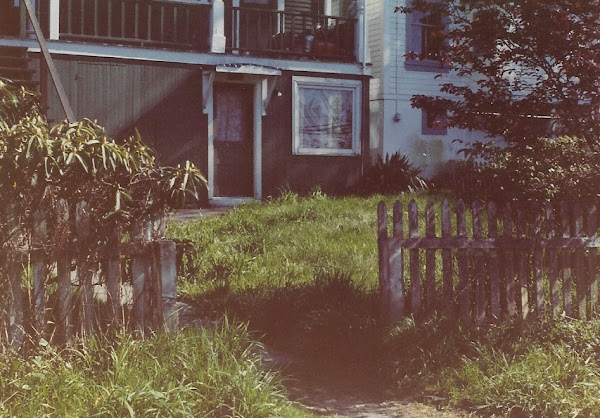 Door to my spacious basement apartment in a 9 unit building with a funky backyard. $155 per month before gentrification in Bellingham.
I looked for full time work, including custodial work for the state at Western Washington University, but the competition for those jobs was fierce. All I could find was part time gardening and a part time custodial shift at a place called Pizza Haven.
I did have plenty of free time, however. Got into writing, postal art, and letters to editors as well as politicians. I had time for many community things and bicycling. I was able to survive, but on a real shoestring budget.
My upstairs neighbor said I had found the healthy balance of working part time. I had stumbled upon it. She suggested I embrace it.
My neighbor had worked in offices for many years and was burned out. She also resented the vast population of freeloaders who seemed to live off inheritances or finding their way onto disability; even back then.
She saw the contrast between overwork and not working at all; herself struggling with burnout, health problems and teatoring toward going on welfare. Her brother was a hard worker / redneck leaning into right wing politics while some of her other aquoitences were hippy artists who found ways to not work 9-5. She often thought they were spoiled.
She talked about a concept called "job sharing" where people work less hours and share the existing jobs more equitably.
When hearing about job sharing, I got to thinking that job sharing would be a good strategy if the economy has to slow down due to environmental restraints. Back then, there was and still is the "jobs versus environment" issue. For instance; the logging industry, around Bellingham, was all but being shut down due to the controversy over preserving habitat for the Northern Spotted Owl.
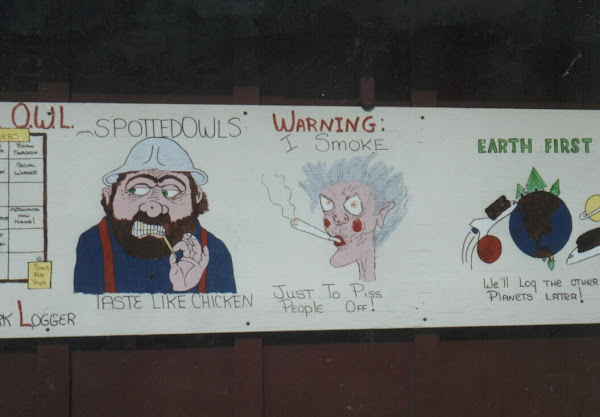 Logger art on Olympic Penisula hints at hunting spotted owl for food to rid the problem that its preservation rules were creating. Many T-shirts in logging country sported logos; "spotted owl tastes like chicken."
Today they talk about "work life balance," but the high cost of today's housing makes that less doable.
I worked part time for many years and eventually found a more full time custodial position that was still fairly laid back. I often didn't put in 8 hours per day, but maybe averaged 7 hours. The job had generous vacation and the ability to take leave of absence for my bicycle travel.
I worried about not having health insurance, but survived with good health. Today, many folks can now benefit from Obamacare reforms; at least in most states; except Texas and a few holdouts against the Medicaid expansion.
I was fortunate to always live quite close to my job. Not owning a car and living in small spaces helped, but that was an era when rents were lower, relative to the rest of the economy. I was living at below market rent, even for those days.
My personal story was different. Part time work. I graduated into a depressed economy; late 70s early 1980s. Rents in Bellingham were quite low, back then, but Jobs were hard to find. I was able to live within easy bicycling, or walking distance from what work I had.

I looked for full time work, including custodial work for the state at Western Washington University, but the competition for those jobs was fierce. All I could find was part time gardening and a part time custodial shift at a place called Pizza Haven.
I did have plenty of free time, however. Got into writing, postal art, and letters to editors as well as politicians. I had time for many community things and bicycling. I was able to survive, but on a real shoestring budget.
My upstairs neighbor said I had found the healthy balance of working part time. I had stumbled upon it. She suggested I embrace it.
My neighbor had worked in offices for many years and was burned out. She also resented the vast population of freeloaders who seemed to live off inheritances or finding their way onto disability; even back then.
She saw the contrast between overwork and not working at all; herself struggling with burnout, health problems and teatoring toward going on welfare. Her brother was a hard worker / redneck leaning into right wing politics while some of her other aquoitences were hippy artists who found ways to not work 9-5. She often thought they were spoiled.
She talked about a concept called "job sharing" where people work less hours and share the existing jobs more equitably.
When hearing about job sharing, I got to thinking that job sharing would be a good strategy if the economy has to slow down due to environmental restraints. Back then, there was and still is the "jobs versus environment" issue. For instance; the logging industry, around Bellingham, was all but being shut down due to the controversy over preserving habitat for the Northern Spotted Owl.

Today they talk about "work life balance," but the high cost of today's housing makes that less doable.
I worked part time for many years and eventually found a more full time custodial position that was still fairly laid back. I often didn't put in 8 hours per day, but maybe averaged 7 hours. The job had generous vacation and the ability to take leave of absence for my bicycle travel.
I worried about not having health insurance, but survived with good health. Today, many folks can now benefit from Obamacare reforms; at least in most states; except Texas and a few holdouts against the Medicaid expansion.
I was fortunate to always live quite close to my job. Not owning a car and living in small spaces helped, but that was an era when rents were lower, relative to the rest of the economy. I was living at below market rent, even for those days.
Monday, October 23, 2023
Happy Halloween.

Subscribe to:
Posts (Atom)