Thursday, January 31, 2008

More interesting for kids than the family car

A friend of mine says his kids prefer riding the bus to going places in their family car. In the car, my friend says he has to ignore his small children and watch the road. On the bus, they get more of his undivided attention. Also there are other passengers and fun things to see on the bus.

I've often thought that families are used as the excuse to drive, rather than live a "low carbon footprint, car free life." Then I met this friend who tells the story of his kids preferring the bus.

He also says his small family (mom, dad, two kids) lives in an apartment, rather than a detached house.

It can be done, even for people living "family lifestyles."

Tuesday, January 29, 2008

When someone owns a mobile home, but rents the space in the mobile home lot, are they considered home owners?

People keep talking about how great it is to be a homeowner. For instance President Bush speaks about the "ownership society." Yet increasingly, home ownership is not available to folks of modest means.

Mobile homes are usually a lot cheaper.

So, when one rents the space in a mobile home park, is that "renting" or "owning?"

Unless the place is cheap, getting into a home usually requires one to earn lots of money.

"Push those products through your store and out to the customers and landfills."

I keep saying, in 1965, the store manager could pay a mortgage by selling roughly 85 televisions. If TVs cost around $300 and houses cost around $25,000.

These days, TVs cost less, but houses cost a lot more. One must push 1,000 TVs, or comparable products and services, through the pipeline to pay for their keep, or at least buy their house.

If it was a mobile home, it would be less expensive, thus creating less of a need for pushing products through the pipeline in order to earn one's keep.

No wonder everyone seems to be scratching their heads trying to figure out how to keep the American consumer going, but what about the environment or people's peace of mind?

Some folks thought they could join the homeowner ranks by purchasing houses with sub prime mortgages. That's the illusion of "affordable home ownership," at least until regular pricing kicks in. Then it's foreclosure time.

Also, the average American moves every few years anyway.

Mobile homes make more sense. The home can travel with you. Travel to the new job, the city you are transfered to or the new marriage.

It is kind of ironic that we are such a mobile society, yet there is so much interest in what is called "home and hearth."

Renting needs more respect also. If we are trying to lower our carbon footprint, living in dense urban settings with a lot of rentals is a good way to go.

For homeowners, clustered condominiums are better than sprawl, but why are condominiums so expensive?

If we were to price housing in terms of "carbon footprint," apartments and condominiums should be cheapest. Unfortunately they are not.

This leaves mobile homes for lower income, lower "carbon footprint" living.

That is, if the mobile home is in a park rather than sitting on one or more acres out in the middle of nowhere.

Since mobiles are often not allowed in the city, people move out into the county and set up on some acre. Unfortunately, that's what many folks do to find affordable housing.

"Buy a remote acre, set up a mobile and then drive everywhere."

"Drive, drive, drive." Ever heard the phrase "drive till you qualify?"

That's not good.

That's sprawl, but a mobile home park on the bus line can be considered infilling, rather than sprawl. It can even promote car free living.

One shouldn't have to be wealthy to live in clustered environments.

If you own a mobile home and rent in the court, are you a coveted owner, like Bush wants to see more of, or a renter?

Are mobile homes the reasonable person's gateway into an ownership society?

Are they good for the environment when clustered?

Most people don't talk about them in this way. Even low income housing advocates seem to ignore them, for the most part.

Monday, January 28, 2008

Biking on narrow road, should one take the lane or stay to the right?

Ideally, I try to avoid narrow roads altogether. I go out of my way for good shoulders or bike trails. Sometimes I use narrower roads with light traffic.

If I must use narrow roads with heavier traffic, I usually stay as far to the right as I can. Sometimes I do take the lane if the traffic is quite a distance behind me. Taking the lane tends to cause the cars that are quite a ways back to tap their breaks and at least slow down to the speed limit. Then, when the cars are closer behind me, I go over to the side to let them by.

I watch the traffic behind me carefully. Take the lane when the traffic is farther back so it slows down, then go to the edge as the traffic is right behind and going past.

That's how I do it at least. Seems to work pretty well.

Friday, January 25, 2008

Be careful in Whatcom County, Bellingham also

Night traffic along Sunset, near Sunset Mall.

In the last couple of months there has been news of 2 bicyclists killed on Whatcom County roadways. One on Portal Way just north of Grandview and the other on Haxton Road in the Lummi Reservation.

More details in other media.

There are a lot of inattentive drivers everywhere. Also quite a few county roads have no shoulder. I avoid many roads and sometimes go a bit out of the way to travel on a safer route. Most of Haxton and north part of Portal are roads I avoid.

I can't really speculate why these accidents happened. Circumstances are different in each case. I just read about it in the media and hear folks talking at local bike club meetings.

My own travels have seemed safe, but I prefer being in town to most of the rural county. Also I light up my bike with lots of LED flashing lights at night.

I try to wear a bright vest, but have recently misplaced my vest. I should get a new one. Of course, I always wear my helmet.

Last week, I rode up into the Meridian area on my normal "not the most direct, but safer" route.

Still, West Bakerview was nearly bumper to bumper.

Ironically, "bumper to bumper" isn't too bad because the traffic is going slower. There is a shoulder also.

I'm on the shoulder going about as fast as the cars. They think they are creeping along at 10 mph, but that's fine for me.

Slow moving traffic: For the cars, urban living takes patience. No breaking the speed limit when it's bumper to bumper.

Coming back, the cars were stopped, not just creeping, they were stopped all the way.

I carefully continued on the shoulder. It seemed like they were backed up all the way from the airport to Meridian.

Then, down the road I saw the blue and red lights.

It wasn't The Fourth Of July. It was police cars.

Rather than head right into the "scene," I rode back to the stoplight at Fred Meyers and went another way home.

When I got home, I read an update in the on-line Herald. There had been a bank robbery and a car was pulled over near Bakerview overpass. It looked like the get-away car, but it wasn't. Still, all that commotion snarls traffic.

Welcome to Bellingham and Whatcom County.

Monday, January 21, 2008

Thinking about solutions to the income gap on Martin Luther King Day

Possibly the biggest discrimination issue we face today is not really race, but income separation. Even the neighborhoods that people live in tend to discriminate based on income and housing type.

There's single family residential, which really should be called "single family ONLY residential." Entry into some of these neighborhoods now requires qualifying for a million dollar mortgage.

Then there's the idea of mixed use and mixed income zoning. An innovation that I think could do more to knit this segregated country back together better than all the rallies, speeches and "remember Martin Luther King" specials on the media.

Yes it's good to remember Martin Luther King, but what are people doing now?

Maybe this isn't the greatest example, but it's enough to impress me. Last weekend there was a feature in Bellingham Herald about the Waldron Hotel, now converted to condominiums. Yes, they're pretty expensive, like in the $900,000 to million range, but the slide show that went along with that article intrigued me. In the background of many Waldron fixtures was the red facade of Chuckanut Square; a low income housing project. Yes, basically right across the street (or really across a parking lot) are the Waldron and Chuckanut Square.

It's a mixed income Neighborhood.


Chuckanut Square. lamps at south end of Waldron in foreground.

I biked down to Fairhaven to take my own picture of that interesting mix. Also stepped inside one of the Waldron's units that was having an open house. No, I couldn't afford to buy, but it was interesting to step inside just so I could say I'd been inside the Waldron.

Actually, I kind of got bored in there. Yes, it's a fancy unit, but I've never paid that much attention to furnishings, fancy bedspreads, wine bottles and counter tops.

It was interesting, for about 5 minutes.

I have friends who would have stayed much longer. They often discuss differing counter tops and sofa spreads while my eyes gloss over during our Wednesday Gay Men's Dinner Gathering. Different interests for different folks. Are they wealthy, or just wealthy wannabes? Or maybe they work in the field of interior decorating?

So it takes quite a bit of money to restore such an old building as the Waldron. Until now, it never really recovered from the panic of 1892. Top floor was never finished and sat empty all those years till this recent renovation.

It's nice to see that building with a new lease on life.

Most of the interesting features are external, in my opinion. Basically the inside was totally redone, to modern earthquake codes and so forth. The old facade remains with a new lease on life and right down the street there's lower income housing. Within easy walking distance is shopping and some cultural life.

I've been to several planning discussions where the virtues of mixed income and mixed use zoning are discussed. A way to reduce some of the growing separation between the Haves and the Have-Nots.


Earlier pictures during reconstruction of Waldron.


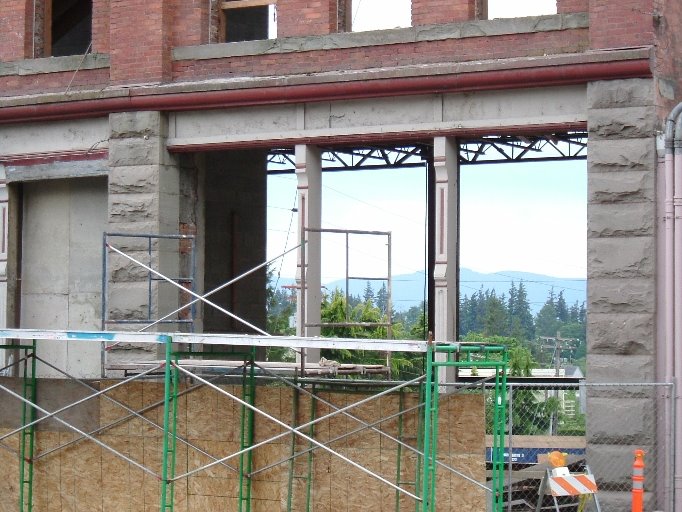
As they restore old Waldren Building in Bellingham's Fairhaven District, scenery is visible through the building. Old insides have been gutted as the facade is being preserved. Building was started, I think around 1890, but never totally recovered from economic panic of 1893. Top floor never finished.

Now, 2006, restoration is starting. it is being turned into condominiums and finally finished to the top.


Friday, January 18, 2008

They say "shop till you drop"

Cause it keeps the economy going and there's just a few paychecks between comfort and homelessness. For the sake of economy, people often neglect their health and their sanity. Remember, you're also only a few heartbeats away from dropping.

Thursday, January 17, 2008

Waterfront Theme Park: "The Pulp Mill From Hell"

I had a vision from the future of Bellingham's Central Waterfront. It wasn't as easy to find buyers / tenets for the waterfront redevelopment as many had hoped (or feared), so the port district decided to make the old pulp mill buildings into a haunted house.

A haunted for house for fund raising purposes.

Let's make it a scary theme park. Call it, "The Pulp Mill From Hell."

People came to from all over. The same folks who went to horror movies.

There was the chipper blade to avoid, so as not to get ground up.

Exhibit B: A monster cloud of chlorine gas wiping out the city.

Then, remember that skeleton found in one of the boiler chimneys, back in the 1980s, I think? Still no one knows who that was, as far as I have read, and the ghost can still roam the park.

There was even a tiger roaming around, on loan from the San Francisco Zoo.

Plenty of lore and some fantasy for a fantastic theme park. Ever tried conveyor belt rides?

The theme park was "world class," "extreme sports," but then I woke up from that nightmare.

Monday, January 14, 2008

Living in a room without a million dollar view, but contemplating astronomical things

I can still see fantastic views from space, on the Internet.

Back when I was in high school, I got this brochure about Pioneer 10 and 11 spacecrafts. First to fly past Jupiter.

Pioneer 11 went on to Saturn.

First artificial objects to pass out of solar system. Launched in the early 1970s.

Internet is so much richer than relying on mailed brochures, or a daily newspaper that would often hide space news behind the sports page.

Since Pioneer, two Voyager spacecrafts have ventured out following similar routes. Launched in the mid 1970s.

I think Voyagers are going faster so they are already farther out than the Pioneers.

Also the Voyagers are still sending back signals. They are now exploring the area where solar wind transitions into the "interstellar environment."

Other stars are far out there indeed.

Traveling at Voyager's speed, it would take around 80,000 years to get to another star, but we can still learn about other stars from the rapidly improving telescopes here at Earth.

People might call the astronomer an "ultimate voyeur." Yes, observing and things are often too far away for interaction.

Voyager and voyeur are similar sounding words anyway.

Nothing wrong with that, there is a passive aspect to contemplating things beyond everyday life. Interaction does happen, here on Earth, among scientists and people asking cosmic questions. Often that's "interaction at its best."


Full moon with my low end digital camera. Image taken at Central Ferry Park on Snake River of Eastern Washington during my 2007 bicycle tour.

Bush wants us to go to Mars. People on Mars, but I don't think it's a good idea. Less scientific "bang for the buck."

I'm more interested in spending money for new telescopes, here on Earth. Also in Earth orbit. New telescopes that might actually see planets like Earth around other stars.

Imagine what wonderful conversations might take place in the sauna about such discoveries.

A nicer way of uniting the nation than 911. Actually uniting the world.

Mars doesn't seem that interesting, except for exploration by unmanned and inexpensive robots. Rovers like Spirit and Opportunity that are now serving nobly on the Red Planet.

Colonizing Mars may not be much help. It's kind of a "cheap version" of Earth. Only about 1/3rd the size of Earth.

By the time we would colonize, population growth on Earth will likely be more than 1/3 larger.

We will have already outgrown Mars before we get there.

Someday we'll set human foot on Mars, but I'm not holding my breath.

Back home, we are entering an era of even more exciting astronomical discoveries.

Here in the state of Washington, they are working on LIGO; a gravity wave detector.

LIGO is opening up yet another frontier of discovery. Picturing the universe in gravity waves.

Our LIGO detector is inside the Hanford Reservation; a place noted for old nuclear reactors and the "Hanford Cleanup."

Hanford can mean more than just "cleanup after nuclear activity." It's also a research facility for the future.

Clean energy, solar energy, gravity waves.

There's a lot of dry space out there and potential for exciting projects.

There's also a LIGO detector near Livingston, Louisiana. More to Louisiana than Hurricane Katrina. More to Hanford than "oh what a mess."

We can still look forward to a brighter future.

Last weekend, I saw a great video about LIGO. Called "Einstein's Messengers." See LIGO page and video should be one of the links.

With so many wonderful views on my computer screen, who needs a million dollar view out the window. I can ride my bicycle to such a view in a matter of minutes anyway.

Many people buy telescopes.

Wealthy people can buy bigger telescopes.

I'm not motivated to buy my own telescope since it's images would pale in comparison to photos from something like the Hubble Space Telescope.

Small scopes might be good for watching things and people, here on Earth. Some might call that voyeurism.

Nothing wrong with that.

Years ago, I once had a scope that I used in the park. When I came home, I set it on a table near my window just to put it down somewhere. Wasn't using it in my home, but neighbors across the street saw it sitting by the window. They put a sign in their window reading:

"Hello Neighbor."

Some of the best interactions in the park come from people standing around telescopes. Astronomy clubs have outdoor gatherings. The passersby who stop for a look get into more discussion.


The moon with camera flash turned on to shorten time exposure; automatic camera, or I forgot how to do it manually.

When I was in college, our astronomy class met on top of Haggard Hall for a sky viewing session.

A small telescope was all Western Washington University could afford in those days.

It's usually cloudy here anyway.

Still, we saw some things.

The rings of Saturn, but they are actually more interesting in textbook photos.

Back then, there were textbook images from the 200 inch reflector on Palomar Mountain.

Our little telescope on Haggard Hall was no match. Still, we were seeing with our own eyes, what ever that's worth.

Now we have the Cassini Spacecraft orbiting Saturn.

From the top of Haggard Hall, I suggested we look at things on land. Was wondering what Bellingham would look like in a bigger telescope than, at least I, could afford.

We wouldn't have to peer in windows, let's just look down some street.

My classmates adjusted the scope so it pointed at a Bellingham neighborhood. Then they said, "We have discovered a pulsar!"

It was the beacon at Bellingham Airport.

Monday, January 07, 2008

Lights out in part of Bellingham

Opportunity for a different perspective on some familiar locations.


Bellingham Herald Building in the dark. Like the newspaper being in the dark, but they did get their January 7 edition out.

Must be a headlight from parking lot across street shining in left window.


Auto parts store lit up by car headlights.


Bellingham Food Co-op at corner of Forest and Holly. Some traffic lights were still working as they were on a different circuit.

For a few blocks, that outage lasted several hours. Not Y2K.

Remember Y2K?

A line came down feeding some substation. I notice they have been working on a few substations recently. Must be doing some upgrades. This day's weather was normal.

My workplace was out of power, but I was able to do some cleaning with the LED headlights from my bicycle. They slide off the handlebar mounts and work like flashlights.

It was a memorable day. Day of the downtown power outage.

Poem from spam

Refinance your house with penis enlarger.
The Repo Man's a real man.

Sunday, January 06, 2008

One way religions give religion a bad name


One way religions don't want certain kinds of people to enter.

Back when I was in high school, they opened up a new bookstore in my home town called "One Way Books." It was from some kind of "Christ is the only way" outfit.

Not knowing any better, my dad thought it was named that to imply "you can't take back any merchandise." "One way, you buy it, no returns." No standing behind the product, so to speak.

Well, that's not quite the concept, but it's pretty good.

Before One Way Books, that little store was another store entirely. It was a hippy outfit called "The Bodywrapper." I'd see sexy long haired guys going in and out of there and the name Bodywrapper was kind of alluring.

Some of my early gay fantasies, just thinking even though I was never in there, except once.

The only time I was in there was with a friend who wanted to check out the waterbed in the basement. Just a fun room full of black lights and a waterbed and you didn't have to be buying anything to justify your existence there. That wasn't a sexual experience, however.

I remember lots of flickering lights and black lights. Oh, the early 1970s.

Bodywrapper eventually moved to a more sterile location in downtown Pullman. It was, basically, a clothing store. One Way moved in after Bodywrapper moved out.

In early 1970s, "One Way" became a slogan of the Jesus Freaks, as they were called. A new more conservative movement. Kind of an answer to the hippie movement. I remember thinking it was based in Spokane, WA. Not sure if that's true, but people said it was "something to put Spokane on the map like hippies put San Francisco on the map."

My art teacher referred to these people as "Freazes Cheeks."

Jesus Freaks often quarreled among themselves over interpretation and who's definition of "the way" was the real one. Now it seems like much of the world, especially the Middle East, is caught up in such quarreling.

I believe there is divine nature to this universe, but there are a lot of pathways in that direction.

Old building where the Bodywrapper and then One Way Books resided was later replaced with a Burger King. Now, even that's gone, I think from that location at least.

Saturday, January 05, 2008

One possible outcome from Tim Eyman's congestion relief proposal


Something my camera found on a concrete wall.

Graffiti art could be a cheap substitute for publicly funded art that's associated with Washington State transportation projects. Some of it isn't that bad, but I'm not a big fan of most graffiti.

The latest Eyman proposal isn't as bad as some of his previous "slash taxes and government" suggestions.

This one calls for creating a special fund devoted to congestion relief on Washington roadways.
Initiative now has a number. It's I-984. (I added this note Jan.9).

Something like $85 million per year. Now estimated at 130 million.

Money would come, in part, from cutting funding for public art and sculpture. Currently, a certain percentage of money spent on capital projects, such as transportation projects in the state, is devoted to art associated with said projects.

This is just small potatoes.

A bigger part of those millions would come from the sales tax that's currently collected when new and used vehicles are sold in the state. 10%
(now increased to 15%) of that sales tax revenue would be diverted into the congestion relief fund, rather than going into the state's general fund where most sales taxes currently go.

Tim Eyman's latest initiative was filed yesterday.

$85 (even 130 million) is hardly a drop in the bucket for relief of traffic congestion. I keep saying that land has gotten so expensive, it's practically impossible for the state to build it's way out of congestion. The land that's under new highway lanes would be a budget buster.

I realize that his proposal is mostly about doing things like timing traffic lights better. Also things like pre positioning tow trucks for faster clearing of blocking accidents.

Small steps can sometimes make a big difference. It's not a totally bad idea.

Still, I don't think there's much we can do to relieve congestion short of getting rid of automobiles as the main form of transportation.

Also, for some reason, the framers of our state's constitution implied that education is the paramount duty of state government.

I know, I sometimes feel there's a lot of waste in education as well.

Education: the biggest priority of money in the general fund.

Diverting even just 15% of sales tax revenue on the sale of vehicles in our state would be like stealing food from the lion's cat dish.

When the lion's share of state funding goes to schools and the constitution roars in it's favor, watch out.

Yes, watch out.

Education? What good is it doing us?

Here might be another way to spell congestion relief in Washington State.

Not spelling it R-O-L-A-I-D-S, as the old Rolaids commercials would have it.

We can put the lion called "education" to work for us. Why can't we encourage our schools to teach alternative transportation?

Remember, "Bike To Work Day" is actually called "Bike To Work AND SCHOOL Day." The schools have already gotten involved to some extent.

There are a lot of things we can do to "learn better ways of getting around" in our state. We can do these things regardless of whether this Eyman proposal succeeds or not.

Thursday, January 03, 2008

Can charcoal save the world? I'm a bit skeptical

Someone I know keeps talking about the virtues of charcoal for sequestering carbon and reducing global warming.

Sequester is kind of an old word that's coming back into use in global warming discussion. Here, I think it means holding the carbon someplace, like in the ground. Holding it rather than releasing it in the form of carbon dioxide gas into the atmosphere, for instance.

Sounds good, but I'm still a bit skeptical, or at least I have some questions that need answering.

When I hear people talk about charcoal, they're always speaking of it's virtues in the garden. Benefits like "enrichment of soil," "home for friendly microbes," "water filtration" and so forth.

All good things for agriculture, but how does charcoal prevent industrialized civilization from spewing carbon dioxide into the atmosphere for our energy needs?

Silence, so far.

Or maybe I'm just not listening at the right time.

Among a lot of environmentalists, there does seem to be a nostalgia for more agrarian times. For times when we lived on farms, had gardens. Thus, one would think of the gardening benefits of charcoal.

Well, there are more than 6 billion overpopulated people in the world. Many of us are living in cities; often above the 5th floor.

Sure, some people have charcoal filters on their water faucets, especially when they don't trust city water.

Is it still charcoal they use in those filters? I've never bought one.

With all the cars, home heating, other energy guzzling habits of both urban and rural dwellers, I'm still wondering how we get energy?

Making charcoal?

For those who might not know, charcoal is basically made by cooking things like wood. Cooking it in a low oxygen environment so it doesn't burn, but transforms into a denser fuel.

Charcoal for the backyard barbecue, for instance.

This cooking can be done in a sealed kiln, or something.

Still, creating charcoal doesn't really create energy, as far as I know.

One needs combustion for energy and there isn't combustion in that low oxygen cooker, as far as I know.

The heat for cooking the wood needs to come from another source. An outside heat source to heat the kiln. Electricity, fire, whatever.

We're back to needing energy and much of our energy comes from burning, thus releasing carbon dioxide into the atmosphere.

Well, maybe there is a way to get some energy. A special kind of slow cooking of organic matter in the kiln.

My friend has mentioned something called "slow pyrolysis." He mentioned it just briefly since we're seldom in the space for slow conversation.

Slow pyrolysis. A new concept for me.

I read that there is some gas that can be cooked off and then burned to heat the kiln.

This gas heats the kiln and has some left over energy. It's a gas like natural gas.

Still releases some carbon dioxide into the atmosphere, from it's combustion. It also releases carbon monoxide.

I guess, since the gas is a hydrocarbon, it could also release water vapor from the hydrogen component of the molecule? This process would releases less carbon than just plain burning of the organic material.

Have I lost you yet?

I'm afraid I might have lost myself.

I never took a chemistry class, but I do have somewhat of a scientific mind.

I'm just thinking out loud.

Maybe there is some promise here, in the more efficient burning of bio-fuels.

Charcoal is created as a byproduct and yes it can be good in the garden. Good for folks that have access to a garden and the rest of us who eat.

Maybe this isn't the magic bullet to save our world, but it's worth learning more about.

Let us know where the energy comes from, since most of us live in the city.

Wednesday, January 02, 2008

Carbon dioxide being dumped into atmosphere is increasing


We need things like this solar cooker described clear back in 1956.

I read that the yearly amount of carbon dioxide being dumped into the atmosphere has gone up since 2000.

It's still obvious to me that population growth is a big problem.

One reason for this increase in greenhouse gas emission seems to be more burning of charcoal (I guess for cooking and heating) in parts of Asia and Africa. As oil prices rise, multitudes of folks revert to using charcoal which must be cheaper than oil. It's also dirtier than oil putting more carbon into the atmosphere for the amount of energy produced.

Efforts at energy conservation have stalled in industrialized nations as well. Too many automobiles, for instance. Conservation efforts like home insulation and more efficient engines have squeezed out some savings, but these efforts only go so far.

More people keep needing cars, houses, whatever.

Come on folks.

More people all the time and do we really need cars?

Clear back in 1956 they were talking about solar cookers in India. Parabolic reflectors. Concentrate the sun's heat, rather than burning fuel.

Possibly my favorite film was made clear back in 1956.

Our Mr. Sun.

It showcased a few solar cookers.

That Frank Capra documentary keeps telling it's truth.

Also talked about the problem of population growth; clear back then.


We were talking about solar houses, why haven't we built more?


Even solar cities. Visionaries told of cities glowing in the dark with phosphorescence.


The film is interesting to watch. Lots of tidbits and makes one wonder what opportunities have been lost.

Sure, there are some great things like the Internet that seem visionary and futuristic.

Still, there seems to be a fear of the future.

Population growth is going to force us into embracing visionary change, or else it's turning the whole Earth into a solar cooker.

Tuesday, January 01, 2008

Check Ashing?


Must be some kind of new service. Ashing your checks.

Oh, the light's burned out.

Monday, December 31, 2007

Blunting the impact of Happy New Year


Looking down on tree from balcony.

Some don't celebrate in bars packed with drinking, driving, craziness.

Impact on the road.

It's also "peak demand time" so they charge high cover.

Dancing is just as fun on Saturday before New Year's. Lower cover, not quite as crowded.

Celebration on the Internet blunts the moment. Softens the impact.

When is the moment of New Year's?

It's 9 PM here, when I connect with my friend in Quito, Ecuador. Midnight Quito time. My friend in Australia has already celebrated.

Happy New Year where ever you are. It doesn't have to be right at the same moment.

Ebenal CH2M Waterfront building 3 stories or 4 stories?

I'm not a libertarian, but it's really none of my business whether this waterfront building is 3 stories or 4 stories. People all over Bellingham are talking about it, of course. Everything is talked to death.

As the world gets more crowded, everyone's in each other's backyards and everyone's going to be in each other's business.

It's across town from me, so why should I worry?

I will say that the plans call for a 4 story building in order to economically justify the construction of an underground parking garage in that complex.

Things people must do to accommodate the almighty automobile.

If folks want to fret about the extra story, they should ride bikes or take the bus. Less need to justify expensive garages.

When chatting to a friend in Australia about all these issues, he says, "boy, I wish that's all I had to worry about." "3 or 4 stories in a building clear across town."

I say, "what problems are in your life?"

His reply, "other problems like having a life."

Like, "get a life man."

Some condominium owners might be upset about a changing view, but their condominiums changed the view also.

Then there's folks who say I'd be missing the point not worrying too much. It's a promise for some height limit that the city has made and then altered.

OK, I guess only a lawyer might pay that much attention to the process leading to the manufacture and then changing of height limits. I'm getting bored now not being a lawyer. Of course, we don't have enough lawyers, ha, ha.

Immigration, population, growth and peak oil

Immigration is really a population issue.

So, they succeed in slowing down immigration from Mexico. The growing population and economy in Mexico are using more oil each year. Mexico has been the second largest supplier of imported oil to the energy thirsty USA. I read that in 5 years, growth which stays in Mexico will use up Mexican oil production. A situation of no more oil exports to USA would effect life in USA even as Mexican population remains in Mexico.

They have as much right to their oil, if not more right, than we do.

Yes, we all need alternative lifestyles, alternative energy and so forth. I'm child free and I ride a bicycle.

Saturday, December 29, 2007

Treadmill: what a strange concept

Electricity causes a belt to run backwards so you can go nowhere when you're walking or jogging.

Save power and just go somewhere by foot or bicycle.

Go dancing.

Happy New Year's.

Actually, I don't mean to belittle the "treadmill resolution folk." It's a step in the right direction and since I work as a custodian for a gym, it pays the bills. Dust can collect under treadmills.

The economy is kind of a treadmill also.

Sunday, December 23, 2007

Traffic: Why they can't "build their way out of congestion."

Folks advocating alternative transportation often say, "you can't build your way out of congestion." Meaning if a city tries to ease traffic by building more highways or adding lanes to existing highways, it wouldn't work. It will just bring more cars in short order as people move farther from jobs and so forth.

Well, maybe this argument didn't apply back in the 1950s when the interstate highway system was first built. A big difference between then and now is the tremendous rise in property values. Maybe you could have built your way out of congestion when houses sold for around $20,000. Now it doesn't work anymore in this world of single family homes approaching 1 million dollars.

Why?

Because it costs so much to buy the land to build the new road, or lanes. Gas tax no longer covers it. Even if the land is condemned "imminent domain" they still have to pay fair market value.

Property values have shot up in the past few years compared to other things in the economy such as the gas tax.

So, especially with property values where they are now, you can not build your way out of congestion.

Ride the bus. Looks like someone's riding that house down the street.


Do they want to put a road through your house? Here's a house going through the road. I saw this house moving several years back.

Thursday, December 20, 2007

Stamp collage, byproduct of Mail Art Network


Christmas card I made back in the 1980s from throwing a bunch of cancelled stamps onto a photocopy machine. Back in the 1970s, my mom had a jug of stamps that she kept for some project at the church. She didn't mind if I grabbed a few.

Then I did quite a bit of international correspondence with part of a loose network of artists in the mail. This type of correspondence is often called Mail Art, or in some cases "CorresponDANCING."


Click on image for larger version.

Wednesday, December 19, 2007

Lighting the winter, or if you're in the southern hemisphere maybe you have too much light already


Seen lots of lights as I bike around town. A few nights ago, I went out with my camera and got a few images. If it isn't raining or snowing, bicycling is a good way to see the lights. Slow enough to stop and look, but not so slow as to linger among dark houses when the lighted ones are spread out.

Also no windows to fog up.

They used to say, "cool the Christmas lights to save energy," but now there are so many new lighting technologies, such as LEDs that are cooler anyway.

So enjoy, guilt free except that some would say it's being too much of a "show off."


The way people often celebrate Christmas kind of discriminates against single people. "It's a family time" meaning you're often left out, or fighting crowded airports and roads to get to fragments of your scattered family across the landscape of our mobile society.


Why not celebrate the family of humanity that's close to where you live, rather than having to book that flight? Many people are lucky to even get one day off at Christmas time. Georgia Pacific workers, in Bellingham, will start a long Christmas vacation Dec. 21. A very long vacation. The mill's closing.


A friend says she doesn't feel real "Christmas like" this year. Political correctness has necessitated squeezing out all but the big shopping holiday. It's become kind of a materialistic ritual gone bankrupt.


Maybe Christmas should go back to it's roots. It's winter solstice roots. Include the broad range of solstice experience. I even hear that India has a festival of lights.


Fundamentalist Christians might hate that suggestion, but the liberal church I went to would say, no problem.

Sunday, December 16, 2007

Remembering Georgia Pacific in Bellingham


More pictures below.

I didn't work there, but I remember the mill being a big part of Bellingham.

Just logged onto December 16 Bellingham Herald and saw that the last part of GP's Bellingham mill closes December 21. Closing of the paper mill.

The pulp section closed in 2001.

Rising cost of electric power is one factor leading to it's closure. Population in the Pacific Northwest has outgrown the inexpensive hydroelectric resource. I read that wood chips, used in the pulp making process are more expensive as well, in this area at least.


Economic backbone
Continued below.

It used to be that GP was a big "reason for being" in Bellingham. An economic reason for being at least. Kind of like "reason for being" is the work you do or the cog you fit in the giant system we call an economy.

When I came to college, I wondered what percent of the economic pie for Bellingham was GP, what percent was the University and so forth.

When GP closed it's pulp mill in 2001, I wondered if Bellingham's retail balloon would deflate. There seems to be a lot of stores in this area that sell to the local market. A lot compared to the number of businesses that bring money in from outside the local market.

Can all these stores survive selling to one another's employees? Can all these stores survive with little "fresh money" coming into the region from outside? Little money to offset all that money going out buying the products we consume. Products from outside the region at least.

I hope I haven't lost you yet.

It's talk of "basic sector versus secondary sector." Most retailing would be considered secondary sector.

The stuff I learned in my economic geography classes.

Surprise! The loss of GP payroll didn't "seem," at least, to deflate local retailing. New restaurants and shops keep coming. Some struggle and close, but others do a bang up business.

A growing market of retired folks have been moving to the area bringing money with them.

To some extent, the local economy can coast on home equity money; a phenomenon made possible by unprecedented growth in real estate prices over the past 20 years.

Many home buying consumers, in Bellingham, don't have to work. They often don't even have to pay a mortgage. Selling some previous home for a fortune means just being able to "write a check" for the new one with money left over. I have friends who have done this.

I'm sure there is more details on how the guts of a local economy works, beyond what I can fathom. New consulting firms coming to town, expansion at local oil refineries, the Internet.

On one hand, it's how people eat, but on the other hand, it's "just money."

Often it's mind boggling, but somehow the economy keeps going.


GP tours

Continued below.


I remember 4 tours of GP that I have taken over the years. They used to offer tours during summer months at regular times. I showed up for one in the late 1970s and got a souvenir box of tissue products.

In the 1980s, there was a computer club called "Bellingham User's Group." BUG for short. We toured GP and looked at the computers. That club had a lot of GP employees as members. It met in a drab old classroom at one of GP's administrative buildings.

Later in the 1980s a friend of mine worked as a tour guide. I took his tour.

Eventually tours were not offered anymore, except under special circumstances.

The last tour I took was sometime after pulp mill's closing. Local citizens went on a tour organized by Waterfront Futures Group.


Where were you on that day?

In 1987, GP had a chlorine leak the same day as the big 1987 Wall Street plunge.

Quite a co-incidence.

Wall Street plunge was early afternoon. GP leak was early evening. I'm sure I remember, it was the same day.

The music stopped in an aerobics class that I was in. Someone made an announcement kind of like, "don't panic, but we are evacuating due to a chlorine leak." First I thought it was a leak at the Y swimming pool, downstairs, but soon realized it was GP. Downtown Bellingham was being partially evacuated.

The crowd of people returning their key cards for the locker room was quite impressive. Milling around the service desk all at once. Now they don't even use those type of key cards at that gym anymore.

I took the short walk to my place and got a portable radio. Then headed up hill to Western Washington University thinking, "chlorine is a heavy gas that sinks." Figured the University would be like a "safe haven." "An ivory tower."

I didn't smell very much chlorine and soon after I got to campus, the radio issued an "all clear." It was OK to come back downtown.


New technology
Continued below.

Chlorine plant from years back. 1987 leak was not from chlorine plant itself, it was (if I remember correctly) loading bleaching formula from a rail car into the paper bleaching section of the mill.

People grumbled about GP using chlorine to bleach paper. In the last years of the pulp mill operation, I think I remember they switched to a new kind of "non chlorine" bleaching process.

When there's finger pointing, I often blame the consumer.

Part of that pure white paper, they produced, was used for photography.

Remember, pure white photo paper for snapshots?

Most of the rest was used in toilet paper of various colors. It used white as a foundation.

I remember writing a letter to the editor, sometime in the mid 1990s suggesting that folks who don't like chlorine ought to start using digital cameras. Bypass the need for photographic paper and so many chemicals used in film developing.

Back then digital cameras were new and still fairly rare. Now, it seems like old fashioned "paper" photography is also becoming a relic of history.

More of my memories about Bellingham with Georgia Pacific.

Picture of balloon doll of Uncle Sam?


Uncle Sam strives to keep economy standing. House prices have been inflated well past much of the rest of the economy. This year, they are starting to deflate. It's kind of like huffing and puffing into a big balloon.

Cars and other products have to sell so people can afford the mortgage, or if they are renters, so people can afford the rent.

Saturday, December 15, 2007

A "take the plunge" swimming hole in Whatcom Falls Park


Probably not a good idea, though lots of people go there in the summer.

Local news has recently reported some law suite being filed against the city of Bellingham related to a serious injury that happened two years ago.

Supposedly, there aren't enough signs. Signs in real life, not above picture where I used photo editing software to replicate the sign.

Over the years, injuries have happened in this area.

It's another case of a law suite and I would think the city should NOT be held liable.

On the other hand, I can think of another argument for universal health care coverage. At least that way, medical bills are covered. I hate to be the Grinch that stole Christmas, so to speak.

Universal coverage would spread risk to the huge US population. Spread it thinner than just focusing guilt on one local government, company or what ever. Might reduce the take that so many lawyers get in our litigious society.

I favor universal access to health care. Sliding scale, single payer; what ever it takes.

Aside from these thoughts, I remember a 60 Minutes piece, or something like that (back when I had a television). It was about some town in California nearly shut down by the cost of liability insurance. Skating rink closed, bowling alley, swimming pool; just about everyplace where people congregated.

Law suites can equal astronomical costs for liability insurance.

They said that folks played in the street cause that was the only thing still open and the street is about as dangerous as it gets. That documentary segment was sometime in the 1980s. Now I even forget which town it was.

So I ponder what this city could potentially do to prevent people from entering some dangerous natural feature in the landscape.

Concertina wire?

Maybe getting close to risky areas could be as frowned upon as nude sunbathing tends to be in the places they call "family areas."

Still, lots of people rebel against being told NO.

In a different context, I remember seeing a sign in 2002, Yakima, WA. It said NO, quite a few times.

Wednesday, December 12, 2007

A carrot from the supermarket


I usually eat one each day. A moderately sized carrot from the supermarket's bin of loose carrots. Eat it like a candy bar. Nice and crisp, slightly sweet.

I only buy one. The store is an easy walk. More than one (or maybe two) can be a bit overwhelming.

That old Lays Potato Chip ad saying, "bet you just can't have one" may not apply to carrots.

Still, they are like candy in small doses.

When I was a kid, my mom was processing carrots from the garden. She also packed a lunch for my dad to take to work. One day, my dad picked up the wrong sack, but didn't discover it till lunch break. It was the sack full of carrots. Overwhelming, so I think he ate in the cafeteria that day.

I buy one carrot at a time as they tend to get rubbery in the refrigerator after more than one or two days.

Tip for being single and not having a garden; live close to the store.

Bagged carrots in the plastic wrap tend to get slimy in 3 days. The supermarket is only a short walk away where carrots always seem to be fresh and tasty.

Apples have longer shelf life at home.

Often, I start my day with a carrot, an apple and a carton of chocolate milk.

Sunday, December 09, 2007

Mall Shootings: Is it getting worse?

Out of 300 million people, it's bound to happen somewhere. Then the media brings a story to everyone's attention. Meanwhile, around 40,000 die in car wrecks every year and people aren't that alarmed.

Out of 300 million people, your chances of being the victim of something like a mall shooting are very slight. You'll more likely to die crossing the street.

The more people we have, the more times that roulette wheel gets spun and the more chances that somewhere in USA a big shooting will occur. Then, the media brings one incident to everyone's attention.

There might be a rash of copycat incidents for a while.

Is it getting worse, per capita? Worse than in America's past history?

Maybe.

The availability of weapons does play a role. Yes, I am for gun registration at least, but aside from that argument, there might have been practically no mass shootings back in, say 1800.

Why?

Back then, it would have taken too long to reload the musket.

Choose your grandparents wisely

Secrets to good health.

For most people, the lion's share of it is lifestyle choices.

Then, as if to keep people from becoming too self righteous, heredity plays a role. Some health problems are based on genetics. A friend of mine was ask what his secret to good health is. One of his answers says, to "choose your grandparents wisely."

Well, I guess there isn't a lot we can do about that one.

The roulette wheel also plays a role in determining health. Some things happen just do to shear chance. Most people know of at least one chain smoker who lives a robust 98 years. Maybe everyone knows that same chain smoker.

Also everyone knows one jogger who drops from a heart attack at 38.

To some extent, it's a crap shoot, but one can stack the odds in one's favor with a healthy lifestyle.

I think lifestyle is the lion's share for most people, so get out there and play. Go dancing, walking, biking. Keep eating those carrots and apples.

Tuesday, December 04, 2007

Pictures at Cedar River Watershed Education Center

Near North Bend at Rattlesnake Lake.


Where's Rattlesnake Lake?

It's up a long hill outside of North Bend, WA. The center is run by Seattle Public Utilities. On the edge of a big watershed for Seattle's drinking water.

Why are the drums at the center?

Drums under downspouts to demonstrate water dripping off the roof over a long period of time. Less apt to flood. It was still gradually dripping on the sunny day I was there. Sounded like a "hippie drumming circle." That's what I thought it was.

Good idea, but how much will it add to the cost of construction?

How much land do all these catch basins take? Land is getting expensive.

Seems like a lot of trouble to slow the runoff from buildings. Why not just eliminate the parking lot? Impervious surfaces of pavement are terrible for runoff. Make people use alternative transit. Sure it's a change, but putting in all these roof gardens can be costly as well.

I hear that around 40% of the space in Los Angeles is devoted to pavement for parking and driving.

There is pavement that lets water soak into the ground below, rather than rush off.

There happens to be some of that pavement in my neighborhood. At the Whatcom Educational Credit Union.

Just ran out to take some images. Nice having a digital camera.


They've got the money.

I doubt this would work for heavily used thoroughfares and freeways. It would get beat up under traffic.

For parking lots? OK.

No problem for bicycle parking, of course. That's what I ride.

Autumn rainstorm after my trip. View of truck out my window.


Saturday, December 01, 2007

Teddy bear in Sudan

Amazing that people would consider it immoral to name a teddy bear after the Prophet Mohamed. "Teddy" comes from Teddy Roosevelt. All teddy bears are named after one of America's great presidents, Teddy Roosevelt, from what I hear. Otherwise, maybe they should be called "stuffed bears."

Can someone, or something be named after God? In USA it would be rare, but possible. Being named God or after the Christian prophet of Jesus might be thought of as being kind of an ego trip, but other than that no big deal.

From what I hear Jesus is a common name in many Latin American countries.

Thinking in another direction, rather than contemplating naming a person or object after a God, maybe humans shouldn't be trying to put a name on God. The mystery defies fitting into those boxes and names, such as "God the father" that we confine it to?

Is God really male, or female? Does God really exist? Especially does such an entity exist in the terms that we confine things to whenever we try to conceptualize stuff.

I believe that there is something related to the order in the universe, I guess, but just how to define that "whatever" is something that I believe we still have to learn.

It's probably worse for religion to try and name and confine the "whatever" in our limited terms. Worse than someone naming a stuffed bear one of the names that people think relates to God.

Teddy bear is named for one of our past presidents.