We need "Superman" to fly out of the sky and fix it all. Is Superman a dictatorship? The committee is one tool of Democracy. I'm not advocating dictatorship. That would be even worse. Superman is just an angle that comes up, by coincidence, because of the name "Super Committee."
Part of the problem is, democracy needs compromise. Senator Patty Murray, a Super Committee member, stated it well when she talked about the need for shared sacrifice.
I notice that if high income people can't pay anything more in taxes, everyone else seems to refuse to give an inch. They say, "No cuts to Medicare, veteran's benefits or whatever."
What happened to the concept of everyone pitching in to help out?
One would think the military might be good at this. They talk about sacrifice and serving one's country, even giving one's life for country, but they don't seem to want to give an inch either. Can't the Pentagon take cuts too?
When the automatic cuts go into effect, the cuts that were placed into law for the occasion of the Super Committee not agreeing on a deal, the Pentagon is cut. The Pentagon is cut along with everything across the board. However, now there's rumblings in Congress to spare every last penny of Pentagon budget.
Maybe our solders could lead the way in sacrifice, so our world wide military could be smaller. Would that endanger the nation? Maybe, but if our economy implodes, the nation is endanger anyway.
Another solution is to just print the money we need to run our government. Just print it and don't worry about the inflationary consequences of printing money.
Seems like part of the reason why our economy is in it's current state of despair is inflation. Not future inflation, but past inflation. USA has ALREADY priced itself out of world markets for many goods and services.
The cost of living and doing business in USA is pretty high. We already have the high cost of US medicine, we've had the housing bubble; even though that's now deflating, we've had the spiraling costs of corporate executives. We have had multi-million dollar law suites and, of course, we have way too many lawyers.
At the same time, overall inflation remains low. Cost of many products and services, such as MP3 players, keeps going down. There are strong factors, in the economy, that are anti inflationary. One of the most important of those factors is technology. It's getting cheaper to do lots of things. Labor is being replaced with robots which are often cheaper than workers, especially workers here in America that are saddled with high healthcare, housing and education costs.
Technology can also mean consumers providing their own service, like booking one's travel, on line, rather than employing a travel agent. We're getting more "self service checkout" in the supermarket. This situation has been building for a long time, but it is most likely accelerating today.
Here is an interesting aside. Years ago, the state of Oregon outlawed self service gas stations. I think they were trying to preserve jobs for gas station attendants. Law is still in effect today. That may not be the best way to preserve jobs, but it's interesting to note. I wonder about how many people know about that law, outside of Oregon, or if any other states do it?
There's a lot of factors holding down prices in some sectors of the economy. Standard worries about inflation may not apply. It certainly seems true that worries about inflation do not apply the same way in all sectors. Instead, there's concern about unemployment. One's hears people say, "it's unemployment stupid."
Technology is a game changer.
Technology can bring great advantage to society. More leisure, for instance, but we have to be willing to rethink some economics to make this work. Not giving an inch doesn't work.

Monday, November 21, 2011

Saturday, November 12, 2011
The revolution will be delicious
 Quote on a shopping bag I saw for sale at the Bellingham Food Coop.
"The revolution will be delicious."
I guess that's as good a reason as any to support said "revolution."
Also, one might add, the dancing is fun. Free form, non bar, hippy style dancing which is quite popular here in Bellingham. The mix of music, people and endorphins can create a delicious experience.
Then there's walking, bicycling and all that stuff. Tends to all go along with what is called sustainable living and sustainable economics.
Friday, November 11, 2011
Information overload graphic

All ones in the date wouldn't be as unique if 20 was included
11/11/11 wouldn't look so unique if it was 11/11/2011.
Wednesday, November 09, 2011
Healthcare may be dimming as an employment bright spot
Recent article in Bellingham Herald about layoffs at Saint Joseph's Hospital. Budget cuts in state and federal programs are taking their toll.
Looks like a lot of articles in the media about employment trends of the future will need to be updated.
For years, healthcare has been cited as a place for future job growth. Some of these predictions were based on the large post war baby boom generation entering older ages and needing more medical services.
Well, the articles must have not taken into account economic issues related to budget cuts in spending on healthcare by governments. Also less and less employers are able to offer private insurance. Eventually this is bound to effect employment predictions in the healthcare industry.
Access to healthcare is also an issue. In some cases, Americans may be over medicated, including those in the post war baby boom generation. Getting older doesn't always imply needing lots more care. Healthier lifestyles can go a long ways to reducing the need for care, but there are still cases when needed care is not be available due to budgetary constraints. These economic issues are bound to effect both the availability of care and the prospects for future employment in the healthcare field.
Saturday, November 05, 2011
Instead of saying extinct, the species go obsolete
Maybe we don't have to worry about climate change. It just means a few species will go "obsolete." No big deal. New jobs can be created by the process of inventing new species. Bio engineering.
I'm just kidding.
Is this the thinking of business interests?
I'm just kidding.
Is this the thinking of business interests?
Thursday, November 03, 2011
Could defaulting on debt be like a graduated tax on wealth?
Looks like investors will be "taking a haircut" as Greece defaults even 50% on it's debt as the most recent agreement I heard about calls for. Those who have the most money will have the most to loose. The most money invested in Greek debt; that is.
Hopefully this is the case. At least it sounds logical to me. Of course, folks always try to Wiesel out of everything, but hopefully logic can prevail.
Does this mean that default is sort of like a graduated income tax? A graduated tax on accumulated wealth?
Big investors loose more than small investors.
Same thing could happen with default of US debt. The more money one has, the more one has to loose.
Default could be like the graduated tax that conservatives usually don't want.
If the wealthy don't pay the tax up front, like supporting a higher income tax, they may end up paying it later, if things default.
Large accumulations of wealth would loose more than small accumulations. Accumulations that are "invested" in these debts at least.
It could be sort of like justice in the end. Another term for this is "poetic justice."
Of course, people with less wealth have a lot to worry about also since even a slight haircut could mean the rent isn't paid or no dinner is on the table. Folks with vast sums of money can take a haircut and still have their basic survival needs met, but here's the catch.
Folks with vast sums of money still have worries. Its a different kind of worry. Folks with vaster wealth have worry about business responsibilities and obligations that can't be met. Watch out, if you are wealthy. Here come your employees, clients, vendors, customers and tax collectors. They are all banging down the door. The wealthy have a lot to worry about. The wealthy have more to loose.
Responsibilities = Headaches.
Still, our world wide debt load means we have to accept taking haircuts. It's best if this can be done as rationally as possible.
Rational haircutting can be a lot of things. One form of it might just be "means testing" for Medicare and Social Security.
If we can get through this rationally, and accept a few haircuts, we can get beyond the world debt crisis.
It was stupid, for the managers of all these various investment instruments to have lent out all this money anyway, but that's water under the bridge now. Or, maybe I should say, "that's money under the bridge;" ... the bridge that needs to be rebuilt.
It's all under the bridge now, but we need to look to the future. We have to take a haircut. The rich will have to take a bigger haircut. We have to resolve this debt mess and move on. Partial defaults, like what's likely happening to Greek debt, is part of the solution.
Printing money may ease the situation some, with the accompanying "tax" of inflation.
Means testing, budget cuts, tax increases and economic growth to pay down current debt. All these things are part of the solution.
Looks like the debt is so big that some of the solution will be "investor haircuts." When we get beyond this "debt overhang," we can move on into what will hopefully be a brighter future.
Hopefully this is the case. At least it sounds logical to me. Of course, folks always try to Wiesel out of everything, but hopefully logic can prevail.
Does this mean that default is sort of like a graduated income tax? A graduated tax on accumulated wealth?
Big investors loose more than small investors.
Same thing could happen with default of US debt. The more money one has, the more one has to loose.
Default could be like the graduated tax that conservatives usually don't want.
If the wealthy don't pay the tax up front, like supporting a higher income tax, they may end up paying it later, if things default.
Large accumulations of wealth would loose more than small accumulations. Accumulations that are "invested" in these debts at least.
It could be sort of like justice in the end. Another term for this is "poetic justice."
Of course, people with less wealth have a lot to worry about also since even a slight haircut could mean the rent isn't paid or no dinner is on the table. Folks with vast sums of money can take a haircut and still have their basic survival needs met, but here's the catch.
Folks with vast sums of money still have worries. Its a different kind of worry. Folks with vaster wealth have worry about business responsibilities and obligations that can't be met. Watch out, if you are wealthy. Here come your employees, clients, vendors, customers and tax collectors. They are all banging down the door. The wealthy have a lot to worry about. The wealthy have more to loose.
Responsibilities = Headaches.
Still, our world wide debt load means we have to accept taking haircuts. It's best if this can be done as rationally as possible.
Rational haircutting can be a lot of things. One form of it might just be "means testing" for Medicare and Social Security.
If we can get through this rationally, and accept a few haircuts, we can get beyond the world debt crisis.
It was stupid, for the managers of all these various investment instruments to have lent out all this money anyway, but that's water under the bridge now. Or, maybe I should say, "that's money under the bridge;" ... the bridge that needs to be rebuilt.
It's all under the bridge now, but we need to look to the future. We have to take a haircut. The rich will have to take a bigger haircut. We have to resolve this debt mess and move on. Partial defaults, like what's likely happening to Greek debt, is part of the solution.
Printing money may ease the situation some, with the accompanying "tax" of inflation.
Means testing, budget cuts, tax increases and economic growth to pay down current debt. All these things are part of the solution.
Looks like the debt is so big that some of the solution will be "investor haircuts." When we get beyond this "debt overhang," we can move on into what will hopefully be a brighter future.
Monday, October 31, 2011
7 billion people, but population growth rate is slowing
Yes the world is getting more crowded, but the growth rate is starting to slow down. Hope the rate slows down fast enough so the earth doesn't turn into a sardine can. Feminism and other changes in societies around the world are working.
Saturday, October 29, 2011
Halloween is a stay local celebration
 Happy Halloween. A holiday that people tend to celebrate locally, rather than Christmas and Thanksgiving where people travel long distances to be with families. Celebrate in your own community.
Some creative signs from Occupy Wall Street protest in Bellingham
* Compiled from some of my earlier blog posts
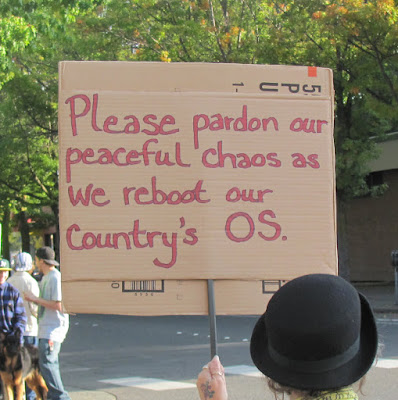 Good message about rebooting our country's operating system, held at Magnolia and Cornwall October 14.
So many issues interrelate. People often ask what Occupy Wall Street is about. I'm not even sure I'm a hundred percent "sold out" fan of Occupy Wall Street, but there is a whole "raft" of interrelated issues being discussed.
I see it as just another part of our cultural "paradigm shift."
Seeking an economy that's better than what we have now. An economy that's more sustainable, in terms of the planet and our own well being. An economy that's more fair, in terms of distribution of income in society.
The income distribution graph, in USA, has gotten out of balance over the past few decades. Continued below.
 Also Occupy Bellingham (the only one I've experienced) is kind of fun. Interesting people. A chance to see friends I haven't run into for a long time.
It's community building that is face to face.
Networking.
The process of culture that's an alternative to other uses of time. Other uses such as shopping, watching TV, fighting traffic and yes, I do spend some of my time at work. I still have a job. I'm not just watching folks on the street playing bongo drums all the time.
Sometimes folks play bongo drums in front of the building my job is in, but that's another story. It's living in Bellingham, our "blue state" (for the most part) city.
 Someone on NPR interviewed an employee who works inside a Wall Street firm in New York City. They ask what people's reaction, inside Wall Street, was to the protests on the outside.
Basically, that person said he thought folks were angry at the wrong thing. Rather than Wall Street, they should be angry at the Federal Reserve for printing too much money and devaluing the dollar, he said.
Federal Reserve has been trying to keep the economy going in face of high unemployment. Also to keep the government debt financed so Uncle Sam "appears" solvent, at least.
One can't really blame them for that.
Seems like the blame can just go round and round which is why I see this as a cultural issue.
It's a "paradigm shift" kind of thing.
In that blog post, I suggested other strategies to deal with unemployment, like job sharing and better distribution of the wealth. Maybe that's considered "spreading the misery," but really, we might do better, as a culture, if we used a bit less. If we had a bit less waste.
A somewhat more austere culture could continue to move forward, since new technology is always coming into the picture anyway. We could still progress toward more of a sense of prosperity.
Prosperity can be defined in different ways.
Much of our new technology points us in the direction of "smaller can be better." A big stereo system from the 1960s isn't necessarily better than an Ipod of 2011, just because it's larger. Smaller is sometimes just as good, if not better.
We need paradigm shifts toward an economy that's better than we've got now. Better, but not necessarily larger or more consuming. An economy that offers a fairer deal to more than just it's top people.
Much of it is about our overall sense of well being.
We may not all define our well being in the same way, but there can be some new consensus about what our priorities are.
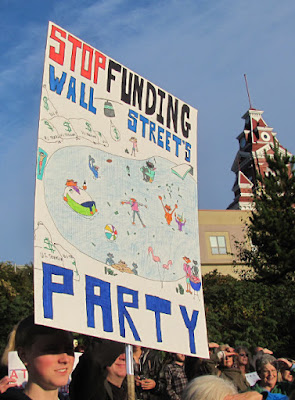
Some signs from Occupy Wall Street protest in Bellingham, October 14 2011.
Below is compilation from some of my posts about the Occupy Movement. I am consolidating blog entries.
One would think folks with savings accounts would march on banks to protest low interest rates
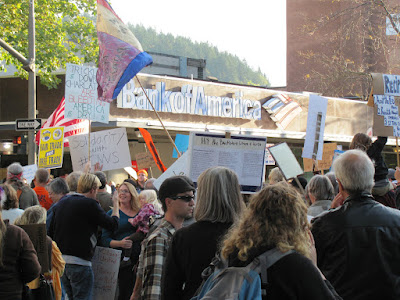 Protest in front of Bank Of America, Bellingham branch October 14 2011.
One would think savers should be marching on the banks demanding better return on savings; rather than just worrying about a $5 per month debit card fee. Maybe the fee is just a tipping point. People are mad at banks.
When I was a kid, banks often paid 5 1/4 interest on savings. Now, interest rates are rock bottom. Bad for savings, but cheap for borrowing; too cheap.
Of course it isn't really the fault of individual banks, it's the world banking system, and things like the Federal Reserve that set overall interest rates.
Part of the reason for the current financial crisis has been interest rates that are too low. When borrowing becomes too cheap, bubbles, such as the housing bubble, get inflated beyond what the normal economy can sustain. There's a disconnect if jobs don't pay much more then $10 per hour while single family homes sell for well over a quarter million.
Video taste of a People's Mike in Bellingham
Segment a bit over 2 minutes.
I see Occupy Wall Street as just another step in the evolution of society
Occupy Wall Street is not necessarily pivotal in the evolution/revolution of our society. It's just another part of the long term paradigm shift toward what can hopefully be a more equitable economy. Also a more sustainable economy.
Important steps, however.
It's good to see so many folks taking interest in the political process and the well being of the community as a whole. Not just personal profits and shortsighted self interests.
Maybe some key congressional races in 2012 will be another step.
It says People's Bank, but the people are protesting
 Another rally of Occupy Bellingham protesters. November 4Th at corner of Magnolia and Cornwall. Rallies have been weekly for the past few weeks.

 Good message about rebooting our country's operating system, held at Magnolia and Cornwall October 14.
So many issues interrelate. People often ask what Occupy Wall Street is about. I'm not even sure I'm a hundred percent "sold out" fan of Occupy Wall Street, but there is a whole "raft" of interrelated issues being discussed.
I see it as just another part of our cultural "paradigm shift."
Seeking an economy that's better than what we have now. An economy that's more sustainable, in terms of the planet and our own well being. An economy that's more fair, in terms of distribution of income in society.
The income distribution graph, in USA, has gotten out of balance over the past few decades. Continued below.
 Also Occupy Bellingham (the only one I've experienced) is kind of fun. Interesting people. A chance to see friends I haven't run into for a long time.
 It's community building that is face to face.
Networking.
The process of culture that's an alternative to other uses of time. Other uses such as shopping, watching TV, fighting traffic and yes, I do spend some of my time at work. I still have a job. I'm not just watching folks on the street playing bongo drums all the time.
Sometimes folks play bongo drums in front of the building my job is in, but that's another story. It's living in Bellingham, our "blue state" (for the most part) city.
 Someone on NPR interviewed an employee who works inside a Wall Street firm in New York City. They ask what people's reaction, inside Wall Street, was to the protests on the outside.
 Basically, that person said he thought folks were angry at the wrong thing. Rather than Wall Street, they should be angry at the Federal Reserve for printing too much money and devaluing the dollar, he said.
Federal Reserve has been trying to keep the economy going in face of high unemployment. Also to keep the government debt financed so Uncle Sam "appears" solvent, at least.
One can't really blame them for that.
Seems like the blame can just go round and round which is why I see this as a cultural issue.
It's a "paradigm shift" kind of thing.
In that blog post, I suggested other strategies to deal with unemployment, like job sharing and better distribution of the wealth. Maybe that's considered "spreading the misery," but really, we might do better, as a culture, if we used a bit less. If we had a bit less waste.
A somewhat more austere culture could continue to move forward, since new technology is always coming into the picture anyway. We could still progress toward more of a sense of prosperity.
Prosperity can be defined in different ways.
Much of our new technology points us in the direction of "smaller can be better." A big stereo system from the 1960s isn't necessarily better than an Ipod of 2011, just because it's larger. Smaller is sometimes just as good, if not better.
We need paradigm shifts toward an economy that's better than we've got now. Better, but not necessarily larger or more consuming. An economy that offers a fairer deal to more than just it's top people.
Much of it is about our overall sense of well being.
We may not all define our well being in the same way, but there can be some new consensus about what our priorities are.

Below is compilation from some of my posts about the Occupy Movement. I am consolidating blog entries.
One would think folks with savings accounts would march on banks to protest low interest rates
 Protest in front of Bank Of America, Bellingham branch October 14 2011.
One would think savers should be marching on the banks demanding better return on savings; rather than just worrying about a $5 per month debit card fee. Maybe the fee is just a tipping point. People are mad at banks.
When I was a kid, banks often paid 5 1/4 interest on savings. Now, interest rates are rock bottom. Bad for savings, but cheap for borrowing; too cheap.
Of course it isn't really the fault of individual banks, it's the world banking system, and things like the Federal Reserve that set overall interest rates.
Part of the reason for the current financial crisis has been interest rates that are too low. When borrowing becomes too cheap, bubbles, such as the housing bubble, get inflated beyond what the normal economy can sustain. There's a disconnect if jobs don't pay much more then $10 per hour while single family homes sell for well over a quarter million.
Video taste of a People's Mike in Bellingham
Segment a bit over 2 minutes.
I see Occupy Wall Street as just another step in the evolution of society
Occupy Wall Street is not necessarily pivotal in the evolution/revolution of our society. It's just another part of the long term paradigm shift toward what can hopefully be a more equitable economy. Also a more sustainable economy.
Important steps, however.
It's good to see so many folks taking interest in the political process and the well being of the community as a whole. Not just personal profits and shortsighted self interests.
Maybe some key congressional races in 2012 will be another step.
It says People's Bank, but the people are protesting
 Another rally of Occupy Bellingham protesters. November 4Th at corner of Magnolia and Cornwall. Rallies have been weekly for the past few weeks.

Sunday, October 23, 2011
Walking can be a pleasure in Autumn and other times of the year
 Where a trail crosses between Barkley Village and Alabama Hill neighborhoods.
Thursday, October 20, 2011
Democracy might come easier in Libya than in Egypt, but hopefully can come to both
Glad the old Libyan dictatorship has been overthrown. Libya has less population than Egypt so it may be easier to get the economy going again. Less people to feed plus there is a fairly easy source of revenue once the oil flows again. Hopefully this can also help Egypt since there have been a lot of Egyptian workers in the Libyan oil industry that sent money home to Egypt. Oil revenue can help in the near future, at least.
In the long run, it would be nice if the world were less dependent on the oil industry, but that's "down the road," so to speak. The road needs to turn into something more like a transit line and bike path.
Oil industry can be a corrupting force since so many oil exporting countries have been dictatorial societies, but this doesn't always have to be the case. Canada is a shining example of an open and multicultural society which exports a lot of oil. In fact Canada is the biggest oil exporting nation to the USA.
I wish both Libya and Egypt good fortune as they hopefully progress toward more democratic societies.
The world is changing.
In the long run, it would be nice if the world were less dependent on the oil industry, but that's "down the road," so to speak. The road needs to turn into something more like a transit line and bike path.
Oil industry can be a corrupting force since so many oil exporting countries have been dictatorial societies, but this doesn't always have to be the case. Canada is a shining example of an open and multicultural society which exports a lot of oil. In fact Canada is the biggest oil exporting nation to the USA.
I wish both Libya and Egypt good fortune as they hopefully progress toward more democratic societies.
The world is changing.
Tuesday, October 18, 2011
New house construction
 Rare to see new house construction, but not that rare. With all the news about housing in the toilet, there's always been quite a trickle still around Bellingham. This one by Lake Samish. I'm surprised there's still any build able lakefront lots there.
 Or, maybe they tore a house down to build this newer one?
There's construction here and there. Seems like usually folks building their retirement home. Probably not enough to employ all the idled contractors, realtors and other job seekers around.
That's the problem. Anemic recovery and if the recovery does pick up steam, here is the question. Is there enough land, not to mention ideal "lakefront" land, to allow for a robust recovery without people grumbling again about turning the lake into a toilet?
And now think about gas prices. When the economy picks up steam, they go up due to limited supply and demand.
That's why we need some major paradigm shifts. We need new ways to grow and improve the economy in sustainable ways.
People often say that they thought New York City couldn't grow any larger than it was in the late 1800s because there was an "absolute limit" to urban growth, due to the horse manure it generated.
We'll, we made it past that, but we had to be open to change.
Sunday, October 16, 2011
Missed the boat that is sinking
At times I felt like I missed the boat since I don't make enough money at my fairly pleasant job to be a homeowner in this market. Not enough money for the monthly mortgage payments to be figured as 1/3 of my income, given responsible banking practices at least.
Too bad, but now, I feel like I missed the boat that is sinking. That's not so bad. Who wants to be on the boat that's sinking?
Too bad, but now, I feel like I missed the boat that is sinking. That's not so bad. Who wants to be on the boat that's sinking?
Monday, October 10, 2011
Crosswalk etiquette and inertia
 When the crosswalk sign starts flashing don't walk, I hear on the radio that one is supposed to not start walking across the street. However the reality is different. Right after the light turns green and the walk sign says walk, there's often a cue of cars that were stopped at the red light. This cue can now go forward and there's a few cars in the cue that are making the free right turn across the crosswalk. Since they don't always stop when making that turn (even though they should) the crosswalk can be full of cars rounding the corner. There's often more traffic across the crosswalk when the walk sign says walk than there is after the walk sign starts flashing don't walk. When the walk sign is flashing don't walk and the cue of cars has passed, the intersection is often empty. That's when I often run across the street.
Bellingham is now installing some flashing crosswalks in areas where there are busy walks with no traffic light. Just push the button and the crosswalk starts flashing. At these crosswalks, I try to be polite and see what's happening with the traffic before I press the button. If cars are just about at the walk, I try to wait till they go past so they don't have to slam on the breaks. Remember, flashing crosswalks don't have a "green, yellow, red" traffic signal. I assume cars are expected to stop as soon as the walk starts flashing. There's no "yellow about to turn red" warning, like there is at intersections with regular stoplights. Keeping this in mind, I try and let the cars that are almost at the walk go on by before I press the button. Then I push the button so cars that are farther back (which are often speeding anyways) have a warning and start to slow down. By the time those cars get to the walk, I've often just finished crossing. Sometimes I jog across the street so as not to hold up traffic for very long at least.
One time I accidentally pushed the flashing crosswalk button right as a large truck was about to cross the walk. The truck stopped and I noticed smoke from the tires. Trucks have a lot of inertia so they are often harder to stop on short notice and also it takes more fuel to get going again.
I didn't see if the driver was upset or not, but later I had a discussion on Facebook with a friend of mine who is a former truck driver. I ask him if the driver would have been upset and his response was, good drivers realize "it comes with the territory." We do the best we can and there usually isn't much point in snarling about things. If more people took that attitude, the world would flow a lot easier.
Fancy Bellingham crosswalks that didn't work out well in the long run.
Thursday, October 06, 2011
Occupy Wall Street is in Bellingham also
 Even though there isn't a street named Wall Street in Bellingham, Occupy Wall Street is here.
 There's a rally planned for corner of Magnolia and Cornwall, Old Federal Building corner, Friday October 7 at 4 to 7 pm.
Someone handed me a flyer that says "all peaceful people and families welcome."
Old Federal Building has been the site of Friday peace vigils for years, since the late 1960s and more recently the location of Food Not Bombs, a free community food table.
Looks like there's going to be quite a turnout in Bellingham as well as other cities all across the nation as people are getting more frustrated with things like long term unemployment, growing disparity between super wealthy and the rest of society, decline of the middle class, cost of the state of war that never seems to end and looming threats of more budget cuts, lack of safety net and other things that folks can add to this list.
On Facebook, I saw an insightful cartoon showing Wall Street executives deciding to "occupy Main Street." On Main Street they found closed businesses, foreclosed houses and high unemployment so they said, "Well, now we know why they have all that free time."
The cartoon brilliantly cuts both ways addressing criticism that "protesters have a lot of time since they don't have to go to work." When unemployment goes up, people are likely to have more time for things like protests and civil disobedience. Executives, be advised.
Above: In front of Bank Of America on Thursday at Holly and Cornwall.
Below: At Holly and State.

 I cut it out of picture accidentally, but it's www.costofwar.com.
Below from a slightly later post.


Thursday, September 29, 2011
Neutrinos faster than light? Maybe it wouldn't take 2 million years for email to get to Andromeda
People think "snail mail" is slow. Light is a real slowpoke when it comes to sending information across cosmic distances. Even just the hint that something might be able to go faster than light is quite exciting. Possibly a historic moment. Who knows what it could mean for civilization in another 50 years. Another 25 years? Providing we ever find other civilizations out in the cosmos, we might not have to wait thousands, or millions of years for the emails to get back and forth.
News headline I saw. "Particles faster than light, revolution or mistake?"
I learned about this about a day after it was announced, but didn't get around to writing this to my blog till today. At least I didn't wait 5,000 years. Imagine if the blog server was 5,000 light years away.
Andromeda Galaxy is said to be 2 million light years away; time it takes for light to travel there. Shorter distances within our Milky Way Galaxy are still mostly measured in thousands and thousands of years.
Turns out this result was based on a mistake in the measurement. Headline I saw later. Nothing yet found to be faster than the speed of light after all.
News headline I saw. "Particles faster than light, revolution or mistake?"
I learned about this about a day after it was announced, but didn't get around to writing this to my blog till today. At least I didn't wait 5,000 years. Imagine if the blog server was 5,000 light years away.
Andromeda Galaxy is said to be 2 million light years away; time it takes for light to travel there. Shorter distances within our Milky Way Galaxy are still mostly measured in thousands and thousands of years.
Turns out this result was based on a mistake in the measurement. Headline I saw later. Nothing yet found to be faster than the speed of light after all.
Monday, September 26, 2011
Open house for Bellingham Housing Authority's green retrofit
 If nothing else, it's an opportunity to visit the roof of Lincoln Square high rise. Oh, what a view.
 The view is interesting to me since downtown Bellingham is my neighborhood.
 Reason for the visit was an open house to celebrate solar collectors on the roof and a green retrofit of the building.
 In my book, a high rise is already green compared to low density housing that spreads out over the landscape. Easier to contain impact of 190 homes when they are studio apartments and all under one roof.
 Stimulus money was available to make this even better. Solar collectors now provide part of the building's electricity.
 Up on the roof, folks discussing the collectors. See if you can spot Mayor Dan Pike in the group.
Some might ask, why bother when Bellingham is so cloudy?
I learned that collectors often work better during overcast conditions. That's because diffuse light from bright clouds shines into collectors better than blue sky. Only when pointed right at the sun do collectors work best on a sunny day. Since the sun tracks across the sky, collectors spend most of their time looking at the blue sky; that is unless one has the type that rotate to follow the sun. For fixed collectors that don't move to follow the sun, bright clouds can scatter the light better than just looking at blue sky.
Of course in Bellingham, the clouds are often dark, but that's another story.
 Looking across town, Washington Square has collectors also. One also sees Bellingham High School, Assumption Church and a bunch of other buildings.
 Looking down to a green roof on top of a utility building. That's where the tour began.
 Quite a bit was done besides just the solar collectors. Upgrades to air systems in the building can reduce stuffiness, but tenants have to be part of the solution as well. The place is now smoke free. Some might feel "big Brother" is taking over, but a smoke free environment is a big step toward a clean environment. One acquaintance of mine, who lives in BHA property, was anticipating the no smoking rule with both hope and trepidation. He hopes he can stop smoking, but fears he can't.
 That sign in one tenant's window does say, "No More DADT." Remembering to celebrate the repeal of Don't Ask Don't Tell, September 20 2011. Official day the military dropped that discriminatory policy.
 Another part of the retrofit called for replacing 400 toilets. Several BHA buildings swapped out their old toilets with low flow toilets. I sometimes wonder if the low water flow toilets are really that much better, but that could be a whole topic in itself.
 What does one do with 400 old toilets besides adding to the landfill?
Build a sidewalk. That's what they did. New sidewalk is between Whatcom Creek and Ohio Streets. Also serves as part of Bellingham's bike path system. Aggregate for concrete was made from 400 crushed toilets. Looks like just about any other concrete.

Saturday, September 24, 2011
Non Sign II advertising nothing at Peace Arch Park
 Rather than being bombarded with commercial messages, this sculpture, commissioned by the US government, basically encases fresh air. Was installed in 2011.
From Wikipedia: A large public art installation entitled "Non-Sign II" was erected near the crossing booths. The art piece is a 'blank space' in the shape of a billboard sign, surrounded by a mass of twisted metal rods. Click on photo to enlarge.
Viewed on my way back from Vancouver in the Nexus Lane. I have a Nexus card even though I'm bicycling and I don't even go up to Canada that often. It's a long story, but I can tell it here.
They now require enhanced Washington State (drivers or non drivers) ID, Nexus or passport to cross the border. I don't have a passport and the year that the enhanced ID requirement went into effect the Washington State Department of Motor Vehicles was a madhouse. In Bellingham, it was by appointment only and booked clear till after that summer. Summer of 2009, so I decided to get a Nexus instead. It costs a bit more, but lasts 5 years. Nexus is pre screened and usually just a hello at the border. Fewer questions.
Now the enhanced ID is easier to get as the crowds have subsided after the switch over, but I've already got my Nexus.
Whatcom Transit Authority bus took me to Blaine on this latest trip Sept 16 2011. Then I biked to the Skytrain station at King George Highway. Skytrain took me and my bike on into Vancouver where I went dancing, that evening and stayed in a hotel. Next day I rode around downtown on peripheral bike paths at Coal Harbor and False Creek. Then took Skytrain back out to King George Highway. From there I biked back to Bellingham, WTA service in Whatcom County is very limited on Saturday.
Friday, September 23, 2011
Trying to prop up middle class with tax breaks doesn't work especially when there are few middle class jobs
Ever increasing tax breaks for families eclipse benefits for special interests reads headline in Washington Post and as government revenues decline, more middle class jobs go on the chopping block.
I say maybe it's time to stop trying to prop up the middle class with tax breaks. The problem is, there aren't enough "family wage" jobs so the middle class is disappearing anyway. More tax breaks may just exacerbate this problem by robbing governments of needed revenue, thus causing said governments to eliminate more middle class jobs as well as the funding for needed infrastructure which helps the private sector create jobs.
The middle class is declining because there aren't enough jobs that pay a mid level "family wage." In the private sector, it seems like the bulk of the jobs are low wage while a few extremely high wage jobs reside at the top. This contributes to growth at bottom and top of wage scales, but not much in the middle class.
Government tends to be a "last bastion" of middle class jobs. The jobs that are reasonably well paid for teachers and so forth. Many of these jobs are on the chopping block.
How can we bring back the middle class? That's a puzzle for sure. Put on your thinking cap.
Taxing the rich and redistributing that wealth to lower income people might get us part way there, but i doubt this solution would get us that far.
Another way to bring back the middle class might be to "grow the economy." Yes, rev up the economy. In an economic boom, wages eventually go up. One hears that a rising tide floats all boats.
This is a popular solution, but it's problematic as well.
Does the rising economy also push up prices? Does the gap between rich and poor just get wider and life becomes even more unaffordable for those close to the bottom?
Also one has to look at the environmental ramifications of a booming economy.
I'm not necessarily against increasing prosperity if changes in technology can provide this without destroying the environment. It's a solution we have to be careful with however.
Another solution might be to make living at low wage jobs more dignified. Maybe low wages are here to stay, so how can one still live, and even thrive, in spite of not being middle class?
Learning to live without the automobile, for instance. Can save lots of money.
Also healthier lifestyles. Living healthier so there can be less need for costly medical care.
Living in smaller, more dense residential settings is another part of this solution.
A lot of creative planning can go into what people call "downshifting."
All these solutions have some pluses and minuses, but at least we're using our thinking caps.
Tax breaks for the middle class are popular, but probably not such a good idea. For instance, the interest deduction on home mortgages is designed to, supposedly, make home ownership more affordable. Problem is, it may just toss money into the market, thus inflating the cost of houses. Government looses the tax revenue while house prices inflate. Home ownership is not necessarily any more affordable.
I hear that the mortgage deduction does not exist in Canada yet the percent of population being able to own a home is still comparable to USA.
Another problem with this deduction is that the high end houses get more. It tends to support McMansions for the wealthy as well as houses for the average person.
There are proposals to phase out the home mortgage deduction, or at least make it less available to "high end" homes. For instance as recommended by the Bowles-Simpson Commission.
Many of the tax breaks, designed for the middle class, end up doing more to help the wealthy in the long run as inflation and bracket creep take place.
Of course we should discuss more taxes on the wealthy, but as some Republicans point out, this might not net that much total revenue. How much total revenue can we squeeze out of just 1 percent of the population?
I'm for taxing the rich, but I realize it may not be a panacea in terms of revenue. Taxing the rich is very important, symbolically however. If the rich get off with low taxes, others become cynical.
If nothing else, taxing the rich creates the feeling of a more level playing field. That could do wonders for people's attitude and sense of fairness, if nothing else.
Still, the middle class (especially the upper middle class) is where a large chunk of the money still resides. We may have to look here if we want to increase revenue.
The main thing that would help the middle class is not more tax breaks, but an economy that creates more middle class jobs. Figuring out how to do that is the real challenge.
I say maybe it's time to stop trying to prop up the middle class with tax breaks. The problem is, there aren't enough "family wage" jobs so the middle class is disappearing anyway. More tax breaks may just exacerbate this problem by robbing governments of needed revenue, thus causing said governments to eliminate more middle class jobs as well as the funding for needed infrastructure which helps the private sector create jobs.
The middle class is declining because there aren't enough jobs that pay a mid level "family wage." In the private sector, it seems like the bulk of the jobs are low wage while a few extremely high wage jobs reside at the top. This contributes to growth at bottom and top of wage scales, but not much in the middle class.
Government tends to be a "last bastion" of middle class jobs. The jobs that are reasonably well paid for teachers and so forth. Many of these jobs are on the chopping block.
How can we bring back the middle class? That's a puzzle for sure. Put on your thinking cap.
Taxing the rich and redistributing that wealth to lower income people might get us part way there, but i doubt this solution would get us that far.
Another way to bring back the middle class might be to "grow the economy." Yes, rev up the economy. In an economic boom, wages eventually go up. One hears that a rising tide floats all boats.
This is a popular solution, but it's problematic as well.
Does the rising economy also push up prices? Does the gap between rich and poor just get wider and life becomes even more unaffordable for those close to the bottom?
Also one has to look at the environmental ramifications of a booming economy.
I'm not necessarily against increasing prosperity if changes in technology can provide this without destroying the environment. It's a solution we have to be careful with however.
Another solution might be to make living at low wage jobs more dignified. Maybe low wages are here to stay, so how can one still live, and even thrive, in spite of not being middle class?
Learning to live without the automobile, for instance. Can save lots of money.
Also healthier lifestyles. Living healthier so there can be less need for costly medical care.
Living in smaller, more dense residential settings is another part of this solution.
A lot of creative planning can go into what people call "downshifting."
All these solutions have some pluses and minuses, but at least we're using our thinking caps.
Tax breaks for the middle class are popular, but probably not such a good idea. For instance, the interest deduction on home mortgages is designed to, supposedly, make home ownership more affordable. Problem is, it may just toss money into the market, thus inflating the cost of houses. Government looses the tax revenue while house prices inflate. Home ownership is not necessarily any more affordable.
I hear that the mortgage deduction does not exist in Canada yet the percent of population being able to own a home is still comparable to USA.
Another problem with this deduction is that the high end houses get more. It tends to support McMansions for the wealthy as well as houses for the average person.
There are proposals to phase out the home mortgage deduction, or at least make it less available to "high end" homes. For instance as recommended by the Bowles-Simpson Commission.
Many of the tax breaks, designed for the middle class, end up doing more to help the wealthy in the long run as inflation and bracket creep take place.
Of course we should discuss more taxes on the wealthy, but as some Republicans point out, this might not net that much total revenue. How much total revenue can we squeeze out of just 1 percent of the population?
I'm for taxing the rich, but I realize it may not be a panacea in terms of revenue. Taxing the rich is very important, symbolically however. If the rich get off with low taxes, others become cynical.
If nothing else, taxing the rich creates the feeling of a more level playing field. That could do wonders for people's attitude and sense of fairness, if nothing else.
Still, the middle class (especially the upper middle class) is where a large chunk of the money still resides. We may have to look here if we want to increase revenue.
The main thing that would help the middle class is not more tax breaks, but an economy that creates more middle class jobs. Figuring out how to do that is the real challenge.
Wednesday, September 21, 2011
The skids to default are greased
Quite a coincidence that the nation now likely to skid into default which has people worried about the contagion affect is Greece. The skids to default for many nations are being "greased," or actually Greeced. A new slang term in economics? One of my brainstorms.
Tuesday, September 20, 2011
Monday, September 19, 2011
Feeling of abundance and generosity creates wealth, not the Tea Party slogan of "hang onto your money"
We're in a retrenchment mood, especially with the Tea Party Republicans.
Can't afford this, can't afford that.
The wealthy have lots of money, but most of them seem to be too uptight to invest it in much, except treasury bonds. It doesn't create a lot of jobs to manufacture a treasury bond. Treasuries just fund the government which really should be funded by collecting enough taxes. The catch with funding government through treasuries is that these instruments, supposedly, need to be paid back.
The rich are afraid and uptight about other private investments since they could loose money. There's less middle class buying power to create markets for investments in companies that sell products and services. It's a vicious cycle. A mood of retrenchment.
If society wants to go down this road, at least we could learn to better deal with less. Downsize and live with less affluence.
I don't see people adapting to this easily even though there are many notable "downshifting" movements. Most folks are still under pressure to be prosperous every time the rent is due. Costs of living are still high. Many of the products and services that people make are inexpensive, but other costs such as housing, health care, education and corporate executive salaries are still unsustainable.
As the uptight money interests; the corporations and Tea Party lead governments, want to cut back, the whole thing goes down into depression. Maybe everything will be brought down. Ruled by fear and holding onto your treasury bonds. Eventually treasuries may go belly up also.
We need to get past this uptight period and recreate the spirit of generosity. Possibly spending more, instead of less. Even if it means printing money, if we want prosperity. Scientific research is one avenue toward new wealth. I listened to a real interesting segment on NPR Science Friday. It's about how basic research is needed for new kinds of wealth in the future. There are worries that the current mood of retrenchment may bring down the hope we've had for a long time that life keeps getting better for us and future generations.
I take a 2 pronged approach to economics. Learn to live and even thrive with less, if that's what's being thrown at us by the environment and economic conditions. At the same time, maybe we can use science, planning and other things to get to even greater, or at least greener, wealth in the future.
The whole definition of what constitutes wealth is also important. Wealth in quality of life, or wealth in better products and services. Maybe we can learn to better enjoy what we've got, but at the same time do what it takes to bring the better products and services.
A more fair distribution of wealth needs to be part of the picture also. How can there be mass markets for businesses to serve if the middle class is disappearing?
I don't think the Tea Party is going to get us to any of these goals. It's just going to make us want more while having less. As the wealthy hold onto their wealth, the feeling of generosity vanishes. Generosity being replaced by a Tea Party mantra of "we're broke."
Can't afford this, can't afford that.
The wealthy have lots of money, but most of them seem to be too uptight to invest it in much, except treasury bonds. It doesn't create a lot of jobs to manufacture a treasury bond. Treasuries just fund the government which really should be funded by collecting enough taxes. The catch with funding government through treasuries is that these instruments, supposedly, need to be paid back.
The rich are afraid and uptight about other private investments since they could loose money. There's less middle class buying power to create markets for investments in companies that sell products and services. It's a vicious cycle. A mood of retrenchment.
If society wants to go down this road, at least we could learn to better deal with less. Downsize and live with less affluence.
I don't see people adapting to this easily even though there are many notable "downshifting" movements. Most folks are still under pressure to be prosperous every time the rent is due. Costs of living are still high. Many of the products and services that people make are inexpensive, but other costs such as housing, health care, education and corporate executive salaries are still unsustainable.
As the uptight money interests; the corporations and Tea Party lead governments, want to cut back, the whole thing goes down into depression. Maybe everything will be brought down. Ruled by fear and holding onto your treasury bonds. Eventually treasuries may go belly up also.
We need to get past this uptight period and recreate the spirit of generosity. Possibly spending more, instead of less. Even if it means printing money, if we want prosperity. Scientific research is one avenue toward new wealth. I listened to a real interesting segment on NPR Science Friday. It's about how basic research is needed for new kinds of wealth in the future. There are worries that the current mood of retrenchment may bring down the hope we've had for a long time that life keeps getting better for us and future generations.
I take a 2 pronged approach to economics. Learn to live and even thrive with less, if that's what's being thrown at us by the environment and economic conditions. At the same time, maybe we can use science, planning and other things to get to even greater, or at least greener, wealth in the future.
The whole definition of what constitutes wealth is also important. Wealth in quality of life, or wealth in better products and services. Maybe we can learn to better enjoy what we've got, but at the same time do what it takes to bring the better products and services.
A more fair distribution of wealth needs to be part of the picture also. How can there be mass markets for businesses to serve if the middle class is disappearing?
I don't think the Tea Party is going to get us to any of these goals. It's just going to make us want more while having less. As the wealthy hold onto their wealth, the feeling of generosity vanishes. Generosity being replaced by a Tea Party mantra of "we're broke."
Wednesday, September 14, 2011
Decline of middle class. Sour grapes. Middle class was hard to enter in Bellingham anyway
Finding what people call a "real job" has not been easy for several decades here in Bellingham, WA. Perceived livability of this city means competition for "professional type" jobs has been fierce be it university faculty, or whatever. People with vast truckloads of credentials have eyed job openings for years ready to move into Bellingham from all over the world.
Now, many other parts of the country are joining Bellingham's tight market conditions for middle class jobs. It's kind of like the rest of the country can say, "we are Bellingham now."
Still, a lot of local people have survived and even thrived over the years with somewhat different expectations than the traditional "American dream." Innovations based on sustainable living and things like bicycle culture can keep expenses down while social connectedness is high. Some call Bellingham the last holdout of the hippies, but there are actually lots of counterculture currents in other parts of the country as well as the world.
On the surface, it looks like the middle class has been strong in Bellingham. With at least 3 major institutions of higher learning there has been a large percentage of the local workforce employed in state type jobs at places like Western Washington University. Also a lot of people choose to retire here, so they often still own homes and have incomes from employment in the other regions where they lived before retirement.
Our local private sector has not been as strong at creating family wage jobs as private sector employment has been in, say major metropolitan markets like Seattle. Still there is some mix of manufacturing, consulting and medical employment. As with a lot of places, Bellingham has lost several large manufacturing employers, such as Georgia Pacific Pulp and Paper mill. A few new manufacturing outfits have started up, but like in much of the country, those jobs are often outsourced or automated.
The rest of USA seems to be catching up with Bellingham's precarious middle class as economic conditions keep changing. It can be depressing, but it also means this country is going through a transition. We're in a paradigm shift that none of us really seem to understand that well.
Many forces are working against the statuesque of middle class America these days. Cuts in government spending are high on the list. Also the middle class is weakened by tax policies that have been tipping away from "sliding scale income tax." Tax policies are tipping more toward favoring the wealthy.
While these things seem more obvious as time goes on, people still tend to vote Republican much of the time. Hard to imagine, since Republicans are usually cold to the concept of "graduated income tax."
Still, there's more to this than just the politics. We are definitely in a transition that neither Republicans or Democrats can manage. Technology and automation creates some new opportunities, but it also eliminates the need for lots of formerly middle class jobs. For instance, people can now book travel online rather than using the services of a travel agent; thus meaning less jobs for travel agents. There are thousands of examples of this all across the economy.
Some folks might vote Republican as a case of "sour grapes." They say, "if we're struggling in the private sector, why do state employees still get such good benefits?"
Other factors hurting the middle class are environmental issues. People often don't like to see virgin lands bulldozed for new subdivisions of middle class homes, yet as population grows, new folks need places to live.
Automobiles are a great convenience, but global warming and peak oil has been lapping at car culture for years. I even remember a book that came out in the 1970s with the title "Death of the Automobile."
Middle class homes and cars are getting harder to come by.
No doubt we need to do things a lot differently as paradigm shifts continue into the future. While changes can be rough, there is a lot of innovation in lifestyles, business practices and government. There's lots of innovation here in Bellingham as well as in other places.
Many pioneers are finding ways to create sustainable culture and economics. Finding ways that sit well with the environment. Also finding ways to benefit from new technologies while still being able to pay the bills. It's all a challenge. A brighter, tho different, future is still possible.
Below posted in 2009.
700 applicants for a custodial position in Bellingham
Made the news in Ohio, but it's not unusual.
Much of the time, here in Bellingham, WA. it seems like custodial positions at the university or school district can draw a hundred applicants at least. Especially as they pay a bit more than most custodial positions in the private sector.
Benefits and health insurance also.
State jobs.
Custodial work is not bad work. Can be fairly hassle free and low stress. Of course depends on situation.
All through the 1980s and beyond, I remember years when custodial positions at Western Washington University would draw huge piles of applications.
The school district and city would be similar.
Much of our local economy is what they call a "service economy."
Retailing, restaurants, lawn mowing.
Lots of waiters, waitresses and store clerks. Many of the jobs have been part time and not paying much more than minimum wage.
Of course, if one has low overhead, life doesn't have to be so bad.
Good health, free time, flexibility and then people say they leave Bellingham when it's time to look for a "real job."
The places I have worked have only had a few full time jobs and large staffs of part time workers.
Much of the local work force is students who work their job schedule around class schedules. Classes come first. After one graduates, life comes first and the job comes second. There are not that many jobs which are super inspiring.
State jobs tend to be more likely to have benefits and full time hours.
Welcome to the new economy.
Bellingham has been there for a long time.
It pays to have "low overhead," but many of the houses in this area are quite large and expensive.
There's a disconnect.
Seems like many of the homeowners are retirees who got into owning in other areas and times.
Local workers are often renters.
Then there are the much sought after state jobs.
Our economy kind of revolves around education and retirement.
Some say it's the result of not being friendly to industry. Yes, much of the industrial base has deteriorated and gone overseas.
Volunteer sector is the most dynamic and exciting part of our city's economy. In spite of recession, one still finds vibrancy at various gathering spots. Political meetings, discussion groups, folk music, dancing, festivals.
Now, many other parts of the country are joining Bellingham's tight market conditions for middle class jobs. It's kind of like the rest of the country can say, "we are Bellingham now."
Still, a lot of local people have survived and even thrived over the years with somewhat different expectations than the traditional "American dream." Innovations based on sustainable living and things like bicycle culture can keep expenses down while social connectedness is high. Some call Bellingham the last holdout of the hippies, but there are actually lots of counterculture currents in other parts of the country as well as the world.
On the surface, it looks like the middle class has been strong in Bellingham. With at least 3 major institutions of higher learning there has been a large percentage of the local workforce employed in state type jobs at places like Western Washington University. Also a lot of people choose to retire here, so they often still own homes and have incomes from employment in the other regions where they lived before retirement.
Our local private sector has not been as strong at creating family wage jobs as private sector employment has been in, say major metropolitan markets like Seattle. Still there is some mix of manufacturing, consulting and medical employment. As with a lot of places, Bellingham has lost several large manufacturing employers, such as Georgia Pacific Pulp and Paper mill. A few new manufacturing outfits have started up, but like in much of the country, those jobs are often outsourced or automated.
The rest of USA seems to be catching up with Bellingham's precarious middle class as economic conditions keep changing. It can be depressing, but it also means this country is going through a transition. We're in a paradigm shift that none of us really seem to understand that well.
Many forces are working against the statuesque of middle class America these days. Cuts in government spending are high on the list. Also the middle class is weakened by tax policies that have been tipping away from "sliding scale income tax." Tax policies are tipping more toward favoring the wealthy.
While these things seem more obvious as time goes on, people still tend to vote Republican much of the time. Hard to imagine, since Republicans are usually cold to the concept of "graduated income tax."
Still, there's more to this than just the politics. We are definitely in a transition that neither Republicans or Democrats can manage. Technology and automation creates some new opportunities, but it also eliminates the need for lots of formerly middle class jobs. For instance, people can now book travel online rather than using the services of a travel agent; thus meaning less jobs for travel agents. There are thousands of examples of this all across the economy.
Some folks might vote Republican as a case of "sour grapes." They say, "if we're struggling in the private sector, why do state employees still get such good benefits?"
Other factors hurting the middle class are environmental issues. People often don't like to see virgin lands bulldozed for new subdivisions of middle class homes, yet as population grows, new folks need places to live.
Automobiles are a great convenience, but global warming and peak oil has been lapping at car culture for years. I even remember a book that came out in the 1970s with the title "Death of the Automobile."
Middle class homes and cars are getting harder to come by.
No doubt we need to do things a lot differently as paradigm shifts continue into the future. While changes can be rough, there is a lot of innovation in lifestyles, business practices and government. There's lots of innovation here in Bellingham as well as in other places.
Many pioneers are finding ways to create sustainable culture and economics. Finding ways that sit well with the environment. Also finding ways to benefit from new technologies while still being able to pay the bills. It's all a challenge. A brighter, tho different, future is still possible.
Below posted in 2009.
700 applicants for a custodial position in Bellingham
Made the news in Ohio, but it's not unusual.
Much of the time, here in Bellingham, WA. it seems like custodial positions at the university or school district can draw a hundred applicants at least. Especially as they pay a bit more than most custodial positions in the private sector.
Benefits and health insurance also.
State jobs.
Custodial work is not bad work. Can be fairly hassle free and low stress. Of course depends on situation.
All through the 1980s and beyond, I remember years when custodial positions at Western Washington University would draw huge piles of applications.
The school district and city would be similar.
Much of our local economy is what they call a "service economy."
Retailing, restaurants, lawn mowing.
Lots of waiters, waitresses and store clerks. Many of the jobs have been part time and not paying much more than minimum wage.
Of course, if one has low overhead, life doesn't have to be so bad.
Good health, free time, flexibility and then people say they leave Bellingham when it's time to look for a "real job."
The places I have worked have only had a few full time jobs and large staffs of part time workers.
Much of the local work force is students who work their job schedule around class schedules. Classes come first. After one graduates, life comes first and the job comes second. There are not that many jobs which are super inspiring.
State jobs tend to be more likely to have benefits and full time hours.
Welcome to the new economy.
Bellingham has been there for a long time.
It pays to have "low overhead," but many of the houses in this area are quite large and expensive.
There's a disconnect.
Seems like many of the homeowners are retirees who got into owning in other areas and times.
Local workers are often renters.
Then there are the much sought after state jobs.
Our economy kind of revolves around education and retirement.
Some say it's the result of not being friendly to industry. Yes, much of the industrial base has deteriorated and gone overseas.
Volunteer sector is the most dynamic and exciting part of our city's economy. In spite of recession, one still finds vibrancy at various gathering spots. Political meetings, discussion groups, folk music, dancing, festivals.
Tuesday, September 13, 2011
To folks who say, about 911, that US corporations and foreign policy had it coming, I say
Over 30,000 people die in the US each year in traffic accidents which could be seen as a byproduct of the corporate, oil economy. Still, I try to not be too bitter. There's both good and bad in pretty much all human activity including even our economy. Sometimes I feel like I'm caught between feuding fundamentalists of many fighting religions and belief systems just living on this planet. I hope I can stay out of their way and also hope I can try and not inadvertently join them.
Monday, September 12, 2011
20th anniversary of my first bike trip across America

Bandshell in Huron, SD. 1991.
20 years after my first cross USA bike trip, I biked in western Washington and Oregon.
Felt just as good as I did in 1991. No aces and pains to think of. Did I cover as many miles each day as 20 years ago?
Hard to say as I couldn't figure out how to set the trip miles on my new odometer. I wasn't even sure if it was reading kilometers or miles either. Sometimes it would just flash zeros at me indicating it wasn't picking up the passing magnate on the wheel. I didn't try to figure it out. Probably the daily total of miles was less, but "what you don't know can't hurt you." The trip was still enjoyable. In 1991, I also had an electronic odometer and carefully kept track of daily trip miles. Seemed like back then, the odometer functions were more intuitive.
In 1991 my total trip miles was much farther than in 2011, but that's because I invested over 2 months of travel time into the 1991 trip. In 2011 the trip was only about 3 weeks.
The odometer hasn't changed much in the years, but some other things I carry have. No longer riding with me is that antenna booster for AM Radio called the Select-A-Tenna. It wasn't that heavy, but many of the talk stations I listened to in the past on AM radio have gone "all sports talk." Boring. For instance KIRO AM 710 out of Seattle is now sports. It's political talk is now on FM which the Select-A-Tenna doesn't help. I've never had much desire to "keep score." Keeping track of daily milage is one thing, but most important is just having a good time.
Instead of that antenna, I have a netbook computer. I stopped at a lot of WIFI places along the way. That's why my daily milage may be in decline; Facebook.
Since the mid 1980s, I have gone on some sort of bike tour every summer. It's been a fairly mellow and enjoyable legacy. Keeps me in reasonable shape, at least along with other things like dancing that I enjoy.
Saturday, September 10, 2011
World Trade Center memories from 40 years ago
 Is it time for the media to move on from the horrible memories of ten years ago on 9/11?
I basically think yes. It should be remembered like we remember World War II. That was a tragedy also. Doesn't have to be the focus of current news and mindsets, but it still comes up in documentaries and so forth. Remembering to try and prevent another Hitler from happening. Remembering the heroism of past service members and so forth, but not having the media dominated by it. The mood of the country can move on, for the most part. Look to the future. Yes, various police agencies still need to be vigilant to keep up the guard, but that's a separate issue from having the mood of our country be dominated by 9/11.
I considered not writing about it myself, but friends suggested my views needed to be heard along with all the expected ten year hype about this topic.
Then I thumbed through some of my 1971 mail. Mail from 40 years ago when I was in high school and wrote to the World Trade Center for information. They sent a bunch of clippings and brochures that I still have.
More pleasant memories than a tragedy, but how dated. Space age communication with reel to reel tape and cameras as large as washing machines. Computers with cathode ray tubes and even push button phones.
Cutting edge, for 1971.

Pictures from World Trade Center brochures and a New York Times advertising supplement.

Tuesday, September 06, 2011
Pristine school. Whatcom Middle School rebuild

At least humankind can build a new school with updated technology and make it look like the original building. I'm impressed as I bike by. schools aren't necessarily all crumbling, tho some could use more investment. Roads, on the other hand; many carry a lot more traffic than they were designed for.
Some earlier pictures below.
 Steel frame going in fast. They say it may be ready for this fall, 1 year ahead of schedule. Being rebuilt after 2009 fire. New outside shell. All new construction except for 2 entryways. New shell designed to look like old building.

Monday, September 05, 2011
Labor Day goal, a 3 day weekend
Less person hours are needed to run our economy and a lot of workers are idle. Maybe it's time to shorten the workweek again. How about a 32 hour workweek and a 3 day weekend?
The 40 hour workweek was seen as progress over longer workweeks in sweatshops of the past. That accomplishment is one of the things people celebrate on Labor Day, yet for many workers, even the 40 hour week is just a dream. Some are out of work, wishing they had a workweek. Others toil overtime in companies that have downsized and placed more of the burden on remaining workers who often toil beyond 40 hours. Still others work the 40 hours, but when one counts time spent on long distance commutes their day is almost shot. Little time for friends and family, let along sleep and exercise.
It's time to think about distributing work hours more evenly. Create jobs for some people who are currently out of work and maybe reduce the burden on many who are still working while feeling overworked and over stressed. Outcome could be a healthier balance for all and possibly less health care costs.
Rather than proposing legislation to reduce work time, I just propose discussion about the workweek, vacations and the overall economy. A shorter workweek isn't necessarily the solution for everyone, but it's something people can think about. Folks can work out answers for their own situations.
One thing that could help is lower cost of living. Some of the average living expenses seems unnecessary. For instance high rents and mortgages just to prop up inflated property values. Toiling to maintain national wealth is one thing, but toiling just to maintain a bubble seems like a waste of effort.
Technology is kind of a two edged sword. It can create a lot of new jobs and opportunities, thus lowering unemployment, but it also has the effect of reducing the amount of work needed for the same unit of productivity. When our economy is growing, the new opportunities from technology can out pace the tendency of technology reduce the need for work. At other times, especially when the economy isn't growing, technology's effect on reducing the need for labor is more evident. We are now in a real slow growth economy.
Better distribution of existing work burdens is in order.
Part of the reason why the economy is growing slowly is all the environmental restrictions and energy costs. Worries about global warming can put a damper on things. A shorter workweek, and reduced wealth expectations, can help us adjust to these environmental issues. Still, the type of wealth we consume can change so we don't necessarily have to just lower our expectations. New technology can create cleaner production. Still, the advent of cleaner production methods has trouble keeping pace with increasing demand for wealth.
Change in society, rather than just technology, can help us redefine what wealth truly means. More free time and less hassle for the average worker could be seen as a form of wealth. Something like the 3 day weekend could be seen as a form of progress for the economy, as the 40 hour week was once seen as progress.
I would guess that the super wealthy would not like the idea of a shorter work week. It would mean that the masses are not spending as much of their time playing the game that the wealthy tend to be "top dog" at.
What Am I doing indoors typing this essay? Glorious sunny day. I should ride my bike somewhere.
Sunday, September 04, 2011
My 2011 bicycle trip photos now on line

A quieter route under freeways in Tacoma.
Bellingham, WA. to Eugene, Oregon. Then east to McKenzie Valley and up to Portland, OR. Train back from Portland.
While US economy looked like it was crumbling, should I be going on vacation, or hunkering down and hoarding food?
Vacation wins. There's still plenty of food. Glad I do have a job. Not a real fancy job being a custodian, but it's a job. Offers month long vacation benefit. That can be worth more than higher pay.
Enjoy leisure while you can. Who knows what retirement will bring. Much of the current economic worry has to do with all the debt overhang. A lot of that debt is actually money people have "saved" (lent to the government) in hopes that the investments will still be whole, when time comes to cash in. A lot of folks are starting to cash in as post war baby boom reaches retirement. Hard to say if the economy will still be solvent enough, with governments and other entities paying back debts, to meet people's retirement expectations.
Might as well enjoy life now rather than storing too many of one's expectations for the future. Savings is a good idea, but balance is needed. Who wants to work too hard, now, just in hopes of being able to afford a great retirement. Much of that retirement can disappear given the condition of our economy. Also the condition of one's health. Don't work yourself to death.
No need to hoard food, yet, but good idea to hoard your health. Who knows what Medicare will be like in the next decades.
Subscribe to:
Posts (Atom)