Tomorrow is the 5 year anniversary, but I think there is too much fanfare over these events. Notoriety and glory is one thing that the terrorists want.
Last Friday, I heard a great interview on KUOW's Conversation show with the author of a new book called "What Terrorists Want," by Louise Richardson.
It sounds like one of the big things they want is notoriety.
Maybe we should shuffle news of these crimes onto the back pages. Shuffle the news behind stories about many more lives that are lost each year to drunk drivers, for instance. Don't give terrorists so much notoriety.
Just let the CIA, Military, FBI, and so forth, quietly do their jobs catching these perpetrators.
It seems like our President has been taken over by terrorists. This is the Presidency that is defined by 911. Bush plans to travel to Ground Zero, Lay reefs, also head to Pennsylvania for that plane crash. It seems like every time Bush opens his mouth, it's about 911 and reaction to terrorism.
Why is he wasting so much of his time, and energy? What about affordability of health care?
Of course, Republicans are usually not very good at putting effort into a domestic issues. Republicans usually talk about getting the government out of domestic affairs. Reduce government so the Walmarts can take over.
Did I say Walmarts, or should I say the marketplace?
Leaving domestic affairs up to "market forces."
It is Republicans who focus on foreign affairs and national defense issues. Democrats are the ones who to get the urban transit systems going. Democrats discuss issues like affordable housing and health care; what ever attempts to make the lives of ordinary Americans work.
We need transit systems to help us become less dependent on that volatile Middle East, for oil.
Will our reaction to terrorism destroy us? Bankrupt us? Distract us from the things we really need to do for energy independence and security?
Maybe we should relegate terrorist crimes to the back pages where they belong. Put them behind the murderers and drunk drivers who take more lives each year.
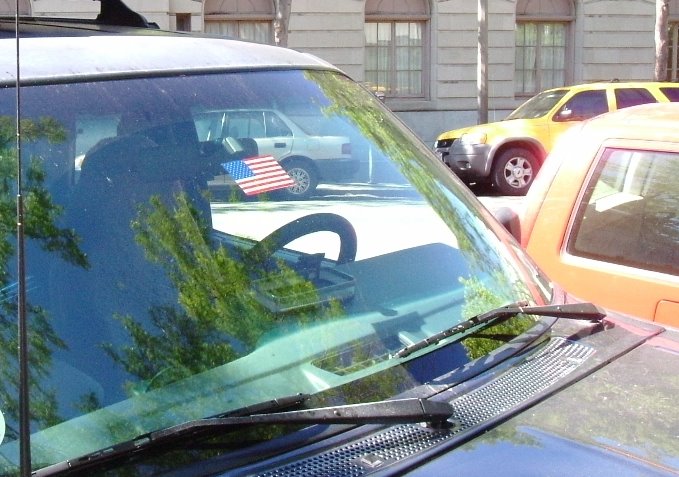
Would I display a flag for 911?
No.
I would rather display the flag for something positive, like the anniversary of Americans landing on the moon.
Can someone do more stories about the Apollo PAC for clean energy?

Sunday, September 10, 2006

Tuesday, August 29, 2006
Santa Barbara, CA.
.
The thing labor needs most?
A long and wonderful vacation.
I am back home from my 2006 trip down the west coast. This was my 5th west coast tour over the years.
Came back by train.
Above picture taken from observation tower atop Santa Barbara County Courthouse. Downtown Santa Barbara has a lot of classical architecture and pedestrian malls.
A similar view was featured in the popular book "Bicycling The Pacific Coast" by Tom Kirkendall and Vicky Spring, (at least in an earlier edition). I remember pouring over that book before my first west coast trip in 1987.
Cyclists are still taking that book with them as they do this trip. (Probably later editions).
At the end of my trip, the radio said that California has just passed a strong piece of legislation designed to roll back state wide greenhouse gas emissions. Roll these back to 1990 levels by 2020.
That will be a tall order as one must remember, population is also increasing.
Just "treading water" (keeping same percapita consumption levels) means increasing consumption if population is increasing.
This will require some major changes.
Or, maybe the goal can't be achieved with conservation? Nuclear power anyone? How about solar? Hydrogen Fusion?
All of the above.
Ironically, southern California seems more bicycle friendly than northern California. More people and more money for infrastructure. Also the need is clearly evident.
Things like bike paths and the southern California Surfliner train are great.
Now, back hear in Washington State, the Dave Ross Show, on Seattle's KIRO, does a segment about how to make roads safer.
Labor Day weekend is a deadly weekend on the roads.
Many kinds of suggestions come in. People suggest things like making truckers only operate at night or having the driving test become harder.
No one mentions making the nation less dependent on automotive travel. Maybe I should have called.
Looking forward to adding photos and stories, from my 2006 trip to these sites in the next few months.
The thing labor needs most?
A long and wonderful vacation.
I am back home from my 2006 trip down the west coast. This was my 5th west coast tour over the years.
Came back by train.
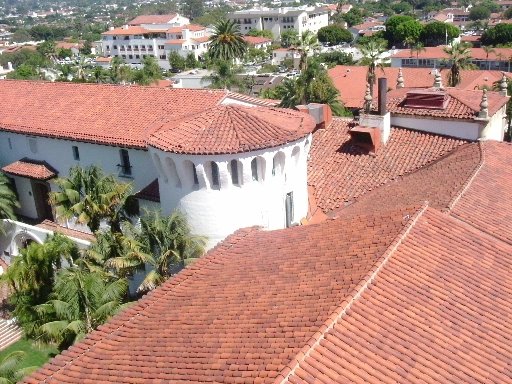
Above picture taken from observation tower atop Santa Barbara County Courthouse. Downtown Santa Barbara has a lot of classical architecture and pedestrian malls.
A similar view was featured in the popular book "Bicycling The Pacific Coast" by Tom Kirkendall and Vicky Spring, (at least in an earlier edition). I remember pouring over that book before my first west coast trip in 1987.
Cyclists are still taking that book with them as they do this trip. (Probably later editions).
At the end of my trip, the radio said that California has just passed a strong piece of legislation designed to roll back state wide greenhouse gas emissions. Roll these back to 1990 levels by 2020.
That will be a tall order as one must remember, population is also increasing.
Just "treading water" (keeping same percapita consumption levels) means increasing consumption if population is increasing.
This will require some major changes.
Or, maybe the goal can't be achieved with conservation? Nuclear power anyone? How about solar? Hydrogen Fusion?
All of the above.
Ironically, southern California seems more bicycle friendly than northern California. More people and more money for infrastructure. Also the need is clearly evident.
Things like bike paths and the southern California Surfliner train are great.
Now, back hear in Washington State, the Dave Ross Show, on Seattle's KIRO, does a segment about how to make roads safer.
Labor Day weekend is a deadly weekend on the roads.
Many kinds of suggestions come in. People suggest things like making truckers only operate at night or having the driving test become harder.
No one mentions making the nation less dependent on automotive travel. Maybe I should have called.
Looking forward to adding photos and stories, from my 2006 trip to these sites in the next few months.
Thursday, August 17, 2006
Wouldn't be as good as a dance floor
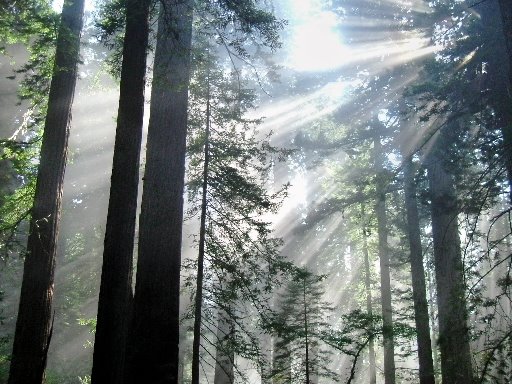
I am passing through Garberville, CA. on my 2006 bicycle tour down west coast. Have enjoyed the huge redwoods. Riding quietly through the big trees on a side road called Avenue Of The Giants. Much nicer than the more "pragmatic 101, where most commutes and trucks go.
Biking is a quiet way to see the trees.
Meeting some other cyclists at the campgrounds. KOA in Eureka had a hot tub. $20 to camp, but worth if for the hot tub. The bike area is big, behind the main building away from the RVs. Most of the time I am in state park "hiker biker" sites. No hot tub, but only $3 per night thanks to Cal state park encouragement for bicyclists.
I passed one big tree that someone wanted to chop down back around 1910. They wanted to use the stump for a dance floor. That idea was nixed and the tree still stands. Would have been too small for a dance floor anyway, but the tree is huge; and I like dance floors. It's just that the tree wouldn't have been a good one. It's better as a tree.
Lots of groves have been preserved in this area. Avenue Of the Giants, and other parts of the Redwood parks are quite extensive. A joint California and federal park system.
Tomorrow I head back to the coast on Cal Highway 1. Headed toward fort Bragg. Then San Francisco, in a few days.
Friday, August 04, 2006
My 2006 bicycle trip has started
Headed south down USA west coast. Every once-in-a-while, I will put details here. Later this coming Autumn, there will be a write up, with photos, on my web site. Past trips are already there.
Tuesday, August 01, 2006
Inclusive Neighborhoods

Photo looking up into Bellingham Farmer's Market clock tower. Light fixtures.
There is a lot of talk about Inclusive zoning these days. Allowing a mixture of housing types and price ranges with-in a neighborhood.
That, instead of places where only (expensive) single family homes are allowed while, across town, a ghetto of apartments is kept in one area. Like, "keep those apartments from escaping."
Inclusive zoning means a mix of housing types and income levels. Also a mix of land uses in one neighborhood. That means one can take a stroll, near one's home, and pass houses, a park, a church and an ice cream parlor.
That's more inviting than some boring "subdivision mile" with nothing but garage doors visible.
It brings diverse income groups together. More trust and understanding between social classes.
Also allows people to live closer to services and activities. Cuts car dependency.
I recently saw a good article about this concept in the July 26 06 Cascade Weekly. Written by one of our city council members, Joan Beardsley. She talked quite a bit about the good effects that "inclusive neighborhoods" have on schools.
In the past, people have spent much effort bussing kids across town to bring various elements of our society together. Well, another way to bring us together can be in how we plan our neighborhoods.
Bring various income classes together, for instance.
After pondering those encouraging words, I had a conversation with a friend in Ecuador, South America.
A conversation via Skype Internet phone.
My friend, in Ecuador, spoke of a negative consequence when the gap between wealthy and poor gets too wide. Latin American nations are noted for wide gaps between income classes.
Something that could be in USA's future, if we don't watch out. The income gap keeps getting wider.
He said single family homes are loosing popularity for the middle class in Ecuador.
Loosing popularity because the crime rate is so high that detached homes are vulnerable to break ins, robberies, even armed robberies.
It's like class warfare.
So the middle class is turning to high rises.
Condominium projects, rather than detached homes.
A condominium complex can provide centralized entrances for security and things like "windows high off the ground," away from the break-in zone.
Interesting observation.
It seems like bringing American income classes together, to lower the crime rate, might help us save the single family home.
Ironically, we may need to be less exclusive about our single family neighborhoods to save them.
Save them from the ravages of societal breakdown.
Monday, July 31, 2006
Being a homeowner is too lucrative for economic good, it can be considered a vocation
Highest paying job in the economy?
Being a homeowner.
It seems like home ownership is the highest paying occupation. I don't have statistics to back this up, but it's a good guess.
One of the strange distortions of our economy that results from the incredible real estate boom, over much of USA, in the last few years.
Does the occupation of home ownership produce anything useful?
Growing food produces something useful. Manufacturing plywood produces something useful. Educating students, writing software, it's all useful.
What does the occupation of "homeowner" produce for others in the economy?
A question to ponder.
As population grows and land gets scarce, home values rise. At the same time, industry gets more restricted. The economic base seems to be shifting away from employment and toward using land as a wealth generator.
One also notices lots of retail and service jobs.
Where do people get the money to shop in all those stores?
Imagine, our economy based on home equity loans.
Amazing.
Now I hear about a New York Times article on middle aged men dropping out of the workforce. The jobs they find pay much less than what they had in the past.
Many have been laid off or down sized. Quite a few of these folks are coasting, for now at least, on their home equity. Others are on disability and so forth.
It's an interesting article in Today's NY Times business section.
"Men Not Working."
Being a homeowner.
It seems like home ownership is the highest paying occupation. I don't have statistics to back this up, but it's a good guess.
One of the strange distortions of our economy that results from the incredible real estate boom, over much of USA, in the last few years.
Does the occupation of home ownership produce anything useful?
Growing food produces something useful. Manufacturing plywood produces something useful. Educating students, writing software, it's all useful.
What does the occupation of "homeowner" produce for others in the economy?
A question to ponder.
As population grows and land gets scarce, home values rise. At the same time, industry gets more restricted. The economic base seems to be shifting away from employment and toward using land as a wealth generator.
One also notices lots of retail and service jobs.
Where do people get the money to shop in all those stores?
Imagine, our economy based on home equity loans.
Amazing.
Now I hear about a New York Times article on middle aged men dropping out of the workforce. The jobs they find pay much less than what they had in the past.
Many have been laid off or down sized. Quite a few of these folks are coasting, for now at least, on their home equity. Others are on disability and so forth.
It's an interesting article in Today's NY Times business section.
"Men Not Working."
Monday, July 24, 2006
Sunday, July 23, 2006
Good human rights discussion in Irshad's blog
Irshad Manji has a great blog.
I sometimes feel like the world would be better off if the Middle East didn't exist, but realize there are a lot of decent people caught up in all that mess. It would be callus to just write everything in that region off, but it's hard to know what the best strategy is for helping innocent people caught in bad circumstances.
Ideas and discussions presented on this blog, and other places can help.
I sometimes feel like the world would be better off if the Middle East didn't exist, but realize there are a lot of decent people caught up in all that mess. It would be callus to just write everything in that region off, but it's hard to know what the best strategy is for helping innocent people caught in bad circumstances.
Ideas and discussions presented on this blog, and other places can help.
Saturday, July 22, 2006
Silver Lining?
US involvement in Iraq and the greater Middle East may have just made things even worse. Fanned the flames more.
If there is any good to come from this, it could be the total discrediting of right wing politics in USA. It may have taken this to discredit much of the religious right and the Republican agenda.
Hopefully, at least much of Congress can change in November.
Many folks keep holding signs that say "impeach Bush," but it is really Congress which has that power. Voting in November may be a step in that direction, but the process is fairly slow. Bush's second term, in the White House, will be over before long anyway. Likely before an impeachment process can unfold.
My, how time flies.
Also, of course, it isn't just the American right wing that's discredited. Fundamentalism looks bad all over the world. Whether it is the "Christian Right," "Islamic Fundamentalism," or what ever, it all looks perverted.
I hope more liberal and tolerant voices can be heard from all corners of the world. Liberal religions and so forth.
If there is any good to come from this, it could be the total discrediting of right wing politics in USA. It may have taken this to discredit much of the religious right and the Republican agenda.
Hopefully, at least much of Congress can change in November.
Many folks keep holding signs that say "impeach Bush," but it is really Congress which has that power. Voting in November may be a step in that direction, but the process is fairly slow. Bush's second term, in the White House, will be over before long anyway. Likely before an impeachment process can unfold.
My, how time flies.
Also, of course, it isn't just the American right wing that's discredited. Fundamentalism looks bad all over the world. Whether it is the "Christian Right," "Islamic Fundamentalism," or what ever, it all looks perverted.
I hope more liberal and tolerant voices can be heard from all corners of the world. Liberal religions and so forth.
Thursday, July 20, 2006
Wandering Around

Grand reading room in Wilson Library at Western Washington University, here in Bellingham. Just an easy walk from my home.
Seems to invite one to slow down.
The only countries I have been to are USA and Canada.
Still, I see many different things than "main stream society" because of the unusual way I travel. Most people go by car and jet.
I bicycle, walk and use public transit. It's almost like seeing a different world.
In 2003, one of my bicycle tours took me through Los Angeles. I described that trip as "leisurely." Others are surprised by that adjective for getting through Los Angeles. Remember, they are going by car, or changing planes at the airport. I go on the bike paths and back roads.
They gripe when it takes several hours.
I have a different perspective and don't mind that it took me two days, from one end of the metropolitan area to the other.
Glad I had enough money for the expensive motels, however.
In USA, it costs more to "stay put" than it does to keep moving. No wonder we have a "rat race" society.
Still, expensive motels are just in the cities. On most of the rural California Coast, state park camping was only $3 per night for bicyclists.
An advantage of being a bicyclist.
I don't seem to feel any need for going overseas. Not that I hate jet planes, or anything. I just feel that most people don't really take the time to be in their local environment.
Here in USA, we will need to pay more attention to our local environment so we can figure out how to make it run with less oil. That might mean actually learning the local bus schedule.
Some folks know more about overseas resort towns than they do about how to cross their own home town with out getting on the freeway.
Travel to a different perspective.
Sunday, July 16, 2006
Imagine a world with-out the Middle East
It seems like most of the bad news comes from the Middle East. Maybe the world would be better if that region didn't exist. Then again it might just mean other trouble spots would rise to the limelight.
Not only is the Middle East the source of most bad news, it's also a big source of oil; that addictive substance in civilization. Like pure sugar, it's bad for us.
I sometimes think that if sacred places and buildings in the Middle East were destroyed, the world could stop fighting over them. This may be an irresponsible attitude. Certainly there are innocent people and places there.
Normally, I like historic buildings, but maybe we could do with out many of those religious places that people keep fighting over. If those buildings turned to rubble, the world might do better with out them. And I believe in God. I just think too much fuss is going into sacred places that are man made.
Maybe the world could learn a lesson from this high school girl, I met, while she was working at an AM / PM Mini-mart in upstate New York.
This was during my 1991 bicycle tour across USA.
The little store was a world of throwaway items and plastic counters; in Upstate New York which is a bastion of American history. It was just an Exxon station, or something like that. All modern and sterile.
Across the street were some apartments with the number "1772" over the main door.
I was intrigued and ask the woman, "Were those apartments really built in 1772, or is that number just the street address?"
She just gave a quick laugh and said, "Built in 1772, I wouldn't be surprised !" "Those apartments look pretty old and crappy to me."
Then she was ringing up the next customer, like that history didn't really matter.
Maybe they had a crummy landlord also.
Smelly carpet?
It was my first time in Upstate New York and I thought "buildings built before the revolutionary war are kind of neat." We don't have things like that here in the state of Washington.
Of course many of the old temples and places of the Middle East are far older than that.
I don't feel like saying this often, but at times one needs to say (about old memories and baggage)
"Get over it."
This is especially true if it causes people to fight.
Not only is the Middle East the source of most bad news, it's also a big source of oil; that addictive substance in civilization. Like pure sugar, it's bad for us.
I sometimes think that if sacred places and buildings in the Middle East were destroyed, the world could stop fighting over them. This may be an irresponsible attitude. Certainly there are innocent people and places there.
Normally, I like historic buildings, but maybe we could do with out many of those religious places that people keep fighting over. If those buildings turned to rubble, the world might do better with out them. And I believe in God. I just think too much fuss is going into sacred places that are man made.
Maybe the world could learn a lesson from this high school girl, I met, while she was working at an AM / PM Mini-mart in upstate New York.
This was during my 1991 bicycle tour across USA.
The little store was a world of throwaway items and plastic counters; in Upstate New York which is a bastion of American history. It was just an Exxon station, or something like that. All modern and sterile.
Across the street were some apartments with the number "1772" over the main door.
I was intrigued and ask the woman, "Were those apartments really built in 1772, or is that number just the street address?"
She just gave a quick laugh and said, "Built in 1772, I wouldn't be surprised !" "Those apartments look pretty old and crappy to me."
Then she was ringing up the next customer, like that history didn't really matter.
Maybe they had a crummy landlord also.
Smelly carpet?
It was my first time in Upstate New York and I thought "buildings built before the revolutionary war are kind of neat." We don't have things like that here in the state of Washington.
Of course many of the old temples and places of the Middle East are far older than that.
I don't feel like saying this often, but at times one needs to say (about old memories and baggage)
"Get over it."
This is especially true if it causes people to fight.
Friday, July 14, 2006

Tuesday, July 11, 2006
Monica Lewinsky topic revisited
Americans becoming more socially isolated in recent years?
Maybe, Bill Clinton's biggest mistake was kowtowing to conservatives with white lies. He should have publicly embraced the concept of friendship and support outside one's primary relationship.
Friendship and support, at least.
Of course there is the worry of venereal disease with sexual relationships, but the line between friendship, support and eroticism can be blurry. Clinton could have handled his yearnings for contact, outside the primary relationship, in a better way, for sure, but said yearnings have validity.
Maybe he should have lead the nation into a dialog about these issues; including polyamory. Imagine, such a discussion starting from "The White House."
It was a missed opportunity, but I know it would have been political suicide.
Yes, we do have lots of workshops, seminars and therapists that provide contact outside the marriage.
It's a whole industry.
Massage workshops, retreats. Even things addressing sexual issues such as the "Body Electric" workshops, for instance.
These types of seminars serve an important function of breaking isolation, but some might criticize them as being "manufactured intimacy."
Yes, "manufactured."
"Just pay your $480 fee and feel connected."
Now I read, there is a study, from Duke University, that says Americans have fewer friends outside of the family. They say American's circle of confidants has shrunk dramatically in the past few decades and the number of people who say they have no one to discuss important matters has more than doubled. This study also indicates that social ties are more family based than before.
Study is called, "Social isolation in America: changes in core discussion networks over two decades."
While I can't provide a detailed review of the study, I can present my own thinking, as inspired from these news items.
It seems like people are desperately clinging to their marriages and shrinking circles of "nuclear family" ties. It's almost like "clinging for dear life" as the world washes away around us. Increasing mobility means neighbors no longer know one another. Longer work hours, longer commutes means less time to nurture friendships outside of the primary relationship.
This trend is in the wrong direction. Most people need more than just the nuclear family.
Even the nuclear family, which is being held so tightly, is on shaky ground. It's influenced by the same mobility forces that brake up friendship networks.
Often it seems like people are loosing wide circles of friends and clinging more tightly to marriages and the marriages are becoming "war zones." Marriages are more apt to end in divorce, these days.
I fear that folks are getting their "variety" from something called "serial monogamy." That is going from one marriage to the next through life.
It's serial monogamy, for variety, rather than wide networks of friends, relatives and neighbors.
I also hear that the nuclear family is more isolated, these days, than in past history. In the past, extended families of grandparents, uncles and aunts provided support networks. Today, these broader "extended family networks" are more scattered.
The nuclear family is isolated and subject to what one could call "cabin fever." When one gets board and seeks variety, it often breaks up.
Serial monogamy leaves a painful trail of broken relationships in its path. It's a sad story.
Putting more energy into a diverse circle of friends is better than putting everything into one's marriage until cabin fever strikes.
Yes, a national dialog on the state of our relationships and the dynamic between "primary relationships" and "outside friends" would be healthy.
Former President Clinton was struggling with these issues along with just about everyone else.
There is a lot of rhetoric about trying to make marriage last. Most Americans seem to talk a lot, while not really living this value.
One can, at least, praise the Clintons for staying married. Through all the news of Clinton's extra marital escapades, that marriage has held together.
These days, people talk about fidelity, but don't practice it. As soon as a rough spot hits, like some extra marital affair, folks bail out.
At least the Clintons demonstrate that old fashioned value of staying together.
I remember someone calling a talk show accusing her husband of winking at another woman in the supermarket. He wasn't having affairs, just winking.
The talk show host had a good answer. She said, "your husband is only married, he's not dead." "He will have feelings."
Expectations can be real high these days. Even winking can become a problem. The bar is set so high that a slight hint of adversity can end things.
This situation must be caused by advertising. It's advertising that constantly pounds people with the message "you deserve better."
The nature of business and advertising raises expectations to unsustainable levels. At the same time, mobility and things like the Internet make "greener pastures only mouse clicks away."
Then there are lots of people, like me, who can live without partners. For single people, friendship networks take on an added importance.
Yes, I think it would be good for people to back off a bit from clinging so tightly to the marriage concept.
People should seek broader networks of community. Relax, "let go" a little and, ironically, even the institution of marriage might benefit.
I guess it was Hillary Clinton who coined the phrase, "It takes a village to raise a child." Well, I say, it takes a village, and more than just one's "nuclear family" to satisfy our needs.
Maybe, Bill Clinton's biggest mistake was kowtowing to conservatives with white lies. He should have publicly embraced the concept of friendship and support outside one's primary relationship.
Friendship and support, at least.
Of course there is the worry of venereal disease with sexual relationships, but the line between friendship, support and eroticism can be blurry. Clinton could have handled his yearnings for contact, outside the primary relationship, in a better way, for sure, but said yearnings have validity.
Maybe he should have lead the nation into a dialog about these issues; including polyamory. Imagine, such a discussion starting from "The White House."
It was a missed opportunity, but I know it would have been political suicide.
Yes, we do have lots of workshops, seminars and therapists that provide contact outside the marriage.
It's a whole industry.
Massage workshops, retreats. Even things addressing sexual issues such as the "Body Electric" workshops, for instance.
These types of seminars serve an important function of breaking isolation, but some might criticize them as being "manufactured intimacy."
Yes, "manufactured."
"Just pay your $480 fee and feel connected."
Now I read, there is a study, from Duke University, that says Americans have fewer friends outside of the family. They say American's circle of confidants has shrunk dramatically in the past few decades and the number of people who say they have no one to discuss important matters has more than doubled. This study also indicates that social ties are more family based than before.
Study is called, "Social isolation in America: changes in core discussion networks over two decades."
While I can't provide a detailed review of the study, I can present my own thinking, as inspired from these news items.
It seems like people are desperately clinging to their marriages and shrinking circles of "nuclear family" ties. It's almost like "clinging for dear life" as the world washes away around us. Increasing mobility means neighbors no longer know one another. Longer work hours, longer commutes means less time to nurture friendships outside of the primary relationship.
This trend is in the wrong direction. Most people need more than just the nuclear family.
Even the nuclear family, which is being held so tightly, is on shaky ground. It's influenced by the same mobility forces that brake up friendship networks.
Often it seems like people are loosing wide circles of friends and clinging more tightly to marriages and the marriages are becoming "war zones." Marriages are more apt to end in divorce, these days.
I fear that folks are getting their "variety" from something called "serial monogamy." That is going from one marriage to the next through life.
It's serial monogamy, for variety, rather than wide networks of friends, relatives and neighbors.
I also hear that the nuclear family is more isolated, these days, than in past history. In the past, extended families of grandparents, uncles and aunts provided support networks. Today, these broader "extended family networks" are more scattered.
The nuclear family is isolated and subject to what one could call "cabin fever." When one gets board and seeks variety, it often breaks up.
Serial monogamy leaves a painful trail of broken relationships in its path. It's a sad story.
Putting more energy into a diverse circle of friends is better than putting everything into one's marriage until cabin fever strikes.
Yes, a national dialog on the state of our relationships and the dynamic between "primary relationships" and "outside friends" would be healthy.
Former President Clinton was struggling with these issues along with just about everyone else.
There is a lot of rhetoric about trying to make marriage last. Most Americans seem to talk a lot, while not really living this value.
One can, at least, praise the Clintons for staying married. Through all the news of Clinton's extra marital escapades, that marriage has held together.
These days, people talk about fidelity, but don't practice it. As soon as a rough spot hits, like some extra marital affair, folks bail out.
At least the Clintons demonstrate that old fashioned value of staying together.
I remember someone calling a talk show accusing her husband of winking at another woman in the supermarket. He wasn't having affairs, just winking.
The talk show host had a good answer. She said, "your husband is only married, he's not dead." "He will have feelings."
Expectations can be real high these days. Even winking can become a problem. The bar is set so high that a slight hint of adversity can end things.
This situation must be caused by advertising. It's advertising that constantly pounds people with the message "you deserve better."
The nature of business and advertising raises expectations to unsustainable levels. At the same time, mobility and things like the Internet make "greener pastures only mouse clicks away."
Then there are lots of people, like me, who can live without partners. For single people, friendship networks take on an added importance.
Yes, I think it would be good for people to back off a bit from clinging so tightly to the marriage concept.
People should seek broader networks of community. Relax, "let go" a little and, ironically, even the institution of marriage might benefit.
I guess it was Hillary Clinton who coined the phrase, "It takes a village to raise a child." Well, I say, it takes a village, and more than just one's "nuclear family" to satisfy our needs.
Thursday, July 06, 2006
Nation's Population About To Blast Past 300,000,000
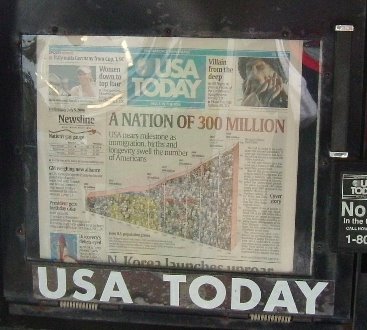
Even if they don't find the "gay gene." one would still think there is plenty of reason not to worry that not everyone leads "lifestyles of procreation."
There are more than enough people.
Evidence for genetic basis of gayness is convincing, to some, but not all. The jury is still out.
A recent interview, on National Public Radio, brought me yet another perspective on the natural state of human beings.
Genetics does not really dictate our sexuality.
One of the beauties of our genetic makeup is that we are given a lot of flexibility. Human behavior, including sexual behavior, is not rigidly dictated by genetic programming. This gives us the ability to adapt our behavior to changing circumstances.
Maybe the genes drop a few hints, but they really don't say as much as some folks might think.
We have the inherent ability to be quite adaptable.
Adaptability is an attribute for survival.
Even thinking about "survival of the fittest" the species with the most offspring is not necessarily the one most likely to be survive.
"Quality," rather than just "quantity" makes a difference.
Elephants, for instance, don't have a lot of offspring, but they take real good care of the offspring they have.
Our genetics may dictate things about the workings of our kidneys and heart, but the more interesting area of human behavior is not necessarily a slave of genes. The ability to use "free will" and adapt to changing circumstances, in our environment, is a great thing we have inherited.
We ought to be glad we have this flexibility.
I don't think there is anything in the "program" that says, "everyone must procreate" to "get with the program."
There is an old phrase that goes, "come on, get with the program."
One can ask, "what program?"
These thoughts are inspired after an interview, I heard several weeks back, with a Professor named David Barash, at University of Washington.
Another way to adapt to growing population. Don't litter.
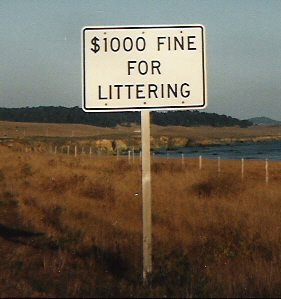
More people, more need to curtail things like littering.
I was never a litterbug, but the first sign I saw that said, "thousand
dollar fine for littering" impressed me. It was on my 1988 bike trip to southern California. Somewhere around San Simeon.
"Wow, thousand dollar fine for tossing a candy wrapper."
Now, these signs are common place; even here in Washington State.
Tuesday, July 04, 2006
Here comes the train
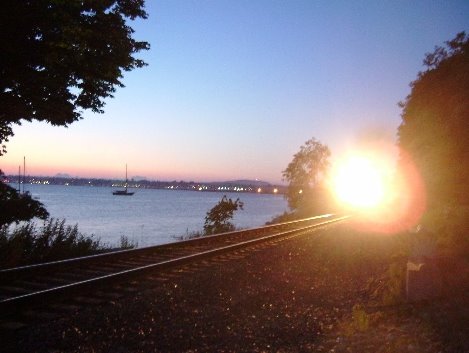
Where the trail and tracks cross a freight train approaches.
Near Boulevard Park.
At dusk, the approaching light is what my camera sees. Looks like a sunrise coming down the track.
Thursday, June 29, 2006
What to do with Georgia Pacific's old Lagoon

Viewing old treatment lagoon over flower beds at WWU campus.
I guess I don't really care whether it becomes a marina, or a park. It's just another thing for people to fight about.
Then there is someone, I know, who suggests just leaving it a waste water treatment lagoon. Who knows, we may have future needs for the lagoon as a treatment facility.
Another writer leans toward the marina idea because he says it brings income and "having a job, being able to eat." is an important priority.
Well, I don't consume very much and I still can live on "part time" work, but it does take money to build something. There are many exciting plans for Bellingham's central waterfront (the old GP mill site), of which this lagoon is just one section.
A bit south of the lagoon are plans for trails, parks, mixed use neighborhoods, old building restoration. There are even plans for relocating WWU's Huxley College of the Environment down there.
I just want to see them get something done, before I pass from this planet.
Maybe the marina is most practical, just so that something gets done. A revenue source.
At least it's a plan that's been on a roll.
There is still a long process of studying, community input and clean up ahead. It will be several years before things really get going. Maybe I am advocating being hasty, in planning, but I just want to see fences come down and the new waterfront take shape, what ever they decide, with-in reason, to do.
There is now the "Bellingham Bay Initiative" as some folks feel there needs to be an even more thorough cleanup than what's currently proposed.
I just point out that 42 thousand people die each year in car accidents. Why can't we throw up a bunch of "paper shuffling" roadblocks in front of the cars?
As for what they do with mercury in the old GP site; it may not be a dreadfully serious hazard. I tend to trust "departments of ecology," and so forth. They will be studying it, planning things and taking extra precautions, for years.
One can count on that.
It was said that the process will cost reams of paper and a truckload of "copy machine toner."
I just hope I am still alive, and able to take a stroll, when that new "waterfront neighborhood" opens.
Monday, June 26, 2006
Service station gone, but old reader board remains. Says, "ride your bike."

I am not sure why they tore down this old filling station near my home. Besides the reader board, there is little left in this weed tangled lot. Little besides an aeration device. Must be for environmental cleanup.
Could said service station be the victim of a leaky tank?
Anyway, I like the message. With all the problems of an oil economy, it is time more people rode bikes. Public transit also.
Monday, June 12, 2006
Healthy Fast Food For Living Alone
But some might disagree.
My sister helped confirm my habits by sending a clipping from the May 23 Spokesman Review.
"Chocolate milk may be the new Gatorade."
Bike racers in the Spokane area are finding that "plain old chocolate milk" is just as good, if not better, than so called fitness drinks.
I'm not a racer, but the bicycle is my transportation. Chocolate milk is a fast source of energy, protein, vitamins and minerals. It's better than so many fitness drinks which can taste like chemical toilets and cost twice as much.
Still it isn't always easy to find. There are drive up coffee spots all over town and just about every restaurant, bar and store has it's coffee, but cartons of chocolate milk? Not common.
Some people say chocolate milk isn't healthy, all full of sugar, dairy, even the low fat that I drink. Then they sip their coffee with sugar, or eat an ice cream cone.
A friend suggested I try "soy milk."
Soy is supposedly healthier, yet it's more expensive. The flavor doesn't hit the spot for me. This friend then admits that she drinks her soy with whipped cream; a whole bunch of whipped cream.
I just drink the carton of chocolate milk and skip the whipped cream.
One can get a quart carton for as low as $1.29 or $1.39, but in just a few places.
Bellingham Food Co-op only stocks "organic" chocolate milk and it's about twice as expensive.
Living in downtown Bellingham, I find myself frequenting places like Rite Aid Pharmacy or the Grocery Outlet for my fix.
If these aren't accessible, I end up at "filling station convenience stores;" heaven forbid.
At Rite Aid, groceries aren't the main stay, but so many people live around there that they stock a few groceries for convenience. Still, one occasionally finds an "out of order" sign on that refrigerator.
Someone recently wrote a letter to the Herald saying we need a "grocery store" in downtown Bellingham. A grocery store that is near where so many people live.
The city is emphasizing "downtown residential" so wouldn't a supermarket be the next step?
A Haggen's, or something?
Unfortunately, these "one stop for everything" kind of markets seem to be all out by the freeway.
Well, we do have groceries, but one must piece together several businesses to make it work.
Good produce at the Food Co-op and also at the Public Market on Cornwall, but one must go elsewhere to get affordable chocolate milk.
Then we have bargain foods at the Grocery Outlet, which usually stocks the milk. Grocery Outlet has a lot of things at good prices, but it's inventory is unpredictable. "They've got it if it's a bargain," such as "overstocked" at another store.
Walking to the Grocery Outlet isn't very inspiring either as that intersection is one of the crazyest near downtown Bellingham. More than 4 streets come together in a big jumble and one of the corners is a "no croswalk" corner.
So, I go to more than one place for my groceries. No, "one stop for all" supermart. I hear that's common in Europe.
With my active lifestyle, apples, carrots, chocolate milk and graham crackers go a long ways. Then I usually eat one restaurant meal per day. Restaurants are a good way to get salad. When one lives alone, salad makings can go bad in the refrigerator.
How long does it take to eat a whole head of lettuce?
For single people, these often go bad, thus causing one to never buy salad makings.
Friends of mine say they prefer eating at home, but you see them in their coffee shops and bars. They spend as much on cookies and beer as I do on my restaurant meals?
Living alone and having no kitchen or garden has an influence my eating habits.
Bicycle touring has an influence also. Everything, including "the kitchen sink," doesn't fit into bicycle panniers.
"Organic living" gurus may scoff at me as they drive home to their suburban kitchens and gardens.
One restaurant meal per day with a salad, chicken or fish works for me. Then it's fast foods like peanut butter sandwiches, graham crackers, apples and chocolate milk.
My sister helped confirm my habits by sending a clipping from the May 23 Spokesman Review.
"Chocolate milk may be the new Gatorade."
Bike racers in the Spokane area are finding that "plain old chocolate milk" is just as good, if not better, than so called fitness drinks.
I'm not a racer, but the bicycle is my transportation. Chocolate milk is a fast source of energy, protein, vitamins and minerals. It's better than so many fitness drinks which can taste like chemical toilets and cost twice as much.
Still it isn't always easy to find. There are drive up coffee spots all over town and just about every restaurant, bar and store has it's coffee, but cartons of chocolate milk? Not common.
Some people say chocolate milk isn't healthy, all full of sugar, dairy, even the low fat that I drink. Then they sip their coffee with sugar, or eat an ice cream cone.
A friend suggested I try "soy milk."
Soy is supposedly healthier, yet it's more expensive. The flavor doesn't hit the spot for me. This friend then admits that she drinks her soy with whipped cream; a whole bunch of whipped cream.
I just drink the carton of chocolate milk and skip the whipped cream.
One can get a quart carton for as low as $1.29 or $1.39, but in just a few places.
Bellingham Food Co-op only stocks "organic" chocolate milk and it's about twice as expensive.
Living in downtown Bellingham, I find myself frequenting places like Rite Aid Pharmacy or the Grocery Outlet for my fix.
If these aren't accessible, I end up at "filling station convenience stores;" heaven forbid.
At Rite Aid, groceries aren't the main stay, but so many people live around there that they stock a few groceries for convenience. Still, one occasionally finds an "out of order" sign on that refrigerator.
Someone recently wrote a letter to the Herald saying we need a "grocery store" in downtown Bellingham. A grocery store that is near where so many people live.
The city is emphasizing "downtown residential" so wouldn't a supermarket be the next step?
A Haggen's, or something?
Unfortunately, these "one stop for everything" kind of markets seem to be all out by the freeway.
Well, we do have groceries, but one must piece together several businesses to make it work.
Good produce at the Food Co-op and also at the Public Market on Cornwall, but one must go elsewhere to get affordable chocolate milk.
Then we have bargain foods at the Grocery Outlet, which usually stocks the milk. Grocery Outlet has a lot of things at good prices, but it's inventory is unpredictable. "They've got it if it's a bargain," such as "overstocked" at another store.
Walking to the Grocery Outlet isn't very inspiring either as that intersection is one of the crazyest near downtown Bellingham. More than 4 streets come together in a big jumble and one of the corners is a "no croswalk" corner.
So, I go to more than one place for my groceries. No, "one stop for all" supermart. I hear that's common in Europe.
With my active lifestyle, apples, carrots, chocolate milk and graham crackers go a long ways. Then I usually eat one restaurant meal per day. Restaurants are a good way to get salad. When one lives alone, salad makings can go bad in the refrigerator.
How long does it take to eat a whole head of lettuce?
For single people, these often go bad, thus causing one to never buy salad makings.
Friends of mine say they prefer eating at home, but you see them in their coffee shops and bars. They spend as much on cookies and beer as I do on my restaurant meals?
Living alone and having no kitchen or garden has an influence my eating habits.
Bicycle touring has an influence also. Everything, including "the kitchen sink," doesn't fit into bicycle panniers.
"Organic living" gurus may scoff at me as they drive home to their suburban kitchens and gardens.
One restaurant meal per day with a salad, chicken or fish works for me. Then it's fast foods like peanut butter sandwiches, graham crackers, apples and chocolate milk.
Tuesday, June 06, 2006
Did traffic kill Eyman's latest initiative?
Referendum 65 failed to get enough signatures to qualify for Washington State ballots. It was an attempt to overturn Washington's new law adding sexual orientation to the anti discrimination laws. With that initiative out of the way, the new civil rights law goes into effect Wednesday. Gay rights leaders can now celebrate.
It would have been poetic justice if Tim Eyman's referendum was squashed in traffic. At 4:30 PM, 1/2 hour before the signature deadline, a radio report said that an Eyman aid was hurrying toward Olympia with the last of the signatures. Radio said, "It's possible that I-5 traffic could determine the fate of the referendum."
Eyman first became famous for filing an initiative that cut car tab fees in Washington, thus leading to huge cuts in funding for public transit.
Since then, some transit agencies have recovered the lost revenue by adding other taxes.
Gee, maybe those last signatures for R-65 could have traveled to Olympia on Sound Transit? Whoops, I wonder if Sound Transit even goes to Olympia? With more funding, it could. Things like Sound Transit can slide people right past bottle necks on I-5.
Really, the traffic was a moot point. It looked like Eyman, and his aids, may have gotten to Olympia on time; barely. Hurrying up the steps just before that deadline, possibly panting all the way, there still weren't enough signatures.
Speaking of panting, when I hear Tim Eyman on the radio, he sounds like he's hyper ventilating. That's a byproduct of seeming to be angry much of the time. Why those bleep bleep politicians and we're not going to take it anymore.
On Monday, Eyman decided to capitalize on his negative image by showing up at a press conference in a Darth Vader outfit. That press conference was to announce that he was going to wait one more day to turn in the signatures. Rather than comfortably getting them in a day before the deadline, he decided to struggle clear to the last moment.
Well, he didn't make it. Washington State can now include sexual orientation in it's non discrimination laws.
It would have been poetic justice if Tim Eyman's referendum was squashed in traffic. At 4:30 PM, 1/2 hour before the signature deadline, a radio report said that an Eyman aid was hurrying toward Olympia with the last of the signatures. Radio said, "It's possible that I-5 traffic could determine the fate of the referendum."
Eyman first became famous for filing an initiative that cut car tab fees in Washington, thus leading to huge cuts in funding for public transit.
Since then, some transit agencies have recovered the lost revenue by adding other taxes.
Gee, maybe those last signatures for R-65 could have traveled to Olympia on Sound Transit? Whoops, I wonder if Sound Transit even goes to Olympia? With more funding, it could. Things like Sound Transit can slide people right past bottle necks on I-5.
Really, the traffic was a moot point. It looked like Eyman, and his aids, may have gotten to Olympia on time; barely. Hurrying up the steps just before that deadline, possibly panting all the way, there still weren't enough signatures.
Speaking of panting, when I hear Tim Eyman on the radio, he sounds like he's hyper ventilating. That's a byproduct of seeming to be angry much of the time. Why those bleep bleep politicians and we're not going to take it anymore.
On Monday, Eyman decided to capitalize on his negative image by showing up at a press conference in a Darth Vader outfit. That press conference was to announce that he was going to wait one more day to turn in the signatures. Rather than comfortably getting them in a day before the deadline, he decided to struggle clear to the last moment.
Well, he didn't make it. Washington State can now include sexual orientation in it's non discrimination laws.
Bellingham Pride parade and festival 2006
 Bellingham's Fourth Corner Pride Festival was good. June 4 2006. Downtown at Depot Market Square, also known as the farmer's market structure. Sometime between noon and 5 PM around 1,000 folks dropped by. The Herald said hundreds. One person, I talked to, said 1,200. Maybe it was 900? What ever. A big turn out anyway. Also featured in June 5th Bellingham Herald.
 Besides many folks from various lgbt walks of life, there were people from the general public who also stopped by. It's getting to be more of a respected "Bellingham event." Next year, folks say "the city" will be among the co-sponsors, what ever that means.
It should.
Many organizations, such as PFLAG, Evergreen Aids Foundation as well as a lot of individuals pool together to make this a success. Even my web page and Yahoo Group makes it's mark. Thanks to the many folks who attend, and some heard about it on my sites.
I hear that "Pride Festival" was the first "non Farmer's Market" event to use the new facility called Depot Market Square. They were still finishing things up around the edges. Construction machinery was evident behind fences.
Last year, the pride festival was at Blodel Donovan Park and several years back, the mayor was one of the speakers proclaiming our legitimacy; also stumping for the "gay vote."
Each year glbt folks, and friends, become more recognized in our city.
Saturday, June 03, 2006
Better to have Bush speak out against gay marriage while he is low in the polls
He could do a lot of damage if he were high in the polls. Bush's low approval rating can help pull down the fortunes of "Focus On The Family" type groups that oppose alternative lifestyles.
My poem.
Religious intransigence. Intransigence almost sounds like insurgency. "Islamic fundamentalist insurgents." "American way" intransigent platforms.
Battle between "closed minded" minds.
Having to keep order with the barrel of a gun.
Policing the world, rising deficits, overpopulation, greenhouse gases, too much "hot air."
It isn't working very well, or at least so say the polls.
The world is hard to manage, especially the intrasigent, insurgent, fundamentalist sides of the world.
Our President on a rough ride.
We need more "alternative lifestyles." Innovate cause there's got to be better ways.
When a sinking ship speaks out against gay rights, hopefully folks of common sense will swim away. Hopefully folks can swim to new paradigms.
My poem.
Religious intransigence. Intransigence almost sounds like insurgency. "Islamic fundamentalist insurgents." "American way" intransigent platforms.
Battle between "closed minded" minds.
Having to keep order with the barrel of a gun.
Policing the world, rising deficits, overpopulation, greenhouse gases, too much "hot air."
It isn't working very well, or at least so say the polls.
The world is hard to manage, especially the intrasigent, insurgent, fundamentalist sides of the world.
Our President on a rough ride.
We need more "alternative lifestyles." Innovate cause there's got to be better ways.
When a sinking ship speaks out against gay rights, hopefully folks of common sense will swim away. Hopefully folks can swim to new paradigms.
Thursday, June 01, 2006
Good News From Mexico
There was an interesting segment on today's "Day To Day" show on National Public Radio. Segment titled "Rising Feminist Voice in Mexican Politics." It is about the candidacy of Patricia Mercado. She is running for President of Mexico. She may not be among the top two candidates, but her vision is the beginnings of a new vision in Mexican politics. Supports feminist issues, gay marriage and so forth. New perspectives, rather than the tired old left or right.
I find this interesting as things in Mexico, such as population growth and economics, effects us here in the USA. Population growth especially. These things effect us via immigration. Newer thinking about human sexuality is needed.
Show is archived on the NPR web site. Go to "Programs" and find "Day To Day" Then visit June 1 show for audio.
I find this interesting as things in Mexico, such as population growth and economics, effects us here in the USA. Population growth especially. These things effect us via immigration. Newer thinking about human sexuality is needed.
Show is archived on the NPR web site. Go to "Programs" and find "Day To Day" Then visit June 1 show for audio.
Monday, May 22, 2006
Would tax cuts stimulate the economy if they really brought cuts instead of deficit spending?
Bush claims tax cuts have actually increased the amount of revenue that the federal government "takes in" by stimulating the economy. They say more taxes are collected from a bigger economy, in spite of the lower tax rates.
Take a deep breath.
That is quite a complicated concept and it has some truth, but here is a question I ask.
Would this "economic stimulation effect" still happen if the tax cuts were accompanied with equal spending cuts on the part of the federal government?
In other words, of course the economy is stimulated as it's getting a double barreled influx of cash.
Lower taxes, but federal spending remains high.
The economy would really suffer if tax cuts were equaled with big cuts in federal spending. Cuts in entitlements, military spending, highways and infrastructure as well as hurricane relief, for instance. If the tax cuts caused these huge spending cuts, then the economy would not be doing so well.
Or, at least I don't think it would be doing well.
Basically the economy is doing well because low interest rates have allowed us to put things on the credit card.
We have low taxes while the federal government continues to dump money into the economy. The federal government can continue to spend money on keeping infrastructure running.
The best of both worlds. That is until the credit card comes due.
Still one might also have to ask, "what else would any president do?" Walk away from hurricane relief?
I never voted for Bush though.
Bringing the troops home from Iraq could save money.
Anyway, our government is spending lots and keeping taxes low. Some say "spending like a drunken sailor," but what other choices does it have?
Will this credit card ever come due?
That's a good question.
Sometimes I wonder. It seems like it's "easy money." Maybe the federal government will eventually declare some form of bankruptcy.
Then what will happen?
Could life just go on with little consequence to the economy?
Life goes on like this is just some sort of "paper shuffling" matter.
Then again maybe not. Who knows.
Take a deep breath.
That is quite a complicated concept and it has some truth, but here is a question I ask.
Would this "economic stimulation effect" still happen if the tax cuts were accompanied with equal spending cuts on the part of the federal government?
In other words, of course the economy is stimulated as it's getting a double barreled influx of cash.
Lower taxes, but federal spending remains high.
The economy would really suffer if tax cuts were equaled with big cuts in federal spending. Cuts in entitlements, military spending, highways and infrastructure as well as hurricane relief, for instance. If the tax cuts caused these huge spending cuts, then the economy would not be doing so well.
Or, at least I don't think it would be doing well.
Basically the economy is doing well because low interest rates have allowed us to put things on the credit card.
We have low taxes while the federal government continues to dump money into the economy. The federal government can continue to spend money on keeping infrastructure running.
The best of both worlds. That is until the credit card comes due.
Still one might also have to ask, "what else would any president do?" Walk away from hurricane relief?
I never voted for Bush though.
Bringing the troops home from Iraq could save money.
Anyway, our government is spending lots and keeping taxes low. Some say "spending like a drunken sailor," but what other choices does it have?
Will this credit card ever come due?
That's a good question.
Sometimes I wonder. It seems like it's "easy money." Maybe the federal government will eventually declare some form of bankruptcy.
Then what will happen?
Could life just go on with little consequence to the economy?
Life goes on like this is just some sort of "paper shuffling" matter.
Then again maybe not. Who knows.
Thursday, May 18, 2006
Under the futuristic Skytrain into Vancouver, BC.
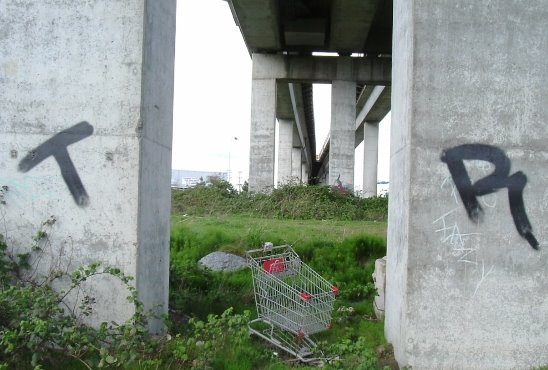
An abandoned shopping cart. Futuristic, or down to earth. Image taken near Scott Road in Surrey.
Just one image I saw as most people blast by in their cars. Several weeks ago, I did a combination bike, bus and Skytrain trip to Vancouver, BC from Bellingham.
"Transportation diversity."
It was a good trip. Spent a night in the YMCA Hotel on Burrard St. Enjoyed dancing that night in Vancouver's gay scene and came back to Bellingham next day.
Trip included bicycling from Bellingham to Whiterock, BC. then taking the 351 bus to downtown Vancouver, from Whiterock. Coming back I rode the Skytrain with my bike to Surrey, BC. Then bicycled to Blaine, WA. and picked up a WTA bus to Bellingham.
The future is emerging. Remember Bike To Work and School Day May 19.
Tuesday, May 16, 2006
Picture of Farmer's Market Structure in Bellingham, WA.
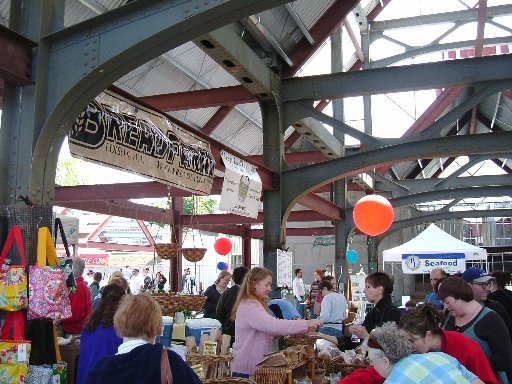
Last Saturday was the first day with booths under the main canopy. Some of the steel came from old Highway 99 bridge across the Skagit River. When the old bridge was torn down, steel was recycled.
I went to the Farmer's market to join Mount Baker Bike Club's annual "Ride With Your Politician" event. That is where they invite local politicians to go on a bike ride. They check out the good things and bad things about riding around town from the standpoint of a bicyclist.
Last year, several politicians showed up, but only one made it this year. Others, who are regulars, had "out of town" engagements.
Soon after the ride, I had an out of town engagement also. I rode my bike 8 miles out into the county to "Salon Q." That's a discussion group which meets in someone's living room. Discusses gay and trans-gender issues.
Then it was a bike trip back into town for a dinner and dancing with "Bellingham Leathermen." I'm not really into leather, I'm more into spandex, but the Leathermen were fun to spend time with. A few folks came down from Vancouver, BC. and up from Seattle, WA. to join the Bellingham gathering.
It was a very social day for me. More interesting things going on in this great city than usual.
Next day, I realized I had left my jacket out at Salon Q so I went on another bike ride to retrieve it. Made that into a loop in Whatcom County. Much of the loop was along Smith Road.
Both days were spectacularly sunny and Mount Baker was very clear out in the county. Summer's haze and auto exhaust hasn't had time to build up yet.
On June 4th, the Farmer's Market will see "Fourth Corner Pride Festival." Pride Festival is the closest thing that Bellingham has to a gay pride event. Rather than a march, it's a festival where many organizations have booths. Festival is jointly sponsored by organizations such as the Evergreen Aids Foundation, P-FLag and the Pride Foundation.
Monday, May 15, 2006
Wiretapping may not be good, but
If Bush is into wiretapping, would he bother listening to my phone calls? I doubt he would take time to read my letters.
No I am not worried that the "government" will find my blog. It's not ment to be private anyway. If "they" are listening in, maybe that's how we can communicate with our government?
I hope the government finds my blog. I did get a nice e-mail from one of our city council members.
In the old Soviet Union, I heard that some folks were living in a big apartment complex. They had trouble getting their heating fixed. When they filled out a repair request form, nothing happened for days. Then they heard that there was a bugging device in the light fixture. They shouted the repair request toward the light fixture and the heat was fixed next day.
No I am not worried that the "government" will find my blog. It's not ment to be private anyway. If "they" are listening in, maybe that's how we can communicate with our government?
I hope the government finds my blog. I did get a nice e-mail from one of our city council members.
In the old Soviet Union, I heard that some folks were living in a big apartment complex. They had trouble getting their heating fixed. When they filled out a repair request form, nothing happened for days. Then they heard that there was a bugging device in the light fixture. They shouted the repair request toward the light fixture and the heat was fixed next day.
Friday, May 12, 2006
Are greenway levies bad for renters?

I plan to vote yes for Bellingham's Greenways, but there was an interesting point made in a May 10th letter to the editor of Bellingham Herald. Letter basically said "Greenways too costly for renters."
It's still cheaper than driving a car. Greenways = transportation.
It is true that the property taxes, our landlords pay, are passed along to renters. The Greenways have added a bit to property taxes over the years.
This levy is just a continuation of the tax that has been collected over past years. The past levy is expiring. It will not raise taxes, just keep taxes from going down a bit, due to the old levy's expiration.
Still this little bit of added cost is worth it, in my calculations.
The Greenways is "transportation." It still costs a lot less than owning a car. That's how I see things. Making it safer to get around town by bicycle is worth the money saved as an alternative to driving.
Of course there are other things paid by by Greenways; like some park and ball field facilities. These are good things to have also. Encouraging recreation for public health can save lots of money on health care costs and insurance expenses.
So I see this as more than icing on a cake. It can be transportation and health. Pragmatic and cheaper than a lot of things we pay for.
Tuesday, May 09, 2006
Soft Landing Off Of Peak Oil
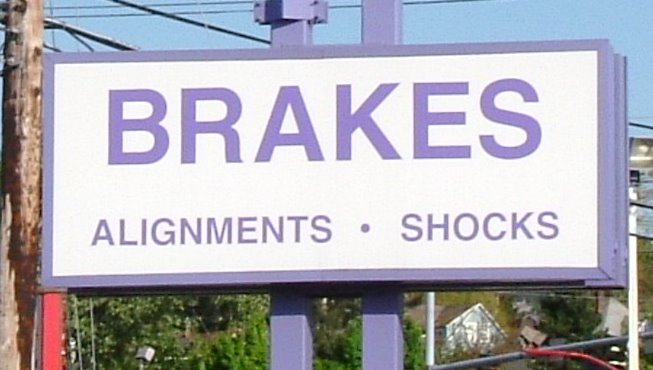
For people who drive, it's getting more expensive, but the sky is not falling on American life.
Many folks talk like "Chicken Little" who said the sky was falling. They notice that oil is used in products from food to clothing. They say the "thousand mile salad" is going to die.
No, that cornucopia of food at our supermarkets from all over the world can continue, maybe just a bit modified. Apples from New Zealand, grapes from Chile. It all takes oil to grow and ship, but oil is only one "line item" in a bigger picture.
Sure the price of products will inch up, but oil is only one part of the story. Oil costs can be absorbed into the "thousand mile salad" fairly easily. Energy prices are hidden among labor, land, technology, capital and other items in the cost of doing business.
Driving will really be the problem, not shopping.
The American economy will survive. It will just have to adjust the price for it's cornucopia a bit.
Local bus fares may go up to 75 cents to reflect a fuel surcharge, but the biggest costs are still labor for driver's wages and so forth. The WTA bus is sure a bargain at 50 cents per ride and 75 cents is still workable.
Most of this "pie chart" continues to be paid by the tax district anyway with the fare box just one sliver.
My point is that driving cars will be hit hard, but the rest of the economy will adjust more easily.
All these Bellingham people keep running around saying "the American economy is finished." "No more thousand mile salad, no more American petrochemical agriculture."
I say hogwash.
The American economy of products and services will adjust to oil's "line item" shock. The price pie for products is much bigger than that. The price can go up slightly, but business can keep going.
Car drivers are the one's who will suffer the most. Car drivers are also being hit by the cost of space for roads leading to traffic congestion as they can't afford to build more lanes. They are even hit with the "driveway runoff" problems in Lake Whatcom Watershed. Oil is just one line item in the automobile's illnesses.
The Chicken Littles will not be able to continue driving with their bumper stickers that say "buy local." They will have to bike or walk to the Food Co-op, but they will still find that cornucopia of apples from New Zealand.
The economy will not collapse, most likely. Not in my lifetime at least. It may change a bit, but still survive. Car drivers will have to change the most. Maybe they will still be able to drive, but long commutes will become the most costly. Much more costly than the thousand mile salad.
Those wonderful crisp (remember it's now autumn in New Zealand) apples will still sit in the bin next to the "buy local" posters on the wall at the Food Co-op.
Even the Co-op is now a "thousand mile cornucopia," but that's okay.
Even the milk isn't really that local. Dairy farmers get their hay and feed corn shipped in. It comes from far afield.
Field's afar?
The carton of "chocolate milk" that fuels my bicycle will still fetch it's inputs from all over; including the tropics where cocoa beans are grown. It may go up in price, but not unbearably.
As gas goes up 50 cents, I noticed only a dime "price hike" in my chocolate milk. The fuel costs that dairy farmers face are hidden in the bigger picture of labor costs, capital expenses and so forth.
America can survive a long time after peek oil. There is even plenty of tar sands in places like Alberta, if need be. We got clean coal. We can learn to use solar, wind. No need to say "good by" to the thousand mile salad.
Automobile driving will have to be reconsidered, but most of the rest of our economy can just be modified slightly.
Maybe people will still drive as electric cars and nuclear power could save them. Problem is the roads are too congested, even if we get our energy from nuclear.
Maybe computers will drive the cars so more can fit on I-5. Then "technology fix" can even reduce traffic.
Driving is the thing that will take the biggest hit, but the rest of our economy can adjust without too much trouble. The sky will not fall.
Speaking of sky falling, there is the green house effect. That's a big problem also.
Again, it's cars and driving habits, not the thousand mile salad, that will feel the most need to change. Everything can adjust if we are flexible and don't get too hot under the collar.
Saturday, May 06, 2006
Parkade Plaza in Spokane. Can Bellingham learn from this example?
 Every once in a while, they discuss parking garages for downtown Bellingham. If people were like me, (non drivers) parking garages wouldn't be needed. Usually folks say, "you can't build a pretty parking garage," but if parking garages can be pretty, Spokane has a good one. I got images of my favorite parking structure as I passed through Spokane, WA. on my 2007 bicycle tour.
 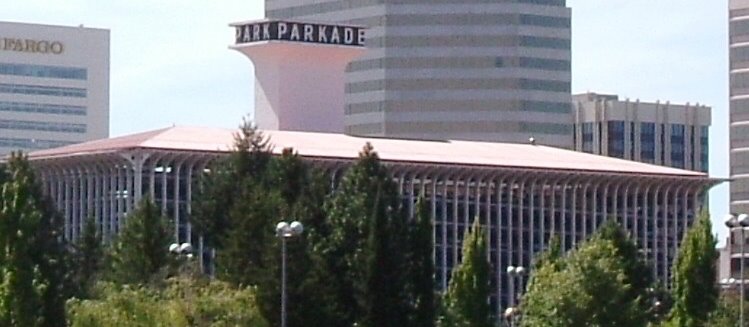 Parkade Plaza was built in 1967. I think it's 11 stories, or maybe that's to the top of the sign. Graceful concrete form.
 I took lower photo from Riverfront Park in 2005.
See my Parkade Plaza images on Flickr.
Wednesday, May 03, 2006
Star Spangled Banner in Spanish
Teach an old dog new tricks.
Okay with me, but a friend pointed out. "We now have to learn more than one language to get a job."
Being bilingual gives one a "leg up" on a resume in our increasingly multi-cultural society. This is true especially for work that involves public relations, such as being a receptionist, teacher, working in a medical office.
With so much of the public speaking Spanish, employers are looking for bilingual skills when filling positions that deal with the public. Many are having to learn more than one language to compete.
It's another requirement, another hassle, or some might say another opportunity, challenge.
In places like Europe, I hear people often speak several languages. They say we have been spoiled, here in America, with a large country speaking mostly one language. Imagine living in Luxemburg with French, Dutch, German, English all around you.
I've often wondered how people speaking several tongues can keep them all separated.
Part of the problem is the competitive nature of our job market.
On a similar note, there are the horror stories of foreign whizzes in math, engineering, you name it, who can run circles around American students. They can be overseas, or immigrate here. We are either hit with out-sourcing or other applicants waiting in line.
If we don't buckle down and go back to school, work and study all night, we slip behind.
They say, "pay more taxes for American education." Keeping up with the foreigners and the Jones'
More, more, faster, faster, move it, move it.
Not to mention rising housing / health care costs in our modern and more crowded world.
No time for sleep or contemplation.
All this just as the post war baby boom reaches retirement age. Getting ready to put one's feet up and relax a bit.
There's a silver lining. Those industrious illegal immigrants might get some sort of amnesty, so they can start paying Social Security taxes. Then post war baby boomers can retire.
Okay with me, but a friend pointed out. "We now have to learn more than one language to get a job."
Being bilingual gives one a "leg up" on a resume in our increasingly multi-cultural society. This is true especially for work that involves public relations, such as being a receptionist, teacher, working in a medical office.
With so much of the public speaking Spanish, employers are looking for bilingual skills when filling positions that deal with the public. Many are having to learn more than one language to compete.
It's another requirement, another hassle, or some might say another opportunity, challenge.
In places like Europe, I hear people often speak several languages. They say we have been spoiled, here in America, with a large country speaking mostly one language. Imagine living in Luxemburg with French, Dutch, German, English all around you.
I've often wondered how people speaking several tongues can keep them all separated.
Part of the problem is the competitive nature of our job market.
On a similar note, there are the horror stories of foreign whizzes in math, engineering, you name it, who can run circles around American students. They can be overseas, or immigrate here. We are either hit with out-sourcing or other applicants waiting in line.
If we don't buckle down and go back to school, work and study all night, we slip behind.
They say, "pay more taxes for American education." Keeping up with the foreigners and the Jones'
More, more, faster, faster, move it, move it.
Not to mention rising housing / health care costs in our modern and more crowded world.
No time for sleep or contemplation.
All this just as the post war baby boom reaches retirement age. Getting ready to put one's feet up and relax a bit.
There's a silver lining. Those industrious illegal immigrants might get some sort of amnesty, so they can start paying Social Security taxes. Then post war baby boomers can retire.
Subscribe to:
Posts (Atom)