Bush claims tax cuts have actually increased the amount of revenue that the federal government "takes in" by stimulating the economy. They say more taxes are collected from a bigger economy, in spite of the lower tax rates.
Take a deep breath.
That is quite a complicated concept and it has some truth, but here is a question I ask.
Would this "economic stimulation effect" still happen if the tax cuts were accompanied with equal spending cuts on the part of the federal government?
In other words, of course the economy is stimulated as it's getting a double barreled influx of cash.
Lower taxes, but federal spending remains high.
The economy would really suffer if tax cuts were equaled with big cuts in federal spending. Cuts in entitlements, military spending, highways and infrastructure as well as hurricane relief, for instance. If the tax cuts caused these huge spending cuts, then the economy would not be doing so well.
Or, at least I don't think it would be doing well.
Basically the economy is doing well because low interest rates have allowed us to put things on the credit card.
We have low taxes while the federal government continues to dump money into the economy. The federal government can continue to spend money on keeping infrastructure running.
The best of both worlds. That is until the credit card comes due.
Still one might also have to ask, "what else would any president do?" Walk away from hurricane relief?
I never voted for Bush though.
Bringing the troops home from Iraq could save money.
Anyway, our government is spending lots and keeping taxes low. Some say "spending like a drunken sailor," but what other choices does it have?
Will this credit card ever come due?
That's a good question.
Sometimes I wonder. It seems like it's "easy money." Maybe the federal government will eventually declare some form of bankruptcy.
Then what will happen?
Could life just go on with little consequence to the economy?
Life goes on like this is just some sort of "paper shuffling" matter.
Then again maybe not. Who knows.

Monday, May 22, 2006

Thursday, May 18, 2006
Under the futuristic Skytrain into Vancouver, BC.

An abandoned shopping cart. Futuristic, or down to earth. Image taken near Scott Road in Surrey.
Just one image I saw as most people blast by in their cars. Several weeks ago, I did a combination bike, bus and Skytrain trip to Vancouver, BC from Bellingham.
"Transportation diversity."
It was a good trip. Spent a night in the YMCA Hotel on Burrard St. Enjoyed dancing that night in Vancouver's gay scene and came back to Bellingham next day.
Trip included bicycling from Bellingham to Whiterock, BC. then taking the 351 bus to downtown Vancouver, from Whiterock. Coming back I rode the Skytrain with my bike to Surrey, BC. Then bicycled to Blaine, WA. and picked up a WTA bus to Bellingham.
The future is emerging. Remember Bike To Work and School Day May 19.
Tuesday, May 16, 2006
Picture of Farmer's Market Structure in Bellingham, WA.

Last Saturday was the first day with booths under the main canopy. Some of the steel came from old Highway 99 bridge across the Skagit River. When the old bridge was torn down, steel was recycled.
I went to the Farmer's market to join Mount Baker Bike Club's annual "Ride With Your Politician" event. That is where they invite local politicians to go on a bike ride. They check out the good things and bad things about riding around town from the standpoint of a bicyclist.
Last year, several politicians showed up, but only one made it this year. Others, who are regulars, had "out of town" engagements.
Soon after the ride, I had an out of town engagement also. I rode my bike 8 miles out into the county to "Salon Q." That's a discussion group which meets in someone's living room. Discusses gay and trans-gender issues.
Then it was a bike trip back into town for a dinner and dancing with "Bellingham Leathermen." I'm not really into leather, I'm more into spandex, but the Leathermen were fun to spend time with. A few folks came down from Vancouver, BC. and up from Seattle, WA. to join the Bellingham gathering.
It was a very social day for me. More interesting things going on in this great city than usual.
Next day, I realized I had left my jacket out at Salon Q so I went on another bike ride to retrieve it. Made that into a loop in Whatcom County. Much of the loop was along Smith Road.
Both days were spectacularly sunny and Mount Baker was very clear out in the county. Summer's haze and auto exhaust hasn't had time to build up yet.
On June 4th, the Farmer's Market will see "Fourth Corner Pride Festival." Pride Festival is the closest thing that Bellingham has to a gay pride event. Rather than a march, it's a festival where many organizations have booths. Festival is jointly sponsored by organizations such as the Evergreen Aids Foundation, P-FLag and the Pride Foundation.
Monday, May 15, 2006
Wiretapping may not be good, but
If Bush is into wiretapping, would he bother listening to my phone calls? I doubt he would take time to read my letters.
No I am not worried that the "government" will find my blog. It's not ment to be private anyway. If "they" are listening in, maybe that's how we can communicate with our government?
I hope the government finds my blog. I did get a nice e-mail from one of our city council members.
In the old Soviet Union, I heard that some folks were living in a big apartment complex. They had trouble getting their heating fixed. When they filled out a repair request form, nothing happened for days. Then they heard that there was a bugging device in the light fixture. They shouted the repair request toward the light fixture and the heat was fixed next day.
No I am not worried that the "government" will find my blog. It's not ment to be private anyway. If "they" are listening in, maybe that's how we can communicate with our government?
I hope the government finds my blog. I did get a nice e-mail from one of our city council members.
In the old Soviet Union, I heard that some folks were living in a big apartment complex. They had trouble getting their heating fixed. When they filled out a repair request form, nothing happened for days. Then they heard that there was a bugging device in the light fixture. They shouted the repair request toward the light fixture and the heat was fixed next day.
Friday, May 12, 2006
Are greenway levies bad for renters?

I plan to vote yes for Bellingham's Greenways, but there was an interesting point made in a May 10th letter to the editor of Bellingham Herald. Letter basically said "Greenways too costly for renters."
It's still cheaper than driving a car. Greenways = transportation.
It is true that the property taxes, our landlords pay, are passed along to renters. The Greenways have added a bit to property taxes over the years.
This levy is just a continuation of the tax that has been collected over past years. The past levy is expiring. It will not raise taxes, just keep taxes from going down a bit, due to the old levy's expiration.
Still this little bit of added cost is worth it, in my calculations.
The Greenways is "transportation." It still costs a lot less than owning a car. That's how I see things. Making it safer to get around town by bicycle is worth the money saved as an alternative to driving.
Of course there are other things paid by by Greenways; like some park and ball field facilities. These are good things to have also. Encouraging recreation for public health can save lots of money on health care costs and insurance expenses.
So I see this as more than icing on a cake. It can be transportation and health. Pragmatic and cheaper than a lot of things we pay for.
Tuesday, May 09, 2006
Soft Landing Off Of Peak Oil
For people who drive, it's getting more expensive, but the sky is not falling on American life.
Many folks talk like "Chicken Little" who said the sky was falling. They notice that oil is used in products from food to clothing. They say the "thousand mile salad" is going to die.
No, that cornucopia of food at our supermarkets from all over the world can continue, maybe just a bit modified. Apples from New Zealand, grapes from Chile. It all takes oil to grow and ship, but oil is only one "line item" in a bigger picture.
Sure the price of products will inch up, but oil is only one part of the story. Oil costs can be absorbed into the "thousand mile salad" fairly easily. Energy prices are hidden among labor, land, technology, capital and other items in the cost of doing business.
Driving will really be the problem, not shopping.
The American economy will survive. It will just have to adjust the price for it's cornucopia a bit.
Local bus fares may go up to 75 cents to reflect a fuel surcharge, but the biggest costs are still labor for driver's wages and so forth. The WTA bus is sure a bargain at 50 cents per ride and 75 cents is still workable.
Most of this "pie chart" continues to be paid by the tax district anyway with the fare box just one sliver.
My point is that driving cars will be hit hard, but the rest of the economy will adjust more easily.
All these Bellingham people keep running around saying "the American economy is finished." "No more thousand mile salad, no more American petrochemical agriculture."
I say hogwash.
The American economy of products and services will adjust to oil's "line item" shock. The price pie for products is much bigger than that. The price can go up slightly, but business can keep going.
Car drivers are the one's who will suffer the most. Car drivers are also being hit by the cost of space for roads leading to traffic congestion as they can't afford to build more lanes. They are even hit with the "driveway runoff" problems in Lake Whatcom Watershed. Oil is just one line item in the automobile's illnesses.
The Chicken Littles will not be able to continue driving with their bumper stickers that say "buy local." They will have to bike or walk to the Food Co-op, but they will still find that cornucopia of apples from New Zealand.
The economy will not collapse, most likely. Not in my lifetime at least. It may change a bit, but still survive. Car drivers will have to change the most. Maybe they will still be able to drive, but long commutes will become the most costly. Much more costly than the thousand mile salad.
Those wonderful crisp (remember it's now autumn in New Zealand) apples will still sit in the bin next to the "buy local" posters on the wall at the Food Co-op.
Even the Co-op is now a "thousand mile cornucopia," but that's okay.
Even the milk isn't really that local. Dairy farmers get their hay and feed corn shipped in. It comes from far afield.
Field's afar?
The carton of "chocolate milk" that fuels my bicycle will still fetch it's inputs from all over; including the tropics where cocoa beans are grown. It may go up in price, but not unbearably.
As gas goes up 50 cents, I noticed only a dime "price hike" in my chocolate milk. The fuel costs that dairy farmers face are hidden in the bigger picture of labor costs, capital expenses and so forth.
America can survive a long time after peek oil. There is even plenty of tar sands in places like Alberta, if need be. We got clean coal. We can learn to use solar, wind. No need to say "good by" to the thousand mile salad.
Automobile driving will have to be reconsidered, but most of the rest of our economy can just be modified slightly.
Maybe people will still drive as electric cars and nuclear power could save them. Problem is the roads are too congested, even if we get our energy from nuclear.
Maybe computers will drive the cars so more can fit on I-5. Then "technology fix" can even reduce traffic.
Driving is the thing that will take the biggest hit, but the rest of our economy can adjust without too much trouble. The sky will not fall.
Speaking of sky falling, there is the green house effect. That's a big problem also.
Again, it's cars and driving habits, not the thousand mile salad, that will feel the most need to change. Everything can adjust if we are flexible and don't get too hot under the collar.
Saturday, May 06, 2006
Parkade Plaza in Spokane. Can Bellingham learn from this example?
 Every once in a while, they discuss parking garages for downtown Bellingham. If people were like me, (non drivers) parking garages wouldn't be needed. Usually folks say, "you can't build a pretty parking garage," but if parking garages can be pretty, Spokane has a good one. I got images of my favorite parking structure as I passed through Spokane, WA. on my 2007 bicycle tour.
 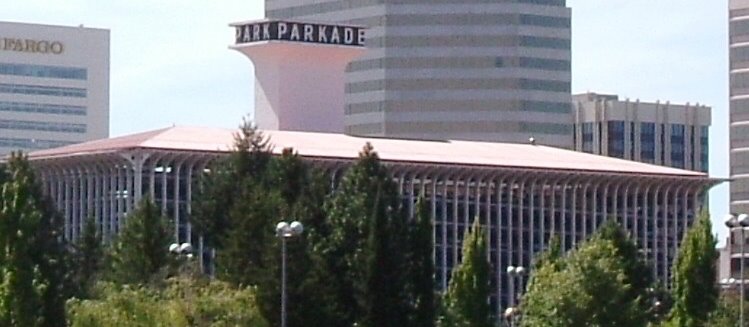 Parkade Plaza was built in 1967. I think it's 11 stories, or maybe that's to the top of the sign. Graceful concrete form.
 I took lower photo from Riverfront Park in 2005.
See my Parkade Plaza images on Flickr.
Wednesday, May 03, 2006
Star Spangled Banner in Spanish
Teach an old dog new tricks.
Okay with me, but a friend pointed out. "We now have to learn more than one language to get a job."
Being bilingual gives one a "leg up" on a resume in our increasingly multi-cultural society. This is true especially for work that involves public relations, such as being a receptionist, teacher, working in a medical office.
With so much of the public speaking Spanish, employers are looking for bilingual skills when filling positions that deal with the public. Many are having to learn more than one language to compete.
It's another requirement, another hassle, or some might say another opportunity, challenge.
In places like Europe, I hear people often speak several languages. They say we have been spoiled, here in America, with a large country speaking mostly one language. Imagine living in Luxemburg with French, Dutch, German, English all around you.
I've often wondered how people speaking several tongues can keep them all separated.
Part of the problem is the competitive nature of our job market.
On a similar note, there are the horror stories of foreign whizzes in math, engineering, you name it, who can run circles around American students. They can be overseas, or immigrate here. We are either hit with out-sourcing or other applicants waiting in line.
If we don't buckle down and go back to school, work and study all night, we slip behind.
They say, "pay more taxes for American education." Keeping up with the foreigners and the Jones'
More, more, faster, faster, move it, move it.
Not to mention rising housing / health care costs in our modern and more crowded world.
No time for sleep or contemplation.
All this just as the post war baby boom reaches retirement age. Getting ready to put one's feet up and relax a bit.
There's a silver lining. Those industrious illegal immigrants might get some sort of amnesty, so they can start paying Social Security taxes. Then post war baby boomers can retire.
Okay with me, but a friend pointed out. "We now have to learn more than one language to get a job."
Being bilingual gives one a "leg up" on a resume in our increasingly multi-cultural society. This is true especially for work that involves public relations, such as being a receptionist, teacher, working in a medical office.
With so much of the public speaking Spanish, employers are looking for bilingual skills when filling positions that deal with the public. Many are having to learn more than one language to compete.
It's another requirement, another hassle, or some might say another opportunity, challenge.
In places like Europe, I hear people often speak several languages. They say we have been spoiled, here in America, with a large country speaking mostly one language. Imagine living in Luxemburg with French, Dutch, German, English all around you.
I've often wondered how people speaking several tongues can keep them all separated.
Part of the problem is the competitive nature of our job market.
On a similar note, there are the horror stories of foreign whizzes in math, engineering, you name it, who can run circles around American students. They can be overseas, or immigrate here. We are either hit with out-sourcing or other applicants waiting in line.
If we don't buckle down and go back to school, work and study all night, we slip behind.
They say, "pay more taxes for American education." Keeping up with the foreigners and the Jones'
More, more, faster, faster, move it, move it.
Not to mention rising housing / health care costs in our modern and more crowded world.
No time for sleep or contemplation.
All this just as the post war baby boom reaches retirement age. Getting ready to put one's feet up and relax a bit.
There's a silver lining. Those industrious illegal immigrants might get some sort of amnesty, so they can start paying Social Security taxes. Then post war baby boomers can retire.
Wednesday, April 26, 2006
Good milaege. 25 miles to the carton of chocolate milk

It doesn't make much difference to my bicycle. I get around 25 miles to the carton of chocolate milk. Have never driven a car.
Still, the price of gas may be reflected in the price of chocolate milk. So far, it's only gone up a dime, where I buy.
Many factors go into milk production, besides just energy. These things cushion the "energy shock."
As usual, I plan to travel quite a bit this summer. Another summer of bicycle touring.
Saturday, April 22, 2006
Earth Day Sign in Bike Shop

Several years ago, around Earth Day, this sign in a local bike shop read, "Ride A Bike For Your Mother Earth."
Wednesday, April 19, 2006
Should Rumsfeld Resign? Actually, Iraq is Congress' War
Rumsfeld is just a figurehead. I actually find some of the things he has said in press conferences to be candid and insightful. Rumsfeld's resignation wouldn't change the policy on the Iraq War. That policy is set by Congress and President Bush.
Maybe they could find a better strategist than Rumsfeld. Basically someone with a magic plan for winning the war, if such a plan were possible. Maybe Rumsfeld isn't the best, but it is possible that he is just a "fall guy." Fretting over whether he should resign, or not, could be just a waste of mental energy; something to occupy talk show hosts and letters to the editor while distracting from deeper issues.
Looking deeper, it is possible that the Iraq War is not a viable strategy.
It does look like another Vietnam War.
How did the Vietnam War finally end?
There are many perspectives, but I think it was Congress that finally pulled the plug on that war.
Congress.
Congress repealed the Gulf Of Tonkin Resolution, in 1971 starting us down the path of troop withdrawal. War powers act of 1973 limited Nixon's power to keep US troops in the war still farther. Congress may have pulled the final plug in 1974 Foreign Assistance Act.
When the money flow was stopped, the war was basically ended.
In November of 2006 there is the opportunity to change much of Congress. Bring in a lot more Democrats and new perspectives.
Changing Congress might even have more effect than a new President.
I see many "Impeach Bush" signs, but hardly anyone is talking about the November 2006 Congressional election.
Congress may still be where the power is, if it chooses to use that power.
Then there are folks who say we must stay in Iraq, like they said we must stay in Vietnam. Give it a chance?
There may be some validity to those fears as well. I just want to say that to hedge my bets.
It does look like the American people are starting to turn against the Iraq War. If that's the case, this November could be a pivotal election. Congress can set policy on the Iraq War if it so chooses. 2006 may be a banner year for Democrats.
Maybe they could find a better strategist than Rumsfeld. Basically someone with a magic plan for winning the war, if such a plan were possible. Maybe Rumsfeld isn't the best, but it is possible that he is just a "fall guy." Fretting over whether he should resign, or not, could be just a waste of mental energy; something to occupy talk show hosts and letters to the editor while distracting from deeper issues.
Looking deeper, it is possible that the Iraq War is not a viable strategy.
It does look like another Vietnam War.
How did the Vietnam War finally end?
There are many perspectives, but I think it was Congress that finally pulled the plug on that war.
Congress.
Congress repealed the Gulf Of Tonkin Resolution, in 1971 starting us down the path of troop withdrawal. War powers act of 1973 limited Nixon's power to keep US troops in the war still farther. Congress may have pulled the final plug in 1974 Foreign Assistance Act.
When the money flow was stopped, the war was basically ended.
In November of 2006 there is the opportunity to change much of Congress. Bring in a lot more Democrats and new perspectives.
Changing Congress might even have more effect than a new President.
I see many "Impeach Bush" signs, but hardly anyone is talking about the November 2006 Congressional election.
Congress may still be where the power is, if it chooses to use that power.
Then there are folks who say we must stay in Iraq, like they said we must stay in Vietnam. Give it a chance?
There may be some validity to those fears as well. I just want to say that to hedge my bets.
It does look like the American people are starting to turn against the Iraq War. If that's the case, this November could be a pivotal election. Congress can set policy on the Iraq War if it so chooses. 2006 may be a banner year for Democrats.
Saturday, April 15, 2006
A wreck before even leaving the sales lot
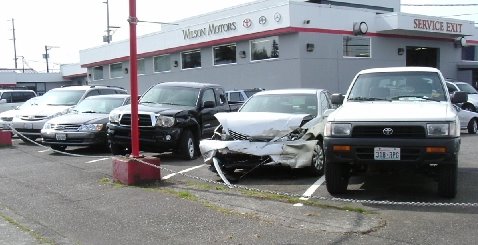
Local newspaper had an article about several cars being hit in a new car lot when another car ran off the road and smashed into the lot. Luckily no one was hurt.
People are often surprised when I tell them that I have never driven a car. I would feel nervous behind such a fast wheel. The kinder pace of bicycling, or public transit, is better. If I was in a hurry, I would book a flight.
Biking on a wide shoulder is safe enough, or on a less traveled road. It is rare when cars run off the road. Most accidents happen in intersections. However, being near the road can be a problem in rare cases, such as that day at the car lot.
Several years ago, a woman was killed sitting at her desk in a travel agency here in Bellingham; with-out even going on a trip. A car crashed through the travel agency's front doors and smashed the reception desk.
One time, as I crossed the border into Canada by bicycle, the custom agent ask why I didn't have a driver's licence. I just had non driver's ID. My explanation was that I didn't want to be part of the "car rat race." He smiled and said, "car wrecks don't happen with out cars."
Wednesday, April 12, 2006
Biking within 2 miles of home
.

Most people overlook these things on their way to the airport for that "yuppy eco-tourism junket to the Himalayas."
Colored ventilation pipes in atrium make nice lobby space.
Often overlooked this artistic atrium resides inside the Environmental Studies building at Western Washington University here in Bellingham. Less than 2 miles from where I live. Building houses Huxley College and the Geology Department.

Drying and on display in the hallway of the Geology department. This old tusk. I think from a mammoth. Recently found in Skagit County. Article in Bellingham Herald said this was estimated to be 18,000 years old.
I had to bike up, walk around in the building and take a look. Many years back (not 18,000 however) I attended Western. Still go through campus quite often by bike or foot.
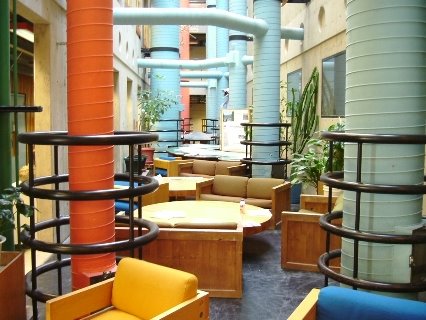
Most people overlook these things on their way to the airport for that "yuppy eco-tourism junket to the Himalayas."
Colored ventilation pipes in atrium make nice lobby space.
Often overlooked this artistic atrium resides inside the Environmental Studies building at Western Washington University here in Bellingham. Less than 2 miles from where I live. Building houses Huxley College and the Geology Department.

Drying and on display in the hallway of the Geology department. This old tusk. I think from a mammoth. Recently found in Skagit County. Article in Bellingham Herald said this was estimated to be 18,000 years old.
I had to bike up, walk around in the building and take a look. Many years back (not 18,000 however) I attended Western. Still go through campus quite often by bike or foot.
Tuesday, April 11, 2006
Bills In The House. Rephrasing The Debate.
The strong anti-illegal immigration bill, proposed in the US House, has opponents marching in the streets again.
Another bill in the House is hardly noticed and might get to the route of the immigration issue better than ever. It's called the "Global Democracy Promotion Act," or H.R. 4465. This would lift gag orders against international family planning agencies. These gag order limits US funding to international agencies dealing with population issues.
Passing H.R. 4465 would be a big step toward addressing world population growth. I think it is mostly Democrats behind this bill.
Now would be a good time to give this little known bill more attention with the backdrop of concern about illegal immigration. Much immigration is population growth flowing over from Mexico and other countries with high growth rates.
Something like H.R. 4465 is a lot better way to deal with the issue than the more punitive, "Republican," ideas of "rounding people up and making them felons."
The gag order is partially imposed because there is fear that family planning agencies might (heaven forbid) promote abortion. Actually, I am not really a fan of abortion, but good family planning can help prevent abortion as well. Prevent unwanted pregnancies.
I think it was Congressman Barny Frank who once said about some of the Republican Right To Life attitudes,
"The right to life begins at conception and ends at birth."
Well, thousands of folks are now marching in the streets opposing the more punitive immigration bills that have surfaced in the Republican controlled House. Illegal immigrants want the right to a good life AFTER birth.
Actually, the immigration debate has split Republicans.
Some in the House want more restrictive policies while President Bush leans in favor of the "Guest Worker" idea.
Let Republicans squabble among themselves. Their "world view" seems to be crumbling.
In some ways, I don't blame people for worrying that too many people are coming into our job markets. Really, it's the housing market, more than the job market, that seems to be the problem. It isn't easy to be low, or even middle income if the American dream home runs over $400,000 in many areas.
Reducing our overall numbers would help, but also redefining the American dream is needed.
Forget the house with a backyard barbecue. Instead, embrace "life on the 25th floor" with the wealth of multi cultural experience close by. Take the elevator to salsa dancing. Don't bother driving. Take the bus which can run every ten minutes in your denser urban neighborhood.
It doesn't have to be all bad, but we do need to think in terms of population, planning and the ecological footprint that each person places on the environment.
Technology can help. If you don't think you have enough room for that huge library of books, in your new urban flat, don't worry. Your entire library can fit onto a small spool of DVDs!
Welcome to the future.
Another bill in the House is hardly noticed and might get to the route of the immigration issue better than ever. It's called the "Global Democracy Promotion Act," or H.R. 4465. This would lift gag orders against international family planning agencies. These gag order limits US funding to international agencies dealing with population issues.
Passing H.R. 4465 would be a big step toward addressing world population growth. I think it is mostly Democrats behind this bill.
Now would be a good time to give this little known bill more attention with the backdrop of concern about illegal immigration. Much immigration is population growth flowing over from Mexico and other countries with high growth rates.
Something like H.R. 4465 is a lot better way to deal with the issue than the more punitive, "Republican," ideas of "rounding people up and making them felons."
The gag order is partially imposed because there is fear that family planning agencies might (heaven forbid) promote abortion. Actually, I am not really a fan of abortion, but good family planning can help prevent abortion as well. Prevent unwanted pregnancies.
I think it was Congressman Barny Frank who once said about some of the Republican Right To Life attitudes,
"The right to life begins at conception and ends at birth."
Well, thousands of folks are now marching in the streets opposing the more punitive immigration bills that have surfaced in the Republican controlled House. Illegal immigrants want the right to a good life AFTER birth.
Actually, the immigration debate has split Republicans.
Some in the House want more restrictive policies while President Bush leans in favor of the "Guest Worker" idea.
Let Republicans squabble among themselves. Their "world view" seems to be crumbling.
In some ways, I don't blame people for worrying that too many people are coming into our job markets. Really, it's the housing market, more than the job market, that seems to be the problem. It isn't easy to be low, or even middle income if the American dream home runs over $400,000 in many areas.
Reducing our overall numbers would help, but also redefining the American dream is needed.
Forget the house with a backyard barbecue. Instead, embrace "life on the 25th floor" with the wealth of multi cultural experience close by. Take the elevator to salsa dancing. Don't bother driving. Take the bus which can run every ten minutes in your denser urban neighborhood.
It doesn't have to be all bad, but we do need to think in terms of population, planning and the ecological footprint that each person places on the environment.
Technology can help. If you don't think you have enough room for that huge library of books, in your new urban flat, don't worry. Your entire library can fit onto a small spool of DVDs!
Welcome to the future.
Sunday, April 02, 2006
Is the art of conversation dying?
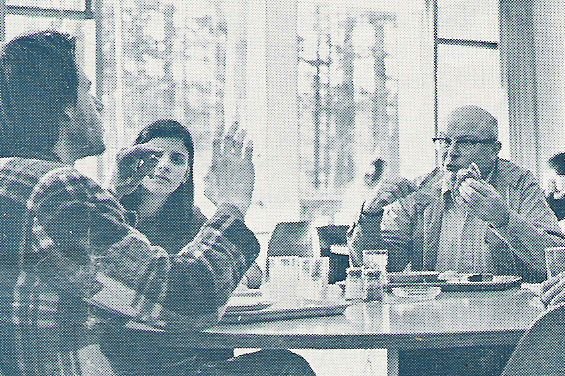
Picture taken in 1977. Me on left.
Last Wednesday, KUOW's show called "The Conversation" featured the author of a book titled "Conversation: A history of a declining art," by Stephen Miller. It was a very interesting discussion even though the topic was cut a bit short to make way for KUOW's pledge drive. Yes, paying the bills takes precedence.
Good conversation can be highly satisfying, according to Miller. Where people gather and discuss topics in depth. Where there can be civil disagreement and something described as "bantering" back and forth with out hard feelings.
This kind of quality conversation has not been that common in America, and could even be in decline for various reasons.
Conversation that is purely for the sake of enlightenment often takes a back seat to more pragmatic matters of business. Also the pace of modern life is full of interruptions, such as cell phones, which fragment people's focus to the level of sound bytes.
Is this situation getting worse?
Maybe not. Here are some of my personal reflections.
Some people think younger generations are less into conversation than, say, us baby boomers.
I remember my college years when baby boomers were young. Moving into an all freshman dorm, I felt people were quite superficial. Most folks seemed to fit into only two categories; party goers or Jesus freaks.
I was in another set of dorms for my sophomore year where there was one dorm for senior citizens. It was a special program called "The Fairhaven Bridge Project." A dorm for senior citizens going back to school to mingle with the college kids.
I often found myself sitting at the senior citizen tables, in the dining hall, because their conversation had more depth than my fellow students. Above photo shows me conversing at one of those tables back in 1976. Picture was taken for a a brochure on the Bridge Project.
It is possible that the superficiality of today's young folk isn't any worse than it was in our generation. At least in my personal experience.
Since college, I have found my conversations have gotten richer as the years pass. Maybe I am just finding myself among more receptive folks.
Do people tend to get more sophisticated as they get older?
Technology is another thing that is often blamed for the decline of conversation. This also might not be any worse than it was 30 years ago. Back then, people would watch TV, rather than talk to one another. Today there are more electronic gizmos to avoid face to face contact, but it could be just "more of same." TV was bad enough. Now there are Ipods, but we had Walkmans back then.
The Internet is blamed, but it might be more of a blessing than a curse. I know of a lot of folks who can get together in small group discussions because they have found each other on the Internet.
One good thing about the Internet is the fact that small gatherings can get the word out. In the bad old days, small gatherings couldn't afford print space or media time. Maybe something could get a short mention in a calendar, but these were basically sound bytes. Now one can open up more meaningful descriptions of small events on the web. It's the small events and discussions where interaction is often best. Big venues are more likely to be lectures, rather than conversations.
One place where civil conversation, and good natured bantering seems to thrive is at the YMCA sauna. (Update: Y sauna closed in Bellingham as of 2020). This may vary from location to location. Also it depends on the time, and who happens to be around. Here at my YMCA, these kind of impromptu conversations seem quite common.
Does nudity create a better climate for sharing? Or is it just the fact that most people are afraid to take their cell phones into the hot space for fear of cooking the electronics. For now, at least, saunas and steam rooms tend to be "cell phone free" spaces.
Many folks lament the lack of good dialog in coffee shops these days. It's true. You look in the window and see folks hunched over their laptops.
Bars have never been that appealing to me. Too superficial and intellectual conversation is discouraged, or drowned out in loud music.
So maybe the art of conversation is still alive in places like saunas; rather than coffee shops. Also, the Internet may be more help than harm. People just need to think in some new ways.
Wednesday, March 29, 2006
Iraq: The "You Break It You Buy It" War
When did Iraq get broken?
After the Gulf War of the early 1990s when we crushed the invasion of Kuwait but then abandoned the uprising against Saddam Hussein that followed, allowing him to slaughter thousands?
Today's Neocons might say Iraq was broken then, so we had a moral obligation to "buy" it with the second Iraq war. The war that was partially justified in terms of spreading "democracy."
Or, was Iraq broken in the 1970s and 80s when our oil purchases helped prop up Saddam Hussein's dictatorial powers?
If we follow a "you brake it, you buy it" philosophy, we're stuck buying for a long time, and buying we are. To the tune of over 600 billion dollars!
Original estimates were closer to $60 billion and a Bush administration official lost his job when he dared to suggest it might cost closer to $200 billion.
It's really closer to $600 billion and still counting when all the veterans benefits and so forth are factored in.
For that money, we could have almost built a large space colony with enough room for both a Palestinian state and Israel! Rather than everyone fighting over the old land, we could have built new land in space.
But, the American taxpayer is not really paying for this war anyway. Bush tax cuts are still in effect. The deficit is paying for it and that deficit is backed by international bankers. One wonders why bankers keep banking on American debt, but somehow they do. Maybe the whole world is broke.

Someone called this anti war artist's sculpture a think tink. I saw it along a trail several years back.
After the Gulf War of the early 1990s when we crushed the invasion of Kuwait but then abandoned the uprising against Saddam Hussein that followed, allowing him to slaughter thousands?
Today's Neocons might say Iraq was broken then, so we had a moral obligation to "buy" it with the second Iraq war. The war that was partially justified in terms of spreading "democracy."
Or, was Iraq broken in the 1970s and 80s when our oil purchases helped prop up Saddam Hussein's dictatorial powers?
If we follow a "you brake it, you buy it" philosophy, we're stuck buying for a long time, and buying we are. To the tune of over 600 billion dollars!
Original estimates were closer to $60 billion and a Bush administration official lost his job when he dared to suggest it might cost closer to $200 billion.
It's really closer to $600 billion and still counting when all the veterans benefits and so forth are factored in.
For that money, we could have almost built a large space colony with enough room for both a Palestinian state and Israel! Rather than everyone fighting over the old land, we could have built new land in space.
But, the American taxpayer is not really paying for this war anyway. Bush tax cuts are still in effect. The deficit is paying for it and that deficit is backed by international bankers. One wonders why bankers keep banking on American debt, but somehow they do. Maybe the whole world is broke.

Someone called this anti war artist's sculpture a think tink. I saw it along a trail several years back.
Tuesday, March 28, 2006
What would Jesus do about immigration reform?
While this may not be practical for mortals, Jesus would probably open the border and welcome everyone in. Then folks would come to him and say, "you're crazy." "There isn't enough bread to go around." "There's only two loves."
Jesus would then say, "don't worry there's plenty." He would start cutting the loves and everyone would eat. Miraculously, there would be 7 loves left over after the feast.
It's something to think about, but problematic in our practical world. I wouldn't recommend trying it literally, but it's worth a thought. For instance, scientific innovation may not be a worker of miracles, but it's better than nothing. When people say, "there are too many people and too many cars, the traffic's terrible," get folks to ride the bus. When New York City was considered too big because there was no place to put all the horse manure, the streetcar came along.
We can build up, instead of out. Up zone for density. We can keep adapting for a while, but short of something miraculous, birth control, in the countries where the immigrants come from, is needed also.
Jesus would then say, "don't worry there's plenty." He would start cutting the loves and everyone would eat. Miraculously, there would be 7 loves left over after the feast.
It's something to think about, but problematic in our practical world. I wouldn't recommend trying it literally, but it's worth a thought. For instance, scientific innovation may not be a worker of miracles, but it's better than nothing. When people say, "there are too many people and too many cars, the traffic's terrible," get folks to ride the bus. When New York City was considered too big because there was no place to put all the horse manure, the streetcar came along.
We can build up, instead of out. Up zone for density. We can keep adapting for a while, but short of something miraculous, birth control, in the countries where the immigrants come from, is needed also.
Monday, March 27, 2006
Mexico's high birth rate: a big factor in our immigration issue
It is kind of ironic that many Republicans in Congress are alarmed and wanting to crack down on illegal immigration, yet they are often the ones to oppose funding for family planning in places like Mexico. I have heard that USA has become somewhat of a safety valve for overcrowding in Mexico.
Besides better birth control, it seems like most of our attempts to control immigration turn out to be rather punitive. Sure we do need to streamline the deportation process, and so forth, but rounding up and deporting 12 million illegal aliens, now in the US, is not practical. Plus much of our economy has become dependent on the labor of illegal aliens. It just seems somewhat punitive and impractical to ship that many folks out of the country.
On the other hand, USA is getting more crowded all the time. The whole world is getting crowded. Even Mexico is getting more crowded. I am sure there are many Mexican offspring who stay in Mexico.
For a while, we can learn to accommodate more people. Denser city planning, wiser use of resources, public transit, less space taken up for parking lots. In many ways, these changes could even improve our economy and quality of life. Still there is a point in which people need to support family planning.
Republicans and others alike: it is time to discard your aversions to organizations like Planned Parenthood.
Besides better birth control, it seems like most of our attempts to control immigration turn out to be rather punitive. Sure we do need to streamline the deportation process, and so forth, but rounding up and deporting 12 million illegal aliens, now in the US, is not practical. Plus much of our economy has become dependent on the labor of illegal aliens. It just seems somewhat punitive and impractical to ship that many folks out of the country.
On the other hand, USA is getting more crowded all the time. The whole world is getting crowded. Even Mexico is getting more crowded. I am sure there are many Mexican offspring who stay in Mexico.
For a while, we can learn to accommodate more people. Denser city planning, wiser use of resources, public transit, less space taken up for parking lots. In many ways, these changes could even improve our economy and quality of life. Still there is a point in which people need to support family planning.
Republicans and others alike: it is time to discard your aversions to organizations like Planned Parenthood.
Sunday, March 26, 2006
When Seattle imposed its Cap Initiative
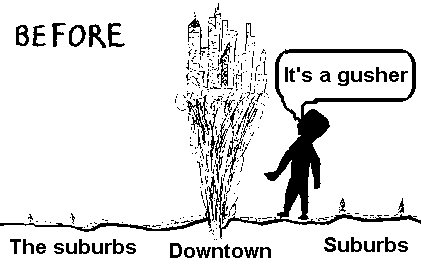
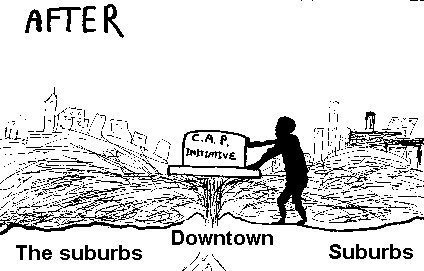
CAP Initiative restricting height of downtown buildings back in the 1980s, I drew this cartoon back then.
Now Seattle is talking about lifting the cap initiative. Let real tall buildings be built downtown again.
Housing.
It's a case of building up instead of sprawling out.
Still, we do have immigration and over population problems. Where can we put all those people? Up is better than out, in my opinion. Still there isn't that much room, especially in Seattle.
Friday, March 24, 2006
One way to reduce immigration
A litmus test for being open minded
Potential immigrants to the Netherlands must watch a film that includes two men kissing and a topless woman.
This and other measures has cut immigration by around one third, according to a March 15 Associated Press article by Bruce Mutsvairo. Someone just sent me a copy from Ohio.com Beacon Journal. (Since then link I had expired. This note written Jan. 09).
Good idea.
Could be called "the litmus test for having an open mind."
That is just as valid, if not more valid, than many other proposals attempting to control immigration.
For instance, here in USA, there are folks who suggest adopting more stringent "English only" policies for people after they have arrived.
Too bad that the Dutch are only applying that law to immigrants from certain parts of the world. People from places like USA, New Zealand and Canada are exempt. Maybe the test should apply to all, so the Dutch don't set themselves up to criticism for "bias based on national origin."
From what I hear, Dutch society is still reeling from the 2004 murder of film maker Theo Van Gogh by a dutch national of Moroccan descent. The film featured a refugee from Somalia who fled an arranged marriage and renounced the Islamic faith. The film maker was murdered by someone who didn't like his message.
I hear some other European nations are coming up with things like a contract that new arrivals must agree to.
"Sign here, that you will respect folks with diverse points of view and ways of life."
From what I hear, the Netherlands, and much of Europe, faces huge numbers of immigrants from Islamic countries. According to another article, around 5.5% of Netherlands population is now Muslim.
Of course it is also important to point out that not all Muslims are bigoted; especially the folks who would be willing to watch the film where two men kiss.
The Netherlands is also a very small country, small in land area. Where are they going to place all the immigrants anyway?
Here in USA, people are not only worried about immigration from overseas. We also fret about people moving to "our neighborhoods" from other parts of our own country.
Our own country, mind you.
Up here in the northwest corner of USA (Whatcom County) there is a strong anti growth movement.
We have a lot more elbow room than the residents of Netherlands, yet people are squawking loud about any new housing development proposed.
Whatcom County isn't a country, so it can't impose immigration laws.
We can't impose laws against Californians for instance. If we could, maybe we should also create a litmus test for an open mind. Learn from the Dutch example.
We don't have a big issue of immigration from Islamic countries, here in Whatcom County, nor do we have as cramped a quarters as the Netherlands. At the same time, I sure hear people, in Whatcom County, griping about all our new residents.
A litmus test for being open minded? It's about as good as any proposal I have heard. Better than, say, that proposal to create a concrete wall across I-5.
Potential immigrants to the Netherlands must watch a film that includes two men kissing and a topless woman.
This and other measures has cut immigration by around one third, according to a March 15 Associated Press article by Bruce Mutsvairo. Someone just sent me a copy from Ohio.com Beacon Journal. (Since then link I had expired. This note written Jan. 09).
Good idea.
Could be called "the litmus test for having an open mind."
That is just as valid, if not more valid, than many other proposals attempting to control immigration.
For instance, here in USA, there are folks who suggest adopting more stringent "English only" policies for people after they have arrived.
Too bad that the Dutch are only applying that law to immigrants from certain parts of the world. People from places like USA, New Zealand and Canada are exempt. Maybe the test should apply to all, so the Dutch don't set themselves up to criticism for "bias based on national origin."
From what I hear, Dutch society is still reeling from the 2004 murder of film maker Theo Van Gogh by a dutch national of Moroccan descent. The film featured a refugee from Somalia who fled an arranged marriage and renounced the Islamic faith. The film maker was murdered by someone who didn't like his message.
I hear some other European nations are coming up with things like a contract that new arrivals must agree to.
"Sign here, that you will respect folks with diverse points of view and ways of life."
From what I hear, the Netherlands, and much of Europe, faces huge numbers of immigrants from Islamic countries. According to another article, around 5.5% of Netherlands population is now Muslim.
Of course it is also important to point out that not all Muslims are bigoted; especially the folks who would be willing to watch the film where two men kiss.
The Netherlands is also a very small country, small in land area. Where are they going to place all the immigrants anyway?
Here in USA, people are not only worried about immigration from overseas. We also fret about people moving to "our neighborhoods" from other parts of our own country.
Our own country, mind you.
Up here in the northwest corner of USA (Whatcom County) there is a strong anti growth movement.
We have a lot more elbow room than the residents of Netherlands, yet people are squawking loud about any new housing development proposed.
Whatcom County isn't a country, so it can't impose immigration laws.
We can't impose laws against Californians for instance. If we could, maybe we should also create a litmus test for an open mind. Learn from the Dutch example.
We don't have a big issue of immigration from Islamic countries, here in Whatcom County, nor do we have as cramped a quarters as the Netherlands. At the same time, I sure hear people, in Whatcom County, griping about all our new residents.
A litmus test for being open minded? It's about as good as any proposal I have heard. Better than, say, that proposal to create a concrete wall across I-5.
Wednesday, March 22, 2006
Great picture of protest in Olympia

I love this picture, even though I did not take it. A friend took it recently as he attended a gay rights rally at our state capitol in Olympia. Looks better in larger version. Click on image to bring that up.
Tuesday, March 21, 2006
Condominium conversion: an alarming trend
Seattle apartments being converted into condominiums.
In 20004 it was 345. 2005 saw 1551 conversions, according to a front page article in March 20 Seattle PI.
If this trend continues there may be little left for rent in Seattle and buying a condo usually costs well over $240,000. That's still cheaper than buying a house.
It's population increase and a strong economy.
The main problem is, lots of people are buying condominiums and where are they going to put them? Seattle is basically running out of room for new construction, so the market turns to existing buildings. Convert them into condominiums, but where do the renters, and those who can't afford home ownership go?
Well, so far, I don't think that problem is too bad up here in Bellingham.
Yet at least.
Tons of new condominiums are being built all over town to help absorb the demand and protect existing rental properties.
So far at least.
Still there is lots of environmental concern about the explosion in construction seen around Bellingham.
Bellingham isn't real affordable either, but at least it isn't quite as bad as Seattle. It has some expansion room and it is also somewhat protected by it's low wage scale.
Supply and demand, but supply needs room.
Supply needs room, or, what developers call "buildable lots."
Seattle has around 10 times as many people as Bellingham, with in it's city limits, but only around 3 1/2 times the land area.
Bellingham isn't as dense, yet, but that is the wave of the future as population keeps increasing.
Another reason why housing demand is so high in Seattle is those huge rings of "low density sprawl" around most American cities. Traffic in all that sprawl is getting so bad that people are wanting to move back into the denser urban cores. Yet the cores can only hold so many.
That is part of the reason why Bellingham is starting to grow up with many new high rises planned for this city. We can become a new urban core, but I am afraid a lot of locals will fight it.
Remember, over population.
In 20004 it was 345. 2005 saw 1551 conversions, according to a front page article in March 20 Seattle PI.
If this trend continues there may be little left for rent in Seattle and buying a condo usually costs well over $240,000. That's still cheaper than buying a house.
It's population increase and a strong economy.
The main problem is, lots of people are buying condominiums and where are they going to put them? Seattle is basically running out of room for new construction, so the market turns to existing buildings. Convert them into condominiums, but where do the renters, and those who can't afford home ownership go?
Well, so far, I don't think that problem is too bad up here in Bellingham.
Yet at least.
Tons of new condominiums are being built all over town to help absorb the demand and protect existing rental properties.
So far at least.
Still there is lots of environmental concern about the explosion in construction seen around Bellingham.
Bellingham isn't real affordable either, but at least it isn't quite as bad as Seattle. It has some expansion room and it is also somewhat protected by it's low wage scale.
Supply and demand, but supply needs room.
Supply needs room, or, what developers call "buildable lots."
Seattle has around 10 times as many people as Bellingham, with in it's city limits, but only around 3 1/2 times the land area.
Bellingham isn't as dense, yet, but that is the wave of the future as population keeps increasing.
Another reason why housing demand is so high in Seattle is those huge rings of "low density sprawl" around most American cities. Traffic in all that sprawl is getting so bad that people are wanting to move back into the denser urban cores. Yet the cores can only hold so many.
That is part of the reason why Bellingham is starting to grow up with many new high rises planned for this city. We can become a new urban core, but I am afraid a lot of locals will fight it.
Remember, over population.
Thursday, March 16, 2006
State of Washington's new tourism slogan, Say Wa.
"Say WA."
That's really a sound byte. It is for the tourists who go to KFC because they don't have time for Kentucky Fried Chicken.
It doesn't hold up traffic.
Now people talk about "doing" for travel. Like let's go to Hawaii and "do the Big Island." People can "do Washington," but it's faster to just say "Do WA."
The next state over is Idaho.
"I Da HO." If prostitution were legal, Idaho's motto could be "I Da Ho." Ho is short for whore.
Say WA, then look at your watch and have quickie sex at I Da Ho.
Moving on, moving on.
Moving on to Montana, what could that be?
You can't say cause you've got to run. The lunch break's over.
Commerce keeps it all moving along.
That's really a sound byte. It is for the tourists who go to KFC because they don't have time for Kentucky Fried Chicken.
It doesn't hold up traffic.
Now people talk about "doing" for travel. Like let's go to Hawaii and "do the Big Island." People can "do Washington," but it's faster to just say "Do WA."
The next state over is Idaho.
"I Da HO." If prostitution were legal, Idaho's motto could be "I Da Ho." Ho is short for whore.
Say WA, then look at your watch and have quickie sex at I Da Ho.
Moving on, moving on.
Moving on to Montana, what could that be?
You can't say cause you've got to run. The lunch break's over.
Commerce keeps it all moving along.
Monday, March 13, 2006
Meditations after the Dubai ports deal news
Staying right here close to home.
Many folks seem to be uncomfortable with things becoming so global. Still, more and more business and the economy is global.
How about vacation? There's eco-tourism, but there is also bike touring right here at home.
By co-incidence, I happened to be corresponding with someone living in the United Arab Emirates just as the Dubai Ports World / USA deal was hitting the news. Since then, that deal has been called off.
Interesting coincidence.
I don't think my correspondent was involved. He was working for some corporation over there. Related to the oil industry, most likely. He's from the US, but was over there for work.
He was writing me for vacation. For information and inspiration about bicycle touring. Was planning to return to USA and do a bicycle tour. Possibly return to living in USA.
I enjoy getting a few inquiries, each month, to my bicycle touring pages. This one just happened to be from the UAE.
He recently wrote that it is difficult to find bicycle attire in UAE. There are not that many people interested in bicycling or touring as there are in the USA and other places. Too many spoiled foreigners who cherish their large SUV's and don't like get out of an Air-Conditioned environment long enough to enjoy the outdoors and the glory of nature. He was looking forward to the peaceful expanse of nature and all that awaits seeing it from the slow lane of life, upon returning to USA.
Yes, I can imagine. Because of the ports deal, the radio has been filled with talk-documentaries about Dubai.
Basically "Dubai 101."
Interesting, but from what the radio says, it sounds like life in the "shopping mall city." Climate controlled, corporate. Then a rather harsh desert outside.
Many parts of the good ol' USA can be great for bike touring.
I have to admit, except for Canada, I have never ventured out of USA. I am sure there are some parts of the world that are nice, but it is fun to start my adventures from my own door. I have never been on an "eco-tour" to far parts of the world, but bicycling in my home town can be like an eco-tour just outside my door.
Many folks seem to be uncomfortable with things becoming so global. Still, more and more business and the economy is global.
How about vacation? There's eco-tourism, but there is also bike touring right here at home.
By co-incidence, I happened to be corresponding with someone living in the United Arab Emirates just as the Dubai Ports World / USA deal was hitting the news. Since then, that deal has been called off.
Interesting coincidence.
I don't think my correspondent was involved. He was working for some corporation over there. Related to the oil industry, most likely. He's from the US, but was over there for work.
He was writing me for vacation. For information and inspiration about bicycle touring. Was planning to return to USA and do a bicycle tour. Possibly return to living in USA.
I enjoy getting a few inquiries, each month, to my bicycle touring pages. This one just happened to be from the UAE.
He recently wrote that it is difficult to find bicycle attire in UAE. There are not that many people interested in bicycling or touring as there are in the USA and other places. Too many spoiled foreigners who cherish their large SUV's and don't like get out of an Air-Conditioned environment long enough to enjoy the outdoors and the glory of nature. He was looking forward to the peaceful expanse of nature and all that awaits seeing it from the slow lane of life, upon returning to USA.
Yes, I can imagine. Because of the ports deal, the radio has been filled with talk-documentaries about Dubai.
Basically "Dubai 101."
Interesting, but from what the radio says, it sounds like life in the "shopping mall city." Climate controlled, corporate. Then a rather harsh desert outside.
Many parts of the good ol' USA can be great for bike touring.
I have to admit, except for Canada, I have never ventured out of USA. I am sure there are some parts of the world that are nice, but it is fun to start my adventures from my own door. I have never been on an "eco-tour" to far parts of the world, but bicycling in my home town can be like an eco-tour just outside my door.
Saturday, March 11, 2006
Future Real Estate Ad?
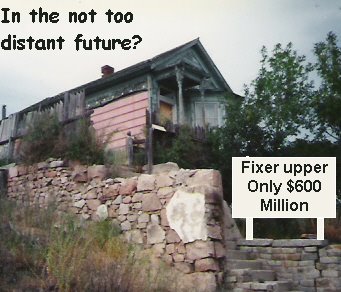
Back in the 1970s, President Ford gave a speech with this great analogy about inflation. He said it is like being at a football game where some people decide to get a better view by standing up. This blocks the view for the people sitting in back so they stand up next. Pretty soon everyone is standing up and the view isn't any better than when they were all sitting down. $600 million fixer upper.
I guess they are just working harder for that same view. Working two jobs and so forth.
I wonder if the rest of the economy will ever begin to catch up with residential real estate? Will minimum wage ever be $100 per hour or the cost of a loaf of bread climb to $50?
It's all just numbers. Population growth and low interest rates take their toll.
Thursday, March 09, 2006
Minute Men Are Minute ... Small
Someone stuck a petition in my face asking me to sign against the Minute Men. Being a nice guy, I said yes, but I don't really care that much; one way or another. Yes, it's a hot button issue, and people get worked up about it, but beyond the symbolism, this isn't earth shaking.
Petition was asking Whatcom County Council to adopt a resolution against the Minute Men similar to what the City Council, in Bellingham has passed.
Oh well.
It's a cause celebre for both liberals and conservatives.
The real problem is over population; high birth rates in various countries around the world spilling over into this country. If conservatives are worried about illegal immigrants flooding over USA, they should support world wide family planning efforts. Let's hear it for Planned Parenthood.
If liberals are really concerned about human dignity, they should support up- zoning, density, housing construction and low income housing, so everyone coming here can have a place to live. Let's hear it for good city planning, public transit and all that. Yes, we can still plan green belts also.
Really, I don't think the Minute Men do that much harm, but they don't do much good either.
If a handful of folks want to sit up by the border, in their pickups, I am not going to lose sleep over it. Also, I'm not that impressed. I don't think there has been one interception of an illegal border crossing, due to the Minute Men, here in Whatcom County at least. Not that I have read about. Maybe it's just for political fanfare.
The Minute Men are minute on my list of social issues.
Petition was asking Whatcom County Council to adopt a resolution against the Minute Men similar to what the City Council, in Bellingham has passed.
Oh well.
It's a cause celebre for both liberals and conservatives.
The real problem is over population; high birth rates in various countries around the world spilling over into this country. If conservatives are worried about illegal immigrants flooding over USA, they should support world wide family planning efforts. Let's hear it for Planned Parenthood.
If liberals are really concerned about human dignity, they should support up- zoning, density, housing construction and low income housing, so everyone coming here can have a place to live. Let's hear it for good city planning, public transit and all that. Yes, we can still plan green belts also.
Really, I don't think the Minute Men do that much harm, but they don't do much good either.
If a handful of folks want to sit up by the border, in their pickups, I am not going to lose sleep over it. Also, I'm not that impressed. I don't think there has been one interception of an illegal border crossing, due to the Minute Men, here in Whatcom County at least. Not that I have read about. Maybe it's just for political fanfare.
The Minute Men are minute on my list of social issues.
Wednesday, March 08, 2006
Just listened to a Town Hall debate between Ron Sims and Ken Hutcherson
It was rebroadcast over KUOW Radio.
Ron Sims is King County Executive and Hutcherson is a reverend.
Interesting to note that Sims is a reverend also. Religious ideas can certainly be interpreted many ways.
Also interesting to note that both men are black.
Civil rights was the topic. Should civil rights protections include sexual orientation?
Sims is in favor, Hutcherson is against.
The debate was lively and spirited.
Rather than me regurgitating the debate, here is a thought that came to my mind just before the broadcast.
One must ask, "why it is against the law to discriminate on the basis of religion, but not against the law to discriminate on the basis of sexual orientation?" Religion seems to be a more divisive and contentious factor than sexual orientation.
I am actually religious, myself, but I am not a fundamentalist. I follow a "liberal" interpretation of Christianity.
Under the original 1964 civil rights act, it would be illegal discriminate against someone describing themselves as "fundamentalist." How about "Islamic Fundamentalist" for instance? That would be considered "religion" and thus protected. However, sexual orientation can still be discriminated against.
Hum.
Isn't religion something people choose as Hutcherson claims that sexual orientation is? Religion can certainly stir up a lot of problems.
Also, of course, as Sims maintains that sexual orientation is not a choice. Science may not be 100% certain (like fundamentalist religions claim to be), but scientific evidence tends to lean toward sexual orientation's biological basis. There are DNA studies and so forth.
Religion, is a matter of choice.
Actually some people might even dispute that. There are religious determinists, but that's another digression.
The 1964 Civil Rights Act only covers race, religion, creed and national origin.
Even sex (whether you are a man or a woman) is not protected. Not protected in the 1964 constitutional act. That's why women will often remind us that we still don't have the ERA.
In most states and local areas, other categories have been added to civil rights. Women (or I should say men and women) are protected this way.
Age has been included, handicap status, marital status and some other things, in various states and localities.
17 states have now added sexual orientation to the list. Washington just passed this protection, last legislative session, but it is being challenged by a possible initiative.
Sexual orientation is a category that I think is at least as deserving as the original 4.
Hutcherson's perspective is kind of scary even though he has a right to his views, just like everyone else. He seems to think one interpretation of the Bible is "God's law" and this nation is based on that.
Sharia Law? Ops, I guess that's Islam. Sharia law is basically governing civil matters under Islamic religious code.
Sims spoke about the need to separate civil law from the various interpretations of religious belief.
Yes, I agree. America has got to be a nation with many flavors of religious, and even non religious belief. Otherwise, look at all that sectarian fighting in the Middle East.
Hutcherson says he doesn't want to be forced to hire a gay person. Well, that is kind of a libertarian argument that can also be used against other civil rights protections as well. Keeping that idea in mind, it is good to point out that Washington State's sexual orientation law would not force Hutcherson to hire gay people in his church. Religious institutions are exempt under that provision. Also smaller businesses with just a few employees or rental units are exempt. If you still wanted to discriminate against a gay person, (or non gay for that matter) in your church or renting a room in your private residence, the new law would not apply.
It does apply to larger things; for instance corporations and government agencies. A somewhat gentle law with quite a few exceptions. Trying to be nice and cater to objections.
Now, would Sharia law be that kind? Whoops, I guess that's Islam. Would fundamentalist religious law, of any kind, be that nice?
Hutcherson, like so many of the fundamentalist persuasion, puts one rigid interpretation of a religious doctrine over everything else. In my mind, a loving spirit matters most and people will always have different interpretations of doctrine.
Ron Sims is King County Executive and Hutcherson is a reverend.
Interesting to note that Sims is a reverend also. Religious ideas can certainly be interpreted many ways.
Also interesting to note that both men are black.
Civil rights was the topic. Should civil rights protections include sexual orientation?
Sims is in favor, Hutcherson is against.
The debate was lively and spirited.
Rather than me regurgitating the debate, here is a thought that came to my mind just before the broadcast.
One must ask, "why it is against the law to discriminate on the basis of religion, but not against the law to discriminate on the basis of sexual orientation?" Religion seems to be a more divisive and contentious factor than sexual orientation.
I am actually religious, myself, but I am not a fundamentalist. I follow a "liberal" interpretation of Christianity.
Under the original 1964 civil rights act, it would be illegal discriminate against someone describing themselves as "fundamentalist." How about "Islamic Fundamentalist" for instance? That would be considered "religion" and thus protected. However, sexual orientation can still be discriminated against.
Hum.
Isn't religion something people choose as Hutcherson claims that sexual orientation is? Religion can certainly stir up a lot of problems.
Also, of course, as Sims maintains that sexual orientation is not a choice. Science may not be 100% certain (like fundamentalist religions claim to be), but scientific evidence tends to lean toward sexual orientation's biological basis. There are DNA studies and so forth.
Religion, is a matter of choice.
Actually some people might even dispute that. There are religious determinists, but that's another digression.
The 1964 Civil Rights Act only covers race, religion, creed and national origin.
Even sex (whether you are a man or a woman) is not protected. Not protected in the 1964 constitutional act. That's why women will often remind us that we still don't have the ERA.
In most states and local areas, other categories have been added to civil rights. Women (or I should say men and women) are protected this way.
Age has been included, handicap status, marital status and some other things, in various states and localities.
17 states have now added sexual orientation to the list. Washington just passed this protection, last legislative session, but it is being challenged by a possible initiative.
Sexual orientation is a category that I think is at least as deserving as the original 4.
Hutcherson's perspective is kind of scary even though he has a right to his views, just like everyone else. He seems to think one interpretation of the Bible is "God's law" and this nation is based on that.
Sharia Law? Ops, I guess that's Islam. Sharia law is basically governing civil matters under Islamic religious code.
Sims spoke about the need to separate civil law from the various interpretations of religious belief.
Yes, I agree. America has got to be a nation with many flavors of religious, and even non religious belief. Otherwise, look at all that sectarian fighting in the Middle East.
Hutcherson says he doesn't want to be forced to hire a gay person. Well, that is kind of a libertarian argument that can also be used against other civil rights protections as well. Keeping that idea in mind, it is good to point out that Washington State's sexual orientation law would not force Hutcherson to hire gay people in his church. Religious institutions are exempt under that provision. Also smaller businesses with just a few employees or rental units are exempt. If you still wanted to discriminate against a gay person, (or non gay for that matter) in your church or renting a room in your private residence, the new law would not apply.
It does apply to larger things; for instance corporations and government agencies. A somewhat gentle law with quite a few exceptions. Trying to be nice and cater to objections.
Now, would Sharia law be that kind? Whoops, I guess that's Islam. Would fundamentalist religious law, of any kind, be that nice?
Hutcherson, like so many of the fundamentalist persuasion, puts one rigid interpretation of a religious doctrine over everything else. In my mind, a loving spirit matters most and people will always have different interpretations of doctrine.
Monday, March 06, 2006

Sunday, March 05, 2006
Outsourcing and teaching people new skills
Visiting Hyderabad, India, Bush said, "The United States would counter job losses by teaching people new skills rather than discouraging outsourcing."
Okay, maybe the definition of new skills will have to be broadened to include learning how to live on lower wages.
This may not be what Bush has in mind, but lower wage jobs, in America's service sector, are becoming numerous. This doesn't have to be all bad as something called "downshifting" can become a social movement.
Downshifting; leaving the rat race of high pressure, high profile work. Opting for what could be a spiritually more fulfilling path. Quality living. More time for friends, taking walks, exercise, volunteer work, art, study, reading, intelligent conversation, dancing, bicycling, what ever.
Can "new skills" include learning to live better with less consumption? I am afraid that is not what our president has in mind, but the way things are going, it's needed. Yes, high technology industry and American ingenuity can bring higher profile work to some people, but world trade points out that America has no monopoly on prowess. The world is becoming a more even playing field.
Part of learning new skills can mean learning to live with more grace and quality, not just measuring all things in terms of material wealth or consumption.
However, the cost of living; housing, health care; things for mere survival are too high in America. Rents and house valuations are way out of step with large segments of the job environment that is emerging in America.
If these costs can be brought down, we might be able to have the cultural renaissance that a little down shifting can bring.
Okay, maybe the definition of new skills will have to be broadened to include learning how to live on lower wages.
This may not be what Bush has in mind, but lower wage jobs, in America's service sector, are becoming numerous. This doesn't have to be all bad as something called "downshifting" can become a social movement.
Downshifting; leaving the rat race of high pressure, high profile work. Opting for what could be a spiritually more fulfilling path. Quality living. More time for friends, taking walks, exercise, volunteer work, art, study, reading, intelligent conversation, dancing, bicycling, what ever.
Can "new skills" include learning to live better with less consumption? I am afraid that is not what our president has in mind, but the way things are going, it's needed. Yes, high technology industry and American ingenuity can bring higher profile work to some people, but world trade points out that America has no monopoly on prowess. The world is becoming a more even playing field.
Part of learning new skills can mean learning to live with more grace and quality, not just measuring all things in terms of material wealth or consumption.
However, the cost of living; housing, health care; things for mere survival are too high in America. Rents and house valuations are way out of step with large segments of the job environment that is emerging in America.
If these costs can be brought down, we might be able to have the cultural renaissance that a little down shifting can bring.
Friday, March 03, 2006
Technology Fix. Bush In India

It's a concept that better technology can help us cope with world problems. President Bush subscribes to this concept, for the most part. Recently visiting India, a deal has been signed promoting nuclear power for this highly populated nation. It's either that or India's huge population continues to industrialize using up more oil, coal and creating greenhouse gas to the max.
To some extent, I believe in technology fix, but there are other questions to ask. Has anyone considered trying to reduce population growth? Has anyone considered what happens when the world runs out of uranium? What about even more idealistic technologies like hydrogen fusion (rather than nuclear fission)? How about wind and solar power?
These more idealistic fixes seem to have always been "20 years in the future." When I was in college, hydrogen fusion was 20 years off. Now, 30 years later, they are still talking about 20 years.
Also there is changing some basic human assumptions. Wanting a better life for one's kids can be costly.
On the other hand, who am I to say that people in poor parts of the world should not have aspirations?
Then there is the whole question of "what is the definition for a better life?"
One can say, "be careful what you ask for as you might get it." Here in USA, the Bellingham area has recently suffered several horrendous car accidents. Multi car pileups. Quite a few deaths, all with-in the past few weeks. In one case, high school kids from Blaine, WA.
Technology fix might be able to address these problems as well. Automobiles spaced and driven by computer; rather than human. Cars that are "auto piloted" while they are on the freeway? It's been discussed by visionaries. Discussed as a solution to traffic congestion.
Then one can ask, "why do people need to drive cars?" Isn't public transit a better way to go? How about things like tele-commuting?
Then there is just slowing down. The modern world keeps moving faster and faster.
While I like some forms of technology fix, the Internet for instance, people are often surprised when I tell them I have never driven a car.
Never driven a car! They exclaim.
Yes, I have never driven a car. Didn't even take driver's ed. in high school. It was just too scary for me. Too scary.
However I do enjoy the gentle pace of my bicycle.
Subscribe to:
Posts (Atom)